Life Under Draconian Lockdown: I Can Barely See the Light at the End of this Long, Dark Tunnel

The process of reopening Spain has been dubbed, rather ominously, “Operation New Normality.”

“Is there any light at the end of this long dark tunnel?” That’s a question many people are asking themselves in Spain, whose government has implemented one of the most draconian anti-Covid lockdown regimes in the world and is now beginning to loosen some of the restrictions. Sunday was the first time in 43 days that children were allowed to venture out, albeit only for a maximum of one hour. And only if they were accompanied by one adult. And under the age of 14.

It was hardly a return to normality, but after six long weeks of being cooped up at home, most of the children and their parents were happy to take up the invitation of a little fresh air, a few rays of sunshine and some open space. For the first time in a month and a half, the streets and squares of villages, towns and cities across Spain were alive with the sound of people.

This being Spain, not everyone obeyed the government’s slightly loosened rules. From the vantage point of our balcony, in the Exiample Dreta district of Barcelona, my wife and I could see many children being shepherded by both of their parents. We could also spot groups of families together as well as opportunistic childless couples who were hoping to blend in with the crowds unnoticed. Some got away with it. Others were stopped by the police and given a stern warning or fined.

Since the lockdown began in Spain some 740,000 people — the equivalent of 18,000 per day — have been fined for breaking the government’s Covid-19 rules, according to El País. That’s three times more than in Italy and almost 200 times more than in the UK during roughly the same period. The only EU country that has dished out more fines is France, whose police issued over 900,000 fines in a five-week period.

In France administrative fines can range from €135 to €3,750. In Spain they can reach as high as €600,000, a spine-chilling figure that was set by the previous Rajoy government in its overtly authoritarian Law on Citizen Security — popularly dubbed the “Gag Law” for its sweeping attacks on freedom of expression. Passed in 2015, the law was primarily intended to crack down on rising social and political protest. Today’s governing parties, then in opposition, pledged to overturn the law. They didn’t. Instead, they have kept many of the most draconian measures in place and are now making liberal use of them.

If parents and children do not follow the strict criteria for outings, those outings will be withdrawn, the government warned. Surveillance and controls will be stepped up if necessary.

As countries around the world are gradually realizing, it’s a lot easier to go into lockdown than get out of it. In Spain, where the number of new cases is averaging around 1,000 a day, the process of reopening the country has been dubbed, rather ominously, “Operation New Normality”. 

Continue reading the article on Wolf Street
Wolf Richter Rails Against Mexican Companies that Borrow in Dollars and then Get Bailed Out When it Blows Up, Which is Now

“I want these f**kers to collapse and their CEOs thrown into a Mexican jail for having borrowed in dollars. I want shareholders and bondholders to pay the price, not the people. Let them eat their dollar-bonds.”

Mexico’s economy, like just about every national economy on the planet, is going through the grinder. Its currency has lost 26% of its value against the dollar in little over two months. In the past week alone, it tumbled 5.7%. One of its most important exports, oil, is trading at historic lows. Its state-owned oil company Pemex has been slashed to junk. Other key commodities are also plunging in value. Most of its car assembly plants are closed and remittance payments from migrant workers in the U.S., another major source of income, are falling as many of those workers lose their jobs.

Yet as the economy grinds to a halt and Covid-19 cases rise, something strange is happening. Mexico’s president, Andrés Manuel Lopez Obrador (AMLO for short), refuses to use Mexico’s limited fiscal firepower to bail out the country’s biggest companies, banks and investors, many of which have only themselves to blame for the predicament they’re in. And that is a definite no-no.

So the Bank of Mexico, known locally as Banxico, stepped into the breech last week, unleashing a $31 billion bailout package — $31 billion in USD of Banxico’s scarce dollar exchange reserves. In addition, it slashed the benchmark interest rate by 50 points to 6.0%. The interest rate had been kept high to keep the peso from plunging further.

One of the pretexts Banxico’s governor, Alejandro Díaz de Léon, cited to justify the bailout package was that foreign investors had pulled some €10 billion worth of funds out of Mexico’s debt markets since the virus crisis began. In other words, foreign investors that had bought the bonds, largely U.S.-denominated, of Mexican companies that earn most of their money in pesos were now getting cold feet after those bonds had plunged in value. Once again, capital is fleeing northward.

Last night, I proposed this unfolding saga as a possible article topic to Wolf. The response I got was an expletive-riddled, heavily capitalized tirade that took even me by surprise, and I’ve been working with Wolf for seven years. Here’s the sublime rant in all its glory:

“Why the heck did these Mexican companies borrow in dollars if they sell most of their product in pesos? Every single company that borrows in dollars and sells in pesos should be allowed to go bankrupt. They borrowed in dollars because it was a lot cheaper than borrowing in pesos, and they all know they take a HUGE risk every time they do it, and it’s the same frigging thing at every crisis. They can’t service and roll over their dollar debts. WHEN WILL COMPANIES THAT DO THIS FINALLY BE ALLOWED TO GO BANKRUPT?

“I’m sick of this. It’s always the same. And shareholders and bondholders always get bailed out. I want these f**kers to collapse and their CEOs thrown into a Mexican jail for having borrowed in dollars. I want the bondholders to pay the price, not the people. WHY THE F**K DID THEY LEND DOLLARS TO THESE MEXICAN COMPANIES THAT SELL IN PESOS???? GREED!! Let them eat their dollar-bonds.”

Continue reading the article on Wolf Street
Supermarket Sales Jumped, Alcohol Sales Spiked 33% & Online Grocery Sales 100%, But “Non-Food” Sales Collapsed

How the Virus Crisis Flipped UK Retail Sales Upside Down.

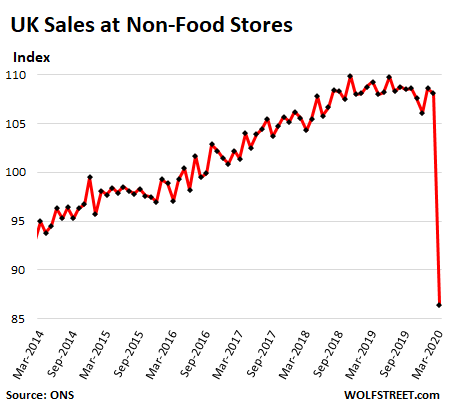
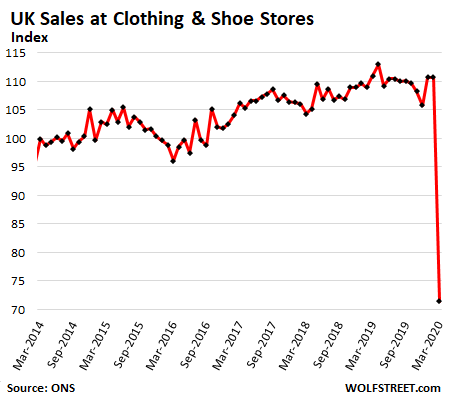
In the UK, where consumers are generally a sturdy lot when it comes to borrowing and spending, retail sales just had their worst month since records began in 1996, according to the UK’s Office for National Statistics (ONS). Sales at “non-food stores” plunged 20.9%. This does not include auto sales or gasoline sales. And sales at clothing and shoes stores collapsed 35.7%. But online sales rose, sales at supermarkets jumped, and sales of alcohol (the drinkable kind) spiked.

Non-food stores are broadly considered non-essential and have therefore been closed since March 23, when the UK’s lockdown began. They’d already been through a sharp decline in the second half of 2019, as some large department store chains entered the UK equivalent of a bankruptcy restructuring. This was followed by an uptick early this year. The first half of March was likely in that range. But the lockdown did a job on them. In April, they’re faced with near-zero sales:

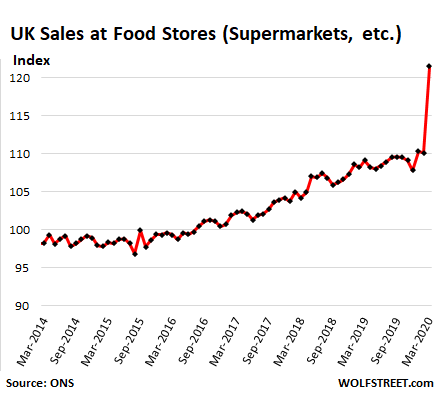
As has happened in many other countries, there was a boom in sales of food and household items at supermarkets, powered by some panic-buying, but also by the shift of consumption from restaurants, bars, cafeterias, work locations, hotels, and the like, to the home. This includes alcohol sales, which spiked 32.6% from February to March.

Sales at food stores, such as supermarkets, jumped by 10.2% from February to March, and by 11.3% year over year:

All combined, total retail sales, including online sales, food sales, non-food sales, and sales at gas stations, but not including auto sales, dropped 6% in March compared to the same month a year earlier, the worst decline in the history of the data.

The worst hit segment of the non-food retailers was clothing and footwear, whose sales plunged 35.7% year-over-year. Even by today’s standards, when more and more things seem to be going to heck in a straight line, it’s a staggering collapse, especially considering the UK’s coronavirus lockdown only began on March 23.

Sales of household goods plunged by 8.9% while fuel sales slumped 23.9% y-o-y as millions of Brits, confined to their homes and estranged from their workplaces, stopped driving. Besides supermarkets, one other outlier was department stores, which clocked up a 2% rise in sales, though according to the ONS a large chunk of these sales were online.

Continue reading the article on Wolf Street
Tourism in Southern Europe, Accounting for 13%-21% of GDP, is on its Knees. When Will it Get Back Up Again?

The economies are still incredibly fragile, even eight years after the last crisis

The tourism industry is in the “eye of the hurricane”, says Manuel Butler, executive director of the World Tourism Organization. “It was the first sector to be afflicted by the virus crisis and, unlike other crises, is likely to be the last to recover from it.”

Tourist spending across Europe already slumped 68% year-on-year in March, when the lockdowns began to spread across the continent, according to a recent UBS analysts’ note based on data from Planet, the VAT refund provider. “Chinese spend in Europe was down 84.6% y/y, with all other nationalities also declining in March,” the report said.

Italy, the first European country to be hit by the virus and the first to enter full lockdown, on March 10, saw the biggest drop in tourist spending, down 96% year-over-year. Hotel occupancy in Italy also slumped to 4%, its lowest level ever.

Overnight stays in hotels in Spain, which entered lockdown around ten days after Italy, plunged 61% year over year in March to 8.3 million, also the lowest number on record, according to Spain’s National Statistics Institute. In April, the number is likely to be much closer to zero since almost all of Spain’s hotels and other temporary lodgings have been closed since March 26.

Spain’s government plans to gradually relax the country’s lockdown conditions, among the harshest in Europe, on May 10, but there will be little relief for the country’s tourism industry. Spain’s Minister of Work, Yolanda Diaz, said in a statement this week that the sector would not be returning to any semblance of normality until at least the end of the year. While her words infuriated some in the sector, most tourism businesses are grudgingly accepting that the summer season is as good as lost.

Even as lockdown conditions are gradually lifted in places like Italy and Spain, many social-distancing restrictions will remain in place, including rules affecting travel. And consumers, still fearful of contracting the virus while also reeling from the deep economic recessions that are hitting just about every national economy on the planet, are unlikely to travel so far or with such frequency for some time.

“Fear of traveling will probably last longer than the pandemic itself. It’s difficult to expect an immediate recovery of tourism once the lockdown measures are lifted,” said Steven Trypsteen, an economist at Dutch bank ING.

The result is that European cities, towns, islands and beach resorts that were gearing up for yet another summer of unfettered tourism, with all the pros (oodles of money and jobs, albeit of the casual, low paid variety) and cons (sky-high prices and rents, overcrowding, noise, environmental degradation and pollution, overstretched public services and infrastructure) it brings, are now facing their most challenging year since the mass tourism industry came into being, in the post-World War 2 period.

The impact is likely to be particularly brutal for Southern European economies, which all share the following three features:

They all depend enormously on tourism. In Spain the sector accounts for 15% of GDP; in Italy it’s 13%; in Portugal it’s 18%, and in Greece it’s 21%. Travel and tourism also provide as much as 26% of jobs in Greece. While huge, these are still macro-level numbers. When you drill down to a more local level, there are many regions, such as Spain’s Canary Islands, for whom tourism represents one-third or more of the local economy. Within those regions in Southern Europe, there are thousands of towns and villages that depend almost entirely on tourism for jobs and income.

They are still incredibly fragile, even eight years after the last crisis. The Italian and Greek economies are still smaller than they were before the 2008 global financial crisis. Spain’s economy has rebounded more robustly but even after six and a half years of growth, its official unemployment rate was still barely below 15%. Now, it’s about to explode well above 20%, for the fourth time in 30 years.

Continue reading the article on Wolf Street
Market Mayhem Meets Liquidity Mismatch: “At Least” 76 Mutual Funds in Europe Were “Gated” in March

Due to “the interconnectedness of the financial system” fund gatings can trigger “contagion risk” with “the potential to become a systemic issue”: Fitch

The mass shuttering of open-end mutual funds, a problem that has dogged the UK’s fund industry for months, appears to have crossed over to multiple fund industries in mainland Europe. According to Fitch Ratings, “at least” 76 European mutual funds, with an estimated $35 billion of assets under management (AUM), suspended redemptions in March after investors scrambled for the exits. Almost £9 billion was pulled from UK-based funds alone, more than any other month on record.

Fitch was able to identify the gated funds by scrutinizing their respective investment managers’ disclosures. But the actual scale of the problem is likely to be a lot larger than the numbers suggest. “The true extent of gating is even greater given that funds’ public disclosures are limited,” Fitch said. According to the European Securities and Markets Authority, funds totaling €100 billion in AUM suspended redemptions or applied other extraordinary liquidity measures in March.Here’s a breakdown (by fund manager location, fund domicile and fund type) of the 76 gated funds identified by Fitch

Fund manager location: Almost two-thirds of the funds (53) were managed in Denmark. Fifteen were managed in the UK, five in Sweden and one a-piece in Finland, Norway and France. The preponderance of Scandinavian countries in the sample may reflect higher disclosure standards for fund managers in the region, Fitch says. In other words, other parts of Europe may also have growing numbers of gated funds that just haven’t been publicly disclosed yet.

Fund domicile: Luxembourg accounted for almost half (36 out of 76) of the gatings, reflecting the country’s dominant position as a domicile for mutual funds. The UK and Denmark respectively boasted 17 and 16 domiciled funds, while Sweden (5), Finland (1) and Norway (1) accounted for the rest.

Types of the gated funds: 15 funds, all UK-based, were in commercial real estate (AUM of €23 billion);

  • 30 funds were in fixed income (AUM: €10.5 billion);
  • 23 gated funds were equity funds (AUM: €1.4 billion);
  • 5 funds were mixed funds (AUM: €1.9 billion).

Don’t Mention the “L” Word

“Widespread gatings like this are rare and the only comparable examples were during the 2008 financial crisis and following the 2016 Brexit vote,” Fitch said.

In the aftermath of the Brexit vote, six commercial real estate (CRE) funds gated. This time round, 15 CRE funds have so far shut their doors. Most of these were retail funds that offered daily redemptions though a few, such as the £3.4 billion BlackRock UK Property, were aimed at larger institutional clients and offered only monthly or quarterly redemptions. Combined, the gated funds account for roughly two thirds of all assets under management in the UK open-end property fund industry.

Continue reading the article on Wolf Street
Mainland Chinese Stop Buying Hong Kong Residential Properties, Try to Unload What They Have, Prices Follow

“Some forced selling is highly likely.”

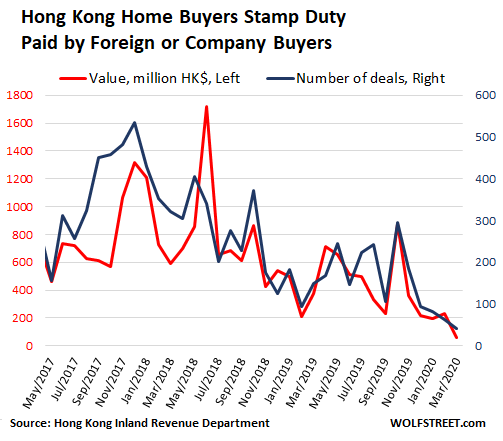
Mainland Chinese buyers, who largely drove the luxury real estate boom in Hong Kong, the world’s most expensive housing market in terms of affordability, have stopped buying. The number of homes eligible for buyer’s stamp duty, which is only paid by overseas or company buyers, mostly from the Mainland, plunged to an unprecedented low of just 42 homes in March, from a record monthly high of 534 in December 2017, according to the city’s Inland Revenue Department:

Sales of Hong Kong property to mainland investors have been trending downwards for the past two years or so, largely due to the Chinese government’s decision, in late 2017, to crack down on money laundering and illicit capital flows from mainland China to other countries. One of the main targets of that crackdown was money used to fund real estate projects in booming global cities with lax money laundering controls.

Since then, the combined toll of the US-China trade war, Hong Kong’s political crisis, and recently Covid-19 has decimated property investor sentiment.

In addition, many Mainland investors are desperately trying to sell those residential properties they have already bought as rental income in Hong Kong slumps and appetite for outbound investment all but vanishes in China. Many of these investors are willing to sell at a sharp discount to offload their property as quickly as possible.

Pummeled by weaker market sentiment, a lack of new launches due to the virus outbreak, and the evaporation of demand from mainland investors, luxury transaction volumes on Hong Kong island tumbled by 44% Q-o-Q in Q1/2020, following a modest rebound in Q4/2019, according to data published by Savills. In Kowloon and the New Territories, which were particularly popular districts among mainland investors, transaction volumes plunged by 50%.

Continue reading the article on Wolf Street
Demand for Bank Notes in Dollars & Euros Spikes Despite Fears of Covid-19 Contaminated Cash

A curious phenomenon

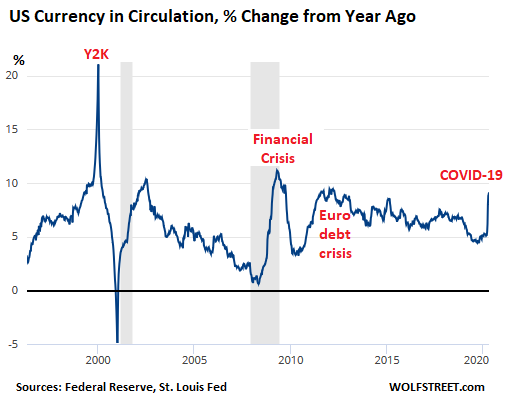
In the United States, as coronavirus concerns grew and state after state went into lockdown, and as consumption plunged and unemployment exploded at a previously unimaginable rate, the amount of physical dollars in circulation spiked to $1.89 trillion, as of the Federal Reserve’s balance sheet on April 16, having jumped 9.1% compared to a year earlier.

During the darkest days of the Financial Crisis, the demand for U.S. dollar banknotes spiked at year-over-year rates of over 8% for ten straight months and peaked at rate of 11%. But that was nothing compared to what happened during the Y2K craze, when fears that computer systems would malfunction when dates rolled over in the new millennium triggered a mad rush for US dollar banknotes. In December 1999 the total value of dollar bills in circulation spiked by 16.9% from a year earlier, the highest rate since the war-years of the 1940s:

The total value of euro banknotes in circulation in March, as countries across the Eurozone went into Covid-19 triggered lockdowns, increased by €36 billion from February, to €1.31 trillion, according to the ECB. It was the fastest monthly increase since October 2008. And it was up 8.1% from a year earlier. This all happened as consumption in the region slumped to unprecedented levels.

Bank notes denominated in US dollars and euros, the two biggest global reserve currencies, are stashed away in large quantities in other countries with unstable currencies, and they’re used to trade certain types or merchandise on the global black market. The euro is also used as currency in some areas that are not part of the Eurozone. And the dollar is used actively in countries that are either fully or partially dollarized. The Fed has estimated that around 70% of 100 dollar bills, which account for nearly 80% of the total value of U.S. currency, are held abroad.

But what triggered this spike wasn’t sudden demand overseas. The banking system must be able to provide sufficient currency even during spikes in demand at local ATMs and bank branches, and a sudden spike like this is a sign that local people are hoarding cash during times of uncertainty — with empty shelves at supermarkets having spooked people.

Continue reading the article on Wolf Street

“Something Has Gone Wrong”: UK Government, Banks Screw Up Coronavirus Loans, Small Firms Near Collapse. Better Results in Other Countries

Part of the problem is cultural: big banks in the UK don’t like lending to small businesses, especially not at 1.5%.

Thanks to its Brexit planning, the UK should have been better positioned to help its small businesses through the coronavirus crisis than most of its European peers. In early 2019, the UK treasury, together with the business department and the state-owned British Business Bank, laid the groundwork for a loan guarantee system for small businesses in the event of a chaotic Brexit. This meant that when the Covid-19 lockdown began, all the government needed to do was dust off those plans and put them into action. It should have been smooth sailing. Instead, it’s been an unmitigated disaster.

On March 19, the day the economy went into lockdown, the government unveiled £330 billion of emergency measures to help shuttered businesses weather the storm. Those measures included the Coronavirus Business Interruption Loan Scheme (CBILS), which the Chancellor of Exchequer Rishi Sunak said would be made available to “any good business in financial difficulty who needs access to cash to pay their rent, the salaries of their employees, pay suppliers, or purchase stock”. Yet almost four weeks later, just 4,000 of the 300,000 companies that have applied for the funds have actually received them.

“Something has gone wrong,” warned former Bank of England governor Mervyn King on Sunday. Due to a combination of voluminous government red tape, complex eligibility criteria, massive roadblocks erected by the participating banks and the temporary closure of a large number of bank branches, the amount of money so far lent out by UK lenders to small or mid-sized businesses is just £800 million pounds. That’s less than 0.25% of the total £330 billion pledged in loans for businesses, small and large.

In Switzerland, with a population roughly one eighth the size as the UK’s, 76,000 small businesses had received emergency loans worth more than CHF15 billion ($15 billion) as of April 6. Since then, the Swiss government has doubled the facility from CHF20 billion ($20.8 billion) to CHF40 billion ($41.6 billion). The much-lauded loan scheme’s success appears to rest on two basic pillars:

One, simplicity and speed. To qualify for a loan of up half a million francs, small business owners merely have to fill in a one-page form containing six basic questions, which they must answer honestly. Once the form is sent to the bank, the application is approved or rejected within no more than 24 hours. If approved, the loan is interest free, does not include penalties and is repayable in five years.

Two, zero risks for banks. All loans of up to CHF500,000 are 100% guaranteed by the state, meaning the banks have nothing to lose and are therefore less worried about the risk of providing financial lifelines to businesses whose future is far from certain, even with the loans.

In the UK, by contrast, 80% of each loan is guaranteed by the state, which means banks must assume 20% of the risk of non-payment. Even before this crisis began, large UK banks were already reticent about lending to small businesses. Worse still, many of the small firms they have lent to ended up being lumbered with dodgy financial products such as payment protection insurance (PPI) or interest rate swaps, which had an annoying tendency to harm or destroy the business’ financial health while making the bank bucket loads of money.

Continue reading the article on Wolf Street

Farm-Labor Crisis under COVID-19 Sends Countries Scrambling

Miserable, crowded living conditions of Europe’s foreign farm workers put them at much greater risk. And they’re staying away.

In one of the many paradoxes of the new world we live in, Western European countries that have seen millions of jobs wiped out in a matter of weeks are now facing an acute shortage of agricultural laborers.

Farmers in Germany, France, Italy, Spain, the UK and other parts of Western Europe have come to rely on huge numbers of cheap labor from Eastern Europe, North Africa, and Sub-Saharan Africa. Now, those workers are either no longer able to make it to the farms or are choosing to stay with their families in their home countries.

This is leading to an “alarming” shortage of farmhands, warns the EU in an as yet unpublished report. The report blames the shortage on two main factors:

  • The restrictions on the movement of workers between EU countries to combat the spread of Covid-19;
  • And the miserable, crowded living conditions in which many imported farm workers live, which put them at much greater risk of contracting the virus.

In Spain a record 900,000 workers dropped off Spain’s social security register of employees in the last two and a half weeks of March, yet farm associations are complaining that they’re short of over 100,000 workers to help pick the fruit, vegetables and tobacco that are now ready for harvest.

“Vineyards are paralyzed because there’s no one to install the conduction system; there are no day laborers to prune the olive trees or remove the weeds in the onion farms; there are not even enough hands to tie the garlic bundles”, says agricultural engineer Arturo Serrano. “All of these crops have work cycles that are governed by nature and cannot be postponed.”

In France, the EU’s biggest agricultural producer where food and rural life form an integral part of popular culture, the government’s rallying cry for local citizens to fill the labor gaps on the country’s farms appears to have been more successful. Some 240,000 freshly furloughed workers have already signed up for the government’s “Des bras pour ton assiette” (Arms for your plate) campaign, partly as a means to get out into the country and escape the confines of their home. Five thousand volunteers have already been put to work.

In the Southern Spanish region of Huelva, where many of the strawberries and other summer fruits are grown and picked, to be consumed in Western Europe, the living conditions on some farms are so deplorable they have been likened to modern-day slavery. In some cases the laborers, mostly from Sub-Saharan Africa, are not even provided with accommodation. Shunned by landlords in neighboring villages, they have little choice but to build makeshift shelters, which rapidly mushroom into shanty towns that have no access to running water or electricity.

Now, many of those workers have failed to turn up for the harvest season, leaving farmers little choice but to source their labor locally. The problem is that most locals don’t want to work on farms under those conditions anymore. Even in areas blighted with eye-watering levels of unemployment such as Huelva (24% before the virus crisis), many locals would prefer to stay on the dole or try to find work in industries that pay better — farmhands can be paid as little as €5 an hour, less than Spain’s legal minimum wage — and offer greater job security. Now, thanks to Covid-19, those slightly better paid, slightly more secure jobs no longer exist.

At the beginning of April, Spanish farm groups lobbied the government to make it legally possible for furloughed workers to work on farms near where they live and continue receiving their unemployment benefits. The government quickly obliged, meaning the farmers now have a new army of low-paid, taxpayer-subsidized workers at their disposal. But according to El Confidencial, the response has so far been disappointing. Not enough people have signed up and of those who have, many only last a day or two in the fields before throwing in the towel.

Spain is Europe’s fourth largest exporter of agricultural produce, behind the Netherlands, France and Germany. In 2018, those exports exceeded €50 billion. With the country’s all-important tourism industry on hold for the foreseeable future, these exports take on an even bigger role.

Continue reading the article on Wolf Street

Now in Lockdown, Mexico’s Economy Slides. Banks & Companies Clamor for Bailout. Government Refuses

All non-essential activities have been suspended for at least a month. But where are the bailouts?

Mexico faces its biggest economic storm since the Tequila Crisis in the mid-1990s. Then, the peso lost almost 50% of its value against the dollar in a matter of weeks, wiping out the life savings of much of the country’s middle class and stoking fears that collapsing asset values would push Mexican banks over the edge, taking part of Wall Street with them. In the end, that fate was averted with a bailout and the creation of one of the world’s first ever “bad banks.”

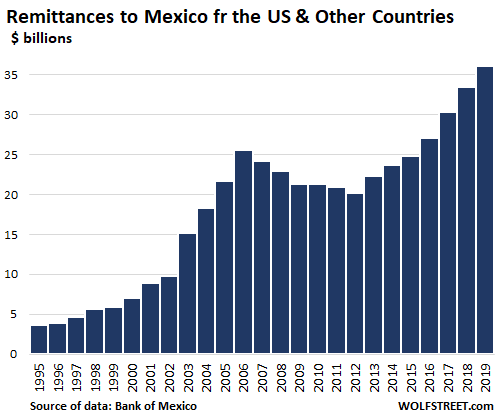
Today, as a whole different kind of crisis — this time a health crisis, global in nature — builds, the peso is once again sinking. In March, it suffered its biggest monthly decline since 2009, though it has since firmed a little. The economy of its biggest trading partner, the United States, has all but ground to a halt. This has major implications not only for Mexico’s exports but also for the remittances that Mexican workers living in the U.S. send back to their families. Last year, remittances from the US and other countries totaled $36 billion.

In some Mexican states, these payments can represent as much as 10% of total revenues, most of which gets spent very quickly in the Mexican economy. Thousands of businesses depend on the funds for capital. But as more and more of Mexico’s migrant workers fall prey to America’s jobs cull, a lot of that money is no longer going to arrive.

“Unemployment in the United States poses a big risk to the Mexican economy”, says José Luis de la Cruz, director of the Institute for Industrial Development and Economic Growth (IDIC). “The remittances have been a key pillar for the economies of many towns, cities and even entire states. Now we are expecting a fall of up to 20% in these funds this year.”

Mexico’s economy already stopped growing last year. Now, it’s beginning to seize up altogether following the government’s declaration on March 30 of a national emergency to tackle Covid-19. All non-essential activities have been suspended for at least a month.

The banks are once again beginning to fret. On Tuesday, Citibanamex sent a letter to clients warning that the economy is in an “state of agony” and in desperate need of “audacious” fiscal measures. Bank of America cautioned that Mexico’s president Andres Manuel Lopez Obrador’s “pro-cyclical measures” will not only deepen the coming depression, they will hasten the downgrading of Mexico’s sovereign debt to junk status.

In part, the banks are talking their own book, hoping to push AMLO into a bailout deal that will serve nobody’s interests but their own and their largest clients’. For the moment, it’s not working.

Continue reading the article on Wolf Street