Construction Activity Plunges in Germany, France, & Italy

And construction companies “aren’t expecting a swift recovery.”

The signs of strain continue to come thick and fast for the Eurozone’s economy. At the end of last week, it registered a fall-off-the-cliff collapse in its all-important services sector. Also confirmed was a vertiginous downturn in manufacturing. Now it’s the construction industry.

The IHS Markit Construction PMI for the Eurozone, which tracks how executives of unnamed companies perceive various aspects of business at their own company, suffered its steepest decline since February 2009, when Euro Area economies were grappling with the fallout of the first installment of the Global Financial Crisis.

In these Purchasing Managers Indices, 50 is the no-growth line; above 50 means expansion; below 50 means contraction. The lower the number below fifty, the more dramatic the decline. The construction PMI collapsed from moderate growth in February (52.5) to 33.5 in March, its lowest level in 11 years.

The downturn in construction activity was broad-based across both geographical regions, with all three of the biggest economies — Germany, France and Italy — experiencing steep declines, and sub-sectors. Both home building and commercial construction projects were hit hard by the downturn while civil engineering work was hit even harder, suffering its fastest contraction in eight years.

Here are some more sobering takeaways from the report:

  • With most of the industry’s activity paralyzed, “eurozone construction firms cut their staff numbers for the first time since January 2017” and at the fastest rate in a decade.
  • “The downturn in construction activity also saw firms scaling back their purchases of raw materials and other building inputs for the first time since October 2016. Moreover, the decline in purchasing activity was the steepest recorded in the survey’s 20-year history.”
  • “Despite the sharp reduction of input purchases, suppliers’ delivery times in the eurozone construction sector lengthened further in March, and at a rate not seen since the survey started in January 2000.”
  • “New business plunged in March, falling at the fastest rate for over 11 years. National data showed a broad-based decline across the eurozone, led by severe falls in Italy and France.”

At the national level, the sharpest decline was registered in Italy, which got hit first by the COVID-19 crisis and was the first European country to halt all non-essential activities, including construction. As a result, its construction PMI collapsed nearly 35 points from 50.5 in February to 15.9 in March, which goes down as the “quickest [rate of contraction] seen since the survey began in 1999.”

Continue reading the article on Wolf Street
Lockdown Hits UK Commercial Real Estate, Retail Landlords & Their Investors: Most Property Mutual Funds Suddenly “Gated”

Never before have so many property funds shut the doors on so many property investors.

Against this backdrop of unprecedented uncertainty, as tenants of shops, bars, restaurants and offices refuse to pay their rents en masse and almost all commercial property deals fall through, it’s all but impossible to put an accurate price on the current value of commercial real estate.

Virtually no one can escape the economic fallout from Covid-19. Not even the owners of commercial real estate, who benefited so handsomely from the central bank-engineered bailouts and property bubbles of the past decade, are immune.

In the UK, a decision by the government to grant retail tenants a three-month moratorium against eviction — an essential lifeline for many businesses that have seen their incomes dry up or drop dramatically as a direct result of the lockdown — has shifted the locus of immediate financial stress from tenants to property owners and their lenders.

The shuttered bars and restaurants in central London are a case in point. Early last week, they received a collective quarterly rent bill of around £500 million. But most of the bars and restaurants took advantage of the government’s moratorium: Instead of paying their rents, they decided to use the freed-up cash to try to weather the crisis. Now, it’s their landlords who are suddenly short of money and who may, as a result, struggle to pay their staff and meet fixed costs such as quarterly interest payments to lenders.

The same is happening across the retail landscape. Some commercial landlords received less than a third of their expected rent on Wednesday.

They include Intu, the embattled owner of dozens of semi-shuttered malls in the UK, as well as a handful in Spain, which revealed it had collected just 29% of expected first-quarter rent, even after offering a deferral and cutting service charges. That compares to 77% during the same period last year, which was already low.

Even before the virus crisis, the company was already on its last legs having endured wave after wave of retail restructurings, resulting in soaring vacancies and plunging property values. In mid-March, two weeks before the UK government initiated a generalized lockdown of the retail sector, Intu warned it was on the brink of bankruptcy after declaring losses of £2 billion for 2019 and a debt of £4.5 billion. Its shares are now worth just four pennies a piece, having tumbled by 96% over the past year.

Intu is now threatening to take legal action against non-paying tenants, saying it would not “bankroll” retailers that have “just decided they don’t want to pay their rent.” Many other retail landlords are reportedly doing the same, despite the fact that many of their tenants have had to halt the lion’s share, if not all, of their business activity, decimating their earnings for the foreseeable future. Even before this crisis hit, many of these retailers were already struggling in the face of slowing sales, high costs, low profitability and rising competition from online rivals.

Continue reading the article on Wolf Street
A Word About Hong Kong’s Retail Sales Collapse: It’s a Mess

Sales at luxury goods stores, once the largest category, collapsed by 86% since their peak in 2013-2014

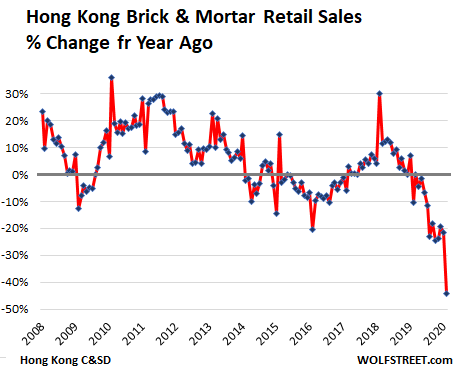
As Hong Kong tourist arrivals collapsed by 96% in February, with travel essentially banned since late January and borders to mainland China blocked, and with mainland visitors down 97.8%, retail sales at brick-and-mortar stores plunged 44% compared to February last year, the 13th month in row of year-over-year decline — and the sharpest yet — after having plunged 21% in January. But as you can see, this collapse in sales started long before COVID-19:

“The business environment of retail trade will remain extremely austere in the near term, as the COVID-19 pandemic has brought inbound tourism to a standstill and severely dented local consumption demand,” a government spokesman said.

Even before the arrival of Covid-19, Hong Kong had already clocked up two straight quarters of sharply shrinking GDP, mostly due to the political crisis that broke out last spring and escalated into a crescendo of violence in the summer. That crisis scared away many tourists from mainland China and elsewhere. Covid-19 did the rest.

The only types of stores that actually saw sales increases — in part powered by panic buying — in February were, according to the provisional data released by Hong Kong’s Census and Statistics Department:

  • Supermarkets and supermarket sections of department stores: +11.5%
  • Fish, poultry & livestock stores (fresh or frozen): +20.3%
  • Fruits & vegetables stores: +17.8%

All other categories saw declines, with some reaching deep into the collapse territory:

  • Luxury goods (jewelry, watches, valuable gifts, etc.): -78%.
  • Clothing, apparel, accessories & footwear: -72%.
  • Alcoholic drinks and tobacco: -68.6%
  • Department stores: -58%
  • Medicines and cosmetics stores: -57%
  • Books, newspapers, stationery and gifts: -46%
  • Other consumer goods: -34%
  • Optical shops: -33%
  • Durable consumer goods, including motor vehicles: -29
  • Fuels: -0.3%

A special word about the collapsing sales at luxury goods stores.

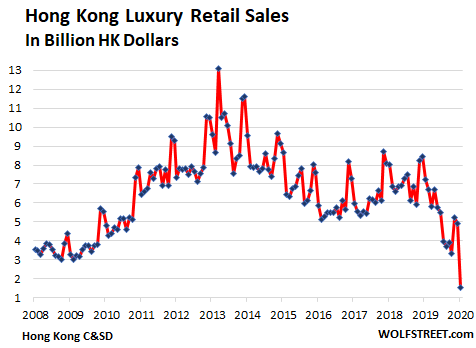
Sales at stores for jewelry, watches, valuable gifts, and the like peaked in 2013 and 2014, as measured in HK dollars. At the time, these stores were by far the largest category. This is where tourists went to drop money. And even though sales started to decline in the following years, these stores remained the largest category by sales volume through 2018. But in 2019, sales suddenly collapsed further, driven by social unrest and the plunge in tourism.

From February 2014 to February 2020, sales have collapsed by 87%, from HK$9.5 billion to HK$1.5 billion, and now among the also-rans, below the category even of stores that sell “fish, poultry & livestock (fresh or frozen).” This was the lowest level of sales in the data going back to 2004:

Will retail sales snap back? Hardly.

Continue reading the article on Wolf Street