Global Slowdown, Internal Issues Hit Mexico: GDP Drops for First Time Since 2009

President AMLO put it this way: “There may be no growth but there’s development and well-being, which are different.”

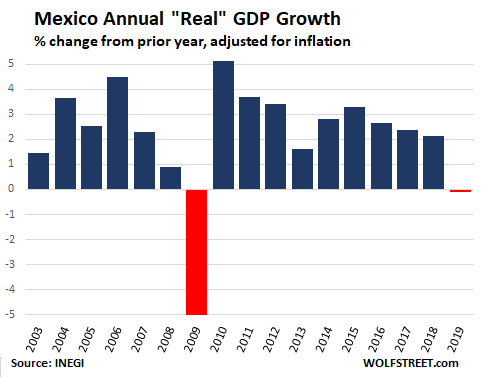
For Mexico’s economy, 2019 was not a good year. The country entered a mild technical recession in the first half and by the end of the year had registered its first annual decline in GDP since 2009. According to a preliminary estimate published by Mexico’s statistical institute INEGI, “real” GDP (adjusted for inflation) for the year 2019 declined -0.1%:
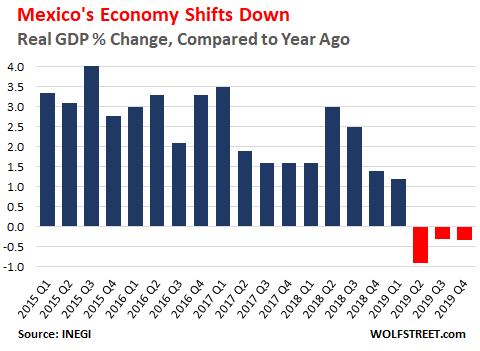
In the fourth quarter, “real” GDP declined 0.3% compared to the same quarter a year earlier, making it the third quarter in a row of year-over-year declines:
The biggest drop was in the secondary sector — manufacturing, mining and construction — which contracted by 1.8% in 2019, its weakest performance in over five years. Particularly hard hit were automakers which saw new vehicle sales in the domestic market slump 7.5%. The current global slowdown in auto demand also took its toll, with total auto exports falling by 3.4% to 3.3 million units in 2019, the first annual decline since 2009.

Manufacturing exports as a whole, which represent 90% of all Mexico’s exports, increased by 3.4% to reach $410 billion. This helped to cushion the blow of a 15% plunge in petroleum exports, to their lowest level in 40 years — the result of two main factors, according to analysts in the sector: the Mexican government’s decision to prioritize sending domestic crude to domestic refineries as opposed to exporting it; and reduced demand from Mexico’s biggest buyer of oil, the United States.

Despite all of this, total exports from Mexico still managed to grow by 2.3% while total imports fell by 5.1%, leaving the country with a trade surplus of $5.8 billion.

Continue reading the article on Wolf Street
Gift Turns into Kafkaesque Ordeal: How My Two WOLF STREET Beer Mugs “Were Disappeared” in Spanish Customs

Many people report similar nightmares trying and failing to get their packages from non-EU countries out of Spanish customs.

In October last year, Wolf Richter, the publisher of this site, decided to send me two of his beautiful WOLF STREET beer mugs, emblazoned with a bedraggled Wolf howling the timeless pearl of wisdom, “Nothing goes to heck in a straight line.” Meant as a gift in recognition of my years of writing for WOLF STREET, the two mugs were dispatched in early October. They were supposed to arrive at my Barcelona apartment within 7-10 days. But they didn’t. Instead, I received a text message to my mobile phone from Spain’s postal service, Correos, informing me that Customs had withheld the package, as import duties had not been paid on its contents.

Thus began a Kafkaesque ordeal that has caused untold frustration and consumed countless hours of my time. I’ve tried phoning the organization indicated in the text message — ATD Postales, a specialized division of Correos responsible for processing the parcels withheld by Customs — eight times and have only been attended by an operator on two occasions. The other times, either the call was not answered at all or I would be passed from one department to another, one operator to another, until the line eventually went dead. On the two occasions I did get to speak to an operator, I did not receive the follow-up call or email I was promised.

The same thing is happening to increasing numbers of Spaniards who buy goods or receive gifts from non-EU countries, only to find themselves trapped in a hellish labyrinth of delays, red tape, and extra costs that eventually lead many of them to simply cut their losses and abandon their efforts. In 2015 alone, around 490,000 packages were abandoned by their owners, according to El País.

If you live in Spain and buy anything from outside the EU worth more than €45, you’re supposed to pay 21% sales tax, along with a 2.5% import tariff. If you’re importing a product that is specially protected by even higher EU duties, such as a bike from China or a kimono from Japan, the tariff can be as much as 48% of the product’s value. The costs don’t end there. If you actually get through the whole bureaucratic rigmarole, pay the import dues requested and your package is finally released, you will probably also have to cover so-called “administrative costs” and the postage charges for the parcel’s delivery from Barajas Airport to your home.

This is all a necessary part of the fight against fraud and piracy, says Spain’s Tax Agency, which runs the customs service. An estimated 14% of counterfeit brand products enter Europe by post and express deliveries. And that number is apparently growing all the time. But so, too, is the number of Spaniards buying goods from outside the E.U. The tax agency’s response is to demand ever larger amounts of paperwork.

Continue reading the article on Wolf Street
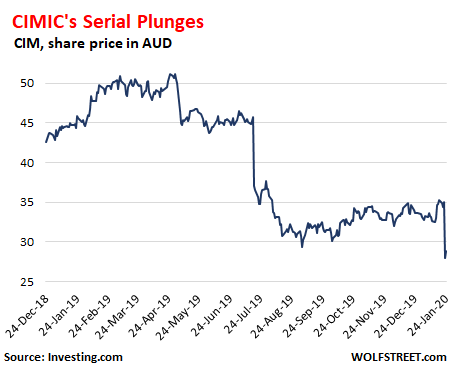
Australian Construction Giant CIMIC Writes Off Disastrous Arabian Adventure, After Being Bludgeoned over Opaque Debts

Shares plunged 20% on the spot, and are down 44% in nine months

The shares of CIMIC, Australia’s largest construction company, plunged 20% on Thursday to a four-year low, wiping AU$2.2 billion (US$1.5 billion) off its market value, following news that the company was abandoning its Middle Eastern operations with the sale of its stake in BIC Contracting (BICC). The firm expects to suffer a AU$1.8 billion ($1.23 billion) charge-off after failing to recover debts owed for projects built (or in some cases, barely built at all) at the tail end of Dubai’s property bubble.

CIMIC’s stock has plunged 44% since April, when the Hong Kong-based research group, GMT, had released a report that accused the company of using reverse factoring agreements with banks and financial institutions to create the illusion of cash flow, reduce the appearance of debt, and lower its leverage ratios:

CIMIC (formerly known as Leighton Holdings before being acquired by Spain’s Grupo ACS) builds many of Australia’s biggest infrastructure projects, including Melbourne’s $6.7 billion West Gate Tunnel and Sydney’s Metro City. It is also the world’s largest contract miner. The company is majority owned by German construction giant Hochtief, which itself is majority owned by ACS, the world’s seventh largest construction and services company (by sales), following its acquisition of the German firm in 2011.

Continue reading the article on Wolf Street

What to Do with Malls? Teetering UK Mall Giant Intu Asks Investors for £1 Billion. Shares Drop to Near-Nothing

Brick & Mortar melts down on mall owners. So “repurpose” malls into housing?

After a weekend of fevered speculation, struggling UK mall owner Intu Properties confirmed on Monday that it plans to raise £1 billion of fresh capital to buttress its shaky finances. The company’s shares reacted in time-honored fashion, plunging 8% to a historic low of 21 pence before ending the day down just 1%. Intu’s share price is now 80% lower than it was a year ago and 95% lower than five years ago, leaving the group valued at just £306 million.

Intu owns dozens of malls in the UK, including nine of the 20 biggest ones, and a handful in Spain. It describes itself as a commercial real estate company that is “in the business of helping customers and brands flourish, whether that’s through leasing space in our prime retail and leisure destinations, commercialisation activations or online through our multichannel platform intu.co.uk.” The problem is that many of its clients — mainly large bricks-and-mortar retail chains — are not exactly flourishing; they’re either battling for survival or going out of business.

Intu is also bleeding funds. Its net rental income in the first half of 2019 slumped by around 18% year-on-year to £205 million as a result of major clients like Topshop’s owner Arcadia, Debenhams, and House of Fraser falling into administration (a form of bankruptcy), resulting in a spike in store vacancies. Its losses surged to £856 million in the first half of 2019, up from £506 million in the same period of 2018. The combined value of its assets also fell, from around £9 billion to just over £8 billion.

The company has £4.7 billion of debt on its books that it cannot service under current conditions, which is why it is asking shareholders to stump up an extra £1 billion of capital. But just how willing will investors be to inject funds worth more than three times the market value of a company whose shares have already collapsed 80% in the last year, at a time when the UK’s retail sector is in the deepest of doldrums?

The UK retail sector had a terrible time in 2019, in particular the second half. The three-month moving sales average between October and December fell 1.1% year-over-year, the biggest decline since September 2009. Many consumers, their psyches’ pummeled by the never-ending uncertainty over Brexit and their finances stretched to the outer limits of their borrowing capacity, have begun to tighten their belts, which is the last thing the UK’s brick-and-mortar retail sector needs.

In the last year alone, 14,500 stores were closed. This is having a direct impact on retail malls, as well as the investors that own them. Open-ended property funds sustained the largest withdrawals on record in 2019, with total outflows of £2.2 billion. In December, the giant UK fund manager M&G suffered a run on its £2.5 billion M&G Property Portfolio, leaving it little choice but to suspend redemptions. The “temporary” ban has not yet been lifted.

Continue reading the article on Wolf Street

US Auto Imports from Mexico Hit Record, but Mexico’s Global Auto Exports Fall for First Time since 2009

GM shifts even more production to Mexico (even as its US sales fall). But Ford’s imports from Mexico plunge. FCA’s, Audi’s, Nissan’s down too.

Hit by the global swoon in auto sales, Mexico’s exports of cars and trucks to the rest of the world fell by 3.4%, to 3.3 million units in 2019, the first annual decline since 2009. Exports to Europe plunged.

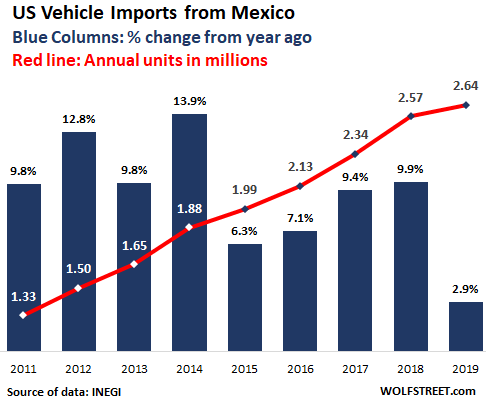
The U.S. imports eight out of 10 cars and trucks that are assembled in Mexico. Over the first nine months of 2019, auto imports from Mexico grew at 8% year-over-year. But in Q4, imports suddenly plunged 11%, according to data from the Mexican automotive industry association AMIA (released by the National Institute of Statistics and Geography INEGI). In December alone, auto imports tumbled 16.7%. The year-end swoon slashed year-total growth of imports from Mexico to just 2.9%, the smallest increase in over a decade. In 2019, the US imported 2.64 million vehicles from Mexico:

The multi-year surge of vehicles imported from Mexico into the US occurred even as new-vehicle sales in the US have fallen for three years, including 1.2% to 11.1 million vehicles in 2019, the lowest since 2014, and below where they’d been in 2000. This increased the share of Mexico-built vehicles in 2019 to a record 15.5% of total US sales, up from a share of 10.5% in 2013.

Mexico’s auto industry is worried. Over the past decade-and-a-half, it has enjoyed the benefits of non-stop growth, largely based on exports to the US. Between 2011 and 2018 the total number of vehicles sent to the U.S. from Mexican assembly plants surged by 93%, rising every single year, sometimes by double-digit percentages, including 13.9% in 2014. Even in 2015, the worst year until this year, the total imports still grew by 6.3%.

These increases happened even as the U.S. car market has been declining for the past three yeas. But now the impact is being felt south of the border.

Continue reading the article on Wolf Street

More ECB Bond Holdings Get in Trouble: Infrastructure Giant Atlantia, Infamous for Collapsed Genoa Bridge, Could Lose its Core Business

Amid a slew of problems

Italy could be on the verge of approving rules that would make it much easier and cheaper to revoke highway concessions. And that could be very bad news for Autostrade per l’Italia (ASPI), the private toll road operator that controls more than half of Italy’s aging toll roads and which is blamed for the collapse of the Morandi Bridge in Genoa in 2018 that resulted in 43 fatalities and left 600 people homeless. The regulatory uncertainty sent shares of ASPI’s parent company, Atlantia, down 10% to eleven-month lows this week.

Majority controlled by the Benetton family’s holding company Edizione, Atlantia is currently facing a criminal inquiry for potential negligence in the Morandi Bridge collapse. Atlantia happens to own the inspection company responsible for safety checks on the bridge. And those checks, it seems, were not very thorough.

Italian prosecutors recently widened their inquiry into suspected safety breaches to include more employees and viaducts than previously identified. The suspects include Atlantia subsidiaries APSI and Spea Engineering, Atlantia CEO Giovanni Castellucci and Chairman Fabio Cerchiai. If found guilty of negligence, Atlantia could face massive fines. The company already booked provisions for the disaster in its 2018 accounts, with a negative impact on its EBITDA of €513 million.

Atlantia’s troubles were compounded this week when the roof of a tunnel operated by ASPI collapsed. Thankfully, this time there were no injuries, but the timing, just days before the parliament votes on the government’s proposed measures to revoke highway concessions, could not have been worse.

Continue reading the article on Wolf Street