Credit Suisse is One of 13 Too-Big-To-Fail Banks in Europe, But It Looks Like It Could Be Failing

Following a string of scandals, bad investments and woeful risk management, Switzerland’s second largest bank, Credit Suisse, is close to the edge.

Yesterday’s much-awaited publication of Credit Suisse’s financial results for the third quarter as well as its latest strategic review gave a somewhat clearer idea of just how bad things really are under the bonnet. And it turns out they are pretty bad — so bad, in fact, that Credit Suisse’s shares yesterday (October 27) suffered their biggest daily rout ever. Today, those shares have so far barely managed to muster a rebound, even of the “dead cat” (apologies to all feline lovers) variety.

A Four Billion Dollar Loss

Credit Suisse is one of 13 European lenders on the Financial Stability Board’s list of Global Systemically Important Banks (G-SIBs). In other words, it is officially too big to fail, but it is nonetheless close to failing. Yesterday it disclosed a whopping third-quarter loss of $4 billion — more than eight times average estimates of just under $500 million. The loss was largely the result of a reassessment of so-called deferred tax assets (DTA).*

This is Credit Suisse’s fourth quarterly net loss in a row. So far this year, it has posted $5.94 billion of losses. Net revenue, at $3.8 billion, was up marginally on the last quarter but down 30% from Q3-2021. The value of its asset base has also shrunk drastically, from $937 billion in December 2020 to $707 billion today.

To steady the ship, the bank has presented a new strategic overhaul — its third in recent years. At the core of the overhaul is a plan to raise $4 billion of fresh capital. The good news for Credit Suisse is that it has already found a major backer — Saudi Arabia’s largest commercial bank, Saudi National Bank (SNB), which has pledged up to $1.52 billion of capital. That will give the SNB 9.9% of outstanding CS shares.

Majority controlled by the House of Saud, the SNB (not to be confused with the Swiss National Bank) has also expressed an interest in participating in future capital measures of Credit Suisse to support the establishment of an independent investment bank in Saudi Arabia. If nothing else, SNB’s participation will make for interesting boardroom drama given the sovereign wealth fund of Qatar, a country that is locked in a diplomatic conflict with Saudi Arabia, has a 5% stake in the Swiss lender.

The question now is whether or now CS will be able to secure the remaining $2.5 billion.  The capital raise is already going to dilute existing CS shareholders, many of whom are miffed at having already poured $12.2 billion of additional capital into the lender — more than its current market value — since 2015. That was one reason why CS’s shares plunged a whopping 18.6% yesterday — their biggest daily fall ever. Those shares are now down an eye-watering 57% so far this year and over 95% since 2008.

To staunch the bleeding, the bank plans to slice its investment bank into multiple parts, exit certain businesses and sell off the rump of its securitized products group, most likely to Apollo Global Management Inc. and PIMCO. It also hopes to bring back the First Boston brand name for its US investment banking business, which Credit Suisse acquired in 1990, only to spin most of it off. According to sources cited by Reuters, CS will still maintain a large stake in CS First Boston but, over time, will wind down its position.

Credit Suisse also plans to slash 15% of its expenses between now and 2025. As part of this “radical” cost-saving plan, it will lay off 9,000 of its 52,000 employees. If all goes to plan, the bank will be back to making profits some time in 2024. But even if that happens, CS aims to achieve a return on tangible equity – a key measure of profitability – of just 6% by 2025, which means it will continue to lags its peers.

“The new Credit Suisse will definitely be profitable from 2024 onwards,” CEO Ulrich Koerner said in an interview with Bloomberg Television. “We do not want to over promise and under deliver, we want to do it the other way around.”

Bad Timing 

As I noted a month ago, in Fast-Shrinking TBTF Giant Credit Suisse Is Living Dangerously, CS has chosen the worst possible moment to go cap in hand to investors, with financial conditions deteriorating rapidly worldwide, the global bear market deepening and its own market cap now valued at just $10.15 billion, less than half its value ten months ago. That makes it much harder to raise equity at a reasonable price to bolster its capital position.

Executing this is highly dependent on economic forces beyond their control,” Chris Marinac, director of research at investment firm Janney Montgomery Scott, told Reuters. “If we were in a big market, you could probably give the company the benefit of the doubt. But because it’s fall 2022 and there’s all this uncertainty…it’s really difficult. This is the pond in which Credit Suisse swims.”

Read the full article on Naked Capitalism
Colombian President Says the Unspeakable Out Loud: “The US is Ruining Economies Around the World”

Until recently Washington’s closest ally/client state in South America, Colombia is now under new management. And that management has a different perception of US influence in Latin America and the wider world.  

Just over a month ago, Colombia’s recently elected left-wing President Gustavo Petro ruffled a few feathers by lambasting the US-led war on drugs from the podium of the UN General Assembly in New York. He also condemned the NATO-Russia proxy war in Ukraine, which raised serious questions about Colombia’s position as NATO’s only Latin American partner. Then last Wednesday, during a visit to Urabá Antioquia, close to Colombia’s northern border with Panama, he set his sights on US economic policy:

An economic crisis is undoubtedly brewing. The United States is practically ruining economies around the world. The German economy has already been destroyed by the war [in nearby Ukraine]. The Russians, Ukrainians and Europeans, first and foremost, have unleashed a war upon their own continent, which is a war for gas, for energy. And as a result of that war the European economy is sinking.

Powerful Germany is entering recession. And who would think it? England, which one day was the world’s dominant colonial power, is mired in a deep economic crisis. In Spain, the residents of towns and cities are up in arms. The same in France. And in the United States decisions are being taken to protect the United States, sometimes without thinking about the consequences elsewhere.

The Growing Pains of a Global Dollar Shortage

Petro places much of the blame for the “looming economic crisis” on the US Federal Reserve, whose aggressive interest rate hikes of the past seven months have propelled the dollar to its highest level since the year 2000.* Raising rates draws capital toward the US economy and away from higher-risk emerging markets. As capital inflows push up the dollar’s value, capital outflows pull down emerging-economy currencies, which makes it much harder for governments and companies to service their US-denominated debt.

The US Ambassador to Colombia, Francisco Palmieri, responded to the accusations by urging Petro not to look for culprits for the worsening economic conditions around the world, only to shift the blame to Russia seconds later:

We must not think about where to lay the blame. We must focus on how to work together to improve and foster the development necessary for economic growth…

Russia’s aggression against Ukraine is a major threat to the global economy. Within the United States, we are also experiencing economic challenges, as are many of the countries in the world.

As the IMF noted last week, the dollar has appreciated 22% against the yen, 13% against the Euro and 6% against emerging market currencies since the start of this year. That the currencies of rich economies like Japan, the UK and the EU have, as a whole, fallen faster against the dollar than emerging market currencies is testament to the severity of the current global dollar shortage. As the Korean economist Keun Lee notes, “while US monetary policy is hardly the only factor in causing that shortage, it is undoubtedly making matters worse.”

The Federal Reserve is hiking rates right now to try to keep a lid on inflation at home, even though high inflation in the US is largely the result of global supply chain pressures. But in doing so, it is exporting inflation to the rest of the world by driving up the value of the dollar. And that is piling yet more pressure on already cash-strapped governments.

Many emerging market crises of the past were caused or exacerbated by a rapidly strengthening dollar. To try to stop their currencies from nosediving and thereby contain rising prices, national central banks are responding to the Fed’s aggressive hikes by tightening their own monetary policy. This squeezes yet more life out of the economy by making it even harder for heavily indebted consumers and businesses to service their debts.

With inflation at multi-decade highs in many places, dollars growing increasingly scarce globally and yields surging on sovereign bonds, governments, particularly of energy-importing countries, are also having to rein in their spending.

“The coffers of Latin American economies are being bled dry,” said Petro. “All of our currencies are falling, not just the Colombian peso.”

The Colombian peso has been on a downward spiral against the dollar since 2012. Having lost almost two thirds of its value in that time, it is now just a whisker from crossing the 5,000-to-USD threshold.

New Management, New Relationship

Until June this year Colombia was Washington’s staunchest ally/client state in South America. The country is home to seven or eight formal US military bases (depending on who you read), and is by far the largest recipient of US aid in the region, having received $13 billion since 2000.

But in June a political earthquake took place. For the first time since Colombia won independence in 1819, a majority of voters elected a left-wing government. Led by Petro, a veteran politician and former guerrilla, that government is determined to shake things up…

Read the full article on Naked Capitalism

Italian Utility Giant Enel Needs a €16 Billion Lifeline, as its Derivatives Hedges Backfire

Enel is one of 70 energy companies in Italy that could end up needing a state-guaranteed credit line, as derivative hedges blow out. Which is likely to place even further pressure on the finances of Europe’s most indebted large economy. 

One thing former European Central Bank Chairman Mario Draghi did before resigning as Italian Premier was to devise a credit scheme to shield Italian energy companies, their lenders and counterparties, from the economic fallout of the proxy war in Ukraine and Europe’s backfiring sanctions against Russia. Under the plan, the country’s trade-credit insurer Sace would provide guarantees for around 70% of the total amount of fresh debt extended.

That plan is now very much in the implementation phase. Italy’s biggest lenders, UniCredit SpA and Intesa Sanpaolo SpA, are expected to contribute €5 billion a piece to a €16 billion emergency credit line for Italy’s largest utility, Enel. State-backed Cassa Depositi e Prestiti SpA and two other banks, Banco BPM SpA and BPER Banca SpA, are likely to throw in an additional €2 billion each. This is an 18-month “revolving credit” line, meaning the money will be withdrawn as needed. Much of that money, like the emergency business loans disbursed during the coronavirus crisis, will be guaranteed by the Italian government.

Enel apparently needs the credit line to cover derivative risks linked to hugely spiking energy prices, although gas and electricity prices in Europe have fallen quite significantly in recent weeks. Just as we recently saw in the UK’s gilt market, derivatives are doing exactly what they did in the GFC: magnifying risk and extending contagion.

An EU-Wide Problem

Significant sums of state-guaranteed credit have already been extended by European governments to energy companies, in order to prevent them from defaulting on their derivatives contracts. As NC reported in early September, this could cause a Lehman-like unravelling of the derivatives markets, with companies facing as much as €1.5 trillion in margin calls. To keep that from happening, Sweden and Finland have already provided guarantees worth €33 billion.

In July, Germany gave the national energy giant Uniper, owned by the Finnish company Fortum, a €15 billion loan, only for the firm to hit the rails once again in September. In the end, Berlin took over 99% of the company, at an additional cost of €29 billion. As Germany’s biggest importer of gas, Uniper was hit particularly hard by the vastly reduced flows of gas arriving from Russia. But its problems actually began before Russia’s invasion of Ukraine, with souring derivatives hedges largely to blame. In January this year Uniper was forced to borrow €10 billion from its Finnish parent group, Fortum, to meet margin calls following a surge in European gas and electricity prices in 2021.

Now, it’s Rome’s turn to help out Italian energy companies. As Yves has previously noted, it will take time before we know whether the liquidity problems at these companies are the result of sensible hedges gone bad, stupid hedges gone bad, and speculation gone bad. That said, it is quite normal for electricity producers like Enel to place shorts on the energy market as a hedge, as the FT explains:

The companies like to de-risk their power sales to households and businesses by taking short positions in futures markets before selling the physical electricity. That way if power prices fall, any losses on the contract will be mitigated by gains from the short position, and if prices rise the additional profit made on the physical delivery should cover the cost of the short.

Under current market rules, anyone taking a short position in futures markets is required to post additional collateral — or margin — to the exchange if the price of the underlying asset rises. In normal times, this is accepted trading practice but in recent months the soaring price of electricity has meant the collateral requirements for utilities that have hedged their power sales — often months or years in advance — have ballooned.

“A Simple Tool… To Manage Financial Risk and Support.”

Interestingly, Enel’s derivative plays appear to have extended far beyond the energy futures markets. In 2021, it partnered with French lender Credit Agricole to establish the first sustainability-linked forex derivative program. As a 2017 piece in ISDA Quarterly lays out, the company uses derivatives for a number of reasons, across a variety of asset classes, including interest rates, FX and commodities.

“We remain substantially stable in terms of our derivatives use. Derivatives are a sufficiently elastic product to keep us aligned with underlying risks, despite the challenges in the market,” said Fabio Casinelli, Enel’s head of treasury and capital markets. “Derivatives are a real support, a simple tool that absolutely helps us to manage financial risk and support.”

Five years later, Enel’s use of that “simple tool” has created a €16 billion liquidity shortfall that Italian banks, with the government’s help, must now fill…

Read the full article on Naked Capitalism

EU Commission is Pushing EU Countries to Accept Joint Gas Purchases, Just As It Did With COVID-19 Vaccines

That those vaccine purchases are now under investigation by EU Public Prosecutors doesn’t seem to matter. The Commission wants a direct role in EU Member States’ purchases of gas and, if possible, weapons.

As winter fast approaches in the northern hemisphere, the European Commission is looking for a way to cushion the blow of the brutally self-destructive sanctions regime it itself played a large part in imposing on Europe’s largest energy provider, Russia. The Commission’s new plan will have the added bonus of further expanding its influence and power over economic policy and decision making in the EU.

This is one of the perverse paradoxes of Europe’s current predicament: the weaker the EU becomes, the stronger the Commission’s role grows within it, and the more centralized and unaccountable the bloc’s decision making becomes. As Politico notes in its recent article, Europe’s American President: The Paradox of Ursula von der Leyen, this process has accelerated under current Commission President Ursula von der Leyen — “with the Commission taking a lead role in big changes of direction, such as the issuance of common EU debt, the joint procurement of COVID vaccines and the introduction of Russia sanctions.”

Pooling Energy Demand

Now the Commission is trying to strong-arm EU Member States to accept joint purchases of gas for future gas storage. The ostensible goal of the plan is to secure better terms from energy suppliers as well as reduce the risk of EU countries outbidding each other for energy contracts. But it also represents yet another encroachment on member state sovereignty. As the German daily Süddeutsche Zeitung reported on Monday, if the plan is implemented, energy demand will be pooled through an EU energy platform operated by the Commission itself (machine translated):

The Brussels authority is likely to present a corresponding draft law as early as Tuesday, together with other initiatives aimed at lowering the high [gas] prices. These include, for example, a price cap on an important gas trading center… The 27 heads of state and government are to discuss the proposals at a summit at the end of the week. The EU energy ministers could adopt the new laws as early as November.

The energy platform is intended to bundle the purchasing power of the EU Member States when they buy [natural gas] in 2023 and 2024 in order to refill the storage facilities before the heating season. The states should secure better prices in negotiations with producing countries instead of outbidding each other. Large amounts are needed: the complete cessation of Russian supplies would mean that a gap of up to 100 billion cubic meters of gas would have to be plugged every year, the commission estimates.

Germany and the Netherlands are apparently already on board with the plan, though Germany has expressed reservations about the idea of capping gas prices. Berlin is concerned, quite rightly, that trying to cap the price of gas across the EU may leave the bloc struggling to attract sufficient supply from global markets, which is a problem they already face to the nth degree.

A Plan Long in Gestation

Of course, the frantic fiddling of the European politicians and bureaucrats who set this crisis in motion and have steadfastly refused to reverse course even as the crippling economic costs have mounted, is unlikely to make much of a difference at this stage. As Yves noted yesterday in her preamble to the post, “Is the UK About to Hit the Wall?”, the European Commission is dithering with the fantasy of technocratic fixes, which is likely to result in disruptive, unplanned rationing in the form of blackouts.

One of those technocratic fixes — the creation of a joint gas purchasing platform operated by the Commission — has been in gestation since at least shortly after Russia’s invasion of Ukraine. In April, the Commission launched a purchasing platform for voluntary joint orders, but it doesn’t seem to have caught on among most member states. So, Brussels now wants to make the purchasing platform mandatory for all member states.

According to the article in Süddeutsche Zeitung, the Commission wants to compel member states by EU law to use the platform to fill at least 15% of the volume of their gas storage facilities:

The fact that only around 15% of the demand will bundled is because there are already long-term contracts in place for a large share of the gas storage volumes. It is all about filling the remaining gaps and securing good deals along the way. There are a total of 160 underground storage facilities in the EU in 18 member states. Germany accounts for more than a fifth of the total capacity. Berlin had long expressed doubts as to whether joint purchases would work, but recently changed tack and called for the platform to be strengthened. This is happening now.

And the Commission already has a model of sorts to fall back on — its €71 billion vaccine procurement program:

As with the procurement of the COVID-19 vaccines, the commission would negotiate contracts with suppliers. The final decision as to whether to accept the offer or not would then be made by the individual governments.

This is where the flaws of the plan become glaringly apparent…

Read the full article on Naked Capitalism

A Central Banker in Finland just told Finns to Stash Up on Cash, Just in Case of Disruption to Payments System

Finland, like its Scandinavian peers, is among the world’s most cashless economies. But according to the central banker, now is not a good time to give up on cash.

Households in Finland should make sure they have some cash on hand, just in case the country’s payments system were to suffer disruptions, warned Päivi Heikkinen, the Head of the Payment Systems Department and Chief Cashier at the Bank of Finland. In an interview with the national broadcaster MTV3 on Tuesday, Heikkinen said her intention was not to ”fabricate catastrophic scenarios”  before warning that in the worst case scenario, the payments system could go down for a period of weeks.

“I don’t want to paint devils on the wall,” she said, “but now we are talking about more serious disruption than what has been brought up in the past.”

Since applying to join NATO in July this year, Finland has allegedly been the target of a number of cyber attacks, including a Denial-of-Service (DoS) attack that targeted the Finnish Parliament on August 9, 2022, temporarily disabling the organization’s website. Since then, the State has begun awarding grants of up to €100,000 to companies, large and small to help them bolster their cyber security.

Although Finland has not yet joined NATO, its foreign minister Pekka Haavisto recently said it would still receive help from its NATO partners in the event of direct threat, even before full membership. Now, a senior official of that country’s central bank is warning of a possible cyber attack against the payments system that could disrupt the system for a period of weeks, and is urging people to hoard cash just in case.

The irony is that Finland, like its Scandinavian peers, is among the world’s most cashless economies. According to the Bank of Finland, it is on track to become completely cashless by 2030. A survey conducted last year by the central bank found that only 7% of people use cash when making purchases. Ninety percent of the survey’s respondents said they pay for their groceries with a card or mobile payment app.

Not a Good Time to Give Up Cash

However, Heikkinen says that now is not a good time to give up cash completely, given the rising risk of attacks against Finnish infrastructure, including its payments system:

“More payment methods bring resilience. If a single payment method sometimes does not work, then we have other payment methods at our disposal. Cash still plays a very important role here.”

One of the oft-overlooked drawbacks of increasingly cashless economies is their inherent fragility. Readers may recall from an article I wrote in June that a widely used payment card terminal in Germany, the H5000, suffered a software glitch, forcing many retailers in the country to display “CASH ONLY” signs on their windows. As I noted in the article, Germans, like their Austrian cousins, have a lingering soft spot for physical lucre. Whereas cash accounts for only about 12% of all payment transactions in Finland, in Germany it accounts for more than 60%.

This meant that when the payment outage hit, German consumers and retailers had a fail-safe option to fall back on. As Heikkinen notes, cash provides resilience. It won’t fail in a power cut or seize up during a cyber attack. That was the lesson offered by Puerto Rico’s harrowing brush with Hurricane Maria in 2017. After the category-four hurricane took out the island’s power grid for weeks on end, the island essentially became a de facto cash-only economy, dependent on airlifts of undisclosed cargoes of cash from the Federal Reserve.

As Brett Scott notes in his recent book Cloudmoney: Cash, Cards, Crypto and the War for our Wallets, any society that runs purely on digital platforms operated by large financial institutions “is going to have major resiliency problems.”

That inherent systemic fragility is one of the reasons why the Bank of Finland has recommended that the use of cash payments be guaranteed by law. In March, the bank initiated a proposal for legislation to ensure a minimal level of cash-paid services.

It also seems that many Finns are already taking the risk of disruption to the country’s digital payments system seriously. According to a study commissioned by Nosto ATMs in April, more than a third of people had already withdrawn or were planning to withdraw extra cash due to the proxy war in Ukraine between neighboring Russia and NATO. That was before Finland applied for NATO membership.

Meanwhile, Down Under…

Finland was not the only US-NATO aligned country where a senior bank regulator warned this week about the heightened risk of disruptive cyber attacks against financial institutions. In Australia Wayne Byres, the outgoing chairman of the Prudential Regulation Authority, said a cyber attack on at least one of the nation’s financial institutions is all but guaranteed; it is just a matter of time:

Financial institutions, at least in a broader context, are quite advanced [in cybersecurity], but what we also know is that, at some point, some sort of event will happen. It doesn’t matter what sort of defences you put in place…

Unlike many risks that financial institutions deal with, you’ve got an active adversary that is constantly trying to defeat your improved defences… It’s high on the priority of all boards of all executive teams; there’s a huge amount being put into investment in improving defences, improving detection capabilities, and improving response capacity.

Bryes was giving testimony Tuesday to a parliamentary committee convened to investigate a recent cyber attack against Optus, Australia’s second largest telecommunications provider. Said attack took place on Sept. 22 and resulted in the personal data of 10 million current and former Optus customers being exposed. That data included customers’ names, dates of birth, phone numbers and email addresses, while a smaller subset of customers had their street addresses, driving licence details, medicare and passport numbers leaked. Some of those customers are now falling prey to scammers.

Australia’s banks have been plagued by a slew of IT outages over the past few years. In fact, on Wednesday, just a day after Bryes’ warning, the Osko payments system suffered an internal system engineering issue. Developed by a consortium of 13 financial institutions, including the Reserve Bank of Australia, Osko provides for almost-instant, around-the-clock settlement of transactions between banks. But when it went down on Wednesday evening, the result was a four-hour industry-wide bank payment transfer outage that left customers in limbo…

Read the full article on Naked Capitalism

Protests Rage Across Europe, as Sanctions-Fuelled Inflation Surges and Economic Crisis Deepens

The long-anticipated “hot autumn” begins as the European economy teeters on the edge of a largely self-inflicted stagflationary depression.

Last Friday (October 7), the 82-year old French writer Annie Ernaux won the Nobel Prize in Literature, for what the panel described as an “uncompromising” 50-year body of work exploring “a life marked by great disparities regarding gender, language and class”. A feminist and politically committed writer, Ernaux is the first French woman to win the award.

The news of her triumph was cause for celebrations, albeit brief, at the Élysée Palace, whose current resident, President Emmanuel Macron, tweeted:

“For 50 years, Annie Ernaux has written the novel of the collective and intimate memory of our country. Her voice is the voice of the freedom of women and forgotten figures of the century”.

Turning the “Knife” on Macron

Ernaux herself responded to the news by describing writing as a political act, a means of opening our eyes to social inequality. To that end, she uses language like “a knife”,  to tear apart the veils of imagination. The next day (October 8), she turned that knife on Macron.

Ernaux’s name headed a list of 69 signatories to an open letter in the Journal du Dimanche calling for public support of an upcoming demonstration against Macron’s government, on October 16. Organisers of the demonstration accuse Macron of failing to tackle soaring prices of energy and other essentials while exploiting the ensuing crisis to obliterate what remains of the welfare state and social rights:

For many French people, fear of the end of the month is increasing. The bills are getting heavier. Receipts are skyrocketing. But salaries, pensions and welfare benefits are not rising, while the profits of some of the largest French firms are reaching new heights

This is the shock strategy: Emmanuel Macron seizes on inflation to widen the wealth gap and boost capital income, to the detriment of the rest. To let the prices of essential products and energy soar, and with them the profits of multinationals. To prevent any additional tax on those profits. While taking advantage of inflation so that real wages collapse. By refusing to compensate local authorities, the inevitable demolition of the public services they provide is guaranteed…

Neoliberals have been banging on for 40 years that there is no alternative. Do not let the heirs of Mr. Thatcher destroy hope, and liquidate our social rights. Another world is possible. Based on the satisfaction of human needs, within the limits of ecosystems. Freezing the prices of basic products and rents, increasing wages and social benefits across the board, setting the retirement age at 60, taxing superprofits, pouring massive investments into ecological bifurcation, transport and public services… Everything is only a matter of political will, and depends on our determination.

When it comes to mobilizing large numbers of people for political protests, the French can be pretty determined. Yet there was one word that was conspicuously missing from the open letter: sanctions. Which goes to show, once again, that well-meaning, left-leaning intellectuals are incapable or unwilling to confront the elephant in the room, Europe’s self-harming sanctions against Russia, even as they threaten to plunge the European economy into a deep depression.

Calls for Macron’s Resignation, NATO Withdrawal

Despite no longer having a majority in parliament, Macron is determined to push ahead with an ambitious program of reform, including highly controversial changes to both the benefits and pensions systems. This is one of the reasons for the recent upsurge in political protests, which have been steadfastly ignored in the mainstream press, both in France and abroad. Hardly a surprise given:

  • The protests are still relatively small in size though growing in number. The gilets jaunes are still pretty active, it seems.
  • The demands of some of the protests, including one in Paris this weekend, have included Macron’s resignation and France’s withdrawal from NATO. Given that France already left NATO’s military command structure once, back in 1966 when De Gaulle was president, this is not a totally idle threat. Needless to say, these are hardly the sorts of ideas the corporate media want circulating in their readers/viewers/listeners’ minds.

At the same time, fuel shortages are rapidly worsening across France as a nationwide strike by workers at TotalEnergies and Exxon refineries stretches into its third week. By Monday roughly a third of fuel stations in the countries were out of at least one fuel product. According to latest reports long queues are forming at gas stations in the Paris region as drivers wait for hours on end to fill up their tanks before yet more pumps run dry. The French people are quickly learning the importance of abundant energy.

This is happening because, as WSWS notes, refinery workers are calling for a 10% pay raise, pointing to inflation and the tens of billions of euros in “super-profits” generated by their employers:

Total refineries at Gonfreville-l’Orcher, La Mède, Feyzin, Donges and Grandpuits are affected, as are Exxon refineries at Notre Dame-de-Gravenchon and Fos. While strike actions at Donges and Grandpuits halted this weekend, it has continued in the other refineries.

Over 70 percent of refinery workers are participating in the strike, according to trade union figures. Striking workers at the Feyzin refinery emphasized the broad impact of the strike in their comments to the press: “There is no exit or entry of products in our entire refinery. This means 200 to 250 trucks per day, without counting barges and train cars, that are no longer entering or leaving the refinery.”’

Stagflation Beckons

The irony is that France has the third lowest inflation rate in Europe, at just 5.6%, behind Switzerland (3.3%) and Liechtenstein (3.5%). That compares to an EU average of 10% — the highest level since the single currency’s creation back in 1997. In Germany, where some of the government’s inflation subsidies recently expired, the official inflation rate surged in September to a 70-year high of 10%, from 7.8% in August.

On the European continent as a whole 27 out of 44 countries, including Russia, have inflation above 10%. In six of those (Latvia, Estonia, Lithuania, Ukraine Moldova and Turkey) it is above 20%. The three Baltic States, Estonia, Latvia and Lithuania, were the first EU Member States to cease all imports of Russian oil and gas, which they did in early April. Since then the countries’ already high inflation has more or less doubled.

Not only is inflation raging but economic activity is grinding to a standstill. Legions of small and medium sized businesses, still shouldering heavy debts after the lockdowns of 2020, are facing an existential crisis.

The UK is already in a full-year recession, says S&P, while inflation hovers just below 10%. The Euro Area is not officially in recession yet but the widely-watched European Sentix Investor Confidence index, which rates the single currency bloc’s six-month economic outlook, is signalling “a very deep recession” for the bloc. The overall index dropped to -38.3 points in October, the lowest level since May 2020, when the entire Euro Area was in lockdown. The expectations index also took a tumble to -41.0 from -37.0, hitting its lowest level since December 2008, three months after the collapse of Lehman Brothers.

Of greatest concern is the Euro Area’s largest economy, Germany, whose industrial backbone is massively dependent on cheap sources of abundant energy, which no longer exist thanks to the recent rupturing of Nordstream I and II.

“The former economic powerhouse is sinking deeper and deeper into the maelstrom of the energy-policy ghost train that the country has gotten itself into,” said Sentix CEO Manfred Hübner. “The current government, and especially the Minister of Economics, Habeck, do not seem to be up to the magnitude of the task.” As NC readers will appreciate, this is an understatement of incredible magnitude.

“Despite this miserable present,” said Hübner, expectations for the future are even worse, having hit an all-time low of -41.3 points. The punchline: “Politicians have already been relieved of their duties for less.”

Is it any wonder protests are on the rise across Europe?

Read the full article on Naked Capitalism

IMF Just Flagged Another Multi-Trillion Dollar Threat to the Global Financial System: Open-End Funds

Open-end funds have grown significantly over the past two decades and now manage around $41 trillion in assets globally. And the risks they pose to the global economy are growing, says the IMF. 

new report from the International Monetary Fund underscores the dangers that so-called open-end (or open-ended) funds could pose to the global financial system, including potentially tightening financial conditions and exacerbating market volatility during times of heightened stress. Open-end mutual funds are investment vehicles that use pooled assets and are always open to investment. In other words, investors can take out part or all of their money any day of the week.

A $41 Trillion Market

These funds have grown significantly over the past two decades. Many mutual funds, exchange-traded funds and hedge funds are open-ended. According to the IMF, open-end funds now manage around $41 trillion in assets globally — equivalent to roughly one-fifth of the non-bank financial sector’s holdings. As Investopedia notes, they “are more common than their counterpart, closed-end funds, and are the bulwark of the investment options in company-sponsored retirement plans, such as a 401(k).”

The region of the world with the highest concentration of open-end mutual funds is Europe, which is already in a world of (largely self-inflicted) economic pain.  According to Statista, the old continent was home to 59,000 such funds at the end of 2021, compared to 33,000 in the Americas, 38,000 in the Asia Pacific region and 1,710 in Africa.

As the IMF report notes, open-end funds play a large role in the financial system, “offering investment opportunities to investors and provide financing to companies and governments.” But they can become a serious problem when the assets they hold are not nearly as liquid as the daily redemptions they offer to their investors.

When large numbers of investors decide to redeem their funds en masse, such as during a financial crisis, those funds have no choice but to sell assets in the portfolio to raise enough money to meet those redemptions. As long as the assets are highly liquid, such as large cap stocks or government bonds, this is normally manageable.

But when the assets in question are high-yield bonds, loans, commercial real estate or large positions of thinly traded small-cap stocks that can take days, weeks or even months to sell, there is a mismatch in liquidity between what the fund offers to its investors (daily liquidity) and what the fund holds (largely illiquid assets). This is a major downside of these types of open-end funds, notes the report.

Such a liquidity mismatch can be a big problem for fund managers during periods of outflows because the price paid to investors may not fully reflect all trading costs associated with the assets they sold. Instead, the remaining investors bear those costs, creating an incentive for redeeming shares before others do, which may lead to outflow pressures if market sentiment dims.

First-Mover Advantage

The inevitable result is a mad rush to the doors. Sophisticated investors are usually the first to make the move. When enough investors try to use the so-called “first-mover advantage” by pulling their money out before everyone else does, the open-end mutual fund faces a “run on the fund” and is forced to sell large volumes of illiquid assets to meet redemptions. But the only way to sell them quickly enough is to sell them at ever lower prices. The longer investors stay in the fund, the more they lose.

When this happens on a large enough scale, setting off a feedback loop of accelerating redemptions and falling asset prices, it can end up posing a risk to the financial system itself, warns the IMF paper.

Pressures from these investor runs could force funds to sell assets quickly, which would further depress valuations. That in turn would amplify the impact of the initial shock and potentially undermine the stability of the financial system.

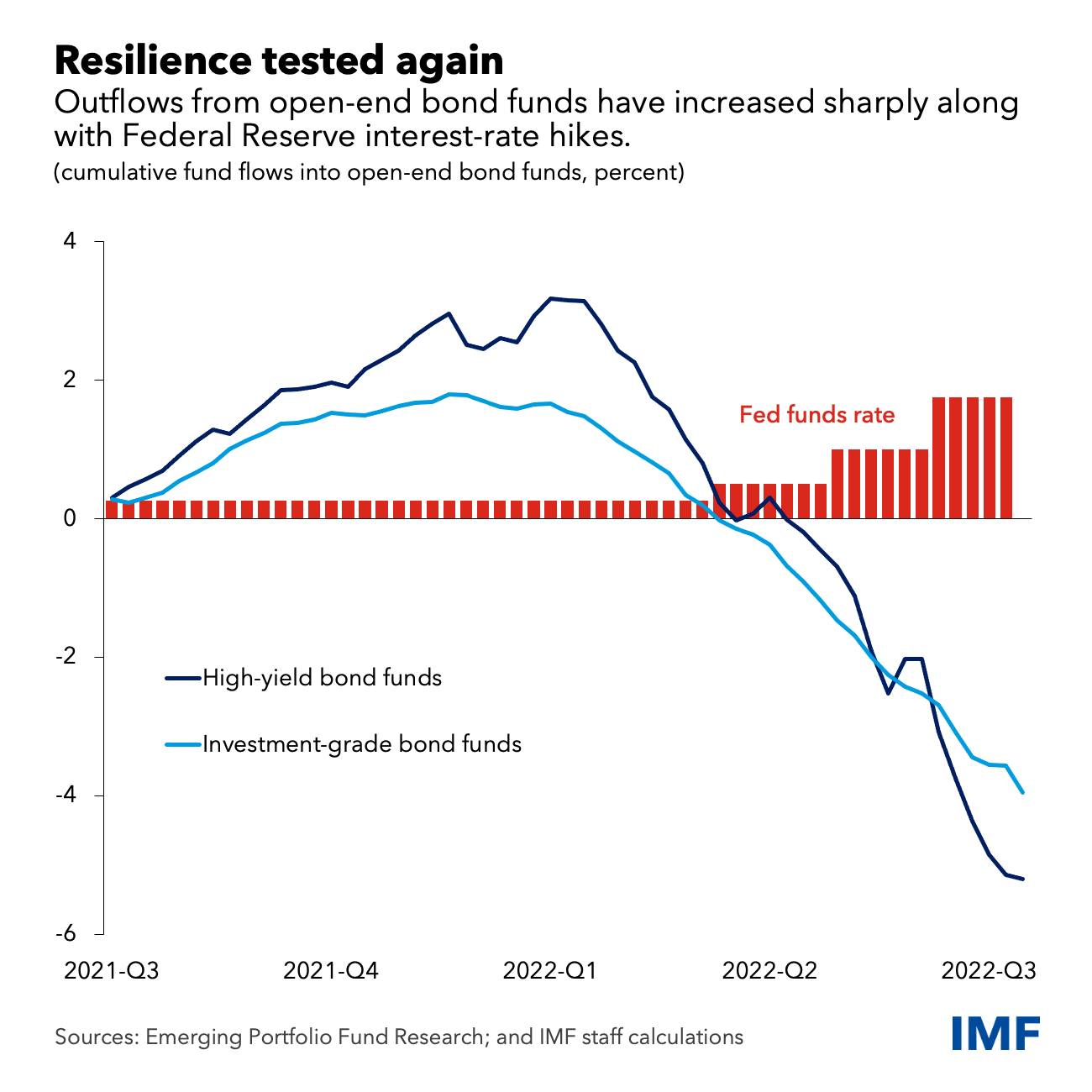
Right now, the pressures are rising as central bank tightening has triggered a surge of outflows from open-end bond funds.

Been Here Before

This is not a new problem, or one that has just suddenly become apparent, such as, say, UK and US pensions funds’ predilection for exotic derivatives. During the global financial crisis many open-end funds were upended by the liquidity mismatch deathtrap. They included a family of bond market funds marketed by the Charles Schwab Corporation as conservative alternatives to money market funds during the lead-up to the Global Financial Crisis. As my former WOLF STREET colleague Wolf Richter noted in a 2019 retrospective, they turned out to be anything but conservative:

The top 10 holdings, which is what investors could see listed, was the usual mix of Treasury securities and investment-grade corporate bonds, and some highly rated corporate paper. Beneath the skin, 45% of the funds’ holdings were mortgage backed securities (MBS), including many backed by subprime mortgages. Most of them were highly rated as well.

But smart investors in Schwab’s conservative-sounding open-end bond mutual fund kept their eyes on the markets. And when the tide turned in the housing market, they started paying attention, and then they saw that people were defaulting on mortgages, as home prices were dropping.

This was the first warning sign. These astute investors sold their shares of the fund back to Schwab and got their money out, after having earned the juicy yields for years. They had the “first-mover advantage” because what came after them turned into a nightmare for slow-poke investors.

As the waves of redemptions intensified and accelerated, Schwab sold off more and more of its liquid assets, until just about all that was left on its balance sheets were MBS. By that time the subprime crisis was in full swing, the mortgage meltdown was all over the media and the value of those MBS was in free fall:

From its $14 billion in assets in 2005, the fund dropped to $13 billion in May 2007, to $6.5 billion in January 2008, to $2.5 billion in March 2008, to $500 million in July 2008, to about $210 million in October 2009, by which time the fund had been shuttered.

As Wolf notes, investors in the funds who didn’t panic first, or at least early enough, ended up losing the lion’s share of their money:

Unlike the prices of stocks or bonds that investors hold outright, bond mutual funds that experience a run cannot recover because the fund is forced to sell the assets, and they’re gone, and when prices of those assets recover, someone else owns them and takes the gain. A run on the fund is a one-way event that is a permanent loss to fund holders.

In the aftermath, lawyers got rich on the ensuing legislation and hedge funds, distressed debt funds and others that bought the distressed MBS for cents on the dollar from the Schwab fund made a killing by selling them at face value to the Fed.

A Particularly British Problem

Today, broad sell-offs are once again rippling across the financial system as central banks hike rates and reverse their asset buying programs in a desperate (and probably vain) bid to tame inflation, which is largely being driven by supply chain factors. The recent mayhem in the UK’s gilt markets has triggered a rapid sell-down of higher risk assets by heavily levered pension funds as they scramble for cash to meet collateral demands…

Read the full article on Naked Capitalism

Pressure Rises on Von Der Leyen as Pfizer CEO Backs Out of Testifying to EU Parliament Covid Panel

“After von der Leyen’s silence, Bourla had the opportunity to set the record straight in the European Parliament, but he preferred to slip away. Why all these secrets? What do they have to hide from European citizens?” 

After an audit report into the European Commission’s COVID-19 vaccine procurement strategy uncovered serious procedural violations, an assortment of Big Pharma big cheeses were invited to give testimony to a European Parliament hearing. They included Pfizer CEO Albert Bourla. His testimony, scheduled for October 10, was supposed to shed light on the furtive contacts he had shared with European Commission President Ursula von der Leyen during preliminary negotiations for what would eventually become the EU’s biggest vaccine contract ever (at least to date).

No Questions Answered

But as Politico reported last Thursday, Bourla has pulled out of attending the hearing, for unspecified reasons. This is the sort of thing big pharma CEOs can do these days without paying a price or even attracting negative media attention — or in this case, any mainstream media attention beyond the Politico article. It is not enough that Bourla’s company enjoys immunity from liability (except for wilful misconduct) for the billions of vaccines it produced; Bourla apparently considers himself immune from having to defend those vaccines at potentially hostile public fora.

As the Politico article notes, Bourla was expected to face tough questioning over the secret vaccine deals he personally struck with von der Leyen (whose triple-barrelled surname will, for the sake of time, space and convenience, hereupon be abbreviated to VdL). That is something Bourla would rather avoid:

The head of the U.S. pharmaceutical giant, the largest supplier of COVID-19 vaccines to the EU, was scheduled to appear before the panel on October 10. The committee is meeting with key officials involved in the EU’s vaccine procurement process to draw lessons on how to respond to future pandemics. Other pharmaceutical executives have addressed the committee, including the CEO of Moderna and senior officials from AstraZeneca and Sanofi.

While it is true that the European Parliament does not have subpoena powers, particularly for non-EU citizens, Bourla’s backing out at the last minute is not a good look. At the very least, it reinforces the impression that Bourla and VdL have something important to hide from EU lawmakers and citizens.

Commission’s Biggest Procurement Deal Ever

One reason why this is important is that the purchase of COVID-19 vaccines for the entire 27-nation bloc was the European Commission’s biggest and most expensive procurement challenge ever, paid for entirely with public funds. And Pfizer was far and away the biggest provider of those vaccines, accounting for just over half of the 4.6 billion doses (the equivalent of 10 per EU citizen) procured from global pharmaceutical companies.

As a result of von der Leyen’s furtive communications with Pfizer, the Commission secured its third — and by far, largest — contract with Pfizer BioNTech. That contract allowed for the purchase of 900 million doses of the wild type vaccine and of a vaccine adapted to variants, as well as the option to purchase an additional 900 million doses. As the European Court of Auditors notes, it was “the biggest COVID-19 vaccine contract signed by the Commission and will dominate the EU’s vaccine portfolio until the end of 2023”.

Yet serious questions remain about how those vaccines were procured and under what conditions.

A recent report by the Court of Auditors into the EU’s vaccine procurement strategy found that VdL had directly participated in preliminary negotiations for the vaccine contract, which was concluded in May 2021. As Politico notes, “this was a departure from the negotiating procedure followed with other contracts, where a joint negotiating team made up of officials from the Commission and member countries conducted exploratory talks.”

Instead, von der Leyen conducted preliminary negotiations on her own, and presented the results to the steering board in April. A planned meeting of scientific advisers, organized to discuss the EU’s vaccine strategy for 2022, never took place. The VdL-headed Commission also refused to provide records of the discussions with Pfizer, either in the form of minutes, names of experts consulted, agreed terms, or other evidence.

“We asked the Commission to provide us with information on the preliminary negotiations for this agreement,” the report’s authors write. “However, none was forthcoming.”

VdL is also in hot water due to her refusal to disclose the content of her text messages with Bourla, despite repeated requests from MEPs and the EU’s ombudsman Emily O’Reilly.  When O’Reilly urged the Commission to undertake a more thorough search for the text messages in question, the Commission played for time before finally declaring that it cannot and does not need to find the text messages.

“Due to their short-lived and ephemeral nature,” text messages “in general do not contain important information relating to policies, activities and decisions of the Commission,” wrote European Vice Commissioner for Values and Transparency Vera Jourová.

What is perhaps most concerning is the glaring disregard the VdL-led Commission appears to hold even for its own basic standards of transparency and accountability. And that is entirely at odds with VdL’s public stance. In her Political Guidelines, VdL states that if “Europeans are to have faith in our Union, its institutions should be open and beyond reproach on ethics, transparency and integrity.” Yet when the Court of Auditors asked the Commission for information about the preliminary negotiations, they were snubbed.

“No information was transmitted,” the inspectors told the Berliner Morgenpost. Internally, the inspectors are stunned: “This behavior is highly unusual, it has never happened before”.

Given all of this and extrapolating from VdL’s own words, Europeans are quite right to be losing faith in the EU…

Read the full article on Naked Capitalism