Bank of England Chief Economist: Avoid Inflation Surge “Like the Plague”

“An upside surprise to inflation is among the greatest risks”; we’d need “to tighten policy even more rapidly or on a more significant scale, or possibly both, in a way that would take the legs out of the recovery.”

“The situation we need to avoid like the plague is one where inflation expectations adjust before we do, or where we wait for proof positive that effects on inflation are not transitory before acting,” said Bank of England chief economist Andy Haldane during the Treasury Select Committee this week. “Because in both of those cases that would be doing too little too late.”

It’s not everyday you hear a central banker of an advanced economy voicing concerns about runaway consumer price inflation. Most of the time, central bankers are doing everything they can to play down such fears. The current price increases, they say, are “transitory” or “temporary,” and as such nothing to worry about. Haldane disagrees:

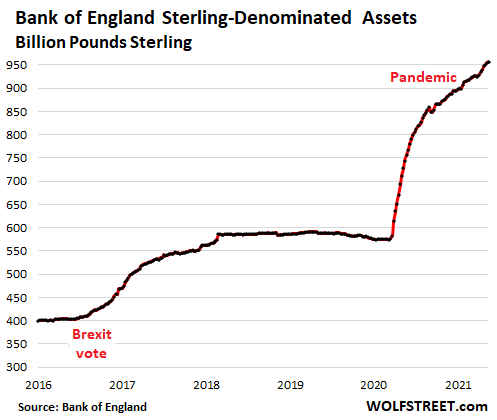
With interest rates at zero, “give or take”, and with the government and Bank of England injecting “unprecedented-in-peacetime fiscal and monetary stimulus” into the economy, Haldane believes that tapering the BoE’s bond purchases is not enough; it’s time to “turn off the tap,” he says. “This is serious money, edging up toward £1 trillion of QE.”
“It’s clear if you speak to businesses across the UK right now that among the top three issues is this pipeline of very significant cost rises. It’s hard to find very much, whether it’s goods or assets, that aren’t going up right now, with the honorable exception of Bitcoin.”

Haldane’s comments are also noteworthy given that consumer price inflation in the UK is not yet nearly as high as it is in the US and other economies. It more than doubled in April, mainly on the back of higher energy prices and clothing costs, but it still clocked in at just 1.5% in April, up from 0.7% in March — a lost less than the 4.2 % increase in the Consumer Price Index in the US.

Haldane won’t be chief economist and executive director of monetary analysis and statistics at the Bank of England for much longer. He is scheduled to leave the Bank in June, having taken up an offer to become chief executive of the Royal Society for Arts in September.

But before he leaves, Haldane is making a few waves. In the last meeting of the Monetary Policy Committee (MPC) Haldane was the only member to vote to lower the UK’s quantitative easing program by £50 billion, to £845 billion, citing inflation concerns. And that, it seems, has touched a few nerves. David Blanchflower, a former member of the MPC, said that while dissenting voices on the panel were important, Haldane was dissenting on the wrong side:

“He should not have been saying there’s going to be lots of inflation. There isn’t. Most of what he said was based on wild guesses and wishful thinking. It’s not what you’d expect from the chief economist, but what you might expect from a commentator on a news program.”

Unlike the Fed, the BoE doesn’t have an open-ended QE program, but has set a target of bringing its holdings of UK government bonds to £875 billion and its holdings of corporate bonds to £20 billion, for a combined target of £895 billion. And like the Bank of Canada, it has already begun to gradually taper its bond purchases, from £4.4 billion a week to £3.4 billion a week.

This stimulus, together with a host of other factors — including low inventories, supply chain shocks, rising shipping costs, surging demand for certain commodities and consumer goods in developed economies — is fueling inflation. Unlike most of his colleagues at the BoE, Haldane believes that inflation, now that it’s arrived, is unlikely to be transitory…

Continue reading the article on Wolf Street
How my Friend’s Small Hostel in Barcelona Survived

“It’s impossible to know how many of these shuttered hotels and hostel will reopen.”

“After hitting rock bottom, we finally appear to be turning the corner. At this rate, by the end of May we may even break even for the month, for the first time since March last year,” says Pol. He and his two partners own Hostal Live Barcelona, a small two-floor hostel in the center of Barcelona that was closed for 12 months, from March 2020 through February 2021.

“We have no idea when, if ever, we’ll be able to rent the rooms at the sort of prices we were charging in 2018. But for now at least the worst appears to be behind us — barring another cataclysm,” he said.

It was touch and go for a while. The only reason Hostal Live is still a going concern is that Pol and his two partners had capital to draw upon when the virus crisis hit. That capital was supposed to be used to expand the business. Instead much of it was used to keep the business alive:

“As our bank manager told is in March, the only reason we qualified for an emergency loan is that we had no debt on our books and we had savings backing us up, which we had planned to spend on buying another hostel,” he said. “We may still have that opportunity at some point further down the line. For the moment we are counting our blessings; many of our competitors didn’t make it this far.”

Pol and his partners also owe a debt of gratitude to the Spanish government’s furlough program, which has paid out 70% of their workers’ wages and most of their social security costs for 14 straight months. The workers are still on furlough though Pol and his partners are now covering the limited hours they’ve been working since the hostel reopened.

Another lifeline was provided by the landlord, who in the fall agreed to a 50% reduction in rent for six months. When that period came to an end, he agreed to extend the conditions for another six months.

Hostal Live finally reopened its doors, albeit to only one of its two floors, in early March. At that time Spain’s economy was still in partial lockdown, non-essential travel between regions was prohibited and a 10 o’clock curfew was still in place. And there were virtually no tourists at all in Barcelona.

“The timing may seem strange,” says Pol. “But we wanted to make some big changes to the hostel before properly reopening to foreign visitors. Most importantly, we wanted to install and test out a contactless key system so that our guests could access reception, their rooms and other hotel areas with their phones. This would help to minimize contact between guests and members of staff for as long as this pandemic lasts.”

But to fill its rooms at a time of almost zero tourism, Hostal Live had to offer historically low prices. In March, that meant charging an average price of €30 room per night, less than half the average price for a normal month of March. But the plan worked: people came to fill the rooms, albeit not from as far and wide as usual.

“With the exception of a few French tourists, almost all of the guests were Spanish. During the week we catered to workers who had come to Barcelona for the day and suddenly found themselves in need of a bed for the night. At the weekend we tended to attract young couples, often from the suburbs surrounding Barcelona, who had pleasure rather than business on their minds. By the end of the month we had achieved an occupancy rate of 15%.”

That may seem pitifully low but it was better than nothing, especially considering that most hotels in Spain were not even open…

Continue reading the article on Wolf Street
“I Don’t Know of a Bigger Story in the World” Right Now Than Ivermectin: NY Times Best-Selling Author

So why are journalists not covering it?

Michael Capuzzo, a New York Times best-selling author , has just published an article titled “The Drug That Cracked Covid”. The 15-page article chronicles the gargantuan struggle being waged by frontline doctors on all continents to get ivermectin approved as a Covid-19 treatment, as well as the tireless efforts by reporters, media outlets and social media companies to thwart them.

Because of ivermectin, Capuzzo says, there are “hundreds of thousands, actually millions, of people around the world, from Uttar Pradesh in India to Peru to Brazil, who are living and not dying.” Yet media outlets have done all they can to “debunk” the notion that ivermectin may serve as an effective, easily accessible and affordable treatment for Covid-19. They have parroted the arguments laid out by health regulators around the world that there just isn’t enough evidence to justify its use.

For his part, Capuzzo, as a reporter, “saw with [his] own eyes the other side [of the story]” that has gone unreported, of the many patients in the US whose lives have been saved by ivermectin and of five of the doctors that have led the battle to save lives around the world, Paul Marik, Umberto Meduri, José Iglesias, Pierre Kory and Joe Varon. These are all highly decorated doctors. Through their leadership of the Front Line COVID-19 Critical Care (FLCCC) Alliance, they have already enhanced our treatment of Covid-19 by discovering and promoting the use of Corticoid steroids against the virus. But their calls for ivermectin to also be used have met with a wall of resistance from healthcare regulators and a wall of silence from media outlets.

“I really wish the world could see both sides,” Capuzzo laments. But unfortunately most reporters are not interested in telling the other side of the story. Even if they were, their publishers would probably refuse to publish it.

That may explain why Capuzzo, a six-time Pulitzer-nominated journalist best known for his New York Times-bestselling nonfiction books Close to Shore and Murder Room, ended up publishing his article on ivermectin in Mountain Home, a monthly local magazine for the of the Pennsylvania mountains and New York Finger Lakes region, of which Capuzzo’s wife is the editor. It’s also the reason why I decided to dedicate today’s post to Capuzzo’s article. Put simply, as many people as possible –particularly journalists — need to read his story.

As Capuzzo himself says, “I don’t know of a bigger story in the world.”

Total News Blackout

On December 8 2020, FLCCC member Dr Pierre Kory gave nine minutes of impassioned testimony to the US Homeland Security Committee Meeting on the potent anti-viral, anti-inflammatory benefits of ivermectin. A total of 9 million people (myself included) saw the video on YouTube before it was taken down by YouTube’s owner, Google. As Capuzzo exhaustively lays out, both traditional and social media have gone to extraordinary lengths to keep people in the dark about ivermectin. So effective has this been that even in some of the countries that have benefited most from its use (such as Mexico and Argentina) many people are completely unaware of its existence. And this is no surprise given how little information is actually seeping out into the public arena.

A news blackout by the world’s leading media came down on Ivermectin like an iron curtain. Reporters who trumpeted the COVID-19 terror in India and Brazil didn’t report that Ivermectin was crushing the P-1 variant in the Brazilian rain forest and killing COVID-19 and all variants in India. That Ivermectin was saving tens of thousands of lives in South America wasn’t news, but mocking the continent’s peasants for taking horse paste was. Journalists denied the world knowledge of the most effective life-saving therapies in the pandemic, Kory said, especially among the elderly, people of color, and the poor, while wringing their hands at the tragedy of their disparate rates of death.

Three days after Kory’s testimony, an Associated Press “fact-check reporter” interviewed Kory “for twenty minutes in which I recounted all of the existing trials evidence (over fifteen randomized and multiple observational trials) all showing dramatic benefits of Ivermectin,” he said. Then she wrote: “AP’S ASSESSMENT: False. There’s no evidence Ivermectin has been proven a safe or effective treatment against COVID-19.” Like many critics, she didn’t explore the Ivermectin data or evidence in any detail, but merely dismissed its “insufficient evidence,” quoting instead the lack of a recommendation by the NIH or WHO. To describe the real evidence in any detail would put the AP and public health agencies in the difficult position of explaining how the lives of thousands of poor people in developing countries don’t count in these matters.

Not just in media but in social media, Ivermectin has inspired a strange new form of Western and pharmaceutical imperialism. On January 12, 2021, the Brazilian Ministry of Health tweeted to its 1.2 million followers not to wait with COVID-19 until it’s too late but “go to a Health Unit and request early treatment,” only to have Twitter take down the official public health pronouncement of the sovereign fifth largest nation in the world for “spreading misleading and potentially harmful information.” (Early treatment is code for Ivermectin.) On January 31, the Slovak Ministry of Health announced its decision on Facebook to allow use of Ivermectin, causing Facebook to take down that post and removed the entire page it was on, the Ivermectin for MDs Team, with 10,200 members from more than 100 countries.

In Argentina, Professor and doctor Hector Carvallo, whose prophylactic studies are renowned by other researchers, says all his scientific documentation for Ivermectin is quickly scrubbed from the Internet. “I am afraid,” he wrote to Marik and his colleagues, “we have affected the most sensitive organ on humans: the wallet…” As Kory’s testimony was climbing toward nine million views, YouTube, owned by Google, erased his official Senate testimony, saying it endangered the community. Kory’s biggest voice was silenced.

“The Most Powerful Entity on Earth”

Malcom X once called the media “the most powerful entity on the earth.” They have, he said, “the power to make the innocent guilty and to make the guilty innocent, and that’s power. Because they control the minds of masses”. Today, that power is now infused with the power of the world’s biggest tech and social media companies. Together social and traditional media have the power to make a medicine that has saved possibly millions of lives during the current pandemic disappear from the conversation. When it is covered, it’s almost always in a negative light. Some media organizations, including the NY Times, have even prefaced mention of the word “ivermectin” — a medicine that has done so much good over its 40-year lifespan that its creators were awarded the Nobel Prize for Medicine in 2015 — with the word “controversial.”

Undeterred, many front-line doctors have tried to persuade their respective health regulators of the unparalleled efficacy and safety of ivermectin as a covid treatment. They include Dr. Tess Lawrie, a prominent independent medical researcher who, as Capuzzo reports, evaluates the safety and efficacy of drugs for the WHO and the National Health Service to set international clinical practice guidelines:

“[She] read all twenty-seven of the Ivermectin studies Kory cited. The resulting evidence is consistent and unequivocal,” she announced, and sent a rapid meta-analysis, an epidemiolocal statistical multi-study review considered the highest form of medical evidence, to the director of the NHS, members of parliament, and a video to Prime Minister Boris Johnson with “the good news… that we now have solid evidence of an effective treatment for COVID-19…” and Ivermectin should immediately “be adopted globally and systematically for the prevention and treatment of COVID-19.”

Ignored by British leaders and media, Lawrie convened the day-long streaming BIRD conference—British Ivermectin Recommendation Development—with more than sixty researchers and doctors from the U.S., Canada, Mexico, England, Ireland, Belgium, Argentina, South Africa, Botswana, Nigeria, Australia, and Japan. They evaluated the drug using the full “evidence-to-decision framework” that is “the gold standard tool for developing clinical practice guidelines” used by the WHO, and reached the conclusion that Ivermectin should blanket the world.

“Most of all you can trust me because I am also a medical doctor, first and foremost,” Lawrie told the prime minster, “with a moral duty to help people, to do no harm, and to save lives. Please may we start saving lives now.” She heard nothing back.

Ivermectin’s benefits were also corroborated by Dr. Andrew Hill, a renowned University of Liverpool pharmacologist and independent medical researcher, and the senior World Health Organization/UNITAID investigator of potential treatments for COVID-19. Hill’s team of twenty-three researchers in twenty-three countries had reported that, after nine months of looking for a COVID-19 treatment and finding nothing but failures like Remdesivir— “we kissed a lot of frogs”— Ivermectin was the only thing that worked against COVID-19, and its safety and efficacy were astonishing—“blindingly positive,” Hill said, and “transformative.” Ivermectin, the WHO researcher concluded, reduced COVID-19 mortality by 81 percent.

Why All the Foot Dragging?

Yet most health regulators and governments continue to drag their feet. More evidence is needed, they say. All the while, doctors in most countries around the world have no early outpatient medicines to draw upon in their struggle against the worst pandemic in century. 

Continue reading on Naked Capitalism

More Bad Omens for Business Travel, As WEF Axes Tropical Davos and Mobile World Congress Suffers Wave of Cancellations

The cancellation of the World Economic Forum’s Singapore meeting and the gathering exodus of participants from the World Mobile Congress in Barcelona do not bode well for the near-term future of business travel.

When even Davos man, with all his material advantages, connections and privileges, doesn’t feel safe enough to gather with large numbers of his own kind, it’s probably safe to assume that a return to some semblance of a normality — even of the new variety — is a long way off for business travel. The event’s organizer, the World Economic Forum, has attracted notoriety over the past year for its modest plan to “reset” just about everything that exists on planet Earth, mainly for the benefit of its own corporate sponsors. But for now, as Covid rages across Asia, it’s unable to even hold a summer version of its annual conference in Singapore.

“Regretfully, the tragic circumstances unfolding across geographies, an uncertain travel outlook, differing speeds of vaccination rollout and the uncertainty around new variants combine to make it impossible to realise a global meeting with business, government and civil society leaders from all over the world at the scale which was planned,” the organization said in a statement. 

The event, whose theme was slated to be “The Great Reset”, had already been rescheduled twice and had been moved to Singapore from its traditional location of Davos, Switzerland. But Singapore is suffering another outbreak of Covid-19, which has forced the local government to close schools and postpone a long-anticipated air travel bubble with Hong Kong that was supposed to begin on May 26. Like Davos, the scheme has faced multiple delays from its initial launch date in November 2020. As a result, two of Asia’s biggest business remain cut off from each other for the foreseeable future.

Global Tech Giants Pull Out of Mobile World Congress, Again

In Europe, the organizer of the Mobile World Congress, the GSMA, insists that the show must go on even as many participants pull out. Scheduled for late June, the world’s biggest mobile trade fair has lost so many key exhibitors in recent weeks, including Samsung, Lenovo, Ericsson, Sony, Google, IBM, Nokia, Qualcomm and Oracle, that it’s now being dubbed the “zombie show”. Without these exhibitors, there’s not much of an exhibition. With a month and a half still to go, there’s time for more companies to drop out. 

The MWC has been an annual event in Barcelona since 2006. It is a key showcase for global tech giants and telcos. In 2019 it drew 110,000 attendees from almost 200 countries. That sprawling global reach, once considered a major attraction, makes the event a perfect melting pot for transmission of COVID-19. Last year’s event, scheduled to take place at the end of February, was one of the first big conferences to get cancelled as industry stalwarts pulled out at the last minute.

This year’s event features a much lower capacity (40,000 people) as well as safety measures such as mandatory PCR testing (every 72 hours), temperature controls and mandatory mask wearing. The GSMA has been positioning MWC as something of a hybrid event. But with so many exhibitors dropping out because of concerns over covid, it’s not clear what the in-person dimension will look like.

If the event is cancelled a second time, the world’s biggest tech firms and start-ups will miss out on another chance to showcase their latest products to their biggest customers on the largest stage. But that is nothing compared to the economic pain that awaits for companies in the travel and tourism sector.

Airlines and travel agents will lose out on yet more flights, tours, and other travel services. It could also be the final nail for some hotels and hostels in Barcelona. Many have been closed for the past 14 months. But they are still having to pay fixed costs such as rent and taxes while generating zero income. For those that stayed open after March 2020, revenues collapsed by roughly half for the remainder of the year.

In a normal year — which we’ve not had for a while — the MWC generates 14,000 temporary jobs and around half a billion euros, much of which ends up in the pockets of local taxi drivers, owners of bars, restaurants and hotels, prostitutes and their pimps and madams, Airbnb hosts, and the thousands of professional pickpockets that converge on the city for the four-day event.

That money has all dried up. And now businesses in the city just want some sign that international tourism will soon resume. Even a pale imitation of the normal event is better than nothing, says Pol, who owns two small hostels that have been closed since March 2020:

“Even if it goes ahead with just a third of the normal number of attendees, it might give a chance for the city to begin to get back on its feet. For us, it might mean being able to finally fill four or five of our beds. Right now, that’s about as much as we can hope for.”

No Recovery In Sight for Business Travel

As vaccination take-up increases across Europe and North America, leisure travel is beginning to pick up. To take advantage, countries like Spain, Italy and Portugal are quickly reopening their borders and reversing Covid-19 restrictions. For these countries tourism represents a huge chunk of the economy. And last year was a complete wipe-out, leaving thousands of businesses on the brink. In Spain tourist arrivals by air, land, and sea collapsed by 77% from 2019, according to the National Statistics Institute (INE).   

But there is no recovery in sight for business travel. And it’s business travel that is the most lucrative source of income for airlines, essentially subsidizing leisure travel’s lower fares. Airlines have already cut capacity drastically on business-travel routes.

Business conventions, conferences and other junkets were also huge money makers in the pre-pandemic era. In Germany and the UK they generated $123 billion and $92 billion respectively in 2017. That money has now run dry.

It is impossible to know how much of this activity will recover in the long term. In the short term the signs are not encouraging. Companies have discovered that it’s perfectly possible to service most existing clients remotely. And they are saving huge sums of money in the process. What’s more, many seasoned business travellers don’t exactly miss life on the road, or up in the sky.

“For a lot of people, frequent business travel has become more of a burden than a perk,” said Scott Cohen, a professor at the University of Surrey in England who studies business travel. 

Almost half of the executives surveyed by healthcare provider Bupa Global said they believed they had better mental health from travelling less. At least one in four intend to cease all time spent away from home for work this year. Obviously, some business travelers can’t wait to get back in the saddle. But the longer the pandemic remains a threat, the more businesses will be forced to seek alternatives. 

Continue reading on Naked Capitalism

Spiking Inflation, Rate Hikes, and Debt Defaults in Latin America

Mexico and Brazil, having seen the economic destruction that high inflation can wreak, don’t want to see it again.

Latin America will soon be hit by a wave of business bankruptcies and defaults, according to Jesús Urdangaray López, the CEO of CESCE, Spain’s biggest provider of export finance and insurance. CESCE insures companies, mainly from Spain, against the risk of their customers not paying due to bankruptcy or insolvency. It also manages export credit insurance on behalf of the Spanish State.

CESCE’s biggest clients are large Spanish companies with big operations in Latin America. For many of those companies, including Spain’s two largest banks, Grupo Santander and BBVA, Latin America is its biggest market. CESCE’s three biggest shareholders are the Spanish State and, yes, Spain’s two largest banks, Grupo Santander and BBVA.

BBVA, which is heavily invested in Argentina, warned about the worsening situation in the country. If Argentina’s economy continues its inflationary spiral, it could end up affecting BBVA’s overall performance and financial health, the Spanish bank said.

Argentina’s government is once again trying to restructure its foreign-currency debt with the IMF, having already defaulted on the debt once since the virus crisis began.

Ecuador was first to default on its foreign currency debt, followed by Argentina, then Surinam, Belize, and Surinam twice more — six sovereign defaults so far in 13 months.

Latin America has been hard hit by the virus crisis. But the region’s cash-strapped governments with weak currencies and surging inflation cannot afford to provide the sort of financial support programs being rolled out in more advanced economies. The fiscal response has added just 28 cents of extra deficit spending for every dollar of lost output. By contrast, governments of more advanced economies have boosted their spending by a dollar for every dollar of lost output. A few, such as those of the United States and Australia, have been significantly higher.

Such fiscal largess was never an option In Latin America. The result has been a massive slump in economic output. The region’s GDP shrank by 7% last year — the worst contraction of any region tracked by the IMF. In some countries, particularly those that are heavily dependent on tourism, it was far worse than that. Peru’s GDP, for instance, contracted by 11% while that of Mexico, the region’s second largest economy, tumbled by 8.5%.

Brazil shrank by just 4.1% last year, as public spending soared. But its debt ballooned. By the end of the year, government debt had reached 89% of GDP, over 30 percentage points higher than the regional average (55%). The Central Bank of Brazil’s decision at the start of the crisis to slash interest rates to 2%, their lowest level on record, helped support the economy.

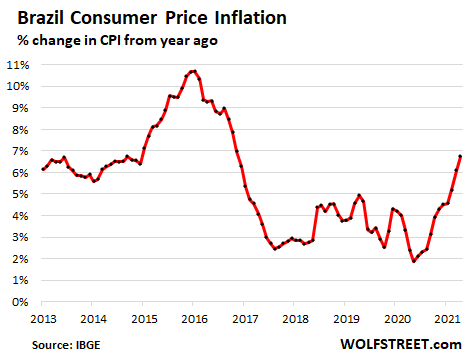
But it also stoked inflation. In April, consumer prices rose at an annual rate of 6.8%, the highest since 2016 and well beyond the central bank’s upper limit of 5.25%.

The central bank, in trying to tamp down on inflation, implemented a surprise shock-and-awe rate hike of 0.75 percentage points in March, and in May hiked its policy rate again by 0.75 percentage points to 3.5%, and at the time indicated that a similar rate hike would come in June. Rising rates are going to make it harder for businesses, consumers, and the government to service their debt obligations.

Inflation is rising more slowly in some Latin American countries (e.g. Peru, Chile, Bolivia) and more quickly in others, particularly in Argentina and Venezuela.

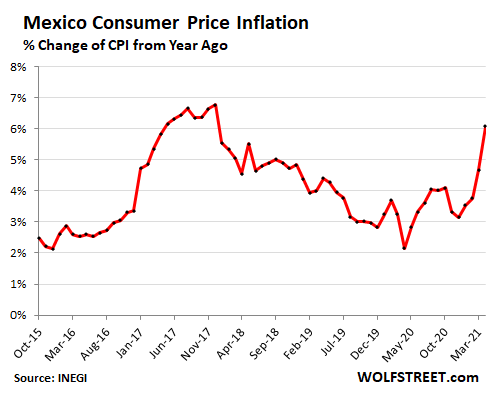
Mexico is also seeing a surge in consumer prices though the government adopted a more restrained fiscal response to the virus crisis. The Bank of Mexico cut its policy interest rate to 4% earlier this year, but that remains relatively high. Inflation spiked to 6.1% in April, double the central bank’s target rate.

The price of food is rising sharply. Corn prices have more than doubled since August last year. This has fueled higher prices for corn tortillas — the quintessential staple in Mexican diet and cuisine — which have reached their highest average level since 2017. One of the last times prices rose this fast, in 2006, it led to food riots.

Mexico, like Brazil, has seen the economic destruction that high inflation can wreak and it doesn’t want to see it again. If consumer prices continue to rise, the Bank of Mexico may have to begin hiking rates, which will make it even harder for the economy to emerge from its deepest recession since 1932…

Continue reading the article on Wolf Street
Bayer-Monsanto Fails (At First Attempt) to Block Mexico’s Phaseout of Glyphosate and Ban on GMO Corn

Mexico has already gone mano a mano with Monsanto before, and it came out on top. But this time it’s on a direct collision course with Big Ag and the U.S. government.

Life used to be a whole lot easier for German pharmaceutical and crop science company Bayer. But that was before it bought the scandal-tarnished US GMO giant Monsanto for $66 billion. That has turned out to be a very price indeed. Bayer itself is now worth just $53 billion — $13 billion less than what it paid for Monsanto in 2018. And it has faced tens of thousands of lawsuits claiming that Monsanto’s Roundup weed killer caused non-Hodgkin’s lymphoma.

The German company has agreed to pay as much as $11.5 billion to resolve existing US litigation. It has also proposed to pay a further $2 billion into a fund that would cover people who’ve been using Roundup but haven’t yet developed non-Hodgkin lymphoma, or just haven’t filed a lawsuit yet. But it also continues to reject claims that Roundup causes cancer even as new lawsuits pile up against it. And it wants to assemble its own panel of expert scientists — as opposed to an independent jury — to rule on the viability of those future claims, which is hardly in the interest of those filing the claims.

A Gathering Customer Exodus

As all this is going on, a growing list of countries, states and cities around the world are banning Roundup. They include Mexico, whose government issued a presidential decree on December 31 phasing out the use of the herbicide glyphosate, Roundup’s active ingredient, and banning the cultivation and importation of genetically modified (GM) corn. After pulling a few strings, Bayer was able to win a temporary reprieve from the government’s planned three-year phase out of the herbicide. But that decision has now been overturned by Mexico’s Collegiate Court.

Bayer insists there’s nothing wrong with the herbicide: “Glyphosate is safe and hundreds of scientific studies support that,” the company said in a recent statement, citing its more than four-decade track record in Mexico.

But Mexico’s Ministry of the Environment (Semarnat), formerly a strong advocate of GMOs, is  having none of it. The ministry already began restricting imports of glyphosate in 2019, citing the precautionary principle. Glyphosate, it says, has proven to be extremely harmful to both human health and the environment. It has also been classified as “probably carcinogenic to humans” by the World Health Organization (WHO). 

To justify its new import ban, Mexico’s government cites the threat of GMO products to human health as well as the risk of contamination of native corn varieties. But there’s another motive at work here: to advance the AMLO administration’s goal of achieving greater food self-sufficiency by promoting domestic corn production. And that puts it on direct collision course with Big Ag and the US government.

Taking On Monsanto, and Winning

The cultivation of GM corn in Mexico, even in field trials, has been prohibited in Mexico since 2013. This was the result of a suit brought by a collective of 53 scientists and 22 civil rights organizations and NGOs. This broad grassroots coalition sought to safeguard Mexico’s diversity and common ownership of corn. It’s a struggle that intensified as GMO oligopolies began pressuring governments across Latin America to introduce legislation that would apply brutally rigid intellectual copyright laws to the crop seeds that farmers are able to grow.

But in Manuel Zeleta, the coalition found a sympathetic — and seemingly incorruptible — judge. In his ruling he banned field trials of GMO corn, citing the potential risks they posed to the environment. If the biotech industry got its way, he argued, more than 7000 years of indigenous maize cultivation in Mexico would be endangered. The country’s 60 varieties of corn would be directly threatened by cross-pollination from transgenic strands.

Monsanto’s response was as swift as it was brutal. Not only did it – and its lackeys in the [Peña Nieto] government – appeal Zaleta’s ruling, it also demanded his removal from the bench for already stating his opinion on a case before sentencing. Targeting the form rather than the substance of Zaleta’s ruling, Monsanto, together with fellow GMO giants such as Syngenta and Dupont, launched at least 90 challenges, all to no avail. And to this day, commercial-scale planting of GMO corn seeds remains illegal in Mexico.

A Sacred Plant

In Mexico corn is far more than just a staple crop. For millenia it has played a vital role in the country’s culture, religions and economy. It was idiolized by the Aztecs and many other pre-Colombian civilizations. But now Mexico, the birthplace of modern corn, is dangerously dependent on international markets for its supplies.

But that is something the AMLO government wants to change. Through his presidential decree Andrés Manuel López Obrador (AMLO for short) doesn’t just want to eliminate the presence of GMOs in the Mexican diet; he also seeks to promote domestic corn production in order to achieve greater food self-sufficiency. He also wants to revitalize rural Mexico, which could help to address one of the root causes of Mexican migration to the US. 

Continue reading on Naked Capitalism

How the BoE & UK Government Stoke the Housing Fire

Mortgage applications spike to record, while 130,000 homeowners are on mortgage holidays, 500,000 on tailored payment plans, and over 1 million are in unmortgageable apartments due to the flammable cladding crisis.

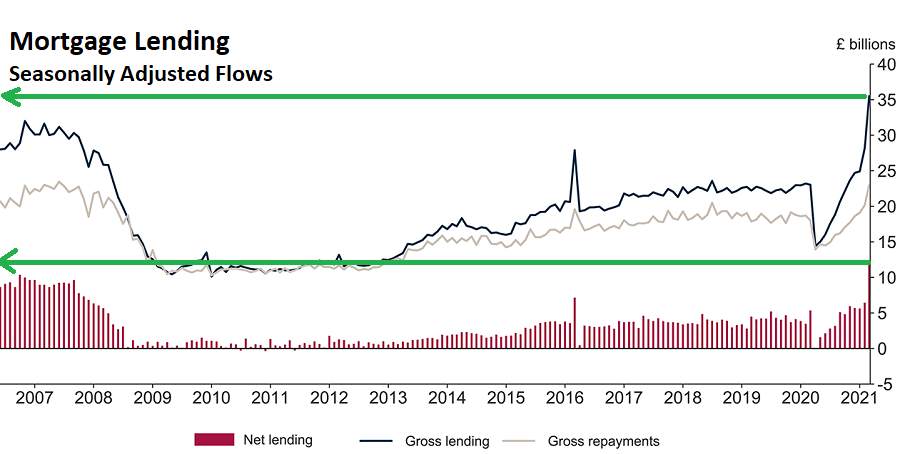
Net mortgage borrowing in the UK hit £11.8 billion in March, the strongest since the series began in 1993, according to Bank of England data. The previous peak was in October 2006 (£10.4 billion), when the UK was in the grip of the pre-financial crisis bubble. The difference between then and now is that back then the economy was about to fall off a cliff, whereas now it has already fallen off a cliff, having last year suffered its biggest drop in economic output in 300 years.

The UK’s biggest lender HSBC said it doled out more mortgages in March than in any other month of more than 40 years offering home loans.

There are plenty of reasons for this lending boom, including the ongoing exodus from the cities to the villages of rural England, even as London’s population is shrinking for the first time in 30 years, and rents have been falling for 13 straight months.

But home prices are also rising, albeit less steeply, in London and other major cities. In April 2021 Chestertons reported 65% more buyer enquiries in London, 75% more sales agreed and 90% more sales completed than in April 2019. These findings chime with HMRC’s latest figures, which show record transactions numbers in March across the UK – up 93% from 2019.

The most important reason for the surging volume of residential property transactions is the support provided by the Bank of England and UK government to property buyers and investors.

In mid-March 2020, as it grappled with the early fallout of the virus crisis, the BoE slashed the UK’s base interest rate from 0.75% to 0.25%, then a week later to 0.1%, the lowest ever. The rate cut was in response to the economic stress caused by the shutdown of the UK economy. And the falling mortgage rates have stoked demand for housing.

The government too has pursued policies aimed at inflating the housing market and propping up the mortgage lending industry. First, it introduced a stamp duty holiday that was supposed to end at the end of March but was extended at the last minute til the end of June. This has driven much of the recent surge in new mortgages.

Then, last month, the Chancellor announced the launch of new government-backed mortgages with 5% down-payments. If borrowers default on the mortgages, taxpayers, rather than the banks, will be on the hook.

Continue reading the article on Wolf Street

India Just Became Latest Country to Approve Use of Ivermectin to Treat Covid-19

There are now more than 20 countries on the planet that are using the off-patent anti-parasite drug against Covid-19. 

Doctors in India, the world’s second most populous country, are locked in an epic, gruesome battle against SARS Cov2. The country currently accounts for half of the world’s cases. Many cities are running out of hospital beds. As happened in Mexico and Brazil just a few months ago, medicinal Oxygen has become dangerously scarce and is being sold on the black market at extortionate prices. As of last week fewer than 10% of Indians had received even one dose of a vaccine. Just 1.6% are fully vaccinated, according to a New York Times database — even though India is producing two vaccines on its own soil and is home to the world’s biggest vaccine manufacturer.

This time around, India’s government has spectacularly failed to contain the spread of the disease, largely due to its own complacency. Many doctors are prescribing Remdesivir despite the medicine’s high cost and lackluster performance in clinical studies and unproven safety record. There has been a surge in black market sales of the drug as people have rushed to try to secure it, leading to a crunch in its supply. A single vial can go for Rs30,000 — ten times the official retail price.

Desperate Times, Desperate Measures

As Jerri Lynn reported on Sunday, the huge uncontrolled wave of infections hitting India is having all sorts of implications for the Modi government. In its desperation to regain control of the virus, India’s government quietly changed its treatment guidelines last week. The new guidelines include the option of prescribing two repurposed medicines for mild Covid patients: budesonid and ivermectin. The former is an inhaled steroid that has been shown to reduce the time to recovery and need for urgent medical care. The latter is an off-patent anti-parasitic that has been discovered to have powerful anti-viral and anti-inflammatory properties. 

India is no stranger to ivermectin. The medicine has been used as an anti-parasitic for decades. It has also been used in the fight against malaria. Two of its regions, Uttar Pradesh (population: 230 million) and Bihar, have been using the medicine since August, to dramatic effect. By the end of 2020, Uttar Pradesh (UP) — which distributed free ivermectin for home care — had the second-lowest fatality rate in India at 0.26 per 100,000 residents. Only the state of Bihar, with 128 million residents, had less.

But Uttar Pradesh (UP) did more than treat 300,000 mild cases at home through 2020; it also used ivermectin as a prophylaxis. COVID response teams began taking the drug and hardly any of them caught the illness. A similar occurrence was reported in a study of frontline critical care workers in Argentina. U.P. then had contacts of COVID patients take it, with similar success. “Recognizing the sense of urgency,” Amit Mohan Prasad, a U.P. health official, wrote in a Dec. 30 article, “we decided to go ahead.”

Yet UP’s remarkable success at bringing the virus under control did not inform national policy — at least not until now. The Indian Council of Medical Research declined in October to recommend ivermectin nationwide, citing, like so many health regulators, the need for more data. But all that changed last week as India became the biggest country on the planet to adopt nationwide use of ivermectin against Covid-19.

A Growing List of Countries…

More than 20 countries are now using ivermectin to treat Covid-19 to one degree or another, with promising results, despite the fact the World Health Organization has not approved its use. They include Mexico, Guatemala, Argentina, Brazil, Bolivia, Slovakia, the Czech Republic, Portugal, Nigeria, South Africa and Egypt.  

Ivermectin has a known safety profile, as a well-tolerated life-saving drug that has been prescribed almost four billion times since the 1980s. In 2015 its creators won the Nobel Prize for Medicine (for more information read my previous article, It’s Time to Talk About Ivermectin).

Large “natural experiments” in regions and countries across Latin America and elsewhere add further weight to claims about ivermectin’s purported efficacy. In many of the places it has been used, case numbers, hospitalizations and fatalities have tended to fall in relatively short order. Of course, there’s no way of definitively proving that these rapid falloffs are due to the use of ivermectin. Correlation, as we well know, is not causation. But a clear pattern has formed that strongly supports its purported efficacy. And it’s not just regions but entire countries that now appear to be benefiting from its anti-viral and anti-inflammatory properties.

Continue reading on Naked Capitalism