Turkey in 2nd Currency Crisis in 2 Years. Lira Hits Record Low

Foreign investors are fleeing, worried about surging inflation, deeply negative real interest rates, and a central bank unwilling to crack down on inflation.

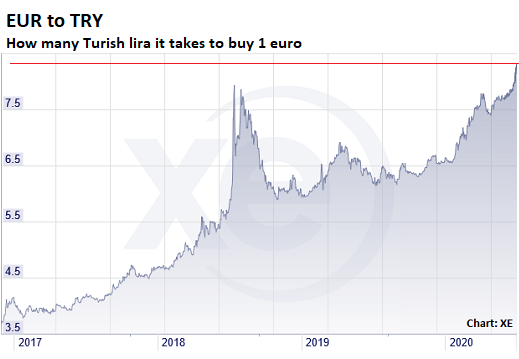
The Central Bank of the Republic of Turkey (CBRT) has burned through tens of billions of dollars of increasingly scarce foreign-exchange reserves trying to prop up the lira. It has also borrowed vast sums of foreign currencies from domestic banks and then sold those currencies to buy lira. But to no avail. The Turkish lira is plumbing depths it’s never seen before. This week, it sank to a record low of 8.30 lira to the euro and closed on Friday at 8.25. This three year chart also shows the currency crisis in August-September 2018:
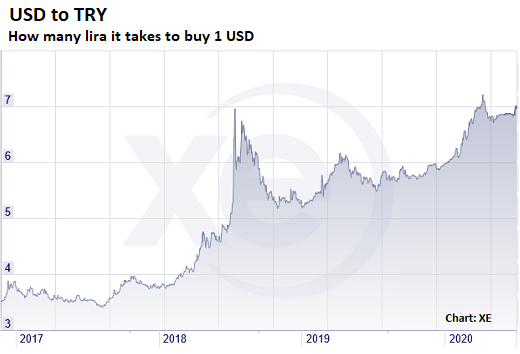
In terms of the dollar, the lira had hit a record low on May 8, at 7.2 lira to the dollar. Then the dollar spiraled into a sharp decline against a basket of other currencies. And the TRY found some relief against the dollar. But that ended early this week, when the lira started falling against the dollar as well, even as the dollar was falling against other currencies — to close on Friday at 7.0 TRY to the USD — stirring fears that Turkey could be on the cusp of yet another debt crisis, just two years after the last one.
A Bleaker Panorama.

Today, Turkey faces a bleaker panorama than it did two years ago. The economy is weaker today than it was then, having already been through one crisis in 2018. Now, the virus crisis has wiped out a big chunk of the nation’s revenue from tourism and exports while the plunging lira is making it hard, once again, for companies and the government to service their foreign-denominated debts, which in April still accounted for 37% of the total debt owed by Turkish borrowers.

This preponderance of foreign-denominated debt in Turkey is a huge risk for banks based in the country, warns S&P. Some of these banks are owned by European banks.

The CBRT, after burning through scarce foreign-exchange reserves to prop up the lira, has another option to try to prop up the lira: raising the benchmark interest rate.

But that is anathema to Turkey’s president Recep Tayyip Erdogan, whose post-2018-crisis plan all along was to reanimate the economy by recreating the exact same debt-fueled consumer and construction booms that paved the way to the last crisis. The CBRT’s former governor, Murat Cetinkaya, tried to hike rates anyway and was sacked for it by Erdogan in July 2019 and replaced with his deputy, who spent the next nine months slashing Turkey’s benchmark rate — to 8.25%.

Back in 2018, Turkey’s consumer price inflation had surpassed 25%, which in part triggered the currency crisis. And to combat it, the CBRT had raised interest rates, which brought inflation back down, and in mid-2019 inflation was back to about 8%. But since then, inflation started storming higher and hit 12.6% in June!

Continue reading the article on Wolf Street

Confession Time for Big Banks in Europe: Banco Santander Reports $12.7 Billion Loss

Too-Big-To-Fail Santander is also one of the Eurozone’s worst capitalized banks.

Banco Santander, Spain’s largest lender and one of the Eurozone’s eight global systemically important banks (G-SIBs), has posted its first ever loss in 163 years of operations. And it was gargantuan. During the first half of the year, the bank racked up a loss of €10.8 billion ($12.7 billion).

The loss was caused by heavy provisions for expected loan losses. This quarter wiped out the equivalent of one-and-a-half years of the bank’s global profits — in 2019, it posted total global profits of €6.5 billion, and in 2018 of €7.8 billion.

The losses were the result of a €2.5 billion charge related to the recoverability of tax deferred assets as well a €10.1 billion write-down on assets across a number of key overseas markets:

  • In the UK: €6.1 billion write-down of “goodwill” — amount overpaid for prior acquisitions, which included Abbey National and Alliance and Leicester. Santander already took a €1.5 billion write-down on the value of its UK business last year, blaming new regulations and the expected economic fallout from Brexit.
  • In the US: €2.3 billion write-down for Santander Consumer USA, which specializes in consumer lending, particularly subprime lending, and these consumer loans are now particularly at risk.
  • In Poland, its largest market in Eastern Europe: €1.2 billion goodwill impairments charge.
  • In its consumer finance division, which is present in 15 markets: €477 million hit.

Santander’s shares initially reacted to the news by slumping 5.8%. They then staged a partial recovery, only to slump again, ending the day down nearly 5%. Shares are down an eye-watering 45% this year, making it one of the continent’s worst-performing large financial institutions.

“The past six months have been among the most challenging in our history,” Santander’s Chairwoman Ana Botin said in a statement. “The impact of the pandemic has tested us all.”

Santander isn’t the only major Spanish bank to have reported unprecedented losses since the virus crisis began. In April, BBVA, Spain’s second largest bank, reported its worst ever quarterly loss, amounting to €1.8 billion, after the bank took a €2.1 billion write-down in the United States. In Mexico, its biggest market, BBVA’s profits also plunged 40%. The bank also faces risks in another major market, Turkey.

Santander and BBVA are more exposed to the emerging markets of Latin America than any other global banks. Those markets have provided bumper profits for both lenders since the last crisis. But in the second quarter, Santander Brasil’s earnings fell 41% to $353 million after the bank set aside €530 million to cover potential coronavirus-related loan losses.

Latin America is currently on the front line of the coronavirus pandemic, having recently surpassed 4.4 million infections. This is putting strains on the economies of countries that have neither the fiscal firepower nor monetary leeway to protect businesses and jobs in the same way that has happened in Europe. The major risk is that the region’s rising bankruptcies, surging unemployment and sharply contracting economies could spark another debt crisis. If that were to happen, Spain’s two largest banks’ outsized exposure to the region could serve as a source of contagion into Europe.

Continue reading the article on Wolf Street
A Midsummer Nightmare for Tourism: UK, Other Countries Impose Quarantine Requirements on Returnees from Spain as Virus Cases Surge

Fresh Tsunami of Cancellations Washes Over Tourism-Dependent Spain amid Fears Borders Will Slam Shut Again.

The UK government this weekend delivered a hammer blow to Spain’s already battered tourism industry. On Saturday night — just two weeks after the government had dropped its two-week quarantine for travelers arriving or returning from a bevvy of European countries, including Spain — it backtracked once again: from midnight that night, it announced that all travelers arriving from Spain, where Covid cases are once again spiking, will face a 14-day quarantine.

On Tuesday morning, the UK changed policy once again. Travelers arriving from high-risk countries such as Spain will be tested for Covid eight days after they land. If they test negative, they will be able to come out of isolation two days later. If they test positive, they will have to remain in quarantine for the whole two weeks.

The quarantine rules are a nightmare for the approximately 1.8 million British holidaymakers either currently in Spain or about to go. Those already in the country now have to go through the rigmarole of informing their employers — assuming they still have one — that they will not be able to come back to work for between 10 to 14 additional days. They will also have to cancel any social engagements they had planned for the post-vacation period.

British tourists accounted for just over one in five of the 83 million visitors to Spain in 2019. Now, many of the tourists who were planning to come this summer will be staying at home or going elsewhere. Aside from reinstating the quarantine for arrivals from Spain, the UK government has also advised citizens to avoid all non-essential travel, not just to mainland Spain but also to its island archipelagos, which is likely to trigger a fresh tsunami of cancellations. The UK’s largest tour operator, TUI, has already axed all holidays to mainland Spain for the next two weeks.

That’s bad news, not just for Spain but for the whole of Europe. The sharp resurgence of Covid cases in Spain deals a heavy blow to any lingering hopes that the spread of the virus might be contained until at least Autumn, allowing tourism-dependent countries like Spain, Italy, France and Greece, to at least salvage something from the Summer tourist season. The UK has warned that it stands ready to apply similar “handbrake restrictions” to other countries in order to stop the spread of coronavirus.

Continue reading the article on Wolf Street
Coca-Cola Confronted by Big Problem in its Second Largest Market. For Once, Political Connections Failed. Oct 1 is the Date.

Per-person consumption of soft drinks in Mexico is the highest in the world. But due to link of obesity to Covid deaths, sugary drinks now face their nemesis.

When billions of people are forced to hunker down at home for months on end, unable to visit their favorite restaurants, bars, nightclubs, theme parks or other leisure venues, they tend to drink fewer soft drinks, as the Coca-Cola Company can attest. In the second quarter, when roughly a third of the world population was put through some form of lockdown, the company’s global revenues slumped 28% year-over-year, to $7.2 billion. It was its largest drop in quarterly revenue in more than 30 years.

By contrast, in Mexico, Coca Cola’s second largest global market after the U.S., sales fell by only 5%. That relatively modest decline was caused by the slumping business at restaurants and at street food stalls, where Coke is the ubiquitous (and invariably cheapest) beverage of choice for washing down tacos, tortas, tamales and the like. Many construction and other manual workers — a key customer segment — have been temporarily laid off since the country’s semi-lockdown began. But apparently, many of those folks bought their coke at the store and drank it at home.

On a per-person basis, Mexico consumes more Coke than any other country in the world, and twice as much as the U.S.

Loving Coca-Cola (a Little Bit Less)

Mexico is also home to independent bottler Coca-Cola FEMSA, which bottles and distributes Coca-Cola and other soft drinks across vast swathes of Latin America, including half of Mexico (and also in the Philippines). Roughly one out of ten of all Coca-Cola products sold in the world is distributed by Coca-Cola FEMSA, making it the second largest Coca-Cola bottler in the world, after Coca-Cola Enterprises.

Business is down. In the second quarter, Coca-Cola FEMSA revenues fell 10.2%. But in Mexico, Coca Cola FEMSA’s revenues fell only 5.6%.

There’s also Arca Continental, which manufactures and distributes Coca-Cola beverages and other products in Northern and Western Mexico, Ecuador, Peru, Northern Argentina, and Southwestern United States. It is the second-largest Coca-Cola bottler in Latin America. Net sales rose 2.3%. So they’re hanging on during the pandemic in Mexico.

The New Threat on the Horizon

But for the Coca-Cola Company, and for the bottlers, fast approaching on the horizon is a threat that could exact a significant long-term toll on sales in Mexico…

Continue reading the article on Wolf Street

Work-from-Home Unleashes Nightmare for Office Landlords & Surrounding Businesses. Global Banks at the Forefront

“There will be a long-term adjustment in how we think about our location strategy…the notion of putting 7,000 people in a building may be a thing of the past”: Barclays CEO. And companies are following through.

This appears to be an increasingly global phenomenon. Roughly 60% of bank executives in the US said they don’t expect all of their employees to return to the office. And over 40% said they plan to reduce their real estate footprint in response to the coronavirus pandemic, according to a survey of US bank executives by Accenture Plc.

Some banks are already making long-term changes. In Midtown Manhattan, French megabank BNP Paribas renewed its lease at the 787 Seventh Avenue tower. But it shrank its footprint by 38%: According to the Commercial Observer, instead of renewing the lease for the 454,200 it currently occupies at the building, it signed a lease for only 280,000 square feet.

In London, large financial institutions are the biggest tenants of the toniest commercial real estate. And they are now seriously reevaluating not only how much workspace they require but what sort of form it should take. Even allowing for physical distancing measures, such as the separation of desks, most companies now have a lot more office space than they think they’ll need, especially if they end up laying off large numbers of workers when the government’s job retention scheme comes to an end, which is scheduled to happen in September.

Goldman Sachs and Nomura said over the weekend that they plan to send only 10% of their UK workforce back to their City of London offices.

Last week, the 30 biggest employers in the City of London said they only intend to bring 20-40% of their workforce back in the coming months.

One of the UK’s “Big Four” banks, RBS (which was renamed “Natwest” today in yet another re-branding exercise for the scandal-tarnished lender) announced that close to 50,000 of its 63,000 workers will continue working from home, at least for the rest of this year.

“Like we’ve done throughout the pandemic the decision has been made carefully, including considering the latest guidance from the UK Government on Friday and our own health and safety standards and procedures,” said a spokesman for RBS. “It’s a cautious approach but we feel the right one to take currently.”

“Work from home if you can.” That was the blanket message the UK government sent out to all non-essential workers during the darkest days of the Covid-induced lockdown. Now that the lockdown is easing, the government is frantically trying to reverse the trend toward working from home, which it itself set in motion and which is unleashing myriad negative impacts across the economy. It has even relaxed the safe distance rules from two meters to “one-meter plus.”

That the British government can’t even persuade RBS — which is still 63% owned by the British State following the bailout during the Financial Crisis — to get its workers back into the office does not augur well for its efforts to halt or reverse the trend toward home working.

Continue reading the article on Wolf Street

Streets and Plazas in Barcelona Still Eerily Quiet as Covid-Chaos Upends Tourism

“Everybody’s drinking beer as if there were no tomorrow, but my bar can barely survive off beer sales alone,” says Yahya, owner of one of my favorite bars.

Tourists from the EU’s Schengen countries could begin arriving in Spain from June 21 and Spain’s borders were officially opened on July 1. Since then, international visitors have begun returning, in drips and drabs. Most people are loath to fly or travel far from home, in case there are fresh outbreaks or new lockdowns. To compound matters, people from over 100 non-European countries are still banned from traveling to the EU.

In Barcelona, the streets and plazas are still eerily quiet. On Friday, my wife, mother-in-law, and I had dinner on a friend’s roof terrace overlooking the mid-section of the Ramblas where the Miró painting is — the exact spot where the truck that mowed down scores of pedestrians in the August 2017 terrorist attack finally stopped. When we arrived, at 8:30, the iconic street, which is normally heaving with tourists, was quieter than normal. By midnight (as you can see in the photo below), it was almost empty. An hour later, as we flagged down a taxi to take us home, there were more beer vendors, prostitutes, drug dealers and pickpockets lining the street than there were punters.

In a July 3 article, Der Spiegel described Majorca as a “ghost island.” Long accustomed to being swamped by German, British and other European tourists in the hot summer months, the island is an “oasis of calm”, the article says. It’s a “long awaited dream for some” and “a nightmare for others.”

It was a stark reminder of just how punishing a reality the so-called “New Normal” is for those who carve out a living in the informal economy. But it’s not that much better in the formal economy. Just 60 of Barcelona’s 440 hotels are open with occupancy between 15% and 20%, compared to over 80% in a normal July.

In 2019, Spain received a record 83.7 million international visitors. This year, according to Expansión, Spain will be lucky to receive 30 million.

In a delicious irony, many Airbnb hosts are desperately trying to rent out their over-priced tourist apartments or rooms to the same local residents they’ve been helping to price out of the market for the last few years. They’re not having much success. In most cases, the rents on offer are insanely high.

In one particularly egregious case, a six square-meter windowless bedroom was initially offered to rent for over €2,000. When there were no takers, the price was dropped to €1,300. Still no takers. It’s now being offered at €650, which is still insultingly high for what you get.

In the absence of tourists, most bars, restaurants and cafes are operating at around 50% capacity. Twenty percent of bars in Spain have still not reopened.

Continue reading the article on Wolf Street

What Happens If Most Businesses & Consumers Tighten Their Belts at the Same Time?

Europe may be about to find out. 128 days with my Mother-in-Law.

As market players cling to the hope that a V-shaped economic recovery is still possible in Europe, to match the central-bank engineered rebounds of benchmark indexes such as Germany’s DAX and the Netherlands’ AEX, the reality on the ground continues to get worse for many families and businesses. On Tuesday, the Bank of Italy published the findings of a survey of Italian households on the impact of the lockdown. As you’d expect, most of the findings were pretty bleak:

  • More than half of the respondents said they have suffered a contraction of household income following the measures adopted to contain the epidemic.
  • Fifteen percent of households have lost more than half their income.
  • Some 40% of families are struggling to keep up with their mortgage payments.
  • More than half of the survey’s respondents believe that even when the epidemic is over, they will spend less on travel, holidays, restaurants, cinema and theaters than they did before the crisis.

No V-Shaped Recovery.

For most of these people, there will be no V-shaped recovery. Not only are they spending less money today, they expect to spend less tomorrow. While it’s true that people often say all kinds of stuff in surveys about how they will act in the future and then not stick to it, this particular response chimes with my own experience as well as the accounts I’ve heard from friends and acquaintances in countries as far and wide as Spain (where I live), the UK (where I’m from), Mexico (where my wife is from), France, Argentina and the U.S.

It is also broadly supported by central bank data, which confirms that the Covid-19 outbreak set in motion a synchronized global consumer deleveraging. Even after the lockdowns were lifted, many people are frantically saving for the next rainy day, despite the fact that interest rates have been driven to unprecedented lows.

In the UK, where the Bank of England has slashed the benchmark rate to 0.1%, the lowest on record, there was a £4.6 billion net repayment of consumer debt in May while deposits held by households, non-financial businesses, and financial businesses rose by £52 billion, following large increases in March and April.

For most people who’ve suffered a big hit to their income during the crisis, saving is not an option. In the UK, over a third of adults have had to eat into their savings to support themselves during the lockdown. They’re also cutting back on their expenses.

I can empathize. As a freelance worker in Barcelona, I’ve lost three of my main clients (out of six) since March, wiping out 30% of my income. My wife is one of the 1.7 million furloughed workers in Spain that are receiving 70% of their pre-crisis income from the government while wondering whether they will have a job to go back to when the furlough program ends, which is scheduled to occur in September. At that point many businesses will have to lay off some or all of their workers. That’s when the real pain will begin…

Continue reading the article on Wolf Street

As the Biggest Restaurant Chains in the UK Fall into Bankruptcy, Attention Turns to KKR & Other PE Firms that Own Them

PE firms sit on lots of cash but won’t invest it in their stripped-bare and failing restaurant chains.

After more than three months of not being able to serve either food or drinks, KKR-owned Casual Dining Group (CDG), one of the UK’s largest restaurant groups, collapsed into administration, a form of bankruptcy under UK law, on Thursday. The company, which owns the Bella Italia, Café Rouge and Las Iguanas restaurant chains, said it plans to shut 91 of its 250 outlets and cut 1,900 jobs. Bella Italia and Café Rouge are the worst hit, with 35 and 32 closures, respectively.

Like many restaurant groups, CDG was already struggling before the arrival of Covid-19 prompted the UK government to shut down all non-essential businesses in late March. Between June 2018 and June 2019 alone, more than 1,400 UK restaurants closed – the result of overcapacity in the sector, weak consumer confidence, and rising costs.

CDG is also no stranger to restructuring processes. In 2014, it entered a company voluntary arrangement (CVA), an insolvency procedure that allowed it to restructure its debt. Four years later, the company changed hands from private equity firm Apollo Management to private equity firms KKR and Pemberton Capital Advisors in a £150 million debt-for-equity swap.

Now, having fallen into administration once again, just two days before restaurants in the UK were finally allowed to reopen, albeit under severe restrictions that will make it even harder to turn a profit, CDG is on the lookout for a new owner, or owners. It has reportedly begun negotiations with “a number of potential buyers,” including European PE firm Aurelius Equity Opportunities, which has offered to buy up Café Rouge and Bella Italia. CDG’s other main asset, the Mexican-themed Las Iguanas chain, has apparently piqued the interest of UK-based PE firm Endless.

CDG is not the only UK restaurant group to have hit hard times in the wake of the lockdown. Chains including Carluccio’s and Chiquito have already hit the wall, leading to thousands of job losses. Chiquito’s owner, The Restaurant Group (TRC), was, until recently, the UK’s largest restaurant operator, with over 300 restaurants, including the Italian-themed chain Frankie and Benny’s and the pan-Asian chain Wagamama. Around a week ago, TRC also went into administration, announcing plans to close down 125 of its sites and lay off 3,000 workers.

Burger chain Byron has also appointed administrators and is seeking a new buyer. It if fails in that task, up to 1,200 jobs could be at risk. The Azzurri Group, which operates the Ask Italian, Zizzi and Coco di Mama brands and is owned by European PE firm Bridgepoint Capital, is also looking for a new owner. Other groups such as Prezzo, Wahaca and Wasabi have hired advisers to explore ways of keeping their businesses alive. Like CDG, many of them are hoping that a PE firm will swoop in at the last minute with an offer.

But a lot of PE firms are already nursing big losses from their own recent incursions into the UK’s casual dining sector. Since 2014, PE firms have splashed £10.4 billion on 132 deals in the UK’s restaurant and bar sectors, according to data from PitchBook. Now, many of them are lumbered with assets that are losing value fast due to the lockdown and the uncertain future facing the restaurant sector as a whole.

Continue reading the article on Wolf Street

UK House Prices in June Fall for First Time Since 2012, Mortgage Approvals Slump to Record Low Despite Reopening

Still waiting for the “Pent-up Demand.”

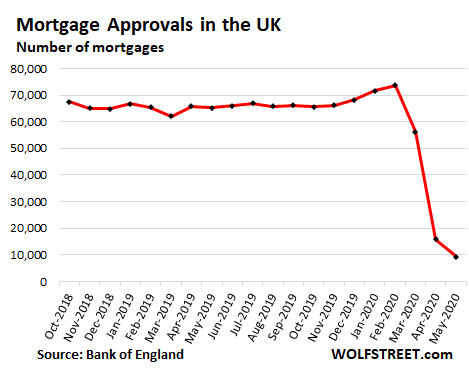
Tentative hopes that the UK’s housing market would stage a swift recovery in June, the first full month of market trading since the lockdown began on March 26, were dimmed by the Bank of England’s latest release of mortgage approval data. Approvals of mortgages to purchase a home tumbled to 9,300 in May, their lowest level on record, from an already unprecedented low of 15,851 in April. They were about 60% below the low point during the Financial Crisis and were down 87% from February, the last month of normal economic activity.

Economists polled by Reuters had expected mortgage approvals to rise to 25,000 in May as interested buyers flooded back into the market. But that didn’t happen.

Mortgage approvals are a forward-looking measure for home sales, due to the lag between the approval of a mortgage and the closing of a home sale, suggesting that home sales in June could slow further still, despite any the pent-up demand.

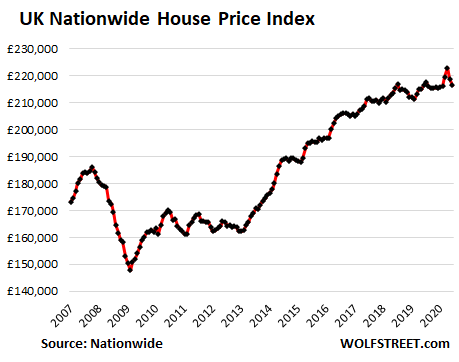
Pricing in June already bent under pressure. House prices in June fell 1.4% from May, seasonally adjusted, after having dropped 1.7% in May from April, according to the Nationwide House Price Index this morning. The index, at £216,403, was down 0.1% compared to June last year, the first year over year decline since 2012, the tail end of the housing bust.

House sales volume, which had collapsed to a historic low in April, rose by 16% in May from April, largely as a result of the lifting of housing market restrictions in England on May 13, according to provisional figures published by HM Revenue and Customs (HMRC). But at 48,450 residential property transactions, sales were still down by 49.6% year-over-year.

Continue reading the article on Wolf Street