Automakers’ Finance Divisions Lobby BoE & UK Gov for Bailout. Auto Sales Collapse 97%, Consumers Apply for Payment Holiday

But auto sales had already dropped three years in a row — before Covid.

The finance divisions of automakers, which dominate the UK’s auto finance sector, could soon be in trouble, and the industry lobby is now badgering the government and the Bank of England for a bailout. Some 480,000 drivers have already applied for a three-month payment holiday on their car loan, reports the Finance and Leasing Association (FLA), which adds, “The FLA urges the Government and Bank of England to open up financial support schemes to all lenders, including non-banks, so that they can meet the significant current demand for forbearance and provide new lending when the economy re-opens.”

In April, new vehicle sales collapsed by 97% year-over-year, after having plunged by 42% in March, according to the Society of Motor Manufacturers and Traders (SMMT). Unlike in the U.S., British car dealerships are not considered by the government to be essential businesses and had to close during the lockdown that started in late March.

But UK auto sales already declined in the three years before Covid-19. By 2019 sales were down 14% from 2016. For the first four months of 2020, sales are down 43% according to SMMT. Given another 97% collapse in May, as dealerships remained closed, and assuming a solid recovery going forward, WOLF STREET estimates that sales for the whole year will be down around 35% (red line):
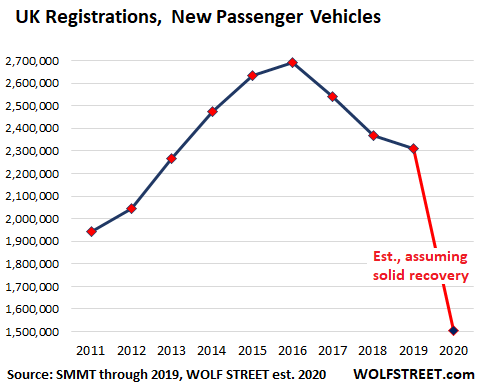
Reasons abound for the UK autoindustry’s multiyear decline, including broad consumer distrust of diesels following the endless disclosures since 2015 of industry-wide diesel emissions fraud, and stagnating consumer and business demand in the UK, due in part to the pervading uncertainty surrounding Brexit. Now, there’s Covid.

“These figures … make for exceptionally grim reading, not least for the hundreds of thousands of people whose livelihoods depend on the sector,” said SMMT’s CEO Mike Hawes.

For the UK’s auto finance sector, new business volumes in the market fell by 27% in March 2020, compared with the same month in 2019, and by 13% in Q1 2020 as a whole, according to FLA. The finance data for April and May haven’t been released yet, but given that auto sales collapsed by 97% in April and by a similar number in May, due to the lockdown, it’s unlikely to be pretty.

On Monday, June 1, dealerships will be allowed to reopen. But given the parlous state of the UK economy, with unemployment expected to surge from 3.9% in March well into double figures in the coming months, the demand for new debt-financed vehicles is likely to be weak. Many drivers — including the 480,000 on payments holiday — are already struggling to service their current auto finance arrangements.

Continue reading the article on Wolf Street
It Starts: The Corporate Mega-Bailout Bonanza in Europe, Germany on Top

Airlines, automakers at the forefront. And it has only just begun. EU waives rules banning state aid. Ryanair, which doesn’t need a bailout, is furious.

Governments around Europe have rolled out a dizzying array of measures, including loan programs, tax payment deferrals, and furlough schemes, to help companies, large and small, withstand the fallout of the Covid-19 lockdowns. Large companies have also benefited from massive central bank purchases of their corporate bonds, which has helped to keep their debt costs low. But for some companies, including many of Europe’s largest corporations, it’s not enough.

The UK government last week launched Project Birch, an initiative that will allow the UK treasury to offer “last resort” support to select firms in order to avoid bankruptcy-type restructurings, that could have severe repercussions for bondholders and stockholders. Those firms could include Tata-owned Jaguar Land Rover, which is currently in talks with the government to secure a loan of more than £1 billion.

“In exceptional circumstances, where a viable company has exhausted all options and its failure would disproportionately harm the economy, we may consider support on a ‘last resort’ basis,” said a Treasury spokeswoman, who reassuringly added: “As the British public would expect, we are putting in place sensible contingency planning and any such support would be on terms that protect the taxpayer.” Not exactly reassuring given the UK government’s recent record when it comes to contingency planning.

Across Europe, governments are following the same playbook. The EU has granted member countries unprecedented fiscal leeway to deal with the economic impact of the coronavirus, enabling governments to open the spending spigots, and wave aside EU budget rules and competition rules that were supposed to, but didn’t really, limit government borrowing and state assistance for national companies.

In France alone, the government has mobilized €450 billion of funds to mitigate the impact of the lockdown. That does not mean France has spent €450 billion, since roughly two-thirds of the amount are in the form of state-guaranteed loans. Those guarantees will only be needed if the companies that use them default on them. Nonetheless, the government still expects France’s public debt to reach 115% of GDP by the end of this year — almost double the 60% ceiling established in the EU’s Stability and Growth Pact.

So far, the biggest recipients of state aid in Europe are European airlines, some of which are still refusing to refund passengers for cancelled flights. Some airlines that don’t want government handouts, such as budget carrier Ryanair, have taken legal action against the airlines and governments involved in the bailouts.

Unlike most airlines, Ryanair has €4.1 billion in cash reserves. Its CEO Michael O’Leary is furious that his cash-flush airline will have to compete with airlines primed with bailout cash, including Italy’s Alitalia which has turned a profit only once since 1946.

This week, it looks as if it’s the car industry’s turn for a bailout bonanza, with the likes of Renault, Jaguar Land Rover and Fiat Chrysler expecting billions of euros in direct loans and state guarantees. Today, Macron announced an €8 billion plan to save the country’s car industry that includes government subsidies for car buyers and long-term investment in innovative tech, especially battery-electric vehicles.

Continue reading the article on Wolf Street
Student Housing, One of the Most Hyped Asset Classes, Runs Out of Students

Here’s the story of two student housing REITs in the UK that crashed.

When it comes to over-priced acquisitions at peak hype, there is no worse time than just before a financial crisis. The UK’s largest student housing real estate investment trust (REIT) Unite Group fell into that trap. In November 2019, it spent £1.4 billion to buy up privately-owned student housing provider Liberty Living Group plc, from the Canada Pension Plan Investment Board. In the process, it more than doubled its net debt, from £856 million to £1.88 billion. The day after the deal was sealed, Unite’s CEO said the enlarged group would “be well positioned to meet the growing need for affordable, high quality student accommodation in university towns and cities where demand is strong.”

That need, instead of growing, has all but vanished. Since March 11, all UK university campuses have been closed due to the virus outbreak. Most students have gone back home.

In late April, Unite Group informed investors that it had been inundated with cancellation requests since offering to waive rents for students who did not plan to occupy their rooms in the final term. Based on requests received up to that point, between 43,000 and 46,000 students would not pay rent this semester, the company said. The total number of vacated beds is the equivalent of 65% of Unite’s portfolio.

As a result, the company said it expected a fall in income from the 2019/20 academic year of 16-20% on a Group share basis, or £125 million, which it said was an improvement on its previous forecasts. But that was before Cambridge University’s bombshell announcement last Thursday that it was cancelling all face-to-face lectures for the entire 2020-2021 academic year, fueling speculation that many students will stay away next year too.

“Given that it is likely that social distancing will continue to be required, the university has decided there will be no face-to-face lectures during the next academic year,” the university said in a statement. “Lectures will continue to be made available online and it may be possible to host smaller teaching groups in person, as long as this conforms to social distancing requirements.”

Given Cambridge University’s import and influence, the move is likely to trigger a cascade of similar announcements from other higher education institutions. If that happens, student life in the UK is set to be a more insular experience for the foreseeable future, dealing a massive blow not only to students, professors, lecturers and other university staff but also to the businesses and communities that have come to depend on the income they generate.

Those businesses include big corporate providers of student accommodation and private landlords, some of whom have continued to charge students for digs they no longer occupy. Many of these companies have enjoyed years of surging profits on the back of years of soaring student rents. One of the largest REITs, GCP Student Living, reported a 51% rise in profits in its last financial year alone. GCP was the first REIT invested exclusively in student housing when it came to the market in 2013, and since then has given its investors a return of 12.9% a year.

But that was before the arrival of Covid-19 and the UK government’s subsequent imposition of lockdown and social distancing measures put its entire business model on hold. The shares of both GCP and Unite Group have slumped by 47% in the past three months. GCP’s stock is now trading at the same price it was trading at in October 2014. In the case of Unite Group, some £2.5 billion has been wiped off its market cap since the coronavirus crisis began.

Continue reading the article on Wolf Street

What Horrified Fund Managers, Banks & UK’s Pension Minister Said About the Bank of England’s Sudden “We Don’t Rule Out” Negative Interest Rates

“The stimulus the country urgently needs is not experimental and dangerous monetary policy.”

Andrew Bailey, the recently appointed governor of the Bank of England (BoE), is considering going where no other BoE governor has ever gone in the central bank’s 325-year history: into negative interest rate territory. On May 20, Bailey told British MPs that the BoE is refusing to rule out cutting the benchmark interest rate below zero in response to the virus crisis.

“We do not rule things out as a matter of principle. That would be a foolish thing to do,” Bailey told MPs. “But that doesn’t mean we rule things in either.”

That statement came just six days after Bailey had told FT readers that negative interest rates are “not something we are currently planning for or contemplating.” Since then, Bailey says he has “changed [his] position a bit.”

Bailey, who replaced Mark Carney as BoE governor just two months ago, is not the only senior BoE official who’s apparently warming to the idea of foisting negative interest rates on the British economy.

So, too, has the central bank’s chief economist Andrew Haldane, who last week said: “The economy is weaker than a year ago and we are now at the effective lower bound, so in that sense it’s something we’ll need to look at – are looking at – with somewhat greater immediacy. How could we not be?”

In the wake of the virus crisis, the Bank of England has already slashed interest rates by 0.65 basis points to 0.1%, its lowest level ever. It has also revved up its swap lines with the Federal Reserve and other central banks, offered billions of pounds of fresh liquidity support to banks, and expanded its QE program by £100 billion to £745 billion and extended what it buys to include corporate bonds.

On Wednesday, markets responded to Bailey’s ambiguous comments on negative rates by pushing the yields on gilts into negative territory for the first time ever. The UK Debt Management Office was able to sell £3.75 billion worth of three-year gilts at a yield of -0.003%, meaning that investors are now effectively paying to lend to the UK government, which is great news for the UK government as it massively increases its spending.

But not everybody’s happy about the BoE’s new openness to negative rates. While British bank executives have so far avoided a direct confrontation with Bailey, former UK pensions ministers, bank analysts and fund managers have warned that the move would be devastating for savers and could obliterate banks’ interest margins and profits.

Continue reading the article on Wolf Street

Green-Energy Zombie Abengoa Threatens to Default 3rd Time Since Enron-Style Collapse, Blames Covid, Begs for Fresh Bailout

In the forlorn hope the world’s biggest green-energy zombie will somehow survive the oncoming storm.

When it comes to amassing and defaulting on insurmountable debt loads and then having the debt restructured to live another day, few companies can hold a candle to Abengoa, the global green energy giant, headquartered in Spain, famed for cooking its books with Enron-esque aplomb before collapsing in 2015. Reverberations were felt the world over, including in the U.S. where its unit filed for bankruptcy with $10 billion in debt. The company then rose from the ashes of its monstrous debt pile, only to reenter default in 2019. Once again, the debt was restructured.

Now, Abengoa is warning of a third default, which it’s partly blaming on Covid-19, although its latest rash of problems seem to have predated the virus crisis. The firm is two-and-a-half months late in releasing its financial report for 2019, which was due in late February.

The ostensible reason for this delay was that the company was conducting a revaluation of its subsidiary Abenewco 2, which apparently unearthed €388 million of heretofore unaccounted-for losses, none of which could be blamed on Covid-19.

According to financial daily El Confidencial, the actual reason for the delay was that Abengoa’s auditor PwC was refusing to sign off on its 10-year business plan. Given Abengoa’s long history of financial chicanery, that’s not beyond the realms of possibility.

Even today, it’s impossible to find a copy of Abengoa’s full financial report for 2019 on its website. But it has released a three-page Updated Business Plan that has been translated into bizarrely bad English. In the document, the company reports increased sales but it has still clocked up losses of over €500 million. Granted, it’s an improvement on last year’s €1.5 billion of losses but apparently not enough to avert a new rescue plan, which includes:

  • A request for €250 million in fresh loans from its five main banks (Santander, Bankia, Caixa, BBVA and Bankinter), which Abengoa hopes will be 70% guaranteed by the Spanish government’s Covid-19 emergency loan fund.
  • A request for further credit lines worth €300 million from these same banks as well as the Spanish Export Credit Agency CESCE. In the first restructuring of Abengoa’s debt the Spanish government used this state-owned body to ever-so-quietly and ever-so-predictably underwrite €400 million of Abengoa’s debt, €100 million of which has already been written off. Now the company wants more of the same.
  • Further haircuts for providers worth up to €700 million.
  • Further debt-for-equity swaps for the company’s creditors. Abengoa’s various classes of shares trade at €0.01 or below. In other words, they do not even qualify as a penny stock.

Abengoa’s main creditors include the Spanish State and many of Spain’s biggest lenders. The biggest lender of them all, Santander, had the greatest exposure to Abengoa’s debt (€1.6 billion) and was most interested in sealing the 2016 deal, thanks to which Abengoa narrowly avoided becoming Spain’s biggest ever corporate failure, with over €25 billion of liabilities. Despite selling part of its stake in 2017 and 2018, Santander is still the largest shareholder.

Many of the other creditors must be wondering why they agreed to restructure Abengoa’s gargantuan debt pile in the first place. Perhaps at the time it appeared to make more sense to agree to a haircut, even a very large one, than to try to recover whatever they could in a liquidation.

Continue reading the article on Wolf Street

With No Mainland Chinese Buyers, Hong Kong’s Commercial Real Estate Dives

The most important source of inbound investment — mainland China — has vanished, with huge ramifications for CRE.

The Hong Kong government’s Land Office did something rather unusual. On May 13, it withdrew a major commercial plot it had put up for sale at the site of the city’s former airport at Kai Tak. The Land Office had received four bids for the plot, including from Sun Hung Kai Properties, Hong Kong’s biggest developer by value, but none of them came close to the government’s undisclosed reserve price, prompting the Land Office to pull the offer.

The withdrawal of the lot, only the fourth since January 2018, came after appraisers had lowered estimates of the land parcel’s value by 20% to a range between HK$6.38 billion ($820 million) and HK$10.44 billion ($1.35 billion). But some market insiders say the government had failed to take this sufficiently into account.

“The government overestimated the [parcel’s worth],” said Charles Chan, managing director of valuation and professional services at Savills. The market has corrected, but the [reserve] price was not in line with the market”.

In another part of Kai Tak, another land deal told a similar story. Goldin Financial Holdings Ltd., a Hong Kong-based investment holding company whose shares have fallen nearly 50% in the past six months, had to accept a loss of 21% or $335 million in its sale of an undeveloped residential land parcel it had bought in 2018. It was a desperate effort to raise cash.

“Considering the preliminary stage of development of the property and the significant capital required for the project, the directors adopted a prudent approach to retain more cash for the group’s existing business, against the uncertain outlook in the property market and the overall economic downturn in Hong Kong,” Goldin said in a bourse filing.

Hong Kong’s commercial property sector has been hit by a quadruple whammy over the last couple of years. First, Beijing imposed capital controls on money flowing out of China, much of which had been pouring into Hong Kong real estate. Shortly after that, trade tensions between the U.S and China began escalating, leaving Hong Kong stuck in the middle. Then the city was rocked by non-stop student protests. And now, to cap it all off, there’s the virus crisis.

Hong Kong’s health authorities have managed the threat posed by Covid-19 far better than many other global cities, largely due to the lessons gleaned from previous outbreaks, including the 2003 SARS episode. The city has so far only registered four deaths from Covid-19. But the economic impact of the partial lockdown and the closure of most of its land borders with China has nonetheless been brutal.

The city is already in the throes of its deepest recorded recession, after notching up three consecutive quarters of falling GDP. The 8.9% contraction suffered in the first quarter of 2020 was the biggest since records began.

And the most important source of inbound investment as well as demand for the city’s luxury retail sector — mainland China — has effectively vanished, with huge ramifications for the city’s commercial real estate (CRE).

Continue reading the article on Wolf Street

Third Mega-Crisis in 12 Years: Eurozone Economy Plunges at Fastest Rate on Record

First the Global Financial Crisis, then the Euro Debt Crisis, now the Big One.

In its 21 years of official existence, the Eurozone has already been through two brutal crises — the Global Financial Crisis and one of its own doing, the Euro Debt Crisis — that nearly tore the bloc apart. Now, it is in the grip of another one that is already exacting a larger toll than the first two, despite having barely begun.

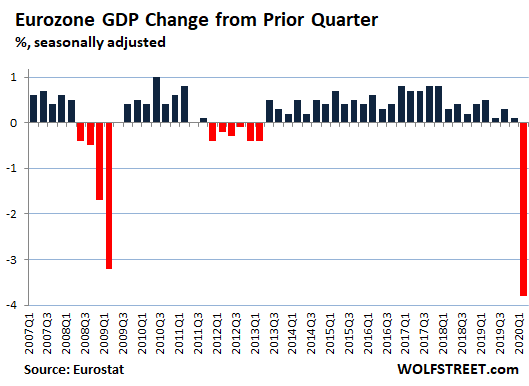
The preliminary GDP in the first quarter for the Eurozone fell by 3.8%, according to Eurostat’s flash estimates (for the entire EU, it fell by 3.5%), “the sharpest declines observed since the time series started in 1995,” Eurostat said. This is despite the fact that most of the region’s lockdowns did not begin until mid-March:

All things considered, the Euro Area’s biggest economy, Germany, got off relatively lightly. It shrank by just (!!) 2.2% compared to the previous quarter. It was still its biggest contraction since the the Global Financial Crisis, more than a decade ago. German industrial production was particularly hard hit, tumbling by 11.6% year-on-year in March, when the lockdown forced factories to close. In Q4 2019, Germany’s GDP growth rate was already negative (-0.1%).

But many other Euro Area countries fared a lot worse. Of the four worst performing economies, three are the bloc’s second, third and fourth largest, France, Italy and Spain, which between them account for almost 45% of Euro Area GDP. The other was Slovakia. Spain, Italy and France suffered more cases of Covid-19 and resulting fatalities than any other countries in the Euro Area. They also imposed the most draconian lockdowns. The impact on their economies has been brutal.

France suffered a mind-watering 5.8% collapse in GDP in the first quarter, the “biggest drop” on a quarterly basis since the Second World War,  according to the country’s INSEE statistics agency. Even in the second quarter of 1968, when France was roiled by civil unrest, mass student protests and general strikes, the economy still shrank by less (5.3%) than it just did. In the first quarter of 2009, when the financial crisis was pummeling Europe’s markets and Greece was beginning to teeter, France’s GDP shrank by a comparatively mild 1.6%.

As happened in Germany, in Q4 2019, France’s GDP growth rate was already negative (-0.1%).

Italy perennially troubled economy shrank by 4.7% in the first quarter — the worst reading since Eurostat began tracking Italy in 1995 — after having already contracted by 0.3% in Q4 of 2019. Italy was the first EU country to impose a lockdown and has also suffered the largest number of Covid-19 deaths. Given the size of its public debt and the fragility of its banking system, it is probably the least well placed large European economy to weather the current economic storms.

The Euro Area’s fourth biggest economy, Spain, also broke records with its latest GDP reading. Clocking in at -5.2%, it was the worst performance since the country began tracking economic growth in the 1970s and is considered to be the largest quarterly drop in economic activity since the Spanish Civil War, in the late 1930s. According to Spain’s National Statistics Institute (INE), retail trade slumped by 15% in March while Spain’s second largest bank, BBVA, estimates that consumption has fallen by half since the government declared a state of alarm on March 14.

Continue reading the article on Wolf Street

Non-Paying Tenants Trip Up Land Securities, Once UK’s Largest Commercial Property REIT. Stock Plunges

The industry exhorts the government to call out “can pay, won’t pay” retailers, many of them global brands that avoid paying rent despite their cash reserves.

Until two years ago, Land Securities was the UK’s largest listed commercial real estate company by market cap. It owns and manages more than 26.5 million square foot of property on the British Isles. The problem is that much of that property is in the worst possible sector — brick-and-mortar retail — at the worst possible time: now. And it’s showing. In its results for its last fiscal year, ended March 31, Landsec posted an £837 million loss — roughly seven times the £127 million loss it posted in the previous year.

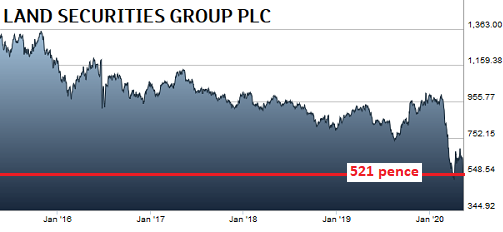
The company’s shares have fallen 17.5% over the past three days, 48% since February 14, and 62% since since May 2015. Intraday today they traded at 499 pence, a new low, and closed at 521 pence. So the problems didn’t just start — but they just got a lot worse. Five-year stock chart via London Stock Exchange:

Besides its retail properties, LandSec owns a vast portfolio of London offices — including Deutsche Bank’s new London HQ at 21 Moorfields — and specialist assets consisting of hotel, leisure and other properties. Those specialist assets, together with its retail properties, represent about half of the portfolio’s total valuation. With the exception of supermarkets and pharmacies, most of those assets have been taken out of action by the UK’s lockdown measures.

“Our leisure and hotel assets were generally closed with turnover-related rental income severely impacted,” said CFO Martin Greenslade during a full-year earnings call. “In retail, shopping centers remain open for essential trading only and footfall all but disappeared.”

A year ago, LandSec’s property empire was worth £13.8 billion. Today, it’s worth £1.18 billion less. According to property valuers CBRE, £380 million of that write-down can be attributed to the lockdown; the rest is due to pre-Covid-related wear and tear, particularly in relation to the company’s retail and specialist assets — those hotels, leisure and other properties. Its retail portfolio lost more than 20% of its value over the last year, with some regional malls down as low as 28%.

By contrast, its office portfolio saw a 1.1% increase in value. But even that line of business faces huge uncertainty going forward. “We have kept our office assets open, but the level of usage is well below 10%,” Greenslade said. “Our development program has been delayed as our contractors adapt to implementing social distancing on site.”

The company hopes the vast majority of the tenants of its office buildings will keep renting more or less the same amount of space as they have done until now, even as they cut back on staff and keep many of their workers at home. Even so, the company expects a 20% fall in office rents over the next year.

Continue reading the article on Wolf Street

Airbnb Gets Disrupted. Hosts, “Super-Hosts” Try to Survive. Apartments in Prime Locations Suddenly Flood Rental Market

Big driver behind soaring rents — the “Airbnb effect” that removed countless properties from global cities’ long-term rental markets — reverses.

With many of the world’s most popular tourist destinations locked down, and many flights canceled, making international tourism all but impossible, the world’s biggest disruptor of global tourism, Airbnb, faces a starkly different market reality. As of mid-April, new bookings on the company’s portal had plunged 85% year over year while cancellation rates were around 90%, according to AirDNA, an online rental analytics firm.

Airbnb has warned that its 2020 revenue could come in 50% lower than its 2019 total. This is a company that wasn’t even able to turn a profit when the Good Times were raging.

To try to keep investors on board, management has unleashed a brutal restructuring of the group’s global operations. Last week, it laid off 1,900 workers, around 25% of its global workforce. The San Francisco-based company also rescinded a contract it has with a call center in Barcelona, resulting in the immediate loss of a further 1,000 subcontracted jobs.

One of Airbnb’s biggest rivals, Amsterdam-based Booking.com, is in similar straits. In March, its American parent company, Booking Holdings, posted a first quarter loss of $699 million, down from $765 million a year ago, as bookings plummeted 43%. Also for March it reported a decline of over 100% in room nights, a feat that was made possible by the fact it received more cancellations than new bookings during the month.

“Looking at things a different way, our newly booked room nights, which exclude the impact of cancellations, were down over 60% year-over-year in March and down over 85% in April,” said chief executive Glenn Fogel at last week’s earnings presentation. “This gives you a clear indication of how much our business is currently impacted by this crisis.”

Things are set to get even worse. In April, Booking warned investors the virus crisis would impact the second quarter of 2020 “much more significantly” than the first, though it declined to offer full second-quarter guidance.

The company recently applied for Dutch government support to help pay its 5,500 workers in the Netherlands, which did not go down well with Dutch taxpayers. Like so many other large listed companies, Booking spent $4.5 billion buying back its own stock in 2019, significantly reducing its capital and impairing its ability to weather future storms such as the current one. Now, to tide it over, the company has borrowed $4 billion of emergency funds.

For companies like Airbnb and Booking that can raise such vast sums of money with such apparent ease, this crisis is likely to be painful but not fatal.

Continue reading the article on Wolf Street

Another SoftBank Unicorn Gets in Trouble: “Reverse Factoring” Specialist Greensill

“Its track record of disrupting traditional financing” hit by fallout from client companies that suddenly collapsed under undisclosed debts. Tentacles spread to Credit Suisse.

SoftBank appears to have a brand new problem on its hands: UK-based unicorn Greensill. Last year, SoftBank’s Vision Fund invested $1.45 billion in two rounds in this company. The second round pushed its “valuation,” decided behind closed doors, to $6 billion. The stated purpose was to allow Greensill to continue “its track record of disrupting traditional financing.”

Greensill provides supply chain financing in form of “reverse factoring” which can be used by companies to create the illusion of cash flow, reduce the appearance of debt, and mask the true state of their leverage ratios. Three of Greensill’s reverse-factoring client companies — NMC Health, rent-to-own retailer BrightHouse, and Singapore commodities trader Agritrade — have spectacularly collapsed over the past three months, under billions of dollars of undisclosed debts and amid red-hot accounting scandals. And the tentacles have spread to Greensill’s and SoftBank’s relationships with Credit Suisse:

NMC Health, which in early March we dubbed “the first Enron” of 2020 after the UAE-based FTSE 100 health care company suddenly “discovered” $2.7 billion of undisclosed debt, on top of its $2.1 billion of disclosed debt. Since then, an additional $1.8 billion of heretofore hidden debt has been unearthed, taking the company’s total debt load to $6.6 billion.

BrightHouse, the UK’s largest rent-to-own lender whose business model essentially consisted of providing finance rental agreements to cash-strapped consumers. Those consumers ended up owning the products they rented as long as they were able to endure the long payment periods and exorbitant interest rates, which could reach as high as 69.9% APR. Many did not. The UK government’s announcement of a three-month payment freeze on rent-to-own loans in April, as part of its Covid-19 measures, was the final straw for Brighthouse, which already faced millions in compensation claims.

Agritrade, a Singaporean commodities trader, that went under in February, after many of its banks refused to continue backing its souring commodities bets. At its demise the company had $1.55 billion in outstanding liabilities to dozens of creditors, including $983 million owed to secured lenders. Many of its lenders accuse the company of misreporting and other financial regularities. “There is strong evidence that a massive, premeditated and systematic fraud has been perpetrated by the defendants,” said Dutch bank ING, which is on the hook for some $100 million of the debt.

What these three now insolvent companies had in common was that Greensill arranged reverse factoring financing for them. Here’s how it works: a company hires a financial intermediary, such as Greensill, to pay a supplier promptly (e.g. 15 days after invoicing) in return for a discount on their invoices. The company repays the intermediary at a later date. This effectively turns the company’s accounts payable into financial debt that is owed to a financial institution. But this debt was not disclosed as debt and remained hidden to investors and auditors.

Greensill may now have to cover some of the losses resulting from its funding of these three insolvent companies. That funding was arranged through a number of funds belonging to Credit Suisse, which forms part of an incestuous relationship with Greensill and SoftBank. Credit Suisse’s asset management division relies solely on Greensill to source investment opportunities for more than $8 billion of supply chain finance funds, according to the FT. And as much as 15% of that money ends up going to companies controlled by SoftBank’s Vision Fund.

In other words, Greensill exclusively brokers the assets of Credit Suisse’s supply chain business. Then, by some shocking coincidence, many of those assets end up financing companies funded by Greensill’s biggest investor, SoftBank’s Vision Fund — which already booked a $16.7-billion loss for its fiscal year ended March 31. Among the companies receiving the funds are car financing business Fair Financial, hotel chain OYO Hospitality, window manufacturer View and auto sales company Guazi.

In past years, Greensill was also instrumental in helping both Abengoa conceal its outsize debts and obligations until the day it collapsed, leaving investors shouldering billions in losses. As has happened with NMC Health, new debts and liabilities just kept popping up.

Continue reading the article on Wolf Street