The $1.5 Trillion Global Tourism Industry Faces $450 Billion Collapse in Revenues, Based on Optimistic Assumptions

“We are temporarily a company with no product and no revenue.”

TUI, the global travel and vacation giant that owns six European airlines, 1,600 travel agencies, over 300 hotels and 14 cruise ships, desperately needs help. And it appears to have got it. On Friday, the company announced that the German government had approved a €1.8 billion loan to help keep the group afloat as COVID-19 brings the global travel sector to a literal standstill. The bridge loan, which still needs to be approved by TUI’s creditors, would be one of the biggest ever issued through German state-owned lender KfW.

“We are currently facing unprecedented international travel restrictions. As a result, we are temporarily a company with no product and no revenue. This situation must be bridged,” TUI CEO Fritz Joussen said in a statement. The same could be said for millions of companies around the world. But unlike TUI, many of them don’t have the ear of their national government.

Even as giant travel companies like TUI line up with airlines and cruise owners for multi-billion dollar bailouts, huge question marks loom over the global travel industry’s future.

The World Tourism Organization (UNWTO), in its updated assessment of the potential impact of COVID-19 — based on the optimistic assumption that the tourism industry will experience a swift recovery over the next 3-4 months — projects that for the whole year 2020, tourist arrivals will have fallen 20-30% from 2019, and international tourism revenues will have plunged by $300 billion to 450 billion, almost one third of the $1.5 trillion generated in 2019.

Taking into account past market trends, this would mean that between five and seven years’ worth of accumulated industry growth will have been wiped out in one fell swoop.

By contrast, the global financial crisis of 2008-09 resulted in a 5.4% fall in international tourism revenues, while the September 11 attacks in 2001 and the SARS outbreak of 2002-3 led to declines of just 2% and 0.4%. These were just momentary blips for an industry that has experienced two decades of almost uninterrupted growth, resulting in a three-fold surge in international tourism receipts, from $496 billion in 2000 to $1.5 trillion in 2019. Even during the worst year, 2009, the 5.4% fall in tourism receipts was cancelled out by a 5.7% resurgence in 2010.

What is happening now — the total collapse of global travel and tourism — has not happened before. As the UNTWO itself concedes, its own estimates “should be interpreted with caution in view of the magnitude, volatility and unprecedented nature of this crisis. SARS and the 2009 global economic crisis are the existing references, but this crisis is like no other.”

Even the scenario of a 20-30% fall in receipts — four to six times more than in 2009 — assumes that the virus will be contained within the next 2-3 months; and once it is, that everything will return to exactly how it was before. It assumes that the virus will be contained globally to such an extent that it allows for unlimited international mass travel and tourism for leisure and business to resume within the next 2-3 months. And it assumes that this large number of people are actually willing to travel within a few months.

But this is hard to imagine. And once things do end up at some sort of new “normal,” the global economy may be in the throes of a recession deeper and more enduring than the one suffered in 2009.

Continue reading the article on Wolf Street
Latin America Was Already Steeped in Economic Problems. Now Come the External & Internal Shocks of COVID-19

Not even Brazil and Mexico have the fiscal and monetary leeway to offset those shocks.

Covid-19 is beginning to gain a foothold in Latin America. Even in some of the region’s tropical areas, the case numbers are rising at a startling rate. Ecuador, which appears to have caught the bug a month ago as a result of its close connections with Spain, now has over 1,300 cases — more than any other country in the region except for Brazil, which has over 12 times Ecuador’s population.

If the virus spreads across Latin America with the same virulence as as it has in Europe, the U.S. and large parts of Asia, the results could be disastrous. The region’s cash-strapped governments simply cannot afford to provide the sort of financial support programs being rolled out in more advanced economies. Even if they could, the measures would not apply to the untold millions of workers eking out a living in the informal economy, most of whom could not afford to miss a day or two of work.

Brazil’s administrative capital Brasilia, which went into lockdown a few days ago, is a case in point. Most of the city’s middle- and upper-class residents, including thousands of politicians and civil servants, are now safely ensconced at home. For the moment, they’re being paid, either to work remotely or just not to go to work. Like many places in Europe, the U.S. and East Asia, the streets in the downtown area are more or less deserted.

But once you venture out into the city’s poorer suburbs, the reality changes. Thelma, a friend who lives in Brasilia, just visited nearby Valparaíso de Goias, which is roughly an hour’s drive from the capital. “It was just like any other day in the city,” she said. “The streets were teeming with people. The buses were rammed, as were the bars, restaurants and shops. These people can’t afford to take a day off, let alone two or three weeks.”

The same is true of countless towns and cities across Latin America. Locking down entire cities or countries and paying millions of non-essential workers not to work while healthcare workers battle to contain the virus is a luxury only afforded to countries with first-world economies, huge public debt capacities, relatively stable currencies and big central banks.

Even before Covid made its first official appearance in Latin America, just over a month ago, big cracks were already showing in the region’s economy. Both Chile and Colombia had been rocked by massive social protests over economic inequality. Venezuela is in the midst of a huge humanitarian crisis, while Argentina is waiting for yet another restructuring of its unpayable debt mountain. The largest economy, Brazil, has barely recovered from its longest recession in history (2014-2017). Mexico, the second largest economy, experienced three quarters in a row of declining annual GDP.

In the last two months, Brazil has suffered $12 billion dollars of capital outflows, mostly the result of foreign investors offloading shares on the country’s benchmark index, reports the Institute of International Finance (IIF). Mexico has an other problem on its hands: the sliding value of its peso against the dollar. In the last couple of days, the currency has rallied somewhat as the dollar has sold off slightly but it is still trading just above historic lows.

The Chilean peso is more or less in the same boat, having hit unprecedented lows to the dollar a week ago before firming slightly over the last few days. Chile’s export-heavy economy is particularly dependent on China, which buys (or at least used to buy) one-third of Chile’s exports, accounting for 9% of Chile’s GDP. The recent Covid-triggered slowdown of economic activity in China means not just lower commodity prices but also lower export volumes for Chile.

Continue reading the article on Wolf Street
Self-Employed Left Hanging after Spanish Government Promised to Protect Them from Worst of Covid-19 Fallout

During the last crisis, Madrid ramped up the tax burden on the self-employed to historic highs while wasting vast sums on corporations and banks. Same thing on an even bigger scale is now in the offing.

Since Spain was put on lockdown, ten days ago, its government has repeatedly said it will do everything within its powers to insulate the self-employed from the worst of the economic fallout. It was a lie. All Madrid has really offered them (or should I say, us) is the opportunity to get into (more) debt. That debt will be provided by the banks, who will get to enjoy all of the interest paid on it, but it will be underwritten by the government to the tune of 80%.

In other words, if you’re self-employed or a small business owner and most or all of your business activity has come to a grinding halt and your earnings have plunged while your fixed costs remain pretty much the same, the only way you can try to solve that problem is by taking on (more) debt. This might make sense if you have a reasonable prospect of generating a healthy income in the near future.

But that is pretty unlikely, all things considered. Once the coronavirus has been brought under some semblance of control, the economy, both of Spain and most of the rest of the world, will probably remain very challenged for a while. On the bright side, so to speak, if things don’t work out and you end up defaulting on the debt, it will be taxpayers, including your relatives and friends — not the banks — that will pick up most of the bill.

The same deal, with certain subtle differences, has been offered up by the governments of most advanced economies. In Spain, the government has also launched tax-relief measures that will allow self employed workers and small-business owners to delay paying up to €30,000 worth of taxes by up to six months, although the interest starts kicking in straight after the third month.

But that’s where the assistance more or less ends. Madrid has prioritized helping out businesses, particularly large ones with overbearing debt burdens, and full-time contracted workers, more than a million of whom have already been temporarily laid off in the last 10 days. Once those workers’ paperwork is done, which could be a while given the sheer numbers, they can claim unemployment benefits equivalent to 70% of their former earnings (up to a certain limit). This is preferable to losing their jobs for good, though there’s no guarantee they’ll still have jobs when their workplaces reopen.

By contrast, what Spain’s self-employed workers need, at the barest minimum, is a break from having to pay their monthly social security contribution (minimum amount: €290, one of the highest levels in the EU). It would ease the burden a little, at least for the duration of the lockdown. And it would not only be easy for the government to do, it would also be pretty cheap. The total fiscal impact of suspending the payment for two months would be a tiny fraction — less than 1% — of the total amount of money (€200 billion) the government has pledged to mobilize to try to combat the economic effects of the coronavirus.

Continue reading the article on Wolf Street
New Currency Crisis Dawns: Mexican Peso Plunges to Record Low Against the Dollar

The flight into US dollars! Dollar-denominated debts of Mexican companies weigh heavily.

As the coronavirus crisis roils the global economy, the strengthening dollar is causing all manner of stress and mayhem for national economies and their respective currencies. Nowhere is this clearer than in Mexico, whose currency, the peso, never really recovered from the last crisis and is now collapsing all over again. As of 4 p.m. Monday (Mexican time), it had tumbled over 3% to a record low of 25.42 pesos to the U.S. dollar.

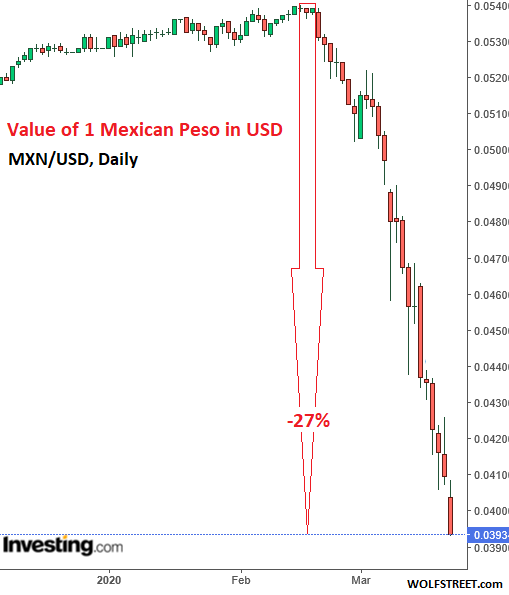
Even by historic standards, the sell-off has been relentless. In the past 16 days, the peso has experienced 16 record daily lows. Not since the height of the last peso crisis, five years ago, has the currency notched up so many new lows in one single month. During that crisis, which lasted from late 2014 to late 2016, the peso lost roughly a third of its value against the greenback, none of which it was able to claw back. During this new crisis, which has so far spanned no more than a month, the peso has lost 26% of its value. The chart shows the value of 1 peso, which has plunged from $0.054 on Feb. 22 to $0.039 today:

The Mexico peso is among a number of emerging market currencies that have become popular vehicles for carry trades, offering juicy interest-rate spreads against currencies with much lower interest rates such as the Japanese Yen or the euro. But when broad market sentiment toward emerging market risks turns, as is happening right now amid all the mayhem being triggered by the global response to the coronavirus, these currencies are particularly prone to capital outflows.

Mexico also has another big disadvantage in moments like these: It has one of the most liquid currencies and one of the biggest bond markets among emerging economies. It is also traded around the clock and has a high correlation with other Emerging Market. And it’s used in instruments designed to hedge against EM weakness. And that weakness is coming back to the fore right now.

If other peso crises are any indication, it’s not just foreign exchange traders after a quick buck that are betting against the currency. So, too, probably, are Mexico’s biggest banks and institutional investors. During the last peso crisis, an estimated 75% of transactions of pesos into dollars were being executed by big institutions and banks, mainly Mexican.

Many large Mexican businesses are in the same group. As I wrote in a July 2015 article, “it is the worst of vicious circles: the stronger the dollar gets, the more the locals want it. The more the locals want it, the weaker the peso becomes. Rinse and repeat.”

Neither the peso’s last collapse nor this latest one are a reflection of the current state of Mexico’s economy; they are the result, primarily, of economic and financial forces taking place far beyond Mexico’s borders. That said, each time the currency weakens, it heaps further pressure on the economy. And that economy is already in the doldrums.

Continue reading the article on Wolf Street
After Epic “Run on the Funds,” 10 More Real Estate Mutual Funds Shuttered as COVID-19 Batters UK Property Values

Triggered by the belated realization of the risks in mutual funds that offer daily liquidity but invest in illiquid assets.

Over the past two days, 10 open-end property funds in the UK have slammed their doors shut on investors, citing concerns about asset valuation. The funds’ two property valuers, CBRE and Knight Frank, say that it is currently impossible to accurately value the funds’ real estate assets amid the market chaos being caused by the response to Covid-19.

“The UK commercial property market is facing unprecedented circumstances as a result of the COVID-19 outbreak, and so valuation firms can no longer make reliable judgement on value. This is known as ‘material value uncertainty’,” said Paul Richards, managing director of the Association of Real Estate Funds (AREF), in a statement. To justify the fund suspensions, Richards cited new FCA rules applying to funds investing in inherently illiquid assets, such as commercial property:

“Funds with more than 20% of their portfolio subject to material valuation uncertainty are required to suspend subscriptions and redemptions in the interests of all investors. Although these rules are not due to come into force until September 2020, existing rules would require fund managers to consider suspending funds in circumstances like the ones they are facing at the current time.”

The first fund to shut its doors was Kames Property Income, with £504 million under management. That was on Tuesday. By Wednesday morning, Janus Henderson and Aviva, which respectively manage property portfolios worth £2 billion and £461 million, had followed suit. Then, over the next 24 hours, another seven funds did the same.

Between them, these funds manage some £11 billion of assets, equivalent to around a third of the total assets under management in the UK’s property fund sector. They invest in commercial real estate across the UK including offices, industrial property and retail parks, a sector beleaguered by retailer failures and crushed values. Just this week, one of the UK’s largest mall owners, Intu, warned that it was on the verge of bankruptcy after posting a £2 billion loss and a 22% plunge in the net asset value of its commercial properties.

Now, it’s the property fund sector that’s beginning to wobble. That includes the sector’s biggest player, the £2.9 billion Legal & General UK Property, which, like AREF, justified its decision to suspend redemptions by citing the “unprecedented set of circumstances caused by the COVID-19 virus” and its impact on “market activity across all sectors”:

“This means that “independent valuers are unable to rely on previous market experience to inform their opinion of values of the properties held by the Fund. We believe this suspension to be the fairest outcome for all investors, taking an appropriate forward looking view through the current crisis.”

Other large funds that have suspended redemptions include the £2 billion Janus Henderson UK Property, the £1.7 billion Standard Life Investments UK Real Estate, the £1.1 billion Threadneedle UK Property and the £1.1 Aberdeen UK Property. These open-end mutual funds are particularly prone to liquidity crises in the event of market sell-offs, as the Bank of England’s Financial Policy Committee warned repeatedly, starting in 2015.

When investors take their money out, the fund will use up the remaining cash and then has to sell assets in the portfolio to raise money to meet the redemptions. This is normally not a problem when the assets in question are highly liquid, such as large-cap publicly traded stocks. But when the assets are commercial real estate that can take weeks or months to sell, if they can be sold at all in a hurry, particularly in a downturn, there is a mismatch in liquidity between what the fund offers to its investors (daily liquidity) and what the fund holds (largely illiquid assets). Eventually, the fund runs out of cash and has no choice but to close its doors, leaving investors trapped and having to contemplate big losses.

Continue reading the article on Wolf Street

European Banks Face Financial Crisis 2, Shares Hit 1988 Lows

The ECB promised “to monitor markets closely.” Then it came out with a new bond buying binge.

Bank stocks in Europe plumbed fresh multi-decade lows despite the release of a hurriedly improvised one-paragraph announcement by the ECB pledging to do just about whatever it could take to keep the banking system in tact. The ECB will continue “to monitor markets closely”, the message read, and is “ready to adjust all of its measures, as appropriate, should this be needed to safeguard liquidity conditions in the banking system.” In other words, the ECB is willing to throw what remains of the kitchen sink at the problem.

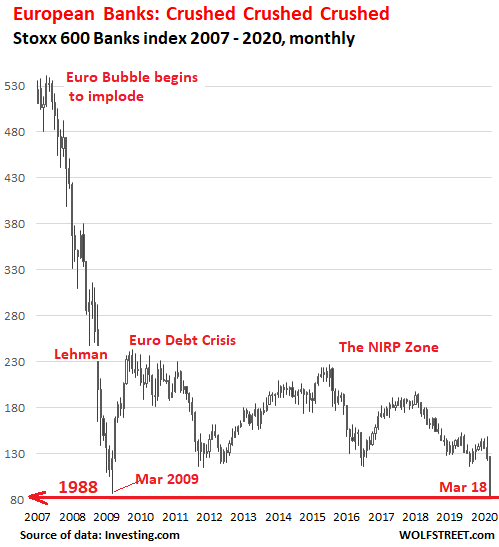
The message may have been intended to reassure investors, calm market jitters, and stop the sell-off of sovereign bonds and bank shares but if anything, it had the opposite effect. The Stoxx 600 Banks index, which covers major European banks, fell 3.7% to close at 83, below even the multi-decade low of 87 in March 2009, at the bottom of the first Financial Crisis this century. Today’s close was the lowest since February 1988, during the sell-off that followed Black Monday in October 1987. The index has collapsed by 85% since its peak in May 2007, after having quadrupled over the preceding 12 years:

The almost vertical collapse of those shares over the past four weeks is but the latest episode in a 13-year story of decline. The Stoxx 600 bank index has slumped by 85% since its peak in May 2007,

But what is the ECB going to do to rescue bank shareholders? Not much. The ECB is primarily concerned with keeping the Eurozone duct-taped together. Unlike the Fed, whose 12 regional Federal Reserve Banks are owned by the banks in their districts, and to whom bank stocks are therefore hugely important, the ECB couldn’t care less about bank stocks, as long as the banks themselves don’t collapse. So it has thrown just about everything it has at the problem of keeping the Eurozone in tact, including conjuring up €4.7 trillion ($5.2 trillion) of fresh money, and pushing its policy rates and many bond yields into the negative, but with largely undesirable consequences for banks and their shares.

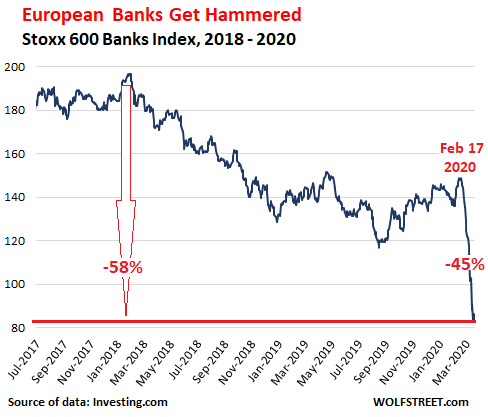
On top of it comes the impact of the coronavirus. The Stoxx 600 Banks Index has plunged 45% since February 17, going to heck in a (nearly) straight line, and is down by 58% since January 2018:

By all appearances, we are headed into yet another full-blown financial crisis, triggered not by the banks this time but by the response to the coronavirus, which is now reverberating throughout the system and hitting the already weak banks. So far, neither the Fed nor the ECB have managed to get a grip on this new crisis, which is moving far faster than the last one.

Bank bonds are selling off, particularly the “senior non-preferred bonds,” a new creature road-tested three years ago by France’s biggest bank. These bonds lured many investors with the promise of a slightly positive yield. It’s “bail-in-able” debt. In return for the tiniest of returns (say, a yield of 2%), you basically get to hold debt that can be turned into worthless equity or be cancelled the moment a bank begins to wobble. Not surprisingly, investors are trying to offload them as quickly as they can, reports the FT.

Continue reading the article on Wolf Street

Welcome to Dystopia: My Life Under Lockdown in Spain

Most importantly, we have our health (touch wood) and each other

The whole of Spain, like the whole of Italy, and the whole of France, is closed for business (and just about everything else) as the government tries to bring Covid-19 under some semblance of control and keep the virus from overwhelming the healthcare system. The number of cases of the virus in Spain has reached 11,000, having shot up by over 2,000 in the past 24-hour phase (though these figures reportedly have a three or four-day lag). There has been a total of 491 fatalities.

We are now on day 3 of the lockdown and for the next eleven days (and probably some time after that), almost every type of commercial and public venue, including bars and restaurants, schools and universities, has been forced to shut and millions of people — myself and my family included — are being forced to live in curfew-like conditions that were barely imaginable just a month ago.

Freedom of movement has been put on hold, as have a host of other basic so-called “freedoms”, such as the freedom to gather. Unless you’re a police officer or municipal worker, you can only be outside if you are on your own. And even if you’re on your own, if you are found on the street without good reason, you can be fined. If you are a repeat offender, you could even face a jail sentence. In the eyes of the law, there are only nine justifiable reasons for venturing out:

  • To travel to or from work, assuming, of course, that your workplace is still open. Most of the businesses that are still open are those that do not have to deal with the public. Factories and offices are still allowed to stay open as long as they have certain health and safety regulations in place.
  • To take out the rubbish.
  • To buy food and other essential goods from the local supermarket or grocery store. Tobacconists, newspaper kiosks and electronic stores are also allowed to open.
  • To buy medical supplies from the local pharmacy.
  • To go to the local health center or hospital, but only in the case of emergency or serious chronic conditions.
  • To visit relatives in need.
  • To take the dog out for a walk.
  • To go to the bank. Most bank branches are still open though a lot of back-office staff are now working from home.
  • To get your hair cut.

No, seriously. Among the reasons accepted for being on the streets of Spain without receiving a three- or four-figure fine from one of the many patrolling police officers is going to a hairdresser. Apparently, this is to “help” people with mobility disabilities and the elderly. 

As for the hairdressers themselves, most are understandably petrified of catching the virus from one of their customers and would much prefer to be at home with their families. Industry groups have even lobbied the government to reverse the ruling.

Continue reading the article on Wolf Street

Mall Giant Intu Warns of Bankruptcy: First, the Meltdown of Brick & Mortar Retail, Now COVID-19

Local governments end up buying dying malls to keep them from becoming dead zones.

Intu Properties which owns dozens of malls in the UK, including nine of the 20 biggest, as well as a handful in Spain, warned this week that it is on the brink of bankruptcy after declaring losses of £2 billion for 2019 and a debt of £4.5 billion. Its portfolio of properties is still valued on its books at £6.6 billion, down 33% from December 2017. Its shares are now worth just four pennies a piece. Two and a half years ago, before many of its high-profile tenants began dropping like flies, the company was worth more than £2 billion; today it’s worth just £55 million.

Like-for-like net rental income was also down by 9% in 2019, to £401 million, due in large part to some of its once-thriving tenants entering administration or company voluntary arrangements (a form of bankruptcy), as well as an increased vacancy rate.

Now, to stave off its own bankruptcy, Intu desperately needs to raise new funds. Intu’s original plan to raise fresh equity capital, unveiled less than two months ago, already failed. It wanted to raise at least £1.3 billion to fortify its shaky finances, keep its creditors at bay, and avoid defaulting on its huge debt pile. But trying to convince already skeptical investors to inject fresh funds, after its shares have already collapsed to almost zero, at a time when the UK’s retail sector is in the deepest of doldrums, was always going to be a tough sale.

The first major investor to pull out of the equity raise was Hong Kong-based Link Real Estate Investment Trust. Others quickly followed and by last week Intu conceded that its plan had been a complete flop, which it nonetheless blamed on “extreme market conditions,” meaning the coronavirus, which is expected to further decimate store traffic in the coming weeks.

Unless another solution is found, Intu will soon breach multiple debt covenants. This could cause lenders, including HSBC and Royal Bank of Scotland, to take control of its assets — assets they would rather not have and will probably quickly sell.

Continue reading the article on Wolf Street

First Enron of 2020: Muddy Waters’ Short-Target NMC Health Just “Discovered” $2.7 Billion Undisclosed Debt

Oops, the rot runs even deeper than Muddy Waters could have imagined.

This wildly turbulent year just produced its first Enron-like scandal. At the rotten heart of it is NMC Health, a FTSE 100 company that has health-care operations in 19 countries and is based in the United Arab Emirates. Last Thursday, the company’s shares were suspended after an internal review uncovered a morass of dodgy accounting and fiduciary shenanigans. Now it was revealed that those shenanigans had helped to conceal at least $2.7 billion of undisclosed debt.

The discovery more than doubles the size of NMC’s debt mountain to around $5 billion, up from around $2.1 billion last June. The proceeds from much of that debt were used for “unauthorized purposes,” the company now admits, although it’s not yet clear what those purposes were. NMC also apparently has no cash on hand to service that debt and is currently receiving support from Daman Insurance, a health insurance company that is 80%-owned by Abu Dhabi’s government and the rest by Munich Re, to pay overdue bills to suppliers.

For some time, NMC’s cash flow was supplemented by reverse factoring deals. Reverse factoring is a form of financial engineering, an arrangement with a lender that turns the company’s trade accounts payable into debt that is owed to a financial institution. But since that debt does not have to be disclosed as debt, the company appears to have less debt than it actually has. Once these shenanigans are discovered, as just happened to NMC as well as to UK outsourcing giant Carillion and Spanish green energy behemoth Abengoa before it, the cash can quickly run dry.

NMC is reportedly two weeks behind in paying February salaries to its staff. Now, banks are wary about lending the company fresh funds. Earlier this month, it even asked lenders for a temporary standstill on its existing facilities.

There had been hopes that NMC might be bought out before things got this serious but those hopes were dashed damning findings of the internal review published last month. One of the two companies that were reportedly mulling a takeover bid, GKSD, has pulled out, while the other, KKR, denies even discussing the matter.

Continue reading the article on Wolf Street

European Bank Stocks Collapse to March 2009 & 1988 Levels

Just how much lower can they go? To Zero. And the ECB’s negative interest rates are driving them closer to it.

Over the past three weeks, stocks in Europe have plunged by 22.5%, their worst decline since the collapse of Lehman Brothers. The sell-off has been across the board but the worst of it has been reserved for the banking sector, whose shares have been relentlessly crushed and re-crushed for 13 years.

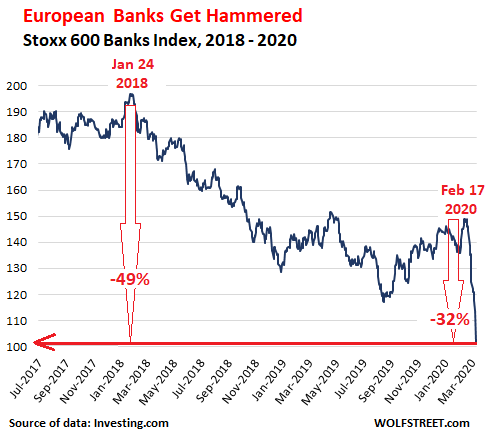
On Monday, the Stoxx 600 Banks index, which covers major European banks, plunged 13%. Today, after a knee-jerk bounce-back that then fizzled, the index closed essentially flat, back where it had been in March 2009. It has collapsed in a nearly straight line by 32% since February 17, when this latest Coronavirus-triggered sell-off began, and by 49% since January 24, 2018:

But it’s even worse: The Stoxx 600 bank index has collapsed by 82% since its peak in May 2007, after having quadrupled over the preceding 12 years. It was the frenzied height of the euro bubble and the sky was supposedly the limit for Europe’s biggest banks. Things got so crazy that for a brief moment in 2008, before it all come tumbling down, the Royal Bank of Scotland, now bailed-out and majority state-owned, was the world’s biggest bank by assets.

Here’s how far the shares of Europe’s largest publicly traded banks by assets fell on Monday (and in parentheses: at today’s close, since February 17):

  • HSBC (UK): -4.82% (-17%)
  • BNP Paribas (France): -12% (-33%)
  • Credit Agricole (France): -16.9% (-42%)
  • Deutsche Bank (Germany): -13.6% (-38%)
  • Banco Santander (Spain): -12% (-30%)
  • Barclays (UK): -9.81% (-32%)
  • Société Générale (France): -17.65% (-41%)
  • Lloyds Bank (UK): -8% (-24%)
  • ING (Netherlands): -14% (-37%)

Today, banks in Northern Europe rebounded a tad from yesterday’s lows. But banks in Italy and Spain, having started the day in the green, closed with some big drops:

  • Unicredit (Italy): -3.6% (down 10% from intraday high)
  • Intesa (Italy): -2.5%
  • Banca Monte dei Paschi di Siena (Italy): -6.3%
  • Banco Sabadell (Spain): -7.1%
  • Santander (Spain): -1%

Banco Sabadell’s shares have collapsed to a record low of €0.55, down 50% so far this year. Many in the industry are now saying that it is toast and will probably be merged with Bankia, which itself has lost over 40% of its market cap so far this year, and is still mostly owned by the state, which had created Bankia by lumping a gaggle of failed banks into one big lump during the Spanish financial crisis, and then floated some of its shares in a misbegotten IPO.

Three of the biggest sell-offs over the past three weeks were endured by France’s three largest lenders: BNP Paribas (-33%), Credit Agricole (-42%), and Société Générale (-41%).

These declines in share prices, while impressive for both their speed and size, represent just one more leg down in the relentless sell-off that began in May 2007 and has dragged the Stoxx 600 82% lower, to just below where it was in January 1988.

Continue reading the article on Wolf Street