Woodford’s Shuttered Fund Crushed Further by Plunging Stocks in its Holdings, such as Muddy-Waters Target Burford Capital

Hedge funds have field day front-running the liquidation. 300,000 investors left twisting in the wind

Neil Woodford, the manager of shuttered asset management fund, Woodford Equity Income fund, just had one heck of a black Friday. First came news that Link Fund Solutions, which manages the corporate governance of Mr Woodford’s investment vehicles, had slashed the valuation of cold fusion developer Industrial Heat, one of Woodford’s largest unquoted holdings, by around 40%, from £91.3 million to £55 million.

The move will shave 4.3% off the net asset value of the Woodford Patient Capital (WPCT) investment trust. Having plunged since the suspension of Woodford’s flagship Woodford Equity Income fund (WEI), shares in the trust dropped a further 5.5% on Friday to 41.5p and are now down 46% year to date. Industrial Heat is also held by WEI. Valued at £115 million at the end of December, that stake is now likely to be worth around £70 million, knocking around 1.4% off the fund’s value.

Then came the second blow: another big Woodford holding, British haulage company Eddie Stobart, announced that it was suspending trading in its shares and had fired its CEO after an accounting investigation had found the group’s profits had been overstated. Twenty-three percent of the company’s shares, already down 47% in the last year, belong to Woodford. As long as the shares remain suspended, there’s no way he’ll be able to sell them.

Continue reading the article on Wolf Street
Liquidity Crunch Mangles UK Equity & Real Estate Funds

Exodus from funds with illiquid assets forces more funds to block redemptions

Equity and property funds in the UK saw withdrawals of £2.5 billion in July, taking total outflows in 2019 so far to £12.4 billion, according to Morning Star data. Equity funds, with total assets of £691 billion, were down £1.6 billion in July and £10.6 billion so far this year. In a broad flight to safety, money market funds experienced their sixth consecutive month of inflows while investors poured £428 million into Fixed Income funds.

Morning Star analysts blamed the outflows from equity and property funds on fears over a UK recession and a no-deal Brexit. But there’s also a structural element at work: the mismatch in open-ended equity and property funds that offer investors daily redemptions while investing in assets that can take weeks or months to sell.

Few funds are as illiquid by nature as commercial property funds, which suffered £2.2 billion of outflows in the first seven months of this year. Just two funds — M&G Property Portfolio and Aberdeen UK Property — accounted for 89% of the £417 million of outflows in July.

“The prices of commercial property – which accounts for most of these funds’ investments – are heavily influenced by the macro environment and if investors believe a downturn is ahead, they are less likely to invest in property funds,” said Morningstar analyst Bhavik Parekh.

Continue reading the article on Wolf Street
HSBC Runs into Buzzsaw in Hong Kong & China, its Home Market Generating 75% of its Profits

HSBC’s pleas of innocence have won little sympathy in Beijing

Global banking behemoth HSBC has found itself on the back foot in recent months in its most important market, Hong Kong and China. The unexpected departure of three senior executives within a week, including its CEO and the head of key China business, sparked a broad sell-off of its shares, which are down 13% in just three weeks.

The world’s eighth biggest bank by assets, HSBC is also reeling from the after effects of increasingly violent political unrest on its home turf. Protracted demonstrations in Hong Kong, triggered by opposition to an amendment to the region’s extradition law, have become increasingly disruptive. The proposed bill has been suspended indefinitely, though not withdrawn. And the Asian financial center is facing its most serious crisis in decades.

At the same time, the weakening yuan is causing all sorts of problems for Hong Kong-based lenders. Citigroup analysts have even warned that it could result in a “drastic” decline in loans to mainland China clients as well as undermine asset quality. “We see bigger earnings risk to Hong Kong banks,” the bank’s analysts wrote, downgrading the rating on BOC Hong Kong to neutral.

Unlike BOC Hong Kong, HSBC’s headquarters are based in London. But it’s in Hong Kong where the bank first cut its teeth (laundering the proceeds from the British East Indian company’s opium trade) and where the lion’s share of its business is still done. In fact, as Bloomberg notes, “few if any of the world’s largest financial companies dominate a single market quite like HSBC does in Hong Kong, a city of 7.5 million people that accounted for roughly 60 percent of the bank’s pretax income in 2018.”

Continue reading the article on Wolf Street

Argentina Crisis Slaps Foreign Banks & Companies Operating in the Country

Peso collapse and inflation force Spanish companies and banks — second largest investors in Argentina, behind US companies — to tally their losses.

Having learnt their lesson, most European companies and banks have limited exposure to Argentina’s crisis-prone economy. One exception is Spain’s corporate sector, which, after the U.S.’s, has the most exposure to the South American economy, with almost €6 billion invested by its companies there, down from around €9 billion in 2011 after some divestments.

For many of those companies, Argentina is still an important source of revenues and profits. But those revenues and profits are getting slammed by the double whammy of a rapidly deteriorating economy and rampant inflation. Now, there’s the potential risk of yet another Argentine default to contend with.

The Argentine peso has slumped 25% since the primary election on Sunday. Stocks have crashed. The risk of default has surged to above 75%, based on the latest credit default swap levels. The peso is worth just 1.7 cents, having lost 68% of its value against the U.S. dollar in the last year and a half.

In June, before this latest episode of political and economic turmoil, annual inflation in Argentina was already over 55%. The lower the peso falls, the worse the inflation gets. Argentina was already deemed to have entered hyperinflation in 2018, meaning that overseas companies operating in the country that report in Argentine pesos now have to reformulate their financial statements, depreciating the value of assets in line with the rapidly soaring prices.

Continue reading the article on Wolf Street

One of World’s Construction Giants Admits Using Risky Hidden-Debt Loophole “Across Group.” Australian Subsidiary Crushed

This “crack cocaine for CFOs” was also extensively used by Carillion until it collapsed.

The world’s seventh largest construction and services company (by sales), with subsidiaries around the globe, Grupo ACS, has revealed it is making extensive use of reverse factoring, a controversial financing technique that played a key role in the collapse of UK construction giant Carillion. In a conference call with analysts, ACS chairman, Florentino Perez, said the firm has been rolling out factoring “across the group,” to “more efficiently manage cash flows and match revenues and costs over the course of the year.”

The admission by ACS that it is using reverse factoring of payables across its vast global empire has spooked investors, given the malign role this supply chain financing tool played in the collapse of Carillion. As Fitch ratings wrote in a report last year that reverse factoring essentially served as a “debt loophole,” enabling Carillion to hide the true scale of its growing debt load. But not indefinitely. In January 2018, it collapsed in almost free-fall fashion under the sheer weight of that debt.

The global operations of ACS, a Spanish company, are significantly larger than Carillion. Its decision to disclose its use of factoring was probably prompted by recent allegations from Hong Kong research group GMT about the rampant use of reverse factoring of payables and other “accounting shenanigans” at ACS’ Australian subsidiary, CIMIC, which is majority owned by ACS’s Germany subsidiary, Hochtief.

In a report released on April 30, GMT Research said that CIMIC, which builds many of Australia’s biggest infrastructure projects, was using “factoring agreements” with banks and financial institutions to create the illusion of cash flow, reduce the appearance of debt, and lower the appearance of its leverage ratios.

Continue reading the article on Wolf Street

Investor Sentiment Goes to Heck After Draghi’s Easing Promise

Bitter irony: As Draghi’s term is about to end, investor expectations plunge to where they’d been when he made his “whatever it takes” speech in 2012.

The Sentix economic index, a gauge of investor sentiment in the Euro Area, fell 7.9 points in August 2019 to minus 13.7, its lowest level since October 2014. The index has been on a downward spiral since January 2018 but in recent months the trend line has sharply steepened.

The index of investor confidence is meant to serve as a barometer of the general mood of people and institutions who are invested in bonds, shares, options and other financial instruments. It is run by the Frankfurt-based boutique investment firm Sentix and is based on a regular survey of investors from over 20 countries. It is less about the real economy than it is about the so-called “animal spirits” — the greed and euphoria, gloom and despondence, and fear and outright panic — of the investment community at any given moment.

And right now, those animal spirits, judging by the latest performance of the index, are subdued and dejected. The two basic measures of the index — investors’ opinion about the current state of the economy and how they expect things to be in six months’ time — both plunged to multiyear lows in August.

On the current state of the Euro Area economy, investor sentiment sank 9.2 points, to its lowest level since January 2015. The pace of deterioration “is increasing rapidly”, said Patrick Hussy, managing director at Sentix, adding that there’s no sign, as yet, of “the central banks being able to slow the trend”.

This is despite the fact that the ECB recently revamped its interest rate guidance and said it was preparing for yet more policy easing, including opening the door to a further rate cut and more bond purchases. It was the biggest gift Draghi has offered the markets since formally putting an end to the ECB’s quantitative easing program in December 2018. But since making the offer, on July 25, stock markets across Europe, rather than celebrating the news, have fallen sharply.

Continue reading the article on Wolf Street

UK Auto Production Plunges to 7-Year Low on Slumping Global Demand & “No Deal” Brexit Fears

Investment in the auto sector grinds to a halt

Production of vehicles in the UK plunged 20% in the first half of 2019, compared to the same period last year, as the fallout from sharply declining demand in key export markets such as Europe and China as well as fears of a no-deal Brexit took a heavy toll on the sector, according to the Society of Motor Manufacturers and Traders (SMMT). Engine manufacturing dropped 10% during the same period. And commercial vehicle production, until recently a rare silver lining for the embattled sector, collapsed 57% in June year-over-year, dragging down the first half by 15%.

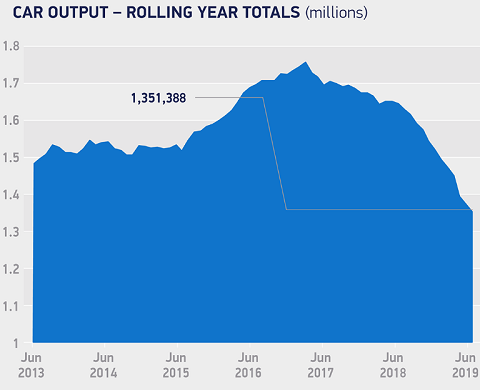
Britain’s car industry has now racked up 13 straight months of declining vehicle production and ten straight months of declining engine production. In 2018, car output fell 9.1% to 1.52 million units, a five-year low for the sector. But the way things are going, 2019 is likely to be a lot worse. This chart (courtesy of SMMT) depicts rolling-12-month car production totals:

Rolling-year total production — the total amount produced over the previous twelve-month period — hit a post-crisis peak of around 1.75 million units in mid-2016, just after the Brexit referendum. Since then, rolling year totals have fallen 23% to 1.35 million last month, down by around 400,000 units from the 2016 high. The last time it was this low was in 2012.

Continue reading the article on Wolf Street

ECB’s NIRP-Forever Policy “Destroys Banks’ Profitability Equation”: Bankia CEO. Spanish Banks Reel. Problems Stack Up

Spain’s Big Five banks (already down from the Big Six) could soon be four.

The ECB’s NIRP forever policy is crushing Eurozone banks’ ability to turn a profit, warned the CEO of Bankia, José Sevilla, on Monday. “It is clear that the current rate scenario is hurting the profitability of the banking business,” he said. “We think low rates are good and perhaps even desirable. But the same cannot be said of negative interest rates since they destroy banks’ profitability equation. Sustained over time — and we have been negative for five or six years now — they hinder and penalize the profitability of Spanish and European banks.”

In February last year, the formerly bailed-out lender launched an ambitious three-year plan (2018-2020) that included an earnings target of €1.3 billion for the third year. By this Monday, that plan was already dashed after the bank unveiled half-year profits that were down 22% year-over-year, prompting Sevilla to admit that the lender will not come even close to achieving its €1.3 billion target for 2020.

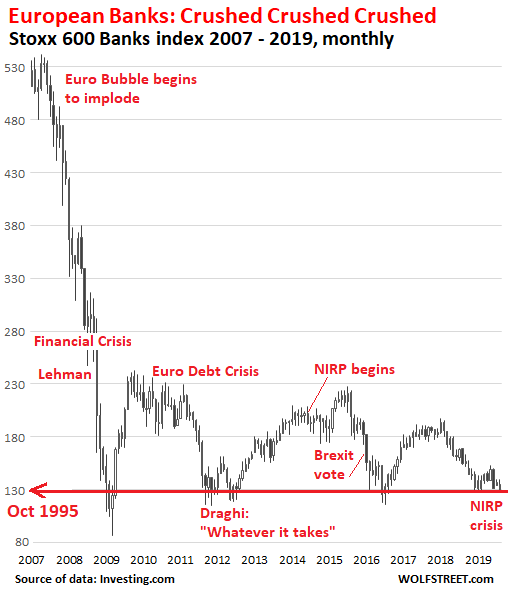
Over the last decade, as rates have gone from low to zero, to below zero, the shares of Spanish and European banks have been crushed, re-crushed and, for good measure, re-crushed again. Over the twelve years since May 2007, when Europe’s seemingly interminable banking crisis began, the Stoxx 600 bank index has plunged 75%, and is now back where it first had been in October 1995:

There are plenty of reasons for this spectacular decline, including the 2008 Financial Crisis, the Euro sovereign debt crisis that quickly followed, and the huge piles of non-performing loans that both of these crises left festering on many banks’ balance sheets. There have also been other aggravating factors such as Brexit and Italy’s ongoing banking crisis, which have further decimated investor confidence in the sector.

Continue reading the article on Wolf Street