“Betting sites have destroyed lives and must be left in the past, like a nightmare from which Brazil has finally awoken.”
Those are the words of Brazil’s four-term president, Luiz Inácio Lula da Silva. On September 25, just a week before the first round of presidential elections, Lula set his sights on one of the country’s fastest growing business sectors, online gambling, which he said was financially crippling Brazilian households. In his speech at the UN general assembly, Lula accused the betting industry of “transforming addiction into profit” and of “destroying homes”.
“Are we remaining passive while society drowns in debt?” Lula said. “Are we remaining passive while society is driven to madness – because this is an illness. People lose their minds; they contemplate suicide or abandoning their homes. So, we are going to take serious action.”
Lula’s maximalist response took many by surprise, even within his own party. Many had expected him to ban online casinos while leaving online sports gambling more or less untouched. Instead, the president, desperately fighting for political survival in a tightly fought election, signed a presidential order that effectively banned all fixed-odds sports betting.
The ban appears to enjoy broad public support. According to an Atlas Intel/Bloomberg survey in late September, 75% of respondents agreed with the ban on online betting platforms. Another 17% were opposed to the measure, while 8% say they neither agree nor disagree.
The presidential decree brought to an abrupt end the legal operation, intermediation and advertising of betting in Brazil — just eight years after it was legalised. The provisional order came into force immediately, but for it to remain in effect it will need congressional approval — by March 4. And that, as we will discuss later, is far from guaranteed.
The executive order prohibited new deposits into online betting accounts and gave users of betting platforms until 5 October to withdraw their funds. Lula’s government also drafted a bill to introduce new criminal offences for fixed-odds betting. Between September 25 and October 6, 13,241 illegal betting websites were blocked and thousands of pages and profiles on social networks were removed, according to the government.
Economic Impact
Today, two months after its entry into force, the ban is already having a major economic impact, including, apparently, on household income and spending as well as the financial fortunes of Brazil’s biggest football clubs.
As the Uruguayan news outlet El Observador reports, data from the Brazilian Supermarket Association (ABRAS), which covers everything from large hypermarkets to small neighbourhood stores, recorded a year-on-year increase of 6.5% in sales in the first week after the ban (October 5-11, 2026) and 6.3% in the second (Oct 12-18):
The rebound was primarily driven by demand for essential staple foods such as rice, soybean oil, noodles, and coffee. ABRAS attributes this trend to the recovery of household budgets after the exit of online betting houses, a phenomenon supported by records from the Central Bank of Brazil, which showed an initial contraction of 10% in PIX transfers that later stabilized at a 7% drop…
While private consumption in the country had already shown moderate expansion before, analysts agree that the withdrawal of gaming platforms from circulation acted as a direct catalyst for increased food demand.
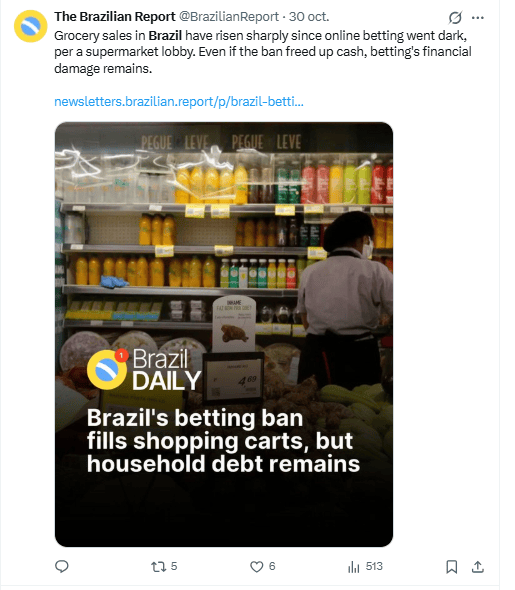
Though correlation does not necessarily equal causation, it is striking that consumption of basic food staples increased almost immediately after public access to legal online gambling sites had been blocked. Money that was being frittered away on gambling was suddenly available for more essential household goods. And this was reportedly the main goal of Lula’s presidential order: to remove one of the biggest burdens for Brazil’s increasingly indebted households.
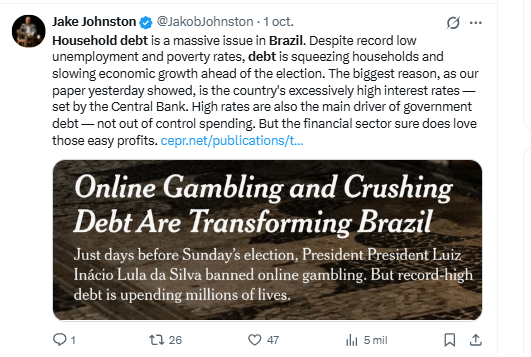
A Serious Gambling Problem
Like the US, Brazil has developed a serious gambling problem since legalising fixed-odds sports betting in 2018 and then regulating the sector in 2023. Like the US, Brazil has emerged from nowhere to become one of the world’s biggest betting markets (#1 in the case of the US, #5 in the case of Brazil). As in the US, the spectacular growth of this nascent sector has come at a very heavy price, reports the Irish Independent:
In 2024, online gambling losses drove an estimated 1.8 million Brazilians into debt. It is affecting the country’s most vulnerable households: In one month last year, hundreds of millions of dollars from the Bolsa Familia, Brazil’s largest welfare programme, were spent on betting platforms. Demand for treatment related to gambling addiction in the public health system has risen 140pc in five years.
Between January 2023 and March 2026, betting companies diverted an estimated R$143 billion ($24.5 billion) from retail trade in Brazil, according to a study by the National Confederation of Commerce of Goods, Services and Tourism (CNC), a volume equivalent to the combined Christmas sales in 2024 and 2025. According to the same confederation, some 270,000 families may have entered severe default (at least 90 days past due) due to online betting.
This mirrors many of the studies conducted in the US in recent years. A study cited by the FT in its article, “The Cost of America’s Sports Betting Habit“, found that $1 of online sports betting deposits corresponds with a reduction in net investment — aka, savings — of about 99 cents. The researchers also registered a sharp rise in credit card debt and the frequency of account overdraft, as well as a decrease in available credit. Credit ratings are also taking a sizable hit.
As NPR reports, a recent study from the New York Fed found that sports betting is linked to plummeting credit in the more than 30 U.S. states where the activity is legal, as well as in neighbouring counties where it was not:
Credit delinquency rates, primarily driven by missed payments on credit cards and auto loans, rose about 0.3% overall in states where sports betting is legal, despite legal sports bettors making up only 3% of the population. But, looking only at the 3% of the population who took up sports betting after their state legalized it, credit delinquencies spiked by more than 10% among gamblers. Credit delinquency means credit payments are at least 90 days past due.
That is not to say that everyone who engages in online gambling ends up losing their shirt. As a few FT readers were at pains to point out, the vast majority of gamblers have no trouble keeping their betting under control. So, why stop something that for the vast majority of people is harmless fun, and risk driving it underground?
The answer may be found in the ubiquity and ease-of-use of online gambling. Never before has it been so easy to place a bet on a sporting event, or a combination of sporting events. Via our smartphones, we all have a giant virtual casino in our pocket or handbag, and it’s open 24/7. It will also happily accept our credit — until the day our bank, or banks, put a block on it.
A Financial Nightmare for Brazilian Football
In a televised speech in early November, Lula highlighted the material benefits already being felt as a result of his government’s gambling ban:
The end of gambling is already having a positive impact on the economy. Without spending on bets, families have increased their consumption. Commerce sells more, industry produces more, and the wheels of the economy start turning again. Betting sites have destroyed lives and must be left in the past, like a nightmare from which Brazil has finally awoken.
But not everybody is pleased with the new reality…
Click here to continue reading on Naked Capitalism

