Neither Brazil nor Mexico, Latin America’s two largest countries and economies, have lent their support to the proposal.
As his job at the top of the Pentagon hangs in the balance, US Secretary of War Pete Hegseth toured Latin American over the past week, “on the hunt” (his own words) for “narcos”. In a speech at the US embassy in Caracas after signing a bilateral military cooperation agreement with the Delcy Rodriguez government, Hegseth said: “to the narco-terrorists who abuse this [Venezuela] as a safe-haven, we will hunt you down, we will find you, and we will kill you”.
The deal comes less than a year after the US bombed Venezuela, killing over 80 people, and kidnapped the country’s president, Nicolás Maduro, and his wife. Yet according to Hegseth, the US’ goal today is to “protect Venezuela from foreign actors.”
The deal is clearly a priority for Washington, reports Pirate Wire Services:
Venezuelan forces have carried out at least two domestic bombings with support from the US military: the killing of “Niño Guerrero,” a Venezuelan gang leader, in the Orinoco region, and an aerial strike on fighters from the Colombian rebel group, the National Liberation Army (ELN), in Apure.
Hegseth made it clear that US priorities are not repairing a badly damaged power grid that leaves most Venezuelans without electricity for 6-8 hours a day, or elections, but rather going after criminal groups the US considers a threat.
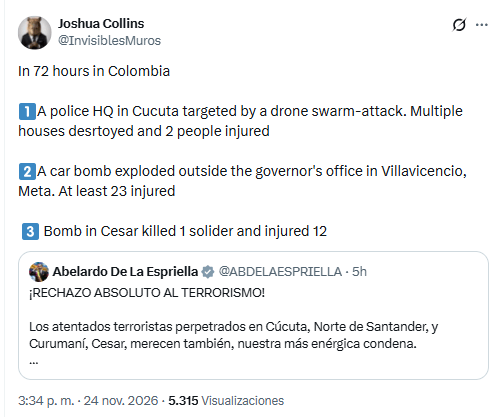
Hegseth’s next stop was Colombia, whose President Abelardo de la Espriella had just had to deny a New York Times report claiming that his government had rejected US participation in anti-drug operations on Colombian soil. Violence is rising rapidly in Colombia as de la Espriella steps up his crackdown on the drug cartels while also calling into question the 2016 peace agreement signed between the government and the FARC.
Hegseth also visited Honduras, where US military forces reportedly landed on Guanaja, a Honduran island in the Caribbean, on the morning of November 22 as part of an operation targeting a suspected drug trafficker. In Ecuador, Hegseth commended the government of US-born President Daniel Noboa’s “shared commitment to confronting narco-terrorist threats, strengthening border security, and delivering decisive results for our shared security.”
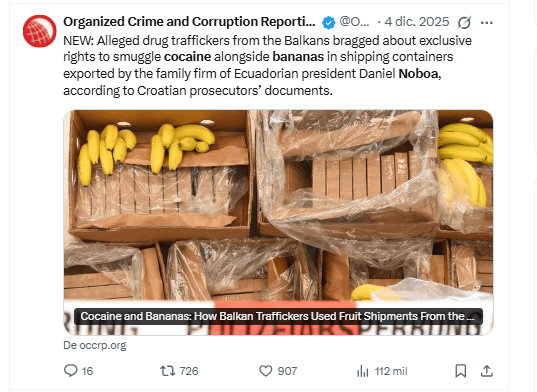
Ecuador is the world’s biggest cocaine exporter, despite not actually producing the drug. The Noboa family’s banana empire, Corporación Noboa, has been repeatedly implicated in the cocaine trade, with hundreds of kilos found in the companies’ banana shipments in recent years. Yet Hegseth praised Ecuador’s role “set[ting] the pace to confront narco-terrorist organizations and networks along the Eastern Pacific and their borders.”
As Ecuador has stepped up its military crackdown on the drug cartels, opening the doors not only to US troops but also US law enforcement agencies, the violence in the country has done nothing but grow, just as happened in Colombia in the ’90s and Mexico in the 2000s. Noboa’s government has also grown increasingly authoritarian, using worsening security as a pretext to persecute critics and implement aggressive military operations in the country.
As we have been warning for over three years, Ecuador is the template for Latin America’s future under the new Monroe Doctrine. The US is now trying to formalise this reality by activating a regionwide Cold War-era mutual defence pact against “narco-terrorism”.
Last Friday, the permanent council of the Washington-based (and controlled) Organization of American States called an extraordinary session to discuss cooperative action for dealing with organised crime and terrorism in the Americas. Twelve of the organisation’s member countries, including the US, the obvious instigator, proposed invoking the Rio Treaty (TIAR), a mutual defence pact signed in 1947, at the inception of the Cold War.
All 12 countries — Argentina, Chile, Colombia, Costa Rica, the Dominican Republic, El Salvador, Honduras, Panama, Paraguay, Peru, Trinidad and Tobago and the United States — are members of the Trump administration’s Shield of the Americas security alliance.
The move was first put on the agenda at a meeting of US regional (vass)allies at the US embassy in San José, Costa Rica, in September. At said meeting, the participants agreed to freeze assets, restrict visas, and sanction those who support 24 criminal organizations labelled by the US as “narco-terrorists”. The 24 groups:
- Mara Salvatrucha (MS-13)
- Tren de Aragua
- Carteles Unidos
- Cartel del Golfo (Gulf Cartel)
- La Nueva Familia Michoacana
- Cartel del Noreste
- Cartel de Jalisco Nueva Generacion (CJNG)
- Cartel de Sinaloa
- Gran Grif
- Viv Ansanm
- Los Lobos
- Los Choneros
- Barrio 18
- Cartel de Los Soles
- Clan del Golfo
- Primeiro Comando da Capital
- Comando Vermelho
- Chone Killers
- Los Viagras
- Juarez Cartel (La Línea)
- FARC Dissident Groups, including FARC-Estado Mayor Central, FARC-Segunda Marquetalia, or aliases, affiliates, and successor groups
- ELN
- Shining Path (Sendero Luminoso)
- Los Tiguerones
The participants at the San José meeting also agreed to co-sign a formal request to the President of the OAS’ Permanent Council calling for “a meeting of consultation to decide on the establishment of an Organ of Consultation under Articles 6 and 13 of the Inter-American Treaty on Reciprocal Assistance (Rio Treaty).”
On Friday, that proposal passed with ease, with 14 out of 18 votes in favour. The next move will see the region’s foreign ministers hold an extraordinary meeting within 75 days to consider diplomatic, legal or other measures. The resolution does not authorise armed force, but it does open the door to discussing collective measures under a treaty written for hemispheric defence.
Founded in 1947, the year the US kicked off the Cold War with the Truman Doctrine, TIAR has drawn inevitable comparisons with the North Atlantic Treaty Organisation (NATO), which came into existence two years later. One of TIAR’s most important clauses, article III, is almost identical to NATO’s article V. It states that:
“The High Contracting Parties agree that an armed attack by any State against an American State shall be considered as an attack against all the American States and, consequently, each one of the said Contracting Parties undertakes to assist in meeting the attack in the exercise of the inherent right of individual or collective self-defense recognized by Article 51 of the Charter of the United Nations.”.
However, the latest attempt to invoke the Treaty is based not on Article 3 but Articles 6 and 13, which read as follows:
Article VI: If the inviolability or the integrity of the territory or the sovereignty or political independence of any American State should be affected by an aggression which is not an armed attack or by an extra continental or intra-continental conflict, or by any other fact or situation might endanger the peace of America, the Organ of Consultation shall meet immediately in order to agree on the measures which must be taken in case of aggression to assist the victim of the aggression or, in any case, the measures which should be taken for the common defense and for the maintenance of the peace and security of the
Continent.Article XIII: The consultations shall be initiated at the request addressed to the Governing Board of the Pan American Union by any of the Signatory States which has ratified the Treaty.
The TIAR already has a chequered history. It was first invoked during the 1954 political crisis in Guatemala that led to the the CIA-backed ouster of President Jacobo Árbenz, who had expropriated unused land from the US-based United Fruit Company. It was also invoked in 1962 to exclude Cuba from the Inter-American System. In 2019, the Juan Guaidó interim government of Venezuela, which was formally recognised by the OAS, announced the possibility of invoking the TIAR to militarily remove Maduro from office.
In other words, while TIAR is ostensibly designed to protect parties to the treaty from external aggression by non-parties, a broad interpretation of its articles could allow for it to be used to treat an internal conflict as a matter of regional security. If, say, a US-aligned member suddenly erupts in nationwide protests, as recently happened in Bolivia, what is to stop that government from invoking Article VI?
As readers may have noticed, neither Brazil nor Mexico, Latin America’s two largest countries, accounting for approximately 55% of the region’s population and around 60% of GDP, have lent their support to the proposal to invoke TIAR. Brazil, together with Uruguay, voted against the proposal while Mexico could not vote because it left the treaty in 2002. Both countries have also refused to join Trump’s Shield of the Americas.
As Reynaldo Aragon writes for Pan American Dispatch, one of the main goals behind the US’ moves at the OAS is to encircle Brazil militarily:
“´The U.S. manoeuvring at the OAS confirms an escalation involving a fight for control of Latin American routes, resources and markets, and Brazil is at the centre of this offensive:
By tying drug trafficking and terrorism to collective defense, the coalition Washington has assembled moves the debate to ground where the gap in power among the countries of the Americas decides the outcome. Nobody has to fire a shot to disrupt trade, transportation and diplomatic relations. The measures only have to be approved. The treaty supplies the tools, and the balance of power will determine how they are used.
Brazil had offered another path. In an official note sent to the OAS before the vote, it called for tracing money and weapons, fighting money laundering, recovering assets and expanding police and judicial cooperation, all with respect for each state’s sovereignty. The choice is not between fighting crime and protecting sovereignty. The point is to keep the fight against crime from becoming a blanket license to concentrate power over other countries.
While Mexico may no longer be a party to TIAR, it was still able to express its rejection of the US-backed resolution. At the meeting on Friday, Mexico’s representative to the OAS, Alejandro Encinas, raised three serious objections to the activation of TIAR. From La Jornada:
First, [Encinas] urged against establishing “an automatic link” between organised crime and “terrorism,” since they are different phenomena, and categorically rejected the term narcoterrorism, which, he said, lacks an agreed definition.
He said that the unilateral designation of a criminal group as terrorist “does not change international rules on the use of force or authorize military operations in the territory of other states,” and that only the United Nations Security Council can make that determination.
Encinas recalled that the first time the TIAR was invoked was against the “democratic and legitimately elected” government of Guatemala, and that the episode culminated in the US’ 1954 intervention that overthrew Jacobo Árbenz.
He argued that the resolution does not reflect the will of all OAS members, since only the countries that follow the treaty voted.
“Drug trafficking does not originate in the southern United States. Organised crime is sustained by drug demand, arms trafficking, and money laundering,” Encinas added.
The Mexican diplomat could have also noted that the biggest global supporter of drug trafficking organisations over the past 70 years is the United States — as the CIA whistle-blower John Stockwell put it, “every major area of operation in which the CIA has worked has left behind a major functioning drug cartel” — but that would have probably meant overstepping the bounds of diplomacy.
What the Americas is now witnessing is a large-scale transformation in the political economy of organised violence throughout the region…

