It’s amazing what can be achieved when a government forgoes the neoliberal structural conditions prescribed by multilateral institutions.
Data from the World Bank’s (WB) international report on poverty and economic growth has confirmed that eight years of progressive, worker-friendly government policies has helped lift 17.3 million Mexicans out of poverty. That figure is roughly equivalent to one-eighth of the country’s population.
As Henry Moon Pie noted in response to a recent post, it’s amazing what can be achieved when a government actually does something for its people. It’s also amazing what can be achieved when said government forgoes the neoliberal structural conditions and economic governance frameworks prescribed by the two Bretton Woods institutions (IMF and World Bank).
Mexico’s last two governments have departed from the script by focusing on expanding incomes at the bottom of the rather than engaging in the usual trickle-down approach to policy. Indeed, one of former President Andrés Manuel López Obrador’s last acts in government, in June 2024, was to take the International Monetary Fund to task for predicting that Argentina’s austerity-governed economy would grow faster than Mexico’s between 2025 and 2027:
“It has just been announced that the International Monetary Fund declared that Argentina will grow more than Mexico, when the International Monetary Fund, with all due respect, was the cause of Argentina’s economic disaster.”
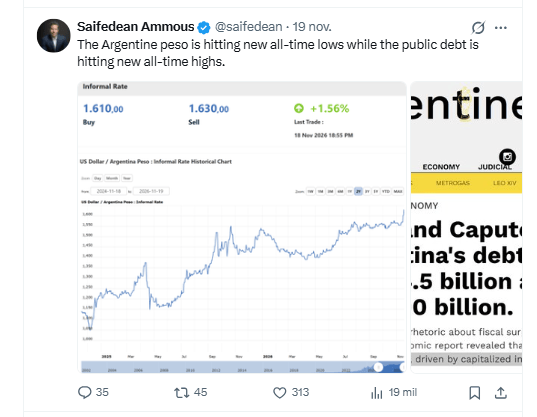
Since AMLO made that statement Argentina’s economy has necessitated two bailouts — one from the IMF and other multilateral organisations and the other from the US treasury — and may soon need another one. Economists are now predicting that Argentina just slipped into technical recession, after the economy contracted for a second consecutive quarter in the July-September period.
As Sovereign Media notes, the economic toll of Milei’s austerity on steroids, all of it fully endorsed by the IMF, is mounting, with 32,290 fewer registered employers between November 2023 and July 2026, a 6.3% decline:
There were also 437,611 formal jobs lost, according to the Centro de Economía Política Argentina (CEPA). Around 32.3% of Argentines are living in poverty during the first half of 2026, up from 28.2% in the previous semester. Meanwhile, consumer spending is down 2.7% during the first nine months of 2026 compared with the same period in 2025. Manufacturing, construction, and retail have been hit hardest by collapsing domestic demand, weakened purchasing power, and competition from cheaper imports.
Meanwhile, export-oriented sectors including energy, mining and agriculture are relative winners on paper, which exemplifies the growing divide between resource-driven growth and the struggling domestic economy. The business class elite are making money, but the overwhelming majority of working people are not.
Back in Mexico, the findings of the World Bank report echo a similar report published in 2025 by the United Nation’s Economic Commission for Latin America and the Caribbean (CEPAL), which estimated that Mexico had accounted for 60% of poverty reduction across Latin America and the Caribbean in the 2024, 30 percentage points above Brazil’s contribution.
“Today, the living conditions of millions of families have improved, purchasing power has been recovered, the minimum wage has increased, and social programs reach those who need them most,” said Mexico’s Secretary of Interior, Rosa Icela Rodríguez, during the government’s official daily press conference on Monday. Rodríguez was deputising for President Claudia Sheinbaum, who was attending the APEC Summit in Shenzen, China.
According to the World Bank’s projections, Mexico’s monetary poverty rate will be 20% in 2026, a decline of 15.3 percentage points compared to 2018, and 18.7% in 2028. The number of people living in monetary poverty in Mexico is projected to be 25.2 million in 2028, representing a reduction of 18.7 million people compared to 2018. In addition, the WB report estimates a 3.4-point decrease in inequality, with the Gini coefficient falling from 46 in 2018 to 42.6 in 2024.
From Sin Embargo (translation by Mexico Solidarity Media):
According to the projections published in October by the World Bank, eight years ago the percentage of the population living on an income below US$8.30 was 35.3. Meanwhile, the projection for 2026 is 20 percent.
This means that in 2018 around 43.9 million people lived in poverty, while a figure of 26.6 million is projected for 2026. A reduction of 17.3 million.
The calculation considers those living on less than US$8.30 a day, adjusted for purchasing power parity, and combines observed data through 2024 with estimates for 2025 and 2026.
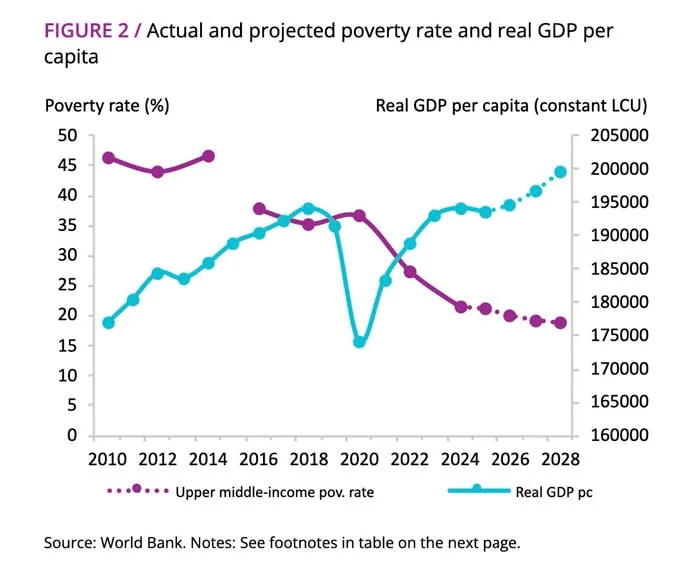
Table included in the World Bank report. Photo: Screenshot
The World Bank report identifies two main factors driving this trend: the AMLO and Sheinbaum government’s more than three-fold nominal increase in Mexico’s minimum wage, which broke with decades of contractionary wage policies; and their expansion of social programs, including universal cash transfers, such as pensions for adults, youth apprenticeships, and agricultural support.
As we reported In January this year, the AMLO and Sheinbaum governments’ double digit annual hikes to Mexico’s minimum wage have come in the face of stiff opposition from Mexico’s business, financial and political establishment, some of it ongoing. Meanwhile, the economic disasters those establishment figures forecast are yet to transpire:
A New Year’s Tradition
Double-digit minimum salary increases have become a New Year tradition in Mexico in recent times. Since 2018, the minimum daily salary has almost quadrupled in nominal terms, from the miserly 88 pesos (just under $5) granted by the former Enrique Peña Nieto government to today’s 315 pesos ($17.50).
As you can see in the graphic below, courtesy of Trading Economics, there have been seven steep increases in the minimum wage since December 2018, not counting the one that just went into effect.
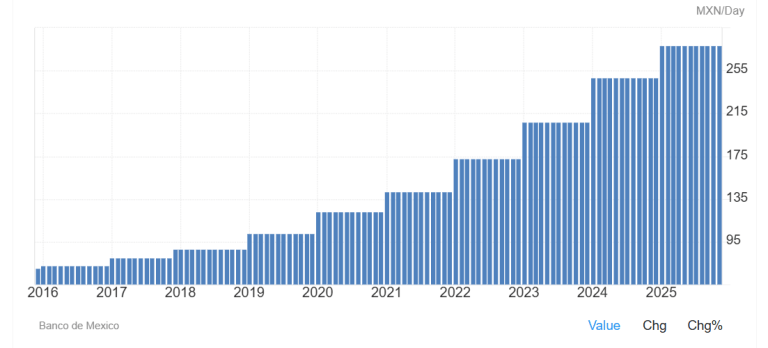
Accounting for official inflation, the latest minimum wage increase will bring the accumulated rise in salaries to 154% in eight years. Yet when the former leftist President Andrés Manuel López Obrador began this process, many opposition politicians, business leaders and economists warned that it would fuel inflation as well as risk higher unemployment.
Neither of these things have come to pass…
Click here to continue reading the article on Naked Capitalism

