The fallout of Ueno Bank’s collapse has quickly spread across the economy, leading to the collapse of Paraguay’s government and the arrest of eight bank executives.
On its founding in 2021, Ueno Bank, a subsidiary of the Vázquez Group, was a small fintech lender that operated almost exclusively through digital payment platforms. The lender did not even receive its banking license until 2023. Yet by 2026, it had grown to become one of Paraguay’s largest banks, with almost 3 million customers.
While that number may sound small by large-country standards, it is equivalent to 60% of Paraguay’s adult population. Hence the reason why the Central Bank of Paraguay’s decision at 3 a.m. on Tuesday morning — while most of the country was sleeping — to place Ueno in resolution was so consequential.
That decision left millions of customers’ savings and hundreds of millions of dollars in public pensions and funds in limbo. The fallout quickly spread across the economy and political establishment, leading to the collapse of Paraguay’s government, the resignation of the central bank governor and the arrest of eight Ueno Bank executives — something that would be unthinkable in the US or most European countries.
As Bloomberg reports, millions of Paraguayans woke up Tuesday morning to a very unpleasant surprise:
“We cannot display your balance. Please try again later.”
That was all 20-year-old nursing student Deisy Asva could see of her life savings on Tuesday morning when she attempted to log into her account at Ueno Bank SA, which caters to one in every three Paraguayans.
Regulators have insisted that the situation is isolated, and that deposits of up to 228 million guaranies ($37,400) would be guaranteed — which the central bank has 15 days to return. Still, that’s been little comfort to customers like Asva who are struggling to figure out how to pay for everything from rent and groceries to bus rides now that their deposits have been frozen.
For Asva, who lives in San Lorenzo, just outside Asunción, the shutdown means temporarily losing access to the account she used every day to reload her transit card, buy snacks at university and cover other routine expenses. She also has university fees due Saturday.
“With so much technology available nowadays, how can this take 15 days?” she said. “I’m going to have to borrow money from my family.”
The banking crisis had an immediate effect on Paraguay’s broader economy. The Association of Importers and Merchants has reported a 35% drop in sales at the country’s large stores. Consumption in the country has been semi-paralysed because money suddenly became inaccessible for over half of the adult population.
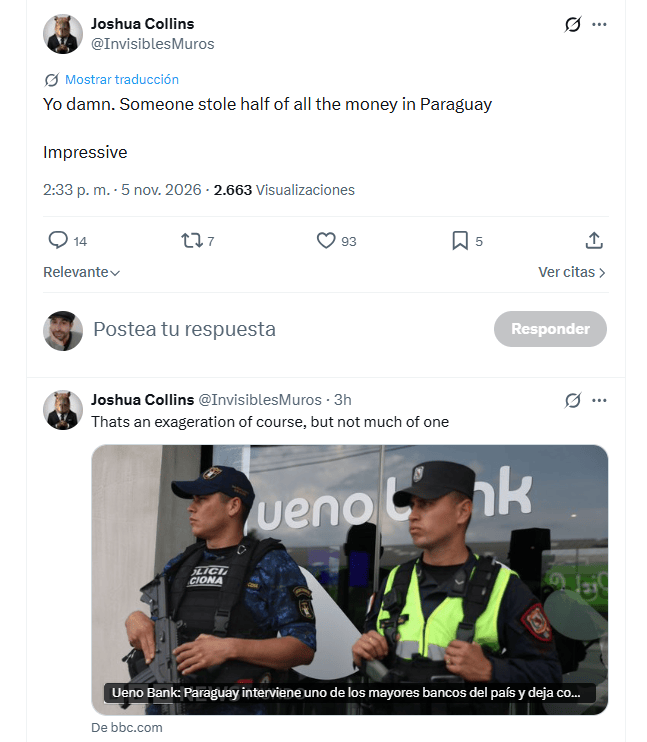
The central bank allegedly decided to resolve Ueno after discovering that its solvency ratio had fallen to 5.56%, less than half of the regulatory minimum of 12%. This was apparently the result of mandatory accounting adjustments that significantly weakened the bank’s financial footing. Ueno was also reportedly unable to replace a legal reserve of US$70 million.
The central bank’s intervention left Ueno Bank’s app and cards inactive, and froze both the savings of private customers and the funds of the State and tens of thousands of retirees. Ueno managed more than US$800 million of public money, including over $300 million of public pension and social security funds.
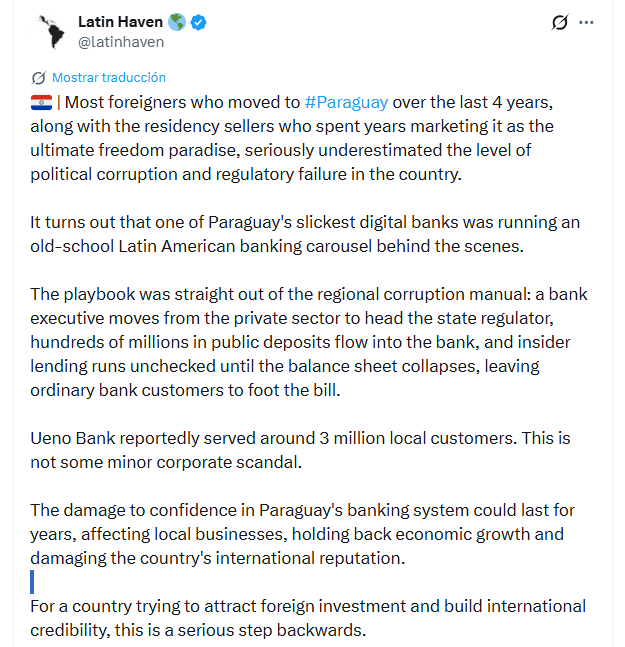
This was one of the main causes of public outrage. Why were public funds worth hundreds of millions of dollars entrusted with a bank with which both the country’s president and central bank governor had close business ties?
President Santiago Peña was a business partner of Grupo Vázquez, Ueno’s holding company, until March 2025 as well a close associate of the group’s main shareholder, Miguel Vázquez Villasanti. Meanwhile, the central bank governor, Carlos Carvallo Spalding, was a former executive of Ueno before being offered the reins of the central bank by President Peña.
It was all just a bit too incestuous, as the following tweet points out…
A Staunch US Ally
Peña, who came to power in 2023, is one of the US’s staunchest allies in South America, having pledged full support to President Trump’s Shield of the Americas initiative. In an interview with Bloomberg Television in Washington in February, after meeting with Secretary of State Marco Rubio, Peña described the US’ relaunch of the Monroe Doctrine as “a good idea” while playing down fears of a return to 19th century-style US colonialism:
“We are completely different, and the alliance we have built is different now, it is more solid and we consider ourselves allies. So it’s not about the United States going to colonize countries in the Western Hemisphere.”
For Peña, Trump’s revamped Monroe Doctrine represents an opportunity to strengthen regional cooperation and development, and not a threat of subjugation. Which is an interesting interpretation given that Washington is openly pushing for countries in the region, including Venezuela, to accept a permanent US troop presence on their soil.
Deposit Insurance Kicks In, But for Whom?
Back to Ueno, it is as yet unclear what will happen to the public funds entrusted with Ueno now that the lender has gone belly up. Regulators insist the bank’s collapse is an isolated case and that the country’s deposit guarantee fund will return to each saver deposits of up to 228 million garaníes (37,700 USD).
But the fund does not protect large institutional pension funds or major state-run investments — or at least is not supposed to. However, Paraguay’s Social Security Institute affirms that pensioners will not lose out as a result of Ueno’s collapse, reports abc (machine translation):
On Tuesday morning, authorities of the Social Security Institute (IPS), at a press conference, addressed the approximately 32,000 retirees who were paid by Ueno Bank and all retirees assuring that there will be no delays in the payments…
In this regard, the IPS informed retirees that they the payment they received through Ueno Bank will be migrated to other financial institutions. The aim is to complete the migration as soon as possible and ensure the continuity of payments.
Ninety-seven percent of depositors (around 2.8 million) are fully covered and should be made whole, according to official estimates. The remaining 3%, whose savings exceed the deposit protection limit, face a more gruelling process. For them, the extent to which they are made whole will depend on the assets available once the resolution process is concluded.
The Central Bank of Paraguay has 15 days to return the guaranteed funds to retail depositors. But as Bloomberg points out, that offers little comfort to customers like Asva, “who are struggling to figure out how to pay for everything from rent and groceries to bus rides now that their deposits have been frozen.”
Over the past 72 hours, the normally quiet streets and squares of the capital Asunción have been engulfed in protests and riots. On Tuesday, thousands of the bank’s customers assembled to demand answers. In some areas, clashes broke out between protesters and police, especially when a group tried to march on the headquarters of the National Congress before being intercepted by security agents.
On Wednesday, when the central bank temporarily suspended withdrawals from certain mutual funds linked to Ueno on Wednesday, the uncertainty grew. Thirteen mutual funds run by five different firms have frozen withdrawals because their money was invested in Ueno.
Political Fallout
To ease the tensions, the Santiago Peña government signed into law an emergency plan that will allow the affected bank depositors to receive an advance of around $19,780 from the Deposit Guarantee Fund. The law was approved by a majority in both the Chamber of Deputies and the Senate. Meanwhile, the political fallout continues to grow.
The president of the central bank, Carlos Carvallo, who was formerly president of Ueno, was prompted to resign by Peña. Eight of the bank’s executives, including its CEO, Miguel Vázquez, are under arrest. The blossoming scandal also ended up toppling the government of President Peña, who faces accusations of conflicts of interest.
Political opponents believe that the central bank was complicit in financial fraud by not raising the alarm early enough about the bank’s growing risks. At the request of 35 legislators, the Chamber of Deputies held an extraordinary session on Thursday to vote on a request for Peña’s impeachment.
The request for impeachment accused Peña of “poor performance of his functions in the exercise of office” as well as engaging in a conflict of interest, diversion of pension funds and the central bank’s institutional cover-up. The fact that the leadership of the centre-right Partido Colorado, which holds a majority of seats in Paraguay’s two legislative chambers, pledged its support for Peña’s impeachment on Wednesday did not bode well for Peña.
During the emergency session, lawmakers voted unanimously to launch impeachment proceedings against Peña over the crisis. Peña preempted the proceedings by announcing his resignation before the vote was cast. In a video message posted on Twitter, Peña apologised to the people, adding that he was facing “one of the most difficult moments” of his life:
With my heart set on Paraguay and with the conviction that our republic must always come before any person or circumstance, I have decided to submit my resignation as president of the republic.
But how did a bank that did not even exist six years ago grow so big, so quickly that within half a decade its customer base included almost two out of three Paraguayan adults?
Continue reading on Naked Capitalism

