Journalist covering global financial, economic, and political developments
The US and Israel’s Planned Takeover of Latin America Hits a Rather Large Snag in Brazil
President Lula’s “mathematically difficult” electoral victory has put a huge spanner in the works of the US’ Donroe Doctrine.
On Sunday, Brazil staged one of the most dramatic electoral comebacks of recent history. Incumbent President Luiz Inácio Lula da Silva managed to beat Flávio Bolsonaro in the run-off of the presidential elections with 64,256,232 votes (51.8% of the vote share) to Bolsonaro’s 59,826,041 votes: a difference of more than 4.4 million votes.
Such an outcome seemed almost impossible just three weeks ago, when Bolsonaro won the first round with 47.03% of the votes to Lula’s 45.16%. Bolsonaro’s Liberal Party, including three members of his family, captured an additional 23 seats in the lower house and nearly doubled its Senate seats, mostly at the expense of centrist parties.
The first-round winner has never lost a Brazilian presidential runoff. That said, the first round has never been this close before.
As the Brazil-based English football pundit Tim Vickers put it: “mathematically difficult, but politically possible.” If anyone could pull it off, it was Lula, whose victory cements his legacy as the first Brazilian president to be democratically elected for four terms. He also managed to pull off a huge, unprecedented swing of over 5.5% in only three weeks.
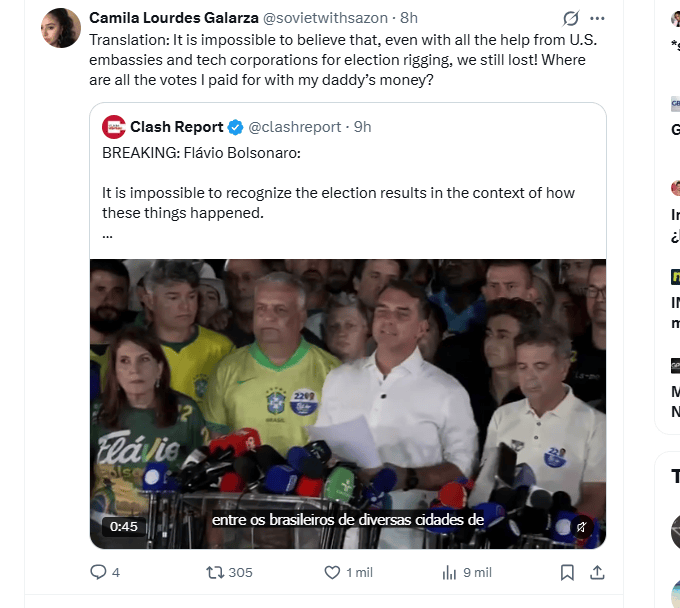
His opponent, Flavio Bolsonaro, initially responded to the defeat much like his father did in 2022 — by refusing to accept it. Later on in the day, he effectively threw in the towel minutes after President Donald Trump indicated he would not intervene on his behalf.
Around the same time, Brazilian authorities ordered Flavio, who is under investigation over his possible involvement in a money-laundering scheme, to surrender his passport in order to prevent him from leaving the country, as his brother, Eduardo, did last year.
As many are noting, Lula did not just defeat Flavio Bolsonaro on Sunday, he defeated:
Presidents Trump, Netanyahu and Milei, who had all supported Bolsonaro and mobilised the power of their respective State machinery to ensure their candidate won. The US and Israel have meddled in multiple elections in Latin America over the past two years.
O Globo, Brazil’s biggest media corporation, which backed Bolsonaro to the hilt after Lula passed a decree banning online gambling in the weeks leading up to the first round of the election. O Globo has significant interests in Brazil’s online gambling sector.
US big tech giant Meta, which did everything it could to restrict messages and content on its Facebook and Instagram apps promoting Lula’s campaign while boosting content promoting Bolsonaro’s. Also, a study by the Eko organisation found that AI platforms like ChatGPT, Gemini, Grok, and Meta AI, were almost universally directing users towards right-wing candidates.
Wall Street, whose banks and payment card duopoly, Mastercard and VISA, are rightly terrified of Pix, Brazil’s free-to-use digital payments system, which Lula has refused to modify to the their tastes.
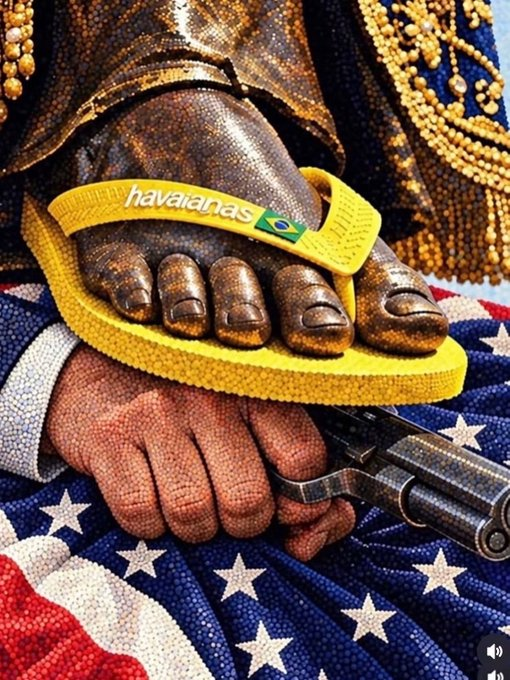
As the title of this post and the picture below suggest, Lula’s victory also represents the first major strategic setback for the US and Israel’s planned takeover of Latin America, which we will discuss in short order.
But first, how did Lula pull off this historic comeback?
There are, I believe, three main reasons, though readers better acquainted with Brazil may know of others.
1.Online messaging. Following Lula and his Worker Party’s first round drubbing, a little known deputy called André Janones created the WhatsApp channel “Lula’s Army”, whose number of followers would surge from 50,000 to 10 million in just three weeks. The goal of the initiative was to control the online messaging for the election as well as saturate opponents’ publications with comments or counter-disinformation narratives.
Janones argued that progressive election campaigns in Latin America had made the mistake of responding to their rivals’ digital provocations with elaborate, lofty speeches, as if we still lived in an analogue world. Instead, he called for combating disinformation campaigns using the same tools as populist-right parties: vertical content, attention-grabbing headlines, plain language and appealing directly to the feelings of the audience.
“Lula’s Army” became a massive turnout machine, as explains an article by Payday Report that was featured on yesterday’s Links page:
It… threw massive parties that brought joy to a movement when Lula was trailing, including massive 1-million-person rallies on Copacabana Beach. Those rallies motivated people to go out and find those votes. For more about how this dynamic worked, check out our video from the 1-million-person rally on Copacabana Beach.
Crucially, Lula radicalised his messaging in the weeks before the run-off, rather than tempering it to appeal to moderate voters, as most left-leaning candidates tend to do. There was also a clear focus on the existential threat a Flavio Bolsonaro presidency would pose to basic pillars of Brazilian society (bolsa familia welfare payments, the public health system, public education, the Amazon rainforest).
The results speak for themselves. Turnout on Sunday was 80.8 percent, nearly 2 percent higher than the previous round. While Bolsonaro gained three million additional votes between the first and second rounds, Lula gained a whopping 10 million.
2. Flavio’s abject flaws as a candidate. Between the first and second rounds of the election, Flavio was clearly going to be stress tested, and his weaknesses quickly became apparent, says Vickers. Those weaknesses include his murky business dealings, his lack of professional experience (outside of his father’s bubble) and his links with paramilitaries and rogue law and order professionals.
3. Flavio’s “Nine Fingers” Jibe. Presidential elections are often decided by fleeting moments of inspiration or ignominy. In this case, it was the latter.
During the second of the two presidential debates, just two days before the second round vote, Bolsonaro mocked Lula’s “nine fingers”. He said that Lula, with one hand, gave to the people and then stole everything he could with his nine fingers. It was a catastrophic misjudgement on Bolsonaro’s part given that Lula lost the small finger on his left hand in an industrial accident aged just 17.
After Lula responded in the only appropriate manner — i.e., grossly offended — Bolsonaro had little choice but to apologise. As the Mexican journalist Témoris Grecko notes, it was Bolsonaro’s arrogance that sealed his fate (machine translation):
He, who has never worked and who owes everything to his father, made fun of someone who had to work since he was a teenager and lost a finger because of it. The “nine-fingered” thing is a joke that Bolsonarism laughed at… until it killed him with votes. It also gave Lula the perfect opportunity to show who represents privilege and who represents the worker.
3. The Trump-Netanyahu-Milei connection. In his comments to the media after casting his ballot, Lula draped his speakers podium with the Brazilian flag and then pointed to it and said: “We’re going to live in a country where the respected flag is this one, because on the other side they campaigned with this flag, but they want to govern with the American flag. We campaigned with this one, govern with this one, and win or lose with this one.”
Given how long a shadow Washington — and, of course, Israel — have cast over elections in Latin America over the past two years, the prospect of much greater US (and Israeli) meddling in Brazilian affairs was probably already on quite a few voters’ minds.
There is also the Milei connection. As readers may recall, Milei intervened in Brazil’s elections before the first round by calling Lula a “thief” and a “prisoner” at a campaign event for Flavio Bolsonaro. Like Santiago Abascal in Spain, Bolsonaro has repeatedly spoken of emulating Milei’s “chainsaw” economic model in Brazil.
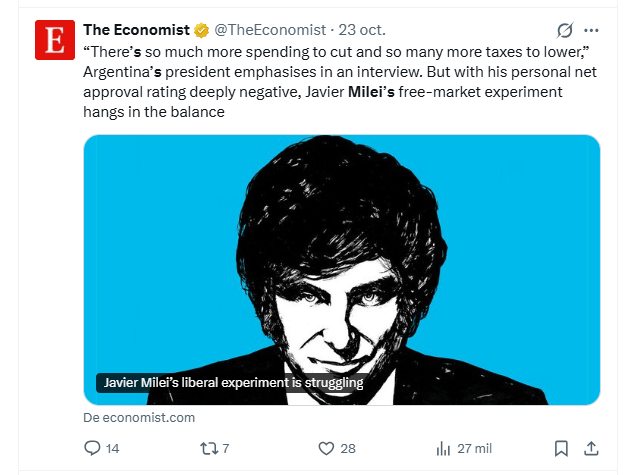
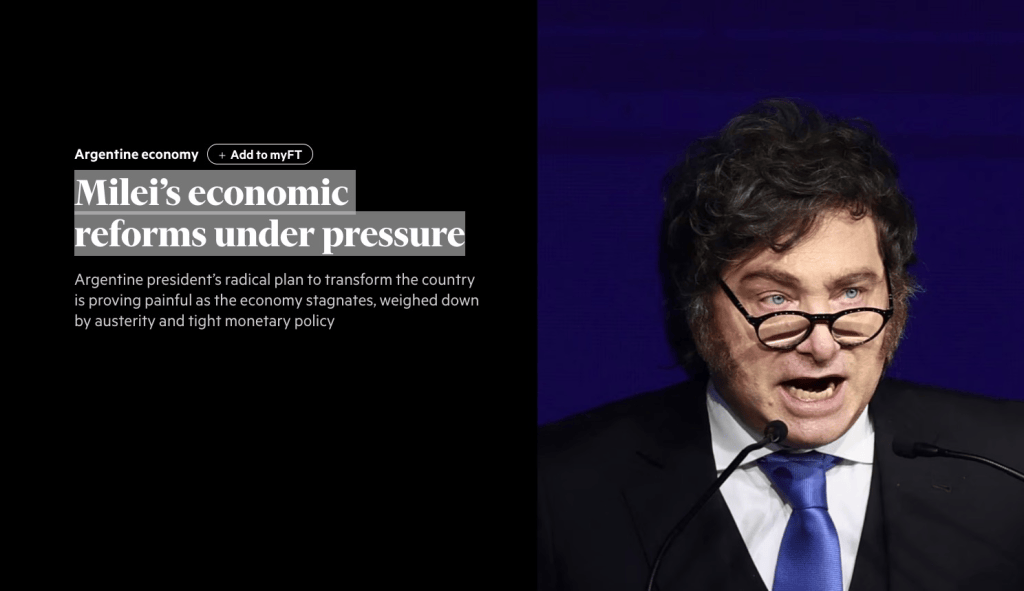
The problem for the likes of Bolsonaro and Abascal is that that economic model is now showing serious cracks, despite the $82 billion in bailout money the Argentine State has received from multilateral lenders and the US treasury over the past two years. Even Wall Street banks and the Anglo-American financial press are beginning to sound the alarm.
As the Spanish commentator Cesar Vidal pointed out, tongue firmly in cheek, how could Bolsonaro possibly lose if he had Trump, Netanyahu and Milei in his corner?
An Uphill Struggle
Incidentally, as of Monday afternoon Milei was the only Latin American leader yet to recognise Lula’s re-election. This is perhaps unsurprising given he bet the future of Argentine relations with its biggest trade partner (for the past 35 years no less) on a Bolsonaro victory. Now that Lula has won a fourth term, Argentina faces an even more uncertain economic future.
It’s also true that Lula will face an uphill struggle getting legislation through a Congress dominated by right-wing parties, including Bolsonaro’s Liberal Party. Per AP, “if right-wing and centrist lawmakers unite, they will command a simple majority in the 513-seat lower house and could even assemble a supermajority in a broad alliance to change Brazil’s constitution.”
As Fiorella Isabel notes, this is one of the reasons why so many members of the liberal classes like Lula — not only is he safe enough to the social democrats in Europe and the West but also because Brazil’s right-wing Congress is going to be controlling him at every turn…