Did The Canary just go down in history as one of the first media outlets in the United Kingdom, if not the first, to be put out of business by debanking?
Yesterday (Oct. 19), the British left-wing news website The Canary announced that it is closing its doors “indefinitely” after 11 years of journalism. The outlet, founded in October 2015, weeks after the election of perennial backbencher Jeremy Corbyn to the leadership of the Labour Party, was de-banked by Lloyds Bank in late June.
Now, the Canary has closed its doors “indefinitely”. In its public statement, the news outlet has promised to set the record straight on what actually led to its downfall:
“It is not over. This week, we will publish what really happened at the Canary and push back against the vicious campaign against our team and us. We may be down, but we’re not out yet.”
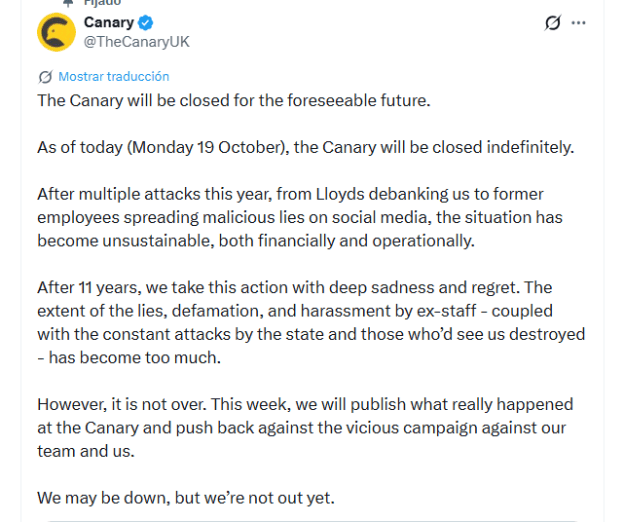
The Canary, which branded itself as an anti-austerity, anti-Zionist and pro-freedom of expression platform, accused its main banking provider, the Lloyds Banking Group, of “withholding a substantial amount of our money” in late June. As tends to be the case, no explanation was given. In September, another lender, Metro Bank, allegedly withdrew its banking services, prompting the outlet to suspend operations.
Following yesterday’s announcement of The Canary‘s closure, attention is now turning to the actual causes of its downfall. The immediate catalyst appears to be the debanking by Lloyds, which unexpectedly froze access to a substantial chunk of the company’s funds, severely crippling its day-to-day cashflow.
Former employees, however, have alleged that the organisation’s demise was primarily the result of “wider financial mismanagement”, including the squandering of funds on a short-lived nationwide newspaper, which folded after a matter of weeks. Employees have also claimed that they were asked by management to sign “non-negotiable” non-disclosure agreements and told that if they refused, changes would be made to their employment contracts.
Presumably, a clearer picture will emerge over the coming months amid the inevitable airing of dirty laundry. But even if things were already bad at The Canary, as former staff claim, the cancellation of banking services by Lloyds would not have helped matters. Indeed, it probably served as the proverbial straw that broke the camel’s back.
The question is: why were those services cancelled?
If it was for political reasons, it would not be the first time The Canary has been the target of a politically driven financial attack. Labour Together, the factional British think tank set up in 2015 by Morgan McSweeney, the recently disgraced political strategist and former Downing Street chief of staff under Keir Starmer, “to delegitimise and destroy” Jeremy Corbyn and restore the Labour right to power, tried to bankrupt The Canary, one of Corbyn’s biggest pillars of support.
As UK Declassified reports, “the key weapon they alighted on was allegations of antisemitism”:
Labour Together aimed, McSweeney wrote in an early confidential strategy paper, to cultivate “seemingly independent voices to generate and share content to build up a political narrative and challenge fake news and political extremism.”
One of these was the campaign group Stop Funding Fake News (SFFN), which later morphed into the Centre for Countering Digital Hate.
One of its first targets was The Canary, a pro-Corbyn website that was achieving 8.5 million hits a month.
Working closely with the anti-Corbyn Jewish Labour Movement, the book says McSweeney secretly recruited Countdown co-presenter Rachel Riley to front a campaign targeting The Canary’s advertisers with claims the outlet was antisemitic.
The Canary was later cleared by the independent regulator Impress…, but the damage was done. The Canary “went down from 22 staff to one member of staff within a few months of us targeting it,” SFFN crowed.
The actual setting in which the Centre for Countering Digital Hate’s CEO and founder, Imran Ahmed, made this statement was a conference on internet anti-semitism organised by the US State Department.
Given this backstory, it’s not too far fetched to imagine that Lloyds Bank, and perhaps also Metro Bank, chose to sever their ties with The Canary due to its “extreme” opinions on the Israel Palestine question. If true, The Canary goes down in history as one of the first media organisations in the collective West, if not the first, to be put out of business by debanking.
As readers may recall, Wikileaks, whose operations were originally based in Sweden, faced major operational disruption when financial institutions including Visa, MasterCard, PayPal, Bank of America, and Western Union cut off all donation processing to the site in 2010, after the massive “Cablegate” scandal. The financial blacklisting reportedly wiped out 95% of the publisher’s revenue, but it was still able to soldier on.
The National Union of Journalists (NUJ) condemned Lloyds Bank’s debanking of The Canary as a “disturbing precedent for UK press freedom”. Commentators from across the political spectrum have warned that the establishment’s ability to cripple media organisations critical of them creates a hostile environment that will pressure other news outlets to fall into line or face similar potential backlash.
“Debanking is arguably the most pernicious form of cancellation,” asserted the Free Speech Union. “Banks must not have the power to effectively shut down an organisation — let alone the media — by removing their access to their funds purely because they and their staff disagree with its views or ideology.”
Following the furore triggered by Coutts’ debanking of Nigel Farage in 2023, a parliamentary committee found that more than 140,000 businesses had had their accounts closed by the UK banks in the previous year. The reasons cited included concerns over financial crime and fraud, customers’ failure to provide requested information and the banks’ own risk appetite.
However, a resulting government enquiry concluded that customers were not being “debanked” for political reasons. As a result, not only has debanking continued but debanked customers now face the prospect of being blocked from setting up new accounts at other banks…
Click here to continue reading on Naked Capitalism

