Those resources include the world’s largest deposits of lithium, huge deposits of oil and gas, rare earth minerals, gold and silver, and the planet’s largest freshwater reservoir.
In January 2023, the then-commander of US Southern Command, General Laura Richardson, gave a speech to the Atlantic Council. In that speech she laid out in disarmingly frank terms why the US is showing a renewed interest in Latin America: its abundant natural resources, including “rare earth elements, lithium, gold, oil, natural gas, light sweet crude (huge deposits of which have been found off the coast of Guyana), copper, abundant food crops, and fresh water.”
General Richardson also voiced one of Washington’s biggest concerns — that many of those resources were being sold to the US’ peer rival, the People’s Republic of China (PRC). Its number-two adversary, Russia, had close strategic and military ties with a number of Latin American countries.
Richardson told the Atlantic Council’s virtual audience that US Southern Command was working with its allies and US embassies in the region to “box out” China and Russia from Latin America’s strategic resources, noting that “in some cases our adversaries have a leg up. It requires us to be pretty innovative, pretty aggressive and responsive to what is happening.”
At that time, those words seemed somewhat fanciful though we did warn that the threat should not be taken lightly given “the US’ long history of interfering in its neighbours’ affairs while sowing discord, conflict and chaos across the region”.
In January 2023, most of the major economies of Latin America, including Mexico, Brazil and Colombia, had governments that were at least somewhat independent of Washington. None of them had agreed to provide support for the war in Ukraine or impose sanctions on Russia. When the genocide in Gaza began, the region would become one of the main opposition fronts to Israel’s war crimes.
China was already South America’s biggest trade partner. The US still held sway over Central America and was still Latin America’s largest trade partner as a whole. But that was primarily due to its gargantuan trade flows with Mexico, which accounted for 71% of all US-LatAm trade. As Reuters reported in June 2022, if you took Mexico out of the equation, China had already overtaken the US as Latin America’s largest trade partner.
Fast forward to today, China still has an enormous — and perhaps even still growing — economic footprint in Latin America, but it has lost strategic influence among the region’s governments. That is largely due to concerted pressure from the Trump administration as well as a massive rightward shift that has taken place in recent elections.
Of the past 16 presidential elections in Latin America and the Caribbean, right-leaning candidates have won 13 of them. Those candidates have had a little help from Washington, of course. The Trump administration has used a combination of voter intimidation tactics (e.g., Trump’s threats of economic catastrophe in Argentina, Honduras and Colombia if voters voted the wrong way) and massive social media disinfo campaigns to tip the scales in their favour.
The main playbook, attributed to former Trump advisor Steve Bannon, is to “flood the zone” with an endless torrent of executive orders, controversial statements, insults, denunciations and plain old lies, with the aim of overwhelming the opposition and sowing total confusion among the electorate. It is an approach that has already worked wonders for Trump 2.0.
The social media campaigns were carried out under the direction of Fernando Cerimedo (aka MAGA’s Man in Latin America), who is — or at least was — under investigation in Bolivia on a host of criminal charges, including attempted murder and drug trafficking. Last week, the man leading those investigations, Bolivia’s then-Attorney General, Roger Mariaca, was abducted by Bolivian security forces, at Washington’s behest, and now faces drug trafficking charges.
The US and Israel have also exploited the rapidly expanding influence of Evangelical churches in Latin America. Those churches have already played a major role in recent elections in Colombia, Costa Rica, Honduras and the first round of elections in Brazil.
Evangelical voters, once again, massively favoured the Bolsonaro candidate over Lula 62% to 29% in Datafolha’s pre-election poll, while Lula has a comfortable lead among Catholics. In Congress, 210 deputies, 40% of the Lower House, are part of the Evangelical bloc, which defends conservative social positions, including opposition to abortion.
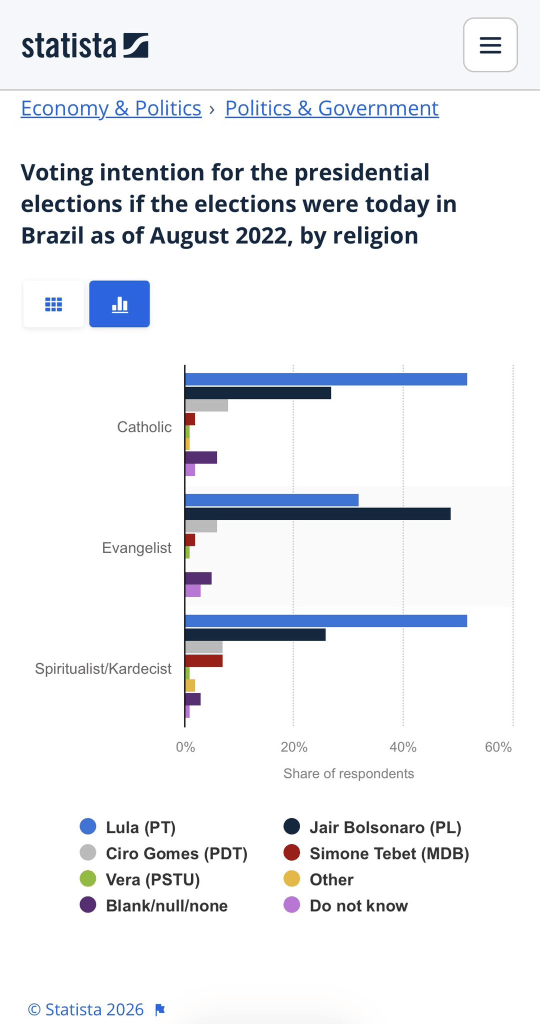
This has been a long time coming. Through a USAID program, the CIA deployed evangelical preachers across Latin America in the 1970s in order to curb movements considered too Marxist within the Catholic Church, such as Liberation Theology. Against a backdrop of dirty wars and Operation Condor, the agency’s aim was to replace the revolutionary spirit with the pursuit of personal enrichment. And it has worked like a (nightmarish) dream.
As the twitter thread below by Mint Press News outlines, this is one of those rare moments where the US government planned for the long term. Washington’s plans were also assisted by Pope John Paul II, who strongly opposed and suppressed Liberation Theology, viewing its focus on radical politics as a dangerous secular drift. The Catholic Church’s suppression of Liberation Theology opened the way for the rise of evangelical churches throughout the region:
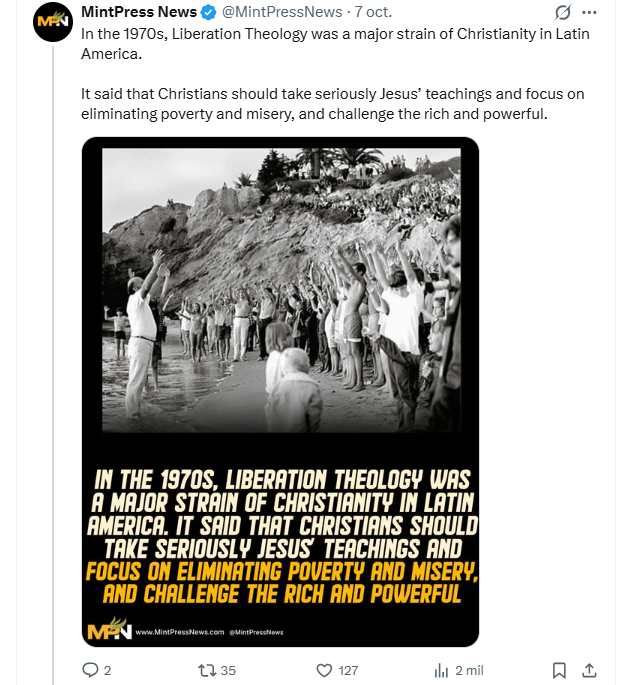
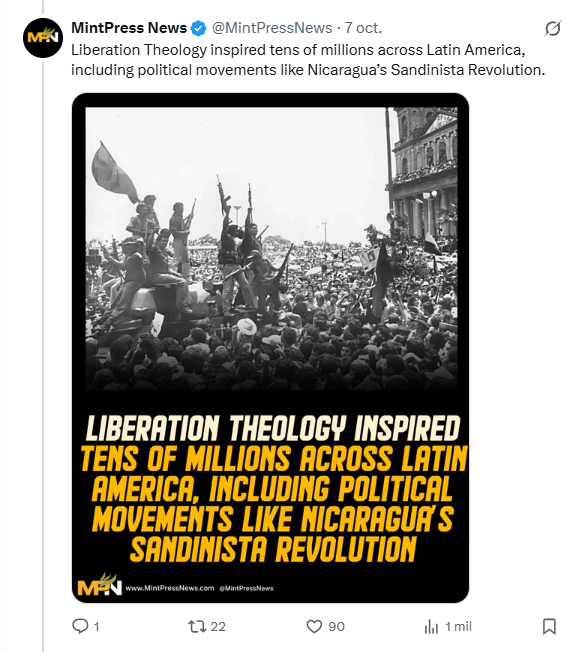
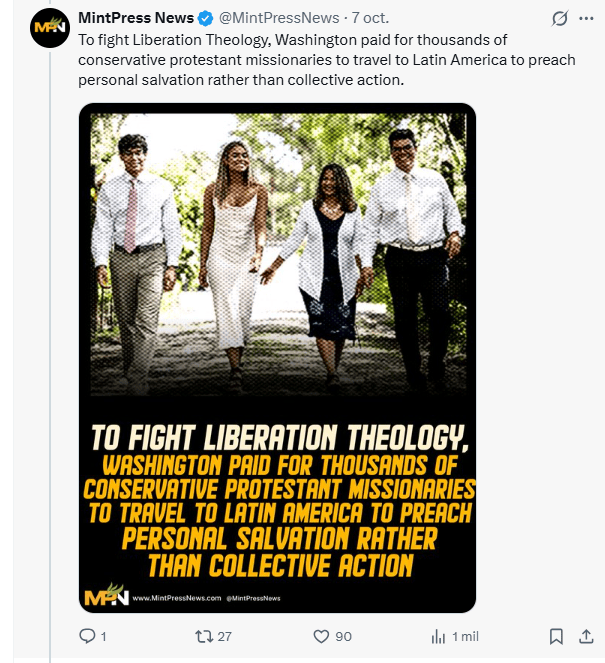
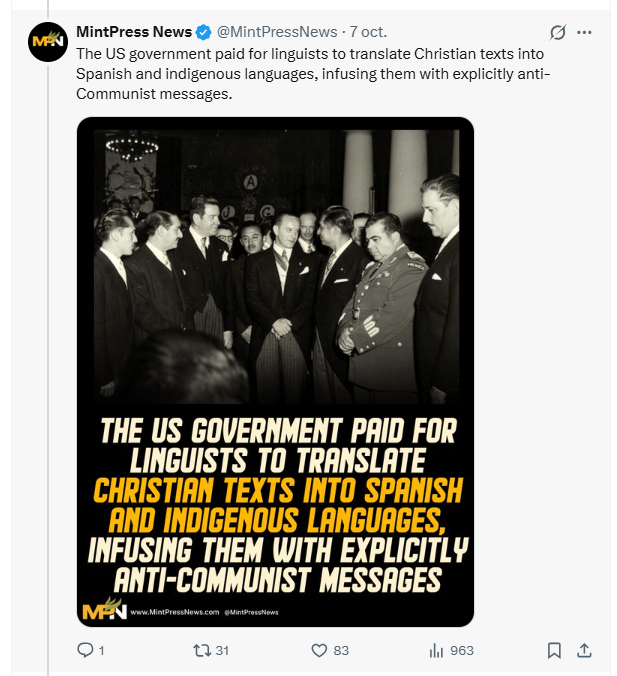
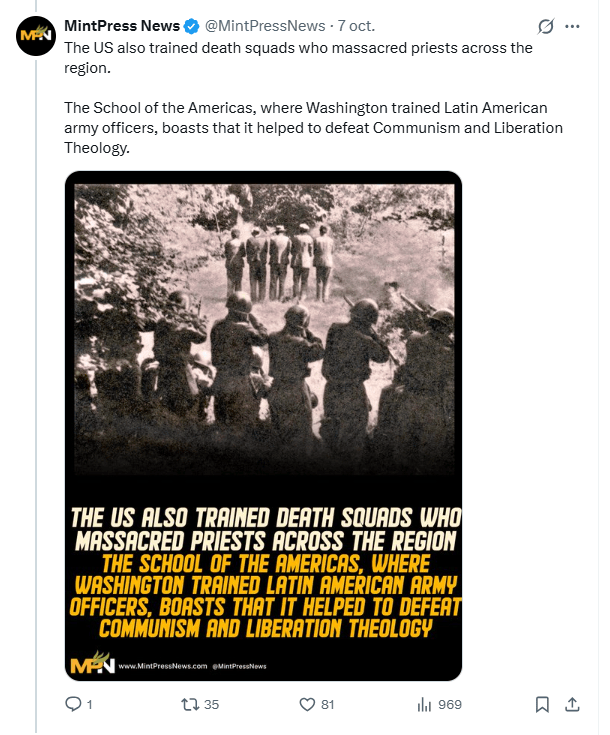
Today, Evangelical and Pentecostal Protestantism are the dominant religion across large swathes of Latin America. Like US megachurches, congregations are often highly conservative and extremely Zionist.
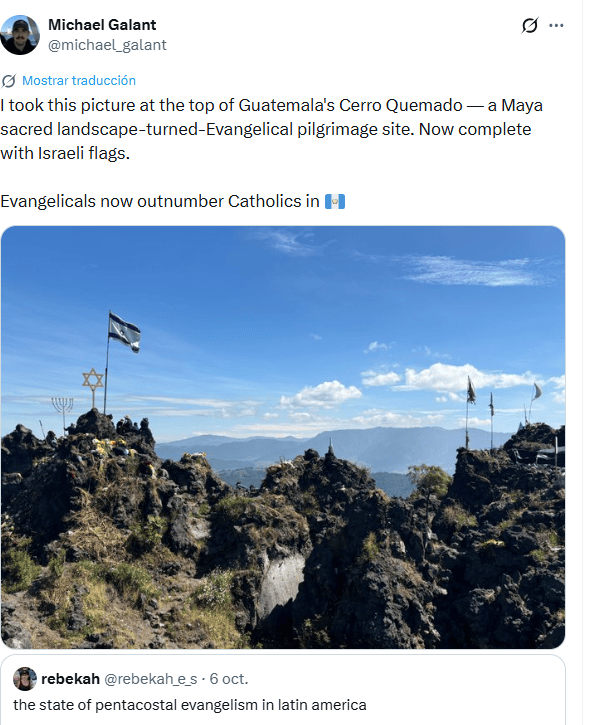
In South America, the US and Israel now have vassal governments installed in eight of the region’s 13 countries (Colombia, Peru, Ecuador, Paraguay, Bolivia, Chile, Argentina and Venezuela) [2]. That number could rise to nine in just over two week’s time if Flavio Bolsonaro wins the second round of elections in Brazil, which is highly likely given his dominant performance in the first round.
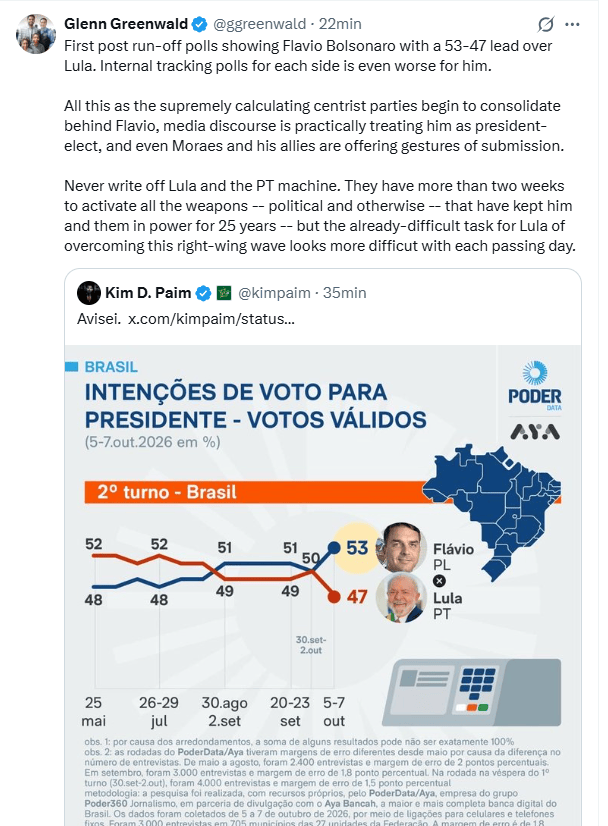
Since no candidate exceeded the 50% majority threshold, the Superior Electoral Court confirmed the runoff scheduled for October 25. Political analysts are in almost universal agreement that even Lula, who hasn’t lost a runoff since 1998, has his work cut out for him. The first-round winner has never lost a Brazilian presidential runoff. That said, the first round has never been this close before.
Brazilian authorities launched an investigation into US election meddling, but it has already been archived due to lack of evidence. Unlike other elections in the region, Trump has not come out with a public endorsement of an opposition candidate, perhaps out of fear that it will have the opposite of the desired effect.
It is also true that the victory margins in recent elections in Colombia, Honduras and Peru were wafer thin, whereas Bolsonaro beat Lula by more than 2 million votes in the first round. Even in a country as populous as Brazil, that is a statistically large number.
Also, Bolsonaro’s success was matched, if not bettered, by his Liberal Party’s domination of the Congressional elections, securing the largest single-party representation in both the Senate and the lower house. Ominously, Flavio Bolsonaro has already said that if he is elected, he will seek to use his majorities in the Congress to push through radical changes to the Constitution, including to the Supreme Court.
Three other members of the Bolsonaro family — former first lady Michelle Bolsonaro, 44, and two of Flavio’s brothers, Carlos and Jair Renan — were able to pick up seats in Congress. There are plenty of local reasons why a majority of Brazilians, including many on low incomes, might prefer (mistakenly in my view) a Bolsonaro government over a Lula one.
While macroeconomic conditions in Brazil may be quite strong after Lula’s third term, the same cannot be said for the microeconomic conditions of many Brazilian households. In fact, as we noted a couple of weeks ago, consumer debt in Brazil is at record highs — in part due to the success of Lula’s financial inclusion programs but also because of the growing problem of online gambling addiction.
As part of his election campaign Lula issued a decree banning all online gambling (which will almost certainly be voted down by the Liberal Party-dominated Congress. He also proposed to write off almost $30 billion of unpaid consumer debt. As we averred in that post, desperate times call for desperate measures, but perhaps if Lula had put those measures into action earlier in the electoral cycle, he wouldn’t be in such a sticky spot today.
As the Colombian economist Omar Montoya Suarez points out (in Spanish) in a twitter thread, “the working class does not act out of moral gratitude to its rulers, but is instead driven by the material conditions of life and by the level of class consciousness it has developed”:
The profile of the working class has changed. Deindustrialisation and precariousness (uberisation) have transformed the proletariat into an informal or atomised sub-proletariat. Millions of people today work in the informal sector, for apps or as self-employed.
Without strong unions as mediators, the neoliberal ideology of “meritocracy”, entrepreneurship and individualism permeates strongly, making the precarious worker permeable to the reactionary discourse of the far right.
For this informal sector, the language of labour rights sounds distant or alien. Instead, the Bolsonarist discourse of hard work, entrepreneurialism and individual merit resonates with the reality of those who depend only on their own effort to generate income.
Neo-Pentecostal evangelical churches have deployed massive territorial work on the outskirts of large Brazilian cities, occupying the space left behind by the State and community political organisations.
The church functions as a center of mutual assistance, emotional and social security for poor families. The Bolsonarist discourse, aligned with the rhetoric of the defense of the traditional family and evangelical morality, finds in this network an organic channel of mobilisation.
Faced with the stark reality of rampant insecurity, the Bolsonarist promise of a “firm hand”, the legal carrying of handguns for self-defence and unlimited support for the police forces offers the promise of a sharp and immediate solution to a problem that afflicts the daily life of popular families.
So, what could a Bolsonaro victory mean for Latin America?
For starters, it would be the feather in the cap of the US and Israel’s neo-colonial designs for the region. Bolsonaro has already pledged to join Trump’s Shield of the Americas initiative, which is essentially a much bigger, more brazen version of Operation Condor. In June, a public letter from Marco Rubio to Bolsonaro implicitly suggested that the latter had offered to put his transition team at Washington’s disposal should he win.
Once again, a national leader in Latin America is offering to put his or her nation at the full service of US strategic interests. This time, however, the country in question is the eighth largest on the planet and a founding member of the BRICS alliance…

