This is Naked Capitalism fundraising week. 1309 donors have already invested in our efforts to combat corruption and predatory conduct, particularly in the financial realm. Please join us and participate via our donation page, which shows how to give via check, credit card, debit card, PayPal, Clover, or Wise. Read about why we’re doing this fundraiser, what we’ve accomplished in the last year, and our current goal: more original reporting.
This time the weakest link could be the Euro Area’s second largest economy.
Just when you thought things could not get worse on the old, creaking continent, it looks like the European Debt Crisis may be back after a 14-year hiatus. And it is no longer the periphery that is the main problem.
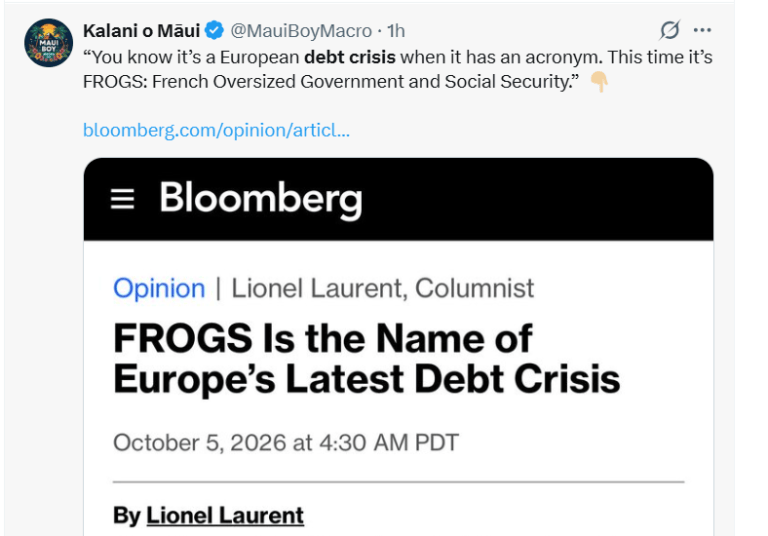
This time, the weakest link could actually be the Euro Area’s second largest economy, France, whose risk premium — the extra interest its government pays over benchmark German Bunds — recently hit its highest level since the first Euro Area debt crisis. Worryingly, the crisis already has an acronym…
France’s 10-year yields have surged in recent months, and are now on the verge of crossing the 5% threshold. To put that in perspective, Italian bond yields at the height of Europe’s first sovereign debt crisis reached a peak of 7.5% on November 11, 2011 before stabilising. Interestingly, Italy’s 10 year bonds are 20 basis points lower than France’s right now, and have been consistently lower for some time.
As the right-hand graphic below shows, French public debt is actually higher than it was during the worst of the COVID-19 virus crisis, when economic activity collapsed during the lockdowns, leading to a massive upsurge in public debt-to-GDP ratios. By contrast, Spain’s debt-to-GDP ratio has almost returned to its pre-COVID level of 97%. Even Italy’s has come down 18 percentage points to a still-ridiculously high 136%.
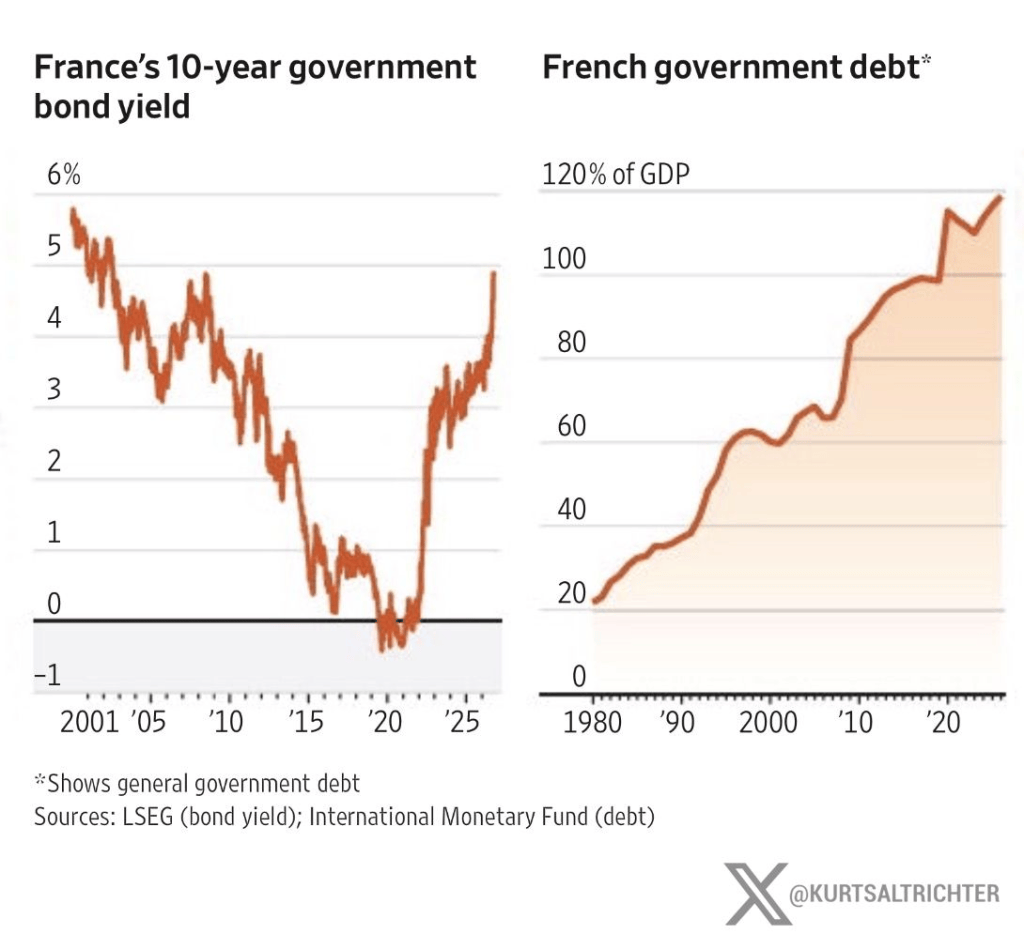
Admittedly, both Spain and Italy benefitted enormously from the ECB’s sovereign debt buying during its near decade-long QE program. Since the pandemic, Spain’s economy has grown much faster than the Euro Area average. For its part, Italy regularly registers primary surpluses — when government revenue exceeds non-interest spending — while France hasn’t registered one since 2001.
Another potential cause for concern is the general provenance of most holders of French debt. As flagged by Eurointelligence, French debt is predominantly held by foreign investors, which makes it particularly vulnerable to sudden capital outflows, higher costs to roll over maturing debt and sudden spikes in government bond yields (as we’re seeing right now):
French debt is predominantly held by foreign investors. According to the Banque de France, 57% of French debt is held by non-residents. Amongst the advanced economies, France has the highest proportion of foreign debt holders. The share is much lower in countries like Spain with 42%, the UK with 32%, Italy with 27% or the US with 23%. The fate of French debt is thus very much in the hands of asset managers outside France. A fact that may not be much appreciated by French political parties.
Of course, none of this means that France’s current debt woes will blossom into a full-blown debt crisis. The UK, for instance, has experienced a couple of near-misses in the bond markets in recent years, most notably with the 2022 UK Gilt Crisis that was triggered by Liz Truss’ “mini-budget”, which caused UK government bond prices to plummet and yields to spike.
In France, it has become harder and harder for the Emmanuel Macron government to pass budgets. In its budget proposal for 2027, the government hopes to reduce the deficit to five percent of GDP with €43 billion in spending cuts. Those measures will further crimp the purchasing power of struggling low and middle-income households.
Per Eurointelligence, pensions above €1260 are to be frozen, their 10% tax allowance lowered, and the employment bonus and civil service pay index frozen. The proposal has already triggered the time-honoured public response…
Political instability has become a defining feature of Emmanuel Macron’s last term in office. Three French governments have collapsed in less than a year. Barnier and Bayrou’s governments both crumbled over budgetary disputes, and Lecornu resigned after less than a day, but was later reappointed.
The budgetary pressures are not limited to the central government, reports Le Parisien:
For several years now, the departments of the Ile-de-France region have been warning about the budgetary difficulties they are facing. Essonne, Yvelines, Seine-et-Marne, Val-de-Marne, Seine-Saint-Denis… Everyone is sounding the alarm.
“The departments of Île-de-France are facing an equation that has become untenable: their revenues, particularly from real estate, are contracting, while the solidarity expenses they have to assume continue to increase,” laments Pierre Bédier, president (DVD) of the Yvelines departmental council and the Association of Île-de-France departments.
Now, as France contemplates life without its extreme centrist (and broadly reviled) president, that instability seems likely to rise. And it’s rising at precisely the worst possible time — when global economic instability is on the rise and interest rates more broadly are surging…
Click here to read the full article on Naked Capitalism

