This is Naked Capitalism fundraising week. 1,007 donors have already invested in our efforts to combat corruption and predatory conduct, particularly in the financial realm. Please join us and participate via our donation page, which shows how to give via check, credit card, debit card, PayPal. Clover, or Wise. Read about why we’re doing this fundraiser, what we’ve accomplished in the last year, and our current goal: funding bonuses for our terrific writers.
“Argentina posted its worst monthly performance since the April 2020 lockdown, with the monthly activity indicator declining 2.9% month on month.”
It is probably fair to say that JP Morgan Chase holds more sway over the Argentine economy than any other banking institution. At last count, six of the senior roles in the Milei government were held by former JP Morgan employees. They include Minister of Economy Luis Caputo, Foreign Minister Pablo Quirno, the President of the Central Bank of Argentina, Santiago Bausili, his deputy, Vladimir Werning, and the deputy minister of Economy, José Luis Daza.
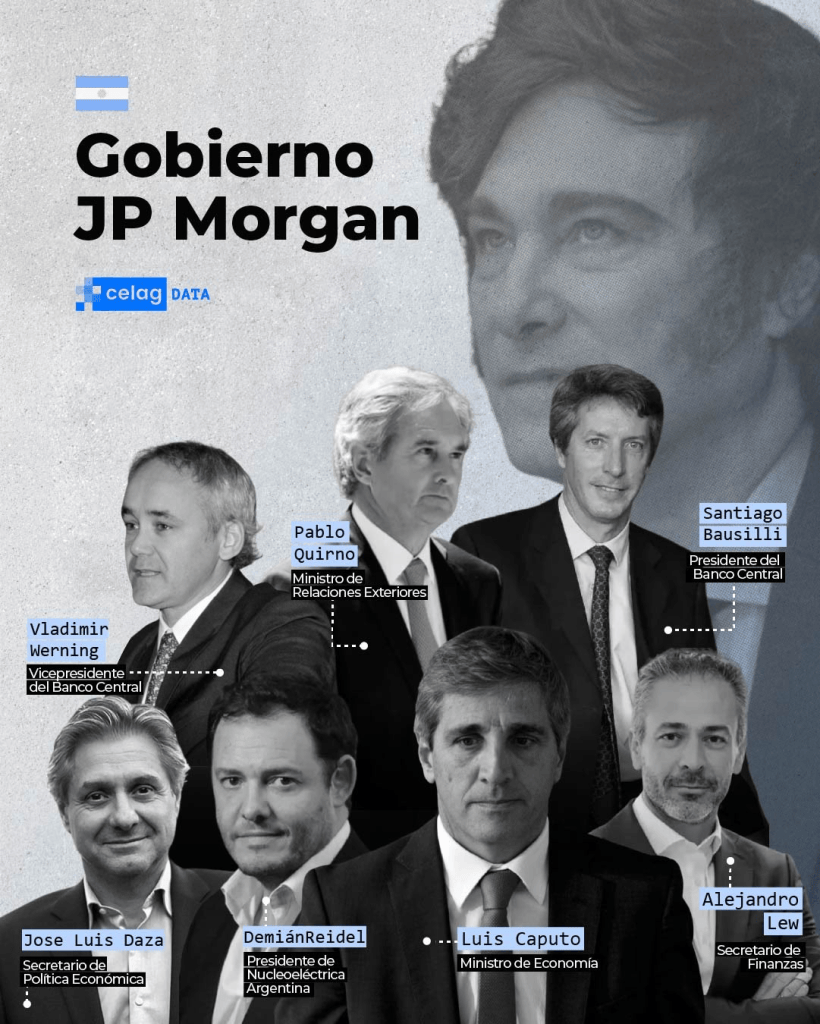
That sort of presence, in theory at least, buys you a lot of influence. JP Morgan has also been one of the biggest proponents of the Milei project — until now. JP Morgan CEO Jamie Dimon has made periodic visits to the country. In October 2025, Dimon was joined on his visit by the current joint chairman of JP Morgan’s International Council, Tony Blair, and former US Secretary of State Condeleeza Rice, who also sits on the council.
Dimon met with members of Milei’s senior economic team during his stay. As we noted at the time, he presumably received a warm welcome considering all four of them are former JP Morgan Chase executives.
In March this year, JP Morgan even agreed to host the annual Argentina Week, a gathering aimed at attracting foreign investment in the country, at its New York headquarters. Dimon gave the opening address. Which is why it may have come as a bit of shock to President Javier Milei and his economic team when they read the US bank’s latest report on the Argentine economy, published just a few days ago. The first paragraph sets the tone:
We expected a weak activity print in July, consistent with the soft backdrop that characterized the second quarter. However, the reported contraction significantly exceeded our forecast of roughly -1% m/m. Argentina posted its worst monthly performance since the April 2020 lockdown, with the monthly activity indicator declining 2.9% m/m, sa and -1.4% relative to July 2025. Excluding the 2020 lockdown, the late-2008 global financial shock and the 2018-19 period of financial stress, no month since 2008 has registered a larger decline.
The preliminary data for July comes on the heels of a 0.6% contraction in the second quarter of 2026. In other words, the Argentine economy is once again on the brink of a technical recession — for what would be the ninth time in 32 years. According to economists consulted by Bloomberg, the only way of avoiding that fate is if economic activity were to grow by around 6% between August and September, which is, to put it mildly, highly unlikely.
Perhaps most striking is the fact that just days before publishing this surprisingly negative report, analysts at JP Morgan Chase were actually forecasting that Argentina could be on its way to achieving investment grade, which would allow international funds to invest with much greater ease in the country. A day later, the National Institute of Statistics and Censuses’ publication of the official economic activity data for July changed everything.
Another problem highlighted by JP Morgan is Argentina’s bleak job landscape. You see, most of the sectors that are growing in Milei’s highly extractive economic model, such as agribusiness, mining, energy and fishing, are not labour intensive while those that are, such as manufacturing, wholesale and retail, are either stagnating or shrinking.
As a consequence, formal employment is today 3.9% below the 2016-2019 average following falls of 5.8% in manufacturing and 29.2% in construction, while low-quality self-employment has grown 3.9% annually since 2016. Fifteen years of practically flat formal job creation, says JP Morgan, is not a cyclical anomaly; it is a structural trend.
Another concerning datapoint: Argentina’s country risk index, a measure of how confident investors are about a nation’s sovereign debt, has risen more than 50% in the past two months, and is now over 600 basis points, its highest level in five months. The index is still significantly below where it was when Milei took over (1,809) but the recent moves have been quite violent.
When the indicator rises, it becomes more expensive for the government and private companies to borrow abroad. A rising risk score also signals that investors perceive a greater possibility of financial stress, debt restructuring, currency instability, or political disruption. A sharp economic slowdown, or recession, could have such an effect, especially roughly a year before general elections.
A recession, with the accompanying deterioration in economic activity, employment conditions and wages, is not going to help Milei’s re-election prospects for November 2027. It is not the fall in economic activity per se that is important for the investor — indeed, it could be argued that in isolation it is preferable since declines in activity improve external balances. What is important is the effect it could have on the electoral outcome in 2026.
There is another possible reason why Argentina’s country risk is suddenly surging: the worsening global economic situation. While emerging markets have shown remarkable resilience to risk-off shocks in recent years, it is only a matter of time before emerging market bonds face pressure as surging US yields prompt investors to favour higher-quality issuers and local-currency debt.
In such an event, Argentina is particularly at risk. According to a recent report by the Inter-American Development Bank (IDB) that analyses how Latin American economies could react to global risk shocks, Argentina is not just the most dangerous country in the region; it is in an entire league of its own. The country scored 80 points on the vulnerability index, almost double second-place Dominican Republic (46).
With Wall Street banks now warning about the potential risks of Argentina’s economy, times have most definitely changed. Less than a year ago, a coterie of US lenders, including of course JP Morgan, allegedly chipped in $20 billions to Argentina pre-election bailout fund, which was instrumental in helping Milei win — or at least not lose — the mid-term elections. At least that’s what the world was told. Months later, it turned out that it was all smoke and mirrors.
It’s not just Wall Street banks that are changing their tone on Argentina. For the first time that I can recall since Milei was elected in November 2023, financial news outlets, both English and Spanish-speaking, are finally asking serious questions about the sustainability of Milei’s shock-therapy-on-steroids economic model.
Spain’s El Economista, which for the past three years has been one of Milei’s biggest cheerleaders, now suggests that the Milei project’s early success had perhaps led to over-excitement and over-blown expectations on the part of, ahem, some analysts:
Javier Milei’s great economic experiment is going through a difficult time. The economy has begun to contract and the risk of falling into a technical recession (two consecutive quarters of GDP contraction) is increasing, while one of the indicators that had given the country and Milei’s government the most joy, the poverty rate, has begun to deteriorate. No one said the country’s economic transformation was going to be easy, but the truth is that the first positive results were seen very soon (at the end of 2024) in the economy, which unleashed euphoria among analysts, the media and Argentine society itself.
However, the tough measures to win the battle against inflation (high interest rates, cuts in public spending, a very strong weight against the dollar…) and the reconversion of the economy towards an export model supported by the oil, gas, mining and agriculture industries are generating a significant bump in the economy. If the economy deflates, Milei’s electoral prospects are reduced and this expectation is already impacting the country risk, which once again exceeds 600 basis points (after having recently fallen to the 4000 basis point area).
All of this has led JP Morgan to revise downwards its outlook for the Argentine economy as well as reduce its growth estimate for all of 2026 from 2.7% to 1.5%. The US lender also forecasts an annualised contraction of 4% during the third quarter, after the decline recorded in the second quarter.
The report also highlighted that urban employment remained virtually unchanged in July, after five consecutive months of declines, and was 1.1% below the level of a year ago. For the bank, this trend limits any chances of a recovery in household consumption in the short term. As the bank admits, mining and energy production for export, two of the main pillars of Milei’s uber-extractivist model, create very few jobs in the domestic market.
The Wall Street Journal has also somewhat shifted its tone regarding Milei in recent months. An article in June warned that the Argentine president’s confrontational social-media style, which helped his campaign, is now alienating allies and eroding public support:
“He’s a creature of the internet, his persona was built online,” said Benjamin Gedan, director of the Latin America Program at the Stimson Center, a Washington-based policy group. “Milei’s thirst for combat on X showcases the traits that limit his ability to build durable coalitions and win over moderates.”
Milei’s approval rating recently fell to its lowest level since he took office. His chief of staff faces allegations of illicit enrichment. Public dissatisfaction with the economy remains high. While inflation has slowed sharply, many Argentines say they still struggle to make ends meet, and polls suggest growing fatigue with Milei’s combative style.
Milei has responded to the latest criticism by asserting that much of the official economic data underlying it is plain wrong, which in all fairness it may be — but almost certainly in the government’s favour…
Click here to continue reading on Naked Capitalism

