The notion that a majority of Mexicans would support US military action is beyond risible, and clashes with the findings of all other recent polls.
Like a broken record playing a warped tune, the Trump administration is once again ramping up its threats of military intervention against Mexican drug cartels. On lead vocals is, of course, Marco Rubio. Last Thursday (Sept. 10), the secretary of state asserted that “the Mexicans have done more than they have ever done to go after these groups, but it is not nearly enough.”
Rubio also reiterated a bogus claim that has become popular among Trump 2.0 figures — namely that Mexico does not control large parts of its own territory, and therefore needs US military support, whether it wants it or not:
“I don’t think it’s a mystery to anyone. There are territories, extensive territories in Mexico, that are not governed by the State, they are controlled by drug trafficking organizations.”
The statement has received pushback from experts on both sides of the US-Mexican border, including the Mexico-based crime journalist Ioan Grillo:
Rubio also asserted that Mexico’s “number one problem, confirmed in survey after survey” (an important theme in this article) is security, adding that political candidates, judges and journalists “are routinely murdered” in the country.
Rubio was speaking from the US embassy in Quito, where he contrasted the efforts of Ecuador and Mexico against the drug cartels — which is ironic given the homicide rate in Mexico has almost halved since President Claudia Sheinbaum took office in October 2024, while Ecuador is currently the most dangerous country in Latin America, with a homicide rate of 51.3 per 100,000.
Mexico’s dramatic improvement in security, with July being the least violent in a decade, has got virtually no air time in the English language media, with Bloomberg being an exception. It no doubt clashes with the general narrative Washington is trying to drive home — that Mexico is no longer capable of looking after its own security.
The situation in Ecuador could not be more different. After signing a security agreement with Washington based on the Clinton Administration’s disastrous Plan Colombia insurgency program in January 2024 and opening the door to US troops and three-letter agencies, the violence has continued to surge. Although Ecuador is not a cocaine producer, more than 70% of the world’s supply flows through its borders.
In 2025 alone, the number of homicides increased by 31%, according to Insight Crime. In the graphic below, you can see how the number of homicides per year has risen almost 10-fold since 2017, the year Lenin Moreno replaced Raphael Correa as President. Under the next three US client governments of Moreno, Guillermo Lasso and now Daniel Noboa, the murder rate has skyrocketed from 5.8 per 100,000 inhabitants to 51.3.
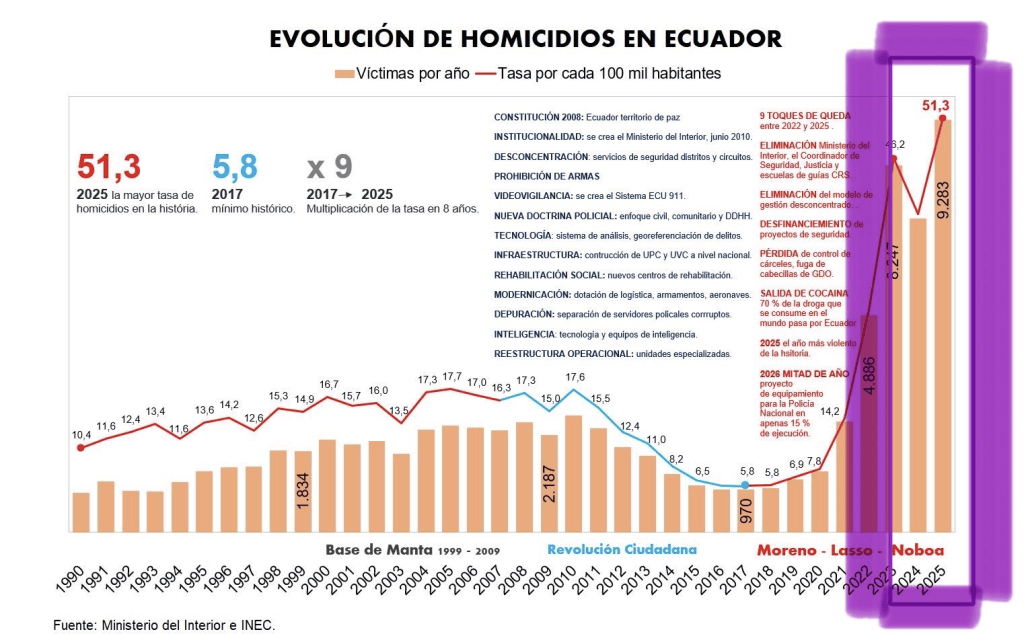
Under Noboa, whose family business has been linked to multiple cocaine seizures in banana shipments to Europe, the violence has continued to rise despite — or rather because of — his government’s unprecedented crackdown. As we have already seen in Colombia and Mexico, drug-war militarisation inevitably leads to more death while the drugs continue to flow.
Colombia, now under new management, has already signed on to the Trump administration’s Americas Counter Cartel Coalition (ACCC or A3C). Rubio wants Mexico to do the same.
“These groups are very dangerous, they need to be confronted. And our hope, our intention, is to do so in collaboration with the Mexican government. That’s the ideal, but eventually that threat is going to have to be faced, one way or another,” Rubio said, resurrecting the ever-looming spectre of a US military intervention in the country.
A day after Rubio’s statement, the MAGA-aligned cable news network News Nation ran a story claiming that a leaked poll attributed to the US State Department has revealed that “a majority of Mexican citizens are in favor of the United States taking action against the cartels, which control Mexico,” including:
- U.S. indictments of Mexican officials accused of cartel ties.
- U.S. strikes on alleged drug traffickers in the Caribbean and Pacific
- U.S. attacks on drug labs or arrests of cartel members inside Mexico without notifying the Mexican government
- The U.S. military unilaterally killing alleged cartel members in Mexico
Here’s the problem: the article does not include the complete document, does not mention the firm that carried out the survey and does not even offer clear details about the survey’s questions or answers. All we are told is that a local research firm interviewed 1,000 residents aged 18 and older, which is a very small sample, to obtain the results.
The story appears to have got little traction in the US media. Even FOX News hasn’t bothered to cover it. However, a number of Mexican news outlets did report the story, largely uncritically, including Excelsior and Aristegui Noticias. Neither outlet mentioned News Nation’s pro-Trump bias.
But this is not the only poll to have generated controversy in Mexico. A few days ago, Simón Levy, a former government figure who has become a serial peddler of anti-government fake news on social media, conducted a poll on X. The poll question, addressed to Lévy’s Mexican followers yet written in English, which in itself speaks volumes, was:
As a Mexican are you willing to allow US special forces to enter Mexico to capture politicians with arrest warrants from that country?
Unsurprisingly, 89% of Levy’s followers voted yes. If nothing else, the exercise serves as a reminder of why Twitter polls suck:
- Results heavily depend on who follows a particular account; a poll posted by an individual creator only reflects the biases of his or her specific audience. In the case of Levy, most of his followers are rabidly opposed to Mexico’s Sheinbaum government.
- Participation in the survey requires no identity control, meaning single individuals can vote using multiple accounts.
- Automated bot accounts and fake profiles can easily skew vote counts. As we have learnt in the recent Honduras-gate scandal and Cerimedo affair, Latin America’s populist right movements are extremely bot-dependent.
But that didn’t stop Derek Maltz, a former acting administrator of the US Drugs Enforcement Agency, from seizing on the results of the survey as evidence that “Mexican citizens overwhelmingly want US military special forces to apprehend corrupt politicians in Mexico.” The Mexico-based journo Kurt Hackbarth tartly described Maltz’s tweet as the “chef’s kiss of US intervention efforts”:
Maltz Sr. then doubled down with the following tweet:
Perhaps the most absurd aspect of this whole saga is that Mexico is probably the least likely country in Latin America to support US intervention. It is already permanently scarred by previous interventions, having lost over half of its territory to its northern neighbour in the mid-19th century. Why would it want more of the same?
Mexico has been invaded so many times by its northern neighbour over the past 200 or so years (at least 10, according to the Council on Hemispheric Affairs) that it is home to a National Museum of Interventions — presumably the only one in the world.
The notion that a majority of Mexicans would support unilateral US military intervention is beyond risible. That’s not to say that a small or even largish minority of Mexicans might be deluded enough to think that a US intervention could be beneficial for their interests — and that is clearly borne out in recent polls (that have not been bankrolled by the US State Department).
In a January poll conducted by De Las Heras Demotecnia, 76% of respondents said they would be opposed to US military intervention. Bloomberg-affiliated El Financiero regularly polls Mexicans on their views regarding a possible found that 78% of Mexicans disagree with the use of US military force to combat criminal groups in Mexico.
That was the highest percentage registered in two years — not much of a surprise given the poll was carried out shortly after the US’ military attack on Venezuela, abduction of its president, Nicolás Maduro, and establishment of a protectorate over the country. Seventy-four percent of respondents said they were even against collaborating with the US to fight organized crime after the arrival of Donald Trump to the presidency of that country. Again, a two-year high.
In other words, Mexican opposition to US military intervention is, if anything, strengthening. By contrast, a majority of Mexicans appear to be in favour of handing over former Sinaloa governor Rubén Rocha Moya, whose links to the Sinaloa cartel are common knowledge, to US justice. The polling firm Enkoll reported that 60% of respondents are in favour of handing him over. The daily newspaper Reforma has the number at 57%.
But there is a world of difference between wanting the Mexican government to extradite a corrupt narco-politician to the US and wanting the US military to come and abduct him, as it did with Nicolás Maduro, leaving over 100 dead bodies in its wake. As with the Cartel of the Suns fairytale, this is purely about manufacturing consent for another US intervention…

