Both the US and Israel have their motives as well as the means.
There are still a lot of known unknowns about what happened in and around the Spanish enclave of Ceuta late last week. As Lambert was wont to say, this is an overly dynamic situation. In the space of around 36 hours, an estimated 60,000 Moroccans crossed the border separating Morocco from Spain’s Ceuta enclave — into a city with a population of just 84,000.
To put that number in perspective, it is at least five times the peak volume of migrant arrivals on the Greek islands in 2015, at the height of the Syrian Civil War, or the southern Italian island of Lampedusa in 2023, according to Le Grand Continent. Elon Musk rather unhelpfully likened the scenes to the zombie movie World War Z, in which at one point swarms of zombies climb over a fortified wall — into Israel of all places.
“The Border Is Wide Open”
First, as El País reports, rumours began circulating, and then proliferating, on social media that the Spanish border was wide open, and people could cross it without the necessary documents. This followed on the heels of reports in the Spanish press and social media that Spain’s Supreme Court had ruled that authorities cannot summarily deport migrants who arrive by sea without due process
The ruling, issued on July 8, opened an operational void that, according to Spain’s intelligence services, Interior Ministry and Moroccan authorities, was exploited by human smuggling networks and amplified by misleading messages on social networks. From El País:
“The Spanish border is open and you can cross it without papers”, was the general message that propelled a wave of young people onto the roads of the north of the Maghreb country…
Almost everything was planned. The same networks cited points of sale of wetsuits, fins, diving goggles, floats and even waterproof bags to transport documents and mobile phones. Google Maps screenshots were detailed to direct the migrants towards Tarajal beach, on the Ceuta border. The areas with less police surveillance to try to flee from misery.
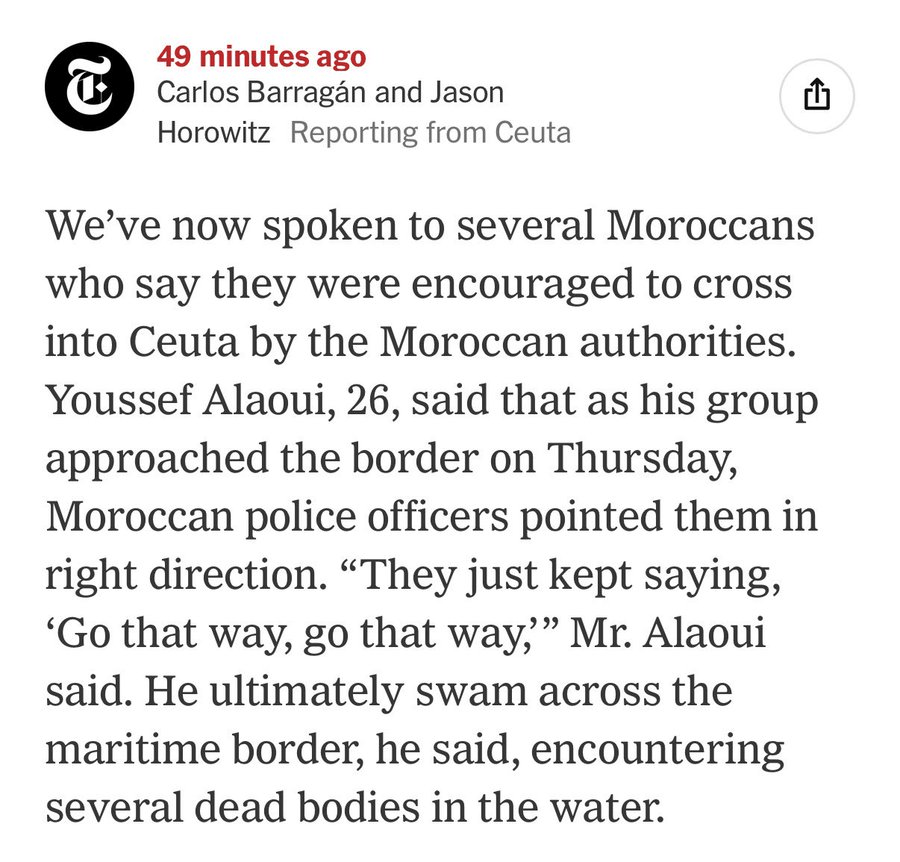
Convoys of trucks then began shifting thousands of migrants to the Spanish border, where the migrants not only received no push back from the Moroccan police and armed forces, but were apparently ushered on their way towards the weakest link in the border chain. From El Diario:
“They told us at the same time that they had opened the Ceuta border and we came running. Some friends called us: They’re letting us in!”
The boys took a bus to the Tarajal border area and, in the vicinity of the beach closest to the border breakwater, they found several Moroccan agents gesticulating with their hands inviting them to continue on their journey — an account echoed by several of the people interviewed by elDiario.es. “Access was open. The police told us: ‘Enter Ceuta’”.
Ben Jelloun, the best-known Moroccan writer in the French language and a regular at the royal palace, has written in an op-ed for Le360 that the mass exodus of Moroccans towards Ceuta inspired feelings of shame and anger in him. “The Moroccan police were not intervening”, he notes, as he came across the young people walking towards the border after leaving the Throne Day reception on Thursday, July 30.
In the inevitable fracas that followed, 88 people died in Spanish, including 13 children (it is unclear know how many perished on the Moroccan side). Many others were in the flower of their youth…
Most of the migrants that didn’t perish in the stampede left Spanish territory almost as quickly as they came. By Saturday morning, Western media were reporting that the vast majority of the crowds had already returned to Morocco, presumably with some rather forceful prodding from Spanish forces. The same does not appear to be the case with the migrants who arrived from other parts of Africa, apparently numbering in their low thousands, who are still in Ceuta.
This following tweet from Vijay Prashad, which Conor featured in yesterday’s cross-posted article, is worth reposting. As Prashad observes, the so-called “migrants” that briefly invaded Ceuta on Thursday and Friday “looked like a rent-a-mob from Morocco’s al-karyan — engineered to cross over and create a diplomatic crisis for Spain?”:
Hybrid War: On Whose Behalf?
As we have seen before in Erdogan’s Türkiye, migration is being used as a tool of pressure within so-called “hybrid” operations. But on whose behalf are these “hybrid” operations being conducted?
It is perfect possible that Morocco was acting unilaterally. After all, this is not the first time Rabat has used immigration extortion against Spain.
In April 2021, Ceuta suffered a massive spike in migration, in which roughly 10,000 migrants crossed the border, just weeks after Brahim Ghali, the leader of the Polisario Front, the political and military organization representing the Sahrawi people, was admitted to San Pedro Hospital in Logroño, Spain, for severe COVID-19. Ghali’s secret entry under a false name sparked a major diplomatic crisis between Spain and Morocco.
Now, like then, there is a clear Algerian connection. On July 20, just over a week before the Ceuta crisis began, Pedro Sánchez met with senior government officials in Algiers — for the first time since 2022, when Spain’s decision to endorse Morocco’s colonial plan for Western Sahara sparked a diplomatic row with Algiers.
Madrid is now keen to rebuild ties with Algeria, its biggest natural gas provider, and is even considering granting Spanish citizenship to 60,000 Sahrawis born under Spanish colonial rule (i.e., before Sept 29, 1977) — precisely the sort of thing that gets Rabat’s back up. Algeria is the strongest supporter of the Polisario Front and is locked in a very fragile peace with Morocco.
But it is also possible — indeed, quite likely — that Morocco is working in tandem with two very powerful allies: the United States and Israel. While there is, for the moment, no smoking gun, both countries have motives aplenty for attacking Spain. The Sánchez administration is one of the only European governments to have strongly opposed and condemned Israel’s genocide in Gaza, with full public support.
Sanchez has also pursued a policy of closer ties and economic cooperation with China, which also runs counter to general EU policy. Perhaps most importantly, Sánchez refused to let the US military use its joint bases in Spain to wage war against Iran.
As we have mentioned before, this is primarily a matter of political survival for Sánchez. Elections are coming next year and as the corruption scandals involving senior figures in his party, including family members, have multiplied, he has decided, quite astutely, that his best form of defence is to pursue policies that are broadly popular with voters.
But in the process, he’s made two very powerful enemies in the US and Israel’s Trump and Netanyahu governments. As Juan David Rojas writes for Unheard, “MAGA has branded Spain Public Enemy No. 1 over its government’s strident posture towards the US and Israel during the Iran war.”
The warning signs were already building a few months ago, as we documented in our May 8th post, “Are the US and Israel Planning to Use Morocco As a Weapon Against Spain?”:
The Trump administration has issued a cacophony of threats against Spain since the Pedro Sánchez government refused to allow US forces to use Spanish military bases or airspace for its operations in the war against Iran. Pedro Sánchez has also been a rare, strident voice against Israel’s genocides in Gaza and southern Lebanon and other war crimes.
In response, Trump has repeatedly threatened to cut trade ties with Spain as well as remove US troops from Spanish bases, neither of which have (yet) come to pass. But arguably the biggest risk for Spain is that the US — and Israel — begin to foment trouble on Spain’s southern flanks, as we flagged [on] March 24:
Some neo-cons in Washington have proposed that the US should move its troop presence in Spain to bases in Morocco, whose government is much closer to Israel. The US historian and former Pentagon adviser Michael Rubin has even suggested in a couple of articles for Middle East Forum that the US should recognise Spain’s two protectorates in Morocco, Ceuta and Melilla, as Moroccan, just as it has done with the disputed territory of Western Sahara.
The US — and Israel — could also retaliate by stoking tensions on Spain’s southernmost border, by supporting the independence efforts of the two Spanish enclaves of Ceuta and Melilla, which sit on the northern shores of Morocco’s Mediterranean coast. Morocco is closely allied with the US and Israel, both of which supported Morocco’s territorial claims over Western Sahara — in return for Rabat’s official recognition of Israel, in late 2020, as part of the Abraham Accords.
Michael Rubin… recently urged Morocco to launch a civil march on Ceuta and Melilla similar to the one that took place in 1975, which triggered the ultimate withdrawal of Spanish forces from Western Sahara. Those forces were quickly supplanted by Moroccan occupying forces….
In an interview with El Español, the Republican congressman Mario Díaz-Balart, a gusano hawk closely tied to Marco Rubio, made some veiled threats in that direction…
Now Díaz-Balart, who chairs the US House of Representative’s subcommittee on Homeland Security, has taken this debate to the floor of the US Congress. A one paragraph section of a report by the Appropriations Committee describes Ceuta and Melilla as “Spanish-administered” but “located on Moroccan territory”. It also encourages the US Secretary of State, Marco Rubio, to mediate on the future status of both autonomous cities.
There is another reason why the US and Israel might be interested in Spain’s two enclaves, Ceuta and Melilla that goes beyond simple revenge: their location. Ceuta and its neighbouring Spanish enclave, Melilla, sit astride the Strait of Gibraltar, one of the world’s busiest maritime chokepoints, as NC reader Luis Almadiz pointed out in response to a previous post:
Spain owns the Chafarinas archipelago, together with the other “plazas” effectively controlling the northern Moroccan coast except for Tangiers and Oujda. These also extend the territorial waters of Spain (more so if we accept that Gibraltar has no such territorial waters, as Spain claims), making the Gibraltar Strait effectively Spanish territorial waters.
While extremely unlikely, this might some day escalate into another “Hormuz crisis” if Spain is antagonized or gets much more assertive than it has been in the last centuries.
However unlikely that possibility, it still represents a risk, especially to Israel, whose trade is increasingly reliant on the Mediterranean-Gibraltar exit following the recent blockades of the Red Sea. Also, lest we forget, the UK already controls Gibraltar. It’s not hard to see the Anglo-Zionist axis wanting to control the other side of the strait, through a pliable vassal state like the Kingdom of Morocco.
Since the latest border crossing incident more details have seeped out about the US and Israel’s growing support for Morocco’s claims over Ceuta and Melilla as well as their intensifying relations with Rabat.
Clarification: the legislation Massie refers to in the tweet above was not a bill but rather a committee report.
Morocco even announced on Monday that it was naming the Dakhla-Tiznit highway, which runs through Western Sahara, after President Trump. Thrilled, Trump exclaimed on Truth Social:
“Thank you to Highly Respected Mohammed VI, the King of Morocco — Such a Great Honor! I look forward to traveling the entire length of this Great Highway someday, hopefully soon!”.
Since last week’s border crisis, there has been a clear, coordinated campaign among Israeli and US social media accounts, including the official account of Israel’s ambassador to the United Nations, to spread the false idea that Ceuta and Melilla are colonial vestiges of Spain in Africa and that they belong to Morocco. The irony is that it is Western Sahara that is widely recognised by the UN as the last remaining colony or non-self-governing territory in Africa.
Some Israeli figures have even been bragging about Israel’s involvement, including Bibi Netanyahu’s own son, tweeting from the relative safety and comfort of Miami, Florida.
In his recent threats against Spain, Trump has repeatedly referenced the 1898 war. In the “disaster of ’98”, Spain lost its colonies in Cuba, Guam, the Philippines and Puerto Rico, in addition to the head-on clash over Sánchez’s anti-genocidal and pro-Palestinian policy that Netanyahu is waging in Gaza.
The Israeli government was also quick to call on Spain to “exercise restraint, protect the rights of refugees, and ensure that the military does not use violence against innocent civilians” in Ceuta. Even by Israel’s standards, the irony is both dark and sick…
Click here to read the full article on Naked Capitalism
 Nick Corbishley