“[F]ew things have provoked more outrage [in Brazil] than Trump’s attack on PIX, the country’s beloved instant-payment system.”
The Trump administration is trying to rebuild the tariff wall that was knocked down last year by the US Supreme Court. This time it is using Section 301 of US trade law, which allows the government, via the Office of the United States Trade Representative (USTR), to investigate and punish foreign countries whose trade policies are deemed to be unfair.
One of the first countries targeted was Brazil, which last Wednesday became the subject of additional 25% tariffs on exports of over 3,000 products to the US, including sugar, clothing and machinery.
The move comes just weeks before the start of Brazil’s presidential campaign that will pit incumbent President Luiz Inácio Lula da Silva against Flávio Bolsonaro, son of far-right former President Jair Bolsonaro. The Trump administration has trotted out a surfeit of reasons for the tariffs, from springing former President Jair Bolsonaro from jail, to scrapping Brazilian tariffs on US ethanol, to Amazon deforestation (as if!), to turfing Chinese companies out of Brazil.
Trade between Brazil and China reached a record $171 billion in 2025, more than double Brazil’s $83 billion in trade with the US. Washington would like nothing more than to see a US client government installed in Brasília that will pull the country out of China’s orbit and secure its resources for US capital, as has already happened in Colombia, Chile and Peru. Bolsonaro Jr would fit the bill nicely.
That said, the biggest driver behind the move appears to be another issue entirely: Brazil’s publicly controlled digital payments system, Pix, which is leaving the global payment duopoly, VISA and Mastercard, and US tech giants increasingly out of the equation. The system, launched in 2020, allows almost instant money transfers between people, companies and government entities 24 hours a day, seven days a week, from any device with an internet connection.
In the tweet below, the USTR claims that since the launch of Pix, the country’s central bank “has acted as a regulator to disadvantage US electronic payments services providers and preference its national champion Pix”:
The Brazilian central bank encourages use of Pix over other services by mandating that participating institutions offer Pix for free to individuals and by capping the fee those institutions may charge businesses for Pix transactions.
In other words, the US Trade Representative is imposing additional tariffs on Brazil because its government and central bank are preventing US banks and financial companies from engaging in fee gouging with the Pix system. Some more background from the Wall Street Journal:
[F]ew things have provoked more outrage here than Trump’s attack on PIX, the country’s beloved instant-payment system that Washington cited as a key justification for its decision this week to impose a 25% tariff on many Brazilian goods.
From coconut sellers to billionaires, more than 90% of Brazilian adults—more than 140 million people—regularly use PIX, a government-run program that allows users to transfer money in seconds on cellphones at no cost. In less than six years since its creation, PIX now handles more transactions in Latin America’s biggest economy than credit and debit cards combined.
As we warned back in November, it was only a matter of time before the Trump administration escalated its attacks on Pix:
Launched by the Central Bank of Brazil in November 2020, Pix is, in the central bank’s own words, “an instant payment scheme that enables its users — people, companies and governmental entities — to send or receive payment transfers in few seconds at any time, including non-business days.”
It is similar to US payment apps like Zelle, but instead of being controlled by a consortium of fee-gouging banks, it is controlled by the Brazilian central bank…
As John P Ruehl writes for Economy for All, “Fast payment systems exist worldwide. However, Brazil’s Pix stands out for its rapid mass adoption, massive user base, international standing, and high degree of central bank control.”…
Where Are the Fees?
Two things set Pix apart from most other instant payment systems in use around the world: first, it is free of charge to individuals and small businesses while the processing fees for larger businesses are still much lower than those for debit or credit cards; and second, it must be adopted by all licensed financial institutions operating in the country.
The rate of uptake since [its launch in 2020] has been nothing short of blistering. A 2022 Bank of International Settlements report found that Pix had the fastest adoption curve among all real-time payment systems in the world. Three years later, the system boasts 175 million users of all income levels — equivalent to around 80% of the country’s population — and accounts for nearly half of the country’s financial transactions, reports the New York Times.
But not everyone is pleased by its success:
[T]he Office of the U.S. Trade Representative is investigating PIX, claiming that Brazil has given an unfair advantage to the digital payments system by requiring all banks to offer it.
“This places a lot of power in the hands of Brazil’s government.”…
PIX is also a monetary blueprint for the BRICS alliance of developing economies, which includes Brazil, Russia, India, China and South Africa, as it seeks to create an international payment platform aimed at reducing reliance on the U.S. dollar.
There are dark sides and downsides to the Pix payment system, however. Its rapid success is accelerating the demise of cash, one of the last vestiges of privacy and anonymity in our increasingly surveiled world.
As is happening in many other less-cash economies, it is becoming harder to pay with cash in Brazil. It was recently announced that physical currency will no longer be accepted as payment at tolls along one of Brazil’s busiest highways, the BR-101 Sul/RS. NC reader Duda, from Brazil, wrote the following in response to our last article on this topic:
Cash transactions are really disappearing – when I try to pay in cash, usually the other part doesn’t have change anymore. They prefer receiving in pix because it’s more secure against theft and the money is instantly in their accounts.
I can go weeks without any money in my wallet and it doesn’t make any difference.
As for the US, its main concerns regarding Pix are three fold:
1. Pix’s threat to the US’ payment card duopoly, Mastercard and VISA. After covering their operating costs, Visa and Mastercard retain over 50% of their revenue as operating profit. Such extraordinary rates of profit come as a direct result of their monopoly control over the channels through which payments must pass.
“Visa and Mastercard control points through which already existing value must pass,” writes Gary Wilson in an article published by Monthly Review Online.
Their monopoly position allows them to appropriate a portion of the surplus value produced throughout the economy. They collect a toll as money moves from buyer to seller.
Pix threatens the tollbooth. It demonstrates that a public payment system can conduct enormous numbers of transactions without handing a cut to two U.S. corporations. Washington’s tariff is an attempt to compel Brazil to preserve a source of monopoly revenue for U.S. finance capital.
That toll is now threatened by the much lower rates offered by Pix. As Reuters reports, while card transaction volumes have continued to grow in absolute terms thanks to the fact that Pix brought more than 70 million Brazilians into the financial system, credit cards’ share of transactions has fallen to about 15% from roughly 20% before Pix’s launch. The share for debit cards has dropped to around 10% from about 26%.
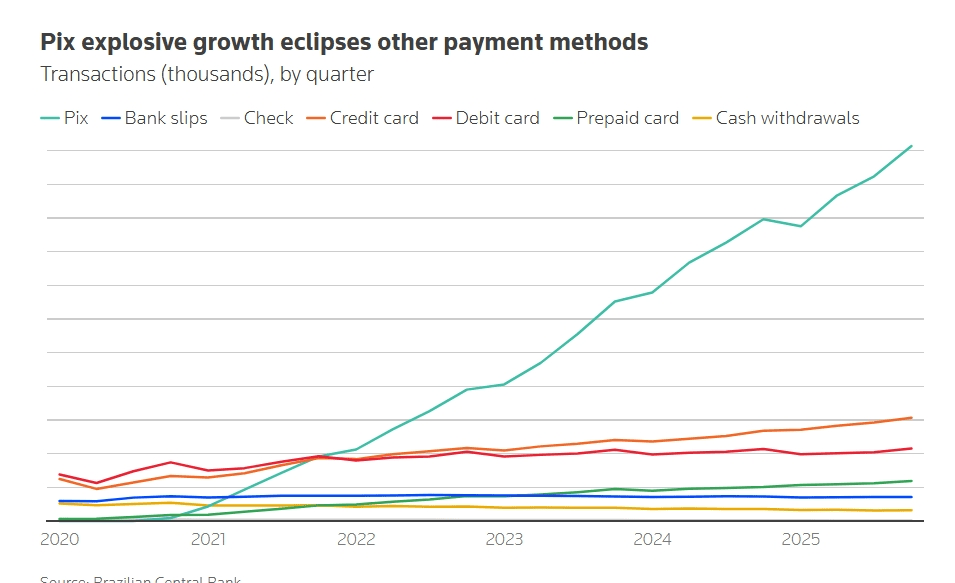
With the recent launch of Pix Instalments, primarily aimed at the 60 million Brazilians with no credit card, the central bank’s digital payment system could even begin to hurt the US duopoly’s credit card business…
Click here to continue reading on Naked Capitalism
 Nick Corbishley