“We had a war until recently with Venezuela and we are going to have one with Cuba in the coming week.”
The United States could enter a war with Cuba in the next week or so, according to Puerto Rico Governor Jennifer González Colón. During an interview with Molusco TV, González cited the US’ growing list of conflicts, particularly in the Americas, as a reason why Puerto Rico remains an indispensable territory for Washington’s imperial ambitions (translation my own):
JGC: Ronald Reagan said [in the early ’80s] that Puerto Rico was ready and prepared to be part of the United States and that it would also be more beneficial for the United States to have Puerto Rico as a state.
Interviewer: But that was during the Cold War.
JGC: There was a Cold War then, just as there’s a Cold War now. We now have a war with China, we have a war with Iran, we have a war with Russia, we had a war until recently with Venezuela and we are going to have one with Cuba in the coming week.”
It is curious to hear the governor of Puerto Rico, an “unincorporated” US territory with a population of around 3.2 million people who cannot even vote in US elections, speak blithely about being at war with China, Iran, Russia, Venezuela, and soon Cuba. González is not the only Latin American leader to have de facto joined the US’ wars of aggression. In March, Milei declared Iran an “enemy” of Argentina and designated the IRG as a terrorist group.
In the grand scheme of things, González is a relatively bit-time player in the US’ military manoeuvres in the Caribbean. However, Puerto Rico did play its part as a staging post for the US’ moves against Venezuela, as Reuters reported in early November.
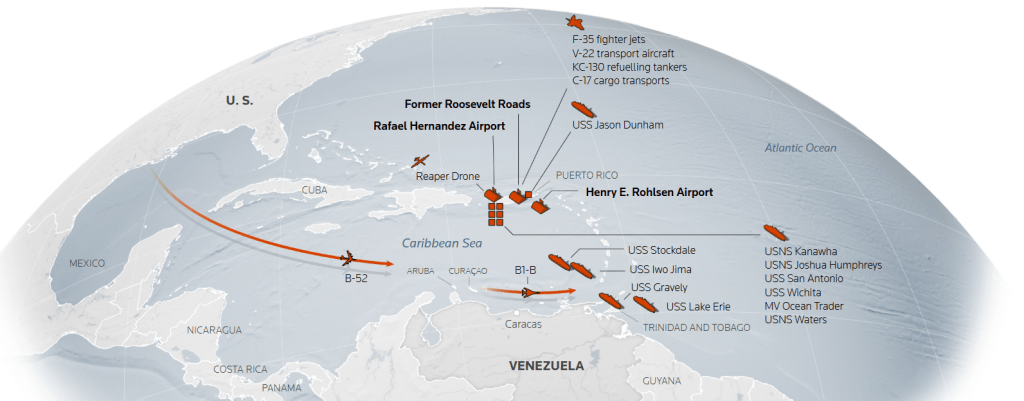
The United States military is upgrading a long-abandoned former Cold War naval base in the Caribbean, a Reuters visual investigation has found, suggesting preparations for sustained operations that could help support possible actions inside Venezuela.
The construction activity at the former Roosevelt Roads naval base in Puerto Rico — shuttered by the Navy more than 20 years ago — was underway on September 17 when crews began clearing and repaving taxiways leading to the runway, according to photos taken by Reuters.
Until the Navy withdrew from the facility in 2004, Roosevelt Roads was one of the biggest U.S. naval stations in the world. The base occupies a strategic location and offers a large amount of space for gathering equipment, one U.S. official said.
In addition to the upgrades of landing and take-off capabilities at Roosevelt Roads, the U.S. is building out facilities at civilian airports in Puerto Rico and St Croix in the U.S. Virgin Islands.
The two U.S. territories sit roughly 500 miles from Venezuela.
Following his abduction on January 3, the plane carrying Nicolás Maduro reportedly made a stop at the Ramey Base in Aguadilla. According to sources cited by Telenoticias, it was a “very short” stop due to a medical emergency before the US forces continued their march to the high seas, where kidnapped president was transferred to a boat that would take him to New York.
González may have been briefed on aspects of the US’ military plans for Cuba and is letting her mouth run a little. Or maybe she hasn’t and is just engaging in idle speculation. Which is the case, her remarks should be read less as an official announcement or diplomatic warning than as part of a political campaign for Puerto Rican statehood.
In the interview, she said Puerto Rico should no longer be seen as “the ugly duckling” but rather as a key strategic asset for the US’ pharmaceutical and military supply chains.
“Puerto Rico is vital in these areas,” González said. We were key for Venezuela barely six months ago and we are going to be key for US public policy in Latin America”.
González’s comments come at a delicate moment for US foreign policy as whole, with the ceasefire in West Asia hanging by a thread. It is highly unlikely (though not impossible) that the US will attack Cuba if fighting resumes in the Persian Gulf. That said, the Trump administration is desperate for a foreign policy win to distract from its catalogue of hugely costly failures, and may, mistakenly or not, view energy-starved Cuba as a soft target.
The Southern Command reported a few days ago the arrival of the aircraft carrier USS Nimitz to the Caribbean, as part of the Southern Seas 2026 mission, officially aimed at strengthening maritime alliances, interoperability and security in the Caribbean, Central and South America.
Washington has also intensified its judicial offensive against Cuba’s senior leadership. The Justice Department announced on May 20 that it had filed an indictment against 94-year-old Raúl Castro Ruz and five other defendants for their alleged role in the shooting down of two Brothers to the Rescue planes in 1996 that killed four civilians.
It is not yet clear, as the veteran Italian journalist Federico Lampini tells El Mundo, whether the US indictment of Raúl Castro is the prelude to a Maduro-style operation, as González suggests, or simply a negotiating tool for applying additional pressure on the Cuban government:
Rubio knows that the US has a disastrous record in its attempts to promote regime change. When the CIA director recently visited Havana, his first request was simple and logical: end all Russian and Chinese military and intelligence presence. That would be a first step toward Venezuelan-style “regime change”: moving from an adversarial geopolitical position to one subordinate to Washington.
Speaking of Venezuela, it seems the man now calling the shots in Caracas is Mauricio Claver-Carone, the US State Department’s former head of Latin America. And Wall Street firms are benefiting bigly, reports Washington Post:
“Claver-Carone, usually operating by phone from his home and office in southern Florida, has been instrumental in picking winners and losers among aspiring investors as the country’s long-faltering oil industry is rejuvenated, said people familiar with his dealings. Most recently, he said, he vouched for Centerview Partners, a New York-based financial firm that was among the many vying to be hired by the Venezuelan government to help restructure its $170 billion debt.”
Hours after Washington announced the charges against Raúl Castro, the US Army mobilised troops from Puerto Rico to an unidentified mission, Fort Buchanan reported on Thursday. Which may be an ominous sign given Puerto Rico already played an important role in the January 3 US military operation against Venezuela, or it may mean very little.
In the months leading up to the Venezuelan op, the island’s Roosevelt Roads base was the scene of intensive military training, as Swiss Info reported in the hours after the attack:
Puerto Rico Gov. Jenniffer Gonzalez on Saturday stressed the importance of the Caribbean island to carry out the U.S. operation against the Venezuelan government on Saturday and achieve the capture of Venezuelan President Nicolas Maduro.
This, Gonzalez said at a press conference, highlights “the importance of the island in the Caribbean, in the role we play in national defense, and that is why Puerto Ricans are proud to be part of this great nation.”
The Roosevelt Roads base, in Ceiba (eastern Puerto Rico), was during the past two months a military exercise area by the United States Army and, according to the official, it also served as a passage for Maduro’s transport to the United States.
Puerto Rico, linked to the United States as a Commonwealth, has a certain degree of autonomy and a local government and Parliament, but areas such as defense, borders, currency or diplomatic relations remain under the control of the United States.
Likewise, the Federal Aviation Administration (FAA) issued an order to cancel more than 300 U.S. airline flights to Puerto Rico for safety reasons until 01:00 (05:00 GMT) on Sunday.
Havana has responded to the latest threats from Washington and Miami by stepping up civil defence exercises and distributing survival guides against possible military attacks. It has also described the charges against Raúl Castro as “fabricated” and has warned of “fierce resistance” to any aggression.
As Patricia Marins notes above, Cuba is expecting an invasion that, by all indications, will become a reality soon. Humanitarian aid continues to arrive from China and Mexico while the US has served CODE PINK’s Medea Benjamin and left-leaning influencer Hasan Piker subpoenas for providing the besieged island of Cuba with medical aid and equipment.
Cuba has only received one shipment of (Russian) oil since the beginning of this year. While Moscow, like Beijing, has expressed support for Cuba since the US indictment of Castro and is the only country to have actually broken the US’ energy blockade, the reality is Russia already has enough on its hands with the war in Ukraine.
With gusano-in-chief Marco Rubio running US operations in Cuba, it seems the old casino mobster class may soon regain control of their island paradise…
Click here to read the full article on Naked Capitalism

