Starmer’s rapid rise and (apparent) fall are symptomatic of a broader trend unfolding across the Davos regimes of the collective West.
Following the Labour Party’s drubbing in last week’s local elections, Prime Minister Keir Starmer needed to do something big and/or bold to salvage his crumbling “leadership” (for lack of a better word) — something that might have conveyed to his disenchanted voters that their welfare actually mattered. He did neither.
Instead, he brought Harriet Harman back into government as his “adviser on women and girls”. In the 1970s, Harman wrote a paper for the Paedophile Information Exchange (PIE) defending child pornography. As The Canary notes, “Starmer’s first act of his reshuffle, after months of scandals over his knowing appointment of paedophiles’ pals to senior positions”, was “to appoint a woman linked to a notorious paedophilia advocacy group.”
Starmer’s next move was to bring back former Prime Minister Gordon Brown as the government’s “special envoy on global finance and cooperation”, which, again, was an interesting choice. Besides failing quite abjectly as prime minister (2007-10), Brown is probably best known for two things:
- Selling nearly 400 tonnes of UK gold reserves between 1999 and 2002 at a 20-year market low, in what famously came to be known as the “Brown Bottom“. By announcing the sale in advance, Brown, then chancellor of the exchequer, helped trigger a 10% fall in the market price of gold before a single ounce has been offloaded.
- Helping to unleash the “animal spirits” of financial liberalisation during his tenure as chancellor (1997-2007), only for his tenure as prime minister to be marked by the 2008 crash — a crisis often described as a collapse of those same spirits. That painful history wasn’t enough to prevent Starmer from pledging last year to “bring back the animal spirits of the private sector” by reducing the regulatory burden on businesses.
Starmer’s third move was to (try to) deliver a skin-saving speech that would, if not inspire the nation, at least put paid to any internal stirrings within his government. But impassioned, inspirational speeches are not exactly Starmer’s forte. As the veteran political analyst Andrew O’Neil put it in the wake of yesterday’s speech, “there’s rarely been a situation so bad that it can’t be made worse with a Keir Starmer speech”:
It certainly wasn’t the Gettysburg Address. But nobody expects that from Keir Starmer. In places it was a familiar walk down memory lane, with the PM bigging up, yet again, his alleged working class credentials. As if we care.
There was plenty of emoting with working people. Though much good it has done them so far. There was a lot of talk of the need for radical change. But no concrete examples of what that would entail. The three policies he announced were simply a rehash of existing policies.
And there were a few outlandish claims, including the assertion that he’d stabilised the economy — and that our economic ‘fundamentals are sound.’ Yes he actually said that.
Normally, when a sitting PM is thumped as badly by the voters as Starmer was on Thursday, they feel the need to say something to the nation. But Starmer wasn’t speaking to us today. He was speaking to the Labour Party, especially its MPs who hold his fate in their hands.
Hence the Labour crowd-pleasing sections on renationalising British Steel — it’s already under state control — taking Britain back to the ‘heart of Europe — whatever that means — and more apprenticeships for young folks — already party policy. So far Starmer’s efforts to save his own skin have been a textbook case of how NOT to save your own skin.
At this point, the only thing that could possibly save Starmer’s skin is the absence of a clear successor within the party’s senior ranks. Labour’s neo-Blairite health secretary, Wes Streeting, appears to have already mounted a leadership challenge. But Streeting is even more exposed than Starmer to the Labour Party’s “prince of darkness”, Peter Mandelson, who is now under criminal investigation over his associations with Jeffrey Epstein.
Streeting is also about as characterless and as devoid of integrity as Starmer and is even more craven to corporate interests (see below). Labour’s soft-left members, like John McDonnell, will stop at nothing to prevent a Streeting premiership. If they fail in that task, Streeting’s ascendance would represent the ultimate coup for the Blairite wing of the Labour Party that sabotaged Jeremy Corbyn’s leadership with the bogus charge that Corbyn was anti-Semitic.
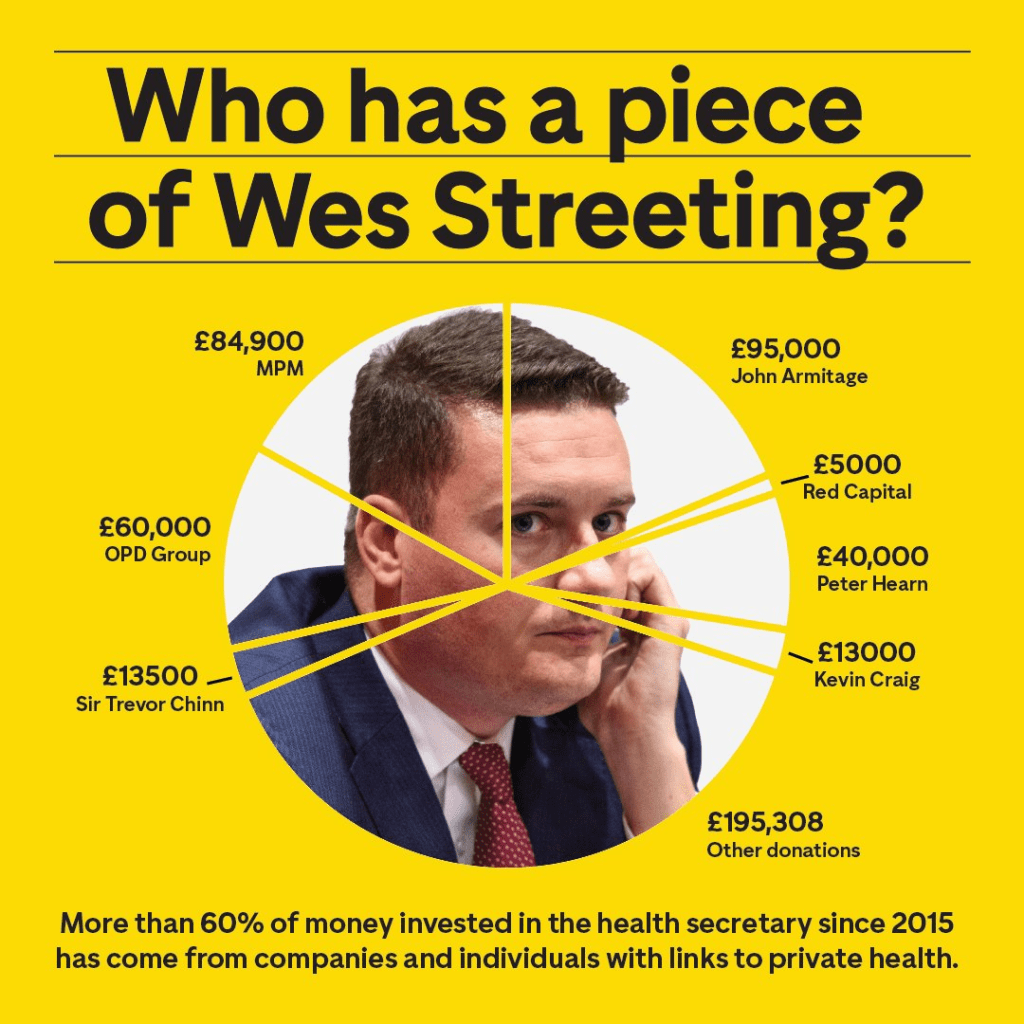
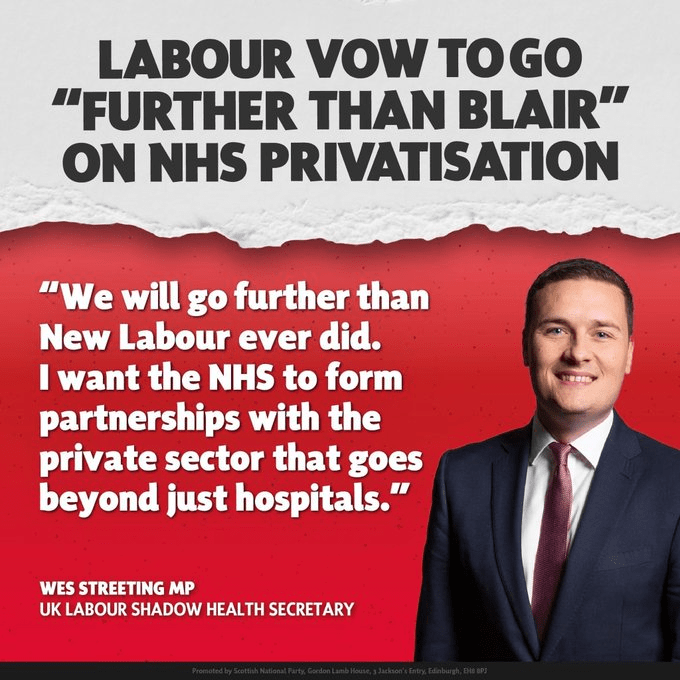
As of writing (Monday evening, GMT), the odds of a Streeting challenge appear to be rising. According to Bloomberg’s Alex Wickham, the prime minister looks in increasing peril as several of Streeting’s allies, including his PPS Joe Morris and constituency neighbour Jas Athwal, have called for Starmer to stand down:
— Labour MPs and aides say developments could now happen quickly if momentum continues to build. A loyalist says it’s now a matter of when not if.
— A Labour official says they believe several Cabinet members are ready to tell the PM he has to set a timetable for his departure if it becomes clear he has lost the authority of the backbenches. They think if the number of public dissenters heads toward three figures that will happen.
— However Cabinet aides insist we are not there yet and they don’t think the whole Cabinet is yet ready to move. One notes that Streeting’s allies appear to have gone after markets closed, after gilts dropped on Monday on the political instability. There will be a lot of attention on market open tomorrow.
— Streeting is silent but there appears to be an orchestrated plot by his supporters to call for Starmer to go so he can move. There was disappointment among some of Streeting’s allies today that he has not moved already but it now feels increasingly inevitable.
Another possible successor is — or at least, was — Manchester City Mayor Andy Burnham, but he would need to become a member of parliament to be able to run as Labour leader. And the Labour Party leadership recently blocked him from being able to stand as a candidate for the by-election in Gorton and Denton. According to Wickham, “Burnham’s allies say he will soon be ready to show he has a route to parliament.”
Burnham, who was formerly a junior minister under Tony Blair, has already run for the party’s leadership twice before, with underwhelming results. Like Streeting and most other high-ranking party members, he also has close ties to Labour Friends of Israel and other Zionist lobbies. Indeed, if Starmer were to fall, one thing we can be totally certain of is that there will be no meaningful change in UK relations with Israel.
Meanwhile, the Labour Party, like the Conservatives before it, is haemorrhaging support — both to Nigel Farage’s Reform Party on the right and the Green Party on the left. This is not a surprise given the scale of Labour’s betrayal to its core voters, beginning with the proposed scrapping of the winter fuel allowance in Starmer’s first months of power, as well as the authoritarian excesses of Starmer’s rule, writes Yannis Varoufakis:
The crux of their debacle lay, first, in a distinctly dictatorial, authoritarian reflex. And second—crucially—in a seething contempt for those who lent them their votes, while simultaneously performing a grotesque pantomime of flattery toward those who never would, and never will, support them.
Having exorcised from the Labour Party its most authentic voices—people of unimpeachable integrity, such as Ken Loach and Jeremy Corbyn, a purge that eluded even Tony Blair’s repertoire—Starmer embarked on a rampage:
He slashed disability benefits; armed and fed intelligence to the Israeli government as it executed genocide in Gaza; channeled his own inner Farage, perhaps his inner Enoch Powell, to vilify migrants and treat refugees as vermin; gutted international aid to masquerade as a defender of defence spending; bulldozed wildlife and their habitats; unveiled a new lexicon of draconian anti-protest laws; left trans people suspended in legal limbo; clung with religious fervour to absurd, socially ruinous fiscal rules; allowed Rachel Reeves to squander £100 billion covering the Bank of England’s outrageous and wholly unnecessary Quantitative Tightening losses—a gift that keeps giving to the City’s banks—while imposing yet another round of austerity on government departments and public services.
Once the great hope of the downtrodden, Starmer’s Labour has become the villain – the genuinely nasty party. Once a human rights lawyer, he has single-handedly plunged Britain into a shoddy, incompetent authoritarianism.
We have covered that creeping authoritarianism in some depth in our two-instalment post, “Just How Dystopian Can Starmer’s Britain Become?” (here and here). Indeed, arguably Starmer’s most important legacy is the way he has instrumentalised the law, particularly the anti-terrorism laws, to arrest and intimidate pro-Palestinian journalists, activists and protesters.
With ruthless zeal, his government has criminalised public opposition to Israel’s genocide in Gaza while lending support to the furtherance of said genocide, including through the provision of more than 100 RAF spy flights over Gaza. In Starmer’s Britain, merely expressing critical views about the political ideology of Zionism in a private conversation can get you arrested…
Even before his election as prime minister, in July 2024, Starmer had shown his colours on the Israel/Palestine question. Starmer had already played a key role in bringing down his former, pro-Palestine boss, Jeremy Corbyn. On October 11, 2023, Starmer, then leader of the opposition, told LBC that Israel had the right to collectively punish Gaza, including by cutting off water and power to the enclave, in response to Hamas’ Oct 7 attacks.
After Corbyn’s downfall, Starmer then began the task of purging the Labour Party of any remaining left-wing thinkers. It is a task he may have been assigned by the Trilateral Commission, a trans-Atlantic forum set up by US billionaire David Rockefeller in the 1970s to help steer Western democracies by prioritising corporate interests over those of labour.
Starmer was the first ever sitting British member of parliament to join the Commission, according to Matt Kennard, which he did behind Corbyn’s back.
Since Starmer’s election in July 2024, the Blairite faction of the Labour Party has wielded outsized influence over government, through the appointment of Blair acolytes like Streeting and Peter Kyle, the science secretary, as well as through Blair’s think tank, the Tony Blair Institute for Global Change (TBI), as we warned in our our May 3, 2024 post, Tony Blair and His Associates Are Waiting in the Wings to Take Back Power in UK:
One of the great contradictions of British political life over the past 15 years is Sir Tony Blair. The three-term prime minister is broadly reviled by the British public, even among many Labour Party voters, yet he continues to be feted and fawned over by the British establishment and media. Even after the “crushing verdict” (in The Guardian‘s words) of the Chilcott Inquiry — that the Blair government’s case for the Iraq war was “deficient” — was finally made public in 2016, Blair remained a go-to person for the British and international media on all manner of topics, particularly the COVID-19 pandemic.
It is a very different story for the British public. In a recent YouGov opinion poll, only 22% of respondents said Blair had had a positive effect on the Labour Party, with 38% saying his impact was broadly negative. Even among Labour Party voters, only 26% labelled his impact as positive compared to 38% who saw it as negative. According to another YouGov survey, this time from 2022, a mere 14% approved of his knighthood and only 3% strongly so, while 63% disapproved, 41% strongly so. Over a million people signed a petition demanding the knighthood be revoked.
In other words, the last thing most people in the UK want to see is Blair making a political comeback. Yet the former PM is closer than ever to regaining political power, albeit through a proxy Labour Party government led by the current party leader, Keir Starmer, who is hotly tipped to win the next general election… Starmer is favourite to win not because of a groundswell of support for his vision or candidacy — the UK public view the party under Starmer even less favourably than under Ed Miliband — but because support for the governing (if you can call it that) Conservative Party is in freefall…
As the FT reported in 2023, TBI has in effect become a global consultancy to the UK government, giving advice on a whole host of issues. It has over $100 million and is currently active in 40 other countries, including the United States. Most, however, are in the global south/majority, where TBI advises governments on DPI such as digital vaccine certificates, digital identity and central bank digital currency.
Since coming to power, Starmer’s government has prioritised the digital authoritarian solutions peddled by TBI, such as digital identity; the mass sharing of the UK’s digital health data, which would hugely benefit TBI’s main paymaster, Larry Ellison; and the nationwide deployment of facial recognition cameras, a project that was begun by the Conservatives but has been massively expanded by Starmer.
Blair’s latest grand proposal for the people of Britain is to scrap the state pension’s triple lock, which will help further impoverish struggling pensioners…
Click here to read the full article on Naked Capitalism

