In His “Radical Centralism” Essay, Tony Blair Is, As Usual, Talking His Book

And that book was written by Larry Ellison. 

Tony Blair’s 5,600 word essay, “The Labour Party Is Playing With Fire Over Its Future and the Future of the Country”, has made some big waves since its publication on Wednesday. Blair has wielded significant behind-the-scenes influence over the Keir Starmer government during the past two years, both through his modestly named foundation, the Tony Blair Institute for Global Change, or TBI, as well as key Blairite cabinet members.

With the release of this essay, however, Blair is once again in the front and centre of the political stage. Some deluded commentators are even calling for his return as prime minister…

Many have viewed the essay as an attack on both Starmer and the main challengers to Starmer’s throne, whom Blair rightly notes have “no coherent plan” for the country.

At the same time, however, Blair seems wilfully blind to the inescapable reality that Britain’s current malaise is the result of almost half a century of neoliberal economics, of which he played a vital part in cementing. He even admonishes those on the left for daring to think that “nothing good [came] out of the last ‘40 years’ of ‘neo-liberalism’”. An apt riposte:

In this humble blogger’s opinion, Blair’s latest intervention smacks of desperation. The Starmer project is coming apart at the seams at the worst possible moment for both Blair and his corporate sugar daddy, Larry Ellison.

The foundations of the so-called “AI revolution” are not quite firmly in place yet, while public opposition to AI is rising rapidly on both sides of the Atlantic. Meanwhile, Labour’s leadership woes appear to be going from bad to worse, with nearly half of the public now saying Keir Starmer should resign rather than contest a future Labour leadership election. His potential successors — Andy Burnham, Wes Streeting and Angela Rayner — inspire zero confidence.

Unsurprisingly, the legacy media has played down some of the conflicts of interests that lie behind Blair’s latest call-to-arms while somehow trying to present his essay as a rare intervention in British politics…

A more realistic take…

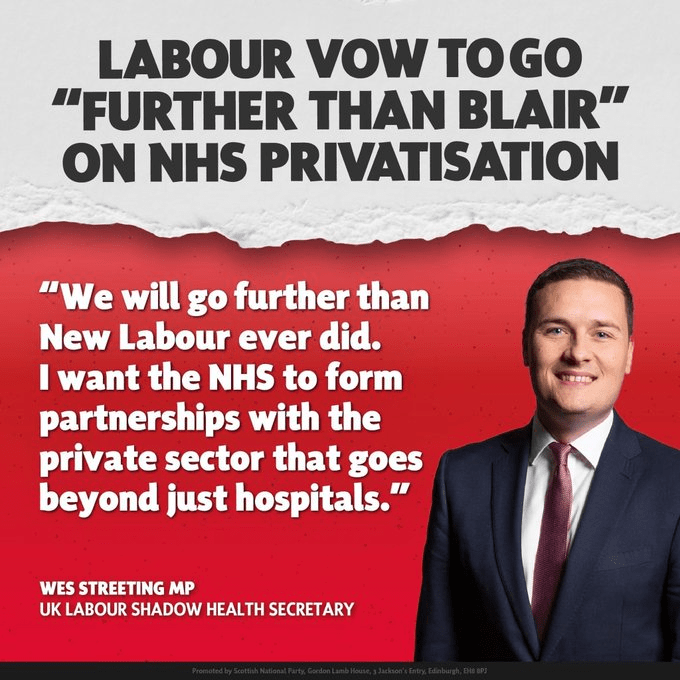
Blair’s essay is brimming with what Blair calls “radical centrist” proposals (economic deregulation, a crackdown on welfare spending, pension cutbacks, more NHS privatisation, more private-public partnerships…) that could have been written at just about any time by either of the two main parties over the past 30 years.

As Richard Murphy notes in his blog post on Wednesday, which we cross-posted here, Blair’s article is full-on TINA:

Blair’s core argument is straightforward. He says Britain is entering an era of immense disruption driven by artificial intelligence, geopolitical fragmentation, declining Western dominance, climate pressures, demographic change and a new global economic order. He argues that politics as we have known it is becoming obsolete, and claims Labour has no coherent response to this transformation.

So far, so good, then, even down to Labour having no answer to those things, because it very clearly has not. What Blair does not notice is that this is because neoliberal politics – of the sort he and Bill Clinton helped create – is not designed to have those answers. Its whole purpose is not to answer questions, but to suggest that these may be found in the market.

That said, Blair is right on two points: that it would be disastrous for the UK to re-join the EU from its current position of economic and political weakness. This is particularly true if it would mean having to give up Sterling and join the eurozone straight jacket, as one senior eurocrat has suggested.

Blair also makes three particularly controversial recommendations that I believe are worth highlighting:

  1. The UK should cosy up to Trump, on whose “Board of Peace” Blair currently sits. It is vital, Blair says, that the US can trust the UK as an ally regardless of who is in power. In an interview on the Newsagents podcast, he says: “It doesn’t matter if you agree with the [current occupant of the White House’s] policies or disagree with his policies, the American relationship matters. And as a prime minister, you’ve got to explain that to the people.”
  2. The UK should take a more active role in the US-Israeli war on Iran. No great surprise here, this being Tony “Butcher of Baghdad” Blair doing the talking. To my knowledge, there isn’t a US-led war Blair hasn’t supported since NATO’s bombing of Yugoslavia in 1999. He is also one of the most fervent pro-Israel voices in British politics, which is some feat given the extent to which Israeli lobby groups have infected British political institutions, especially since joining forces with the Blairite wing of the Labour Party to bring down Jeremy Corbyn’s leadership.
  3. The UK should abandon its Net Zero commitments and embrace cheap energy, describing the Starmer government’s phasing out of oil and gas licences as key mistakes. This is not the first time Blair has pushed back against climate change policies. In April 2025, TBI launched a call to “reset action on climate change”. As always with Blair, money is the prime motivator. Cheap energy is a vital input for the data centres that will power the AI systems his foundation has been plugging for years. Besides the huge sums of money it has received from tech overlord Larry Ellison, the TBI is part-funded by oil companies and petrostates.

In all three of the aforementioned proposals, Blair is essentially talking his book, as he always does. And that book was written primarily by Larry Ellison.

Ellison is far and away TBI’s largest backer. Ellison invested $130 million in the foundation between 2021 and 2023, with a further $218 million pledged since. As Agenda Publica reports, Ellison’s donations have propelled TBI into a category all of its own among UK-based think tanks:

Ellison donations have seen it grow to close to 1,000 staff, working in at least 45 countries. It enjoys US levels of funding and influence, so while UK counterparts like Policy Exchange had income of £4.3 million in the last financial year, and the Institute of Public Policy Research registered £4.3 million in 2023, TBI’s turnover was $145.3 million…

Blair himself takes no salary from TBI but in recent years it has been able to recruit from bluechip firms like McKinsey and Silicon Valley giants Meta. In 2018 before the Oracle founder’s funding surge, TBI’s best-paid director earned $400,000. In 2023, the last year where accounts are available, the top earner took home $1.26 million.

One former staff member said the effect of this cash injection was to make the culture “toxic as fuck”, while others described a form of AI boosterism that silenced nuance and pushed the boundaries of lobbying for Oracle. Some TBI staff — including a number who left because of it — say the cash injection has produced a toxic culture at the institute that is rife with nepotism , dominated by AI optimism that silences nuance and pushes the boundaries of lobbying for Oracle.

All three of the aforementioned proposals, if acted upon, would either benefit Ellison directly, by lifting energy restrictions and regulatory obstacles for the development of AI, or indirectly — by fortifying the UK government’s relations with the Trump administration, of whom Ellison is both a prominent backer and major beneficiary, and its unquestioning support of the State of Israel, to which Ellison, a fervent Zionist, is a big donor.

As we reported in our article, Larry Ellison’s Dark Vision for “OUR” Future, Ellison has a religious-like belief in AI, describing it as “maybe” the most important discovery in the entire history of humankind — more important, seemingly, than fire, the wheel, language, steam, electricity and the atom. He is also aggressively pushing for governments to embrace AI-enabled control and surveillance technologies, with a significant onus on biometric identifiers:

The world’s fourth richest man, Larry Ellison, has a vision for the future, and it is one that most of us would never vote for if given the chance (which, of course, we won’t be). It essentially involves harvesting and storing all of a nation’s data, including all of its citizens’ most personal data, in one place, and then letting AI programs scour all over it. That data, he says, should include economic data, electronic healthcare records, including our genomic data, spatial information, agricultural data and info about infrastructure.

“I have to tell [the] AI model as much about my country as I can,” Ellison said in a recent onstage discussion with his old friend Tony Blair at the World Governments Summit. “We need to unify all the national data, put it into a database where it’s easily consumable by the AI model, and then ask whatever question you like. That’s the missing link”…

Today, Ellison is determined to turn his dystopian vision of the future into reality through his deep connections with two markedly different governments: Donald Trump’s second administration in the US and Kier Starmer’s Labour government in the UK…

Now, Ellison wants to take AI-enabled digital surveillance and control systems to a new level by totally centralising them, despite the obvious security implications. He also envisions a world without passwords and personal identification numbers (PINs) in which access to IT systems and tech platforms will be based purely on our biometric identifiers. As he says in the clip below of his recent chat with Blair, “this is the last year you will ever log onto an Oracle system with a password… biometric logins are the future.”

Ellison also talks about the need for national governments to have their own “sovereign” data centres to power their AI systems, which will no doubt provide Oracle, the world’s largest database management company, with lots of new income streams.

In an Oracle financial analysts meeting in September, Ellison told investors that AI will usher in a new era of surveillance that he said, gleefully. will ensure “citizens will be on their best behaviour.” It is as if Ellison read Orwell’s 1984 and Huxley’s Brave New World and came away with a new business model.

In September last year, the New Statesman published a report flagging growing concerns among TBI staff about Ellison’s malign influence over TBI, as his cash injections have produced “a culture that is dominated by a form of AI boosterism, and which, as they see it, amounts to lobbying for Oracle”:

The TBI, however, was welcomed by Keir Starmer’s Downing Street operation, which includes many figures with close connections to the former prime minister. Peter Kyle, an adviser in Blair’s second term, was appointed technology secretary and called on governments to show “a sense of humility” towards Big Tech companies. In an August 2024 paper on “preparing the NHS for the AI era”, TBI found “good reasons” for building new digital health records with an existing system run by Oracle.

In January 2025, Starmer’s government announced the creation of dedicated AI Growth Zones to enable the “rapid” build-out of data centres. As David Powell reported last year, the AI Growth Zones represent a fundamental shift in how the UK approaches industrial development, bypassing normal environmental assessments and community consultation processes:

This mirrors the Freeport model – special economic zones where normal rules don’t apply. While the government hasn’t explicitly confirmed tax holidays for AI Growth Zones (our FOI requests are pending), the pattern is clear: deregulation, fast-track planning, and corporate subsidies disguised as economic development.

The regulatory divergence from Europe is stark. While the EU has enacted comprehensive AI governance through the AI Act, the US and UK have pursued what JD Vance called a “hands-off approach.” This creates regulatory arbitrage – allowing practices in Britain and America that the EU has deemed too risky.

The regulatory divergence from Europe is stark. While the EU has enacted comprehensive AI governance through the AI Act, the US and UK have pursued what JD Vance called a “hands-off approach.” This creates regulatory arbitrage — allowing practices in Britain and America that the EU has deemed too risky.

Blair’s essay ends with a ten-point plan for political reform, the first of which provides a textbook example of this way of thinking:

1. The private sector will go through a process of adaptation to this new AI world and, therefore, business and entrepreneurs need to know government is on their side, removing obstacles to business growth – not creating them as they go through this massive process of adjustment. So, all those measures I described above which hold business back should be corrected or mitigated.

Yet those obstacles are exactly what are needed to protect local residents and communities from the dark externalities of AI. While companies like BlackRock profit from managing British pension funds and investing them in data infrastructure, residents near those facilities face a litany of health, environmental and financial impacts that mirror experiences in the US…

Click here to continue reading the article on Naked Capitalism
Puerto Rico’s Trump-Adjacent Governor Warns of an Imminent US Attack on Cuba

“We had a war until recently with Venezuela and we are going to have one with Cuba in the coming week.”

The United States could enter a war with Cuba in the next week or so, according to Puerto Rico Governor Jennifer González Colón. During an interview with Molusco TV, González cited the US’ growing list of conflicts, particularly in the Americas, as a reason why Puerto Rico remains an indispensable territory for Washington’s imperial ambitions (translation my own):

JGC: Ronald Reagan said [in the early ’80s] that Puerto Rico was ready and prepared to be part of the United States and that it would also be more beneficial for the United States to have Puerto Rico as a state.

Interviewer: But that was during the Cold War.

JGC: There was a Cold War then, just as there’s a Cold War now. We now have a war with China, we have a war with Iran, we have a war with Russia, we had a war until recently with Venezuela and we are going to have one with Cuba in the coming week.”

It is curious to hear the governor of Puerto Rico, an “unincorporated” US territory with a population of around 3.2 million people who cannot even vote in US elections, speak blithely about being at war with China, Iran, Russia, Venezuela, and soon Cuba. González is not the only Latin American leader to have de facto joined the US’ wars of aggression. In March, Milei declared Iran an “enemy” of Argentina and designated the IRG as a terrorist group.

In the grand scheme of things, González is a relatively bit-time player in the US’ military manoeuvres in the Caribbean. However, Puerto Rico did play its part as a staging post for the US’ moves against Venezuela, as Reuters reported in early November.

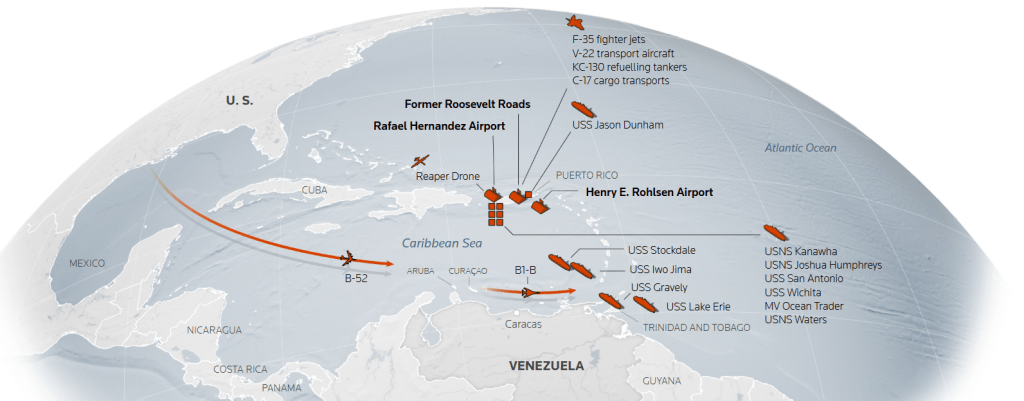
The United States military is upgrading a long-abandoned former Cold War naval base in the Caribbean, a Reuters visual investigation has found, suggesting preparations for sustained operations that could help support possible actions inside Venezuela.

The construction activity at the former Roosevelt Roads naval base in Puerto Rico — shuttered by the Navy more than 20 years ago — was underway on September 17 when crews began clearing and repaving taxiways leading to the runway, according to photos taken by Reuters.

Until the Navy withdrew from the facility in 2004, Roosevelt Roads was one of the biggest U.S. naval stations in the world. The base occupies a strategic location and offers a large amount of space for gathering equipment, one U.S. official said.

In addition to the upgrades of landing and take-off capabilities at Roosevelt Roads, the U.S. is building out facilities at civilian airports in Puerto Rico and St Croix in the U.S. Virgin Islands.

The two U.S. territories sit roughly 500 miles from Venezuela.

Following his abduction on January 3, the plane carrying Nicolás Maduro reportedly made a stop at the Ramey Base in Aguadilla. According to sources cited by Telenoticias, it was a “very short” stop due to a medical emergency before the US forces continued their march to the high seas, where kidnapped president was transferred to a boat that would take him to New York.

González may have been briefed on aspects of the US’ military plans for Cuba and is letting her mouth run a little. Or maybe she hasn’t and is just engaging in idle speculation. Which is the case, her remarks should be read less as an official announcement or diplomatic warning than as part of a political campaign for Puerto Rican statehood.

In the interview, she said Puerto Rico should no longer be seen as “the ugly duckling” but rather as a key strategic asset for the US’ pharmaceutical and military supply chains.

“Puerto Rico is vital in these areas,” González said. We were key for Venezuela barely six months ago and we are going to be key for US public policy in Latin America”.

González’s comments come at a delicate moment for US foreign policy as whole, with the ceasefire in West Asia hanging by a thread. It is highly unlikely (though not impossible) that the US will attack Cuba if fighting resumes in the Persian Gulf. That said, the Trump administration is desperate for a foreign policy win to distract from its catalogue of hugely costly failures, and may, mistakenly or not, view energy-starved Cuba as a soft target.

The Southern Command reported a few days ago the arrival of the aircraft carrier USS Nimitz to the Caribbean, as part of the Southern Seas 2026 mission, officially aimed at strengthening maritime alliances, interoperability and security in the Caribbean, Central and South America.

Washington has also intensified its judicial offensive against Cuba’s senior leadership. The Justice Department announced on May 20 that it had filed an indictment against 94-year-old Raúl Castro Ruz and five other defendants for their alleged role in the shooting down of two Brothers to the Rescue planes in 1996 that killed four civilians.

It is not yet clear, as the veteran Italian journalist Federico Lampini tells El Mundo, whether the US indictment of Raúl Castro is the prelude to a Maduro-style operation, as González suggests, or simply a negotiating tool for applying additional pressure on the Cuban government:

Rubio knows that the US has a disastrous record in its attempts to promote regime change. When the CIA director recently visited Havana, his first request was simple and logical: end all Russian and Chinese military and intelligence presence. That would be a first step toward Venezuelan-style “regime change”: moving from an adversarial geopolitical position to one subordinate to Washington.

Speaking of Venezuela, it seems the man now calling the shots in Caracas is Mauricio Claver-Carone, the US State Department’s former head of Latin America. And Wall Street firms are benefiting bigly, reports Washington Post:

“Claver-Carone, usually operating by phone from his home and office in southern Florida, has been instrumental in picking winners and losers among aspiring investors as the country’s long-faltering oil industry is rejuvenated, said people familiar with his dealings. Most recently, he said, he vouched for Centerview Partners, a New York-based financial firm that was among the many vying to be hired by the Venezuelan government to help restructure its $170 billion debt.”

Hours after Washington announced the charges against Raúl Castro, the US Army mobilised troops from Puerto Rico to an unidentified mission, Fort Buchanan reported on Thursday. Which may be an ominous sign given Puerto Rico already played an important role in the January 3 US military operation against Venezuela, or it may mean very little.

In the months leading up to the Venezuelan op, the island’s Roosevelt Roads base was the scene of intensive military training, as Swiss Info reported in the hours after the attack:

Puerto Rico Gov. Jenniffer Gonzalez on Saturday stressed the importance of the Caribbean island to carry out the U.S. operation against the Venezuelan government on Saturday and achieve the capture of Venezuelan President Nicolas Maduro.

This, Gonzalez said at a press conference, highlights “the importance of the island in the Caribbean, in the role we play in national defense, and that is why Puerto Ricans are proud to be part of this great nation.”

The Roosevelt Roads base, in Ceiba (eastern Puerto Rico), was during the past two months a military exercise area by the United States Army and, according to the official, it also served as a passage for Maduro’s transport to the United States.

Puerto Rico, linked to the United States as a Commonwealth, has a certain degree of autonomy and a local government and Parliament, but areas such as defense, borders, currency or diplomatic relations remain under the control of the United States.

Likewise, the Federal Aviation Administration (FAA) issued an order to cancel more than 300 U.S. airline flights to Puerto Rico for safety reasons until 01:00 (05:00 GMT) on Sunday.

Havana has responded to the latest threats from Washington and Miami by stepping up civil defence exercises and distributing survival guides against possible military attacks. It has also described the charges against Raúl Castro as “fabricated” and has warned of “fierce resistance” to any aggression.

As Patricia Marins notes above, Cuba is expecting an invasion that, by all indications, will become a reality soon. Humanitarian aid continues to arrive from China and Mexico while the US has served CODE PINK’s Medea Benjamin and left-leaning influencer Hasan Piker subpoenas for providing the besieged island of Cuba with medical aid and equipment.

Cuba has only received one shipment of (Russian) oil since the beginning of this year. While Moscow, like Beijing, has expressed support for Cuba since the US indictment of Castro and is the only country to have actually broken the US’ energy blockade, the reality is Russia already has enough on its hands with the war in Ukraine.

With gusano-in-chief Marco Rubio running US operations in Cuba, it seems the old casino mobster class may soon regain control of their island paradise…

Click here to read the full article on Naked Capitalism

The US Just Went Full Orwellian on Cuba and Argentina

Washington is inventing industrial-scale lies to justify its escalating collective punishment of Cuba as well as its latest power grab in Argentina.

Never go full Orwellian. At least that’s what someone should tell the US State Department. As the Trump administration tries to starve the 11 million people of Cuba into submission through a near-total siege of the island, the US Secretary of State Marco Rubio released a statement on Wednesday placing the entire blame for the island’s rapidly worsening humanitarian crisis on the shoulders of the Cuban government.

In a short video message addressed (in Spanish) to the Cuban people (though the real intended target, of course, was the US voting public), Rubio said:

“The reason you are forced to survive 22 hours a day without electricity is not because of an oil blockade by the United States…[but] because those who control your country have looted billions of dollars.”

This is political hypocrisy of an unusually high order, even by Washington’s standards. As the New York Times correspondent and former Obama administration foreign policy wonk Ben Rhodes points out, Rubio “works for a guy who has looted far more billions of dollars for himself and his cronies than even the most corrupt Cuban officials.”

To save readers from wading through the rest of Rubio’s message, CODEPINK have provided a handy English-language translation and summation…

The Trump administration’s official messaging on Cuba in recent days has been so Orwellian — in the sense of twisting the truth so much that that it ends up resembling the direct opposite of reality — that even NEWSMAX hosts apparently aren’t buying it.

Meanwhile, the cooked up charges against 95-year old former president Raul Castro, which are essentially a pretext for war, have served to shine a light on the shady role played by the network behind CIA-trained Brothers to the Rescue. That includes bringing down a Cuban civilian airliner in 1976 in which 73 people perished as well as carrying out bombings on other civilian targets.

As Max Blumenthal explains in his latest appearance on Judging Freedom, the Brothers to the Rescue deliberately and repeatedly violated Cuban airspace in 1996 before their two planes were eventially brought down by Cuban air defences.

Worse still, Colonel Larry Wilkerson suggests in his weekly slot on Judging Freedom that the Brothers to the Rescue actually wanted the Cuban authorities to bring down the two planes:

The Brothers to the Rescue actually saw that their flights where they dropped arsenals of equipment and other things like bombs on Cuba periodically, they saw they weren’t having a whole lot of effect. And so they concluded that in order to get them to have the kind of effect they wanted, they needed something really awful to happen. And it needed to happen and be blamed on Cuba.

So they persisted in what they were doing and we know this pretty closely now — we being the people that actually worked with Cuba for some 10, 15 and in some cases 30 years. They actually encouraged one of the planes with neophytes in it to essentially go and challenge what they knew was going to be from Fidel’s very specific statements about what he was going to do to the next one, to have it done to them.

They actually got their own plane shot down and the people in it killed.

The problem for the Trump administration is that even before it decided to go full Orwellian on Cuba this week, a huge majority of the US’ war-wearied, economically challenged citizens are against any military action. Rubio’s bile is unlikely to change many minds. From CEPR:

A new poll by YouGov finds that 64 percent of Americans oppose the US going to war against Cuba, while 15 percent support it and 21 percent are not sure.

Among those who express a view, 81 percent are against a war.

“This should make President Trump think twice about another ‘war of choice,’” said Mark Weisbrot, Senior Economist and Co-Director of the Center for Economic and Policy Research (CEPR). “Almost all of the experts on Cuba would laugh at the idea that Cuba presents a security threat to the United States. And the war against Iran has already cost Trump and his party significant support.”

The YouGov poll, sponsored by CEPR, found that respondents agreed that the war in Iran has harmed Americans and the world, by a margin of 62 percent to 24 percent.

As Caitlin Johnstone notes in the tweet below, arguably the most dangerous turn of events for Cuba is a relaxation of tensions between the US and Iran — “the US never makes peace, it just moves the crosshairs… from nation to nation.”

Meanwhile, Aguaje Films, a Cuban media collective, has taken a leaf out of Iran’s Explosive Media’s playbook by producing a satirical Sesame Street-themed animated short that ridicules what it portrays as the modern US regime-change playbook. Like Explosive Media’s content, the video includes a catchy rap tune but with a particularly deep bassline. It also features a perfect representation of Rubio’s floppy hairstyle.

“Protecting the Global Commons” in the South Atlantic

It’s not just on the issue of Cuba that the Trump administration has been engaging in industrial-scale gaslighting. On Monday, the US Embassy in Argentina announced a controversial agreement between US Southern Command and Argentina’s Javier Milei government to patrol Argentina’s “maritime zone” for five years.

The official aim of the programme is to strengthen regional security and combat maritime threats, including illegal fishing and other illicit activities in the South Atlantic. The initiative will start small but the goal is for it to scale quickly, reports La Nación (machine translation):

The partnership begins with the “delivery of a specialized camera on board an aircraft dedicated to patrolling the Argentine maritime zone.”

This program will be expanded over the next five years with “advanced equipment, elite training and support to intercept and neutralize maritime threats,” the U.S. Embassy in Argentina said in the last few hours, in a message that was replicated by the Southern Command on social networks.

But it’s the name that was given to the programme, which will presumably be extended to other maritime territories in the Western hemisphere, that is most eye-catching: “Protecting the Global Commons”.

As titles for US government programs go, this one is way out there. Firstly because Argentina’s sovereign waters do not remotely belong to the global commons, they belong to the nation — and by extension, the people — of Argentina. Or at least they did before Milei invited the US forces in. This is a fact that has not been lost on certain opposition lawmakers who have raised objections to the prospect of US interference in maritime surveillance tasks.

There is also something particularly galling about the Trump administration claiming to seek to safeguard the global commons when it is actually seeking to plunder the Western hemisphere’s vast treasure trove of strategic minerals and other resources — for the benefit, of course, of US-aligned corporations. All that will be left behind are the usual externalities (water pollution, habitat destruction, and community displacement).

Washington doesn’t, and never has, given a fig about the global commons, and for decades has done everything it can to undermine public ownership of any common goods or services, both within and beyond its borders. Worse still, Wall Street firms are leading the global charge to financialise and tokenise nature itself, as Whitney Webb reported in her 2023 article, “Wall Street’s Takeover of Nature Advances with Launch of New Asset Class”.

Called a natural asset company, or NAC, the vehicle will allow for the formation of specialized corporations “that hold the rights to the ecosystem services produced on a given chunk of land, services like carbon sequestration or clean water.” These NACs will then maintain, manage and grow the natural assets they commodify, with the end goal of maximizing the aspects of that natural asset that are deemed by the company to be profitable…

[E]ven the creators of NACs admit that the ultimate goal is to extract near-infinite profits from the natural processes they seek to quantify and then monetize….

Framed with the lofty talk of “sustainability” and “conservation”, media reports on the move in outlets like Fortune couldn’t avoid noting that NACs open the doors to “a new form of sustainable investment” which “has enthralled the likes of BlackRock CEO Larry Fink over the past several years even though there remain big, unanswered questions about it.”

So, to recap, this has nothing to do with protecting the global commons (quelle surprise!) and everything to do with projecting US power, particularly over vital international sea routes. As we reported in January, the US is making big moves in Latin America’s Southern Cone:

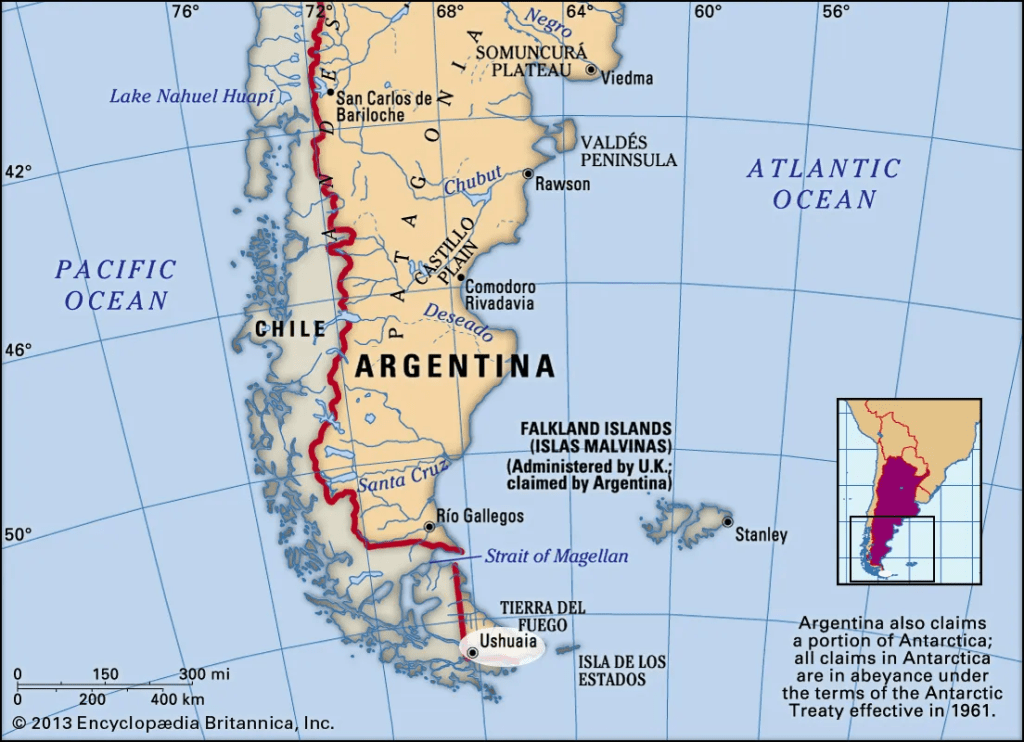
ON Sunday (Jan 25), a Boeing C-40 Clipper belonging to the US Air Force landed in Ushuaia, Argentina’s — and the world’s — southernmost city under a blanket of near-total secrecy. Argentina’s Ministry of Foreign Affairs was silent on the matter and the local Tierra del Fuego government, run by a self-declared opponent of Javier Milei’s, said it had been kept in the dark.

On the same day, at least two private flights departed from Buenos Aires’ San Fernando airport to Ushuaia. Again, no details were provided. The information blackout has local authorities on high alert, especially given the timing of the visit. Just two days earlier, the Milei government had formalised a 12-month administrative takeover of the port of Ushuaia, citing financial irregularities and the diversion of public funds.

As we discussed previously, Ushuaia’s location is of clear strategic value to the US:

On the one hand, it is on the doorstep to the Antarctic, with its vast stores of unexplored and unexploited resources, including the largest freshwater reserve on the planet… On the other hand, [it’s right next] to the Drake Passage, a wide waterway connecting the Atlantic and Pacific Oceans between Cape Horn (the southernmost point of South America) and the South Shetland Islands off Antarctica. If the US could control both the Drake Passage and the Panama Canal, it would control the two bi-oceanic passages on the American continent.

As an aside, it’s worth adding that control over Cuba would grant the US control over another key piece on the geopolitical chessboard: the Gulf of Mexico. As the Mexican politician José Cuauhtémoc Cervantes notes, Cuba is located right opposite one of the continent’s most important trade and oil routes. Whoever has total control over Cuba would have significant capacity to monitor and exert pressure on maritime traffic in the Gulf.

US Treasury Secretary Scott Bessent has described Argentina as a centrepiece for US strategy for Latin America. Since Milei came to power in December 2023, Ushuaia has been visited by two US SOUTHCOM commanders, Laura Richardson and Alvin Hosley. In 2024, Milei travelled 3,000 kilometres to meet up with General Richardson to announce the establishment of a joint naval base that would allow Argentina and the US to control this key entry point to Antarctica.

If the US is able to build a modernised military port with air, land, and naval capabilities near Antarctica, it “would enhance US control over key maritime routes and resources, thus compromising Argentina’s neutrality vis-a-vis Russia and China,” points out an article in MercoPress.

Under Milei, Argentina is moving forward in this direction of a strategic alignment with US military interests, particularly in controlling access to Antarctica and the Strait of Magellan…

Critics argue that a US base would strain relations with China and Russia while sidelining regional partners like Brazil and Chile. Additionally, concerns have been raised about bypassing constitutional requirements for congressional approval of foreign troop deployment, which could even include US submarines in Ushuaia.

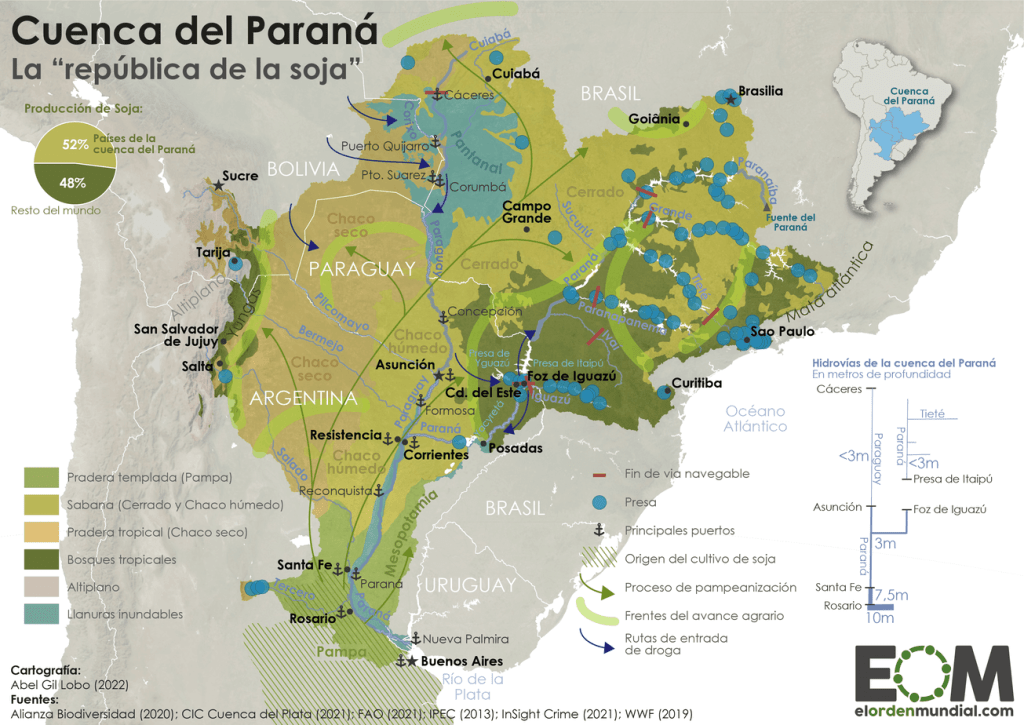
It is not just Argentina’s southern tip that the US is keen to control. In its last days in office, the government of Alberto Fernández signed a controversial agreement with the US Army Corps of Engineers for the study and management of the Paraná river, upon which 80% of all Argentina’s exports travel. One of Milei’s first acts in government was to ratify that memorandum. 

The Paraná is part of a vast river trade corridor that represents the main exit route for raw materials from the entire South American region. It crosses five countries (Brazil, Bolivia, Paraguay, Argentina and Uruguay) and is mainly structured on the Paraguay and Paraná rivers. In total, it comprises 3,400 kilometres of navigable waterways, the longest stretch of which is on Argentine territory.

Now, the Milei government is moving forward with a megaproject aimed at dredging and deepening the river, thus allowing larger vessels to navigate the waterway. Activists warn the project will have disastrous consequences for all the communities that depend on the Paraná, Paraguay and La Plata river basin, including Buenos Aires, and that it violates the Escazú Agreement, an international environmental agreement signed by 24 Latin American and Caribbean nations.

But the project is key to the Milei government’s deeply extractivist economic model that seeks to exploit Argentina’s primary resources (oil, natural gas, lithium, industrial agriculture) to the max while allowing the country’s national industry to fall along the wayside. In the last two years Argentina has registered the worst industrial performance in the world, along with Hungary.

“The re-primarisation of the economy has as its counterpart the destruction of industry, the destruction of science, the destruction of education and a brutal environmental flexibility,” Enrique Viale, president of the Argentine Association of Environmental Lawyers tells El Salto.

But this is the inevitable endpoint of the Trump corollary, which is ultimately a reheated version of the Roosevelt corollary. If it succeeds in its goals, the only real function of the other 34 countries of the American continent — 35, if you include Greenland — will be to serve the material interests and needs of the US empire…

Click here to read the full article on Naked Capitalism

US-Israeli Plan to Neo-Colonise Latin America Hits Resistance in Bolivia

The surname of Bolivia’s president, Rodrigo Paz, translates as “peace”, as does the name of Bolivia’s capital city, La Paz. But there is nothing peaceful about Bolivia right now.

Elected in October on a platform of alleviating Bolivia’s worst economic crisis in decades, Rodrigo Paz is already in serious trouble. After weeks of unrest, his fledgling government faces a general strike, nationwide road blockades and violent street clashes that have brought the country’s already struggling economy to a standstill.

At the root of the protests is the so-called “Marinkovic Law”, or Law 1720, which seeks to transform land rights in Bolivia by facilitating the conversion of small properties into medium-sized properties. This opens the way for large landowners to take over campesinos’ small holdings which, perhaps unsurprisingly, has found little favour among rural communities.

In recent days, demonstrators, led by mining unions, neighbourhood councils and indigenous organisations, have clashed with law enforcement as tensions boil over. As Jacobin reports, the protesters have converged on the capital from far and wide, many on foot, through gruelling conditions — all with one main goal: to demand Paz’s resignation:

Marching for over twenty days from the tropics into freezing high-altitude terrain, many wearing nothing more substantial on their feet than plastic sandals, land workers and indigenous representatives arrived in the capital of La Paz this week to defend their territories…

The marchers are from northern Amazonian territories of Beni and Pando and are protesting the new Law 1720, which will transform land rights in Bolivia and could herald the end of the plurinational model of land distribution that safeguards indigenous and peasant land holdings.

The march has been grueling. Many marchers suffered from dehydration and exhaustion; at least fifty indigenous marchers from the delegation of the Central of Ethnic Mojeño Peoples of Beni (CPMB) required medical treatment last week…

Law 1720 is the latest in a long-standing tendency in Bolivia toward the intensification of land inequalities with a view to benefiting large-scale agribusiness. Law 1720 supposedly benefits small-scale farmers by enabling them to convert their smallholdings into “medium-size” businesses and therefore to obtain mortgages. But in reality, Law 1720 sets a precedent for the encroachment on territories and communities by corporate interests.

Some images from La Paz over the last couple of days, including this great photo…

Footage of rural teachers marching through La Paz…

Ominously, the US and Israel have issued eerily similar statements denouncing the protests. This should not surprise our regular readers. Eight governments in Latin America, all members of Trump’s Shield of the Americas initiative and closely aligned with Israel — Argentina, Chile, Costa Rica, Ecuador, Guatemala, Panama, Paraguay, and Peru — have all issued a joint statement on Friday expressing “concern” over the humanitarian situation.

As we reported in our January 20 post, The Attempted Israelisation of Latin America, it is not just Washington that is seeking to significantly expand its dominance over Latin America through its alliance with far-right governments in the region; so, too, is Israel’s Netanyahu regime.

Notably, one of Rodrigo Paz’s first acts in government was to remove Bolivia from the Hague Group — an international bloc of Global South nations established in early 2025 to coordinate legal and diplomatic measures against Israel. Bolivia was a founding member.

A few days after that post, Middle East Eye similarly reported that “US interventions [in Latin America], including extensive lobbying by US politicians, threats against regional leaders and the recent seizure of Venezuelan President Nicolas Maduro, are geared towards tilting the region towards much closer alignment with Israel.”

The recent Hondurasgate scandal exposed by Spanish news outlet Canal Red Latinoamerica revealed the extent to which Washington and Tel Aviv are willing to go to cement their dominance of the region — and the critical resources it holds. From The Canary:

At the centre of the story are the war-criminal US regime of Donald Trumpconvicted drug trafficker and far-right ex-president of Honduras Juan Orlando Hernández, Argentina’s far-right president Javier Milei, and the genocidal government of Israel.

Key facts include that:

Rumours of Live Ammunition

US-supported crackdowns of indigenous resistance movements in Latin America have a tendency of ending in mass bloodshed. The most recent case was the Dina Boluarte government’s suppression of protests in Peru in 2022, which left 65 dead.

According to some unconfirmed reports, the Bolivian police have already received orders to use live ammunition against protesters.

Late afternoon Monday, Bolivia’s Government Palace was still surrounded by police and military forces. The barricades to block Bolivia’s highways — and by extension paralyse the country’s economy — are, if anything, growing as unions in the two most economically important regions (Santa Cruz and Potosí) just joined the general strike, now on day eight.

Meanwhile, prominent far-right influencers in Latin America, such as the Argentine Agustín, Antonetti are calling for foreign intervention, presumably from the US. Rolando Pacheco, a Bolivian deputy, of the Popular Alliance, has alleged that Argentina’s Milei government sent two plane loads of tear gas and other crowd control tools, just as the Mauricio Macri government illegally furnished Jeanine Áñez’s coup forces with weapons in 2019.

Blackwater founder and long-time Trump ally, Eric Prince, has also called for the US to intervene in what he describes as “a violent takeover of the government of Bolivia by an international cartel of narco communist terrorists”. From his Twitter account:

Heads up all those who respect rule of law!

Act immediately to prevent the violent takeover of the Government of Bolivia by an international cartel of narco communist terrorists financed and directed by the leader of coca growers in Bolivia, Evo Morales.

Morales stole hundreds of millions of dollars while he was President of Bolivia. He is a cocaine trafficker currently on trial for sexual assault of a minor.

Armed narcotics gangs and terrorists from Colombia, Chile, Cuba, and other countries have entered Bolivia, joining Morales’ own Bolivian militia of terrorists, and are taking over government buildings and even an airfield built by the US Drug Enforcement Administration, Morales’ nemesis.

They are attempting to surround and take the Presidential Palace in the capital city of La Paz, where the constitutional President and his Cabinet are working to protect the country. The objective of these terrorists is to overthrow the democratically-elected government of President Rodrigo Paz.

Paz has been in office mere months and is trying to clean his country of organized crime gangs, many responding to Morales, that have caused harm, violence, and economic hardship in Bolivia.

Please United States to take (sic) the lead in repelling the international criminal invasion of Bolivia and to restore order and constitutional rule. Bolivia had a real election. Rodrigo Paz won, don’t let the narcos overthrow him.

Prince has taken a growing interest in Latin America’s trouble spots since Trump’s re-election. The world’s most notorious military contractor has already been invited to help out, in an advisory role, in both Haiti and Ecuador, two of Latin America’s most violent countries. He also organised a crowdfunding campaign “Ya Casi Venezuela” (“Almost There Venezuela”) to raise funds to oust the Maduro regime. Where those funds ended up is anyone’s guess.

Economic Grievances

Besides Law 1720, the Bolivian protesters have other grievances. They include fuel shortages, the government’s removal of fuel subsidies, the controversial sale of “junk gasoline” (gasolina basura), which severely harms engine components in cars and motorcycles, an acute dollar shortage, the rising cost of living, aggravated by the progressive fall in exports of natural gas, historically the country’s main source of income, and a new US-led war on drugs.

The IMF is also back in town — not just figuratively but literally. An IMF mission is currently in La Paz hammering out the terms and conditions for a new loan, Bolivia’s first in five years. And Bolivia has had a complex relationship with the Fund.

As the Fund returns to Bolivia, so too, inevitably, will the privatisations of public services and national assets, including, of course, Bolivia’s vast trove strategic resources. Besides lithium and natural gas, Bolivia is an emerging frontier for critical minerals (primarily nickel and cobalt but also antimony, indium, and tungsten reserves). It is also a major producer of tin and silver, while also producing meaningful amounts of gold, zinc, lead, and copper.

In Paz’s defence, many of Bolivia’s economic problems long pre-dated his arrival, with the obvious exception, of course, of his government’s removal of fuel subsidies. Bolivia’s long-touted economic miracle turned sour a long-time ago, mainly because the key driver of that miracle — natural gas exports, principally to Brazil and Argentina — had begun to decline in price and volume.

However, since Paz took over the reins, Bolivia’s collapse has accelerated — the IMF forecasts a more than 3% drop in the country’s GDP this year. Workers’ already low salaries have depreciated sharply amid surging prices. The abrupt withdrawal of public subsidies has compounded the economic pain, fuelling increases of up to 160% in the price of diesel.

There are also fears that Paz’s government is planning to privatise Bolivia’s industries, including its natural gas and lithium mining sectors. Ominously, one of his first acts was to dissolve the Ministry of Environment and Water.

As one mining leader said, the protesters’ only demand is the president’s resignation:

The sole demand of the mobilised people is the removal of the president due to his inability to solve this country’s structural problems. He is leading us adrift, giving away our natural resources, mortgaging the country for our children and grandchildren.

There is another dimension to Bolivia’s nationwide protests, revolving around Washington’s alleged plans to capture former President Evo Morales (2006-19), who is on trial for allegedly fathering a child with a 15-year-old girl while in office.

Morales claims he is a victim of “lawfare” aimed at destroying him physically and morally. For her part, the alleged victim of the crime denies the charges and has requested that the case be dismissed, but the prosecution insists on proceeding.

After Morales refused to attend the hearings on the grounds that he would not receive a fair trial, the prosecution last week issued a warrant for his arrest. According to media speculation, Morales is hiding out in Cochabamba, where his most loyal supporters are protecting him against any risk of imprisonment or abduction by US-backed forces.

On Friday, Morales announced on Twitter:

“The U.S. ordered the government of Rodrigo Paz to execute a military operation, with the support of the DEA and the U.S. Southern Command, to detain or kill me. 

According to Radio Kawsachun Coca, a leaked confidential document from the General Command of the Bolivian Police outlines a plan to capture the former president. The operation, dubbed “Operation Tambaqui Lightning,” would entail a massive deployment of forces in the Cochabamba region, jointly coordinated by the Government, the Armed Forces and the US DEA, which recently resumed operations in Bolivia following a 19-year absence.

For the moment there is no way of confirming the veracity of the alleged documents or Morales’ claims. That said, the US is developing a habit of abducting senior left-wing political figures in Latin America, starting with the January 3 “capture” of Venezuelan President Nicolás Maduro and his wife and serving senator, Cilia Flores.

In recent days, reports have emerged that the US plans to charge 94-year-old former Cuban leader Raúl Castro in connection with the deaths of four men aboard two Brothers to the Rescue planes shot down 30 years ago. On Sunday, Venezuela’s interim president Delcy Rodríguez turned former minister of industry and senior diplomat Alex Saab back over to the US in what is widely seen as definitive confirmation of her betrayal of the Chavista movement.

In other words, South American countries are on full alert for US military interventions in support of right-wing client governments in the region…

Washington Is Closer Than Ever to Pulling Off Its 66-Year Dream of Regime Change in Cuba

The fact that the head of the CIA is in Havana meeting with senior government figures suggests that things could be about to move — and possibly break — very quickly.

Almost exactly 65 years after the Bay of Pigs debacle, the US is reportedly considering another military invasion of Cuba. President Trump has repeatedly mused about taking over Cuba, as his administration tightens its starvation siege of the island nation. Last Friday, he even suggested that an aircraft carrier returning to the US from Iran could be stationed offshore.

This, of course, presupposes that US aircraft carriers will be returning from the Persian Gulf any time soon, which perhaps smacks of wishful thinking. One thing that is apparently happening is that the US Air Force is intensifying its reconnaissance flights off Cuba’s coast, just as it did before the January 3 attack against Venezuela, reports Drop Site News:

The U.S. Navy and Air Force have conducted at least 25 intelligence-gathering flights off the coast of Cuba since February 4, most of them near Havana and Santiago de Cuba and some coming within 40 miles of the coast, a CNN analysis of publicly available aviation data showed—a sudden surge with no precedent in recent years.

The aircraft involved include P-8A Poseidon maritime patrol planes, RC-135V Rivet Joint signals intelligence aircraft, and MQ-4C Triton high-altitude drones—the same platforms that conducted surveillance ahead of U.S. special forces’ capture of Venezuelan President Nicolás Maduro and ahead of joint U.S.-Israeli strikes on Iran.

CNN noted that a similar pattern of escalating rhetoric coinciding with a visible uptick in surveillance flights preceded both of those operations, and that the aircraft are capable of masking their location beacons but have not done so, raising the question of whether the flights constitute a deliberate signal to Havana.

This intensification of military activity around Cuba coincides with the collapse of the Cuban economy brought about by the US’ near-total energy blockade. Since January, neither Venezuela or Mexico, the island’s two biggest energy providers have been able to send oil. The delivery of 730,000 barrels of crude oil by the Russian-flagged Anatoly Kolodkin in late March brought a brief respite, but that oil has been used up and there are no signs of replenishments.

“We are going to continue providing support to Cuba,” said the Russian ambassador in Havana, Víctor Koronelli. However, support from other countries is desperately needed, he added: “It would be very important for other countries, countries that are friends of Cuba, to try to break this energy siege as Russia did. If we act in this way, united, that will yield results.”*

But time is running out. By Wednesday, Cuba had completely exhausted its diesel and fuel oil reserves. With blackouts dragging on for up to 22 hours per day in parts of Havana (imagine what the countryside is like!), protests have begun to break out as some of Cuba’s long-suffering residents lose their patience. From yesterday’s Financial Times:

Protests erupted overnight in Cuba after the government said it had completely run out of diesel and fuel oil, the energy supplies essential to its power generation.

Energy minister Vicente de la O Levy blamed US President Donald Trump’s near-total energy blockade of the communist island over the past four months for the crisis.

“We have absolutely no fuel [oil] and absolutely no diesel,” he said on Wednesday in remarks carried on state-run media. “We have no reserves.”

Cuba’s President Miguel Díaz-Canel called the country’s energy situation “particularly tense”, writing in a post on X that he blamed the “dramatic worsening” on the “genocidal US blockade”.

Images shared on social media showed protests had broken out overnight in parts of the capital, Havana, with residents banging pots and pans and burning blockades in the streets. There were reports of clashes with police.

Havana’s long reliance on Venezuelan oil supplies — which it traded for Cuban doctors and spies — was severed in January when US troops snatched hardline leader Nicolás Maduro.

Mexico delivered one oil cargo to Cuba on January 9 but then, under pressure from Trump, also halted shipments. In late January, Trump threatened tariffs on any country that supplied Cuba as the administration in Washington ratchets up pressure to try to bring about regime change.

My first assumption on hearing this news was that CIA assets would be well represented at said protests. Hours later, the following news alert appeared on my Twitter feed:

So, for the first time ever, a director of the CIA — the same organisation that tried to kill Fidel Castro dozens, if not hundreds of times — is meeting with senior representatives of Cuba’s communist government — something that would have been unimaginable just months ago. From the CNN article:

CIA Director John Ratcliffe led a US delegation to Havana to meet with Cuban government officials on Thursday as the island deals with a collapse of its energy sector amid rising tensions with the US, according to the Cuban government.

“Following the request submitted by the US government that a delegation presided over by the CIA Director John Ratcliffe be received in Havana, the Revolutionary Directorate approved the realization of this visit and the meeting with its counterpart from the Ministry of the Interior,” the statement read.

Havana said its officials stressed in the meeting that Cuba “does not constitute a threat to the national security of the US” and that there are no “legitimate reasons” to include it on the US’s list of State Sponsors of Terrorism, as it has been under the Trump administrationThey also insisted the country does not harbor, support or fund terrorists – something the US has long accused it of doing – and denied hosting foreign military or intelligence bases.

The energy blockade is just one aspect of the Trump administration’s total economic siege against Cuba. The targets of that siege have even included the island’s international medical missions. As we reported in a previous post, this measure has not only deprived Havana of one of its most important sources of foreign currency; it has also deprived dozens of countries in the “Global South” of the vital medical care provided by Cuban doctors.

We will probably never know how many people have died, needlessly, as a result of these sanctions. According to a paper published last year in Lancet (which we covered here), US-led sanctions have led to around 564,000 deaths annually since 1970 — a mortality burden similar to or even higher than total direct deaths from armed conflicts.

In the clip below, Cuba’s Foreign Minister Bruno Eduardo Rodríguez Parrilla describes the US blockade as “an act of genocide and collective punishment”. Infant mortality, he says, has doubled, and 12,000 children are awaiting surgery.

As Fidel Castro once said, one of the reasons why Washington so despises Cuba is that it constantly casts the US model in a bad light. The fact that Cuba has (or at least had until Washington escalated its siege) similar life expectancy to the US, lower infant mortality, better primary care coverage (at a fraction of the cost) and a higher literacy rate despite decades of US sanctions is (or at least should be) the ultimate badge of shame for Washington.

In recent weeks, the US has continued to tighten the screw on Cuba’s suffocating economy. On May 1, the Trump administration authorised sweeping restrictions against any foreign individual or entity that US State Department deems to have operated in priority areas of the Cuban economy.

Days later, US Secretary of State Marco Rubio issued crippling secondary sanctions against Cuba’s military-run business conglomerate GAESA, its director Ania Guilermina Lastres Morera, and a Canadian-Cuban joint mining venture, Moa Nickel SA, which is co-owned by one of Cuba’s largest foreign investors, Sherritt International.

When asked about the sanctions, Rubio claimed that GAESA is a company that basically is taking anything that makes money in Cuba and illegally putting it into the pockets of a few regime insiders.” However, as Arturo Dominguez notes, Rubio is conveniently ignoring the fact that GAESA, like any large state-owned company, has a huge economic footprint:

“[H]e’s ignoring that millions of Cubans work for state-run companies that operate under GAESA. Like most other unilateral economic sanctions imposed by the United States, these directly impact the Cuban people and result in suffering and death, particularly for the most vulnerable Cubans.

In anticipation of the Treasury Department designation, Sherritt, which also produces Cuban natural gas for electricity generation and is Cuba’s largest foreign investor, announced that its senior leadership had resigned as the company and its employees begin packing their bags after more than three decades of operating in Cuba.

As Lee Schlenker writes for Responsible Statecraft, the third-party sanctions have put foreign hotel operators, financial institutions, and energy companies operating in Cuba — particularly the Spanish hotel chains Meliá and Iberostar, both of which also manage U.S. properties — on high alert:

The administration has only given foreign firms a tight four-week window to wind down transactions with any GAESA-owned entities before their U.S. assets are blocked.

A source with knowledge of companies’ operations tells RS that financial institutions, particularly across Canada, the European Union and Latin America, have initiated a de facto boycott of all transactions involving Cuba given their potential exposure to costly Treasury Department enforcement actions. “Additional designations can be expected in the following days and weeks,” [US Secretary of State Marco] Rubio said Thursday.

As conditions deteriorate in Cuba as a result of the US’ starvation siege, Rubio is barely able to contain his glee. Like other Cuban-American politicians, he has built his career on vilifying the Cuban Revolution and trying to economically strangle and starve into submission the people of his parents’ homeland.

“What is happening in Cuba is unacceptable,” said Rubio (in Spanish) while traveling to China aboard Air Force One. “And having a failed state just 90 miles off our coast is a threat to the United States. It is a state that is not functioning worse than ever, with a regime that not only does not allow open political activity but is also economically destroying the lives of Cubans.”

The fact that Rubio can say those last six words with a straight face while imposing the harshest economic siege on his parents’ native country, a siege that is literally killing people right now, illustrates why Rubio is such a dangerous and clearly sociopathic US secretary of state — not only for Cuba but the entire Latin American region, for which he has such apparent disdain.

Rubio even offered Cuba $100 million dollar in humanitarian aid, to be distributed through branches of the Catholic Church. That works out at roughly $10 per Cuban man, women and child — an amount that pales in comparison with the amount of damage the US has wrought, not just in recent months but over the course of sixty-six and a half years.

The original intent of US sanctions on Cuba, initiated in the early 1960s by the Kennedy administration, was to economically asphyxiate the Cuban Revolution, punish the Castro government for nationalizing US assets, and provoke enough hunger and desperation to overthrow Fidel Castro’s communist regime.

That goal may soon be in reach, though Fidel has long departed the scene. The fact that the head of the CIA is in Havana meeting with senior government figures, including Raúl Rodríguez Castro, aka “Raulito”, Raúl Castro’s grandson and right-hand man, as well as with the Cuban Minister of the Interior, Lázaro Álvarez Casas, and the head of the Cuban spy services, suggests things could be about to move — and possibly break — very quickly.

Click here to read the full article on Naked Capitalism

Is This the End of Keir Rodney Starmer (As UK Prime Minister)?

Starmer’s rapid rise and (apparent) fall are symptomatic of a broader trend unfolding across the Davos regimes of the collective West. 

Following the Labour Party’s drubbing in last week’s local elections, Prime Minister Keir Starmer needed to do something big and/or bold to salvage his crumbling “leadership” (for lack of a better word) — something that might have conveyed to his disenchanted voters that their welfare actually mattered. He did neither.

Instead, he brought Harriet Harman back into government as his “adviser on women and girls”. In the 1970s, Harman wrote a paper for the Paedophile Information Exchange (PIE) defending child pornography. As The Canary notes, “Starmer’s first act of his reshuffle, after months of scandals over his knowing appointment of paedophiles’ pals to senior positions”, was “to appoint a woman linked to a notorious paedophilia advocacy group.”

Starmer’s next move was to bring back former Prime Minister Gordon Brown as the government’s “special envoy on global finance and cooperation”, which, again, was an interesting choice. Besides failing quite abjectly as prime minister (2007-10), Brown is probably best known for two things:

  • Selling nearly 400 tonnes of UK gold reserves between 1999 and 2002 at a 20-year market low, in what famously came to be known as the “Brown Bottom“. By announcing the sale in advance, Brown, then chancellor of the exchequer, helped trigger a 10% fall in the market price of gold before a single ounce has been offloaded.
  • Helping to unleash the “animal spirits” of financial liberalisation during his tenure as chancellor (1997-2007), only for his tenure as prime minister to be marked by the 2008 crash — a crisis often described as a collapse of those same spirits. That painful history wasn’t enough to prevent Starmer from pledging last year to “bring back the animal spirits of the private sector” by reducing the regulatory burden on businesses.

Starmer’s third move was to (try to) deliver a skin-saving speech that would, if not inspire the nation, at least put paid to any internal stirrings within his government. But impassioned, inspirational speeches are not exactly Starmer’s forte. As the veteran political analyst Andrew O’Neil put it in the wake of yesterday’s speech, “there’s rarely been a situation so bad that it can’t be made worse with a Keir Starmer speech”:

It certainly wasn’t the Gettysburg Address. But nobody expects that from Keir Starmer. In places it was a familiar walk down memory lane, with the PM bigging up, yet again, his alleged working class credentials. As if we care.

There was plenty of emoting with working people. Though much good it has done them so far. There was a lot of talk of the need for radical change. But no concrete examples of what that would entail. The three policies he announced were simply a rehash of existing policies.

And there were a few outlandish claims, including the assertion that he’d stabilised the economy — and that our economic ‘fundamentals are sound.’  Yes he actually said that.

Normally, when a sitting PM is thumped as badly by the voters as Starmer was on Thursday, they feel the need to say something to the nation.  But Starmer wasn’t speaking to us today. He was speaking to the Labour Party, especially its MPs who hold his fate in their hands.

Hence the Labour crowd-pleasing sections on renationalising British Steel — it’s already under state control —  taking Britain back to the ‘heart of Europe — whatever that means — and more apprenticeships for young folks — already party policy. So far Starmer’s efforts to save his own skin have been a textbook case of how NOT to save your own skin.

At this point, the only thing that could possibly save Starmer’s skin is the absence of a clear successor within the party’s senior ranks. Labour’s neo-Blairite health secretary, Wes Streeting, appears to have already mounted a leadership challenge. But Streeting is even more exposed than Starmer to the Labour Party’s “prince of darkness”, Peter Mandelson, who is now under criminal investigation over his associations with Jeffrey Epstein.

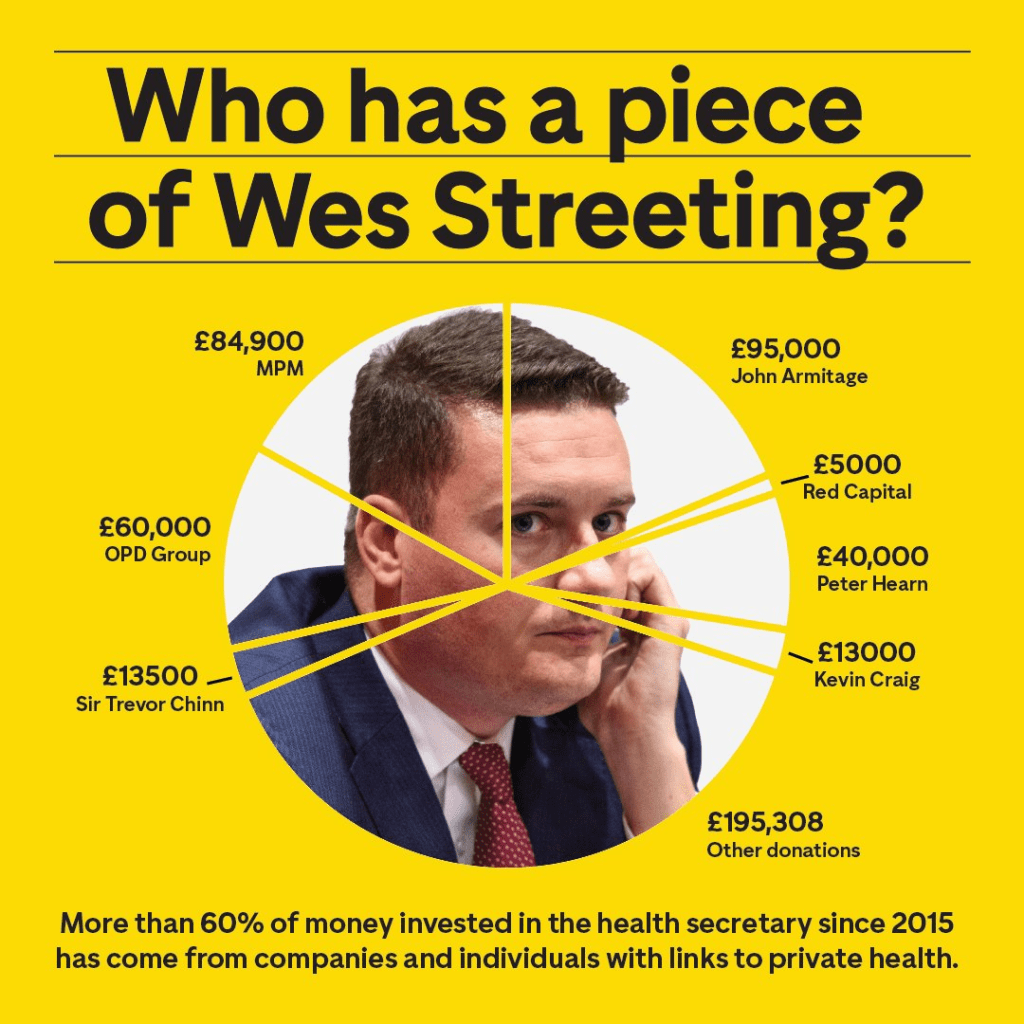
Streeting is also about as characterless and as devoid of integrity as Starmer and is even more craven to corporate interests (see below). Labour’s soft-left members, like John McDonnell, will stop at nothing to prevent a Streeting premiership. If they fail in that task, Streeting’s ascendance would represent the ultimate coup for the Blairite wing of the Labour Party that sabotaged Jeremy Corbyn’s leadership with the bogus charge that Corbyn was anti-Semitic.

As of writing (Monday evening, GMT), the odds of a Streeting challenge appear to be rising.  According to Bloomberg’s Alex Wickham, the prime minister looks in increasing peril as several of Streeting’s allies, including his PPS Joe Morris and constituency neighbour Jas Athwal, have called for Starmer to stand down:

— Labour MPs and aides say developments could now happen quickly if momentum continues to build. A loyalist says it’s now a matter of when not if.

— A Labour official says they believe several Cabinet members are ready to tell the PM he has to set a timetable for his departure if it becomes clear he has lost the authority of the backbenches. They think if the number of public dissenters heads toward three figures that will happen.

— However Cabinet aides insist we are not there yet and they don’t think the whole Cabinet is yet ready to move. One notes that Streeting’s allies appear to have gone after markets closed, after gilts dropped on Monday on the political instability. There will be a lot of attention on market open tomorrow.

— Streeting is silent but there appears to be an orchestrated plot by his supporters to call for Starmer to go so he can move. There was disappointment among some of Streeting’s allies today that he has not moved already but it now feels increasingly inevitable.

Another possible successor is — or at least, was — Manchester City Mayor Andy Burnham, but he would need to become a member of parliament to be able to run as Labour leader. And the Labour Party leadership recently blocked him from being able to stand as a candidate for the by-election in Gorton and Denton. According to Wickham, “Burnham’s allies say he will soon be ready to show he has a route to parliament.”

Burnham, who was formerly a junior minister under Tony Blair, has already run for the party’s leadership twice before, with underwhelming results. Like Streeting and most other high-ranking party members, he also has close ties to Labour Friends of Israel and other Zionist lobbies. Indeed, if Starmer were to fall, one thing we can be totally certain of is that there will be no meaningful change in UK relations with Israel.

Meanwhile, the Labour Party, like the Conservatives before it, is haemorrhaging support — both to Nigel Farage’s Reform Party on the right and the Green Party on the left. This is not a surprise given the scale of Labour’s betrayal to its core voters, beginning with the proposed scrapping of the winter fuel allowance in Starmer’s first months of power, as well as the authoritarian excesses of Starmer’s rule, writes Yannis Varoufakis:

The crux of their debacle lay, first, in a distinctly dictatorial, authoritarian reflex. And second—crucially—in a seething contempt for those who lent them their votes, while simultaneously performing a grotesque pantomime of flattery toward those who never would, and never will, support them.

Having exorcised from the Labour Party its most authentic voices—people of unimpeachable integrity, such as Ken Loach and Jeremy Corbyn, a purge that eluded even Tony Blair’s repertoire—Starmer embarked on a rampage:

He slashed disability benefits; armed and fed intelligence to the Israeli government as it executed genocide in Gaza; channeled his own inner Farage, perhaps his inner Enoch Powell, to vilify migrants and treat refugees as vermin; gutted international aid to masquerade as a defender of defence spending; bulldozed wildlife and their habitats; unveiled a new lexicon of draconian anti-protest laws; left trans people suspended in legal limbo; clung with religious fervour to absurd, socially ruinous fiscal rules; allowed Rachel Reeves to squander £100 billion covering the Bank of England’s outrageous and wholly unnecessary Quantitative Tightening losses—a gift that keeps giving to the City’s banks—while imposing yet another round of austerity on government departments and public services.

Once the great hope of the downtrodden, Starmer’s Labour has become the villain – the genuinely nasty party. Once a human rights lawyer, he has single-handedly plunged Britain into a shoddy, incompetent authoritarianism.

We have covered that creeping authoritarianism in some depth in our two-instalment post, “Just How Dystopian Can Starmer’s Britain Become?” (here and here). Indeed, arguably Starmer’s most important legacy is the way he has instrumentalised the law, particularly the anti-terrorism laws, to arrest and intimidate pro-Palestinian journalists, activists and protesters.

With ruthless zeal, his government has criminalised public opposition to Israel’s genocide in Gaza while lending support to the furtherance of said genocide, including through the provision of more than 100 RAF spy flights over Gaza. In Starmer’s Britain, merely expressing critical views about the political ideology of Zionism in a private conversation can get you arrested…

Even before his election as prime minister, in July 2024, Starmer had shown his colours on the Israel/Palestine question. Starmer had already played a key role in bringing down his former, pro-Palestine boss, Jeremy Corbyn. On October 11, 2023, Starmer, then leader of the opposition, told LBC that Israel had the right to collectively punish Gaza, including by cutting off water and power to the enclave, in response to Hamas’ Oct 7 attacks.

After Corbyn’s downfall, Starmer then began the task of purging the Labour Party of any remaining left-wing thinkers. It is a task he may have been assigned by the Trilateral Commission, a trans-Atlantic forum set up by US billionaire David Rockefeller in the 1970s to help steer Western democracies by prioritising corporate interests over those of labour.

Starmer was the first ever sitting British member of parliament to join the Commission, according to Matt Kennard, which he did behind Corbyn’s back.

Since Starmer’s election in July 2024, the Blairite faction of the Labour Party has wielded outsized influence over government, through the appointment of Blair acolytes like Streeting and Peter Kyle, the science secretary, as well as through Blair’s think tank, the Tony Blair Institute for Global Change (TBI), as we warned in our our May 3, 2024 post, Tony Blair and His Associates Are Waiting in the Wings to Take Back Power in UK:

One of the great contradictions of British political life over the past 15 years is Sir Tony Blair. The three-term prime minister is broadly reviled by the British public, even among many Labour Party voters, yet he continues to be feted and fawned over by the British establishment and media. Even after the “crushing verdict” (in The Guardian‘s words) of the Chilcott Inquiry — that the Blair government’s case for the Iraq war was “deficient” — was finally made public in 2016, Blair remained a go-to person for the British and international media on all manner of topics, particularly the COVID-19 pandemic.

It is a very different story for the British public. In a recent YouGov opinion poll, only 22% of respondents said Blair had had a positive effect on the Labour Party, with 38% saying his impact was broadly negative. Even among Labour Party voters, only 26% labelled his impact as positive compared to 38% who saw it as negative. According to another YouGov survey, this time from 2022, a mere 14% approved of his knighthood and only 3% strongly so, while 63% disapproved, 41% strongly so. Over a million people signed a petition demanding the knighthood be revoked.

In other words, the last thing most people in the UK want to see is Blair making a political comeback. Yet the former PM is closer than ever to regaining political power, albeit through a proxy Labour Party government led by the current party leader, Keir Starmer, who is hotly tipped to win the next general election… Starmer is favourite to win not because of a groundswell of support for his vision or candidacy — the UK public view the party under Starmer even less favourably than under Ed Miliband — but because support for the governing (if you can call it that) Conservative Party is in freefall…

As the FT reported in 2023, TBI has in effect become a global consultancy to the UK government, giving advice on a whole host of issues. It has over $100 million and is currently active in 40 other countries, including the United States. Most, however, are in the global south/majority, where TBI advises governments on DPI such as digital vaccine certificates, digital identity and central bank digital currency.

Since coming to power, Starmer’s government has prioritised the digital authoritarian solutions peddled by TBI, such as digital identity; the mass sharing of the UK’s digital health data, which would hugely benefit TBI’s main paymaster, Larry Ellison; and the nationwide deployment of facial recognition cameras, a project that was begun by the Conservatives but has been massively expanded by Starmer.

Blair’s latest grand proposal for the people of Britain is to scrap the state pension’s triple lock, which will help further impoverish struggling pensioners…

Click here to read the full article on Naked Capitalism

Are the US and Israel Planning to Use Morocco As a Weapon Against Spain?

If Trump was hoping his threats against Spain would trigger a shift in policy in Madrid towards the US-Israel war against Iran, he must be disappointed.

The Trump administration has issued a cacophony of threats against Spain since the Pedro Sánchez government refused to allow US forces to use Spanish military bases or airspace for its operations in the war against Iran. Pedro Sánchez has also been a rare, strident voice against Israel’s genocides in Gaza and southern Lebanon and other war crimes.

In response, Trump has repeatedly threatened to cut trade ties with Spain as well as remove US troops from Spanish bases, neither of which have (yet) come to pass. But arguably the biggest risk for Spain is that the US — and Israel — begin to foment trouble on Spain’s southern flanks, as we flagged in our March 24 post, “Spanish Government Intensifies Criticism of US-Israeli War on Iran As Trump Mulls Withdrawing US Troops from Spanish Bases“:

Some neo-cons in Washington have proposed that the US should move its troop presence in Spain to bases in Morocco, whose government is much closer to Israel. The US historian and former Pentagon adviser Michael Rubin has even suggested in a couple of articles for Middle East Forum that the US should recognise Spain’s two protectorates in Morocco, Ceuta and Melilla, as Moroccan, just as it has done with the disputed territory of Western Sahara.

We expanded on that danger in our April 10 post, US Considers Withdrawing Joint Military Base(s) in Spain As “Punishment” for Its Non-Cooperation in Iran War: WSJ

The US — and Israel — could also retaliate by stoking tensions on Spain’s southernmost border, by supporting the independence efforts of the two Spanish enclaves of Ceuta and Melilla, which sit on the northern shores of Morocco’s Mediterranean coast. Morocco is closely allied with the US and Israel, both of which supported Morocco’s territorial claims over Western Sahara — in return for Rabat’s official recognition of Israel, in late 2020, as part of the Abraham Accords.

Michael Rubin, an influential neo-con analyst and former Pentagon advisor, recently urged Morocco to launch a civil march on Ceuta and Melilla similar to the one that took place in 1975, which triggered the ultimate withdrawal of Spanish forces from Western Sahara. Those forces were quickly supplanted by Moroccan occupying forces.

In an interview with El Español, the Republican congressman Mario Díaz-Balart, a gusano hawk closely tied to Marco Rubio, made some veiled threats in that direction.

“We have seen that [Sánchez] is a president who acts aggressively and I would not be surprised if the US administration is looking for alternative options that are different from those we have had with Spain for many decades.

[I]t seems that Mr. Sánchez values the relationship with the dictators of Iran, Cuba and Venezuela more than with the United States…

QUESTION: Does the United States consider Morocco as an alternative where to take the military bases if Spain continues with its ‘no to war’ position?
ANSWER.– It is interesting, because Ceuta and Melilla are in Moroccan territory. The attitude of the King of Morocco has been positive. It is always interesting to see what the geopolitical and geographical reality of Morocco is, these are important issues for this country. The relationship between the US and the Alawite country has remained consistent, it is very important, there is an alliance that has remained even in difficult times. And those are questions that exist: the attitude of Ceuta and Melilla and whether they are part of Spain or should be part of Morocco are issues that are always open and are resolved through alliances and friendship. But it is very sad that this individual [Sánchez] is jeopardizing that alliance between the United States and Spain, something that the Kingdom of Morocco has not done.

Now Díaz-Balart, who chairs the US House of Representative’s subcommittee on Homeland Security, has taken this debate to the floor of the US Congress. A one paragraph section of a report by the Appropriations Committee describes Ceuta and Melilla as “Spanish-administered” but “located on Moroccan territory”. It also encourages the US Secretary of State, Marco Rubio, to mediate on the future status of both autonomous cities.

The paragraph in question does not appear in the legislative text itself, but in the explanatory memorandum that accompanies House Bill 8595, which must still be approved in plenary before reaching the Senate and the Oval Office, reports El Pais‘ Washington correspondent Macarena Vidal Liy. It reads as follows:

“The Committee notes the historic alliance between the United States and Morocco, as formalized in 1786 by the Moroccan-American Treaty of Peace and Friendship. The Committee notes that the Spanish-administered cities of Ceuta and Melilla are located on Moroccan territory and are the subject of Morocco’s long-standing claim. The Committee supports efforts by the Secretary of State to encourage diplomatic engagement between Morocco and Spain on the future status of Ceuta and Melilla.”

This is the first time a body of the lower house of the US Congress has questioned the Spanishness of the two autonomous cities, notes El Confidencial‘s North African correspondent, Ignacio Cembrero, who was first to break the story.

A Little Background

For readers who are not familiar with the finer details of Spanish geography, below is a map of Spain’s territory (courtesy of El Orden Mundial). The position of the two enclaves/exclaves is depicted in the bottom right-hand circle.

Both Ceuta and Melilla are semi-autonomous cities, with their own statutes that grant them administrative powers similar to those of Spain’s 17 “Autonomous Communities”, but without full legislative capacity.

More background from the business intelligence website Investment Monitor:

The coastal cities of Ceuta and Melilla are both located within Morocco yet have been Spanish territories since the 17th and 15th centuries, respectively, making them home to the only European land borders on the continent of Africa.

The government of Morocco has repeatedly contested Spain’s sovereignty over the territories, though they were initially designated as Spanish and not a vestige of colonialism to be relinquished when Morocco’s independence was recognised in 1956. It was in 1956 that both France and Spain gave up their Protectorates in Morocco which they had had since the signing of the Treaty of Fez in 1912.

Spain highlights that the territories of Ceuta and Melilla, which also include three uninhabited islets (the Alhucemas Islands, the rock of Vélez de la Gomera and the Perejil Island) had preceded the creation of the Protectorates. Instead they date from the time of the Reconquista, the centuries-long series of battles by Christian states (today’s Portugal and Spain) to expel the Muslims from the Iberian Peninsula.

In fact, Ceuta was conquered by the Portuguese first, in 1415, but then ceded to Spain in 1668 after the Iberian Union (formed by the Kingdoms of Aragon and Castille in today’s Spain and the Kingdom of Portugal) ended.

Melilla was occupied and conquered by Spain in 1497.

That is one of Spain’s main arguments for its ongoing sovereignty over the territories, pointing out that its rule over Ceuta and Melilla preceded its rule over some regions in mainland Spain. This includes parts of the north of the country, for example, but also cities in southern Spain such as Granada, the last Muslim enclave, which was conquered at roughly the same time (1492).

Conversely, Morocco argues that Spain’s territories within its kingdom are a remnant of colonialism and should be given back. However, the UN does not include these exclaves in its list of non-self-governing territories, defined as territories “whose people have not yet attained a full measure of self-government”. Both Ceuta and Melilla have a similar semi-autonomous status as that enjoyed by all other regions of mainland Spain…

Why Do Ceuta and Melilla Matter So Much?

Similarly to Gibraltar, Ceuta and Melilla’s historic importance stems from their strategic geographic location. Ceuta sits right on the Strait of Gibraltar, directly across the sea from the British territory.

In fact, both cities have served over the years as military and trade enclaves for Spain, linking Africa to Europe, and with sizeable military populations. Ceuta expands over 20 square kilometres and has a population of over 82,500, while Melilla’s size is 12 square kilometres and its population is about 83,190.

The two cities both lay at the bottom of Spain’s regions socioeconomically. They have the lowest levels of GDP per capita, as well as the highest levels of unemployment.

Exploiting Spain’s Weak Link

The House of Representatives’ Appropriations Committee is not alone in suddenly questioning the Spanishness of Ceuta and Melilla. Amine Ayoub, a Morocco-based fellow at the Washington-based, pro-Israel Middle East Forum, wrote in Israel’s Y Net Global that tensions between the US and Spain over Iran and NATO “create an opening for Morocco to press its claims on Ceuta and Melilla, with Israel positioned to back Rabat diplomatically within a US-led alliance”.

Similar articles have been published in the American Enterprise Institute as well as in several Israeli newspapers (Times of IsraelYedioth AhronothIsrael Hayom and Jerusalem Post), notes Cembrero:

“´[T]hese articles, as well as the paragraph penned by the Appropriations Committee, are interpreted as a desire to punish Pedro Sánchez’s government for its criticism of Israel and the war waged by President Donald Trump against Iran…

In the eyes of Díaz-Balart and these polemicists, Ceuta and Melilla are a weak link for Spain, all the more so since they are claimed by a country like Morocco, with which the Republican Administration has forged both a bilateral partnership and a broader alliance within the framework of the Abraham Accords. Rabat joined that pact in December 2020.

In signing that pact, Morocco became one of four Arab nations (alongside the United Arab Emirates, Bahrain and Sudan) to normalise diplomatic, economic, and security relations with Israel.

The Accords have already paid off handsomely for Rabat. Almost immediately afterwards, Trump recognised Moroccan sovereignty over Western Sahara. In doing so, he abandoned the decades-long calculated ambiguity the US had held over the disputed territory and began openly supporting Morocco’s claims. The Biden administration did nothing to change that.

Israel was next to recognise Moroccan “autonomy” over Western Sahara, in 2023. Two years later, the United Nations described Morocco’s autonomy plan as the “most feasible solution” to the 50-year-old conflict over the disputed territory. In April 2026, the EU lent its backing.

Spain, Western Sahara’s former colonial power, also ended up backing Morocco’s plan, much to the chagrin of some of Sánchez’s coalition partners. A recent report by the Royal Elcano Institute found that public opinion in Spain continues to strongly support Western Sahara’s right to self-determination.

The Sánchez government chose to prioritise other concerns such as safeguarding its strategic interests (e.g., by appeasing Morocco at a time when migrant pressures from the Maghreb are building as well as keeping the US and Israel happy) and maintaining stability along Spain’s southern border. The problem is that the US and Israel seem intent on upending that stability — and not just because of the recent rift with the Sánchez government.

Morocco has been a key piece for the US in the region since the days of the Cold War, due to its strategic location astride the Strait of Gibraltar and Atlantic Africa. It is also situated next to Algeria, Africa’s largest country which has long been a close ally of Russia’s. For decades both the US and Israel have worked to buttress Morocco territorially, militarily and diplomatically. That trend seems set to intensify…

Click here to read the full article on Naked Capitalism

Claudia Sheinbaum Is Caught Between a Rock and a Hard Place

The rock is the rising threat of US military intervention in Mexico; the hard place is Sheibnaum’s own party’s narco-politicians.

Late last week, as Mexico was still reeling from revelations that CIA agents are operating in Chihuahua, in direct violation of Mexico’s constitution and sovereignty, the Sheinbaum government received an extradition request from Washington for 10 Sinaloa-based individuals. They included the state’s governor, Rubén Rocha, and its senator, Enrique Inzunza Cázares.

The indictments pose the biggest threat yet to Sheinbaum’s presidency. If she bows to US pressure and agrees to indict Rocha, a senior member of Sheinbaum’s Morena party, and the other nine serving and former politicians and security chiefs, she risks opening the floodgates to more US extradition requests. If she doesn’t, she risks the wrath of an increasingly unhinged Trump administration.

“Without Precedent”

The veteran Mexican journalist Denise Marker described the development as “extremely worrying” and “without precedent”. As one twitter commenter remarked tartly, it is indeed “without precedent”: drug cartels have operated in Sinaloa with total impunity and government protection for nigh on 80 years and not a single PRI or PAN governor has ever been extradited.

Speaking to Al Jazeera, Vanda Felbab-Brown, an expert on non-state armed groups at the Brookings Institution think tank in Washington, DC, said that indicting elected politicians in Mexican had “long been considered a very big step, almost a ‘nuclear option’”. And more indictments are likely to come, she added.

Rumours are already flying of an approaching second wave of extradition requests — including for three more governors, two legislators and the son of an ex-president, presumably Andrés Manuel López Obrador. For the moment, this is pure conjecture, but it would be in keeping with the Trump administration’s slash-and-burn approach to international relations.

Perhaps that’s why the Sheinbaum government has declined the extradition request — for now. Mexico’s Attorney General’s Office (FGR) on Friday ruled out provisionally detaining the suspects indicated. The head of the Specialized Prosecutor’s Office for Competition Control of the FGR, Raúl Jiménez Vázquez, said there was not enough evidence to justify taking such an action.

Until now, Sheinbaum has generally bent to the US’s will despite her constant reaffirmations of Mexican sovereignty and independence, reports Ioan Grillo:

“We are not a protectorate of the United States. We are not a colony of the United States,” Sheinbaum, the 63-year old former scientist, said Monday.

However, in actions, Sheinbaum has delivered to President Donald Trump on several key demands since he returned to office last year. Her government helped halt the flow of undocumented migrants though Mexico to the U.S. border, slashing Border Patrol encounters to the lowest in decades (this is also due to Trump largely killing asylum at the border). She has whacked fentanyl trafficking, so U.S. border seizures of the venomous drug were down 72 percent last month compared to when she took office in October 2024.

But the demands continue to grow in size and number. As the Wall Street Journal notes, each time Sheinbaum gives President Trump an inch, he demands a mile:

More than a year after both leaders took office, the give and take is forcing Mexico’s president into a corner. In that way, she may be following other world leaders who have tried to forge a working partnership with Trump—from Italy’s Giorgia Meloni to French President Emmanuel Macron—only to face a falling-out.

It was a by-now-familiar pattern in the relationship between the two neighbors. It began with decisions that cost Sheinbaum very little political capital, such as sending National Guard troops to the border to stop U.S.-bound drug smuggling and closing Mexico’s doors to migrants from Venezuela and other countries.

But lately Trump has pushed Sheinbaum into moves that risk angering her political base.

Just over a week ago, it was revealed that four CIA agents had participated in an anti-narcotics operation with the state police force of Chihuahua without informing Mexico’s federal authorities. This was a complete violation of Mexico’s constitution and sovereignty. The only reason why the public — and apparently, the federal government — learned of the operation was that two of the CIA agents died in an alleged car accident as it unfolded.

The resulting scandal severely damaged relations between Mexico and the US while sparking a fierce showdown between the federal government and the Chihuahuan governor, Maru Campos Galván, who has thrown her state’s doors wide open to US government agencies including the CIA, the DEA and the FBI. In doing so, Campos Galván not only violated the constitution, she committed the most serious of crimes: high treason.

Amid the resulting fallout, the Trump administration, represented in Mexico by Ron Johnson, a former CIA agent and Green Beret with decades of experience of destabilising foreign countries, including by training death squads, tightened the screw further by unsealing the indictment of Rocha. In a rare departure from custom, the indictment included 34 pages of allegations that have already been made public.

The goal, it seems, is two-fold: first, to distract the US and Mexican publics from the Chihuahua debacle (and whatever other scandals du jour the Trump administration need cover from, including, of course, Epstein); and second, to paint Sheinbaum into a corner. If she complies with the extradition request, she opens the door to the US gradually picking off more and more of Morena’s elected representatives, with the resulting damage this could do to Morena’s base.

Rocha is fully aware of this fact. In what can be easily read as a veiled threat to Morena’s leadership, he tweeted a couple of days ago (emphasis my own):

“This attack is not just aimed at my person but the whole Fourth Transformation movement, its emblematic leaders and the Mexicans who represent the cause”.

According to unnamed sources cited by the Mexican corporate law firm León Barrena Rodríguez & Partners LLP (LBR), “the Governor’s defiance carries an implicit, scorched-earth ultimatum directed straight at the National Palace”:

The subtext is clear: if Sheinbaum attempts to sacrifice him to appease Washington, he will take the entire structure down with him. A sitting governor with his level of access doesn’t just go to a U.S. interrogation room to face a life sentence; he goes there to trade. The leverage is absolute. The threat (“if you hand me over, I disclose everything regarding AMLO, the presidency, and Morena’s tactical alliances with the cartels”) is the only thing keeping him from being extradited tonight. Sheinbaum is now effectively a hostage to her own party’s regional power brokers.

On the other hand, if Sheinbaum declines the extradition request, as she has done so far, she risks being painted by the US government, Mexican opposition parties and pliant media outlets in Mexico and abroad as a “narco president” who is more interested in protecting the country’s drug lords than helping the US Department of Justice put them behind bars.

Refusal to cooperate also increases the risk of US military intervention in Mexico. After all, if US forces can abduct a sitting president in Venezuela, what’s to stop them from snatching a regional governor in Mexico (apart from Mexico’s US-trained and equipped armed forces)? According to LBR’s sources, this option has been on the table “for months”:

[T]he use of US special operations forces to apprehend Governor Rocha, Senator Inzunza, and other indicted officials has been a live option on the tables of the DOJ, DOW, and DEA for months…

Sheinbaum and AMLO have decided that a total diplomatic rupture with the U.S. is a smaller price to pay than the existential threat of Governor Rocha “spitting” in a New York courtroom. They are gambling on the assumption that Washington lacks the will for forceful extraction. This is a fatal error.

The former DEA agent Mike Vigil, who lives in Mexico, believes than an extraction is unlikely, warning in an interview with the Chilean outlet Entrevistas Meganoticias that any attempt to abduct Rochoa would be a disaster, not only for Mexico but also Latin America as a whole (translation my own):

They did it in Venezuela with Maduro and his wife Cilia Flores. But Venezuela is not Mexico. So, to go that way, which for me was an act of war, to remove politicians in Mexico would be a disaster. This would cause instability throughout Latin America.

It would also be a disaster for the US government, Vigil says without elucidating as to why. One thing is clear: this is all happening at the most delicate of times for US-Mexico relations, with the USMCA trade deal up for mandatory joint review in June. One might think that the last thing the US needs right now, as the global economy teeters on the edge of a global crisis of Trump’s choice, is to risk upending its biggest trade partnership.

It’s possible, of course, that Trump is using the extradition requests as leverage in the trade  negotiations. However, the threat of US military intervention against the cartels has been on the cards since at least early 2023, when neo-con Republicans like Lindsey Graham, Marco Rubio and former Attorney General William Barr began talking of the need to designate the cartels as “terrorist organisations.”

Which was one of the first things Trump did on his return to office. Sheinbaum and her government are now feeling the inevitable fallout from that.

Between a Rock and a Hard Place

“She’s caught between a rock and a hard place because she obviously understands what’s at stake for her government and the US and the critically important USMCA review,” said Arturo Sarukhán, a former Mexican ambassador to the US.

Sheinbaum has so far prioritised loyalty to Morena. On Friday, she declared that the ten Mexican officials charged with drug trafficking and weapons offences will be tried in Mexico, not the US — if credible evidence emerges against them.

As for Rocha, he allegedly travelled with Sheinbaum to meet with AMLO at his “La Chingada” ranch in Palenque, Tabasco, at the weekend. Immediately afterwards, the Sinaloan governor took temporary leave, which removes all the legal protections against prosecution he enjoyed as a sitting governor.

But is he guilty of colluding with the Sinaloan cartel? Most probably yes.

The word that keeps popping up to describe Rocha, including in some pro-government media outlets, is “undefendable”. He clearly has ties to the Sinaloan cartel (who doesn’t in the higher reaches of Sinaloa’s government?) and allegedly received campaign funding from prominent cartel members. He has almost certainly been fingered (no, not that way) by members of the Chapitos branch of the Sinaloan cartel, who’ve turned witness in return for lighter sentences.

All that being said, Rocha is still a relatively small pawn in a much larger game being played by Washington. That game extends to the entire American continent, and its ultimate goal is to remove all obstacles to the US’ dominion over the strategic resources of that region — including, crucially, its oil and gas. Or as RevKev put it recently, to turn all of Latin America into one giant quarry for Western corps, as we are already seeing in post-Maduro Venezuela.

To achieve that goal, Washington must remove all governments in the region that are not entirely subordinated to its interests and wish to maintain some degree of national sovereignty. And its main instrument for doing that, as we saw with Venezuela, is the so-called war on the drug cartels…

Click here to read the full article on Naked Capitalism

Leaked Audio Files Point to Israeli Involvement in Trump’s Pardon of Honduran “Narco-President” Juan Orlando Hernández

The Trump and Netanyahu governments allegedly have big plans for the newly freed Hernández, including putting him back in power in Honduras.

Leaked WhatsApp, Telegram and Signal audio messages published this week by the Spanish news website Canal RED suggest that pro-Israel groups helped secure President Trump’s pardon of Honduran president and convicted drug trafficker Juan Orlando Hernandez, popularly known by his initials JOH, from US federal prison late last year.

According to the recordings, the arrangement consisted of trading Trump’s pardon for a package of concessions in Honduras. However, as Drop Site News notes, “they do not clearly delineate which concessions are assigned to which actor, but frame them as part of a joint U.S.- and Israel-aligned agenda in the country”.

Nor is it clear who the “pardon money” went to. Canal RED says it has more leaked audios to publish, so maybe these questions will become clearer in time. One thing that is clear, as Stephen Holmes warns in an article published by Project Syndicate shortly after JOH’s pardon, is that Trump is fast turning the presidential pardon into a giant indulgencies racket (h/t JohnA).

JOH is heard saying in one of the leaked audios: “The pardon money … came from a board of rabbis and people who supported Israel, and they had previously supported Yani Rosenthal.” Rosenthal is a former president of the Liberal Party of Honduras and close associate of JOH’s who was convicted in 2017 of laundering drug proceeds for a prominent Honduran cartel.

In 2024, JOH was convicted in a US federal court of trafficking 400 tonnes of cocaine as well as arms running, for which he received a 45-year prison sentence. He was also found guilty of receiving money from the former leader of the Sinaloa Cartel, Joaquin Archivaldo “El Chapo” Guzman, to finance electoral fraud.

However, Trump pardoned JOH on December 1 last year — at the same time that US forces under his command were pulverising speed boats in the Caribbean and Eastern Pacific suspected of transporting illicit narcotics. Trump described the DEA investigation into JOH as a “Biden administration set up”  without providing a shred of proof.

Interestingly, as Holmes notes, JOH’s prosecution was overseen by Emil Bove, who would go on to “become Trump’s personal lawyer, then his acting deputy attorney general, and who now sits on the US Court of Appeals. So, Trump has pardoned a man his own future counsel helped to convict.”

Trump’s pardon of JOH apparently forms part of a much larger plan by the US and Israel to extend their “areas of control” in Central America, reports Valeria Duarte Galleguillos for Canal RED, a crowdfunded news and analysis website co-founded in 2023 by the former Podemos leader Pablo Iglesias, who has close ties to left-wing governments in Latin America.

The leaked recordings suggest that JOH has already begun building a “web of corruption” to eliminate any political resistance to his eventual return to power. For the moment, legal obstacles prevent him from returning to Honduras, but the Asfura government is apparently working round the clock to have them removed (machine translation):

The plot also involves the current president, Nasry Asfura, the president of the National Congress, Tomás Zambrano, the National Electoral Counselor, Cosette López-Osorio, and Vice President María Antonieta Mejía.

All of them appear in a series of WhatsApp, Signal and Telegram audios obtained exclusively by Canal RED and Hondurasgate that uncover an operation of political interference and corruption of historic proportions, which includes the return of Hernández to the presidency of Honduras with the support of Trump and Israeli financing. [In return, JOH has agreed to] cede control of development zones, a US military base, and legislative development of a legal environment favourable to US and Israeli AI companies…

The plot revealed by the audios has an ultimate goal: to guarantee the return of Juan Orlando Hernández to the presidency of Honduras in the next elections. According to the leaked conversations, the former president is not only planning his physical return to the country once all the judicial proceedings against him are annulled, but is already negotiating with Nasry Asfura an agreed succession.

Under this scheme, Asfura would be a transitional president who would pave the way for Hernández to run again in the next electoral cycle. If it comes off, Hernández would become Donald Trump’s main political operator and Israeli lobbyist in the region, a person in charge of turning Honduras into a strategic area of military, logistical and economic operations for the United States, replicating the model of the Palmerola base and the ZEDES (special economic zones), but with even more concentrated power.

It would not only be a matter of restoring JOH to power but also transforming Honduran territory into a key geopolitical node for US interests vis-à-vis China and other rival powers in Latin America.

Most legacy media outlets in Spain and the US have so far not covered the story. Whether this is due to their prominence, the delicate nature of the allegations or concerns about their veracity is unclear. But it’s not like this sort of thing is out of the ordinary these days…

JOH has personally denied the allegations, saying the recordings are clearly fake. But there has so far been a conspicuous lack of any threat to sue Canal RED for defamation, as one would expect in a case like this. Like Trump, JOH blames the Biden administration for conducting a witch hunt against him.

There’s a glaring problem with this storyline, however: JOH’s brother and fellow National Party congressman, Tony Hernández, was charged with drug and gun-related offences in 2019 by the Trump 1.0 Justice Department and was eventually sentenced in 2021 to life imprisonment for distributing 185 tonnes of cocaine.

Tony Hernández’s prosecution would end up incriminating JOH, who in turn was extradited in 2022 and later sentenced to 45 years’ imprisonment on three counts of drug trafficking and weapons conspiracy. New York prosecutors even went so far as to describe Honduras as a “narco-state” under JOH’s watch fuelled by millions in cartel bribes.

The former president allegedly even had an accused co-conspirator taken out in a Honduran prison to protect himself, and once apparently boasted, “We are going to stuff the drugs up the gringos’ noses, and they’re never even going to know it.”

Selective Application

In his decision to pardon Hernández, Trump did not present a single shred of evidence that Hernandez’s trial was biased or corrupted, points out the Gray Zone’s Wyatt Reed:

“Nor has he explained how the then-president of Honduras could have been unaware of the massive cocaine trafficking conspiracy which his own brother – Tony Hernandez – was indicted for by Trump’s Department of Justice.”

Trump pardoned Hernández a day after the Honduran elections of November 30, 2025, in a move that, according to the audios, was less a gesture of clemency than a down payment on a far-reaching agreement between Trump, JOH and Netanyahu. Trump also intervened directly in the Honduran elections by endorsing Tito Asfura, the candidate of Hernández’s National Party, while pillorying his opponents and warning of severe consequences if Asfura wasn’t elected.

What was not known at the time is the alleged role played by pro-Israel groups in JOH’s release. In one of the recordings, JOH claims that Israeli Prime Minister Benjamin Netanyahu had “everything to do” with his release and the negotiation that made it possible.

JOH’s ties to Israel and Netanyahu go back a very long way, as the journalist José Alberto Niño documents in a prescient post published just after JOH’s presidential pardon:

[JOH’s] relationship with Israel began long before he held national office. As a young man in the early 1990s Hernández traveled to Israel under the auspices of Mashav, the Israeli Agency for International Development Cooperation. The Jewish Telegraphic Agency noted that he completed a Mashav enrichment course in 1992, at the beginning of his diplomatic career.

Three decades later, at the opening of the Honduran embassy in Jerusalem, Hernández stood before an audience and called that first visit to Israel a “life-changing” experience. He said the trip had shaped his view of security, agriculture, and innovation.

Once he entered the presidential palace, Hernández turned that personal link into state doctrine. In October 2015, he arrived in Jerusalem as head of state and told an audience convened by the Israel Council on Foreign Relations and the World Jewish Congress that “As long as I am president, Honduras will stand behind Israel.” The World Jewish Congress described the event in glowing terms and singled out his declaration that ties between the two countries had never been closer.

This was not idle rhetoric. Hernández set out to reposition Honduras as one of the most reliable pro-Israel governments in Latin America… He adjusted the Honduran voting record at the United Nations so that his country would abstain from or oppose resolutions deemed hostile to Israeli interests…

Hernández also opened a diplomatic and trade office in Jerusalem, signaling recognition of the city as Israel’s capital. He then promised to relocate the full Honduran embassy from Tel Aviv to Jerusalem, issuing joint statements with Israeli and U.S. officials that set public deadlines for that step. In June 2021, he completed the move.

In the security arena, Hernández took positions that aligned perfectly with Washington and Tel Aviv. His government designated Hezbollah as a terrorist organization, a move welcomed by major American Jewish groups…

Even when the walls began to close in, Hernández treated Israel as his ultimate safety net. As his legal exposure increased and the prospect of extradition grew more likely, he reportedly turned to Israeli officials to ask for help in delaying or preventing his transfer to U.S. authorities. The Times of Israel reported that plea and underscored Hernández’s assumption that his years of unwavering support had earned him political capital in Jerusalem.

That calculation looked naïve when he arrived in New York in chains. It looks far more rational now that Donald Trump has delivered a pardon.

The audio recordings suggest that Hernández’s presidential pardon was managed through intense lobbying by Roger Stone and the Republican caucus in the United States, with the implicit support of Netanyahu. Stone had been publicly calling for a pardon of JOH since 2024. According to the leaked conversations, the former president’s return to Honduras and all the logistics involved in putting him back in the presidential seat would be financed by Israel.

Four Main Objectives

The audio files, if authentic, imply that the US and Israel are pursuing four main objectives in their support of JOH:

1. The expansion of special employment and economic zones, or ZEDEs as they are known in Honduras. The ZEDEs, which the government of Xiomara Castro had begun to dismantle, represent a huge cession of national sovereignty, effectively allowing foreign legal systems and courts independent of the State to operate on Honduran soil.

As we reported in 2024, the amount of autonomy that the government of Hernández’s predecessor, Porfirio Lobo Sosa (Jan 2010- Jan 2014), had granted to the owners of the ZEDEs was simply mind-boggling:

[T]he 2013 law clearly established that “each ZEDE will have its own internal security bodies (…), including its own police, crime investigation bodies, intelligence, criminal prosecution and penitentiary system.” The cities will also have an independent financial regime, and will not be subject to the exchange control of the Central Bank of Honduras; they are empowered to develop their own internal monetary policy.

Even before Castro’s election, local businesses were complaining that the law had granted too many privileges to foreign investors to the detriment of domestic capital. The US economist Paul Rohmer, the godfather of international charter cities who had initially worked with the Lobo Sosa government to develop ZEDEs, had disowned the project, warning that Honduras’ ZEDEs system was undemocratic, opaque, destined for collapse and shrouded in lies. As an article in The Intercept explains, the legal showdown between the Honduran government and the investors behind the charter cities presents an “almost impossible-to-believe scenario”:

A group of libertarian investors teamed up with a former Honduran government — which was tied at the hip with narco-traffickers and came to power after a U.S.-backed military coup (in apparent reference to the governments of both Lobo Sosa and Hernandez) — in order to implement the world’s most radical libertarian policy, which turned over significant portions of the country to those investors through so-called special economic zones. The Honduran public, in a backlash, ousted the narco-backed regime, and the new government repealed the libertarian legislation. The crypto investors are now using the World Bank to force Honduras to honor the narco-government’s policies.

Under a new Hernández government, those policies will not only be honoured but aggressively expanded. In orher words, we can expect new Prosperas Inc, backed by radical Silicon Valley “libertarians” like Balaji Srinivasan, Peter Thiel, and Marc Andreessen, to prosper in the years ahead.

2. New US military base, or bases. Honduras is already home to one major US military base — the US Soto Cano Air Base, also known as Palmerola Base, which is seen as key to Trump’s mass deportation program and drug war policies, reports VoA. But the US apparently wants more.

This follows a clear pattern across Latin America, with a new base under construction in Argentina as well as a $1.5 billion upgrade to the US naval base in Callao, Peru, just 70 kms south of the Chinese run mega-port at Chancay.

El Salvador’s main international airport has quietly turned into a forward operation location for the US Air Force while Panama’s José Mulino government, under extreme pressure from the Trump administration, has allowed for the return of US troops, although in limited numbers, to the so-called Canal Zone.

In Ecuador, more than 38,000 troops have been mobilised nationwide as part of security operations involving US forces — despite the fact that an overwhelming majority of the populace voted against the reestablishment of US military bases in last year.

Meanwhile, the threats against Cuba continue to escalate…

Click here to continue reading the article