But is it already too late to reverse course?
When news about the scale of British Labour Party grandee Peter Mandelson’s ties to Jeffrey Epstein broke in early February, it was clear the resulting fallout would be significant. Since then Mandelson has been arrested, Starmer’s chief of staff, Morgan McSweeney, has resigned, and calls are rising for Starmer himself to walk following revelations that he had ignored and overruled his own vetting team in appointing Mandelson as ambassador to the US.
If Starmer were to resign in the coming days or weeks, perhaps, just perhaps, some of the more dystopian policies his government has aggressively pursued may be halted, or even binned, before they become an irreversible reality. They include the hugely contentious proposal to restrict trial by jury, one of the most important pillars of justice in common law systems like the UK’s, which has already passed its second reading in the House of Commons.
Another possible silver lining is that Mandelson-gate has shone a bright light on Palantir’s expanding operations in the UK, as we noted in our post, “The Political Fallout from the UK’s Mandelson-Gate Scandal Has Only Just Begun“:
As readers may recall, one of Mandelson’s few “accomplishments” during his brief tenure as UK ambassador to the US was to arrange a visit for Starmer to Palantir’s facilities in Washington.
As we noted at the time, the visit immediately sparked accusations of conflicts of interests:
Palantir is a long-standing client of Global Counsel, the lobbying company Mandelson co-founded during his time out of politics. Now that he’s back, Mandelson may have stepped down as chairman of Global Counsel but still retains “significant control,” according to Companies House.
Palantir UK’s chief executive, Louis Mosley, the grandson of Britain’s most famous fascist, Oswald Mosley, who was also in attendance, said Starmer “gets” Palantir — hardly a surprise given Starmer’s authoritarian impulses…
Palantir is not only closely tied to Mandelson but also features prominently in the latest Epstein files drop. It is now clear that Palantir co-founder and Chair Peter Thiel maintained a business relationship with Epstein from 2014 to the paedophile’s final arrest in 2019.
That business relationship seemingly extended to Thiel and Epstein’s joint ownership, together with former Israeli PM Ehud Barak, of the Israeli-linked intelligence company Carbyne, which now runs and controls the 911 emergency systems throughout multiple states and counties in the US, reports investigative journalist Whitney Webb, author of One Nation Under Blackmail:
Their initial software descriptions revealed that they harvest tons of data from phones that call into those 911 call systems and store that information, previously touting they would use it for pre-crime-style functionality.
You may be outraged about the Epstein files and the Epstein cover-up, but you should also be investigating how nothing practical is being done to dismantle what Epstein helped build. This foreign company should be nowhere near essential US services, but it continues to rack up local contracts.
Indeed, Webb has argued in recent interviews that Palantir is essentially taking over the job of sex blackmail rings like the one operated by Epstein:
“[A]nother thing I argue is that Epstein, the type of sex blackmail activity he was engaging in was no longer, is no longer needed to blackmail people. You can do all of that stuff digitally now. And I think it’s no coincidence that, I argue— that, you know, Epstein told Ehud Barak to check out Palantir, which I argue in my book is really, you don’t need an Epstein blackmail style operation if you have Palantir operating.
“And there’s a straight line as I’ve noted in other past articles from the Promise Software scandal, which involved Israel, the CIA, this exact network, including Robert Maxwell among other figures that pop up repeatedly in the story, all the way through Palantir’s creation as a rebranding of the… Bush era Total Information Awareness program.”
Straight-Up Corruption
In recent weeks, reports have surfaced that Mandelson had maintained a 24% stake in his lobbying firm, Global Counsel, even as he, as then-British ambassador to the US, personally brokered a deal between the firm’s client, Palantir, and the UK’s Ministry of Defence. The resulting contract, awarded directly to Palantir, was worth around £250 million.
The government has so far refused to release the documents from the secret meeting between Starmer, the UK defence secretary and Palantir’s CEO, on the absurd grounds that it’s too expensive to find them.
In a letter released as part of the “Mandelson Files” published by the government last week, Mandelson said how “proud” he was of the “UK-US tech deal” signed during his time in Washington. The deal, he said, would “help write the next chapter of the special relationship” between the UK and the US.
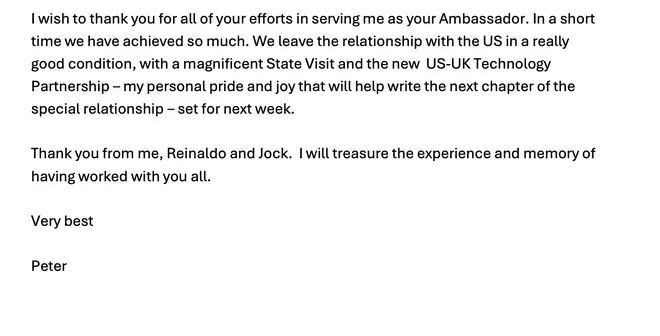
A lot has happened since that letter was written. Pressure is now rising on the government to terminate its dealings with Palantir. The reason this is important is that the company was still relatively little known in the UK until Mandelson-gate.
As we wrote in our June 17, 2025 post, Welcome to Peak Palantir, “the darker the world grows, the richer the pickings for Silicon Valley’s darkest unicorn.” Now, however, Palantir appears to have hit a stumbling block, at least in the UK and other European markets.
The leader of the Liberal Democrats, traditionally the UK’s third largest party, Ed Davey, told LBC yesterday that “there should be an investigation into all the meetings Mandelson had where subsequently there were contracts signed by the government”:
Asked if there was anything he could do from a Parliamentary perspective, Sir Ed told LBC, “We’re going to press the government, just as we have been doing with files relating to Andrew Mountbatten-Windsor.
“I hope the government is not going to come to the House of Commons and force their hand again. They should publish all these notes and minutes.
“This reeks. Palantir has loads of contracts in our health service, in our defence, probably other parts of the government too.
“Many of us have been worried for some time about how this American technology company, with links to Donald Trump, has got such a vested interest across our government.”
Deep Penetration
Palantir now has 24 contracts with UK public institutions including the Ministry of Defence, the Police Force, the Cabinet Office, the National Health Service and the DLUHC. The following infographic gives an idea of just how far and deeply Palantir has penetrated UK government institutions:
One of the biggest causes of concern is Palantir’s management of the National Health Service’s Federated Data Platform, which we formerly covered here and here. As the British Medical Journal reported a few days ago, every hospital in England has been urged to disobey an NHS directive to use software operated by controversial US analytics software company Palantir:
A coalition of human rights, health and patient organisations, and unions sent out the plea to NHS trusts by email, out of concern over Palantir’s federated data platform (FDP).
They urged hospitals to not follow NHS England’s instructions to sign a memorandum of understanding to use the FDP, as set out in planning guidance issued in October.1
This guidance said all trusts should be using FDP “core products” from April, although this, NHS sources indicated, was a policy decision rather than an enforceable instruction.
The FDP was created during the covid pandemic with the aim of helping manage a federalised, siloed health service at a time of national crisis. Palantir won the now £1bn contract to supply the service using its Foundry software, a platform that can connect incompatible databases and allows customers to integrate and analyse data from across many different sources.
In the post-covid NHS this involves monitoring things such as waiting lists, hospital supplies, and available beds and operating theatres.
But a new briefing document from the health worker campaign group Medact, called Concerns Regarding Palantir Technologies in NHS Data Systems,4 emphasises that hospitals have the ability to refuse NHS England’s directive and urges them to do so.
The document, shared with The BMJ and Guardian, outlines concerns over Palantir’s past behaviour, data security of the FDP platform, potential harm to trust among patients, and the risk of the FDP being used by other government departments to access people’s health data.
“We know the FDP rollout is not going to plan, and we know that NHS England is under intense pressure to cancel the contract when it reaches its break clause in February 2027,” said Medact’s Rhiannon Osborne.
She spoke for a collection of groups concerned about Palantir, including Amnesty International, the Good Law Project, Privacy International, Just Treatment, Corporate Watch, and the United Tech and Allied Workers Union.
She added, “Fifty thousand patients have written formal complaints to their hospitals, and the BMA is telling members to explore ways around using Palantir products.
“It’s a key time for local hospitals to exercise their autonomy when NHS England isn’t listening.”
Medact is also concerned that, with Palantir systems in place, the Home Office border control, police forces across the country, and current or future UK governments could use NHS data for other purposes.
In the US, Palantir is already using the health data of millions of people to help ICE hunt down down undocumented workers, according to a recent investigation by 404 Media.
“National Security Threat”
One of the most common arguments trotted out by successive UK governments to justify their ever-multiplying contracts with Palantir is that the data remains in-house. Palantir, they say, manage it but does not own or control it. As a Ministry of Defence spokesperson told the Nerve, “all data remains sovereign and under the ownership of the MoD”.
Unfortunately, this is simply not true. In a recent exposé, the Nerve spoke to two high-level MoD insiders with detailed knowledge of the underlying technology. They warned that not only are such statements “ignorant” and/or misleading, but also that Palantir poses “a national security threat to the UK”:
The insiders, who are senior systems engineers with knowledge of the Palantir software systems the MoD is using, have come forward to speak after the Nerve published an investigation in January that revealed Palantir had at least £670m worth of contracts across the UK government, including £15m with the UK nuclear weapons agency…
In that investigation, data and security experts claimed that the contracts with the firm, owned by Peter Thiel, are a critical risk to Britain’s national security…
It’s believed to be the first time individuals currently working with the ministry have spoken out about the national security risks Palantir poses. They are doing so because they believe that these are matters of the highest public interest and that parliament needs to act.
The first, a senior systems engineer with the MoD who has decades of experience across the defence industry, told the Nerve: “Ministers clearly have a lack of understanding of Palantir’s technology. The statements with respect to sovereign data appear to be missing the point entirely. [They’re] missing the realities of data scraping, of aggregation, and the fact that Palantir is building its own rich picture of our nation that they can use for their own ends.
Allowing a single entity, foreign or domestic, to have such far-reaching, pervasive access is inherently dangerous. How our national cybersecurity centre has allowed this beggars belief.”
At the heart of the claims is that while the underlying data may remain under the MoD’s control, any insights derived from that data do not. The implications of this, the insiders say, are far-reaching, especially because of the vast quantity of personal and other data the company has access to across UK government departments.
One source said: “Palantir does not need to own the data or even have stewardship. They can extract, transform and exploit the metadata to build their own rich picture.”
A second source, who has a background in intelligence, said Palantir probably has “a complete profile on the whole UK population. They have visibility into wildly different focus areas, yet their data is all condensed into one foreign supplier’s control/visibility. At the very least I’d call that a security risk.”
The UK is apparently not the only country that appears to be suffering pangs of buyer’s remorse after finding out its government has outsourced data management responsibilities to Palantir…
 Nick Corbishley