This is part of a broader European — or more specifically, Central European — trend.
On Sunday, (March 9, 2026), Swiss citizens voted in a referendum to enshrine the right to cash in the country’s constitution. Just over 73% of voters supported the legal amendment, which the government proposed as a counter to a similar initiative by a pro-cash group called the Swiss Freedom Movement. From Politico:
The Swiss Freedom Movement triggered the national referendum after its initiative to protect cash collected more than 100,000 signatures, triggering a national referendum. Its initiative secured only 46 percent of the final vote after the government said some of the group’s proposed amendments went too far…
The Swiss Freedom Movement has previously pursued campaigns to sack unpopular government ministers, ban electronic voting, and protect citizens from professional or social retribution if they refuse to be vaccinated against Covid-19 — none of which made it to the ballot box.
Switzerland’s decision to put cash into the national constitution, thus making it more difficult for future governments to abandon cash, is part of a broader European — or more specifically, Central European — trend. The first country to take the plunge was Slovakia.
In June 2023, the Robert Fico government passed an amendment to the constitution stating that “everyone has the right to make a payment for the purchase of goods and the provision of services using cash as legal tender.” The amendment also specified that cash payments can only be refused for reasonable or generally applicable reasons,” including security (e.g., risk of robbery) and technical reasons (e.g., a vending machine that does not accept cash).
The move did not go unnoticed by EU institutions, as we noted in our Jan 19, 2024 post, “ECB and EU Commission Seek to Prevent EU Member States from Constitutionally Enshrining Right to Use Cash“:
The constitutional law was unanimously adopted by the National Council of the Slovak Republic. In total, 111 of the parliament’s 150 MPs supported the amendment, reports English-language newspaper Slovak Spectator. According to the deputies, the complete abolition of cash in the future could seriously impact low-income groups as well as civil associations that finance their charitable activities from fundraising. Preserving the right to cash, they said, is also an essential step in promoting the financial literacy of the younger generation.
A Letter from Lagarde
But the new law has already run into trouble. On January 13, the European Central Bank published a letter signed by the ECB President Christine Lagarde warning that: a) it had not been consulted on the law before its passage; and b) no euro zone member has the competence to introduce such measures in the monetary policy realm. Put simply, as the letter states, rules governing the status of legal tender of euro banknotes are “an area of exclusive competence of the Union under Article 133 of the Treaty.”
In other words, national member governments of the Euro Area do not have the right to protect cash’s status as legal tender. As such, the ECB (emphasis my own) “recommends that the provisions of Article 39a… of the Constitution guaranteeing the issuance of cash as legal tender and the right to make a payments in cash should either be deleted or, alternatively, amended to merely refer to the relevant provisions of Union law” — in other words, brought back in line with EU laws on legal tender.
Since then, the ECB has pledged that will work together with banks, arguably the biggest enemies of cash, to ensure that communities across the Euro Area will have adequate access to cash services. It has also set new, clearer guidelines for the mandatory acceptance of cash across the Euro Area.
That didn’t stop Hungary’s Viktor Orban government from elevating the use of cash as a constitutionally protected right, closely tied to personal freedom, privacy and social inclusion, in March last year. Hungary, unlike Slovakia, is not a member of the Euro Area, which means its government has far more leeway to take action in the monetary policy arena.
As in Slovakia, the amended legislation adopted by the Hungarian parliament imposes a general obligation on Hungarian businesses to provide a cash payment option in addition to any digital payment methods they may already offer. As CEE Legal Matters notes, by adopting this legislative package, “Hungary has assumed a distinctive position within the European legal framework by embedding the right to use cash into its constitutional order.”
More recently, Slovenia amended its constitution in December 2025 to enshrine the right to use cash for transactions, protecting financial privacy and access. As in Switzerland, the process began with a grassroots campaign and a petition supported by tens of thousands of signatures. Unlike Slovakia, Slovenia appears to have sought ECB input before passing the new law.
Next up could be Austria, one of Europe’s cash bastions, where politicians have been talking about constitutionally protecting physical notes and coins for the best part of a decade. But no government has yet delivered on that promise.
Cash No Longer King in Switzerland, But Still Important: SNB
Since COVID-19, cash’s role has shrunk significantly in most jurisdictions, even in cash-loving ones like Switzerland and Austria. According to the findings of the Swiss National Bank’s latest survey of people’s spending habits, conducted in late 2024, cash has already been overtaken by the debit card as the most frequently used means of payment.
Just 30% of retail transactions were settled using physical money, according to the survey. That’s down from 40% in 2020 and 70% in 2017. By contrast, some 35% of in-store transactions were settled using debit cards. Another 18% were settled using mobile payment apps and 14% via credit cards.
In terms of transaction value, the debit card already overtook cash as the payment method with the highest share for non-recurring payments some years ago, though cash is still used more often for small purchases. That being said, cash is still a very emotive issue for most Swiss citizens, reports Forbes:
[E]very [Swiss] inhabitant on average holds the equivalent of $10,481 in bills and coins. That’s the second-largest holding of all economies where the Bank for International Settlements collates data.
This was largely the result of a public backlash against the Swiss National Bank’s negative interest rate policy that ended in 2022, as customers took large quantities of their money out of bank accounts to avoid fees, and stored it in bills instead, reports Bloomberg.
The SNB’s 2024 payments survey also revealed that a clear majority of Swiss citizens (68%) would like the option of using cash to remain unchanged in the future. Despite marked differences in payment behaviour, respondents across all age groups want cash to be retained as a payment method.
Interestingly, as the following graph from Swiss Info reveals, Switzerland is now among the European countries that least use cash after being one of the biggest users less than a decade ago.
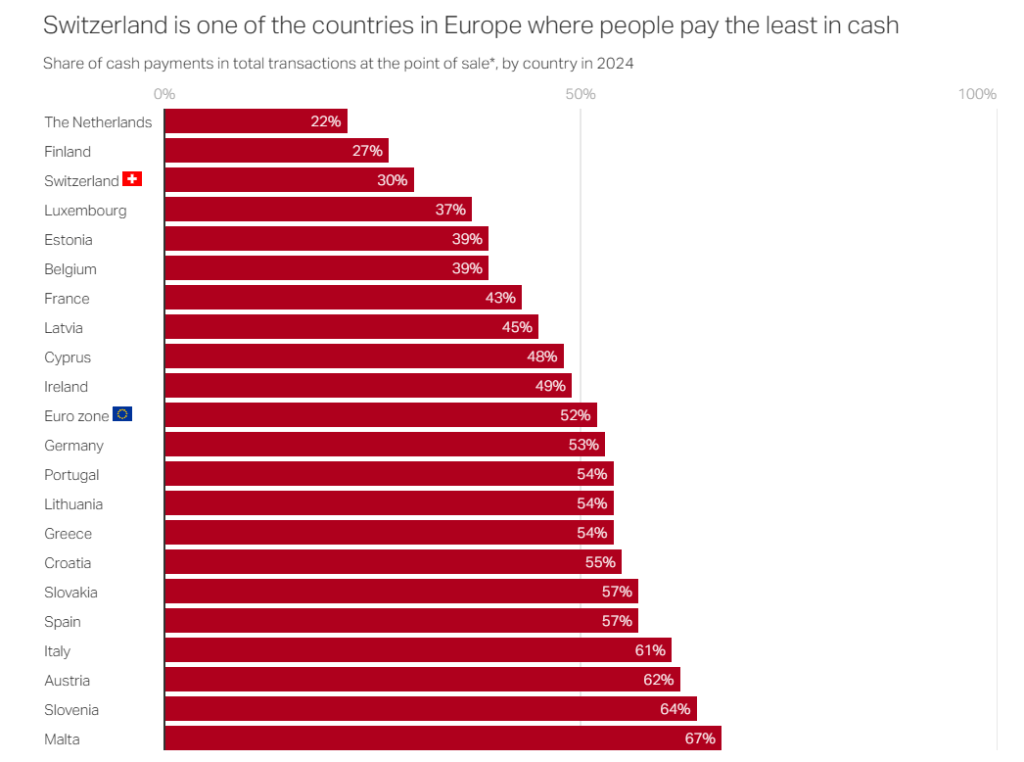
One major difference between Europe and the US, and other so-called “advanced” economies, is that cash is still the number one retail payment method in Europe, though, as the graph above, the scale of its use diverges sharply among countries.
The amount of cash in circulation in the Euro Area’s 20 member states is once again growing after “plateauing” for a couple of years (2023-2024), as the ECB reported last year. Even most 18-37 year olds in Europe increasingly see cash as a necessary fallback solution, according to the ECB’s 2024 Study on the Payment Attitudes of Consumers in the Euro Area (SPACE) report.
That said, the graph above is somewhat misleading given it does not include the old continent’s least cash-friendly countries, Sweden, Norway and the UK. But even in Sweden and Norway, efforts are underway to reverse the trend…
 Nick Corbishley