Government censorship of public online discourse in the West’s ostensibly liberal democracies has been largely covert until now, as revealed by the Twitter Files. But thanks to the EU’s Digital Services Act, it is about to become overt.
Next month, a little-known development will occur that could end up having huge repercussions for the nature of public discourse on the Internet all over the planet. August 25, 2023 is the date by which big social media platforms will have to begin fully complying with the European Union’s Digital Services Act, or DSA. The DSA, among many other things, obliges all “Very Large Online Platforms”, or VLOPs, to speedily remove illegal content, hate speech and so-called disinformation from their platforms. If not, they risk fines of up to 6% of their annual global revenue.
The Commission has so far compiled a list of 19 VLOPs and VLOSEs (Very Large Online Search Engines), most of them from the US, that will have to begin complying with the DSA in 50 days’ time:
- Alibaba AliExpress
- Amazon Store
- Apple AppStore
- Booking.com
- Google Play
- Google Maps
- Google Shopping
- Snapchat
- TikTok
- Wikipedia
- YouTube
- Zalando
Very Large Online Search Engines (VLOSEs):
- Bing
- Google Search
Smaller platforms will have to begin tackling illegal content, hate speech and disinformation from 2024 onwards, assuming the legislation is effective.
Ominously, as Robert Kogon reports for Brownstone.org (granted, not the most popular source of information on NC, but it’s a good, well researched piece), the DSA “includes a ‘crisis response mechanism’ (Art. 36) that is clearly modeled on the European Commission’s initially ad hoc response to the conflict in Ukraine and which requires platforms to adopt measures to mitigate crisis-related ‘misinformation.’”
In a speech in early June, EU Vice-President for Values and Transparency, Věra Jourová, made it crystal clear which country is the current prime target of the EU’s censorship agenda (no points for guessing):
Cooperation among signatories and the high number of new organisations willing to sign the new Code of Practice show that it has become an effective and dynamic instrument to fight disinformation. However, progress remains too slow on crucial aspects, especially when it comes to dealing with pro-Kremlin war propaganda or independent access to data…
As we prepare for the 2024 EU elections, I call on platforms to increase their efforts in fighting disinformation and address Russian information manipulation, and this in all Member States and languages, whether big or small.
Meet the “Enforcer”
The EU is offering tech companies little in the way of wiggle room. When Twitter withdrew from the EU’s Code of Practice on Disinformation in late May, the EU’s Internal Market Commissioner, Thierry Breton, issued a fiery reprimand as well as an unveiled threat — on Twitter of all places:
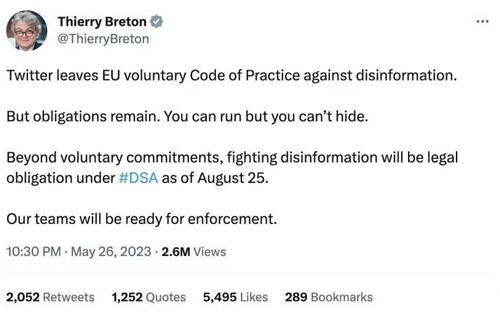
Jourová also laid into Twitter, saying the platform had mistakenly chosen the path of “confrontation.”
Days later, Breton announced he was visiting Silicon Valley to “stress test” US tech giants, including Twitter, to see how well prepared they are for the launch of the Digital Services Act on August 25. Calling himself the “enforcer”, serving the “will of the state and the people” (as if the two were the same things), Breton remind tech platforms that the EU’s DSA would transform its code of practice on mis- and disinformation into a code of conduct. From Politico:
“We are going there, but don’t want to be vocal before because I don’t want to speak too much. But we offer this and I’m happy that some platforms took our proposal,” Breton said of the non-binding compliance checks. “I am the enforcer. I represent the law, which is the will of the state and the people.”
“It’s a voluntary basis, so we don’t force anyone” to join the code of practice on disinformation, Breton said. “I just reminded (Musk and Twitter) that by August 25, it will become a legal obligation to fight disinformation.”
While Twitter may have left the EU’s voluntary code of practice, many of its other actions suggest it is complying with, rather than defying, the EU’s new rules on disinformation. After all, many other Big Tech platforms have not signed the code of practice, including Amazon, Apple and Wikipedia, but will be subject to the DSA’s obligatory requirements, as long as they want to continue operating in Europe. Also, as Kogon documents, recent programming that has gone into the Twitter algorithm includes “safety labels” to restrict the visibility of alleged “misinformation”:
The general categories of “misinformation” used exactly mirror the main areas of concern targeted by the EU in its efforts to “regulate” online speech: “medical misinfo” in the context of the COVID-19 pandemic, “civic misinfo” in the context of issues of electoral integrity, and “crisis misinfo” in the context of the war in Ukraine.
In its January submission to the EU (see reports archive here), in the section devoted precisely to its efforts to combat Ukraine-war-related “misinformation,” Twitter writes (pp. 70-71):
“We … use a combination of technology and human review to proactively identify misleading information. More than 65% of violative content is surfaced by our automated systems, and the majority of remaining content we enforce on is surfaced through regular monitoring by our internal teams and our work with trusted partners.”
Moreover, some Twitter users recently received notices informing them that they are not eligible to participate in Twitter Ads because their account has been labelled “organic misinformation.” As Kogon asks: “Why in the world would Twitter turn away advertising business?”:
The answer is simple and straightforward: because none other than the EU’s Code of Practice on Disinformation requires it to do so in connection with the so-called “demonetization of disinformation.”
Ultimately, Kogon notes, once the DSA comes into full effect, in 50 days’ time, if Elon Musk stays true to his word on freedom of speech and chooses to defy the EU’s “permanent task force on disinformation”, the Commission will mobilise the entire arsenal of punitive measures at its disposal, in particular the threat or application of fines of 6% of the company’s global turnover. In other words, the only way for Twitter to actually defy the EU is to leave the EU.
That is something most tech platforms can but will not do, due to the huge impact it would have on their bottom line. One possible exception to this rule appears to be the Toronto-based streaming platform Rumble, which in November disabled access to its services in France after the French government demanded the multinational company remove Russian news sources from its platform.
EU Commission: Judge and Jury
So, who in the EU will get to define what actually constitutes mis- or disinformation?
Surely it will be the job of an independent regulator or a judicial authority with at least clear procedural parameters and no or few conflicts of interest. At least that is what one would hope.
But no.
The ultimate decider of what constitutes mis- or dis-information, possibly not just in the EU but across multiple jurisdictions around the world (more on that later), will be the European Commission. That’s right, the EU’s power-hungry, conflict-of-interest-riddled, Von der Leyen-led executive branch. The same institution that is in the process of dynamiting the EU’s economic future through its endless backfiring sanctions on Russia and which is mired in Pfizergate, one of the biggest corruption scandals of its 64-year existence. Now the Commission wants to take mass censorship to levels not seen in Europe since at least the dying days of the Cold War…
Read the full article on Naked Capitalism
- Brazil’s Lula Government Proposes to Ban Online Casinos Less Than Two Weeks Before Presidential Elections
- Nice Timing: US Removes Venezuela from List of Countries Failing to Combat Drug Trafficking Two Weeks After Historic Oil “Deal”
- Poll Attributed to US State Dept Claims Most Mexicans Support Unilateral US Military Intervention Against Cartels
- New Poll Suggests That 70% of EU Citizens Have a Negative View of EU
- British Independent News Website The Canary Suspends Operations After Being “Debanked” By Second Lender

