European Systemic Risk Board Issues First Ever “General Warning” about “Financial Stability Risks”

The European Systemic Risk Board is essentially an offshoot of the European Central Bank. And central banks are normally the last to admit that a crisis is around the corner, if not already here.

The European Systemic Risk Board (ESRB), an advisory body set up in the wake of the Global Financial Crisis to monitor the macro-prudential risks bubbling below the surface of Europe’s economy, issued a “general warning” yesterday (Sept. 29) about the financial system. It is apparently the first time the body has taken such a drastic move since its creation in 2010, when Europe was in the maw of the sovereign debt crisis, and it comes just a day after the Bank of England bailed out highly leveraged pension funds.

Given that the ESRB lacks (in Wikipedia’s words) “juridical personality,” it relies on the European Central Bank (ECB) for both hosting and financial support. The board’s members include representatives from the ECB, national central banks and supervisory authorities of EU member states, and the European Commission. And the chairwoman of the board is Christine Lagarde. In other words, it speaks with the full authority of the EU’s two most powerful institutions, the Commission and the ECB.

Crisis Already Here

Another reason this is important is that central banks are normally the last to admit that a crisis is around the corner. In fact, when they finally sound the alarm, it means the damage is already done and the crisis — which they invariably helped create — is already here. In fact, based on the date at the top of the 15-page document (Sept. 22), it seems to have taken the ESRB a full week to get round to publishing the conclusions of its meeting. Which is ironic given the apparent gravity of its findings. Take these two sentences from the opening paragraph:

“[T]he probability of tail-risk scenarios materialising has increased since the beginning of 2022 and has been exacerbated by recent geopolitical developments. Risks to financial stability may materialise simultaneously, thereby interacting with each other and amplifying each other’s impact.”

What isn’t mentioned, of course, is that those recent geopolitical developments include the European Commission’s mind-watering decision to sanction its most important energy provider, which has, all too predictably, eviscerated Europe’s economy. Following the sabotage of Nordstream 1 and Nordstream 2 earlier this week, the EU is almost totally cut off from Russian gas and it doesn’t have an alternative supplier that can remotely fill the void. The price it will pay for this is likely to be fiendishly high, including in the financial sector and markets.

Three Main Risks

The ESRB identifies three main risks to financial stability:

First, the deterioration in the macroeconomic outlook combined with the tightening of financing conditions implies a renewed rise in balance sheet stress for non-financial corporations (NFCs) and households, especially in sectors and Member States that are most affected by rapidly increasing energy prices. These developments weigh on the debt-servicing capacity of NFCs and households.

No great surprise here. As I warned on August 30, in Europe’s Energy Crisis Is Tipping Legions of Small Businesses Over the Edge, energy-intensive companies, particularly small and mid-size ones, are bearing the brunt of the economic pain of Europe’s entirely self-inflicted energy crisis. Many in-person businesses only managed to weather the lockdowns of 2020-21 by taking on huge amounts of debt, which they now have to pay off. Yet that is becoming harder and harder as the price of energy and most everything else soars.

The ESRB’s second risk:

Risks to financial stability stemming from a sharp fall in asset prices remain severe. This has the potential to trigger large mark-to-market losses, which, in turn, may amplify market volatility and cause liquidity strains. In addition, the increase in the level and volatility of energy and commodity prices has generated large margin calls for participants in these markets. This has created liquidity strains for some participants.

Again, nothing new here. As Yves noted in early September, in Lehman Event” Looms For Europe As Energy Companies Face $1.5 Trillion in Margin Calls, “we are beginning to see, as in 2007 and 2008, that market time moves faster than both real economy and political time, and that has consequences.”

Those consequences include untimely margin calls on energy bets gone bad. As Yves noted in her piece, “It will be some time before the press can ferret out how much of this [is] due to sensible hedges gone bad, stupid hedges gone bad, and speculation gone bad.”

Now for ERSB’s risk number three (comment in parenthesis my own):

The deterioration in macroeconomic prospects weighs on asset quality and the profitability outlook of credit institutions. While the European banking sector as a whole is well capitalised, a pronounced deterioration in the macroeconomic outlook would imply a renewed increase in credit risk at a time when some credit institutions are still in the process of working out COVID-19 pandemic-related asset quality problems. The resilience of credit institutions is also affected by structural factors, including overcapacity, competition from new providers of financial services as well as exposure to cyber and climate risks.

Note the mention of “overcapacity,” one of the ECB’s biggest bugbears. For the central bank, Europe has too many small banks, as opposed to too many banks that are simply too big to exist…

Read the full article on Naked Capitalism
Fast-Shrinking TBTF Giant Credit Suisse is Living Dangerously

Time, money and options are fast running out for Switzerland’s second largest lender, Credit Suisse.

After a string of hugely costly, self-inflicted crises (sound familiar?), Credit Suisse appears to be in the process of prising the mantle of Europe’s most troubled systemic lender from Deutsche Bank, which the German bank has held for most of the past decade. As the Wall Street Journal noted a few days ago, “Credit Suisse has taken pole position in a race to the bottom among big, but weak, European banks.”

The scandal-splattered bank has already reported losses of over $2 billion in the first half of this year, significantly under performing expectations as revenue at its investment bank has continued to plunge. That was after reporting an annual loss of $1.7 billion in 2021. Since the second quarter of 2021 CS’ asset base has slumped in value from $941 billion to $753 billion. Net revenues are also falling. Over the past nine quarters the bank has only managed to muster one quarter of actual year-on-year growth.

A Torrid March

It was in the Spring of 2021 when Credit Suisse’s current crisis began. And that crisis has revealed glaring flaws in its risk management processes.

As readers may recall, two of the bank’s major clients — the private hedge fund Archegos Capital and the Softbank-backed supply chain finance “disruptor” Greensill — collapsed in the same month (March 2021). By the end of April 2021, Credit Suisse had reported losses of $5.5 billion from its involvement with Archegos. Its losses from its financial menage á trois with Greensill and its primary backer, Softbank, are still far from clear, as the bank is trying to claw back almost $3 billion of unpaid funds for its clients (more on that later).

What is clear is that 2021 was a watershed moment for Credit Suisse. The bank’s then-CEO Thomas Gottstein called it “a very challenging” year. The irony is that the year before, when financial markets almost fell off a pandemic-induced cliff, the bank managed to generate a net profit of $2.84 billion while many of its peers posted record losses. Credit Suisse was even lauded for its risk management in the weeks leading up to the lockdowns, picking up Risk.net’s Credit Derivative House of the Year award in February 2021:

Within weeks, the US credit markets were in meltdown. The Covid-19 pandemic crippled corporate earnings and everyone wanted credit protection. CDS indexes jumped to their highest levels on record, according to Bloomberg data.

Credit Suisse was a step ahead of the tide. The moves it made in February paid off in a big way. The put options on LQD returned 30 times the initial premium outlay. The desk was also actively sourcing front-end single-name CDS protection from issuers of synthetic collateralised debt obligations in the second half of 2019 and early 2020.

All of this meant it was in a good position to offer liquidity when credit spreads blew out in March. “When volatility escalated, we were able to help clients with what they needed to do without needing to protect ourselves,” says David Goldenberg, Credit Suisse’s head of global index and options, and head of US credit derivatives.

A month after receiving that award Credit Suisse’s reputation for risk management was in tatters. As banks offering prime brokerage services to Archegos Capital began liquidating billions of dollars’ worth of various stocks on which Archegos owned options after the hedge fund had failed to meet a margin call, CS was slow to react. As the Wall Street Journal reported at the time, Goldman Sachs and Morgan Stanley were able to minimize their losses relating to Archegos by responsing more quickly than Credit Suisse and Nomura Holdings. Even Deutsche Bank was able to close its substantial positions rapidly and avoid any losses.

A Long-Term Trend

But like most financial flag carriers in Europe, Credit Suisse’s problems date back to the massive build up of private debt during the pre-crisis years. Many banks in the Euro Area never got over the resulting Global Financial Crisis and the European sovereign debt crisis that followed shortly after. In Switzerland, it was UBS, the country’s largest lender, that landed itself in serious trouble in 2008 through its exposure to US mortgage securities. UBS was bailed out with public money while Credit Suisse was able to raise capital from the private sector.

But ever since then, Credit Suisse’s stock has been in a death spiral, having lost 95% of its value since 2007…

Read the full article on Naked Capitalism

The US-Led War on Drugs, Now in Its 51st Year, Just Hit a Major Snag in Colombia

After a million deaths in Latin America, Washington’s staunchest ally in the region, Colombia, just called time on the US’ “irrational war against drugs”.

While the world’s attention was riveted on Vladimir Putin’s speech this week, with good reason given its potential ramifications, a Latin American leader launched a scathing critique of the US-led war on drugs from the podium of the UN General Assembly in New York. That leader was Gustavo Petro, the recently elected left-wing president of Colombia, which until now was the United States’ staunchest ally/client state in Latin America and one of the most important theaters of the global war on drugs.

“A Country of Bloody Beauty”

“I come from one of the three most beautiful countries on Earth.” With this line and without mentioning the other two, Petro began a speech that was not just powerful and profound; it was even occasionally poetic:

“There is an explosion of life. Thousands of multicolored species in the seas, in the skies, on the land. I come from the land of yellow butterflies and magic. There, in the mountains and valleys of all shades of green, not only do the abundant waters descend but also torrents of blood. I come from a country of bloody beauty.”

Colombia has been at war with itself, on and off, for almost 60 years. Its internecine conflict is one of the longest and most complex wars of modern times, generating one of the largest internal displacements the world has seen, with an estimated nine out of fifty million people affected. Despite the peace deal signed in late 2016 between the Santos government and the Revolutionary Armed Forces of Colombia (FARC–EP), a low-intensity asymmetric war continues to simmer between the government, far-right paramilitary groups, crime syndicates, and far-left guerrilla groups.

Much of that violence continues to be fuelled by the drugs trade and the US-led war against it. And that war has failed spectacularly, Petro said. It is not an isolated view. Colombia’s Truth Commission ended its four-year investigation into Colombia’s multi-decade civil war with the conclusion that the drug war had been a resounding failure. It also concluded that all sides of the conflict had been involved in the drugs trade.

Colombia’s new left-wing leader is determined to shake things up. His government has pledged to end forced eradication of coca as well as offer growers viable crop alternatives. It will also introduce legislation to decriminalize and regulate domestic cocaine sales in a bid to undercut illicit markets and the profit motive driving them. Also under consideration is a radical rethink of Colombia’s extradition arrangements with the US, so that drug traffickers who comply with government surrender conditions and abandon the narcotics trade are not extradited. It is a plan that has been on the table for decades but has never been used.

Poisoning the Amazon With Glyphosate

The global fight against climate change has also been a resounding failure, Petro said in his speech. He apportioning most of the blame for this on corporate greed in the northern hemisphere and the fixation on economic growth:

“The climate disaster that will kill hundreds of millions of people is not being caused by the planet, it is being caused by capital. By the logic of consuming more and more, producing more and more, and for some people earning more and more.”

Petro also blasted the indiscriminate use of glyphosate and other noxious chemicals used by previous governments to eradicate cocaine farms, leaving in its wake a vast trail of environmental destruction. Yet Colombia’s output of the illicit white stimulant has continued to grow despite the $13 billion Washington has splashed on eradication, policing and military programs in the country.

“To destroy the coca plant they throw poisons, such as glyphosate, that drips into our water. They arrest the growers and imprison them. In the battle to destroy or possess the coca leaf, a million Latin Americans are murdered and two million Afro-Americans are imprisoned in North America. ‘Destroy the plant that kills,’ they shout from the north, but this plant is just one among the millions that perish when they unleash fire on the jungle.”

On average, 1.5% of Colombia’s lands has been deforested each year over the past decade, partly due to the lack of controls on extensive cattle ranching and African oil palm companies.

A Message for NATO

Petro also had a message for NATO:

“What is the point of war if what we need is to save the human species? What is the point of NATO and empires if what we are facing is the end of intelligence?”

Petro called on Latin American leaders to build “a space for peace” and take advantage of the opportunity to “close the gap” on powers such as the United States, Europe, Russia, South Korea and all of Southeast Asia. He also stressed that the region can ill afford to be divided between those who, like Colombia, have traditionally supported NATO and those who, like Venezuela, have support Russia.

The fact this statement was made in downturn New York, the financial heart of the declining US empire, at a time of escalating hostilities between Russia and NATO, speaks volumes about Petro’s political courage. One of the reasons why he is Colombia’s first left-wing president is that many of the other serious candidates that came before him — from Jaime Pardo Leal to Bernardo Jaramillo Ossa, to Carlos Pizarro Leongómez — were assassinated on the campaign trail. Petro himself has already faced a number of threats on his life.

US Beachhead in Latin America

The reason why Petro’s speech is significant is that Colombia has been of vital strategic value to the US for the last four decades. It is one of nine “partners across the globe” NATO has developed bilateral relations with in recent years (the others being Afghanistan, Australia, Iraq, Japan, the Republic of Korea, Mongolia, New Zealand and Pakistan). It is also the United States’ “beachhead” in Latin America, as explains an article published by the North American Congress on Latin America in late May, just two months before Petro’s electoral victory:

This came amid the Colombian government’s fight against guerrilla groups that controlled vast areas of the country, the rise of Chavismo in Venezuela, and the radicalization of various currents of the Left in Latin America. [Alvaro] Uribe’s government welcomed U.S. military bases, advisers, troops, and tutelage into its strategic position to safeguard what Washington has long considered its backyard: Latin America, and specifically the juncture between South and Central America and between the Caribbean and the Pacific. This strategic site is now in serious jeopardy for Washington—not because of guerrilla victory as was the case in decades past, but because of the results of a peaceful, democratic, electoral process.

Changing Times?

One problem with Petro’s plan is that targeting demand in Colombia is likely to have a muted impact on Colombia’s supply chain given that almost all the money made in the cocaine trade is generated in the US and other rich economies. A kilo of cocaine can go for as little as $1,000 in Colombia but can have a street value of close to $200,000 in the US. As the Italian novelist and investigative journalist Roberto Saviano told the Spanish documentary series Salvados back in 2014, Cocaine is a merchandise that is sold everywhere in the world, all the time:

I [said in my book Zero Zero Zero that Cocaine] “governs the world” because the data are astonishing: More than 400 billion dollars of revenue per year… If I invested 1,000 dollars in an Apple share, in one year I would make back around $1,200, $1,500. If I invested the same amount in cocaine, I could make back $182,000. That’s the power of cocaine…

I detest all types of drugs, but I’m in favour of blanket legalization. I understand that it’s a moral problem. But I also know that the only way to take the drugs out of the hands of the mafia is legalisation. There’s no other way… the world is drowning in criminal capital.

The only way that will happen is if governments of rich countries in the west, particularly the US, begin deescalating their war on drugs…

Read the full article on Naked Capitalism

Digital Dollar and Digital Euro Just Took a Big Step Closer to Becoming a Reality

As the US government begins setting up the regulatory guardrails for a digital dollar, the EU forms a consortium, including Amazon and large EU banks, to develop a prototype for a digital euro.

It is a rare experience to find oneself in more or less full agreement with a senior central banker, particularly these days. Yet that is what happened to me just over a month ago. In early August, Neel Kashkari, ex Goldman, ex Pimco employee, currently the President of the Minneapolis Fed, lambasted the idea of creating a digital dollar, arguing that US consumers already had access to instant digital payments through private-sector platforms.* Speaking at the 2022 Journal of Financial Regulation conference at Columbia University, he also flagged concerns about the threat central bank digital currencies (CBDCs) could pose to privacy, anonymity and other basic freedoms.

“I can see why China would do it,” Kashkari said. “If they want to monitor every one of your transactions, you could do that with a central bank digital currency. You can’t do that with Venmo. If you want to impose negative interest rates, you could do that with a central bank digital currency. You can’t do that with Venmo. And if you want to directly tax customer accounts, you could do that with a central bank digital currency. You can’t do that with Venmo. I get why China would be interested. Why would the American people be for that?”

Kaskari is right, of course: they probably wouldn’t. But they’re not being consulted on the matter. In fact, in most cases they’re not even aware it is happening.

White House Recommends Creating a Digital Dollar

Today, the digital dollar is closer to becoming a reality than ever before. On Friday (Sept. 16), the Biden Administration released a framework for the responsible development of digital assets, including cryptocurrency, CBDCs and other items of value that exist only in digital form. An alphabet soup of government agencies, including the US Treasury, the Justice Department, the Consumer Finance Protection Bureau and the Securities and Exchange Commission, have been tasked with contributing to reports that will explore the risks, development possibilities and usage of digital assets.

All of this was put into motion just over six months ago by Joe Biden’s Executive Order 14067, officially dubbed “Ensuring Responsible Development of Digital Assets.” Signed on March 9, it  represented the first ever “whole of government approach” to regulating digital assets. Among the executive order’s many goals is to make the handling of digital assets easier and more secure; to safeguard US global leadership in digital asset innovation; and, as laid out in section 4, to lay the groundwork for the creation of a digital dollar:

Sovereign money is at the core of a well-functioning financial system, macroeconomic stabilization policies, and economic growth. My Administration places the highest urgency on research and development efforts into the potential design and deployment options of a United States CBDC. These efforts should include assessments of possible benefits and risks for consumers, investors, and businesses; financial stability and systemic risk; payment systems; national security; the ability to exercise human rights; financial inclusion and equity; and the actions required to launch a United States CBDC if doing so is deemed to be in the national interest.

On Friday, US Treasury Secretary Janet Yellen posited two reasons for developing a digital dollar: first, because “some aspects of the current payment system are too slow and too expensive”; and second, “to reinforce the US’ role as a leader in the world financial system”.

This is seen as increasingly necessary as China forges ahead with its digital yuan. China’s central bank has been exploring the possibilities offered by digital currencies since 2014. The digital currency is now being piloted in more than 20 regions and cities and was also widely showcased in this year’s Beijing Winter Olympics. As British technology news website The Register reported last week, the Chinese government is now looking to integrate the digital yuan with China’s private digital payment systems — most notably Alibaba’s AliPay and Tencent’s WeChat Pay, which dominate China’s payments landscape and which already have millions of payment terminals outside China.

Simpler, Cheaper, More Direct

In theory, CBDCs will allow for the creation of a simpler, cheaper, more direct payment system, by cutting out most, if not all, financial intermediaries, as the Washington-based analyst NS Lyons notes in his brilliant article, Just Say No to CBDCs:

A customer would open an account directly with a country’s central bank, and the central bank would issue (create) digital money in the account. Crucially, this makes the money a direct liability of the Fed, rather than of a private bank. Using a simple smartphone app or other tools, the customer can then initiate direct transactions between Fed accounts. The digital money is deleted in one account and recreated in another instantaneously.

However, in its Future of Money and Payments report, the US Treasury envisages a two-tiered model under which the Fed would issue and redeem digital dollars but the distribution of those digital dollars would be handled by intermediaries eligible for an account at the Federal Reserve. Payment services would also be managed by banks and other private sector players:

This would be similar to how paper currency is distributed through commercial banks. It also shares similarities to responsibilities surrounding noncash retail payments today: the intermediaries onboard, provide customer support, and manage payments. In addition, intermediaries would likely implement AML/CFT obligations, while relevant supervisors would monitor compliance with those obligations.

In other words, a select group of banks and non-banks would continue to play a role in the new financial system, while most financial institutions — including the small local lenders and credit unions that serve local communities — will presumably get disintermediated. As the European Central Bank recently warned, a broadly adopted CBDC is likely to lead many people and businesses to pull their money out of commercial banks at the first, slightest whiff of a financial crisis and put it into the supposedly safer accounts held with the central bank…

Read the full article on Naked Capitalism

EU Hipocrisy Hits Dizzying New Heights as Commission’s Scandal-Tarnished President Pledges to Wage Global Fight on Corruption

This is Naked Capitalism fundraising week. 992 donors have already invested in our efforts to combat corruption and predatory conduct, particularly in the financial realm. Please join us and participate via our donation page, which shows how to give via check, credit card, debit card, or PayPal. Read about why we’re doing this fundraiserwhat we’ve accomplished in the last year,, and our current goal, expanding our reach.

Given EC President Ursula von der Leyen’s apparent allergy to basic transparency, she is the last person in Brussels to be leading the EU’s roll out of so-called “corruption sanctions”. 

On Wednesday (Sept. 14), European Commission President Ursula von der Leyen gave her State of the European Union speech. Predictably enough, it was heavy on the war in Ukraine (which Ukraine and its allies, including the EU, are handily and heroically winning) and light on the boomerang effects of the EU’s ever-escalating sanctions against Russia, which risk tipping the bloc’s economy and many of its industries over the edge. The speech also mentioned the Commission’s plans for a European Sovereignty Fund, a European Critical Raw Materials Act and a European Hydrogen Bank.

Von der Leyen extended an invitation to join the EU not only to Ukraine but also to Georgia, the two countries whose prospective NATO membership has represented a big, fat red line for Moscow since at least 2008, as well as Moldova and the western Balkans. Toward the end of her speech, she set her sights on corruption. And this is where things got really interesting. The EU, she said, needs to tackle corruption head on abroad, by applying so-called corruption sanctions. But that is not enough, said vdL. It also needs to eliminate corruption at home (presumably meaning everywhere in the EU except Brussels), which it intends to begin doing by suspending billions of euros of EU funds earmarked for Hungary, Russia’s closest EU ally, over corruption allegations:

If we want to be credible when we ask candidate countries to strengthen their democracies, we must also eradicate corruption at home.

That is why in the coming year the Commission will present measures to update our legislative framework for fighting corruption.

We will raise standards on offences such as illicit enrichment, trafficking in influence and abuse of power, beyond the more classic offences such as bribery.

And we will also propose to include corruption in our human rights sanction regime, our new tool to protect our values abroad.

Corruption erodes trust in our institutions. So we must fight back with the full force of the law.

The EU will not be the first Western power to project its “values” abroad in this way. It will, as almost always, be following the US’ lead. In its Global Magnitsky Act of 2016 Washington granted itself powers to sanction foreign government officials worldwide who are deemed to be human rights offenders or involved in significant corruption. Offenders can have their assets frozen or find themselves barred from entering the U.S (NC’s in-house legal expert Jerri-Lynn wrote a piece about it at the time). Three years later, the UK government passed its own Magnitsky amendment to its Sanctions and Money-Laundering Bill.

Nice Timing

But what makes von der Leyen’s declaration of total war on corruption particularly noteworthy is that it came just two days after the EU’s court of auditors released a report flagging up vdL’s own repeated violations of basic rules and procedures in her opaque dealings with Pfizer BioNTech. As Politico noted on Monday, the EU’s negotiations with Pfizer are looking less and less like normal business and more and more like a Whodunnit:

For all the other vaccine deals struck by the EU between 2020 and 2021, a joint team comprising officials from the Commission and seven member countries conducted exploratory talks. The outcome was then taken to a Vaccine Steering Board made up of representatives from all 27 EU member states who signed off on it.

But this established procedure was not followed in the case of the EU’s biggest contract, the Court of Auditors says. Instead, von der Leyen herself conducted preliminary negotiations for the contract in March, and presented the results to the steering board in April. Meanwhile, a planned meeting of scientific advisers, organized to discuss the EU’s vaccine strategy for 2022, never took place, the court writes.

Unlike with the other contract negotiations, the Commission refused to provide records of the discussions with Pfizer, either in the form of minutes, names of experts consulted, agreed terms, or other evidence. “We asked the Commission to provide us with information on the preliminary negotiations for this agreement,” the report’s authors write. “However, none was forthcoming.”

Even by the Commission’s usual standards, this total lack of transparency or accountability is highly unusual, a senior auditor who helped lead the investigation and who requested anonymity told Politico: “This comes up almost never. It’s not a situation that we at the court normally face.”

As I previously reported (here and here), vdL is already in hot water due to her refusal to disclose the content of her text messages with senior Pfizer executives, including the company’s CEO Albert Bourla. None of those communications have been made public. When the EU’s ombudsman Emily O’Reilly got involved in the matter in late 2021, urging the Commission to conduct a more thorough search for the text messages in question, the Commission played for time before finally declaring that it cannot and does not need to find the text messages.

“Due to their short-lived and ephemeral nature,” text messages “in general do not contain important information relating to policies, activities and decisions of the Commission,” wrote European Vice Commissioner for Values and Transparency Vera Jourová.

“The Biggest COVID-19 Vaccine Contract”

As I noted in a previous piece, text messages may be ephemeral — especially if you delete them as quickly as possible — but the results of them are not. In the case of the Commission’s negotiations with Pfizer BioNTech impact every EU citizen, for the simple reason that it is they who are picking up the bill. As a result of von der Leyen’s furtive communications with Pfizer, the Commission secured its third — and by far, largest — contract with Pfizer BioNTech, for 1.8 billion doses of the vaccine. As the European Court of Auditors notes, it was “the biggest COVID-19 vaccine contract signed by the Commission and will dominate the EU’s vaccine portfolio until the end of 2023”.

After Pfizer’s negotiations with vdL, the price of its vaccine shot up from €15.50 to €19.50 — all paid for with public funds. In total, the contract is worth up to €35 billion, which even for Pfizer is a princely sum.

VdL’s European Commission, working together with the governments of EU Member States, has done everything it can to get those shots into as many arms as possible…

Read the full article on Naked Capitalism

Political Violence is on the Rise Again in South America

This is Naked Capitalism fundraising week. 828 donors have already invested in our efforts to combat corruption and predatory conduct, particularly in the financial realm. Please join us and participate via our donation page, which shows how to give via check, credit card, debit card, or PayPal. Read about why we’re doing this fundraiserwhat we’ve accomplished in the last year,, and our current goal, karōshi prevention.

Political violence is back with a vengeance in South America, as death threats abound, coups d’états are foretold and assassination attempts are carried out.

Less than a month before going head-to-head with incumbent President Jair Bolsonaro, Brazil’s former (and quite possibly future) President Luiz Inácio Lula da Silva — Lula for short — has warned that political violence in Brazil is being normalized. This was after a voter for Lula’s Workers’ Party (Partido dos Trabalhadores, or PT) was stabbed to death by a work colleague and fervent Bolsonaro supporter last Wednesday. In a press conference on Friday Lula laid the blame for the rising “culture of political violence” sweeping Brazil on Bolsonaro, his main rival in next month’s general elections:

“Before, there was no culture of violence. This is happening now and [it happened] in 2018, and it is not our doing. This is very serious. I hope that the Police and electoral system are attentive and also the electoral system, to see if there is order [to the events], guidance, if it is [part of] a political strategy.”

The murder, committed in a rural area of Mato Grosso, is the second homicide of the electoral campaign so far. In late July another Bolsonaro supporter shot a PT militant in Foz de Iguazú. Lula himself has received numerous death threats as well as complaints of political “provocations” at bus stops and other public spaces. He also mentioned the case of a pastor who threatened to expel members of his congregation from the church if they vote for PT, as well as a landowner who threatened to fire his workers.

On Sept. 7, Bolsonaro organized a huge campaign event to mark the bicentennial of Brazil’s independence, which drew hundreds of thousands of supporters from Rio de Janiero, São Paulo and Brasília. At the event, which mingled military parades with political rallies, Bolsonaro told his supporters that he will never be taken prisoner, presumably in allusion to the ongoing investigations into his escalating attacks against Brazil’s electoral system. He also said that “history could repeat itself,” in reference to the military coup Brazil suffered in 1964, which paved the way to 21 years of military dictatorship.

Many leftist leaders urged their supporters to avoid clashes by refraining from participating in the counter-demonstrations organized for the same day. But with more than a month to go before the elections and tensions rising as the race between Lula and Bolsonaro tightens, the risk of further clashes is high. But Brazil is not the only country in the region to have seen a recent surge in political violence:

  • In Argentina, the former two-term President (and current Vice President) Christina Fernández de Kirchner — who is often referred to as CFK — was the target of a botched assassination attempt on September 1. Both the author of the crime, Fernando Sabag Montiel, and his girlfriend (and alleged accomplice), Brenda Uliarte, have been charged with attempted murder. CFK is far and away the most prominent political figure in Argentina and is loved and hated in equal measure. If the assassination attempt had succeeded, the blowback would have been immense. Like Brazil, Argentina is a powder keg waiting to explode. Its economy is in tatters, with an official inflation rate of 71% and the Argentine peso, if anything, accelerating its terminal decline. Ninety-five percent of respondents to an IPSOS poll said the economy was in bad shape in August. To continue servicing its debt, the government is considering requesting yet another IMF loan. Against such a backdrop and with many of the country’s corporate media more than happy to exacerbate tensions and divisions, it is hardly a surprise that Argentina is passing through a period of extreme political polarization.
  • In Chile, Simón Boric, a journalist who also happens to be the brother of the country’s recently elected President Gabriel Boric, was attacked in the street by a group of youths. Also in Chile, more than 100 MPs have reportedly received death threats in an apparent attempt to derail the rewriting of Chile’s Pinochet-era constitution. The new constitution  was rejected at first blush by an overwhelming majority of Chilean voters, but the weakened Boric government is determined to draw up a new proposed charter “that unites us as a country”.
  • In Colombia, an advance security team belonging to Colombian President Gustavo Petro was sprayed with gunfire in the Catatumbo region, on the border with Venezuela, a couple of weeks ago. A former Marxist guerrilla, Petro received numerous death threats on the campaign trail, including from a narco-paramilitary group called Eje Cafetero Colombiano. Given the number of presidential candidates who were assassinated during Colombia’s decades-long conflict between the government, far-right paramilitary groups (with close ties to the Colombian military), crime syndicates, and far-left guerrilla groups — Álvaro Gómez Hurtado (1995), Bernardo Jaramillo Ossa (1990), Luis Carlos Galán (1989), Jaime Pardo Leal (1987) — the threats were taken very seriously.

The first leftist leader in Colombia’s history, Petro knows he has a gargantuan task ahead of him. He also has limited room for manoeuvre. His coalition government has to govern a country that faces rapidly slowing economic growth, surging inflation and a plunging peso. It is also a country that has been at war with itself, on and off, for almost 60 years…

Read the full article on Naked Capitalism

Big Banks in Australia and Canada are Leading the Way on Digital Identity

This is Naked Capitalism fundraising week. 574 donors have already invested in our efforts to combat corruption and predatory conduct, particularly in the financial realm. Please join us and participate via our donation page, which shows how to give via check, credit card, debit card, or PayPal. Read about why we’re doing this fundraiserwhat we’ve accomplished in the last year,, and our current goal, rewarding our guest bloggers.

Canadian and Australian lenders will be the perfect guardians of people’s digital identity, thanks to their high levels of public trust. At least so say the banks.

Australia’s “big four” banks — ANZ, CBA, NAB and Westpac — are about to branch into a new line of business: “identity as a service”. According to an article published by the Australian Financial Review (AFR), a newly created entity called Australian Payments Plus will co-ordinate the four banks’ investments. The move will apparently help them fend off competition from international payments giants moving into digital ID — presumably a reference to Mastercard which has indeed been making big moves in the digital ID space.

A New Revenue Stream

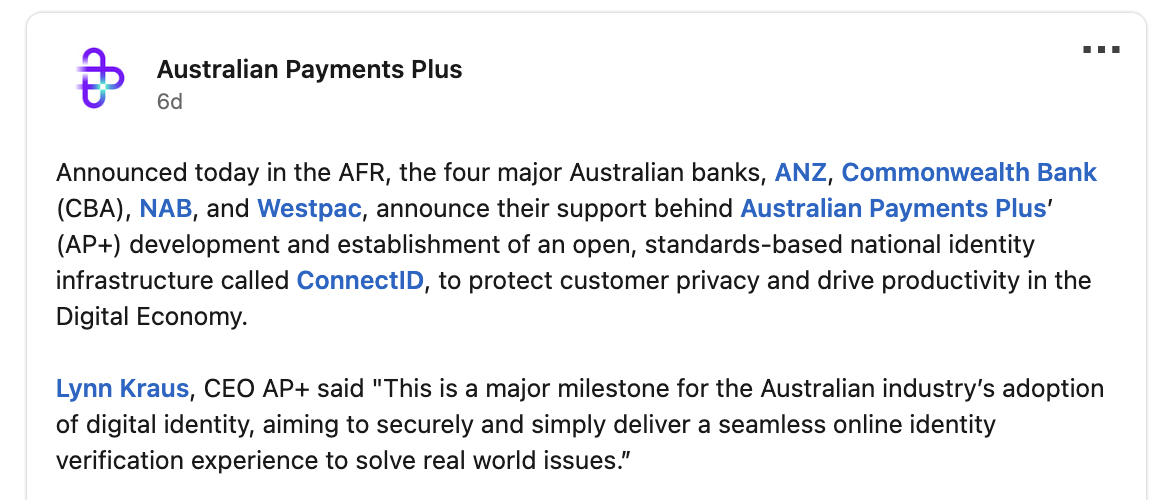
The AFR article says (emphasis my own) that the banks apparently “see ‘identity-as-a-service’ as an incremental revenue stream that will allow them to charge retailers, utilities or fintechs for validating customer details, given banks are highly trusted in the digital economy”. In the words of Australia Payments Plus (AP+) CEO Lynn Kraushe, the service will offer a “seamless online identity verification experience”.

AP+ sent out the following message the same day as the AFR article:

Now, a little bit of background. AP+ was set up in 2021 to bring together Australia’s three domestic payment organisations — BPAY Group, eftpos and NPP Australia — under one roof, while apparently allowing them to continue operating as separate businesses with distinct brands under a single Board. So what are these organizations and who do they belong to?

  • BPAY is an electronic bill payment SaaS company which facilitates payments made through a financial institution’s online, mobile or telephone banking facility to organisations that are registered BPAY billers. It is a wholly owned subsidiary of Cardlink Services Limited, which, in turn, is owned in equal parts by Australia’s “big four” banks.
  • EFTPOS (stylized as, “eftpos”), whose initials stand for “electronic funds transfer at point of sale”, is an electronic payment system involving electronic fund transfers based on the use of debit or credit cards, at payment terminals located at points of sale. The current members of EFTPOS Payments Australia Ltd include, again, the “big four” as well as a mishmash of international banks (e.g. Citigroup, ING Australia), fintechs (e.g. Paypal) and retailers (e.g. Woolworths).
  • NPP Australia is an open access system for fast payments set up in 2014. The system’s infrastructure was built and is maintained by the 12 founding members of NPP Australia Limited, which include all of the “big four” except CBA, as well as Citigroup, ING, HSBC, the London-based fintech Wise (formerly known as Transferwise), and the Reserve Bank of Australia.

ConnectID is scheduled to launch next year. Already accredited under the federal government’s Trusted Digital Identity Framework, its applications could end up extending far beyond the digital payments space. At least that’s the goal. According to the website Fintech Australia, the ConnectID team is collaboratively working with governments, businesses, online merchants, banks and other identity providers with a view to building identity into the national payments infrastructure, as well as other commercial applications for all Australians and Australian businesses.

Australia is also heading up the Digital Identity Working Group (DIWG), an eight-country consortium whose mission is to make digital identity a key component of the global digital trade and travel ecosystem. Chaired by Australia’s Digital Transformation Agency, the working group’s other members are Canada, Finland, Israel, New Zealand, Singapore, the Netherlands, and the United Kingdom.

Where’s the Trust?

There are plenty of reasons why this latest development down under should be a cause for concern (and not just for those living down under). Firstly, the idea that Australia’s “big four” banks can be trusted to roll out digital identity in Australia is beyond risible. These are the same four banks whose CEOs had to apologize to parliament in 2016 for a litany of scandals including the “mis-selling” of insurance products, interest rate rigging and bank-lending shenanigans aimed at continuously inflating the country’s housing bubble.

The resulting Royal Commission into Misconduct in the Banking, Superannuation and Financial Services Industry (RC), set up in 2017, revealed “an epidemic of crime.” It also showed the lengths to which the banks were willing to go to sustain Australia’s multi-decade housing bubble, which could be in the process of finally bursting…

Read the full article on Naked Capitalism

7 Reasons Why Naked Capitalism Deserves Your Money

I, like you, owe this wonderful website a big debt of gratitude.

I remember a former editor at a business journal once telling me that headlines with lists in them are the epitome of cheap, lazy, reductive journalism. But they are also highly effective at generating clicks, he said, particularly among the MBAs who made up most of the journal’s readership. So every now and then we would hold our noses and publish such an article. In my 22 months of writing for Naked Capitalism I have published just one (this is now my second), and that article was “Seven Reasons Why a Vaccine Passport, Pass, Certificate (Or Whatever They Want to Call) Should Give Us Pause,” posted in April 2021.

I thought long and hard before deciding to write that article. I knew it was a risky subject at a sensitive time. Digital COVID-19 passports were being marketed by just about every media outlet as perfectly innocuous digital upgrades of the paper vaccine certificates that have been around for aeons. Also, the COVID-19 vaccines themselves seemed to be working pretty well, as cases of the virus were plunging in both Israel and the UK, two of the countries leading the vaccine charge. They were also being marketed as exceedingly safe.

Today, 17 months on, I do not have the slightest regret about writing that article. As luck would have it, it came to the attention of Vermont-based independent publishing company Chelsea Green, which contacted me three months later with an offer to expand the article into a short book about the risks posed by vaccine passports and digital identity. That book, published in March this year under the title “Scanned”, has sold thousands of copies and has been translated into German and, remarkably, Bulgarian.

But if I hadn’t been writing for Naked Capitalism, that article – and by extension the book it inspired – would never have happened. Most publishers, mainstream or independent, would not even touch the topic. Many of them were too busy blaming the unvaccinated for the ongoing pandemic. In fact, it wasn’t until early 2022, long after the arrival of Omicron, that some media outlets began, tentatively, to question the logic of mandating vaccine passports for vaccines that offer such scant protection against infection or transmission.

In other words, I, like you, owe Naked Capitalism a big debt of gratitude, which I hope to repay by doing the occasional article on the house. As for you guys, here are seven reasons why I believe Naked Capitalism deserves your money (or you can take a detour to the Tip Jar, which tells you how to give, and come right back):

1. Accurate, honest reporting is a scarce resource, especially in these times. As Yves and Lambert remind readers at the top of every links page, we are living in the toughest informational environment ever. And it is getting tougher, as propaganda, often in its crudest form, substitutes for news analysis. The fog of war — and the fog surrounding many other vital issues, from public health to vaccine safety, to the economic war on Russia and its consequences for the global economy — is growing fiendishly thick. By sticking to the raw substance of stories and shining a light on their implications for the world around us, Naked Capitalism has done an admirable job of navigating its readers through that fog.

2. NC has a habit of getting the important things rightThe Economist finally admitted in the last week of August that “the sanctions war is not going as well as expected.” Any regular visitor to this site could have guessed as much even before Russia began its invasion. You see, reading Naked Capitalism on a daily basis is like having a cheat sheet for the future. Here is a list, more or less off the top of my head, of some of the big things NC’s writers called correctly in recent years (feel free to add your own):

  • The Global Financial Crisis and its discontents
  • The betrayal of Barack Obama (h/t Jerri Lynn)
  • The inevitable impossibility of Grexit, largely due to technical issues
  • The UK government’s woeful mishandling of Brexit negotiations
  • The scale of the threat posed by COVID-19, not just to human health and life but also to the long-term health of the global economy
  • The disastrous mismanagement of the pandemic by our vaccine-fixated governments
  • The importance of mask-wearing and ventilation and the limited efficacy of the vaccines
  • The dangers and logical insantity of the COVID-19 vaccine passports
  • Russia’s slow, grinding progress in Ukraine

3. NC is not compromised by partisan loyalties or oodles of advertising money. This is another important arrow in Naked Capitalism’s quiver. Thanks to the generous donations it receives each year from its readers and its resulting limited dependence on advertising revenue, NC is able to provide news coverage, insights and opinion free of outside influence. And in today’s largely co-opted media landscape, that makes it a bit of a freak. It also makes the following advantage possible.

4. It is willing to take on the thorniest of topics. From day one Naked Capitalism’s guiding mission has been to provide “fearless commentary on “Finance, Economics, Politics and Power.” And it has stuck to that mission, often going where most other publishers won’t.

5. For a US blog of its size, NC’s focus is surprisingly global. The inhabitants of the five-eye countries (US, UK, Canada, Australia, New Zealand) are not exactly famed for their interest in the non-English speaking world. NC readers are an exception to this general rule. In the past couple of months alone Naked Capitalism has published exclusive articles on India, Turkey, Saudi Arabia, Mexico, Colombia, Nicaragua, Argentina, Chile, Bolivia, Italy, Spain, France, Germany, the United Kingdom, China, Australia, Japan, Taiwan, Ukraine, Russia and Sri Lanka, while also covering, often in minute detail (Lambert, take a bow), the most important developments in the United States.

As if that wasn’t enough, NC offers a comprehensive roundup of global news stories and developments on its links page, which are then often expounded upon by people living in the parts of the world featured in the stories. The site’s global focus is, if anything, set to grow thanks to the recent drafting onto the team of John McGregor and Conor Gallagher, whose bailiwicks include Europe, Turkey and the Asia Pacific.

6. Despite expanding the scope of its coverage far beyond economics and finance, NC is still one of the best financial news websites out there. Let’s not forget why NC was founded in the first place, almost 15 years ago. As Yves says, it was an attempt to counteract the “obvious underreporting in the US of the severity and extent of the underpricing of risk in all credit instruments… It’s hard to state emphatically enough how obvious it was to someone with reasonable financial markets experience who simply read the Financial Times and Bloomberg that the official narrative was a crock.”

Today, the official narratives surrounding most areas of public policy are no better, which means NC has to cover a vast terrain, including foreign policy, war, climate change, energy policy, education, and, of course, public health. Nonetheless, the blog remains an authoritative source on financial and economic matters. Yves’ dogged coverage of CalPERS’ ongoing shenanigans is one such example. So, too, is Hubert Horan’s exhaustive investigation into Uber’s almost god-like ability not to turn a profit.

As Mark Ames wrote way back in 2011, Naked Capitalism is “our online university in finance and politics and ideology”:

Whereas other online universities are set up to turn millions of gullible youths into debt-shackled Wall Street feeding cows, Naked Capitalism is the opposite: Completely free, consistently brilliant, vital, and necessary, making us smarter, teaching us how we might one day overthrow the financial oligarchy.”

7. It boasts one of the best-informed commentariats on the World Wide Web. Naked Capitalism wouldn’t be what it is without the contributions of the sharp-minded critical thinkers that comment on this site day in, day out, come rain or shine. Both the depth and breadth of the knowledge on display continues to astound me. Put simply, Naked Capitalism’s commentariat is a significant source of its added value.

Every time I post an article, whatever the topic, I learn something new from the comments below the byline. This symbiotic relationship between the writers and the readers is one of the things that sets Naked Capitalism apart. I do now know of another website that consults its readers to the extent that Yves and Lambert do. Through the constant back and forth, often on matters of huge import, NC has honed a process of synthesizing ideas and knowledge that is, to my knowledge, unique in the blogosphere.  

But what most impressed me in the past year was the way in which the commenters responded to the news of Jerri Lynn’s departure. The outpouring of gratitude, affection and support was truly something to behold. Many readers expressed a genuine interest in her future endeavors, promising to buy a copy of her crime novel when it is published. I know from having spoken to Jerri in recent months just how much those remarks meant to. The loneliness of the long-distance blogger can be tough at times, but on Naked Capitalism you never feel alone.

And this is arguably the greatest testament to Yves and Lambert’s creation: with the help of other writers, support workers, and the commentariat, they have built, from the ground up, a close-knit community of fellow travellers from far-flung places that continues to flourish even during one of the worst periods of economic, political and social division of recent history. And for that reason alone it deserves your money. So give generously! The Tip Jar beckons!

The Race for Lithium is Heating Up in Latin America

As the US remains “grossly unprepared” to meet the exponential increase in demand for lithium, it stakes a claim to Argentina’s massive deposits of “white gold.” All for Argentina’s benefit, of course. 

The main spur for this article was a video conference last week by the Mexican geopolitical analyst Alfredo Jalife-Rahme, titled “The Lithium War Between China and the US.” Until now China has been winning that war handily, mainly because it realized the strategic importance of lithium long before the US, or at least took earlier action to secure supplies and build up the different links of the supply chain. The Asian giant is now the number one refiner of processed lithium and the number one maker of lithium batteries.

By 2020, China controlled 76% of global lithium-ion battery production capacity, while the US accounted for just 8%. As Jalife points out, between 2018 and 2021 China spent twice as much money securing lithium mining rights as the four main economies of the Anglosphere (US, UK, Canada and Australia) combined.

Now, the US and its five-eye allies are having to play catch up. Much of their attention will be on Bolivia, Chile and Argentina, the three South American nations whose borders intersect in the salt flats basins known as “the lithium triangle.” This area not only accounts for roughly two-thirds of the world’s known reserves of lithium; its lithium is also much easier to extract than many other deposits. It is here where the main focus of what Jalife calls the “lithium war” will be centered. Asked by a listener whether this will mean more coups d’état in the region, Jalife responded, with a wry, weary smile:

Yes, we need to have them on the radar. And attacks. We are going to see some strange accidents. Yep, same as always. The setting is the same,… it’s the resources that are different. This time they are strategic.

Of course, according to some reports, Latin America has already suffered one coup d’état over the white metal. In 2019, Evo Morales, the then-president of Bolivia, the country with the largest lithium deposits on the planet, was toppled by a coup. Morales and Bolivia’s current President Luis Arce blame said coup in large part on companies with commercial interests in the lithium sector, including TESLA whose CEO Elon Musk famously tweeted at the time: “We will coup whoever we want. Deal with it!”

Chile’s Undesirable Constitution

Last week, the Bezos-owned Washington Post ran an editorial kindly pointing out that Chile’s proposed new constitution needed a significant rewrite before being presented to voters this past weekend. The first reason cited for opposing the new constitution was its  environmental provisions, which would pose a serious threat to American mining companies’ ability to exploit Chile’s lithium. As you can see, even the first word of the article is “lithium”:

Lithium is a key input in batteries that run millions of laptops and upon which the United States is basing its electrified automotive future. Chile sits atop the world’s largest lithium reserves; it produced about 25 percent of the world’s commercial supply in 2020. That’s reason enough to pay attention to Chile’s impending Sept. 4 referendum on a proposed new constitution: It could recast the legal framework for mining in the South American nation, which has an 18-year-old free trade agreement with the United States.

This one paragraph almost perfectly encapsulates how Washington views most other countries on the planet — as sources of (ideally cheap) resources. And remember: this is a WP editorial, not a column, meaning it reflects the official stance of the newspaper.

That is not to say that Chile’s proposed constitution wasn’t problematic and couldn’t have done with a rewrite — just not for some of the reasons expounded by the WP. In the end, an overwhelming majority of Chileans voted against the proposed constitution, anyway, which will no doubt have pleased Bezos and the Washington establishment his newspaper speaks for (and most of the time to).

Main Target: Argentina

But it isn’t Chile’s lithium that Washington covets the most. It is Argentina’s, which is far less protected and regulated than Chile’s or Bolivia’s. It is the only one of the three where lithium is not defined as a strategic resource. The fact that Argentina’s economy is quite literally on its knees, with inflation galloping at a 30-year high of 71%, and its heavily indebted government is desperate for US dollars is an added bonus…

Read the full article on Naked Capitalism

China Just Gave a Foretaste of One of the Biggest Dangers of Biometric Surveillance Systems

Like just about anything on the Internet, biometric surveillance systems are eminently hackable as well as prone to human error.

As previously reported on Naked Capitalism, biometric surveillance systems, a common trope in dystopian novels, are being hastily rolled out across the West, with next to no public debate. That, of course, is for an obvious reason: if an open, informed debate on the pros and cons of biometric surveillance systems was actually allowed, the public would overwhelmingly reject it. Which is why these systems are increasingly encroaching into our lives under the radar, with limited public knowledge or understanding.

Insecure Data

However, a recent incident in China has underscored the potential vulnerability of biometric data storage systems. As Tech Crunch reported on Tuesday, a Hangzhou-based tech company called Xinai Electronics has left a huge cache of data containing 800 million records, including millions of faces, vehicle license plates and resident ID numbers, exposed to public view and access for months on end:

The company builds systems for controlling access for people and vehicles to workplaces, schools, construction sites and parking garages across China. Its website touts its use of facial recognition for a range of purposes beyond building access, including personnel management, like payroll, monitoring employee attendance and performance, while its cloud-based vehicle license plate recognition system allows drivers to pay for parking in unattended garages that are managed by staff remotely.

It’s through a vast network of cameras that Xinai has amassed millions of face prints and license plates, which its website claims the data is “securely stored” on its servers.

But it wasn’t.

Security researcher Anurag Sen found the company’s exposed database on an Alibaba-hosted server in China and asked for TechCrunch’s help in reporting the security lapse to Xinai.

Sen said the database contained an alarming amount of information that was rapidly growing by the day and included hundreds of millions of records and full web addresses of image files hosted on several domains owned by Xinai. But neither the database nor the hosted image files were protected by passwords and could be accessed from the web browser by anyone who knew where to look.

The database included links to high-resolution photos of faces, including construction workers entering building sites and office visitors checking in and other personal information, such as the person’s name, age and sex, along with resident ID numbers, which are China’s answer to national identity cards. The database also had records of vehicle license plates collected by Xinai cameras in parking garages, driveways and other office entry points.

TechCrunch says it contacted the company on numerous occasions to warn it about the exposed database, yet its emails were never returned. The database was publicly accessible for at least several months before finally being taken down in mid-August. But that was only after a data extortionist claimed to have stolen the contents of the database. If true, the implications are dire. Given the innate uniqueness of biometric data, if it is hacked, there is no way of undoing the damage. You cannot change or cancel your face, iris, fingerprint, or DNA like you can change a password or cancel your credit card.

The Growth of Biometric Surveillance in the West

Meanwhile, at the opposite end of the Eurasian landmass, the EU is assembling a gargantuan facial recognition system, by allowing, for the first time ever, police forces across the EU to link their photo databases. Brussels is also about to launch an automated Entry/Exit System (EES) to register travelers from third countries. The system will register the traveler’s name, type of travel document, biometric data (fingerprints and captured facial images), as well as the date and place of entry and exit.

The UK and the US are also investing heavily in facial recognition technologies, despite fierce opposition from civil liberties groups…

Read the full article on Naked Capitalism