WeWork Forerunner IWG/Regus Restructures its Business, Unleashing Mayhem on Landlords and Investors

Regus’ U.S. subsidiary, RGN Holdings, has already filed for Chapter 11 bankruptcy.

IWG — for “International Workplace Group,” previously known as Regus, the serviced-offices and coworking giant whose business model served as inspiration for WeWork — announced plans this week to close some of its city-based locations in Australia, in order to refocus its attention on the suburbs and rural areas. The move forms part of an aggressive global restructuring program that is causing all kinds of headaches for its landlords and investors.

IWG accounts for roughly 11% of the entire global flexible workspace market, around six and a half times times more than WeWork. In 2019, it had revenues of £2.7 billion. It operates 3,392 centers globally, including over 1,000 in the United States. Those US offices are operated by RGN-Group Holdings, LLC (RGN), a U.S. subsidiary of Regus Corporation, which operates the brands Regus, Spaces, HQ, and Signature by Regus, is a subsidiary of IWG.

In the US, RGN Holdings has already filed for Chapter 11 bankruptcy protection. The bankruptcy filing means that Regus can seek to have its rents dismissed. This affords it a great deal of leverage in its negotiations with landlords, from whom it hopes to extract deferred rent payments and improved lease terms, including in some cases a turnover-based model.

US commercial mortgage-backed securities (CMBS) have considerable exposure to Regus. Kroll Bond Rating Agency found 157 properties that served as collateral for $13 billion in loans with exposure to an affiliate or franchise of Regus. Regus is the largest tenant in 30 of these properties and is the sole tenant in three properties. Due to the corporate structure of Regus, RGN’s bankruptcy does not involve all Regus locations.

The Kroll analysts warn that although IWG has sought to extract rent deferrals and lease modifications from its landlords, the bankruptcy filing means the company can walk away from its rental obligations. IWG tends to sign leases and file bankruptcy petitions through single-purpose limited liability companies. That means that part of its portfolio can enter bankruptcy and tear into landlords without impacting other locations.

In the UK, the company has threatened to plunge Jersey-based Regus plc into insolvency. As a result, up to £790 million of lease guarantees could be dissolved, leaving landlords in the lurch. The only way for the landlords to avoid such a dire outcome, IWG says, is to agree to sharp rent cuts across 500 centers.

Unlike WeWork, IWG made a profit last year. But in the first half, IWG booked a pre-tax loss of £176 million, compared to the £145 million profit in first half of 2019. IWG has already warned that it expects to lose substantially more in the second half, despite slashing costs by £300 million. Its shares are currently down 43% year-to-date.

The shift to work-from-home (WFH), sparked by the pandemic, has taken a big toll on the flexible workplace market.

The crisis has also exposed the deep-seated flaws of its business model, which hinges on signing long-term leases on buildings and then sub-letting the space in smaller sections on shorter terms. Now, many of its tenants want out while many of its landlords still want to be paid.

As the ongoing virus crisis sows mayhem and uncertainty in office rental markets across the globe, IGW is seeking to downsize its global network. New York, for instance, stands to lose 20% of all of its IWG-leased locations.

Many operators are hoping that that the so-called “new normal” economy being ushered in by governments’ pandemic response will create a surge in demand for flexible workplace spaces, particularly in the suburbs, as workers seek out spaces that offer alternatives to large crowded office buildings, while providing employees a simple, cost-effective solution to their work-home boundary dilemmas.

For the moment, though, the sector remains in a state of limbo, as countries across Europe and in North America announce new lockdowns amid a resurgence of Covid-19 cases. Some co-working members are taking advantage of the advertised contractual flexibility of co-working spaces to cancel their contracts, in a last-ditch effort to control their cashflow and reduce liabilities.

Continue reading the article on Wolf Street
US, Global Corporate Giants Not Amused Mexico Finally Forces Them to Pay the Taxes They Owe

American Bar Association, Mexican business lobby, ambassadors from the US, Canada, etc. in uproar over holding executives accountable and threatening them with criminal probes. 70 Mexican officials also investigated.

The American Bar Association (ABA) this week lambasted the Mexican government for using heavy handed tactics, including criminal probes into tax fraud, to motivate corporate tax dodgers to finally settle their tax bills. The complaint echoes a similar broadside from the International Bar Association last month and reflects growing frustration among companies about the government’s use of more stringent audits, tighter surveillance methods, and the threat of tough legal action to crack down on corporate tax dodgers and tax frauds.

The Government says it has launched criminal proceedings against 43 companies that owe 55 billion pesos ($2.6 billion) to the treasury in unpaid taxes dating back to 2010. Most other companies that have been subject to audit in recent months have agreed to settle their tax debts.

Thanks largely to its zero tolerance approach toward corporate tax dodging,the government so far this year through August has already collected over 60% more in taxes from large corporate taxpayers — 155 billion pesos ($7 billion) — than in the entire year 2019, Raquel Buenrostro, who heads Mexico’s SAT tax authority, told Reuters.

But authorities had reviewed only 627 large companies so far, she said, and over 11,000 companies, each with annual income above 1.52 billion pesos ($72 million), have not yet been audited, and more work needs to be done.

Each peso is desperately needed, not only to finance the government’s ambitious programs aimed almost exclusively at the country’s most vulnerable, but also to plug the gaping balance sheet hole left behind by the state-owned and now bailed-out oil major Pemex.

Before the arrival of the current president Andrés Manuel Lopez Obrador (AMLO), in late 2018, Mexico had the weakest tax take in the OECD and the fifth weakest of all economies in Latin America and the Caribbean. In 2018, it collected the equivalent of 16.1% of GDP — just 1.5 percentage points higher than the notorious tax haven Panama and less than half the amount of tax revenue collected as a proportion of GDP by Latin America’s other alpha economy, Brazil (33%).

One major reason for the discrepancy is that in Mexico many large companies, both domestic and subsidiaries of multinational corporations, have a long history of not paying the taxes they owe — in some cases going back decades. But that is beginning to change. In recent months, Walmart’s Mexico unit, Coca-Cola bottler Femsa, and brewer Grupo Modelo, a division of the world’s largest brewer Anheuser-Busch InBev, have all agreed to pay hundreds of millions of dollars in current taxes and back taxes.

The main reason companies are finally settling their debts is that the price for not doing so is a lot more punitive than it used to be. A few weeks ago, Audi agreed to an audit over some $4 million of unpaid local taxes, but only after the governor of Puebla threatened to close the German automaker’s plant.

The cases of two big companies that have refused to settle with authorities have been passed to the fiscal prosecutor’s office, Buenrostro said. Earlier this month, Mexico’s top fiscal prosecutor Carlos Romero said that the office may bring criminal charges against individuals that instigated or perpetrated the tax fraud, including executives and tax attorneys, who may face jail time.

When the AMLO administration took over almost two years ago, it “realized that there was no desire to collect taxes from certain companies,” Buenrostro, who heads the SAT tax authority, told El País. “Some businessmen were surprised to be summoned [to the tax office] because they had never had to pay the taxes. They told me that every three years they would simply waive the unpaid taxes.”

That is now changing. So far this year, executives of 627 companies have passed through Buenrostro’s office — except for the two — with check book in hand. Years-long and in some cases decades-long legal claims are being resolved in a matter of days, as the likes of Walmart, BBVA, Coca-Cola, and América Móvil finally settle their debts.

Continue reading the article on Wolf Street

Amid Eviction Moratorium, Wiggle Room Tightens for Retail Landlords & Tenants in the UK

Land Securities, a Giant UK REIT, announced that it would try to sell a large portion of its properties. No buyers identified yet.

Land Securities (Landsec), one of the UK’s largest REITs, has unveiled plans to sell of up to a third of its £12.8 billion portfolio in a huge shift away from the retail market. It has not yet identified buyers. Besides its retail properties, LandSec owns a vast portfolio of London offices and specialist assets consisting of hotel, leisure and other properties. Those specialist assets, together with its retail properties, represent around half of the portfolio’s total valuation. But some of them are now on the chopping block.

Landsec says it will sell some properties to “crystallise significant value already created” and invest in new projects in London, including offices, whose occupancy levels have also been hit hard by the virus crisis. London, it says, remains “one of the world’s gateway cities” and central London assets, which already represent 64% of its portfolio, are “a good source of liquidity over time, with clear potential to recycle capital out of some assets and reinvest into new growth opportunities.”

At the end of September, when rents for the final quarter of 2020 came due, retail tenants paid only 13% of rent due for the fourth quarter, worse than at the shortfall on rent-due date at the end of June, according to the UK’s National Law Review. This added £2 billion to the pile of unpaid rents.

Foot traffic remains down almost a third compared to a year ago, with large cities hit hardest. And it keeps on falling, as the government’s hospitality curfew, work-from-home policies and online shopping batter the high street. Many shops have already hit the wall. In the first nine months of this year, 13,900 high street stores were forced to shutter indefinitely, up one quarter from the same period in 2019, which itself was a record year, reports the Centre For Retail Research.

In the hospitality sector, 82% of businesses say they need a reduction in rent to survive the winter months, particularly after the UK Government imposed its 10 p.m. curfew for bars and restaurants.

Many tenants aren’t paying their rents, either because they can’t or are choosing not to. At the end of September, the government, much to the dismay of commercial property owners, extended its ban on evictions of commercial property tenants to December 31. The moratorium is not a rent holiday and tenants remain liable for unpaid rent. But many retailers have used the hiatus to preserve cash and/or try to renegotiate the terms of their rental lease.

Landlords argue that without the threat of eviction, tenants have a free pass to not pay up, even when they can. Even big chains that did not have to close during the lockdown are refusing to pay their rents, in the hope of securing a better deal from their landlords. Walgreens Boots Alliance, which was classified as an essential retailer during the lockdown, argues that reduced footfall and a 50% collapse in sales during the lockdown mean it should be treated similarly to retailers who were forced to close.

But the balance of power in the market has shifted in the favor of tenants — at least those that still have a viable business model. Even if evictions were allowed, landlords know that in the current context, they would have difficulty replacing an evicted tenant — and the fact there there isn’t a good alternative after eviction makes landlords more flexible in dealing with their tenants.

But there is a line they refuse to cross. For many, that line is a lease based only on store revenues. Three weeks ago, the struggling fashion retailer New Look was able to secure a revenue-linked model for 402 of its 470 stores, whereby rent will be charged at between 2% and 12% of revenues. Other large stores will no doubt ask for similar treatment. But some landlords, particularly listed ones, are refusing to budge.

Continue reading the article on Wolf Street

Extend-and-Pretend Caused Bankruptcies to Plunge in Germany, France, Spain. Now Central Banks Tell Banks to Prepare for Bankruptcy Surge

The “second wave,” if prolonged, could cause bad loans to almost triple, to €1.4 trillion, says the ECB.

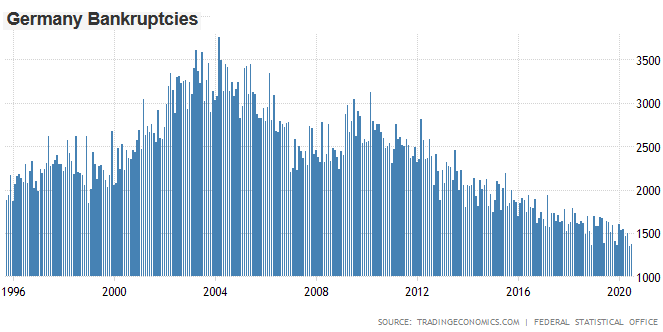
German banks need to prepare themselves for a sharp spike in corporate bankruptcies early next year, the Bundesbank warned this week in its 2020 Financial Stability Review. It anticipates around 6,000 insolvencies in the first quarter of 2021. While this would be a little lower than at the peak quarter of the Global Financial Crisis, the Bundesbank cautioned that it “cannot rule out that … a lot more companies will go bankrupt than is currently expected.”

Although Germany is in the grip of its worst economic contraction since World War 2, fewer insolvencies have been filed this year compared to 2019. This is the result of the weird bailout-and-stimulus economy, and includes these factors:

  • Banks’ broad application of forbearance measures, which has given businesses extra financial leeway;
  • The roll out of state-backed emergency loans and grants for struggling businesses, large and small, which forms the backbone of the country’s €1.3 trillion (so far) stimulus program;
  • Germany’s “Kurzarbeit” social insurance program, which enables employers to reduce their employees’ working hours instead of laying them off, picking up government subsidies in the process.
  • And most importantly, the temporary suspension of bankruptcy-declaration requirements.

Helped along by these measures, the number of firms declaring insolvency in Germany fell 6.2% to 9,006 in the first half of this year from the same period last year, trending at their lowest level in 25 years, even as the economy shrinks at its fastest rate in over 70 years.

Before the virus crisis, German companies that defaulted on their obligations and had piled up unsustainable debts had to file for insolvency. But that is no longer necessary — thanks to a new law introduced on March 1 that gave struggling companies extra breathing room. The law was supposed to expire on September 30, but, in classic extend-and-pretend fashion, its expiry date was postponed until the end of this year.

This trend has been broadly replicated across much of Europe.

In France, bankruptcies have been consistently falling on a year-by-year basis since 2015. And they’ve kept falling throughout the virus crisis. During the 12 months through July 2020, the number of insolvencies fell year on year by 28%, to 38,548, according to Banque de France. Even in sectors that bore the brunt of the crisis fallout, insolvencies have fallen sharply. Even the hard-hit travel and tourism sector saw a 28% fall in the 12 months through July.

It’s a similar story in Spain, where insolvencies hit a six-year peak of 1,979 in the last quarter of 2019 — testament to the problems the Eurozone’s fourth largest economy was already grappling with before this year began. Since then, against the backdrop of Europe’s worst contraction yet, the number of insolvencies in Spain has done nothing but plunge, first by 13% year-on-year in the first quarter, and then by 30% year-on-year in the second quarter.

For the moment, there is no official data for insolvencies in Italy, but probably much the same has happened. In all of these countries, struggling companies have hit the wall in fewer numbers than in recent years, and far fewer numbers and than would have been the case if it weren’t for all the government and central bank intervention.

That intervention has merely postponed the huge economic pain. How many of the companies benefiting from government assistance, central bank liquidity, and new bankruptcy legislation were already in deep trouble before the pandemic and are in far deeper trouble now?

Continue reading the article on Wolf Street

Highly Leveraged Commercial Real Estate Bets that UK Local Authorities Took to Meet Budget Shortfalls Begin to Unravel

With impeccable timing.

For the last two years, KPMG has refused to sign off the accounts of Spelthorne borough council, a tiny local authority on the outskirts of London that has taken on huge amounts of debt to buy more than £1 billion of commercial and residential property, it has been revealed. The council has an annual budget of just £22 million, yet it has amassed more commercial property than just about any other local authority in the UK, all of it debt financed.

Between 2016 and 2018 Spelthorne borrowed £1.17 billion from the Public Works Loan Board (PWLB), an arm of the UK treasury that is supposed to offer relatively cheap loans to councils for building new schools and other civil projects. But many councils have begun tapping the funds for speculative property investments instead, as a means of supplementing their income.

In correspondence seen by the London Times, KPMG raised “material concerns” about three purchases Spelthorne made in 2017-18 in which it allegedly ignored rules that forbid councils from borrowing purely to make a profit on subsequent investments. These investments significantly increased the council’s exposure to risks in the property market, though it insists it is not endangering funds, with this flawless argument:

The Council is not risking council taxpayers’ cash to buy commercial properties; the low cost government funding for this strategy comes from the financial markets.

KPMG is not convinced and has said it may even take the council to court. Spelthorne recently replaced the big four firm as its auditor with BDO, which rents office space in a building that Spelthorne bought in September 2018 – a purchase that BDO was supposed to assess as part of the council’s 2018-19 audit. According to the auditor, auditing its landlord poses no conflict of interest.

Spelthorne’s investments include a research center in Sunbury it bought from BP for £385 million in 2018. It was the most expensive property investment ever made by a UK local authority. Its second most expensive asset is 12 Hammersmith Grove, an office building in West London that cost £170 million. The building’s tenants include WeWork, which recently persuaded Spelthorne to defer its rent for 18 months, resulting in a £4.5 million short-term loss to the council.

But that’s a drop in the ocean compared to the scale of the losses Spelthorne could face if KPMG were to take the “nuclear option” of taking the council to court. If the court were to rule in KPMG’s favor, Spelthorne would probably have to divest its properties. That could end up bankrupting the authority, a senior figure within the council told the Bureau of Investigative Journalism:

“Supposing the council has to sell the properties and repay the Public Works Loan Board. The cost of [early] repayment is massive – someone told me it’s as much as 30% on top of what we borrowed. And then you’re trying to sell properties into a Covid-related commercial market. It would bankrupt the council. There’s no doubt about it.”

A ruling against Spelthorne would not only put at risk the council’s entire £1 billion investment portfolio but could also have serious knock-on effects for dozens of other local authorities across the UK that have also borrowed heavily to fund property purchases, as well as other speculative investments.

Many of these cash-strapped councils invested in the commercial property market in order to offset recent spending cuts forced upon them by the central government. In 2018-19 alone, councils across England and Wales spent £6.6 billion acquiring offices and struggling shopping malls nobody else wanted – more than ten times the amount spent in the previous three years.

A recent inquiry by the Public Accounts Committee into local authority property acquisitions accused the government of turning a blind eye while councils ignored the rules and borrowed heavily to fund property binges. The Treasury said it would put an end to such practices, but has yet to deliver on the threat, reports the Bureau of Investigative Journalism.

Many other councils now face the prospect of big losses on their property bets. The Office for Budget Responsibility (OBR) has warned that the price of offices and commercial buildings across the country will fall by nearly 14% this year.

Continue reading the article on Wolf Street

Private-Equity Firm Blackstone, Spain’s Largest Landlord, Tries to Unload its Properties

What does it mean when Wall Street mega-landlords that bought the impaired assets after the last crash are trying to unload during the worst economic crisis on record?

With Spain in the grip of its deepest recession on record, house prices have begun to fall for the first time since 2015 on a year-over-year basis. In a bid to buck this trend, Aliseda and Anticipa, two real-estate firms that private-equity giant Blackstone acquired in 2017 from Banco Santander, have pledged to reimburse investors up to one tenth of the sale price if the value of the properties they buy drops by more than a tenth in the three months after a deal is sealed.

Many of the 8,400 properties on offer have been sitting on the market since 2018, without finding a buyer. The total portfolio is valued at €1.04 billion. Now, Blackstone is trying everything it can to offload the properties, including offering investors the sweetener of a little extra security.

Blackstone is the biggest private landlord in Spain, with some 100,000 real estate assets in the country, including a huge portfolio of impaired assets, such as defaulted mortgages and the homes that back them, and real estate-owned assets (REOs), that are controlled via dozens of companies. It is heavily exposed to any downturn and has an obvious interest in keeping Spain’s ultra-fragile housing recovery going. That could be why it’s offering such enticing inducements to attract buyers.

“We detected the current context was generating uncertainty for buyers, and wanted to provide them with security and send a message of confidence in the Spanish real estate market,” said Aliseda communications director Jaime Navarro.

The initiative could be a sly marketing ruse, says Spanish financial daily El Confidencial. Aliseda already reduced its offer prices before the Covid-19 outbreak, after surmising at the beginning of this year that Spain’s roughly five-year housing boom was running out of steam. After the lockdown, it undertook another price review and reductions, to where its asking prices could be reasonably well adjusted to the new reality.

But the offer could also send the opposite of its intended message, giving investors the impression that some of the biggest sellers are so worried about the prospect of cascading prices in a market that was already running out of steam before Covid arrived that they’re willing to do just about anything to attract prospective buyers. And that might be enough to convince those prospective buyers to sit on their hands a little while longer, putting further downward pressure on prices.

Eduard Mendiluce, chief executive of Aliseda and Anticipa, insists that the prices of the properties are “highly competitive and that now is a good time to buy a home.”

Spain has so far suffered the biggest post-Covid economic contraction of any EU Member State, including Italy, Greece and Portugal. It has also seen the sharpest rise in unemployment.

Memories are still fresh of the last housing crisis, which was triggered by the collapse of a ten-year housing bubble, during which prices almost tripled, and culminated in a seven-and-a-half year long housing bust. Since then, in many places, prices have not come close to recovering their former boom-era levels. And now, the lukewarm recovery that began in 2015 may be in the process of unraveling.

Continue reading the article on Wolf Street

Small-Business Emergency Loan Program in the UK Threatens to Descend into Chaos

A goldmine for enterprising criminals. Even legitimate borrowers face sky-high default rates. Taxpayers to eat the losses.

Demand continues to surge for the UK’s Bounce Back Loan (BBL) program, which provides cheap emergency lending to small and medium-sized businesses. On Wednesday, HSBC announced it was having so much difficulty processing the deluge of new applications that it has decided to halt pandemic lending to new business customers.

The BBL program was first launched in May. Since then, £38 billion has been lent to 1.26 million businesses — in a country of roughly 5 million businesses. SMEs are able to borrow up to 25% of their revenues to a maximum of £50,000 under the program. The loans, interest-free for 12 months, are administrated by private-sector banks, but are 100% backed by the government.

Besides the Bounce Back Loans, banks have also lent £15.5 billion to 66,600 mid-sized businesses (with revenues up to £45 million) through the Coronavirus Business Interruption Loan Scheme (CBILS), and £3.5 billion to 566 large businesses (with revenues over £45 million) through the Coronavirus Large Business Interruption Loan Scheme (CLBILS). Both loan programs are 80% guaranteed by the State.

In total, £58 billion has so far been disbursed across the full gamut of the UK’s coronavirus emergency lending programs — the equivalent of 2.6% of GDP. That’s relatively low compared to some countries. In France, for instance, companies have received €106 billion — the equivalent of roughly 4% of GDP. In Spain, the state-owned bank ICO has guaranteed over €100 billion in business loans — almost equivalent to 10% of GDP.

Before the BBL program was launched, very little emergency lending was actually reaching small UK businesses, partly due to voluminous red tape but also because 80% of each loan was guaranteed by the state, meaning that banks had to assume 20% of the risk of non-payment on loans that they knew had extremely high risk of non payment. Hence the decision by the government to provide 100% backing for the Bounce Back Loans.

The loans are also self-certified, making them quick and easy to process. Because banks are not liable for any unpaid debts, they are quite happy to release the funds with little in the way of background checks. This has created a goldmine for enterprising criminals.

Continue reading on Wolf Street