Another Negative-Interest-Rate Central Bank Laments What Negative Interest Rates Have Wrought

Instead of warning about the effects of this absurdity, they could just raise rates and quit buying bonds

Just two days after French luxury giant LVMH picked up Tiffany & Co. in a €14.7-billion deal, the Bank of France has warned that large French non-financial corporations, many of them part-owned by the state, have been taking advantage of years of low or negative interest rates to take on dangerous levels of debt.

Much of that debt has been used to buy up overseas companies and assets, the central bank warned in a report published in its November monthly bulletin.

Unlike some of their European peers, French firms’ net financial indebtedness (the total amount of debt minus available cash) has continued to rise since the 2008 financial crisis, reaching €3.6 trillion earlier this year, the equivalent of 143% of GDP, having increased more than 30 percentage points in 10 years. That was enough to earn the country eighth place on WOLF STREET’s leaderboard of the world’s most monstrous corporate debt pileups, just one notch below China in seventh.

The Bank of France’s warning is the latest in a series of dire warnings by central banks about the risks they themselves have created with their QE programs and interest rate repression, while simultaneously doubling and tripling down on QE and interest rate repression — much like a doctor might misprescribe a medicine, then, after the damage has been done, warn the patient about the dangers of taking that medicine, and yet for some reason continue to insist that the patient keeps taking the medicine.

Among the central banks that have issued warnings in the last past two weeks alone:

  • The Federal Reserve cautioned that business debt levels are “high compared with either business assets or GDP, with the riskiest firms accounting for most of the increase in debt in recent years”. Around half of investment-grade debt outstanding is currently rated in the lowest category of the investment-grade range (triple-B) “– near an all-time high.”
  • The ECB warned that “very low interest rates, coupled with the large number of investors which have gradually increased the duration of their fixed income portfolios, could exacerbate potential losses if an abrupt repricing were to materialize.”
  • The German Bundesbank said that negative interest rates are encouraging banks in take on ever greater risks, expanding their lending to “relatively high-risk businesses” while simultaneously reducing their provisions. German lenders have also increased their exposure to the fast-growing domestic real estate market, while the Bundesbank considers house prices in many cities overvalued by 15% to 30%.

Now, it’s the turn of Banque de France to sound the alarm bells concerning the massive, unchecked rise of corporate debt in the country. The interest rate for lending to NFCs averaged 1.56% in 2018, its lowest level on record, according to S&P Global Ratings. This year, the ECB has cut its negative policy rate deeper into the negative. Small and midsize enterprises (SMEs) have used this opportunity to take out bank loans, while large companies have issued debt easily on the capital markets.

Continue reading the article on Wolf Street
Negative Interest Rates Bite: Bundesbank Warns of Risks to Financial Stability, Moody’s Downgrades Outlook for German Banks

Yield-starved banks expanded lending to “relatively high-risk businesses” and to the property sector, as the Bundesbank considers house prices in many cities overvalued by 15% to 30%.

The “risks to financial stability have continued to build up in Germany,” the Bundesbank warns in its Financial Stability Report, published this week. One major risk highlighted by the central bank is that Germany’s current economic slowdown — the result largely of “unfavourable external economic developments” — could turn into an “unexpected economic downturn”.

The country’s export-led economy has barely grown in the last five quarters as global trade has slowed. If the situation gets much worse, it could trigger a “deterioration in the debt sustainability of enterprises and households,” which in turn could lead to cascading loan defaults and credit write-downs.

Many yield-starved banks have significantly expanded their lending to “relatively high-risk businesses” while simultaneously reducing their provisions against losses on lending. As the Bundesbank puts it, “there are signs that banks’ lending portfolios now include a higher share of enterprises whose credit ratings could deteriorate the most in the event of an economic downturn.”

The banks are also heavily exposed to the fast-growing domestic real estate market, one of the few in Europe to have avoided a slump in the wake of the 2008 crisis. Since then, prices have surged as investors, domestic and foreign, have poured funds into real estate, and banks have shifted their focus toward property transactions.

Last year alone, house prices in Germany grew at an average rate of 8%. The Bundesbank estimates that property prices in German towns and cities are overvalued by between 15% and 30%. According to the 2019 Global Real Estate Bubble Index, housing in Munich is now the most overpriced in the world.

If the economy’s slowdown turns into a downturn, as the Bundesbank fears, Germany’s property boom could turn to bust, leaving investors, banks and developers shouldering large losses. Yet for now, surveys suggest that both households and lenders expect prices to continue rising long into the future. As the central bank notes, even as Germany’s macroeconomic situation deteriorates, the persistently low interest rates not only help to mask that reality, they provide ideal conditions for the financial vulnerabilities to grow further.

Continue reading the article on Wolf Street

As Bad Loans Explode in Turkey, Government Tries to Recreate Debt-Fueled Boom that Led to its Financial & Currency Crisis

Banks are being pushed to lend with the same reckless abandon

İşbank, one of Turkey’s largest private banks, has warned that the non-performing loans (NPLs) in its portfolio could reach 7.5% of its total loan book by the end of this year, up from a previous estimate of 6%.

Deputy CEO Senar Akkuş, during a recent earnings call, blamed weak demand for new loans as one of the main reasons behind the increase in the bank’s NPLs, since weaker credit growth renders the portion of soured loans relatively larger when compared to total loans.

Bad loans in Turkey have almost doubled since last year’s currency and financial crisis lopped off roughly a third of the Turkish lira’s value, making repayment of loans denominated in dollars or other foreign currencies much more difficult. By the peak of the crisis, foreign currency loans accounted for a staggering 40% of the country’s banking sector’s total assets.

Many of the delinquent loans have since been restructured. At the beginning of this year, after pressure from President Recep Tayyip Erdogan, state-owned banks gave struggling bank customers and small businesses an offer most of them could not refuse: to consolidate their debts at one of the state lenders, which then paid off the money they owed their respective banks. This effectively shifted consumer and small-business debts, particularly non-performing debts, from banks to state entities, which become a form of “bad bank.”

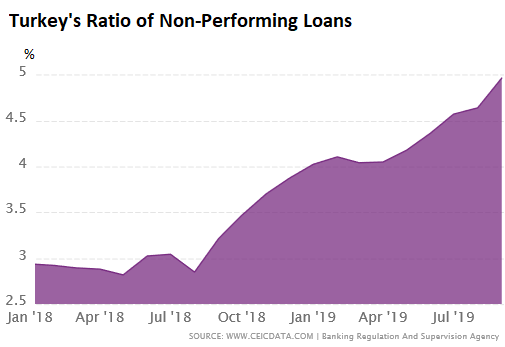
Despite all the assistance provided by Turkey’s state-owned bad banks, the NPL ratio of Turkey’s regular banks reached 5% in September for the first time since 2010. Through mid-2018, before the crisis was beginning to bite, the NPL ratio was mostly around 2.8%. It is expected to rise to 6.3% by the end of this year, according to Turkey’s banking watchdog, the BDDK (chart via CEIC):

In September, the BDDK forced banks to take losses on $8 billion of bad loans and set aside loss reserves — a move that some of the larger banks, saddled with some $20 billion in loans that construction and energy companies could no longer service, had heretofore resisted since it would mean acknowledging the bad debts as losses on their books.

Continue reading the article on Wolf Street

Screwed Investors Still Stuck in Woodford’s Imploded Mutual Fund Get a Glimpse of Their Losses

After a “run on the fund” triggered when people figured out it was loaded up with crappy illiquid assets

Hundreds of thousands of investors trapped in the imploded and shuttered Woodford Equity Income (WEI) fund, which is now down to £3.1 billion, could lose a third or more of their remaining investment by the time the fund is wound up, according to an analysis commissioned by the fund’s administrator Link Fund Solutions.

In a base case scenario modeled by private equity specialists PJT Park Hill last month, losses could reach 32.5% of total funds as the fund is liquidated. Under the worst-case scenario, the fund’s value would fall by 42.6%.

In other words, the fund’s investors could collectively lose between £1 billion and £1.3 billion of their remaining funds. This would be on top of the losses they already suffered in the years preceding the gating of the fund five months ago. Between 2015 and June 2019, when the fund was shuttered, the total amount under management at WEI shrank by almost two thirds, from £10.2 billion to £3.1 billion, as its portfolio has unwound dramatically.

As an “open-end” mutual fund, WEI had to sell some of its assets each time an investor asked to redeem their funds, which they could do at just about any time. This is not a problem when the assets in question are highly liquid, such as large-cap stocks. But when the assets are bonds, loans, real estate, large positions of thinly traded small-cap stocks, or unlisted shares that can take days, weeks or even months to sell, there is a mismatch in liquidity between what the fund offers to its investors (daily liquidity) and what the fund holds (largely illiquid assets). A “run on the fund” can be catastrophic for this type of fund, one of the oft-undisclosed risks of investing in open-end mutual funds.

In the case of Woodford, his specialty was small-cap stocks and holdings of unlisted start-ups in the tech or biotech sectors — assets that can take a long time to offload. When, at the beginning of June, Kent County Council, a longstanding backer of Woodford, requested the return of approximately £250 million, there was no way he could sell assets quickly enough to redeem the funds. Instead, he placed a ban on redemptions, meaning that investors who hadn’t already yanked out their money, including Kent County Council, were trapped. Now, they stand to lose as much as 42% of their money.

Continue reading the article on Wolf Street

Mexico’s Cancelled $13-Billion Zombie-Airport Refuses to Die

The people voted to scrap the project that was one-third finished, $4 billion over budget, mired in allegations of corruption, and built on an unstable lake-bed. But it has a life of its own.

A year ago, the Mexican people — albeit a small fraction of the electorate — voted to scrap a new $13-billion airport for the capital that was almost one-third finished, at least $4 billion over budget, and mired in allegations of corruption. Around $5 billion had already been poured into the new Texcoco airport, which was to feature a futuristic, X-shaped terminal designed by Norman Foster. Another $8.3 billion was earmarked to finish it.

And for the foreseeable future, Mexico City, one of the world’s largest metropolises, must continue to make do with an ancient airport, Benito Juarez, that is already overwhelmed by passenger numbers, has no room for further growth, and in some places, like many parts of Mexico City, is gradually sinking into the bed of one of the lakes on which the center of the city was originally built.

The final decision to undo years of construction work on Texcoco, at an estimated cost of $9 billion, ultimately fell to Mexico’s new president, Andrés Manuel Lopez Obrador (AMLO), who had spearheaded the opposition to the project in the first place, mainly on grounds of corruption and lack of transparency. A staggering 70% of the contracts for the project, some of which had a duration of 50 years (with the option of extending them to 100 years), were awarded without tender, in direct contravention of the Mexican government’s own anti-corruption laws.

But the biggest problems with the Texcoco airport are structural and environmental. The site chosen for its development is a drained lake bed that happens to attract much of Mexico City’s run-off water. The ground still has extremely high water content and low resistance to stress. For the big construction companies involved, it would have been the perfect boondoggle: once the airport was built, the chronic structural problems that ensued would have necessitated huge amounts of maintenance work, just to keep the land fit for purpose.

“The Texcoco lake bed is the worst land imaginable for building any kind of construction on,” said José Luis Luege Tamargo, the former head of Mexico’s water regulator, in an interview. Under Texcoco’s marshy land is one of Mexico City’s most important aquifers, but it is being depleted at an alarming rate. As a result, the land above it is sinking at an average rate of between 20 and 40 centimeters a year, further increasing the risk of flooding at Texcoco. In 2014, Luege Tamargo alerted the consortium in charge of the project to these risks but his warnings were ignored.

Yet while the airport project may have been cancelled and some of the bonds issued to finance its construction have already been repaid, it is still far from dead and buried. An avalanche of more than 140 lawsuits brought by a tenacious, well-funded coalition of business leaders, airline representatives and lobbyists has prevented AMLO’s government from dismantling the work on Texcoco and proceeding with his alternative project, to build two commercial runways at the Santa Lucia air force base and a new runway at Toluca Airport..

Continue reading the article on Wolf Street

Months After Takeover, European Supermarket Giant Dia Discloses Huge Losses, Plunging Revenues, Soaring Debt

Russian billionaire rues the day he bought it. “We should have been more cautious and done our due diligence better.”

Dia, once one of Europe’s largest supermarket chains but now struggling with cascading losses and a near-bankruptcy experience, has just disclosed its results for the first three quarters of 2019. The firm racked up even more losses (€504 million) in the first nine months of this year than it did in the whole of last year (€365 million), when it was rocked by accusations that its executives, with the complicity of its auditor, KPMG, had engaged in accounting fraud to conceal the true extent of the firm’s losses.

Luxembourg-based investment fund LetterOne (L1) took over the supermarket group in the summer with the purchase of 70% of the group’s shares. L1 is owned by Russian billionaire corporate raider Mikhail Fridman who had made his fortune in oil, retail and banking during Russia’s chaotic transition to a free market economy in the 1990s and who was listed by Forbes this year as London’s richest resident.

In the first nine months of this year the supermarket chain’s EBITDA (earnings before interest, tax, depreciation and amortization) plunged 80% from a year ago, to €48.3 million. Sales dropped 7.4% to €5.1 billion and its total net debt soared by €1.1 billion, from €1.5 billion at the end of 2018, to to €2.6 billion in Q3 2019.

Dia’s main creditors include not only big Spanish lenders like Santander, BBVA, CaixaBank and Banco Sabadell and European heavyweights like Barclays, Société Générale, and Deutsche Bank, but also the ECB which as of last year held at least €200 million worth of Dia’s bonds, although it may have since sold them at a multi-million euro loss.

Continue reading the article on Wolf Street