The escalation, as we’ve argued, has nothing to do with the drugs trade and everything to do with Venezuela’s huge deposits of oil, gas, gold and other minerals.
The Donald J Trump administration is, not for the first time, on a mission to topple the Nicolás Maduro government in Venezuela. And it’s willing to use whatever means necessary, including wanton murder on the high seas. However, serious doubts are being raised about the legality of its actions — including, interestingly, by some mainstream media outlets.
On Wednesday, the New York Times published an article outlining how the Venezuelan speed boat allegedly destroyed (as far as I’m aware, Venezuela’s Maduro government still questions the veracity of the video) by US missiles in the Caribbean last week “had altered its course and appeared to have turned around before the attack started”:
´[T]he people onboard had apparently spotted a military aircraft stalking it, according to American officials familiar with the matter.
The military repeatedly hit the vessel before it sank, the officials added, speaking on the condition of anonymity to discuss a sensitive matter. President Trump has said he authorized the strike and claimed the boat was carrying drugs.
The disclosures provide new details about a military operation that was a startling departure from using law enforcement means to interdict suspected drug boats. Legal specialists who have called it a crime to summarily kill suspected low-level smugglers as if they were wartime combatants said the revelations further undercut the administration’s claim that the strike was legally justified as self-defense.
“A Novel Argument”
So far, the Trump administration has presented no evidence to corroborate its claims that the 11 people on board the boat were transporting drugs heading to the US and were part of a Venezuelan gang, Tren de Aragua.
NC readers with basic knowledge of boats have already trashed that idea, pointing out that such a small vessel could never make it even close to Florida (h/t KLG). Recent revelations suggest that the boat was actually heading to Trinidad and Tobago, and could have been carrying drugs, other smuggled goods, fishermen or migrants.
We will probably never know since all the physical evidence has been vaporised.
Instead of providing a detailed legal rationale for its actions, the Times notes, the Trump administration has “put forward the outlines of a novel argument that using lethal military force was permissible under the laws of armed conflict to defend the country from drugs because 100,000 Americans die annually from overdoses.”
This may be enough to sway some, perhaps even many, in the MAGA base, for whom the US’ opioid epidemic is, understandably, an important issue. But that does not make it legal. As Nick Turse reports for The Intercept, the lethal strike was a criminal attack on civilians, according to a high-ranking Pentagon official who spoke on the condition of anonymity.
As we have documented in previous posts (here, here and here), Venezuela is a relatively small-part player in the drug trafficking business. Over 85% of the world’s cocaine supply is transported via the Pacific, from ports in Colombia, Peru and Ecuador. Meanwhile, Trump’s own claims that the Tren de Aragua gang is under Maduro’s control is contradicted by a declassified Department of Justice report.
More important still, almost all drug deaths in the US are caused by fentanyl, not cocaine, and Venezuela does not even feature as a manufacturer or transit country for that drug. In other words, the US could launch all-out war on Venezuela’s drug traffickers — and visit all manner of death and destruction on the country itself — and barely save an American life.
The Ecuadorian Connection
These days, the world’s leading exporter of cocaine is Ecuador, which is only a transit country and whose government is one of the US’ closest allies in the region.
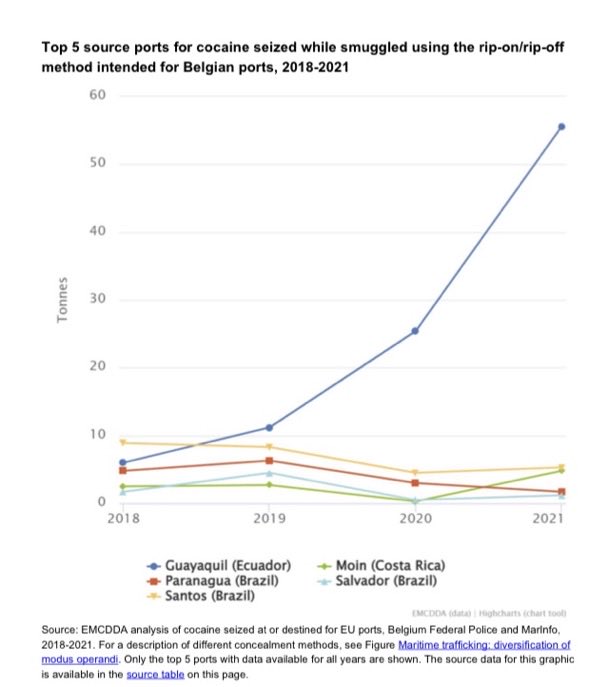
Ecuador’s US-born and raised president, Daniel Noboa, is the heir to a banana empire exporting $3.5 billion annually. As we have reported before, subsidiaries of the Noboa Corporación have been caught trafficking hundreds of kilos of cocaine to Europe via its banana shipments between 2020 and 2024:
According to an investigative report by the magazine Raya, Noboa Trading Co., a banana producing and trading firm belonging to the Noboa family, one of the richest in the country, has been caught on three occasions concealing hundreds of kilos of cocaine in cargos of bananas destined for Europe.
This is the way by which much, or even most, of the cocaine transported from Ecuador reaches Europe: through the banana trade. Although the police seized the shipments in flagrante delicto, those allegedly involved, including members of the Noboa family, have not faced justice. From Progressive International:
“Part of the investigation was revealed last weekend by Ecuadorian journalist Andrés Durán, who, after disclosing several official documents containing reports on the drug seizure, had to leave the country due to death threats and legal harassment from the ruling political party, Movimiento Acción Democrática Nacional (ADN).
In an interview with Revista RAYA, Durán spoke about his investigation and his departure from Ecuador:
“This is the first documented case in Ecuador’s history in which a presidential family is allegedly involved in cocaine trafficking. The Noboa family controls the entire chain of the banana export business, from planting and harvesting to transportation and private ports. There is no doubt that the death threats are closely linked to this investigation.”
During his recent visit to Ecuador, US Secretary of State Marco Rubio, an Ecuadorian journalist points out the inconvenient fact that Ecuador, not Venezuela, is the main transit route for cocaine trafficking, as documented by the UN’s annual drug report. Rubio responding by saying he doesn’t care what the UN says.
Here’s a cartoon that nicely sums up the situation: the US drops a bomb on a tiny fishing boat while four massive ships sail on by unimpeded. The one on the far left represents the US and Western banks that launder the proceeds of drug trafficking; the one next to it, Ecuador’s banana consignments; the one next to that, the transnational drug cartels; and the one on the far right, the US’ insatiable demand for narcotics.
In recent days, the Grayzone has delved into the CIA’s historic ties with drug trafficking generals — the supposed founders of what came to be designated as the Cartel de los Soles — back in the 1990s:
Here is the original 60 Minutes episode on the fallout from the quickly buried and forgotten scandal:
Congress MIA
Meanwhile, the US Congress is once again missing in action as another military misadventure looms, this time in the US’ “backyard”. However, there are a few grumblings of disquiet, mainly from Republican Party members, as Connor Echols reports for Responsible Statecraft:
The rapid escalation seems to have put Congress on the back foot. While many lawmakers moved quickly to condemn Trump’s attacks on Iran earlier this year, strikingly few members of Congress have shown the same level of enthusiasm when it comes to Venezuela.
Responsible Statecraft reached out to 19 congressional offices about the campaign but only heard back from Rep. Adam Smith (D-Wash.), who simply shared a statement asking a series of questions about the goals and legality of the strike. (Smith later used stronger language, accusing Trump Thursday of trying to start “a war with Venezuela.”)
A smattering of other lawmakers have put out statements condemning the strikes. Rep. Chuy Garcia (D-Ill.) lamented that Trump launched the campaign without congressional authorization and called on Congress to act in order to avoid a new “forever war.” Sen. Rand Paul (R-Ky.), for his part, told Newsmax that “it isn’t our policy just to blow people up.” But Sen. Tim Kaine (D-Va.), Sen. Bernie Sanders (I-Vt.), Rep. Ro Khanna (D-Calif.) and Rep. Thomas Massie (R-Ky.)—all of whom often rail against presidents for starting conflicts without consulting Congress—have so far stayed silent on the issue.
While they stay silent, the US’ executive branch continues to escalate.
Puerto Rico is now a key staging area in the US’ military manoeuvres in the Caribbean, with the US sending 10 F-35 fighter jets and the USS Iwo Jima to the island, which is neither a sovereign nation nor a US state. During Hegseth’s visit, Puerto Rico Gov. Jenniffer Gonzalez (Rep) tweeted:
We thank @POTUS Trump and his Administration for recognizing the strategic value Puerto Rico has to the national security of the United States and the fight against drug cartels in our hemisphere, perpetuated by narco-dictator Nicolas Maduro. We are proud to support America First policies that secure our borders and combat illicit activities to protect Americans and our homeland.
While on board the USS Iwo Jima on Monday, Hegseth told the ship’s crew:
“What you’re doing right now – it’s not training. This is the real-world exercise on behalf of the vital national interests of the United States of America to end the poisoning of the American people.”
Another Decapitation Strike?
Later on, Hegseth was asked by Fox and Friends whether the end goal is regime change in Venezuela, to which he responded that the Pentagon is “prepared with every asset that the American military has” should Trump choose to move forward with such an operation. Trump, for his part, has rejected the notion that the troop deployment’s are aimed at regime change while refusing to rule out targeted strikes against cartels inside Venezuela.
Asked by a reporter if he was considering attacking “cartels” inside Venezuela, Trump responded ambiguously, saying only, “Well, you’re going to find out.”
Given the size and sophistication of the forces being deployed to the Caribbean, regime change is clearly the goal…
 Nick Corbishley