Tony Blair and Larry Ellison Make One HELL of a Partnership

Blair and Ellison have a shared vision for the future, and it is one that most of us would never vote for if given the chance (which, of course, we won’t be)

This is Naked Capitalism fundraising week. 422 donors have already invested in our efforts to combat corruption and predatory conduct, particularly in the financial realm. Please join us and participate via our donation page, which shows how to give via check, credit card, debit card, PayPal, Clover, or Wise. Read about why we’re doing this fundraiserwhat we’ve accomplished in the last year, and our current goal, supporting our new Coffee Break/Sunday Movie features

You know the world is in a dark place when in the space of just a few days Tony Blair, an unrepentant war criminal and profiteer, is proposed as chairman of a “board of peace” for Gaza while Larry Ellison, the world’s second richest man, takes a controlling stake in TikTok’s US operations. Both are fervent Zionists as well as long-standing business associates, and they are on a mission to transform the world in ways most of us would probably recoil from.

A Regime Run by “Affluent Foreigners” with “Palestinians at the Bottom”

During his second term in office, Tony Blair considered allowing Israel to take over “five main settlement blocs in the West Bank” which would “become part of Israel”, according to newly released British government documents. He is also an honorary patron of a charity, the UK branch of Israel’s Jewish National Fund (JNF), that displays a map on its website including the occupied Golan Heights, West Bank and Gaza Strip as part of Israel.

Blair will now head the Gaza International Transitional Authority (Gita), a regime run by affluent foreigners with Palestinian executives at the bottom, as Liza Rozovsky reports for Ha’aretz:

Former British Prime Minister Tony Blair’s plan for running the Gaza Strip after the war proposes a multilayered, hierarchical structure in which senior international diplomats and businesspeople are on top and the Palestinians running things on the ground are at the bottom.

According to the document, which Haaretz is publishing in full for the first time, the Gaza International Transitional Authority (GITA) will be run by an international board.

Its chairman will be Gaza’s top political executive, but he will work “in close consultation” with the Palestinian Authority. As Haaretz has previously reported, Blair himself is slated to hold this position, according to an Israeli government source.  (Tony Blair’s draft Gaza plan obtained by Haaretz)

Among other things, the chairman will be responsible for diplomacy – with other countries, with international organizations and with donors. This includes “strategic security diplomacy with external actors, including Israel, Egypt, and the United States.”

GITA will operate under a mandate from the UN Security Council and be given broad powers, including responsibility for coordinating security in Gaza and passing legislation that will govern residents’ lives.

It remains to be seen whether Blair will accept the governor/viceroy role or prefers a more hands-off position such as an “adviser”. One thing that is clear is that he will not be welcome by the overwhelming majority of Palestinians, for obvious reasons.

Regaining Narrative Control

Ellison’s buyout of TikTok’s US assets is no less controversial given he is the largest individual donor to the Israeli Defence Forces and one of six Jewish billionaires that have “quietly become the backbone of Israel’s wartime spending and tech innovation”, according to the Jerusalem Post. As Wikileaks points out, the takeover is all about regaining narrative control, particularly around Israel’s ongoing genocide in Gaza and multi-front conflicts in the Middle East:

Ellison, who made his fortune developing Oracle – a database system he originally built for the CIA – already controls CBS, Paramount, MTV, Comedy Central, Showtime, Nickelodeon (which makes kids shows) as well as Channel 10 in Australia and Channel 5 in the UK. Ellison is also expected to finalize control over Warner Bros. Discovery (including CNN, HBO and the Discovery channel) before the end of 2025.

Even before the forced sale is finalised, censorship of TikTok content critical of Israel, including of the deal itself, has reached extreme levels as the platform moves to align with its prospective new owners. Fox – a Murdoch asset – is also seeking to join the Ellison consortium, a move that could enable cross-promotion between Fox and TikTok, further tightening the Israeli-aligned information bubble.

Disapproval of what Israel is doing in Gaza has risen to 60% of the US population, nearly double the approval rate of 32%.

The U.S. still has over three years of Trump left. Israeli-aligned Jewish billionaires control OpenAI, Google, Meta/Facebook/Instagram/WhatsApp, Palantir, CBS, HBO, and most of Conde Nast (Reddit, Vogue, The New Yorker, Wired, GQ, Vanity Fair) as well as numerous Hollywood studios, regional papers and radio stations.

Ellison’s Dark Vision for OUR Future

But it is what Ellison and Blair are doing together that is getting a lot less attention, despite the fact it could end up impacting all of our lives. Ellison has donated or pledged a staggering £257million for the Tony Blair Institute for Global Change, which appears to be securing him significant access to, and influence, over the Starmer government.

In late February, we published a post titled “Larry Ellison’s Dark Vision for OUR future”. Ellison, we noted in the first paragraph, “has a vision for the future, and it is one that most of us would never vote for if given the chance (which, of course, we won’t be)”:

It essentially involves harvesting and storing all of a nation’s data, including all of its citizens’ most personal data, in one place, and then letting AI programs scour all over it. That data, he says, should include economic data, electronic healthcare records, including our genomic data, spatial information, agricultural data and info about infrastructure.

“I have to tell [the] AI model as much about my country as I can,” Ellison said in a recent onstage discussion with his old friend Tony Blair at the World Governments Summit. “We need to unify all the national data, put it into a database where it’s easily consumable by the AI model, and then ask whatever question you like. That’s the missing link.”

Ellison believes that the benefits of such a system will include improved healthcare, thanks to treatments tailored to individuals, as well as the ability for governments to increase food production by better predicting crop yields. And at the World Governments Summit he was touting those benefits to senior representatives of many of the world’s governments, with Blair by his side helping to lubricate the sales pitch.

The octogenarian tech titan has an almost religious faith in AI, describing it as “maybe” the most important discovery in the entire history of humankind — more important, seemingly, than fire, the wheel, language, steam, electricity and the atom. He is also aggressively pushing for governments, particularly the US and the UK, to embrace AI-enabled control and surveillance technologies, with a significant onus on biometric identifiers — something both countries have already been doing for some time, with help from Ellison.

Now, Ellison wants to take AI-enabled digital surveillance and control systems to a new level by totally centralising them, despite the obvious security implications. He also envisions a world without passwords and personal identification numbers (PINs) in which access to IT systems and tech platforms will be based purely on our biometric identifiers. As he says in the clip below of his recent chat with Blair, “this is the last year you will ever log onto an Oracle system with a password… biometric logins are the future.”

Ellison also talks about the need for national governments to have their own “sovereign” data centres to power their AI systems, which will no doubt provide Oracle, the world’s largest database management company, lots of new income streams.

In an Oracle financial analysts meeting in September, Ellison told investors that AI will usher in a new era of surveillance that he said, gleefully. will ensure “citizens will be on their best behaviour.” It is almost as if Ellison read Orwell’s 1984, Huxley’s Brave New World, Phillip K Dick’s Minority Report and a host of other dystopian novels and came away with a new business model.

Now, Ellison’s vision is rapidly becoming a reality on both sides of the Atlantic, as the world’s second richest man flexes his financial muscles not only in the development of AI data centres, digital health, online surveillance systems and biometric identifiers but also with big moves in the traditional and social media space.

Mandatory Digital ID for Work

Meanwhile, as we warned last Tuesday (Sept 23), the UK’s Keir Starmer government is going all-in on digital identity. Two days later, Starmer said this:

Starmer’s announcement directly contradicted his government’s previous claims that adoption of digital ID would not be mandatory. Government ministers have spent the past three days tying themselves in knots over the issue, with one even saying that it will be mandatory to have a digital identity but not mandatory to use one.

Serious concerns have been raised about the potential implications for the millions of UK citizens who do not have smartphones. From London Loves Business:

Elizabeth Anderson, CEO of the Digital Poverty Alliance said, “The introduction of digital IDs sets a dangerous precedent, potentially only allowing people the right to work if they can afford and use a smartphone.

That ignores the 19 million people who are suffering from digital poverty and lack a smartphone, connectivity or skills, creating a black hole in the labour market and a significant portion of the population who are immediately excluded even further.”

“The people most impacted are those on low incomes, older people, young people paying for their own phone bill, refugees and domestic violence victims, as they are the most likely to not have access to a smartphone.”

“A serious concern is where this will definitely stop at the right to work? Or in reality, will it stretch to accessing the NHS, applying for benefits or pensions, or applying for training? Many of us take for granted these essential services, but the steps taken to implement a digital ID system could have a worrying impact on millions of people who are already being left behind.”

The Labour government’s announcement of mandatory digital ID for work coincided almost perfectly with the publication by the Tony Blair Institute for Global Change of a report titled “Time for Digital ID: A New Consensus for a State That Works”. The report’s executive summary claims that UK “citizens are rightly expecting the government to deliver common-sense solutions [in the digital space] or make way,” presumably for a government that will:

Digital ID is one such solution – and there is a massive political upside for those who embrace it. Build a system that works and voters will respond.

modern digital ID does three things. It allows people to prove that they are who they say they are, prove that certain things about them are true, and seamlessly and securely access services on that basis. Far from reflecting the “papers, please” caricature of an ID card, digital ID is the foundation of a new system that brings fairness, control and convenience to people’s everyday interactions with each other and with the state.

There is so much brazen propaganda in these two small paragraphs alone that it is hard to know where to begin. First off, you have to admire the slyness of the authors for slipping in the word “control” between the two reassuring words, “fairness” and “convenience”, as the intended benefits of the digital identity system, presumably hoping readers won’t notice it.

After all, the centrally controlled digital identity systems being rapidly erected around the world are all about control. A full-fledged, government-backed digital identity system could end up touching just about every aspect of our lives, from our health to our private and public communications, the information we are able to access online, our dealings with government, the food we eat, the goods we buy and even our ability to participate in the economy…
Continue reading on Naked Capitalism

Washington’s Debt Trap Diplomacy and Election Meddling in Argentina

This unprecedented decision by the Trump administration to bail out Argentina directly has more to do with geopolitical considerations than economic ones.

This is Naked Capitalism fundraising week. 94 donors have already invested in our efforts to combat corruption and predatory conduct, particularly in the financial realm. Please join us and participate via our donation page, which shows how to give via check, credit card, debit card, PayPal. Clover, or Wise. Read about why we’re doing this fundraiserwhat we’ve accomplished in the last year,, and our current goal, strengthening our IT infrastructure.

It seems perfectly fitting that in the same week that Javier Milei launches his new book, La Construcción del Milagro (The Building of the Miracle), Argentina’s zombified economy once again needs a massive bailout, this time directly from the US Treasury Department. News of the bailout came after Argentina’s central bank burnt through $678 million of foreign reserves on Friday trying to support the peso — its largest intervention for a single day since Oct 2019.

On Monday, US Treasury Secretary Scott Bessent announced that the US was standing ready to do what is needed to support Argentina, a “systemically important US ally in Latin America”, registers as a trade partner for the US.

On Wednesday, after meeting with Presidents Donald J Trump and Milei, Bessent provided a little more clarity on what kind of financial support Argentina can expect as the country gets ready to vote in its mid-term elections in October. 

Under President Milei, Argentina has taken important strides toward stabilization. He has achieved impressive fiscal consolidation and a broad liberalization of prices and restrictive regulations, laying the foundation for Argentina’s historic return to prosperity. The @USTreasury stands ready to purchase Argentina’s USD bonds and will do so as conditions warrant.

We are also prepared to deliver significant stand-by credit via the Exchange Stabilization Fund, and we have been in active discussions with President Milei’s team to do so. The Treasury is currently in negotiations with Argentine officials for a $20 billion swap line with the Central Bank. We are working in close coordination with the Argentine government to prevent excessive volatility.

In addition, the United States stands ready to purchase secondary or primary government debt and we are working with the Argentine government to end the tax holiday for commodity producers converting foreign exchange.

Needless to say, the news of the Milei government’s latest bailout — its second in just five months — triggered a cacophony of memes on Twitter. A few stand-outs:

This was one of the sharpest observations:

Rich Irony

The irony got even richer when Bessent, the former billionaire hedge fund manager who was a leading member of the firm (Soros Fund Management) whose bet on the Black Wednesday collapse of the British Pound sterling earned the firm over $1 billion, warned on Wednesday that “Argentina has the tools to defeat speculators, including those who seek to destabilize Argentina’s markets for political objectives.”

It is even more ironic when you consider that Milei’s government, with the assistance of the IMF, has enriched the speculator class more than any other Argentine government in recent history, with the possible exception of Mauricio Macri’s (2015-19). Like Macri’s, Milei promoted creative financing, largely through the so-called carry trade, that kept inflation artificially low by keeping the peso artificially high.

Just as with Macri, these policies enriched financial speculators, domestic and foreign, at the expense of the broader economy. As we warned in December 2024, the carry trade was not remotely sustainable and its inevitable unravelling would trigger a new currency and debt crisis, as has happened so many times before. Four months later, the IMF stepped in. Five months after that, it’s the US Treasury’s turn.

This was eminently foreseeable the moment Milei hired the same JP Morgan bankers who had entrapped Argentina into tens of billions of dollars of debt during Macri’s term, to head the most important positions in his administration and central bank. We warned about the possible repercussions in the first month of Milei’s presidency in our post, “Who Is Luis Caputo, Argentina’s New Economy Minister (Who Is Already Making the Economy Scream)?“:

In Spanish, as in English, the word “kaput,” taken from the German “kaputt”, means done for, knackered, wiped out. The surname of Argentina’s new Economy Minister, Luis “Toto” Caputo, is similar, just with a “c” instead of a “k” and ending in “o”, which is probably fitting given that his first dose of economic shock therapy — including a 54% devaluation of the Argentine peso, to bring the official exchange rate closer to the informal “blue” one; a halt on all public works; the freezing of public sector salaries; a sharp rise in taxes, and the elimination of many public subsidies — could wipe out what remains of Argentina’s fragile economy.

Predictably, the package of measures places the lion’s share of the burden on the already buckling shoulders of Argentina’s middle and working classes while the so-called political and economic caste — whom Milei vowed to eliminate during his election campaign — will emerge either largely unscathed or even wealthier.

It took just a year and a half for Argentina’s economy to require another 10-figure bailout — the 23rd of its 209 year history. This one was worth a total of $42 billion, and was provided by the IMF ($20 billion), the World Bank ($12 billion) and the Interamerican Development Bank ($10 billion). Much of that money was delivered upfront, prompting accusations that the IMF was essentially bankrolling Milei’s electoral campaign for Argentina’s mid-terms.

Which is precisely what happened — only that the bank did not roll for quite long enough. Hence the need for a second bailout.

As we noted at the time, many senior members of the IMF staff refused to sign off on the April loan even at the risk of getting fired, presumably because they knew it would never be repaid. Just like the loan in 2018, this one was politically motivated.

They also presumably feared that the Fund, by pressuring the Milei government to remove many of the country’s capital controls, would once again be facilitating another round of massive capital flight, allowing the same speculators who had gorged on the carry trade to get their money out of dodge as the trade unravelled.

One thing that is now clear is that the half lives of economic bailouts of Argentina are growing dangerously short.

US-Style Debt Trap Diplomacy

One last irony: the US is engaging in exactly the sort of “debt trap diplomacy” that it has been accusing China of in recent years, with an important difference: most of the debt in this case is used to enrich financial speculators rather than build actual things for the benefit of the country or its people. It is debt in return for nothing.

As we warned in May, Washington is once again weaponising the IMF to try to reclaim its “back yard”:

Through its lending to struggling economies in Latin America, the IMF is once again helping Washington to reassert its strategic influence in its backyard. It is probably no coincidence that three of the four countries in the region that have outstanding debts with the IMF — Argentina, Ecuador and El Salvador — all have governments that are not only completely aligned with Washington but are also completely on board with Israel’s genocide.

It is also clear that the Trump administration is now meddling directly in Argentina’s political process, just as it has been meddling in Brazil’s by trying to get Trump’s close friend, Jair Bolsonaro, off the hook for his attempted coup in 2022. To that end and at the alleged urging of Bolsonaro’s son, Eduardo, Trump has even imposed 50% sanctions on US imports of many Brazilian goods.

During his address to the UN General Assembly on Tuesday, Brazil’s President Luiz Inácio Lula da Silva gave a powerful defence of national sovereignty:

“[E]ven under unprecedented attack, Brazil chose to resist and defend its democracy regained 40 years ago… Before the eyes of the world, Brazil sent a message to all aspiring autocrats and those who support them: our democracy, our sovereignty are non-negotiable.”

Meanwhile, Milei’s Argentina is more firmly than ever in Washington’s grip. And Washington, through the mouth of Bessent, has a very clear message for the Argentine people — vote for Milei, or else:

I have also been in touch with numerous US companies who intend to make substantial foreign direct investments in Argentina multiple sectors in the event of a positive election outcome.

The Trump Administration is resolute in our support for allies of the United States, and President Trump has given President Milei a rare endorsement of a foreign official, showing his confidence in his government’s economic plans and the geopolitical strategic importance of the relationship between the United States and Argentina. Immediately after the election, we will start working with the Argentine government on its principal repayments.

I will be watching developments closely, and the Treasury remains fully prepared to do what is necessary.

“No Strings Attached”. Yeah, Right. 

The obvious next question is: what does the US get out of this?

Senior figures in the Milei government have been making the risible claim that there will be no strings attached to this latest bailout. Even Milei’s strongest supporters are having trouble swallowing that one…

Continue reading on Naked Capitalism

Quelle Surprise: UK’s Keir Starmer Government Goes All In On Digital Identity

The government is finally admitting the truth: it wants to launch a universal digital ID dubbed “Britcard” — despite the fact it’s a smartphone app.

Regular UK-based readers of this site can’t say they weren’t warned. On July 5, 2024, the day Keir Starmer became UK prime minister with a massive majority despite winning just 33.8% of the entire vote share, we ran a piece titled “Will a Keir Starmer Government Make Digital Identity a Reality in the UK?” Our conclusion was that it would try its damnedest (and probably make a giant pig’s ear of it, given UK.gov’s long history of IT disasters).

The reason we knew this was two-fold:

  1. Just about every country on the planet, from the poorest to the richest, from BRICS partners to NATO members, including even the US itself, is hurriedly trying to erect a nationwide digital identity system. The United Nations, its strategic corporate partner, the World Economic Forum, and the World Bank have been pushing for digital ID for years.
  2. The government of the UK, like Ireland and the US, was always going to face a more uphill struggle since it does not have a national ID card system. However, Starmer was always going to follow the lead of his tech-infatuated mentor, Tony Blair who tried (but failed) to bulldoze through a national ID system when he was PM. As we predicted in May 2024, Blair would end up wielding an inordinate amount of influence over the Starmer government:

Many of the key positions in a Starmer government will be filled by members of the Blairite wing of the Labour Party, which has spent the past four years purging the party of its genuine left-wing politicians and members, including former party leader, Jeremy Corbyn, and the veteran British filmmaker Ken Loach. As the veteran US journalist Robert Kuttner writes, Starmer “has virtually outsourced his entire program to Tony Blair” and his modestly named non-profit foundation, the Tony Blair Institute for Global Change (often shortened to TBI)….

As we noted at the time, the beauty of this arrangement for Blair is that he would be able to continue expanding the influence of his global political consulting empire, which is currently helping to define the future of post-genocide Gaza without apparently consulting the Gazans on the matter, while also pulling the Starmer government’s strings — presumably to benefit primarily his consultancy’s VIP donors, the most important of whom is the US tech mogul (and world’s second richest person) Larry Ellison.

Reality has, if anything, exceeded our worst fears. In early September, The New Statesman asked: “Is This Keir Starmer’s Government or Tony Blair’s”. The article notes that “[t]here is no comparable example of a past prime ministerial court dominating a successor’s.”

Indeed, the only real political setback Blair has suffered in the past 15 months was the recent firing of his close friend and former colleague Peter Mandelson as the UK’s ambassador to the United States due to Mandelson’s former close ties to Jeffrey Epstein, which were already common knowledge even on his appointment as ambassador.

As noted in our previous post, one of the reasons why Blair’s quiet return to political power could be so key to the UK’s future is his near-total obsession with digital and AI technologies:

Blair’s Digital Nirvana

There is an almost evangelical zeal to Blair’s faith in digital technologies, including biometrics. …Blair’s prescriptions are, unsurprisingly, technocratic. They include promoting the full gamut of “digital public infrastructure”, or DPI, currently being rolled out in countries across the Global South, often with World Bank loans and financing from billionaire philanthro-capitalists like Bill Gates and Pierre Omidyar.

Blair has repeatedly called for the development of a digital identity system in the UK, after trying but failing as prime minister to introduce an identity card system in the country. In a speech at the World Economic Forum’s 2020 cyber attack simulation event, “Cyber Polygon”, he told the event’s participants that Digital Identity would form an “inevitable” part of the digital ecosystem being constructed around us, so government should work with technology companies to regulate their use.

Fourteen months on, the Starmer Government is finally admitting the truth: it wants to launch a universal (and probably soon to be mandatory) digital identity system. That system already has a name: “Britcard”, despite the fact it’s essentially a smartphone app. The political pretext for launching “Britcard” will sound eerily familiar to US readers: iIlegal immigration. From the FT:

Sir Keir Starmer is pressing ahead with the introduction of digital IDs, with an announcement expected as early as his party conference this month, as the British prime minister tries to show he has a credible plan to reduce illegal migration.

Officials said Starmer was determined to plough ahead with launching a digital ID scheme, despite Sir Tony Blair’s costly and failed attempt to roll out compulsory ID cards in the 2000s.
The announcement may come at Labour party conference later this month, according to two people briefed on the matter. They cautioned that the finer details of the scheme were still being ironed out and that the timeline could change.

One of the models being looked at would involve giving a digital ID to every person with a legal right to be in Britain — either through citizenship or legalised immigration status, according to one of the people.

The digital ID programme’s “efficacy depends on everyone having them”, they said, otherwise the government would have to contend with a combination of paper and digital systems.

Civil rights groups argue that a mandatory digital identity is unlikely to have much impact on illegal immigration — most other European countries already have national identity systems in place, some even have government-controlled digital identity systems in place, but many of them are struggling with similar problems with illegal immigration as the UK. At the same time, digital identity systems pose serious threats to broader human rights.

“Any digital ID system designed to reduce irregular migration will not solve the problem its proponents suggest, but would pose a host of wider human rights questions,” says Sam Grant, Director of External Relations at Liberty. “There are many countries that have mandatory ID systems, and it’s been shown there is no clear correlation between irregular migrant population, underground economies and ID policies.”

In 2022, the NYU School of Law warned in its report, “Paving the Digital Road to Hell: A Primer on the Role of the World Bank and Global Networks in Promoting Digital ID“, that the emerging infrastructure for digital identity in Global South countries, financed by the World Bank, has “been linked to severe and large-scale human rights violations in a range of countries around the world, affecting social, civil, and political rights.”

The Role of Labour Together

Interestingly, the Starmer government’s proposed plans for a “progressive” (I kid you not) Britcard appear to be borrowed directly from a paper put together by Labour Together, a neoliberal think tank closely aligned with the government. Here’s the abstract to that paper:

For a progressive society to work, it needs to be able to collectively agree who is allowed to join it. Because it will exclude those who cannot join it, it needs to give its members proof that they belong. The UK doesn’t do this. Our conflicted historic approach to issuing identity credentials has led to a situation that represents the worst of both worlds. We currently can’t effectively stop people from living and working in our country illegally. Nor can we efficiently support legal citizens and residents to exercise their rights.

This paper makes the case for the introduction of BritCard: a mandatory national digital identity that would be issued free of charge to all those with the right to live or work in the UK, whether they are British-born nationals or legal migrants. The BritCard would be a verifiable digital credential downloaded onto a user’s smartphone, which could be instantly checked by employers or landlords using a free verifier app.

Labour Together was founded by Morgan McSweeney, a Svengali credited with piloting Starmer’s rise to Downing Street. As with the TBI, its supporters hold top jobs in Starmer’s cabinet. Labour Together also played a key role in toppling Jeremy Corbyn from the party’s leadership, helped along by money provided by City of London financiers like Lord Myners, the former Rothschild director, and Trevor Chinn, the high-profile Jewish businessman.

Much of that money was undisclosed and Labour Together is now facing serious questions about its financing, as set out by the upcoming book The Fraud. From The Times:

The Fraud is expected to raise questions about Morgan McSweeney’s leadership of the think tank Labour Together and its failure to declare donations worth hundreds of thousands of pounds…

While McSweeney was in charge of the group, Labour Together failed to report donations of more than £700,000 made by venture capitalists and businessmen.

It included £147,500 when McSweeney was running Starmer’s campaign to become Labour leader in 2020, while remaining company secretary of Labour Together.

These revelations have prompted accusations from Labour’s opponents that the prime minister of the United Kingdom may have been brought into office by an illegal slush fund.

Now Blair and McSweeney are apparently working together to build the political case for digital identity. According to a recent editorial in The Observer, “a new internal paper by the Tony Blair Institute on the role of technology in government, commissioned by Morgan McSweeney, Starmer’s chief of staff, is understood to be ‘forceful’ in pressing the case for digital ID as a way of meeting voters’ demands and heading off the threat from Reform UK.”

But while the government believes that the UK public’s innate fear of immigration, much of it stoked by politicians and the media, will finally get the government’s digital ID legislation over the line, the ultimate ambitions for digital identity are far bolder. From the FT piece:

Earlier this year, former technology secretary Peter Kyle announced the creation of a new gov.uk app that will allow Britons to access thousands of public services on their smartphones.

He also announced that by the end of the year, the government would launch a new digital wallet that will allow people to hold driving licences and veteran ID cards on their smartphones.

A government spokesperson said: “We are committed to using tech to make it easier for people to interact with the state, learning from other countries on how best to deliver this for citizens.”

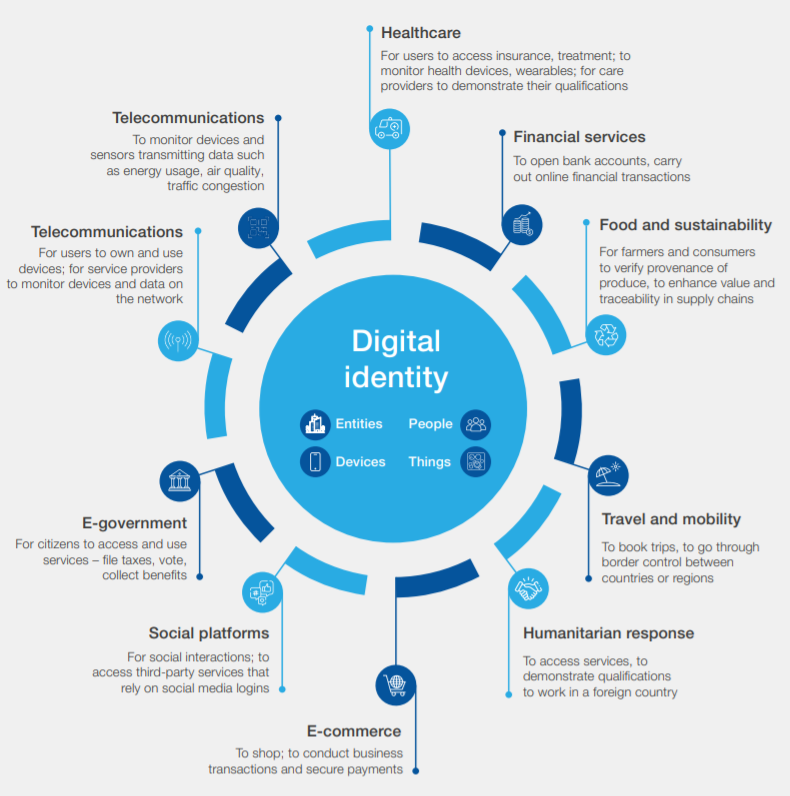
As we have previously reported, a full-fledged, government-backed digital identity system could end up touching just about every aspect of our lives, from our health (including the vaccines we are supposed to receive) to our money, to our business activities, our private and public communications, the information we are able to access, our dealings with government, the food we eat and the goods we buy.

As the now-infamous WEF infographic makes clear, life without digital identity could become very cumbersome indeed.

If governments like the UK’s, Australia’s and the EU are successful in imposing all-encompassing online age verification systems on their respective populaces, biometric-empowered digital identity could soon become our gateway card for using the Internet.

Digital identity systems are also a necessary prerequisite for the roll out of central bank digital currencies, as we have documented many times before. CBDCs are not only traceable forms of digital money, meaning they could be used to track who spends what, where, and when, but also programmable, allowing money to be restricted for specific uses. Expiry dates could also be imposed as well as accounts blocked based on user behaviour or location.

Inherently Exclusionary and a Potential Bonanza for Hackers

While often touted as a tool for social and financial inclusion, the reality is that digital identity systems are inherently exclusionary. As the World Economic Forum admits, while verifiable identities “create new markets and business lines” for companies, especially those in the tech industry that will help to operate the systems while hoovering up all the data, they also (emphasis my own) “open up (or close off) the digital world for individuals.”

As one FT reader wrote in the comments thread, “the basic idea is to make compulsory owning a smartphone and carrying it at all times.”

There are also major security concerns about all the additional data that would be harvested by and for the digital identity system. The UK has already suffered hugely costly data breaches in recent years, including the Afghan data leak whose total expected cost the government is currently unable to calculate but is likely to run into the billions.

As we warned in May, the government’s cavalier approach to security for its rapidly expanding digital governance and identity systems should be enough to give all UK citizens pause…

Read the full article on Naked Capitalism

US Expands Scope of Its (Fake) War on Drug Cartels to Colombia; Colombia Responds By Threatening to Stop Buying US Weapons

Is this the beginning of another US-sponsored coup?

The Trump administration is expanding its war on non-aligned, progressive governments in resource-rich countries in Latin America the drug cartels while making bad jokes about killing innocent fisherman in the Caribbean Sea, an area spanning 2.7 million square kilometres. Seeing the audience laugh at such a bad-taste joke gives an indication of why most Latin Americans are not exactly thrilled at the US’ newfound interest in neighbourly relations.

Following a US strike against a second small speed boat on Monday, this time allegedly holding three civilians, Trump bragged that there were “no boats in the ocean anymore,” and conceded that the fishing industry had been “hurt” as a result of US military actions in the Caribbean. Once again, his administration failed to provide a single shred of evidence that the incinerated occupants of the boat were drug traffickers.

On Tuesday, before departing for the UK, Trump told reporters that a third Venezuelan boat had been “knocked off,” without providing further details. He also cautioned that the same gung-ho approach to the so-called “war on cartels” could be extended to alleged land routes.

The Nicolás Maduro government has responded to the US’ escalating hostilities by accusing Washington of trying to goad Venezuela into a “major war” for oil-driven regime change ends. Caracas has also signed a new “strategic partnership treaty” with Russia that will expand the scope for political and economic cooperation between the two countries.

Venezuela’s Minister of Interior Affairs, Diosdado Cabello, claims that Venezuelan forces have dismantled an attempted false flag attack by the DEA aimed at framing Venezuela for drug trafficking and justifying US aggression:

There is no way of confirming these claims. However, one thing that is clear is that the US’ acts of summary murder in the Caribbean are intended as a warning, not just to Venezuela but to all non-aligned governments in the Latin America and Caribbean. Just as it did in the Middle East, the US government reserves the right to drone-strike anyone it deems a threat to US security.

This week, the Trump administration shone the spotlight on the left-leaning government of Colombia, its long-time vassal state, by decertifying the country as a drug control partner for the first time since 1997. In a memorandum to Congress, President Trump accused Bogotá, together with Afghanistan, Bolivia, Myanmar and Venezuela, of “failing demonstrably to meet its drug control obligations.”

In a statement, US Secretary of State Marco Rubio said:

Colombia’s been a great partner historically.  Unfortunately they have a president now that in addition to being erratic has not been a very good partner when it comes to taking on drug – the drug cartels.  So they just don’t meet the standard under his leadership.

I think we have willing partners.  If it was up to the military, the police – we’ve been working with them for decades.  It’s a great – good news story.  But they have bad leadership right now when it – especially on this issue of drugs.  But they can change.  They can be more cooperative.  And they can meet the criteria to get off the – get back on the list of certification.

From NPR:

Colombia, the world’s largest cocaine producer, is behind a record-breaking year for the global cocaine market, according to the United Nations Office on Drugs and Crime’s (UNODC) most recent annual report, published in June.

It found that from 2022 to 2023, the most recent year with available data, Colombia’s estimated cocaine yield rose by 50%.

Trump used the decertification announcement to personally criticize Colombian President Gustavo Petro, a former leftist rebel who has been at odds with the White House since a spat over deportation flights in January.

Petro has attempted to stem drug trafficking through crop substitution programs and negotiations with criminal organizations that have enjoyed little success.

“Under the erratic and ineffectual leadership of President Gustavo Petro, coca cultivation and cocaine production and trafficking by narco-terrorist organizations in Colombia has surged to unprecedented levels,” wrote Trump.

This is presumably the first step in Washington’s progressive demonisation of Colombia as a rogue government. The White House has so far stopped short of imposing sanctions on Colombia, preferring to grant its erstwhile vassal state a “national interest waiver” that preserves US aid and security cooperation.

South America’s Israel No More

Until not so long ago, Colombia was the US’ bestie in South America, and was even sometimes referred to as the “Israel of the region”, including by former Venezuelan President Hugo Chávez and former Bolivian President Evo Morales. It’s not hard to see why. From our June 21, 2022 post on the election of Colombia’s first left-wing president Gustavo Petro, “A Political Earthquake Just Took Place in Latin America“:

The US currently has seven formal military bases in Colombia, according to the Latin American Strategic Center for Geopolitics (also known as CELAG). Other reports I have come across suggest it has eight. However, a report (in Spanish) published by School of Americas Watch in April 2021 claims there are also dozens of so-called “quasi-bases” — which differ from formal bases in no other way than that they lack a formal lease agreement for use of facilities — scattered around the country, particularly in areas rich in mineral resources and/or close to Colombia’s border with Venezuela.

Since the year 2000 Colombia has received $13 billion of aid from the US, according to the Washington Office on Latin America. In recent years the US has further strengthened its military ties with Colombia. In 2017, Colombia became one of NATO’s global partners, and the Alliance’s first Latin American partner. The apparent benefits of being a global partner of NATO include interoperability with NATO forces as well as the opportunity to participate in NATO-led operations and missions around the world. As a matter of fact, Colombian forces already participated in Ocean Shield, NATO’s maritime operation to counter piracy off the Horn of Africa, in 2015, two years before becoming a NATO partner.

As CNN Español puts it, since the late ’90s Colombia has served as Washington’s most trusted ally in South America on national security and defence issues — aka the perfect vassal state. However, that began to change in June 2022, when the former M-19 guerrilla Gustavo Petro made history by becoming Colombia’s first left-wing president since the country won independence in 1819.

Tensions with Washington began to rise when Colombia became one of the first countries in the world to sever ties with Israel over its ongoing genocide in Gaza. That was in early 2024. Petro’s Colombia would also become one of the first — and for a long time, only — countries to impose economic sanctions on the Jewish state. Now, other nations, including Spain, Belgium and Slovenia, are finally doing the same.

Petro has also strengthened Colombia’s relations with China, even going so far as to sign Beijing’s Belt and Road Initiative and become a member of the BRICS’ New Development Bank, neither of which will have earned him plaudits in Washington.

“No More Glyphosate,… No More Dead Policemen”

One possible way for the Petro government to get back into Washington’s good books would be to revoke its recent suspension of key drug extraditions to the United States. In late June, it introduced a radical shakeup in the country’s extradition agreement with the US, so that drug traffickers who comply with government surrender conditions, lay down their guns and abandon the narcotics trade are not extradited.

But Gustavo Petro has shown little willingness to comply with Washington’s orders, arguing that it is the US’ insatiable demand for drugs, not Colombian supply, that is ultimately driving the recent surge in output. He also refused to bow to US pressure to readopt policies of forced substitution of crops, which often leads to widespread environmental destruction or bloody clashes between state security forces and drug traffickers.

“That’s over, no more dead policemen,” Petro said, adding that forced fumigation, “is a US policy that has failed”:

“In order to reduce coca leaf cultivation, what is needed is not glyphosate dropped from small planes, but a decrease in the demand for cocaine, mainly in the United States and Europe.”

This echoes arguments Petro used in his scathing critique of the US-led war on drugs from the podium of the UN General Assembly in New York in 2022. From our post, “The US-Led War on Drugs, Now in Its 51st Year, Just Hit a Major Snag in Colombia“.

Petro… blasted the indiscriminate use of glyphosate and other noxious chemicals used by previous governments to eradicate cocaine farms, leaving in its wake a vast trail of environmental destruction. Yet Colombia’s output of the illicit white stimulant has continued to grow despite the $13 billion Washington has splashed on eradication, policing and military programs in the country.

To destroy the coca plant they throw poisons, such as glyphosate, that drip into our water. They arrest the growers and imprison them. In the battle to destroy or possess the coca leaf, a million Latin Americans are murdered and two million Afro-Americans are imprisoned in North America. ‘Destroy the plant that kills,’ they shout from the north, but this plant is just one among the millions that perish when they unleash fire on the jungle.

The Nuclear Option

In response to the US’ decertification of Colombia, Petro appears to have opted for the nuclear option of ceasing all purchases of US-made weapons. In a bold move, Petro insisted that the Colombian army’s long-standing dependence on US weaponry will be brought to an end. He also announced that Colombia will begin to finance the purchase or production of weapons with its own resources.

“The dependence of the Colombian Army and its Military Forces on U.S. weapons is over. No more handouts or gifts. (…) The Colombian Army does better if it buys its weapons elsewhere or if we manufacture them with our own resources. Otherwise, it will not be an Army of national sovereignty.”

According to Petro, his government’s goal is to strengthen national sovereignty and reduce external influence over Colombia’s national defence strategy. Of course, while trying to do all that Colombia still has seven (or more) formal US military bases on its territory as well as all the other quasi bases.

At the same time, 11 opposition parties have published a communique denouncing Colombia’s deteriorating relations with Washington under Petro’s presidency and distancing themselves from his threat to stop buying US weapons:

The 11 parties that signed this statement express our firm rejection of President Gustavo Petro’s statements against the United States government, represented by President Donald Trump, following Colombia’s recent decertification in the fight against drug trafficking. The executive branch’s statements do not reflect the country’s position and constitute an insult to a nation that has supported Colombia in this effort for decades.

Former President Ivan Duque, a strong critic of Petro, wrote on X:

“As we warned so much, the Petro government was decertified by the U.S. for the dismantling of manual eradication groups, the exponential growth of illicit crops and the lowest seizures (of drugs) as a percentage of potential production in decades.”

This is ironic given that during Duque’s presidency (2018-22) cocaine production in Colombia soared by 50% to levels not seen since the days of Pablo Escobar in the 1990s.

Duque also had alleged ties to the now-deceased narco-linked cattle rancher José Guillermo Hernández, aka Ñeñe Hernández.

Even more important, Duque’s political mentor, Alvaro Uribe, who has arguably wielded more influence over Colombian politics this century than anyone else and was just found guilty of fraud and witness tampering. He was also listed among “important Colombian narco traffickers” by the DEA in 1991, 12 years before he became president and a “key US partner in the war on drugs”. From a 2004 document in the US National Security Archive:

Then-Senator and now President Álvaro Uribe Vélez of Colombia was a “close personal friend of Pablo Escobar” who was “dedicated to collaboration with the Medellín [drug] cartel at high government levels,” according to a 1991 intelligence report from U.S. Defense Intelligence Agency (DIA) officials in Colombia. The document was posted today on the website of the National Security Archive, a non-governmental research group based at George Washington University.

Uribe’s inclusion on the list raises new questions about allegations that surfaced during Colombia’s 2002 presidential campaign. Candidate Uribe bristled and abruptly terminated an interview in March 2002 when asked by Newsweek reporter Joseph Contreras about his alleged ties to Escobar and his associations with others involved in the drug trade. Uribe accused Contreras of trying to smear his reputation, saying that, “as a politician, I have been honorable and accountable.”

The newly-declassified report, dated 23 September 1991, is a numbered list of “the more important Colombian narco-traffickers contracted by the Colombian narcotic cartels for security, transportation, distribution, collection and enforcement of narcotics operations.” The document was released by DIA in May 2004 in response to a Freedom of Information Act request submitted by the Archive in August 2000.

The source of the report was removed by DIA censors, but the detailed, investigative nature of the report — the list corresponds with a numbered set of photographs that were apparently provided with the original — suggests it was probably obtained from Colombian or U.S. counternarcotics personnel. The document notes that some of the information in the report was verified “via interfaces with other agencies.”

President Uribe — now a key U.S. partner in the drug war — “was linked to a business involved in narcotics activities in the United States” and “has worked for the Medellín cartel,” the narcotics trafficking organization led by Escobar until he was killed by Colombian government forces in 1993. The report adds that Uribe participated in Escobar’s parliamentary campaign and that as senator he had “attacked all forms of the extradition treaty” with the U.S.

Stirrings of a Coup?

Could there be an even darker side to this unfolding story?

As we warned in mid-June, evidence was mounting that that a coup against Petro may be in the works. Petro himself certainly seemed to believe so, especially after Miguel Uribe Turbay, an opposition MP and potential presidential contender, was assassinated by a 15-year old sicario.

The hit bore echoes of the assassination of the journalist-turned-presidential candidate Fernando Villavicencio in the lead-up to Ecuador’s presidential elections in 2023. Villavicencio’s assassination was widely credited with galvanising support for the eventual election winner, Daniel Noboa, the US-born and raised son of Ecuador’s richest man, Alvaro Noboa, a banana magnate whose family business is accused of trafficking cocaine to Europe.

Noboa has not only designated drug cartels as terrorist organisations but also signed agreements with Washington for the reestablishment of US military bases in Ecuador after the country voted in a 2009 referendum to eject all foreign military bases. Pointedly, this week he issued a presidential decree officially designating Hamas, Hezbollah and the Iranian Revolutionary Guards as terrorist organisations.

In recent months Villavicencio’s widow has gone public with allegations that Ecuador’s Attorney General, Diana Salazar, pressured her into blaming Ecuador’s former left-leaning President Rafael Correa for the murder of her husband, which in turn helped to get Noboa elected.

As happened in Ecuador, the attempted assassination of Uribe Turbay created an atmosphere of fear and panic in Colombia, a country that has spent much of the past 100 years in a state of civil war. In our June article, we noted that the situation in Colombia was, as Lambert was wont to say, “overly dynamic”, as well as the fact this was not the first time that Petro had accused his opponents of plotting a coup against him.

As such, as we conceded in that post, our contention that Colombia could be witnessing the early stirrings of a coup was unavoidably speculative in nature.

Two or three weeks later, however, El País released leaked recordings revealing that Petro’s former foreign minister, Álvaro Leyva, had with met with advisors close to the Trump administration in order to drum up support for a coup against Petro. In the recordings Leyva could be heard saying he’d already drummed up support for coup from the Clan del Golfo, a prominent right-wing Colombian neo-paramilitary group and the country’s largest drug cartel.

A week later, the Colombian publication Revista Raya published the testimony of an alleged witness to Leyva’s discussions with US lawmakers. According to the witness, the first stage of the coup would involve disseminating rumours accusing Petro of uncontrolled drug abuse, which Leyva executed by writing three letters to media outlets.

Crucially, the next stage would involve US congressmen such as Mario Díaz Balart pressuring Donald Trump to decertify Colombia in the fight against drugs — a measure that, according to the witness, “would be fundamental for the transition of a new government that would be headed by Vice President Francia Márquez.” As Revista Raya notes, this would not be the first time the US used decertification as a tool of punishment against Colombia:

In the 1990s, the US decertified Colombia during the government of Ernesto Samper, alleging lack of cooperation in the fight against drugs. At the time, Washington denied the country access to financial resources and technical assistance, and included it in the list of “pariah nations.” The measure, far from being technical, was clearly political: the U.S. Congress used it to try to force the departure of Samper, who clung on in office but was marginalised from the international community.

The strategy drawn up and led by Leyva evokes that precedent. The aim, it seems, was to recreate a similar scenario of isolation, with economic, legal and diplomatic consequences, in order to force a transition of power without the need for impeachment or military intervention.

During Trump’s presidency, the threat of decertification this year has been repeatedly evoked. In January 2025, Juan Cruz, a former Trump adviser, said Colombia should prepare for that scenario. And in April, Kevin Whitaker, former US ambassador in Bogotá, was more direct, saying that if Colombia did not demonstrate concrete results, it would be punished.  

War on Drugs: The Gift That Keeps on Giving

As we have been saying since the very beginning of direct US hostilities against Venezuela over a month ago, this confected conflict has nothing to do with stemming the flow of drugs to the US and everything to do with furthering US strategic interests in the region…

Read the full article on Naked Capitalism

It Finally Happens: Spain Rebels Against Israel and Its Genocide in Gaza

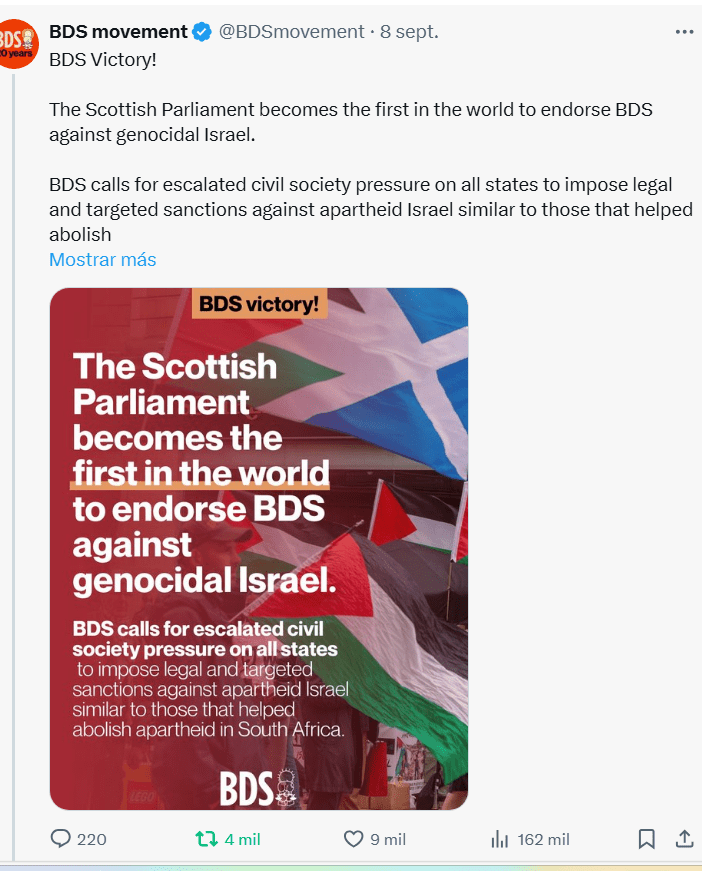
The BDS (Boycott, Divest and Sanctions) movement appears to be going from strength to strength. As with South Africa, it is largely a bottom-up process. 

Exactly a week ago, we reported on how Spain had become the fourth EU country to impose some form of sanctions on Israel over its ongoing genocide in Gaza (after Ireland, Slovenia and Belgium). The sanctions imposed include a ban on the purchase or sales of weapons, ammunition and military equipment from or to Israel. There is also a ban on Israel-bound ships and aircraft carrying weapons or fuel from calling at Spanish ports or entering Spanish airspace.

Since then, things have escalated rapidly. Over the past two weeks, thousands of protesters have disrupted key stages of the 90th edition of Spain’s La Vuelta cycling race due to the organisers’ decision to allow an Israeli team to compete. That team is sponsored by Israel Premier-Tech whose owner, Sylvan Adams, is close to Benjamin Netanyahu and has done everything in his power over the past decade to project a good image for Israel through cycling.

Before the event began, pro-Palestine movements made repeated requests to the organisers and the Spanish government to expel the Israeli team from the event to prevent Israel from being able to “sportswash” its image as it commits the worst of all war crimes. But they were ignored. So, they took matters into their own hands by disrupting the race at various stages, starting in Catalonia. The cycling-mad Basques also put some sticks in spokes.

But it was during the final stage, in and around Madrid, where the coup de grace was delivered. On Sunday, an estimated 100,000 demonstrators (according to the government) managed to bring the race to a grinding halt despite a massive mobilisation of riot police. The cyclists were eventually forced to stop around 60 kilometres from the finishing line. The mayor of Madrid and the president of the Community of Madrid, both fervent Zionists, were seething.

It is not hard to see this as history in the making. For the first time in a very long time, Israel has suffered a humiliating defeat at the hands of one of its Western allies. The people of Spain have finally said “basta” to the non-stop orgy of death and destruction taking place in Gaza. Just listen to the cacophony of noise ring out across Madrid’s streets and squares (you may want to turn the volume down):

Here they are chanting, among other things, “this is not a war, it’s a genocide”.

Spain’s Prime Minister Pedro Sánchez, to his immense credit, has responded to the events by praising the protestors and calling for Israel’s expulsion from all international competitions, becoming the first European leader to do so. He has also threatened to boycott Eurovision 2026 should Israel participate. He even addressed the elephant in the room since October 7, 2023 — the EU’s glaring double standards over Israel when compared to Russia:

“Why was Russia expelled after the invasion of Ukraine, but Israel is not expelled after the invasion of Gaza?”

Here’s the full subtitled clip:

As we pointed out last week, Spain’s government has been slow to act, but at least it is now acting — unlike some:

Granted, the Sánchez government had little choice in the matter: pro-Palestine sentiment is strong across a broad cross-section of Spanish society, with 82% qualifying Israel’s acts in Gaza as genocide, according to a recent survey. Plus, Sánchez is facing myriad scandals at home and appears to have decided, wisely, that the Gaza crisis makes for a useful diversionary tactic, especially given the opposition’s unwavering support for Tel Aviv.

Whatever one might say about Sánchez, he is an innate political survivor. Since heading his first broad-based — or as some called it, Frankenstein — government in 2018, he has steered Spain through seven years of multiple crises (the fallout from the Catalan independence movement, the COVID-19 pandemic and its aftermath, surging inflation…) and, more recently, modest economic growth, even outlasting most of his EU peers.

Also, to his credit, he was one of the first EU leaders to criticise Israel for its indiscriminate bombing of Gaza, which he did back in November 2023, just one month into the genocide. It then took his government another six months to recognise Palestine but at least it did it. At the same time, his government continued to buy and sell weapons to and from Israel.

He has also been pushed into taking many of these actions by the sheer strength of opposition to Israel’s genocide in Gaza among both the Spanish public and his coalition partners. In a new interview Irene Montero recounts how in the early days of Israel’s assault of Gaza, Sánchez would bristle each time she and her fellow minister at the time, Ione Belarra, used the word “genocide” in public:

“When this genocide began, Ione Belarra and I were still ministers in the Spanish government. And one of the biggest sources of frustration for Pedro Sánchez was the fact that we began calling this a genocide on the very first day. The Socialist Party at the time wanted no one to use the word “genocide” and asked us not to. There is a level of hypocrisy here — to be more concerned about not naming the genocide than trying to stop it…

When you say it’s a genocide it means you can do something about it at the institutional level, and that was something the Socialist Party did not want. Now that civil society is pouring onto the streets to demand the end of this genocide, it has forced the government to shift position — or at least commit to doing something so that it can be seen to be taking action, even though there is a lot more it can do.

That all being said, at least someone in the collective West is doing something. Former French prime minister Dominique de Villepin says Spain is “saving Europe’s honour” (or what little is left of it. As readers may recall, de Villepin gave a historic speech at the UN Security Council, voicing France’s opposition to the United States’ military intervention in Iraq. He is also a fierce critic of Israel’s actions in Gaza. From El Independiente:

“We would like French diplomacy; we would like France to be more active, to be able to take initiatives, either by denouncing the association agreement with the Europeans, or by taking additional embargo measures as Spain does. Today, who is saving Europe’s honour in this region? Spain, not France,” De Villepin said in an interview on French public television Franceinfo

“In this sense, I consider that France is not up to the task. Spain has already recognised the Palestinian state along with other countries, such as Ireland and Slovenia. Therefore, it is clear that an effort must be made. Peace and justice are the two conditions for a new stability in this region. And this message must be conveyed to Benjamin Netanyahu and to all the Israeli people,” said the former French premier, whose statements in solidarity with Gaza have brought him back into the public spotlight after more than a decade out of active politics.

Last week, even the European Commission President Ursula von der Leyen announced some EU-wide sanctions against extreme Israeli ministers and violent settlers as well as the suspension of free trade with Israel during her annual “state of the union” speech to the European parliament in Strasbourg.

It is a sign that even some of Israel’s staunchest supporters in Europe are finally buckling under the weight of public and legal opinion as the genocide in Gaza approaches its two-year mark. As we previously reported, VdL has faced a barrage of criticism within EU institutions, including by the Commission’s chief diplomat, Josep Borrell, as well as in some European capitals, for her early unqualified support for Israel:

Following her visit to Israel in October, she was accused in a letter signed by 842 EU staffers of turning a blind eye to Israel’s war crimes in Gaza. The letter accused VdL of giving “a free hand to the acceleration and the legitimacy of a war crime in the Gaza Strip”. It also warned that the EU is “losing all credibility” as well as its status “as a fair, equitable and humanist broker,” while  ripping into VdL’s “patent” double standards over what is currently unfolding in Palestine and events in Ukraine.

In early May, Borrell laid into his boss for ignoring a request lodged three months earlier by the governments of Spain and Ireland to conduct a thorough review of the EU’s trade agreement with Israel due to human rights violations in the Gaza Strip. Spanish President Pedro Sánchez and the-then Irish Prime Minister, Leo Varadkar, sent a letter to the EU Commission president in February proposing a reconsideration of the association agreement, which includes among its clauses the possibility of suspending the agreement’s terms if international law is breached. But instead of suspending the agreement, VdL promoted closer EU-Israel cooperation.

It is not just her EU colleagues or underlings accusing VdL of complicity in war crimes. On May 22, two European human rights organisations — the Geneva International Peace Research Institute (GIPRI) and the Paris-based Collectif de Juristes pour le Respect des engagements internationaux de la France (CJRF) —  and a group of “international concerned citizens”, submitted a legal brief to the ICC Chief Prosecutor Karim Khan requesting the opening of an investigation into the EU Commission president for her complicity in Israel’s war crimes against Palestinian civilians in the Occupied Palestinian Territories, including the Gaza Strip.

Here’s the Spanish MEP Irene Montero (Podemos) tearing into VdL’s criminal inaction over Gaza at the European parliament:

As the UN Special Rapporteur on the Occupied Palestinian Territories noted, Von der Leyen’s partial U-turn last week was simply “too little, too late”:

Given the speed and scale of the slaughter in Gaza, time is of the essence. A new report, by Doctor Gideon Ploya and Prof. Richard Hil, suggests that as many as 680,000 Palestinians, including 479,000 children, may have lost their life…

Continue reading on Naked Capitalism

As US’ Case Against Venezuela Unravels, Trump Administration Escalates Its War Footing Anyway

The escalation, as we’ve argued, has nothing to do with the drugs trade and everything to do with Venezuela’s huge deposits of oil, gas, gold and other minerals.

The Donald J Trump administration is, not for the first time, on a mission to topple the Nicolás Maduro government in Venezuela. And it’s willing to use whatever means necessary, including wanton murder on the high seas. However, serious doubts are being raised about the legality of its actions — including, interestingly, by some mainstream media outlets.

On Wednesday, the New York Times published an article outlining how the Venezuelan speed boat allegedly destroyed (as far as I’m aware, Venezuela’s Maduro government still questions the veracity of the video) by US missiles in the Caribbean last week “had altered its course and appeared to have turned around before the attack started”:

´[T]he people onboard had apparently spotted a military aircraft stalking it, according to American officials familiar with the matter.

The military repeatedly hit the vessel before it sank, the officials added, speaking on the condition of anonymity to discuss a sensitive matter. President Trump has said he authorized the strike and claimed the boat was carrying drugs.

The disclosures provide new details about a military operation that was a startling departure from using law enforcement means to interdict suspected drug boats. Legal specialists who have called it a crime to summarily kill suspected low-level smugglers as if they were wartime combatants said the revelations further undercut the administration’s claim that the strike was legally justified as self-defense.

“A Novel Argument”

So far, the Trump administration has presented no evidence to corroborate its claims that the 11 people on board the boat were transporting drugs heading to the US and were part of a Venezuelan gang, Tren de Aragua.

NC readers with basic knowledge of boats have already trashed that idea, pointing out that such a small vessel could never make it even close to Florida (h/t KLG). Recent revelations suggest that the boat was actually heading to Trinidad and Tobago, and could have been carrying drugs, other smuggled goods, fishermen or migrants.

We will probably never know since all the physical evidence has been vaporised.

Instead of providing a detailed legal rationale for its actions, the Times notes, the Trump administration has “put forward the outlines of a novel argument that using lethal military force was permissible under the laws of armed conflict to defend the country from drugs because 100,000 Americans die annually from overdoses.”

This may be enough to sway some, perhaps even many, in the MAGA base, for whom the US’ opioid epidemic is, understandably, an important issue. But that does not make it legal. As Nick Turse reports for The Intercept, the lethal strike was a criminal attack on civilians, according to a high-ranking Pentagon official who spoke on the condition of anonymity.

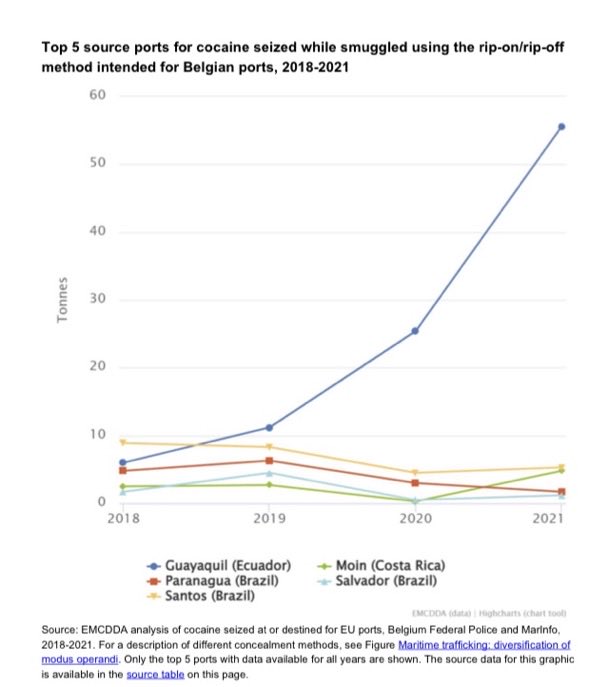
As we have documented in previous posts (herehere and here), Venezuela is a relatively small-part player in the drug trafficking business. Over 85% of the world’s cocaine supply is transported via the Pacific, from ports in Colombia, Peru and Ecuador. Meanwhile, Trump’s own claims that the Tren de Aragua gang is under Maduro’s control is contradicted by a declassified Department of Justice report.

More important still, almost all drug deaths in the US are caused by fentanyl, not cocaine, and Venezuela does not even feature as a manufacturer or transit country for that drug. In other words, the US could launch all-out war on Venezuela’s drug traffickers — and visit all manner of death and destruction on the country itself — and barely save an American life.

The Ecuadorian Connection

These days, the world’s leading exporter of cocaine is Ecuador, which is only a transit country and whose government is one of the US’ closest allies in the region.

Imagen

Ecuador’s US-born and raised president, Daniel Noboa, is the heir to a banana empire exporting $3.5 billion annually. As we have reported before, subsidiaries of the Noboa Corporación have been caught trafficking hundreds of kilos of cocaine to Europe via its banana shipments between 2020 and 2024:

According to an investigative report by the magazine Raya, Noboa Trading Co., a banana producing and trading firm belonging to the Noboa family, one of the richest in the country, has been caught on three occasions concealing hundreds of kilos of cocaine in cargos of bananas destined for Europe.

This is the way by which much, or even most, of the cocaine transported from Ecuador reaches Europe: through the banana trade. Although the police seized the shipments in flagrante delicto, those allegedly involved, including members of the Noboa family, have not faced justice. From Progressive International:

“Part of the investigation was revealed last weekend by Ecuadorian journalist Andrés Durán, who, after disclosing several official documents containing reports on the drug seizure, had to leave the country due to death threats and legal harassment from the ruling political party, Movimiento Acción Democrática Nacional (ADN).

In an interview with Revista RAYA, Durán spoke about his investigation and his departure from Ecuador:

“This is the first documented case in Ecuador’s history in which a presidential family is allegedly involved in cocaine trafficking. The Noboa family controls the entire chain of the banana export business, from planting and harvesting to transportation and private ports. There is no doubt that the death threats are closely linked to this investigation.”

During his recent visit to Ecuador, US Secretary of State Marco Rubio, an Ecuadorian journalist points out the inconvenient fact that Ecuador, not Venezuela, is the main transit route for cocaine trafficking, as documented by the UN’s annual drug report. Rubio responding by saying he doesn’t care what the UN says.

Here’s a cartoon that nicely sums up the situation: the US drops a bomb on a tiny fishing boat while four massive ships sail on by unimpeded. The one on the far left represents the US and Western banks that launder the proceeds of drug trafficking; the one next to it, Ecuador’s banana consignments; the one next to that, the transnational drug cartels; and the one on the far right, the US’ insatiable demand for narcotics.

In recent days, the Grayzone has delved into the CIA’s historic ties with drug trafficking generals — the supposed founders of what came to be designated as the Cartel de los Soles — back in the 1990s:

Here is the original 60 Minutes episode on the fallout from the quickly buried and forgotten scandal:

Congress MIA

Meanwhile, the US Congress is once again missing in action as another military misadventure looms, this time in the US’ “backyard”. However, there are a few grumblings of disquiet, mainly from Republican Party members, as Connor Echols reports for Responsible Statecraft:

The rapid escalation seems to have put Congress on the back foot. While many lawmakers moved quickly to condemn Trump’s attacks on Iran earlier this year, strikingly few members of Congress have shown the same level of enthusiasm when it comes to Venezuela.

Responsible Statecraft reached out to 19 congressional offices about the campaign but only heard back from Rep. Adam Smith (D-Wash.), who simply shared a statement asking a series of questions about the goals and legality of the strike. (Smith later used stronger language, accusing Trump Thursday of trying to start “a war with Venezuela.”)

A smattering of other lawmakers have put out statements condemning the strikes. Rep. Chuy Garcia (D-Ill.) lamented that Trump launched the campaign without congressional authorization and called on Congress to act in order to avoid a new “forever war.” Sen. Rand Paul (R-Ky.), for his part, told Newsmax that “it isn’t our policy just to blow people up.” But Sen. Tim Kaine (D-Va.), Sen. Bernie Sanders (I-Vt.), Rep. Ro Khanna (D-Calif.) and Rep. Thomas Massie (R-Ky.)—all of whom often rail against presidents for starting conflicts without consulting Congress—have so far stayed silent on the issue.

While they stay silent, the US’ executive branch continues to escalate.

Puerto Rico is now a key staging area in the US’ military manoeuvres in the Caribbean, with the US sending 10 F-35 fighter jets and the USS Iwo Jima to the island, which is neither a sovereign nation nor a US state. During Hegseth’s visit, Puerto Rico Gov. Jenniffer Gonzalez (Rep) tweeted:

We thank @POTUS Trump and his Administration for recognizing the strategic value Puerto Rico has to the national security of the United States and the fight against drug cartels in our hemisphere, perpetuated by narco-dictator Nicolas Maduro. We are proud to support America First policies that secure our borders and combat illicit activities to protect Americans and our homeland.  

While on board the USS Iwo Jima on Monday, Hegseth told the ship’s crew:

“What you’re doing right now – it’s not training. This is the real-world exercise on behalf of the vital national interests of the United States of America to end the poisoning of the American people.”

Another Decapitation Strike?

Later on, Hegseth was asked by Fox and Friends whether the end goal is regime change in Venezuela, to which he responded that the Pentagon is “prepared with every asset that the American military has” should Trump choose to move forward with such an operation. Trump, for his part, has rejected the notion that the troop deployment’s are aimed at regime change while refusing to rule out targeted strikes against cartels inside Venezuela. 

Asked by a reporter if he was considering attacking “cartels” inside Venezuela, Trump responded ambiguously, saying only, “Well, you’re going to find out.”

Given the size and sophistication of the forces being deployed to the Caribbean, regime change is clearly the goal…

Continue reading on Naked Capitalism

Spain Becomes Fourth EU Country to Announce Sanctions Against Israel: Beginning of a Trend?

Too little, too late? Yes, but surely better than nothing — unless, of course, it’s pure virtue signalling. 

Israel is beginning to learn that committing all manner of war crimes, including genocide, against a civilian population on a constant basis for almost two years eventually comes at a price. The country’s economy is experiencing what 130 of its top economists describe as a “spiral of collapse.” In the 50-country Nations Brand Index, Israel came rock bottom

As it continues to escalate its genocide in Gaza and its war crimes on the West Bank and other parts of the Middle East, some governments in Europe are finally, at long, long last, beginning to say “¡Basta!” Popular movements throughout the world have been hollering that word since Israel began its horrific pogrom in Gaza 23 months ago, many of them risking arrest.

That was followed by this:

Which was then followed by this:

On Saturday night, an estimated 180,000 people gathered in Mexico City’s Zócolo for the concert of Calle 13’s lead rapper, Residente. Led by a tearful Palestinian girl, ear-splitting chants of “Viva Palestina” and “Palestina Libre” rang out across the gargantuan square. Standing next to the girl and Residente was Palestine’s ambassador to Mexico, Nadya Rasheed.

In recent weeks, dockworkers in France, Italy and other countries have refused to load any arms components bound for Israel. As Labor Notes reports, this was no one-off protest:

It built on a decades-long tradition of internationalism, anti-militarism, and anti-imperialism among European dockworkers, including coordinated actions to block weapons to Saudi Arabia in 2019.

In the past week, Italian dockworkers have threatened to “shut down all of Europe” and block all shipments to Israel if communication with the latest aid flotilla bound for Gaza is lost. Speaking at a protest in the port of Genoa on behalf of the Unione Sindacale di Base (USB), a syndicate of various grassroots unions in Italy, a dockworker said:

If we lose contact with our boats, with our comrades – even for just 20 minutes – we will shut down all of Europe. Our young women and men must come back without a scratch, and all this cargo, which belongs to the people and is going to the people, must reach its destination, down to the very last box. 13,000-14,000 containers leave this region every year for Israel. Not a single nail will leave anymore.

On that Freedom Flotilla:

Over the past weekend, Spain’s foreign minister José Manuel Albares said he would support expelling Israel-Premier Tech from the Vuelta a España cycling tour after the Israeli cycling team was targeted by pro-Palestinian demonstrators who disrupted the race. In addition, a Spanish chess tournament this week reportedly banned Israeli players from competing under their national flag, before reversing its decision.

The BDS (Boycott, Divest and Sanctions) movement appears to be gathering steam with each fresh Israeli assault on Gaza, despite all the desperate attempts to suppress it on both sides of the Atlantic. Just as happened in Apartheid South Africa, it is Israel’s own vile actions that are driving the success of BDS.

Spain Imposes (Partial) Sanctions on Israel

On Monday, Spain became the fourth EU country to impose sanctions on Israel, after becoming one of the first Western European countries to recognise Palestine last year. The country’s prime minister Pedro Sánchez said Spain must be on the “right side of history”:

The government of Spain believes it is one thing to protect your country, protect your society and quite another to bombard hospitals and starve innocent children to death. What PM Netanyahu presented in October 2023 as a military operation in response to the atrocious terrorist attacks by Hamas has ended up turning into another wave of illegal occupations and an unjustifiable attack against Palestine’s civilian population — an attack that the UN Special Rapporteur and other leading experts have qualified as “genocide”.

The sanction measures adopted include the “legal consolidation of an arms embargo on Israel that has been applied de facto since October 2023”, reports El País. Some have contested this claim, including ourselves. A study by the Delàs Centre holds that Spain has bought arms from Israel worth more than $1 billion since the start of the Gaza offensive, while the government has claimed that some of the contracts included in that list were suspended.

Spain “will be banned from buying or selling weapons, ammunition and military equipment from/to Israel”, Spanish PM Pedro Sánchez announced on Monday morning. From the wording, it seems that the ban will not extend to IT security products, of which Israel is a global leader.

The sanctions package also prohibits Israel-bound ships and aircraft carrying weapons or fuel from calling at Spanish ports or entering Spanish airspace. This prohibition was already de facto in place: Spanish authorities have prevented the stopover of Israel-bound ships on at least three occasions in the past year, which even prompted the US Federal Maritime Commission to open a sanctioning file against Spain.

Madrid has also imposed a ban on the “the entry into Spanish airspace of State-owned aircraft carrying defence material bound for Israel”. This is a measure aimed in practice at the United States, whose military aircraft or those chartered by the Pentagon regularly transport military equipment to Israel via Europe.

However, it may be difficult for Spanish authorities to enforce these bans on maritime vessels and aircraft given they currently do not inspect ships and aircraft that NGOs claim to be suspected of being involved in arms trafficking to Israel.

Madrid has also pledged to increase aid to the Palestinian authority and the UN Relief and Works Agency for Palestine Refugees in the Near East (UNRWA) as well as impose an embargo on goods made in Israeli settlements in the occupied Palestinian territories. It will also ban anyone who has participated directly in Israel’s “genocide” in Gaza from entering the country.

In response, Israel’s Foreign Minister Gideon Saar accused Sánchez of trying to divert public attention from his domestic corruption scandals and qualified his measures as “antisemitic”.
Tel Aviv has also banned Labour Minister (and Deputy Prime Minister) Yolanda Diaz and Youth Minister Sira Rego, both from left-of-centre junior coalition partner Sumar, from entering Israel.

One thing the Sánchez government has ruled out doing is to sever diplomatic ties with Israel, arguing that it would cut Spain off from dialogue not only with the government of Israel, but also with civil society groups that oppose Netanyahu and, above all, with the Palestinian Authority.

At the same time, this just happened yesterday (for some reason the insert function on twitter/X wasn’t working for this particular tweet):

That Makes Four

So far, four EU countries (out of 26) have announced the imposition of some form of sanctions on Israel: Ireland, Slovenia, Belgium and Spain. But to what extent will they actually impact Israel’s economy and ability to wage war?

Continue reading on Naked Capitalism

The US Is Looking to Merge Two Failed Wars in Latin America, the War on Drugs and the War on Terror

“All-out war in Venezuela cannot be ruled out”, warns Jeffrey Sachs. “Anything is possible because this is a long-standing operation.” 

In 2014, the Community of Latin American and Caribbean States (CELAC) declared Latin America and the Caribbean a “land of peace” based on respect for the principles and rules of international law. That peace is now in the process of being shattered by a US government determined to reimpose its strategic dominion over its direct neighbourhood, using a hybrid of the failed war on drugs and the failed war on terror as a pretext.

Ironically, it was during the early years of the Global War on Terror that Washington began to lose strategic influence in its “backyard,” as we noted in our 2021 post, “The US Is Losing Power and Influence Even In Its Own ‘Back Yard‘”:

China’s rise in Latin America coincided almost perfectly with the Global War on Terror. As Washington shifted its attention and resources away from its immediate neighbourhood to the Middle East, where it frittered away trillions of dollars spreading mayhem and death and breeding new terrorists, China began snapping up Latin American resources. Governments across the region, from Brazil to Venezuela, to Ecuador and Argentina, took a leftward turn and began working together across various fora. The commodity supercycle was born.

China’s trade with the region grew 26-fold between 2000 and 2020, from $12 billion to $315 billion, and is expected to more than double by 2035, to more than $700 billion… According to the World Economic Forum, “China will approach—and could even surpass—the US as LAC’s top trading partner. In 2000, Chinese participation accounted for less than 2% of LAC’s total trade. In 2035, it could reach 25%.”

The US is determined to reverse this trend. It is also intent on (in the words of former SOUTHCOM Commander Laura Richardson) “boxing out” China and Russia from Latin America’s resources, which it covets for itself. That is the real driving force behind Washington’s escalating hostile actions against Venezuela, which, lest we forget, is home to the largest oil reserves on the planet as well as many other mineral resources (gold, diamonds, iron ore, bauxite…).

Those actions include putting a $50 million bounty on Venezuelan President Nicolás Maduro’s head, designating two Venezuelan cartels, Tren de Aragua and the Cartel de los Soles, as terrorist organisations, Trump’s ordering of the US military to fight drug cartels abroad, and the deployment of eight military vessels, a submarine and air assets to waters near Venezuela.

On Tuesday, the US military upped the stakes by carrying out an alleged lethal drone strike against a small vessel that was allegedly transporting drugs from Venezuela.

From Venezuela Analysis:

During a press conference at the White House on Tuesday, President Donald Trump claimed the vessel “came out of Venezuela” and it was carrying “a lot of drugs.”

Trump later shared a video on his Truth Social platform that appeared to show a speedboat exploding at sea after being fired upon by a missile. Eleven people on board were reportedly killed instantly in the strike, which the US alleges took place in international waters within the US Southern Command’s “area of responsibility.”

“Let this serve as notice to anybody even thinking about bringing drugs to the United States,” Trump warned in his post.

According to the US government, the destroyed vessel belonged to the so-called “Tren de Aragua” gang, which was designated a “foreign terrorist organization” by the US in February. Washington alleges, without evidence, that the gang is led by Venezuelan President Nicolás Maduro. The “Tren de Aragua” was a prison-born gang and its operations inside Venezuela were dismantled in a raid in 2023.

In early August, Washington offered a US $50 million reward for information leading to Maduro’s arrest, claiming he is also linked to the so-called “Cartel de los Soles.” There has never been any disclosed court-backed evidence that proves the cartel’s existence, nor Caracas’ connection to any drug trafficking or transnational criminal activities.

According to an Insight Crime report, there is also no reliable evidence that “Tren de Aragua” ever grew to become a regional threat or a transnational drug trafficking outfit.*

The US has provided no evidence whatsoever that the people onboard the boat were trafficking drugs — we just have to take US President Donald Trump’s word for it. And that will presumably be the case going forward. It goes without saying that the US strike on the boat represents a clear violation of international law, but the same goes for just about all military operations undertaken by the US these days, including its complicity in Israel’s genocide in Gaza.

Of course, the US could have just intercepted the vessel and made its case against the alleged traffickers, but the problem with that is there probably wasn’t any case to be made.

Indeed, the Maduro government has responded to the alleged strike by claiming that the video is AI-generated, and that the attack never took place. As the US journalist Dan Cohen reports for pro-government Venezuela News, the claim has fuelled speculation that Washington is running an AI video experiment designed to test how easily public perception can be manipulated as well as how far AI video technology has come.

One thing that is clear is that this is just the beginning of the US’ remilitarisation of the Americas. US Defence Secretary Pete Hogseth said the strike was the start of “a long-term operation in the Caribbean that will take place by land, sea and air” — this despite the fact that the Caribbean is not nearly as important an area for drug trafficking as the Pacific.

“Is This a Joke?”

US Secretary of State Marco Rubio has said that military strikes on alleged drug traffickers will “happen again”, batting away concerns over the legality of such strikes and the sovereignty of Latin American nations. Speaking at a press conference in Mexico City Wednesday, Rubio pledged to continue to coordinate on security matters with countries like Mexico, but suggested the US would not hesitate to take unilateral measures.

On Thursday, Rubio was in Ecuador meeting with the country’s President Daniel Noboa. Ecuador is cooperating very closely with the US on security and intelligence matters. In 2023, the FBI even participated in the investigation of the assassination of the presidential candidate of Fernando Villavicencio in 2023. Today, the US is considering reopening a military base in Ecuador, a country that voted in a 2011 referendum to close all foreign military bases.

Yet despite all the military and intelligence support from Washington, the violence has only worsened in Ecuador while cocaine trafficking has increased — just as happened in Colombia and Mexico following the signing of the Plan Colombia and Merida Initiative security arrangements. Meanwhile, Noboa and his family’s banana business are accused of involvement in the export of more than half a ton of cocaine since 2020 to several countries in Europe.

As was painfully clear from day one, Trump’s appointment of Rubio as secretary of state and his acting national security advisor, making Rubio arguably the most powerful sec state since Henry Kissinger, could only bode ill for Latin America. In an article cross-posted here, Medea Benjamin and Nicholas Davies pointed out that “Rubio’s disdain for his ancestral home in Cuba has served him so well as an American politician that he has extended it to the rest of Latin America”:

He has sided with extreme right-wing politicians like Jair Bolsonaro in Brazil and Javier Milei in Argentina, and rails against progressive ones, from Brazil’s Ignacio Lula da Silva to Mexico’s popular former President Lopez Obrador, whom he called “an apologist for tyranny” for supporting other leftist governments.

In Venezuela, he has promoted brutal sanctions and regime change plots to topple the government of Nicolas Maduro. In 2019 he was one of the architects of Trump’s failed policy of recognizing opposition figure Juan Guaido as president. He has also advocated for sanctions and regime change in Nicaragua.

In March 2023, Rubio urged President Biden to impose sanctions on Bolivia for prosecuting  leaders of a 2019 U.S.-backed coup that led to massacres that killed at least 21 people.

In her book, “Corporate Coup: Venezuela and the End of US Empire,” the Gray Zone’s Anya Parampil details some of the incongruences in Marco Rubio’s rise to power, including his confected family history:

In 2011, the Washington Post revealed that Rubio had based his entire political coming-of-age story on a lie. Though he repeatedly spouted a clichéd south Florida tale of his parents’ escape from Fidel Castro’s socialist hellscape, immigration records demonstrated that the Rubios had in fact gained permanent US residency nearly three years before Cuba’s 1959 revolution — meaning they had actually fled thee regime of the country’s US-backed military dictator, Fulgencio Batista.

Aside from pathetic dishonesty, Rubio’s character was tarnished by revelations that throughout the 1980s, his brother-in-law, Orlando Cicilia, directed a $75 million cocaine smuggling ring out of his home in West Kendall, Florida.

Merging the War Against Drugs with the War on Terror

One of Trump’s first acts back in office was to officially designate eight Latin American drug trafficking groups as terrorist organisations. Six of them were Mexican (cártel de Sinaloa, cártel de Jalisco “nueva generación”, cártel del Noreste, la Nueva Familia Michoacana, cártel de Golfo and “Cárteles Unidos”), one of them Venezuelan (Tren de Aragua) and the other Salvadorian (Mara Salvatrucha, or MS-13).  

As feared, this move has opened the way to more aggressive, unilateral US military action in the countries affected: Mexico, El Salvador and Venezuela. Also, all property and interests in property of those designated as terrorist organisations that are in the United States or that are in possession or control of a US person can be more easily seized.

Since then, three more cartels have been designed terrorist organisations: the supposed Cartel de los Soles, of which Maduro is allegedly the leader (according to the US president), and two Ecuadorian cartels, Los Lobos and Los Choneros. This is a move that has been in the works for some time, as we reported in our Sept 26, 2023 post, “Back to Business As Usual: The US Is Once Again Vigorously Stirring the Pot in Latin America“:

Droves of high-profile figures, including arch neocon and regime change-specialist Lindsay Graham, presidential candidates Donald Trump and Ron de Santis, and media pundit Tucker Carlson, have been calling for direct, overt US military intervention against Mexico’s drug cartels in order to stem the flow of fentanyl.

In an op-ed for the Wall Street Journal in March, former Attorney General (under both George HW Bush and Donald Trump) William Barr likened Mexico’s “narco-terrorists” to Isis and called for “a far more aggressive American effort inside Mexico than ever before.” Barr also called AMLO the cartel’s “chief enabler” for refusing to wage war against the cartels with quite the same zeal as his predecessors.

Barr is hardly one to talk given his central role in burying evidence of then-President George HW Bush’s involvement in the “Iraqgate” and “Iron-Contra” scandals, the latter of which involved the trafficking of huge volumes of cocaine to the US by the Contras, as the hand-written notebooks of Oliver North, the National Security Council aide who helped run the contra war, amply show. Years later, courageous journalists like Gary Webb and Robert Parry would show that the CIA was also heavily involved in bringing crack cocaine into the US.

Back to today, it goes without saying that the real driving motivation behind the latest calls to expand the war on drugs is not to stem the flow of drugs into the US, or to tackle the escalating violence of drug cartels across Latin America — if Washington was serious about that, all it would have to do is pass legislation to stem the southward flow of US-produced guns and other weapons. But that would hurt the profits of arms manufacturers.

And if it was serious about tackling drug addiction, it would never have let Big Pharma unleash the opium epidemic in the first place. And once it had, it would never have let the perps walk free with the daintiest of financial slaps on the wrists.

No, this is primarily about what the US war on drugs has always been about: pursuing geopolitical and geostrategic dominance in key regions of the world while controlling and imprisoning for serious sums of money the restive populace at home. This is a point that is explained elegantly by Jorge Retana Yarto, a former director of the Intelligence School for National Security of Mexico’s Centre for National Intelligence (CNI), in an article for the news website Contralinea:

The ideology of the “war” on drugs and organized crime in the United States is an immense fabrication. That does not mean that the problems linked to the multinational trafficking of prohibited drugs and the criminal organizations that have specialized in it, and everything that this entails, do not exist. They exist and are very acute, but both phenomena were ideologized for the purposes of geopolitical and geostrategic dominance, and were imposed through exportable reactive and punitive public policies in matters of intelligence and security, causing social, political-institutional, cultural and economic devastation. By assuming a military dimension, (the War on Drugs) the foundations for armed intervention in the Latin American region were laid, converting the territories, as well as national sovereignties, into areas of geostrategic action.

“Vulgar, Thuggish and Illegal”

As Jeffrey Sachs explains in an interview with Hindustan Times, the US has been trying to topple Venezuela’s Chavista government for over 20 years, so far to no avail, though it has caused huge disruption and destruction in the process, including an economic collapse caused by US sanctions “that may literally be unparalleled in peacetime”.  As such, everything that is happening right now is “also part and parcel of ongoing US policy… It’s all flagrantly vulgar, thuggish and illegal…, and another of America’s delusions of hegemony”.

Like the Global War on Terror, the whole edifice of the US’ war on the drugs cartels, is built on a foundation of lies…

Continue reading on Naked Capitalism

UK Consumer Study Sounds Alarm About Security Risks of Mobile Wallets

As the problem of digital bank fraud grows, one issue that will become increasingly heated is who should pay for it.

This time last year, we discussed the recent explosion in digital fraud and theft, much of it targeting the digital wallets on mobile phones. As one would expect, the more cashless the country, the greater the scale of the problem.

Fortune magazine reported, perhaps somewhat hyperbolically, that going cashless had turned Sweden from one of the safest countries in Europe into a “high-crime nation“:

Law-enforcement agencies estimate that the size of Sweden’s criminal economy could amount to as high as 2.5% of the country’s gross domestic product.

To counter the digital crime spree, Swedish authorities have put pressure on banks to tighten security measures and make it harder on tech-savvy criminals, but it’s a delicate balancing act. Going too far could slow down the economy, while doing too little erodes trust and damages legitimate businesses in the process.

Using complex webs of fake companies and forging documents to gain access to Sweden’s welfare system, sophisticated fraudsters have made Sweden a “Silicon Valley for criminal entrepreneurship,” said Daniel Larson, a senior economic crime prosecutor.

Sweden’s central bank, the Riksbank, acknowledged in its 2024 payments report “serious fraud problems that could undermine trust in the payment system”. Digitalization also makes payments “more vulnerable to cyber attacks and disruptions to the power grid and data communication,” the central bank pointed out.

These developments suggested “that we should concentrate more than before on the challenges of digitalization.” Like the central banks of neighbouring Norway and Finland, the Riksbank is backpedalling plans for a cashless society, and has even begun urging citizens to hold and use cash in the name of civil defence and system resilience.

Meanwhile, Brazil, Latin America’s most cashless economy, is suffering an epidemic of digital crime, with 1,640 mobile phones stolen every hour, reported El País last year. The target is usually not the device itself but its applications, contacts and passwords, possession of which has helped Brazil’s criminal gangs to exponentially increase their profits. Each victim loses on average 1,500 reais ($275, just over the monthly minimum wage) in addition to the smartphone.

UK Raises Alarm

Now, the consumer magazine Which? has published a report warning about the rise of digital scams in the UK as fraudsters steal card details to set up a digital wallet on their own mobile devices. Worryingly, this can happen even if you don’t have a digital wallet of your own.

The root cause of the problem is banks’ continuing widespread use of one-time passcodes (OTPs) to set up digital wallets, even though they’re prone to abuse by fraudsters, as industry body UK Finance has repeatedly warned. The Which? investigation, which surveyed 15 high-street and digital banks, found that the majority are still using SMS OTPs to verify when a card is added.

As the report notes, victims are almost always reimbursed by the bank for any fraudulent payments made. However, the costs will probably end up being passed on to bank customers in general through higher interest rates on mortgages and loans, less generous account perks and lower interest on savings.

The researchers found that of the 14 providers that allow cards to be linked to Apple Pay, Google Wallet and other apps, only three do not depend on OTPs. Digital-only lenders Chase and Monzo confirmed they have never used them, while Starling has phased them out of Google Pay.

However, high street lenders like HSBC and Santander still issue OTPs via text messages, which leaves consumers reliant on a flawed system that fraudsters have become adept at exploiting. Here’s how the scam works:

Digital wallets can be very convenient and have security advantages compared to paying by card: namely, that you have to authorise every payment with your fingerprint or face.

But as you don’t need a physical card to add a card to a digital wallet, fraudsters could steal your card details and set up a digital wallet on their own phone.

They can then use this to spend your money online or in physical stores. Unlike physical contactless cards, which are typically limited to £100 per transaction, digital wallets have no arbitrary spending limit, making it easier for criminals to make large purchases.

Digital wallet fraud can occur during a takeover of an entire bank account, but another common method involves tricking you into giving up your debit or credit card details.

This often starts with a fake ad for a product or a phishing text or email, such as a bogus parcel delivery message. When you click the link, you are taken to a fake website that prompts you to enter your card details to complete a transaction.

The scammer monitors the website in real time. Once you submit your personal and card information, they receive it and use it to set up a digital wallet immediately.

As part of the setup, banks and providers must verify that you want to add your card to a digital wallet, and many send a one-time passcode (OTP) via text or email. The scammer’s fake website will then ask for this code, claiming it’s needed to authorise the payment you thought you were making.

In reality, the fraudster uses the OTP to complete the digital wallet setup on their own device. Once the digital wallet is set up, the fraudster can spend money from your account. You might not even know it has happened unless your bank notifies you, and research shows that some providers do not.

The Cost of Complacency

One of the most concerning findings of the report is the general complacency in the banking sector. Which? has been warning about the risks of OTP authentication for years yet many major banks, building societies and credit card companies are still using it as part of the digital wallet setup process.

The general mood of complacency also seems to extend to the broader population. According to a survey cited by Cityam, UK shoppers continue to prioritise convenience over safety when it comes to how they pay:

Among those who prefer mobile wallets, the primary driving force is speed, rather than security.

Nearly three-quarters cited convenience as their top reason for using them, and more than half pointed to faster transaction times…

Fraud experts warn that the latest wave of scams marks a new level of sophistication.

By exploiting OTPs, criminals can hijack digital wallets and drain accounts without ever needing to clone a physical card.

Once added to a wallet, stolen credentials can then be used to purchase goods in shops or online, often months after the original scam, to avoid detection.

Gift cards and supermarket vouchers are also common targets, allowing gangs to quickly launder stolen funds.

The recent explosion in digital fraud in near-cashless Sweden provides a cautionary tale of what can happen when mobile payment apps become the dominant form of payment at the point of sale… 

Continue reading on Naked Capitalism