Is Washington Trying to Build a “Coalition of the Willing” Against Venezuela?

Second question: does the “supposed” Cartel de los Soles actually exist?

Before we get to the meat of this article, which is really two articles in one, a quick recap (just in case some readers have been on a news-fast for the past three weeks).

A few months ago, the US government designated the “SUPPOSED” (more on that later) “Cartel de los Soles” as a terrorist organisation, of which Venezuelan President Nicolás Maduro is its alleged leader — alleged as in according to the US government. In early August, the Trump Administration offered a $50 million reward, up from $25 million, for information leading to the arrest of President Nicolás Maduro, accusing Venezuela of being a “narco state.”

Shortly thereafter, the US announced the deployment of a missile cruiser, a submarine, and three amphibious ships carrying 4,500 troops to the Caribbean, under the pretext of intercepting drug trafficking networks. There is no open talk of regime change though that is clearly the goal, as we noted in our post last Friday on the real reasons behind Washington’s latest show of force against Venezuela:

Anyone who believes or supports this latest pretext for war against a country the US has tried to regime change at least twice so far this century and which has been subject to more than a decade of crippling US sanctions is either exceptionally gullible or an apologist for empire.

The most important reason, of course, is oil. As the Mexican-Lebanese geopolitical analyst Alfredo Jalife says, Venezuela, once the “ranchito” of the Rockefeller family, is written with a capital “P” for “petróleo”. Indeed, even as Trump has ratcheted tensions with Venezuela, Chevron is still pumping out Venezuelan oil and shipping it back to the US.

Other possible reasons include Venezuela’s close ties to China, Russia and Iran, the US’ three most important strategic rivals. As we noted in that post, the build-up of troops could also be part of a diversionary tactic as the Trump administration continues to reel from the Epstein scandal. This being Trump, it could also be just pure bluff or bluster. But it could also be the beginnings of something far more serious: another US-led military disaster.

In recent days, the Venezuelan government has mobilised no fewer than four million army reservists to defend “la patria“. Venezuelan Defence Minister Vladimir Padrino López announced plans to reinforce the country’s anti-narcotics efforts through the deployment of military vessels and 15,000 troops to patrol the country’s “territorial waters.”

President Maduro said on Monday that all branches of Venezuela’s armed forces were prepared to defend the country. Thousands of civilians joined a voluntary militia enrolment drive in public squares over the past weekend.

At the international level, Venezuela’s Permanent Mission to the United Nations called on member states to demand an end to the US’ “hostile actions”. Some countries in the region, including Colombia, Mexico, Brazil and Bolivia, have expressed alarm about the US’ deployment of so much naval hardware so close to Venezuelan waters.

Russia, China and Iran have also voiced their support for Maduro in recent days. China is estimated to have poured around $67 billion into Venezuela since 2007 and has a keen interest in the country’s oil supplies, whose exports have been severely curtailed by US sanctions.

The 11 member nations of the Bolivarian Alliance for the Peoples of Our America (ALBA-TCP) unanimously condemned the US threat to regional stability. However, other governments in the region have sided with Washington and even offered up their land and waters for US troop movements.

France Joins the Ruckus

France has decided to join the ruckus by sending more ships to Guadeloupe, its overseas territory in the Caribbean. The Macron government claims its naval reinforcements are part of an international cooperation effort to regime change Venezuela against criminal networks in the area, and stressed the need to protect its overseas territories, in particular Guadeloupe and Martinique, which are often used as transit points for drug trafficking to Europe.

The move comes, ironically, as fears of a French government collapse send its borrowing costs soaring. In fact, one thing that all three of Europe’s largest economies, Germany, the UK and France, have in common is their growing financial pains.

Both France and the UK now have higher yields on their ten-year bonds than Spain and Greece, and there is even talk in both countries of the possible need for an IMF bailout. Meanwhile Germany’s Chancellor (and former BlackRock board member) Friedrich Merz has warned that Germany’s welfare state model is no longer sustainable. As Yves would say, quelle surprise!

Something else that unites the three countries is their governments’ determination to expand their military spending, at US insistence, despite their rapidly deteriorating finances. While French Prime Minister Francois Bayrou plans to freeze welfare payments, reduce pensioners’ benefits and abolish two national holidays, the one area where spending will dramatically increase is the military.

As the French government deplores the state of its finances at home, it is sending military vessels to the Caribbean to join the US’ latest act of imperial misadventure. Which invites the question: will other US client and vassal states in Europe and Latin America be doing the same in the coming days and weeks? Is the US trying to build a “coalition of the willing” against Venezuela, just as it did against Iraq, Afghanistan and Libya with such disastrous consequences?

There are certainly moves in that direction. Trinidad and Tobago’s recently elected right-leaning government last week expressed its support for the US naval operation, noting that organized crime and drug trafficking pose a direct threat to the security of the entire Caribbean. Desperate to court favours in Washington, the government also offered up its waters and territory for US operations against Venezuela if Washington requests them — to defend neighbouring Guyana, of course.

The Essequibo Border Dispute

For its part, the Guyanese government has also called for the strengthening of cooperation against transnational organized crime and narco-terrorism, in direct reference to the criminal organisation Cartel of the Suns. The President of Guyana, Irfaan Ali, said last Saturday that his country is willing to take actions to defend its territory and sovereignty in the “new environment”.

This is a reference to the escalating border dispute between Guyana (formerly British Guyana) and Venezuela over the Essequibo, a 160,000 square-kilometre oil-soaked territory that is on track to become Exxon Mobil’s largest single source of revenue by the end of this decade and which the US, unsurprisingly, would like to turn into a military outpost. For Guyana, the huge oil discoveries could end up being as much as curse as a blessing, as the NYT reported last year:

The deal that made [Exxon’s success] ´possible — and which gave Exxon Mobil the bulk of the proceeds — has been a point of public outcry and even a lawsuit, with a seeming consensus that Guyana got the short end of the stick. But the deal has nonetheless generated $3.5 billion so far for the country, more money than it has ever seen, significantly more than it gained from conserving trees. It’s enough to chart a new destiny.

But that new destiny has already included escalating tensions with its much larger neighbour, Venezuela, and risks turning Guyana into another disposable pawn in the furtherance of US geostrategic interests in its direct neighbourhood. As we warned in November 2023, this centuries-old dispute in an oil-rich corner of South America has the potential to become the next geopolitical flashpoint:

Essequibo is not only rich in oil and gas; it boasts other mineral deposits, including Gold and Bauxite, as well as huge fish stocks and fresh water supplies, which a government minister even recently talked about exporting to other countries. As the Commander of US Southern Command (USSOUTHCOM), General Laura Richardson, said in January, Latin America is home to 31% of the world’s fresh water.

But for the moment, it is Guyana’s vast untapped energy supplies that are of prime interest to US and global corporations. According to U.S. Geological Survey estimates, Guyana’s coastal area has roughly 13.6 billion barrels of oil reserves and 32 trillion cubic feet of gas reserves waiting to be drilled. For a country with one of the lowest population densities on the planet and a GDP of slightly less than $10 billion, a bonanza awaits. But Caracas contends that the untapped energy supplies belong to Venezuela and that the arbitration panel that granted Guyana jurisdiction over Essequibo was rigged.

A Meagre Coalition So Far

So far, four countries in the region have designated the Cartel de los Soles as a terrorist organisation: the United States, Ecuador, Paraguay and Argentina. My guess is that Peru will be next in line. Venezuelan opposition leader, María Corina Machado, has already said that she has “not the slightest doubt” that Peru, like other countries in the region, will join this latest US-led charge against the Maduro government.

However, as coalitions go, this one is pretty meagre. One country that is missing is Colombia, which has played a key role in previous regime change attempts, including Juan Guaidó’s risible coup attempt in 2019. However, since the election of left-leaning Gustavo Petro as president in 2022, Colombia has tried to replace its alignment with the US with multilateral relations, even going so far as to join the BRICS’ New Development Bank and China’s Belt and Road Initiative.

When Petro took the reins as president, diplomatic ties between Colombia and Venezuela were essentially on hold. Since then, relations have gradually been re-established. In recent months Petro has even proposed building a confederation of nations with neighbouring countries (Venezuela, Ecuador and Panama) based on the former Greater Colombia that existed between 1819 and 1931 and comprised the four aforementioned countries.

It will be very interesting to see how Colombia responds to developments in Venezuela. A few days ago, Maduro announced the movement of 15,000 troops to Venezuela’s border with Colombia earlier this week. Then yesterday (Aug 28), Gustavo Petro announced the movement of 25,000 Colombian troops to the other side of that border, which has been greeted positively by the Maduro government.

This border region has long been a focal point of violent clashes between government forces (on both sides), insurgency and paramilitary groups. Lest we forget, Colombia is trying to put behind it 52 years of civil war. However, political violence is once again rearing its ugly head. A few weeks ago, the opposition politician Miguel Uribe finally succumbed to the injuries he sustained in an assassination attempt in mid-June.

In addition, a car bomb was recently set off next to a military base in Cali and a police helicopter downed in the town of Amalfi. In total, 19 people were killed and 65 injured in the two attacks. The car bomb explosion in Cali has been described by local media as the “worst terrorist attack” in the country since 2019, when ELN guerrillas staged a car bomb attack against the General Santander police school, in the south of Bogotá, leaving 21 dead.

Both attacks were attributed to dissident factions of the now-extinct Revolutionary Armed Forces of Colombia, or FARC. President Petro described what happened as “a day of death.”

One can imagine Petro spending much of his time looking over his shoulder. Colombia is home to at least seven US military bases, and was until recently considered by many, including Hugo Chávez, as the Israel of Latin America. But Petro has tried to change that — first, by building alliances with other Global South countries, and second, by severing ties with Israel over its genocide in Gaza. In the process, he will have made lots of enemies, at home and abroad.

In July, audio recordings were released in which Petro’s former Foreign Minister Álvaro Leyva could be heard talking about organising a coup against the Petro government. Israel is also stirring the pot, as the veteran journalist Gonzalo Guillén warned in a tweet yesterday,

Benjamin Netanyahu’s regime and the far right in general are promoting an irresponsible and fallacious narrative: that Hezbollah terrorism is hiding on the border between Colombia and Venezuela. This claim, besides being completely unsubstsantiated and absurd, clearly aims to ignite the region and destabilise both countries.

This accusation is entirely baseless and has serious geopolitical implications. They seek to generate chaos, confrontation, and destruction.

Does the Cartel de los Soles Actually Exist?

This is a question NC reader Veronius asked in a comment to our previous post on Venezuela.

According to Gustavo Petro, the answer is a definitive “no”.

“It is the fictitious excuse used by the far right to overthrow governments that do not obey them,” Petro wrote on X earlier this week. In so doing, he opened up an intriguing can of worms. According to US government agencies, there is more than sufficient evidence tying senior Venezuelan army commanders and senior members of the Maduro government to drug trafficking.

But not everyone agrees. Even the former Venezuelan presidential candidate Enrique Capriles, who is certainly no friend of the Maduro government, has said in an interview with CNN (see below) that the US government needs to back up its claims with evidence.

We, Venezuelans, don’t know who is part of the Cartel de los Soles. I don’t have any information on that. I can’t provide it and I think the United States needs to present the evidence. Such a serious accusation requires putting the proof on the table. Who are the members of the Cartel de los Soles? Who runs it, where does it operate? But not just in rhetoric, show the evidence.

If the Cartel de los Soles does indeed exist, one thing is clear: it is not nearly as big a player in the global drugs trade as the Trump administration is making out — and certainly not as big a player as the US government itself…

Read the full article on Naked Capitalism

Even Libertarians and Austrian-School Economists Are Pillorying Javier Milei’s Economic Program

It makes a nice change to read scathing critiques of Milei’s disastrous economic program from the right as well as the left.

Argentina is scheduled to hold mid-term elections in a few weeks’ time, and Javier Milei’s government is once again in the spotlight for all the wrong reasons. As we reported a few weeks ago, the economy is back in crisis mode just months after receiving the first instalments of a $42 billion bailout package from the IMF, World Bank and Inter-American Development Bank — a bailout over which high-ranking IMF officials resigned or were fired for refusing to greenlight.

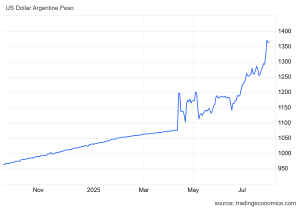
In July, the Argentine peso posted its worst month since Milei devalued it in December 2023. In recent days, JP Morgan Chase has cut its 2025 growth forecast for the Argentine economy for 2025 from 5.3% to 4.7%. That came on the heels of a slowdown in the second quarter of this year. The latest reports suggest that economic activity shrank in July (on a month-by month basis) for the fifth consecutive month.

Another Looming Default?

Ten days ago, the government tried to roll over bonds by offering investors what should have been a mouth watering 69% interest rate, yet only succeeded in rolling over 61% of them. As the Palestinian-Jordanian libertarian economist and prominent Bitcoin advocate Saifedean Ammous notes, the fact that “even a 69% annual interest rate isn’t enough to tempt investors to risk lending to the Milei ponzi… means they either expect a default very soon, or they expect price inflation to exceed 69% over the next year.”

If the peso continues to plunge, inflation could once against surge (it’s still at 36% annually). Meanwhile, unemployment is at a four-year high. Car sales continue to slide while industrial production shows no sign of recovering from Milei’s chainsaw austerity, with output levels at their lowest since 2007.

A new study by the Faculty of Economic Sciences of the University of Buenos Aires suggests Argentina has “lost its lure” among multinational companies and foreign investors. For all the promises of foreign money pouring into the country, the reality has been quite the opposite. Now that the government has lifted capital controls, at the IMF’s insistence, the money is flowing the other way.

Perhaps unsurprisingly, distrust in the government is on the rise, reports Perfíl. According to one survey, almost seven out of 10 (67%) Argentines say they do not believe that the government’s official inflation figures reflect their true cost of living.

Ripping Off the Disabled

That distrust is almost certain to have grown in recent days with the eruption of yet another sordid scandal involving senior Milei officials. Last week, audio recordings leaked to local media purporting to show Diego Spagnuolo, President Milei’s personal lawyer and the head of the country’s disability agency, describing a kickback scheme tied to government health contracts for the disabled that funnelled money to top officials, including Milei’s own sister, Karina.

Other alleged participants in the scheme include Eduardo and Martín Menem, two nephews of the former President Carlos Menem who both hold senior roles in Milei’s government. As readers may recall, Carlos Menem was the man whose neo-liberalisation of the Argentine economy and harebrained one-to-one peg of the Argentine peso to the dollar helped pave the way for Argentina’s 2001 default and resulting IMF bailout.

That, in turn, set the stage for bank runs, the subsequent harsh restrictions placed on bank account withdrawals (in dollars) — the so-called “corralito” — and the inevitable devaluation that ended up wiping out the savings of millions of Argentines. Of course, before the restrictions came into effect, foreign investors, political insiders and Argentina’s business elite were tipped off, allowing them to get their money out of Dodge.

It is not hard to see the same happening in the coming months, probably shortly after the mid-term elections. All the pieces are certainly in place. Once again, an IMF bailout will be used to subsidise capital flight so that Argentina’s wealthiest businesses and citizens can yank their money out of the country before the currency collapses — all on the government’s tab.

Readers may also recall that one of Milei’s campaign pledges was that he would do away with Argentina’s political caste, just as Trump pledged to drain the swamp in Washington. It would be the elite, Milei said, not ordinary working people, who would bear the brunt of the structural adjustments needed to transform Argentina into a viable, flourishing economy.

It was a lie, of course. Many of Argentina’s political elite ended up filling senior government roles in Milei’s government, including Luis Caputo, the former JP Morgan Chase banker who helped create the conditions for Argentina’s 2018 default.

As always, it is the poor and middle classes, particularly those of pension age, that have borne the brunt of the economic pain, all of it applauded by the IMF and Western media…

Continue reading on Naked Capitalism

What Are the Real Reasons Behind Washington’s Latest Show of Force Against Venezuela?

The US Empire’s drums of war are once again beating loud and hard in Latin America.

Three US destroyers equipped with the Aegis system, a defence technology designed to track multiple targets and neutralise air or sea threats simultaneously, will be arriving off the coast of Venezuela in the next couple of days, according to reports by Reuters. They will be accompanied by 4,000 troops, surveillance planes and a submarine in what is by far the largest ever show of force the US has mustered against Venezuela’s Chavista government.

The ostensible casus belli of this military operation is to take down drug trafficking organisations in Latin America, now classified by the White House as narco-terroristas. They include Venezuela’s Tren de Aragua and the Cartel de los Soles, which according to Washington has close ties to the Maduro government.

Needless to say, anyone who believes or supports this latest pretext for war against a country the US has tried to regime change at least twice so far this century and which has been subject to more than a decade of crippling US sanctions is either exceptionally gullible or an apologist for empire.

That is not to say that Maduro or elements within his government are not engaged in drug trafficking — though the US is, to my knowledge, yet to present any evidence supporting that — but rather that this has little, if anything, to do with the US’ latest escalation in what is now a years-long simmering conflict.

An Old, Tired and Poorly Written Script

This latest escalation began around two weeks ago with US Attorney General Pam Bondi’s announcement of a $50 million bounty for information leading to Maduro’s arrest, up from $25 million. Erik Prince, the shadowy founder of the disgraced mercenary firm Blackwater whose name has changed so often it’s hard to keep up, followed up by tweeting: “Should be dead or alive.” It is an old, tired and increasingly poorly written script:

The news of the deployment, reported by CNN, was later corroborated by White House press secretary Katerine Leavitt. Asked if the new operation might include the landing of troops on Venezuelan shores, she replied that the US was considering “using all its power” to stem the flow of drugs from Venezuela to the United States, and insisted that Venezuelan leader Nicolás Maduro is the head of a cartel, as well as an illegitimate ruler.

This must be a sweet moment for US Secretary of State Marco Rubio, who has been dreaming of regime change in Venezuela, as well as Cuba and Nicaragua, for as long as he has been in politics.

On August 14, Rubio confirmed the deployment of US naval and air forces in the Caribbean Sea in what he described as an effort to combat drug cartels that are “utilizing international airspace and international waters” to transport drugs to the US.

From Venezuela Analysis:

The deployed US sailors and marines are assigned to the Iwo Jima (IWO) Amphibious Ready Group (ARG) and the 22nd Marine Expeditionary Unit (MEU) Special Operations Capable (SOC). Both units are trained and equipped to conduct quick global missions to accomplish US strategic goals. They are not anti-narcotics units.

At a press conference, Rubio identified as a primary target the so-called “Cartel de los Soles,” which Washington alleges is led by Maduro and other high-ranking Venezuelan officials intent on “flooding” the US with narcotics.

“The Cartel de los Soles is one of the largest criminal organizations that exists in the hemisphere. It is indicted in the federal courts of the United States,” Rubio said. He added that the US does not recognize the Maduro government, calling it a “criminal enterprise” that threatens US national security and oil interests in Guyana, referencing Exxon Mobil’s operations in the disputed Essequibo region.

Of course, this has about as much to do with combatting the narcotics trade as the wars in Iraq, Syria, Libya and Afghanistan had to do with combatting Islamist terrorism.

After all, the US is arguably the largest enabler of drug trafficking organisations on the planet while it wages a Global War on Drugs, just as it has been arguably the largest supporter of Islamist terrorist organisations while waging a Global War on Terror. Both types of organisations have proven to be useful allies in the pursuance of US imperial ambitions (e.g. the Colombian and Mexican cartels during Nicaragua’s Contra insurgency in the 1980s, or the Al Qaeda offshoots in Syria) while also serving as handy pretexts for military intervention.

The Real Reasons

The Venezuelan government is under no illusions about the US’ real goals. Venezuela’s Defence Minister Vladimir Padrino Lopez said that the United States wants to “force regime change” in the South American country — a goal it has been seeking for over two decades, since the failed right-wing coup against Chavez in 2003. And let’s not forget the farcical attempted coup by Trump’s hand-picked “interim leader” for Venezuela, Juan Guaidó, in 2019.

It is not hard to see why the US wants regime change in Venezuela:

It is not just that Venezuela has more oil under its soil and sea than any other country; it is the fact that it is located slap bang in the US’ direct neighbourhood. During last year’s presidential campaign Trump openly admitted that he wanted to seize Venezuelan oil, saying (emphasis my own): “When I left, Venezuela was ready to collapse. We would have gotten all that oil, it would have been right next door.”

This little nugget of a speech is a perfect example of why Trump is loathed by so many in the Washington beltway — he says the quiet part out loud regarding Washington’s imperial ambitions.

Other reasons why the Trump administration once again wants to topple the Maduro government despite the lingering embarrassment from the Guaidó affair include Venezuela’s close ties to China, Russia and Iran, the US’ three most important strategic rivals.

It will be interesting to see how China and Russia respond if the US does attack Venezuela. For its part, Beijing has condemned Washington’s military build-up in the South Caribbean Sea and has expressed its opposition to “any move that violates the purposes and principles of the US Charter and a country’s sovereignty and security.”

Meanwhile, Moscow has, to my knowledge, remained conspicuously silent on the issue despite its recent strengthening of military and economic ties with Venezuela. This has stoked speculation in certain quarters that Putin has given Trump the green light to attack in exchange for concessions over Ukraine.

[UPDATE: On Friday evening Sergei Lavrov held a phone conversation with Venezuela’s Vice President Delcy Rodriguez in which he conveyed Moscow’s clear political support for Caracas in its efforts to “defend national sovereignty and guarantee institutional stability” from “growing external pressure”. The Russian foreign minister did not specifically mention the US’ deployment of military ships off the Venezuelan coast]

It is also perfectly plausible that the build-up of troops is part of a diversionary tactic. The Trump administration desperately needs to distract its MAGA base from the ongoing Epstein scandal, over which it is bleeding support from high-profile figures such as Joe Rogan. In an expert piece of trolling, Maduro responded to the US raising its bounty on his head by offering a $50 million reward for information pertaining to the Epstein case:

President Maduro has so far responded to the mobilisation of US forces by ordering the deployment of four and a half million members of the National Bolivarian Militia to defend Venezuela’s “territory, sovereignty, and peace.” From Venezuela Analysis:

In a televised address on Monday, Maduro urged all militia members to be “armed and ready” to defend the entire national territory. He also ordered the activation of campesino (peasant) and workers’ militias in rural areas and factories nationwide.

“No empire will come to touch the sacred soil of Venezuela, nor should it touch the sacred soil of South America,” Maduro remarked.

The Bolivarian Militia is a voluntary combat unit of the Venezuelan armed forces that was created in 2005 by President Hugo Chávez. It is composed of civilian men and women of all ages.

Venezuelan Defense Minister Vladimir Padrino López responded on Tuesday that the militia was prepared to “defend every inch” of the Caribbean nation. Caracas has prohibited the use of drones in Venezuelan territory for 30 days.

Washington’s threats are not just aimed at Venezuela, warns Maduro; they are aimed at the entire Latin American region. And he’s right: as we have been warning since 2023, the US is seeking to use the war on drugs as a means of reasserting its power and strategic influence in its direct neighbourhood, one gun at a time. The Venezuelan leader called for support and unity from all of the countries in the region.

Washington has rekindled its interest in its so-called “backyard” as it seeks to retrench from certain parts of the world back to the American continent as well as reassert control over the region’s abundant resources — including its rare earth elements, lithium, gold, oil, natural gas, light sweet crude, copper, abundant food crops  and vast deposits of fresh water.

Here’s Laura Richardson, the former commander of US Southern Command, laying out what SOUTHCOM wants from Latin America and the Caribbean:

The US government and military, and the corporations whose interests they serve, have their eyes on all of these prizes. They also have their eyes on the region’s two bi-oceanic passages, the Panama Canal and the Drake’s Passage, hence the US military’s renewed interest in Argentina, as well as no doubt the interoceanic corridor being developed across Mexico’s Isthmus of Tehuantepec.

The Mexican-Lebanese geopolitical analyst Alfredo Jalife argues that one of the main goals of US policy is to maintain firm control over the so-called “American Mediterranean”, a term first coined in the 19th century by the geographer Alexander von Humboldt to describe the combined maritime space of the Caribbean Sea and the Gulf of Mexico.

The area took on geopolitical significance in the mid 20th century thanks to the work of US strategists Alfred Mahan and Nicholas Spykman, with Spykman describing it as the US’ soft underbelly. Jalife’s hypothesis gives added weight to Trump 2.0’s renaming of the Gulf of Mexico to the “Gulf of America,” one of his first acts back in office.

A Chorus of Opposition

In recent days, many of the region’s governments have spoken out against Washington’s mobilisation of forces against Venezuela. According to O Globo, Brazil’s Lula da Silva fears that Trump is planning a military intervention in Venezuela to overthrow the Maduro government, which would put Brazil in an even more delicate position vis-a-vis the Trump administration.

The US president has imposed 50% tariffs on most Brazilian goods, citing the Brazilian judiciary’s “witch hunt” against former far-right President Jair Bolsonaro over his alleged coup attempt in 2024. There are other potential reasons for Trump’s displeasure with Brazil, however, such as Lula’s growing calls for dedollarisation, including most recently at the BRICS summit in Rio.

Other Latin American leaders have expressed concern about this latest episode of US belligerence.

“From the heart of South America we strongly condemn the military deployment of the United States in waters surrounding Venezuela,” Bolivian President Luis Arce wrote on his social networks. “Linking the Bolivarian Revolution and… President Nicolás Maduro with drug trafficking is one of the greatest infamies of the Trump administration in recent times, as well as the recurrent use of the fight against drugs as an instrument of imperialist intervention in countries that do not align with its geopolitical interests.”

However, Arce will be ending his term soon. His replacement will be one of two conservative candidates who made it through to the second round of Bolivia’s presidential elections after the left-leaning MAS movement that has governed Bolivia for the best part of the past two decades turned on itself. Whoever wins the second round, one thing is safe to assume: Bolivia will soon be seeking closer realignment with the US.

In addition, Arce made an “urgent call” for multilateral organisations like the Community of Latin American and Caribbean States (CELAC), the Union of South American Nations (Unasur) and the Bolivarian bloc ALBA-TCP to convene “emergency meetings” to “address this issue with the seriousness it deserves” and defend regional “sovereignty and peace.”

At an extraordinary meeting convened by Maduro, the 11 heads of state and government of the Bolivarian Alliance for the Peoples of Our America (ALBA-TCP) signed a declaration describing the US’ actions as a threat to regional security. The text also denounces Washington’s orders to deploy US military forces under “false pretexts” and demands the immediate cessation of any interventionist action.

Cross-regional unity is extremely unlikely, however Many of the governments in the region would love to see the back of Maduro and his Chavista movement. If there’s one thing the US’ Empire of Chaos has always been able to count on, it is division and polarisation among Latin America’s contingent nation states, in part because Washington itself has helped to sow it.

Readers may recall that it was Lula himself who blocked Venezuela’s proposed membership of the BRICS alliance last year, just months after Maduro’s contested re-election. That move has left Maduro more isolated on the world stage.

Maduro can count on the diplomatic support of neighbouring Colombia and Mexico, however. Colombian President Gustavo Petro warned that the US would make a mistake if it attacked Venezuela.

“The gringos are losing the plot if they think that invading Venezuela will resolve their problems,” said Petro. “They seek to put Venezuela in the same situation as Syria, only that they risk dragging Colombia into the problem.”

Colombia, of course, is the US’ closest client state in South America with at least seven US military bases. But since Petro’s election in 2022, the country has tried to steer a more independent course, recently joining the BRICS’ New Development Bank.

Mexico’s President Sheinbaum has also criticised the US’ deployment of troops near Venezuela citing Mexico’s constitutional commitment to the principles of non-intervention and self-determination of peoples. Mexico, of course, also faces the threat of US military intervention after being designated a US adversary the US Justice Department– a fate the Sheinbaum government has tried to avoid by sending dozens of cartel capos Washington’s way.

“Our Constitution clearly says it and it is always our position: the self-determination of peoples, non-intervention and the peaceful solution of disputes,” Sheinbaum said, adding that these problems can be resolved with dialogue.

Unfortunately, these are principles Washington has little time or respect for…

Continue reading on Naked Capitalism

The EU’s Latest Plan to Stifle Online Privacy Is Terrifying

The “Chat Control” law threatens to transform the Internet into an even more centrally controlled, surveilled environment. And it could be a legal reality by October.

Regular readers are by now familiar with the EU’s Digital Services Act (DSA), which we have covered on several occasions since July 2023. For those who aren’t, a quick primer: the DSA imposes a legal requirement on very large online platforms (VLOPs), and very large online search engines (VLOSEs) to take prompt action against illegal content hosted on their platforms, either by removing it, blocking it, or providing certain information to the authorities concerned.

VLOPs and VLOSEs are also required to take action against risks that extend beyond illegal content, including vague threats to “civic discourse”, “electoral processes” and “public health”. It is down to the Commission or national authorities to define what those threats might entail. This is where the EU’s mass censorship regime began to take form.

The overarching goal of the DSA is to combat — i.e., suppress — mis- and disinformation online, not just in Europe but potentially across the world. It is part of a broader trend of Western governments and UN institutions pushing to censor information on the Internet as they gradually lose control over key narrative threads.

Platforms that fall foul of the Act face potentially ruinous fines of up to 6% of their global annual turnover. As such, it’s probably safe to assume that they err on the side of caution, deleting content that could be considered harmful, even when it is entirely lawful. So begins the slippery slope of systemic online censorship.

As retired German judge Manfred Kölsch warned in an op-ed in Berliner Zeitung, the DSA not only poses an existential threat to the freedom of speech in Europe, it contravenes many of the EU’s own laws on freedom of expression and information:

A careful look behind the facade of the rule of law reveals that the DSA knowingly undermines the right to freedom of expression and information guaranteed by Article 11 of the EU Charter of Fundamental Rights, Article 10 of the European Convention on Human Rights and Article 5 of the Basic Law (Germany’s written constitution, agreed by the allies back in 1949 when the first post-war government was established in West Germany).

The text of Article 11 of the EU Charter of Fundamental Rights reads as follows:

Everyone has the right to freedom of expression. This right shall include freedom to hold opinions and to receive and impart information and ideas without interference by public authority and regardless of frontiers.

As we warned back in 2023, the reverberations of the DSA are likely to extend far beyond the EU’s borders and could even go global, much like its predecessor, the General Data Protection Regulation (GDPR). Those concerns were echoed by a report released in January by the US House of Representatives Judiciary Committee, which singled out the DSA as a “foreign censorship threat.” From Politico:

[The report] includes non-public information about how the European Commission and national authorities implement the rules, including confidential information from EU workshops, emails between the EU executive and companies, content takedown requests in France, Germany and Poland and readouts from Commission meetings with tech firms.

“On paper, the DSA is bad. In practice, it is even worse,” the report said.

“European censors” at the Commission and EU countries “target core political speech that is neither harmful nor illegal, attempting to stifle debate on topics such as immigration and the environment,” it said. Their censorship is “largely one-sided” against conservatives, it added.

This assertion is supported by recent claims from Telegram founder Pavel Durov that French intelligence officials approached him earlier this year with requests to censor pro-conservative content ahead of the May 2025 Romanian election, a request he says he refused. As Le Monde notes, Durov hasn’t provided any evidence to support these claims. However, given the lengths to which the EU went to meddle in the Romanian election, they are hardly far-fetched.

Interestingly, diplomatic wrangling over the DSA’s wording is one of a number of ongoing issues holding up a trade statement formalising last month’s trade deal the EU and US. According to the FT, the EU is trying to prevent the US from targeting the bloc’s landmark digital rules as the two sides wrangle over the final details of a delayed statement:

EU officials said disagreements over language relating to “non-tariff barriers” — which the US has previously said includes the bloc’s ambitious digital rules — are among reasons for the hold-up of the joint statement.

It was originally expected days after European Commission president Ursula von der Leyen and US President Donald Trump announced a tariff agreement on July 27 in Scotland. Two EU officials said the US wanted to keep the door open for possible concessions on the bloc’s Digital Services Act, which forces Big Tech companies to police their platforms more aggressively. The commission has said that relaxing these rules is a red line.

Chat Control

In the meantime, Brussels is pushing hard on another front: its so-called Regulation to Prevent and Combat Child Sexual Abuse. Dubbed the “Chat Control” law, the proposal seeks to curb the spread of child sexual abuse material (CSAM) online. While this is a commendable goal, the way the EU is going about it not only threatens fundamental rights and protections for everyone; it risks transforming the Internet into an even more centrally controlled, surveilled environment.

In its current form, the Chat Control law effectively mandates the scanning of private communications, including those currently protected by end-to-end encryption. If enacted, messaging platforms, including WhatsApp, Signal and Telegram, would have to scan every message, photo and video sent by users, even when encrypted, starting in October.

As Brussels Signal notes, the mechanism at the heart of the proposal is called client-side scanning, and Denmark’s rotating six-month presidency of the EU council is determined to push it through — indeed the resubmission of the Chat Control legislation, first proposed in 2022, was the presidency’s very first formal step upon its assumption of duties in July:

Through [client-side scanning], content is analysed on a user’s device before encryption. What this means, for the less tech-savvy reader, is opening a permanent backdoor that bypasses the privacy guarantees of secure communication. This would be like having the state read your letters before you seal the envelope, and would subject every EU citizen’s private messages to automated scrutiny. East German readers may find such Stasiesque instruments familiar; most wouldn’t want them making a grand comeback, either in Germany or elsewhere.

Unfortunately, instead of reading the room and studying alternative, milder versions of the legislation, (Danish prime minister Mette) Frederiksen has instead chosen to double down on this major political and historical mistake. As many as 19 EU states now apparently back the proposal. Germany remains uncommitted for the moment, but will likely be pivotal. Indeed, if Berlin joins the “yes” camp, a qualified majority vote—requiring 15 states representing 65 per cent of the EU population—could see the law passed by mid-October. The Danish presidency is driving this process through Council working groups, with its objective being to finalise positions by September 12, 2025. The only step that would then be missing is the final vote in October.

The downsides of the EU’s Chat Control are self-obvious, notes the Brussels Signal article, and should suffice to prompt a sound rejection by European nations, which obviously isn’t happening:

Once it is in place, the system’s scope could expand beyond CSAM to virtually any other content, be it political dissent—surely a reasonable concern when, in Britain, Starmer is hard at work forbidding your VPN, France’s leading presidential candidate was barred from running in the next election or, in Germany, almost 10,000 are being charged every year for sharing “politically incorrect” memes and jokes online. Indeed, even as the Eurocrats are trying to snoop into your online conversations, Brussels is also pushing for aggressive content moderation under the Digital Services Act.  

So the downsides are self-obvious, and should by themselves illustrate why this legislation should be soundly rejected by European nations. How about its advantages? They’re way less clear. A year ago, Europol noted in a report that sophisticated criminals often use secretive, unregulated platforms, rendering mass scanning ineffective against the intended targets while burdening ordinary citizens with the full weight of a repressive Leviathan. Confidentiality-focused platforms like Signal have threatened to exit the EU market rather than comply. So they should, but what that will do is harm Europe’s digital economy while pushing users to less secure alternatives.

The UK’s experience so far with the Online Safety Act’s age verification rules offers a foretaste of how much chaos can by generated by government crackdowns on online access and speech. One of the most notable impacts so far has been a proliferation of work-arounds, including VPNs and other inventive ways of bypassing age verification systems.

As the Keir Starmer government is slowly learning, trying to restrict people’s access to the Internet is a game of whack-a-mole — and one that the government appears destined to lose.

Continue reading on Naked Capitalism

Netanyahu’s Argentine Dilemma Reinforces Just How Isolated He Has Become On the Global Stage

Javier Milei is desperate to declare Netanyahu an “honorary resident” of Argentina. But if the Israeli prime minister visits the South American country, he could face arrest. 

Argentina’s faux libertarian President Javier Milei is one of the world’s most vocal, unabashed supporters of Israel’s war crimes in Gaza. As Eldar Mamedov writes in an interesting article for Responsible Statecraft, Argentina’s iron-clad alignment with Israel stems from Milei’s “ideologically Manichean worldview, framing global conflicts as a battle between absolute good (Israel/West) and evil (Iran/leftists)”.

Argentina “cannot be neutral in the Third World War,” Milei is reported to have said in an off-screen comment in Aril 2024. As Mamedov notes, the Argentine president, “determined to be on the ‘right side of history’,… has visited Israel twice since taking office, including a trip in June 2025 just days before Israel’s strike on Iran“:

Moreover, Milei’s devotion to Israel borders on the mystical — a Catholic who studies Kabbalah and offers tearful prayers at the Western Wall with rabbis, treating Zionism as both political ideology and personal spiritual awakening.

On Monday, Milei announced plans to use the $1 million in prize money he recently received from Israel’s Genesis Prize Foundation to launch a new nonprofit, the American Friends of the Isaac Accords (AFOIA), whose mission will be to build ties between Israel and Latin America.

Milei is also keen for Netanyahu to visit Argentina. In late July, the Jewish News Agency revealed that Netanyahu would soon travel to the South American country to meet with Milei after receiving an official invitation from the national government.

The invitation is intended as an expression of gratitude for Milei’s recent visit to Israel, where, in addition to meeting with Netanyahu and President Isaac Herzog, the Argentine president spoke in the Knesset to announce the transfer of Argentina’s embassy to Jerusalem in 2026. Diplomatic and security channels have already begun to coordinate the logistics for Netanyahu’s visit which, according to Infobae, would take place in September.

However, the logistical challenges — in particular, the legal hurdles — could prove to be insurmountable. As La Politica Online (LPO) reports, the Israeli government is concerned about the arrest warrants issued by the International Criminal Court (ICC) in November 2024 for Netanyahu and his former defence minister, Yoav Gallant, for war crimes in the Gaza Strip:

This opens up a can of worms for the Javier Milei government since Argentina is a member of the ICC and will have to comply with to that arrest warrant. State parties to the Rome Statute, which established the ICC, have a duty to cooperate with the court.

Since the ICC does not have its own police authorities, it depends on the nation states for the execution of those orders. In this case, a judge should act despite the resistance of the executive branch.

The Rome Statute says that if this situation does not arise, a “finding of non-cooperation” could be applied. “Where, in contravention of the provisions of the present Statute, a State Party refuses to comply with a request for cooperation made by the Court, preventing it from exercising its functions and powers in accordance with the present Statute, the Court may make a finding to that effect and refer the matter to the Assembly of States Parties or the Security Council, if the latter had referred the matter to him,” details Article 87, paragraph 8 of the Statute.

Moves are already being made to try to prevent Netanyahu’s visit next month, or in the event that the visit takes place to ensure that he is immediately remanded in police custody. In recent days, two organisations from Argentina, ATE and H.I.J.O.S*., have requested in a complaint filed with the Federal Criminal and Correctional Court that Netanyahu be arrested as soon as he sets foot the country, in compliance with the ICC’s arrest warrant.*

“We have filed a formal complaint with the Federal Court requesting the immediate arrest of Israeli Prime Minister Benjamin Netanyahu for his responsibility in war crimes, genocide and crimes against humanity against the Palestinian people, in accordance with the arrest warrants issued by the ICC on November 21, 2024,” the two organisations said in a press release.

From TRT Global’s Spanish edition (machine translated):

The brief cites reports and publications describing Israel’s actions since October 7, 2023, as part of a systematic plan to displace Palestinians. It also mentions that the ICC holds Netanyahu criminally responsible for causing death by starvation, assassinations, persecution and destruction of civilian infrastructure.

Both organisations called on the Argentine authorities to hand [Netanyahu] over to The Hague or prosecute him in the country, in accordance with the principle “aut dedere aut iudicare” (extradite or prosecute).

Netanyahu “is criminally responsible as a co-perpetrator of the war crime of intentionally causing death by starvation; crimes against humanity such as murder, persecution and other inhumane acts; as well as the destruction of civilian infrastructure, including health centers, schools and United Nations refugee camps,” the complainants assert.

Public opposition to Netanyahu’s slated visit is also growing. In Argentina and Chile, thousands of protesters took to the streets of cities across both countries last weekend to call for a ceasefire and reject Tel Aviv’s policies. In the case of Argentina, it was the first time pro-Gaza protests of this magnitude had taken place. According to the event’s organisers, 10,000 people turned out in Buenos Aires alone.

Israel’s Growing Isolation

This is all part of a global trend. As Israel doubles down on its genocidal pogrom in Gaza, both the country and its prime minister, Benjamin Netanyahu, face increasing isolation on the world stage.

While depressingly few countries have taken direct action against Tel Aviv by, say, cutting diplomatic ties or imposing economic sanctions, Israel’s position is fast becoming untenable. Erstwhile allies in Europe, including even the UK, have begun to distance themselves from the Netanyahu government — in public at least — as the shocking, grisly reality of Israel’s genocide in Gaza becomes impossible to hide or obfuscate (despite the best efforts of some media outlets).

Some countries, including France and the UK, are even threatening to recognise Palestinian statehood. Admittedly, by this stage in proceedings, with much of Gaza already flattened while Israel steps up its ethic cleaning of Palestinians in the West Bank, such a gesture amounts to little more than virtue signalling/ass covering. By the time these countries acknowledge Palestinian statehood, there will be little left of Palestine to recognise.

In the case of the UK, the government continues to provide military support for Israel’s actions in Gaza — on the hush hush, of course, though it is becoming increasingly difficult for the UK government and military to keep their complicity in the genocide under wraps. Even The Guardian has begun to ask questions about the UK’s “near-daily” surveillance flights over Gaza — with the help of a US contractor, Sierra Nevada Corporation. All paid for by UK taxpayers.

Now that these questions are finally seeping out into the public discourse, the British government is trying to block any possibility of a public inquiry.

At the same time, the UK government’s case for proscribing the Palestine Action, a pro-Palestinian direct action network, as a terrorist group is also quickly unravelling:

There are even murmurs of disquiet on the back benches as Labour peers and MPs express regret over voting to ban the activist group. From The Guardian:

A former cabinet minister has said the UK government is “digging itself into a hole” over Palestine Action and fellow Labour peers and MPs were regretting voting to ban the group.

The warning by Peter Hain, who opposed proscription, came as a Labour backbencher who supported it said the issue would arise again when parliament returned in September.

Lord Hain, who was a leader of the anti-apartheid movement and the Anti-Nazi League in Britain during the 1970s and 1980s, was lacerating about the response to recent protests in support of Palestine Action.

“It will end in tears for the government,” he said. “We are seeing retired magistrates, retired and serving doctors and all sorts of people being arrested and now effectively being equated with terrorists such as al-Qaida, which is absolutely wrong.”

In other words, even a stalwart ally like the UK is struggling to maintain its support of Israel due to the growing public backlash. Granted, Israel can, for now, still count on the unquestioning support of the US executive and legislative branches. Netanyahu can still waltz into Washington whenever he wants and get treated as royalty by a bought-and-paid for Congress despite the fact that he has an international arrest warrant against him.

But the US is unique in a number of ways: unlike most collective West nations, it is not a signatory to the International Criminal Court; its politicians are totally beholden to the Israel lobby, and Washington can still do just about anything it wants on the world stage without facing serious legal consequences. However, even in the US, patience is running thin in certain quarters…

Continue reading on Naked Capitalism

On the United States’ “Imminent” Military Intervention Against Mexico

The Trump administration’s latest escalatory threat comes just days after Rolling Stone reported on a drug trafficking cartel operating out of Fort Bragg. 

Picture this scenario: it’s 2003 and a corrupt, narco-connected government in Mexico is grappling with an institutional crisis. Lawlessness is on the rise as Mexican cartels take their fight with US authorities to the streets of Houston and San Diego. One of the cartels launches a terrorist attack on the US embassy in Mexico City. This confluence of events sparks a migration crisis as millions of Mexicans flood toward the US border, threatening US national security.

In response, a US expeditionary force launches a three-pronged infantry attack against Mexico, one heading eastward through Brownsville towards Tampico, another from Fort Hood toward Monterrey and onto Guadalajara, and the third from Arizona into Sonora. The land offensive is accompanied by a maritime attack on the port of Tampico and a lightening air assault on Mexico’s Santa Lucia airport.

Psychological warfare is also waged to convince the local population that the US invasion is good for Mexico (sound familiar?). At the same time, Mexico’s foreign minister pulls off a coup against the sitting president with US backing. Mexican special forces launch an assault on the presidential residence only to find that the president has already fled. The US invasion ends with a crippling attack on the last dredges of the Mexican Army in the mountains of Zacatecas.

Within days the operation is complete and order is restored to Mexico. The new coup government installed in Los Pinos has already called for new elections and the cartels are on the back foot. A resounding military success that never happened.

However far-fetched this all may sound, it is one of the five post-Cold War scenarios war gamed by Caspar Weinberger, the former defence secretary under Reagan, in his 1998 book, The Next War. The book was cowritten with Hoover Institute scholar Peter Schweizer and features a foreword by Margaret Thatcher.

The Next War serves, if nothing else, as confirmation that even back in 1998 — eight years before Mexican President Felipe Calderon launched his disastrous war on the drug cartels, which has left an estimated half a million people dead and thousands of victims of forced disappearance — US military commanders were contemplating a possible future invasion of Mexico on the pretext of the war on drugs.

In a 2009 article on Weinberger’s Mexico invasion scenario, the Mexican military general and academic José Francisco Gallardo Rodríguez wrote that “Mexico has been in the sights of the United States for some time, particularly now that the US is desperate to maintain its global hegemony.” Gallardo Rodríguez describes the War on Drugs as the pretext by which “the US has historically sought to intervene economically, politically, socially, and militarily in Mexico.”

The Looming Threat of US Military Force

Today, the likelihood of a full-blown US military invasion of Mexico is, thankfully, low. However, the threat of a unilateral US military attack on Mexican drug cartel targets, with all the ugly reverberations that could unleash, appears to be growing by the day.

As the New York Times revealed a few days ago, “President Trump has secretly signed a directive to the Pentagon to begin using military force against certain Latin American drug cartels that his administration has deemed terrorist organizations.”

They include the Sinaloa Cartel, the Jalisco New Generation Cartel, the Cartel del Noreste, the Gulf Cartel, La Nueva Familia Michoacana, the Venezuela-based Tren de Aragua, and the Salvadorian MS-13, all of which were designated as terrorist organisations back in February.

A more recent addition was the Venezuelan Cartel de los Soles, which Washington claims has close ties to Nicolás Maduro’s Chavista government. Some say the cartel doesn’t even exist. The US has also upped the reward on Maduro’s head from $25 million to $50 million. According to US Attorney General Pam Bondi, Maduro is “one of the largest drug traffickers in the world and a threat to US national security.”

From the Times’ article:

The decision to bring the American military into the fight is the most aggressive step so far in the administration’s escalating campaign against the cartels. It signals Mr. Trump’s continued willingness to use military forces to carry out what has primarily been considered a law enforcement responsibility to curb the flow of fentanyl and other illegal drugs.

The order provides an official basis for the possibility of direct military operations at sea and on foreign soil against cartels.

U.S. military officials have started drawing up options for how the military could go after the groups, the people familiar with the conversations said, speaking on the condition of anonymity to discuss the sensitive internal deliberations…

Unilateral military assaults on cartels would be a marked escalation in the long drive to curb drug trafficking, putting U.S. forces in a lead role on the front lines against often well-armed and well-financed organizations. A sustained campaign would also likely raise further issues related to Mr. Trump’s push to use the military more aggressively to back a variety of his policies, often in the face of legal and constitutional constraints.

As the article points out, “It remains unclear what plans the Pentagon is drawing up for possible action, and where any potential military operations might take place.” Mexico’s President Claudia Sheinbaum has so far responded to the revelations by categorically rejecting the idea that the US might invade Mexico.

“The United States is not going to come to Mexico with their military,” she said during a daily news conference on Friday. “We cooperate, we collaborate, but there will be no invasion. It’s off the table, absolutely off the table.”

Is Trump Mad Enough?

Back in April, we asked whether the Trump administration was mad enough to launch drone attacks against Mexico. The US president has also discussed sending kill teams to take out cartel leaders. As we noted in the post, the potential fallout could include a rupture in relations between the world’s two largest trade partners, a massive upsurge in northward migration to the US, another US-sponsored forever war, this time on the US’ own doorstep, and the definitive disintegration of the USMCA trade agreement.

Imagine what kind of toll that would take on each country’s economy, not to mention all the innocent lives that will be lost or ruined. It would also make life a lot more difficult for the tens of millions of Mexican-Americans living in the US and the roughly 1.6 million USians living in Mexico. As NC reader Cristobal put it in a comment to the previous post, Trump seems determined to plunge the US and Mexico into a more dangerous co-existence:

For years the US has enjoyed the enviable security of being bounded by large oceans to the east and west, and weak and friendly nations to the north and south. Mr. Trump may, if he is not careful, end that privileged status. He could cause the neighbor to the south to become not so friendly.

Mexico may have a third card to play (maybe a trump card) in that the US southwest is as much Mexican as it is American. As the Tigres del Norte sing: I did not cross the frontier, the frontier crossed me (or words to that effect). If things get ugly there could be real problems.

And all in return for what?

Further militarising the war on drugs is unlikely to hamper the flow of drugs; it just creates yet more cycles of violence. We have already seen this play out in Colombia and Mexico, and is currently playing out in Ecuador.

The Andean nation is experiencing its most violent year on record a year and half after Daniel Noboa’s US vassal government designated the local drug cartels as terrorist organisations and declared an “internal armed conflict” against them. In late 2023, Ecuador, like Peru, asked Washington to draw up anti-drug initiatives modelled on the disastrous Plan Colombia. Now the country is reaping the whirlwind.

Mexico’s President Claudia Sheinbaum and her predecessor, Andrés Manuel Lopéz Obrador, have repeatedly made the point that waging a war on drugs in Mexico serves little purpose if nothing is done on the demand side in the United States, the world’s largest narcotics marketplace. As Christopher Fettweis, a professor of political science at Tulane University in New Orleans, wrote in Responsible Statecraft last May, the drugs always find a way:

Those proposing the special forces “solution” to the fentanyl crisis do not appear to grasp the basic economics: supply will always find a way to high demand, and new narcotics entrepreneurs will always arise. When the Colombian cartels waned in the 1990s, one may recall, other suppliers quickly emerged in Mexico. If the current moles in Mexico are whacked, new ones will soon pop up elsewhere. Killing the middlemen of the drug trade never solves the problem.

While we’re on the topic of drug cartels, it’s interesting to see the word “cartel” being used to describe a drug-trafficking organisation in the United States. Not only that but said organisation is operating out of Fort Bragg — the same North Carolina military base that helped train up members of the Mexican Special Forces that ended up deserting and founding the Zetas, the notoriously violent cartel and insurrectionary group that terrorised Mexico during the first decade of this century.

As the Mexico-based US journalist Kurt Hackbarth notes in the following clip from the (often excellent) Soberania podcast, the word “cartel” is hardly ever used to describe US-based drug trafficking organisations.

The US’ Failed Kingpin Strategy

The US has been using the “kingpin” strategy of targeting the management and leadership of Mexico’s drug cartels for the best part of the past two decades, and all it seems to have achieved is to fuel more violence — and by extension, demand for US-made weapons. As we noted in our previous post, any blowback from a unilateral US military attack against Mexican targets would inevitably find its way across the US border and into US cities:

As the Ukraine war has shown, drone warfare is a massive leveller, allowing smaller or technologically less advanced nations or even non-nation actors to project power and defend themselves effectively against larger adversaries. They include… Mexico’s drug cartels.

Even the normally war-loving Atlantic Council cautions that a unilateral military action against Mexico would come with serious risks attached, especially given the capacity of Mexican drug cartels to retaliate against US targets:

Mexican cartels are not merely criminal organizations; they operate as paramilitary entities with deep financial resources, global supply chains, and sophisticated logistical networks that extend into the United States. It is unlikely that such groups would passively absorb US attacks. Instead, as history shows, cartels are highly likely to retaliate both pre-emptively and reactively. They possess a substantial capacity for terrorism that, when coupled with their established presence within the United States, could escalate conflict far beyond what proponents of a purely military solution may anticipate.

Trump has wanted to attack Mexico’s drug cartels since his first term in office. In 2020, the then-45th US president asked Mark Esper, his secretary of defence, about the feasibility of launching missiles into Mexico, to “destroy drug labs” and annihilate cartels. He even ventured that US involvement in such an attack could be kept secret. Esper refused to even entertain the idea, calling it crude, absurd, and counterproductive, for which he paid with his job.

But today Trump is surrounded by legions of yes-men and -women, while his obsession with launching an attack on Mexico seems to have grown…

Continue reading on Naked Capitalism

Demand for Cash In Euro Area Is Rebounding Just As ECB Prepares to Launch Digital Euro

The ECB insists that cash’s role will be protected once the digital euro goes live. But can its word be trusted?

This is a story you’re unlikely to see on the front pages — or indeed any pages — of Europe’s newspapers: cash is staging a comeback. According to the European Central Bank (ECB), the amount of cash in circulation in the Euro Area’s 20 member states is once again growing after “plateauing” for a couple of years (2023-2024). Speaking at the European Chamber of Commerce on Monday, ECB executive board member Piero Cipollone said:

At present, 30.4 billion banknotes are in circulation, with a total value of €1.6 trillion. After plateauing when we raised interest rates – which made it less attractive for people to hold large amounts of savings in cash – these figures are growing again, currently at an annual rate of 2.3% in terms of volume and 1.7% in terms of value. To put it into perspective: almost €5,000 worth of banknotes are currently in circulation for each euro area citizen.

The demand for cash during crises, such as the 2008 financial crisis, the European sovereign debt crisis and the COVID-19 pandemic, underscores its importance, especially in turbulent times. Chart 1 highlights the robust demand for banknotes, with spikes during these crises when the annual growth rate of banknotes in circulation more than doubled. The ECB and the national central banks (NCBs) maintain ample stocks of banknotes and effective distribution channels to ensure they are ready to meet these sudden surges in demand.

Possible Reasons for Cash’s Rebound

Aside from Cipollone’s rather questionable explanation, of plateauing interest rates, it is not entirely clear why demand for euro notes and coins is increasing once again.

Could it be fear of another looming crisis? Given the state of Europe’s economy and the destabilising impact of Trump’s tariffs, it’s perfectly possible. There’s also the accelerating (though still somewhat genteel) decline of the US dollar? In June, the ECB President Christine Lagarde posited that a “global euro” could be a major beneficiary of that decline — a notion that Thomas Fazi dismissed as fantastical given the currency’s myriad structural flaws.

Or is it that more and more people are storing emergency reserves of cash at home, as some European governments and even the EU itself have recommended in recent months. It’s also true that the anomaly in the long-term trend is not the recent return to growth but rather the brief period of negative growth that preceded it.

One thing that is clear is that cash use remains strong in the Euro Area despite the growing popularity of digital payments. While the overall share of cash payments at the point of sale (POS) has declined in recent years, it still accounted for 52% of transactions in 2024, according to the European Central Bank’s (ECB) 2024 Study on the Payment Attitudes of Consumers in the Euro Area (SPACE). That’s down from 59% in 2022 and 72% in 2019.

It’s still a surprisingly high figure, especially given the concerted efforts of cash’s legion of enemies (banks, payment processers, big tech, fintechs, governments and, in some cases, central banks) to impede its use. Cash also accounts for 39% of the total value of POS payments across the Euro Area, as the bottom bar in the chart below shows.

The most cash-intensive countries in the Euro Area are Malta (67% of the share of payments are in cash), Slovenia (64%), Austria, Spain and Slovakia (57%), and Germany (52%). The less-cash countries are the Netherlands (22%), Finland (27%), Luxembourg (37%) and Belgium (39%).

A Tool of Trust

The resilience of cash payments in the Euro Area mirrors similar trends we have seen elsewhere. In the UK, for example, cash use has rebounded slightly since 2022 — despite all the efforts by the largest lenders to restrict cash access. Data from the Nationwide Building Society in January this year showed that cash payments have risen for a third year in a row — findings that are backed up by data from the British Retail Consortium.

These trends counter the prevailing narrative of the past decade — that cash’s decline is as inevitable as it is desirable, and that a cashless economy is a matter of when not if. That belief was reinforced by the unprecedented explosion of e-commerce and contactless payments during the COVID-19 lockdowns. But that trend has slowed — and in some places, reversed — in the past couple of years.

Many have rediscovered — or in the case of many Gen Zers, discovered — the budgetary benefits of using cash at a time of sticky inflation. Geopolitical trends have led some of the world’s most cashless countries (Sweden, Norway, Finland…) to reconsider the wisdom of abandoning cash altogether while recent natural disasters and payment outages, including Spain’s recent one-day blackout, have shone a spotlight on the fragility of cashless economies and the vital role of cash as a contingency payment option.

In a world that seems increasingly fragile, cash stands out as a tool of trust, a source of systemic resilience. In 2022, holding cash at home surged, especially among 18-37 year olds, according to the ECB’s SPACE report. This age group, considered ultra-digital, increasingly sees cash as a fallback solution. In the Euro Area as a whole, 62% of respondents said it is important to be able to pay in cash. Even in the most digitally advanced countries, this option remains vital.

At the same time, however, most central banks around the world, including the ECB, are forging ahead with plans to launch a central bank digital currency. According to the Atlantic Council’s CBDC tracker, 137 countries & currency unions, representing 98% of global GDP, are exploring a CBDC. That apparently includes the US, which is curious given the Trump Administration’s recent executive order halting all work on a retail CBDC:

In 2025, President Trump issued an executive order to halt all work on a retail CBDC, making the US the only country to do so. However, the US continues to engage in wholesale cross-border payments research through Project Agorá, an initiative in collaboration with six other major central banks.

The Euro Area, like 40 other jurisdictions, including all five founding members of the BRICS, is at the pilot phase. According to the Atlantic Council’s CBDC tracker, the world’s largest currency bloc is “advancing a ‘global euro moment as it pilots the digital euro, aiming to strengthen the euro’s international role.” The “preparation” phase of the digital euro is scheduled to end this October as the European Parliament, the EU’s rubber stamping chamber legislative assembly, votes to approve the definitive legal framework for the bloc’s proposed CBCD.

In fact, the digital euro is apparently so close to completion that in recent months the ECB and the EU Commission have decided that the time has finally come to sell the project to the people — with the help, of course, of the legacy media and news agencies. From out March 15 post, “Five Reasons Why Euro Area Citizens Should Be Terrified By the ECB’s (Apparently) Fast Approaching Digital Euro“:

So, how do you sell a project whose advocates (in the words of Federal Reserve Governor Christopher Waller) “often fail to ask a simple question: What problem would a CBDC solve?”

The answer, it seems, at least in the case of the Euro Area, is to generate as much fear as possible about Europe’s outsized dependence on US payments providers as well as the growing threat posed by (predominantly US-based) stablecoins.

The European Central Bank chief economist Philip Lane has warned that Europe’s outsized dependence on US payment providers could leave it open to future economic coercion.

This, lest we forget, is the same trade and currency-bloc that has prostrated itself before Trump by signing one of the world’s most unbalanced trade deals ever.

The most cited justification for launching a CBDC is to preserve the relevance of public money. In most modern economies, a tiny fraction (just 3-5%) of money takes the form of physical cash
created by the central bank. The remaining 95-7% comes in the form of electronic bank deposits created by private commercial banks, which is not public money.

ECB President Christine Lagarde says the digital euro is necessary in order to preserve Europe’s monetary sovereignty — oh, the irony. According to the German financial journalist Norbert Häring, the only identifiable function of the digital euro is to “help displace cash and bring Europe closer to total digital surveillance.”

The fact that the approaching launch of the Digital Euro follows on the heels of the launch last year of the EU’s digital identity wallet is no coincidence. As we have noted on numerous occasions since our March, 2022 post, “Unbeknown to Most, A Financial Revolution Is Coming That Threatens to Change Everything (And Not for the Better)“, the mass rollout and adoption of a digital ID is a necessary precondition for the mass rollout and adoption of a CBDC.

EU officials insist that the adoption of the digital euro will not signify the end of cash. In his talk to the European American Chamber of Commerce on Monday, Cipollone said EU authorities “are fully committed to cash and are working to ensure that it remains widely available and accepted”:

[R]est assured: a digital euro will not replace banknotes and coins but rather complement them, offering a “digital expression of cash”[20] that expands the benefits of cash to digital payments. The availability of cash in both physical and electronic form will strengthen Europe’s autonomy in payments. With a digital euro alongside cash, Europeans will benefit from a broader range of payment methods. They will be able to use central bank money for nearly all types of payments, including online transactions, and they will benefit from enhanced safety, security, efficiency, privacy and inclusivity.

As we move forwards, euro area consumers will appreciate having banknotes, coins and digital euros in their wallets – all with legal tender status, accessible anytime and anywhere, and tailored to diverse payment preferences and scenarios. Cash will therefore remain highly relevant and will exist alongside other means of payment. Particularly in times of crisis, cash can serve the public’s critical needs that alternatives cannot fully replace.

Cash, Cipollone pointed out, remains functional even when electronic payment systems are disrupted by power outages, internet failures, software malfunction or other events:

Recent natural disasters and geopolitical tensions have underscored the urgency of ensuring cash continues to circulate to support confidence and economic stability during crisis episodes.

The ECB collaborates with the European Commission on the EU Preparedness Union Strategy, which emphasises the role of cash in strengthening societal resilience. We also work closely with the NCBs to enhance crisis preparedness and ensure that cash remains available during emergencies. The recent power blackout in the Iberian Peninsula once again demonstrated that cash, being independent of technology, can always be relied on.

The ECB will apparently work together with banks, arguably the biggest enemies of cash, to ensure that communities across the Euro Area will have adequate access to cash services — “striking the right balance between fulfilling consumers’ needs and enabling banks to enhance their efficiency.” At the same time, Cipollone says that the ECB and Commission will be setting clearer rules for the mandatory acceptance of cash across the Euro Area:

Practices such as merchants refusing cash or displaying “no cash” signs are not only undesirable, as they restrict the payer’s freedom of payment choice, but are also fundamentally inconsistent with the legal tender status of euro cash, as interpreted by the Court of Justice of the European Union (CJEU).[14] One of the reasons why the ECB strongly opposes such practices, which unfortunately seem to be becoming more widespread, is that they risk excluding some members of society, especially those that rely on cash.

The ECB stressed this critical stance in its opinion on a proposal for a regulation on the legal tender of euro banknotes and coins, in which it advocated for a clear prohibition of such “no cash” practices. To address this issue, the designated national competent authorities must monitor and enforce compliance once the Legal Tender of Cash Regulation comes into effect. Furthermore, as with any European Union regulation, Member States must establish effective and deterrent sanctioning regimes.

Too Good to Be True?

It all sounds too good to be true, and probably is — especially if the European Commission is in any way involved, which it almost certainly will be…

Read the full article on Naked Capitalism

Less Than Four Months After Joint IMF-World Bank Bailout and Lifting of Currency Controls, Argentina Is Back in Crisis Mode

“The IMF’s maximum credit to Argentina… is projected to reach 1,352% of the country’s quota in 2026. This would be the Fund’s largest exposure in absolute terms in its history.”

Before we get to the meat of this story, let’s begin with a wee refresher. On April 11, as readers may recall, Argentina’s faux libertarian President Javier Milei gave a televised address to the nation. Flanked by his senior cabinet members, Milei told the Argentine people that his government had finally lifted the currency controls that had plagued the economy since 2011 so that people can once again buy dollars unhindered.

Economic stability, he said, had finally returned to the country — all thanks to another, ahem, IMF bailout, Argentina’s 23rd since becoming a member of the fund in 1956.

The latest $42 billion injection — $20 billion from the IMF, $12 billion from the World Bank and $10 billion from the Interamerican Development Bank — was intended to artificially prop up the peso in the months leading up to mid-term elections in October. But the peso is already in freefall, and the elections are just two months away.

As I noted at the time, this was the first time, to my knowledge that an Argentine government, or indeed any national government, had responded to a bailout from the IMF — an institution that Milei had described as “perverse” before his election as president — with jubilant celebration:

Normally, an IMF bailout is the last resort for a government that has run out of options as well as a source of great shame, not the beginning of a new golden age or the source of great pride, as the Milei government is trying to present it.

The fact that the Milei government is filled with pseudo-libertarians to whom the IMF should be anathema makes it all the more surreal. Argentina’s Finance Minister Luis Caputo, a serial debtor and former JP Morgan Chase banker who already burdened Argentina with a $57 billion IMF loan in 2018, even thanked his wife and children for their support during the negotiations, as if he were winning a lifetime award.

At the same time, some senior IMF staffers were so opposed to the deal that they were willing to walk away from their jobs.

Milei’s faster-than-expected lifting of currency controls was initially celebrated on Wall Street. Milei “is moving full speed ahead toward cleaning up Argentina’s decades-old macroeconomic mess,” investment bank UBS wrote. “The elimination of capital controls, and the strengthening of the fiscal anchor, have all surpassed even the rosiest analyst expectations.”

Time to “Take a Breather”: JP Morgan Chase

Despite all the talk of removing currency controls, there are clear exchange rate bounds for the dollar (between $1,000 and $1,450). Initially, the peso performed reasonably well, given that citizens and businesses were finally able to buy unlimited sums of dollars — albeit only digitally (the controls on cash are, if anything, tighter than before) — and send them overseas.

Pressures, however, have gradually risen, as the peso has moved closer and closer to the $1,450 upper bound. Meanwhile, increasing doubts have set in among international investors, reports Buenos Aires Herald:

´[A] JP Morgan report, titled “Argentina: Taking a breather,” suggested taking profits in long [Argentine bonds, or] LECAPs. Although the financial institution remained “constructive on Argentina’s medium-term prospects given disinflation and fiscal progress,” it warned about potential issues — namely, the fact that “peak agricultural inflows” have past, likely continued tourism outflows, potential election noise, and the Argentine peso’s underperformance, which prompted the Central Bank to intervene in the foreign exchange market via derivatives.

“With positive seasonality close to an end and elections looming, we prefer to take a step back and wait for better entry levels to re-engage in bullish local markets trades,” the report said.

In April, the firm had recommended that investors participate in short-term carry trades in Argentina after the administration lifted several capital restrictions for individuals and companies. However, in last week’s report, they said that “recent developments warrant a more cautious approach in the near term.”

The lifting of the currency controls at the behest of the IMF has enabled investors to get the money out of the country, just as happened in the 2018 bailout. In April and May, the first two months following this year’s bailout, USD 5.247 billion left the country, reports Perfil. That is equivalent to 44% of the first instalment of $12 billion issued by the IMF. This is a feature, not a bug, of IMF bailouts.

“The level of outflows in May exceeded the monthly averages of all the years of the exchange balance series prepared by the Central Bank of the Republic of Argentina — that is, from 2003 to date,” warns the Center for Research and Training of the Argentine Republic in a recent study. “It is even higher than the monthly average of 2018 and 2019, when the valuation of financial assets collapsed during the Macri government.”

If you combine the figures from April and May with the estimates from June, around $10 billion has left the country in just three months, notes the economist and former president of Banco Nación, Carlos Melconian. To put that in perspective, Argentina’s entire annual energy trade surplus is around $12 billion.

As hot money leaves the country, the pressures are building on the Argentine peso. In June, the official dollar exchange rate rose sharply. In July, the rise went almost vertical: 14% in just one month.

Last Thursday, as Bloomberg reported, the peso dropped more than 4.4% in just one day, making it the worst performer in emerging markets and rounding off a woeful month for the Argentine currency:

It has tanked by more than 12% in July, the worst monthly decline since Milei devalued it after taking office in December 2023.

The government has been building up international reserves in July, pushing pesos into the economy, amid pressure to meet goals of its program with the International Monetary Fund. The market has also seen increased demand from the private sector as businesses seek cover in the greenback ahead of October mid-term elections.

A central bank report shows dollar purchases rising in June by more than $800 million to total around $4 billion, with the number of Argentines buying foreign currency almost doubling the amount of those selling it.

“Grab the Pesos and Buy US Dollars”

The irony is that this comes just weeks after Economy Ministry Luis Caputo disparaged analysts for daring to suggest that the government has been artificially propping up the peso in a bid to contain inflation, which is exactly what it’s been doing since December 2023. The two main drivers behind Milei’s success in bringing down inflation are: a) his government’s austerity-on-angel dust program; and b) the artificial cheapening of the dollar.

This latter approach has not only made Argentina the most expensive country in Latin America in dollar terms while destroying the competitiveness of the country’s manufacturers; it has also burnt through tens of billions of dollars of central bank reserves while generating easy profits for financial speculators. It is also wholly unsustainable, as we warned in December. As Philip Pinkerton notes, the moment the economy started to grow again import demand began surging and the peso came under renewed pressure.

Now, back to Economy Minister (and former JP Morgan Chase banker) Luis Caputo.

“To anyone who thinks [the dollar] is that cheap, grab the pesos and buy [U.S. dollars],” Caputo said sarcastically a few weeks ago. “Don’t miss out on it, champ. If you have pesos, the exchange rate is free-floating, and you know for a fact it is very cheap, go ahead and buy”.

And that is what many have done. From that moment, the exchange rate has surged by AR$135, almost 11%. As the FT reports, the sinking peso presents Milei with a thorny dilemma:

The potent peso is policy. Milei is betting it will help him achieve the goal on which he has staked his political reputation: killing inflation. Argentina holds midterm elections in October and although last month’s inflation was the lowest in five years, prices are still up 43 per cent year on year.

Faced with a dilemma between reducing inflation, boosting growth or building reserves and stabilising the exchange rate, “the government prioritised inflation, which is politically the most profitable, at the expense of the others,” said Eduardo Levy Yeyati, an economist and professor at Torcuato di Tella university in Buenos Aires. “Now the other areas are screaming for attention.”

With the peso about 40 per cent stronger against the dollar in real terms, imports have surged, small businesses are struggling and unemployment has jumped to a four-year high. Despite Milei’s oft-professed desire to transform statist Argentina into a beacon of free markets, chief executives are not opening their wallets.

As the dollar rises, the risk of a sharp resurgence in inflation rises. Prices are already surging at the checkout, reports Perfil. Milei’s response has been to double down on his chainsaw austerity…

Continue reading on Naked Capitalism

Quelle Surprise: UK’s Online Age Verification Law Triggers Explosion in Demand for VPNs

It looks like we were right: online age verification is being used as a Trojan horse for the mass rollout of digital identity systems.

Last Friday (July 25), the Starmer government took a historic step by making age verification checks mandatory for accessing pornography and other supposedly adult content online. The age verification checks can include uploading an ID document — including, presumably, the government’s recently launched digital ID wallet –, checking a person’s age via their credit card provider, bank or mobile phone network operator, or a selfie for validation and analysis.

“It is the biggest step forward in safety since the invention of the internet,” said Labour Party Tech Secretary Peter Kyle. “When it comes to children, that is something we celebrate.”

The Potential Costs of Non-Compliance

While one can argue that restricting children’s access to online pornography is a noble goal, the new rules apply to a bewildering array of websites, platforms and apps, including social media, search engines and even Wikipedia. One estimate suggests that as many as 100,000 services will now have to comply with the rules, or risk ruinous fines of up to £18m or 10% of global turnover, whichever is higher.

The brainchild of successive former Conservative administrations, the new rules form part of the so-called Online Safety Act, which was passed by the Sunak government in 2022 and has since creeped into force in piecemeal fashion. The majority of Labour Party MPs voted against the bill when it was presented. However, since coming to office the Starmer government has not only embraced the Act but expanded its scope by enabling censorship of online speech.

Like the EU’s Digital Services Act, the OSA seeks to compel online platforms “to remove illegal disinformation content if they become aware of it on their services. This includes the removal of illegal, state-sponsored disinformation through the Foreign Interference Offence, forcing companies to take action against a range of state-sponsored disinformation and state-linked interference online.”

The banned content so far has already included politically sensitive news and developments, notes Fred de Fosssard in an op-ed for The Critic:

Footage of British people being arrested in Leeds while protesting against asylum seekers’ hotels was censored on X for users who had not verified their age.

Even worse, videos of a speech made in Parliament by Katie Lam MP detailing the horrors of the rape gangs have also been blocked by these new rules. Speech which has been constitutionally protected from censure since the 1689 Bill of Rights is now being censored online via age verification technology.

It is hard to overstate the significance of this. British people are being forced by the state to verify their age and hand over personal information to view political news about their own country. It is the sort of thing for which British diplomats would castigate third world or tyrannical governments.

Growing Public Opposition

The new law is already deeply unpopular among large segments of the UK public — despite the fact that an estimated eight in 10 Britons supported mandatory age checks to stop young children accessing pornography sites before the new rules came into place, according to a poll by YouGov.

What they probably don’t support is banning children from using Wikipedia to do their homework or blocking access to sensitive political news online. As the FT reports, even a post on X containing YouGov’s own polling on the subject was blocked as it contained “pornography” in the title.

Public support for the measures has already fallen to 69%, says YouGov, though the wording of the survey question has changed slightly from one that specified “pornography websites” only to one that asks about “websites that may contain pornographic material”. If it is anything like Starmer’s public approval, support for the measures will probably have slumped to single figures within a few months.

As of today, more than 465,000 people have signed a petition asking for the OSA to be repealed. Many more are using VPNs to skirt the age checks. So far, one in four Britons (26%) have encountered the new restrictions while browsing, according to YouGov.

As we warned in November, these online age verification checks that are now proliferating across the collective West’s ostensibly liberal democracies threaten to trap everyone, not just minors, in their web. As the Australian government admitted last year, though the age restrictions are only meant to apply to children under 15 or 16, their enforcement requires everyone to verify their age — unless, of course, they use a VPN (more on that shortly):

For governments around the world, one of the great advantages of age verification, or assurance as the Austrian government is now calling it, is that it traps everyone in the same web — not just under-16s but just about anyone who wants to use the Internet. As members of the Australian government recently admitted, everyone will soon have to prove their age to use social media. And that will presumably mean having to use the government’s recently launched digital ID app, myID:

The UK’s Online Safety Act is also hitting hurdles. While the introduction of the age-gating for pornography websites has meant that five million extra online age checks are being carried out per day, according to The Guardian, it has also driven a massive, seemingly sustained surge in demand for virtual private networks, or VPNs. According to some reports, some VPN companies have reported a 1,400 percent increase in sign-ups since the OSA came into force.

For readers who don’t know, virtual private networks, or VPNs, are a very standard part of business IT that allow you to connect remote computers together on the same virtual network. As NC reader Balan Aroxdale notes in the comments below, “they are about as common as internet proxies or email”. However, as fellow NC reader Bugs notes, in more recent times “they have become shorthand for services that allow you to appear to have an IP in a different country” (h/t Bugs).

Britons have made use of other creative workarounds. For example, one rather cheeky security consultant revealed on X that it was possible to bypass one age verification tool using a screenshot of Mr Kyle’s own face. From WIRED:

In some cases, reportedly, you can even use the video game Death Stranding’s photo mode to take a selfie of character Sam Porter Bridges and submit it to access age-gated forum content.

For proponents of the law, there is progress to point to as well. The UK’s communications regulator Ofcom says that more than 6,600 porn websites have introduced age checks so far. And major social platforms like Reddit, X, and Bluesky have also added age verification for content that is now restricted in the UK or are in the process of doing so. Microsoft has even started rolling out voluntary age checks for Xbox users in the UK. But even if this movement is satisfactory for now, digital rights advocates point out that normalizing such mechanisms creates the possibility that they will be enforced more aggressively in the future.

“I think people just want to show that we can make some progress on this without thinking about what the consequences of the progress will be,” says Daniel Kahn Gillmor, a senior staff technologist at the American Civil Liberties Union. “We do know that there are some things that you can do to help kids have a better relationship with digital tools. And that involves having an adequate social support network; it involves listening when kids run into problems and making sure that they have functioning emotional relationships with adults who can respond to them. But instead what we’re looking for is a quick technological fix, and those technological fixes have consequences.”

Seema Shah, VP of research and insights at the market intelligence firm Sensor Tower, says five VPN apps have experienced particularly “explosive growth” and reached the top 10 free apps on Apple’s UK App Store by Monday.

The fact that tech-savvy youths are already finding work-arounds while older generations are generally falling into line is hardly a surprise. As we noted in our July 2024 article on Spain’s plans to launch a similar age-verification system for accessing online porn, which even contemplated rationing the amount of porn adult users could access, “if someone specifically wants to continue accessing Spanish-hosted porn, they could do so by simply using a VPN.”

Prior to the launch of the age-checks, the UK government was given fair warning about what would happen. Melanie Dawes, the head of Ofcom, told MPs in May that people would use VPNs to get around the restrictions.

“A very concerted 17-year-old who really wants to use a VPN to access a site they shouldn’t may well be able to,” she said. “Individual users can use VPNs. Nothing in the Act blocks it.”

As VPN use has surged in the past few days, reports have surfaced that the government may try to curtail their use. Such an act would certainly be consistent with its general authoritarian impulses. In a press release published today, it fired off a broadside warning platforms that “they have a clear responsibility to prevent children from bypassing safety protections”:

This includes blocking content that promotes VPNs or other workarounds specifically aimed at young users.

This means that where platforms deliberately target UK children and promote VPN use, they could face enforcement action, including significant financial penalties.

The Register, a British technology news website, predicts that any move against VPN use would likely backfire:

[E}xperts we spoke to were predictably dismissive. One told us that it’s “not gonna happen.”

The government could pull various technical levers, such as banning the sale of VPN kit, but as people who spoke to The Register about the matter said, it would be like banning people from smoking in their own homes.

“You might not like it, but good luck enforcing it,” said Graeme Stewart, head of public sector at Check Point Software. “The logistics are near-impossible. You could, in theory, ban the sale of VPN equipment, or instruct ISPs not to accept VPN traffic. But even then, people will find workarounds. All you’d achieve is pushing VPN use underground, creating a black market for VPN concentrators.

“The only way to do it is badly. You’d effectively be forcing ISPs to block legitimate encrypted traffic and, in doing so, you’d be regulating an entire industry out of existence. Worse still, you’d be legislating against cybersecurity and privacy.”

Jake Moore, global cybersecurity advisor at ESET, told us that other methods could see the UK veering into enemy territory, not to mention a PR calamity.

“Although we shouldn’t even consider adopting a route used by China, the Chinese use the technique of analyzing traffic patterns for VPN usage, but this requires expensive infrastructure and constant updates so again, not feasible,” he said.

“Furthermore, many VPNs offer modes to make their traffic look like regular HTTPS anyway, making detection harder yet again.”

To put it in his plainer terms: “Not gonna happen.”

Scott McGready, co-founder of Damn Good Security, agreed that if UK ISPs started snitching on their customers’ VPN usage, it would be “a very worrying position to be in” and the unintended consequences for legitimate users and businesses would be massive…

Morally unconscionable?

Some countries that ban the use of VPNs include Russia, the United Arab Emirates, Iran, Saudi Arabia, Turkmenistan, Myanmar, Belarus, and China. That’s not even an exhaustive list, but it shows the questionable company the UK would keep should it choose to ban VPNs.

A ban not only puts the UK on a concerning trajectory from a privacy and cybersecurity standpoint, but it is also unlikely to work in practice. Possible? Yes, but the practicality of policing such a ban would be challenging.

As shown by individuals in nearly all the aforementioned countries that outlaw VPNs, bans don’t prevent use. People always find ways to circumvent such restrictions, as they do routinely and successfully in more authoritarian countries.

All a UK ban would do is provide the impetus for young people to learn how to circumvent the legislation by using outlawed privacy tech. They would find a way, they always do.

Given the Starmer government is already perceived by voters as “chaotic” while its approval ratings continue to sink to fresh lows, it may think twice before targeting VPNs. That said, the people using VPNs are presumably a minority of the population, and minorities always make for easy targets. At the same time, however, pressure is coming from Washington, which sees the OSA as a bureaucratic nightmare that will punish US companies with huge fines.

Whatever the Starmer government ends up doing, one thing is clear: the Online Safety Act is likely to be manna from heaven for Nigel Farage’s rapidly rising right-wing Reform Party, which is already leading in the polls.,,

Continue reading on Naked Capitalism