It’s not just Mexico’s government that is calling for economic diversification away from the US; so, too, is its biggest business lobby.
It was not my plan to write about Mexico again — this is my third consecutive Mexico-themed article in just the past week. I even started a post yesterday on the UK’s burgeoning local government debt crisis, which I have had to shelve for another day. For the fact of the matter is that when the US’ largest trade partner and most dependent economy, Mexico, decides to finally accept an invite to the BRICS summit, it’s probably worth paying attention.
For years rumours have abounded, sometimes even from credible sources, that Mexico was on the brink of joining the BRICS. As readers may recall, Mexico’s flag was even among the 14 featured on the purely symbolic BRICS banknote Vladymir Putin flashed for the cameras at the 16th BRICS summit in Kazan last year (it’s the one in the middle of the far-right column). As we noted at the time, the stunt probably amounted to little more than expert trolling from Putin.
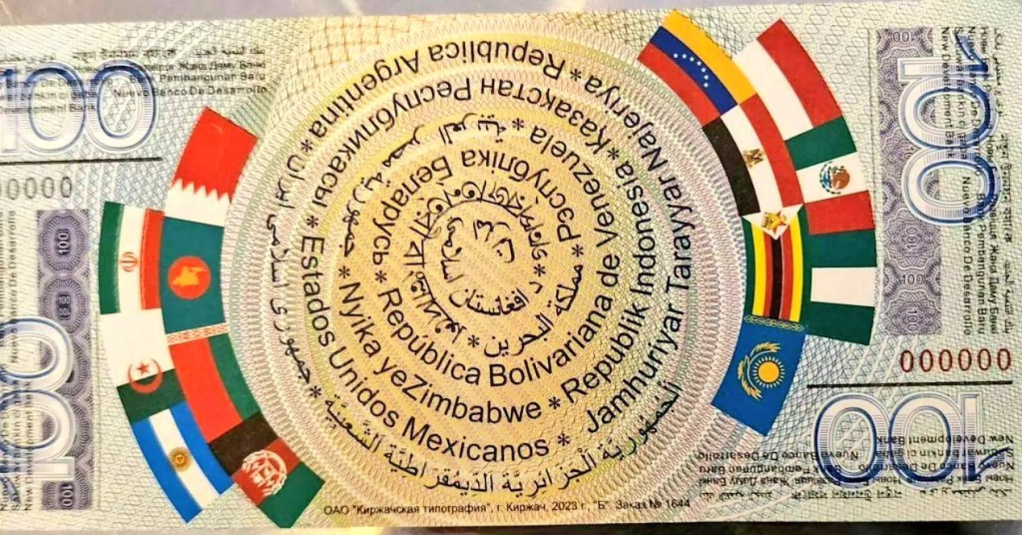
Russian Embassy spokesman Andrei Zemskiy recently acknowledged that the USMCA makes it much more difficult for Mexico to join the BRICS — a goal that Russia is openly pursuing. According to the renowned Mexican-Lebanese geopolitical analyst Alfredo Jalife, Mexico’s membership of the BRICS would be a net-positive for the country, but the US will never let it happen.
North America First (Until Now)
In the lead-up to the 15th meeting of the BRICS summit in Johannesburg in August 2023, South Africa’s Foreign Minister Naledi Pandor claimed that Mexico was among more than a dozen countries that had applied to join the alliance.
But each time the rumours reached fever pitch, the Mexican government batted them down. Here’s what former President Andres Manuel López Obrador (aka AMLO) had to say in response to Pandor’s claims (translation by yours truly):
“Our proposal is to strengthen the treaty with the United States and Canada, consolidate ourselves as a region, strengthen us, help each other, complement each other, share investment, technology, labour forces, the skills of the workers of the three countries, improve wages, and consolidate North America.”
On another occasion, AMLO conceded that Mexico’s geographic reality left it little choice but to pursue further economic integration with the US and Canada:
We cannot shut ourselves off, we cannot break up, we cannot isolate ourselves. It is a fact that we have 3,800 kilometres of border, for reasons of geopolitics (presumably in reference to the US’ invasion, occupation and appropriation of more than half of Mexico’s territory in the mid-19th century). With all due respect, we are not a European country, nor are we Brazil. We have this neighbourhood and, furthermore, if we agree on things, as we have done, we can help each other out… Our economic integration is already well advanced.
It initially seemed that AMLO’s presidential successor, Claudia Sheinbaum, would follow the same course. But since Donald J Trump’s return to the White House, Mexico’s already strained relations with the US have soured to the point of curdling.
How can one possibly talk about consolidating North America as an integrated economic bloc when the US is constantly threatening to impose tariffs on both of its North American trade partners, in direct violation of the USMCA trade agreement, while openly talking about invading Mexico and turning Canada into the 51st state?
Over the past week, Washington has declared Mexico a foreign “adversary” together with the likes of Iran, Russia and China. It has also imposed potentially ruinous sanctions against two Mexican banks and a brokerage house for allegedly laundering money for drug cartels without presenting any clear evidence. As is becoming increasingly clear, the move was essentially a shakedown by the Trump admin aimed at getting greater control over Mexico’s banking system as well as its relationship with China.
Until recently, the accepted wisdom in Mexico was that Mexico’s economy is simply too integrated with the US and Canada’s and too dependent on the US for it to be able to join the BRICS. Economically speaking, it seemed to make little sense: Mexico shares with the US the world’s largest trade partnership as well as a significant trade surplus whereas with China it has a significant — and growing — deficit.
Trump 2.0: The Great Global Unifier
But as we previously noted, if anyone is able to change this dynamic, it is Trump 2.0, the great global unifier:
…either through its constant bullying or its wilful destruction of the USMCA, a trade deal that Trump himself brokered and which Trump himself called the “best trade deal ever” just five years ago. Simply by calling Mexico an adversary and comparing the country with the likes of Russia, China and Iran, Trump’s attorney general has helped further alienate the US’ most important trade partner while further arousing anti-US sentiment among the Mexican public.
Lo and behold, one week later President Sheinbaum just announced that her government will be participating as an observer in the 17th annual meeting of the BRICS summit in Rio de Janeiro on July 6-7. Sheinbaum herself will not be part of the delegation since her government, she says, has enough on its plate at home. Instead, Mexico will be represented by its Foreign Minister Ramon de la Fuente.
It could be argued that this is part of a process that already began with AMLO’s election in 2018. Unlike many of his direct predecessors, AMLO was keen to reengage with Latin America and the Global South as a whole, even going so far as to rejoin the G77+China in 2023.
The BRICS association currently comprises ten countries – Brazil, Russia, India, China, South Africa, Egypt, Ethiopia, Indonesia, Iran and the United Arab Emirates. In October 2024, an additional 13 countries (Algeria, Belarus, Bolivia, Cuba, Indonesia, Kazakhstan, Malaysia, Nigeria, Thailand, Turkey, Uganda, Uzbekistan and Vietnam) were invited to participate as “partner countries”, allowing them to engage with and benefit from BRICS initiatives.
It’s worth stressing that Mexico is going as an observer country, which is the first of many steps towards becoming a member. It is not officially a member of the group and cannot participate in any of the internal decisions taken at the Summit. But it can give its opinion and collaborate in joint projects, especially in areas of economics and development. More importantly, it will be able to put out feelers to see what kinds of models of future collaboration may be on offer.
At the same time, the Sheinbaum government is intensifying efforts to diversify Mexico’s economic and trade relations away from the US. That includes a possible deepening of its trade ties with Brazil. In August, a key meeting is scheduled to take place between the two countries’ secretaries of Commerce and Foreign Affairs to discuss ways of expanding trade. Brazilian companies will also be in attendance and meeting with Mexican businessmen to see how the economies can complement each other.
“We can supply what Brazil doesn’t have and they can supply what Brazil has that we don’t, not only in terms of the trade agreement but also in terms of investments,” Sheinbaum said.
Together, Brazil and Mexico represent 65% of the GDP of Latin America and the Caribbean. Trade between the two countries has already grown by over a third in the past six years, from $10 billion in 2019, to more than $13.5 billion in 2024, according to Rodrigo Almeida, head of the Commercial Sector of the Brazilian Embassy in Mexico. That is despite the very limited trade agreement currently in place between the two countries.
As the FT points out, $13.5 billion is still a tiny fraction of the $840bn of goods traded between the US and Mexico last year — and the $161.8bn in 2024 exchanged between Brazil and China in 2024. But there is also room for continued growth:
For Mexico, which is gearing up for a tense renegotiation of its USMCA deal with the US and Canada, Brazil could offer investment opportunities in sectors such as aerospace and pharmaceuticals, while helping ease its dependence on the US for imports of grains including yellow corn. Brazilian officials say its industrial and agribusiness sectors are interested in increasing exports to Mexico.
A major milestone came just over a year ago when the Mexican Mexicana de Aviación purchased 20 aircraft from the Brazilian company Embraer.
At the same time, Mexico is also looking to expand its bilateral trade with India, the EU and the United Arab Emirates. In her meeting last week with Indian Prime Minister Narendra Modi on the side lines of the G7, Sheinbaum discussed areas of opportunity, particularly regarding critical materials.
“We are very interested in the link with the pharmaceutical industry in India, but that it is invested in Mexico,” Sheinbaum said. “This year we are going to have a very important meeting about it.”
Even Mexican Businesses Are Looking Elsewhere
It’s not just Mexico’s government that is talking in earnest about diversifying Mexico’s economic and trade relations away from the US; so, too, is its biggest business lobby. The Employers’ Confederation of the Mexican Republic, or Coparmex, warned that the fallout from the US’ dramatic shift towards protectionism leaves Mexico little choice but to shift its trade policy towards closer ties with Asia, Africa and Latin America.
Edmundo Enciso, president of the Nearshoring and Foreign Trade Commission of Coparmex Mexico City, told El Economista that the tariffs imposed by the Trump administration on steel, the automotive sector and agricultural products are already generating devastating effects on value chains throughout North America. This, together with Trump’s crackdown on migration, the mass deportation of Mexican workers and his new tax on remittance payments, is destabilising entire communities in Mexico and destroying local employment.
“Mexico has a historic opportunity to diversify its alliances, and that does not mean breaking with the United States but rather rebalancing our relationship and developing an autonomous foreign policy, which puts Mexico’s interests at the centre,” said Enciso.
The fact that big business lobbies like Coparmex, which represent the interests of arguably the biggest beneficiaries of Mexico’s decades-long trade liberalisation with the US, are now calling for greater trade diversification hint at the scale of the damage Trump 2.0 has already inflicted on US-Mexico relations in its first five months in power…
Continue reading on Naked Capitalism
 Nick Corbishley