Colombia Looks to Strengthen Its Sanctions Against Israel As Europe “Loses Its Soul in Gaza”

“Nobody is going to listen to us ever again when we go around telling others to respect human rights and international law”: the EU’s former head gardener chief diplomat, Josep Borrell. 

After 659 days of gradually intensifying genocide in Gaza, live-streamed around the world every minute of every day, depressingly few countries have taken anything approaching meaningful action against the country directly perpetrating the genocide. Almost all of them are in the so-called “Global South”. They include Colombia whose Gustavo Petro government was one of the first to break off diplomatic ties with Israel, in May 2024.

As we noted at the time, the move was not without its share of risks, given: a) Colombia is one of Washington’s longest standing vassal states in Latin America and is home to at least seven US military bases; and b) the historic role Israel has played not only arming Colombia’s security forces but also in training its paramilitary groups, which killed more citizens than the guerrillas in the decades-long Civil War, according to Colombia’s Truth Commission.

The Petro government’s next move was to become one of the first — and only — national governments to try to impose economic sanctions against Israel in response to its war crimes in Gaza. Not only did it suspend all purchases of Israeli weaponry, it also blocked all sales of Colombian coal to Israel.

“Colombian coal is used to manufacture bombs that kill Palestinian children,” Petro said to justify the move, which was not without its critics at home.

Corporate Sanction Busters

That was on August 14, 2024. Yet according to recent reports, Colombian coal continues to flow from El Cerrejón, a huge open air mine in northern Colombia, to Israel. In an address before Congress to mark the 215th anniversary of Colombia’s independence last Sunday, Petro accused two global mining companies — Swiss-based Glencore and Birmingham, Alabama-based Drummond — of continuing to export Colombian coal to Israel despite the export ban.

Petro insists that officials in his own government, including the former Minister of Industry and Commerce, Luis Carlos Reyes, contravened his presidential decree. For his part, Reyes claims that Petro knew all along that the decree included sufficient loopholes and wriggle room to allow transnational companies to continue sending Colombian coal to Israel, and is now using his as a fall guy.

For the moment, it is unclear who is telling the truth. One thing that is clear is that the shipments of Colombian coal to Israel have continued, albeit in lower volumes. According to Colombia’s National Mining Association, “since the entry into force of the ban on exports to Israel, sales of Colombian coal have fallen from 250,000 to 100,000 tons per month.”

This more or less coincides with the testimony of Igor Díaz, a representative of the Sintracarbón mining union who told El País that at least three ships have set sail from Colombia without authorisation, one belonging to Glencore and two to Drummond.

Last Thursday, Petro ordered the Colombian Navy to stop any ships sailing from any Colombian port with coal to Israel. He also called on the Wayuu indigenous authorities along Colombia’s Caribbean coastline and other peoples affected by coal exploitation to block all mining activity at the El Cerrejón, one of the world’s largest open-air mines, if shipments of coal continue to leave for Israel.

“I have ordered that not a single ton of coal will be sent to Israel,” Petro said. “Colombia will not be complicit in genocide.”

A Corporate-Sponsored Genocide

The same cannot be said of Glencore and Drummond. Both are among 60 companies featured in the report, “From Economy of Occupation to Economy of Genocide”, published by the United Nation’s special rapporteur on the occupied Palestinian territories, Francesca Albanese.

Albanese argues that western companies have been under a legal and moral obligation to break ties with Israel’s system of occupation since last summer when the ICJ ruled that Israel’s decades-old occupation was a criminal enterprise based on apartheid and forcible transfer.

As the British journalist and author Jonathan Cook reports in his article, “Israel’s Genocide Is Big Business – and the Face of the Future“, many of the foreign companies operating in Israel have responded to the allegations by claiming that “this was Israel’s responsibility, not theirs, or that it was for states, not international law, to regulate their business activities.”

The dozens of high-profile businesses identified in Albanese’s report represent an array of sectors, from tech (Google, Microsoft, Amazon, Palantir, and IBM, again supporting genocide, this time by providing Israel with biometric databases) to automotive (Volvo, Hyundai), to energy (BP, Chevron), finance (Barclays, BNP Paribas) and mining (Glencore, Drummond). As Cook notes, they are all profiting from Israel’s crimes in Gaza:

In an interview with US journalist Chris Hedges, Albanese, an expert in international law, concluded: “The genocide in Gaza has not stopped, because it is lucrative. It’s profitable for far too many.”

Albanese lists dozens of major western companies that are deeply invested in Israel’s oppression of the Palestinian people.

This is not a new development, as she notes. These firms have exploited business opportunities associated with Israel’s violent occupation of the Palestinian people’s lands for years, and in some cases decades.

The switch from Israel’s occupation of Gaza to its current genocide hasn’t threatened profits; it has enhanced them. Or as Albanese puts it: “The profits have increased as the economy of the occupation transformed into an economy of genocide.”

The special rapporteur has been a growing thorn in the side of Israel and its western sponsors over the past 21 months of slaughter in Gaza.

That explains why Marco Rubio, Trump’s secretary of state, announced soon after her report was issued that he was imposing sanctions on Albanese for her efforts to shed light on the crimes of Israeli and US officials.

Revealingly, he called her statements – rooted in international law – “economic warfare against the United States and Israel”. Albanese and the UN system of universal human rights that stands behind her, it seems, represent a threat to western profiteering.

13 Countries Take On Israel  

Albanese was recently in Bogotá to attend a gathering with representatives of more than 30 states seeking to develop an emergency plan for stopping Israel’s genocidal attack on Gaza and the West Bank. The meeting was convened by the “Hague Group”, a bloc of nations co-founded in January by officials from several countries in the Global South, including South Africa and Colombia. The group aims to ensure compliance with the sentences handed down against Israel by the International Criminal Court (ICC) and the International Court of Justice (ICJ).

In her speech Albanese called on all States to suspend their ties with Israel:

The occupied Palestinian territory is now a living hell. In Gaza, Israel has dismantled even the UN’s last function – humanitarian aid – in order to starve, repeatedly displace, or deliberately murder a population it has marked for elimination. In the West Bank, including East Jerusalem, ethnic cleansing is proceeding through illegal siege, mass displacement, extrajudicial executions, arbitrary arrests and widespread torture. In all areas under Israeli rule, Palestinians live under the terror of annihilation, broadcast in real time to a watching world.

The Hague Group has two chairs — Colombia and South Africa — and six members: Bolivia, Cuba, Honduras, Malaysia, Namibia and Senegal. But the Bogotá conference drew delegates from 32 nations, including China, Brazil, Mexico, Venezuela, Turkey, Egypt and Qatar.

The only Collective West countries in attendance were Spain, Ireland, Slovenia. None of them featured among the 13 States (Bolivia, Colombia, Cuba, Indonesia, Iraq, Libya, Malaysia, Namibia, Nicaragua, Oman, Saint Vincent and the Grenadines, South Africa, and Türkiye) that ratified measures aimed at blocking the transfer of weapons and other military equipment to Israel through their respective territories and upholding universal jurisdiction mandates in order to ensure justice for victims of Israel’s crimes in Palestine.

Admittedly, 13 countries out of 193 is a pathetically small number given the breathtaking array and gravity of war crimes Israel has committed in Gaza — including the worst of all, genocide — over the past 659 days. But it is something.

Of course, these 13 (mostly smallish) countries will have their work cut out preventing Israel from sourcing weapons for its ongoing genocide in Gaza and expansionary wars in the Middle East. As Colombia’s recent experience shows, it’s one thing to try to impose sanctions on Israel; it’s a whole other thing to enforce them.

But at least the intention is there and more countries may sign on. The Houthis have certainly made their stand. Grassroots resistance is also on the rise as port workers in Europe refuse to service ships bound for Israel while in Greece citizens bar the disembarkation of Israeli tourists. As Yves pointed out a few days ago, Israel is increasingly subject to a death of a thousand cuts…

Read the full article on Naked Capitalism
Washington and Beijing’s Mexican Standoff

As Trump’s bumbling threats continue to alienate the US in Latin America, China is increasingly determined to hold its ground in the US’ so-called “backyard”.

Just over a week ago, the embassies of the world’s two apex economic superpowers, the US and China, clashed in Mexico. The spark was a speech given by US Ambassador (and former CIA agent and Green Beret) Ronald Johnson at a gathering of a gala dinner of the American Society of Mexico (AMSOC) sponsored by the billionaire tycoon Ricardo Salinas Pliego, who is seeking to position himself as a populist Milei-type figure in Mexican politics.

In what can only be described as a severe case of projection, Johnson accused “countries like China of trying to impose their financial control and greater economic and supply chain dependence on some places in our own Western Hemisphere”. The words represented the latest escalation in the battle for economic power and influence in Latin America between the US and China.

It is a battle that the US is handily losing, as we have reported for the past four years and as even the FT conceded last year. China is already South America’s largest trade partner. As Reuters reported in 2022, if you take Mexico’s huge trade partnership with the US out of the equation, which Trump seems determined to torpedo, China has already overtaken the US as Latin America’s largest trade partner.

Even a fanatically US-aligned government like Milei’s is strengthening its ties with China, much to Washington’s chagrin, while the Petro government of traditional US vassal state Colombia has joined the BRICS bank and is talking about cancelling its NATO global partnership due to the military alliance’s support of Israel’s genocide in Gaza.

As is becoming increasingly clear, China is determined to hold its ground in the US’ so-called “backyard”. As the American Quarterly notes, the recent China-CELAC (Community of Latin American and Caribbean States) summit underscored the striking contrast between the two countries’ approaches:

Xi Jinping appears to be aligning more closely than ever with the region as the Trump administration pushes an agenda focused on migration, tariffs, and even expansionist ambitions…

By announcing a $9 billion yuan-denominated credit line and fresh infrastructure investment for the region, Xi not only reasserted China’s role as a development financier but also positioned the yuan as an alternative to the dollar-dominated monetary logic—a strategy aligned with the country’s long-term efforts to internationalize its currency. “There are no winners in tariff wars or trade wars. Bullying or hegemonism only leads to self-isolation,” Xi said in his inaugural speech.

In September last year, Beijing urged the US to give up the antiquated Monroe Doctrine as Washington intensified its meddling in Mexico, Venezuela and Honduras. The Chinese government also continues to block a corporate deal that would transfer ownership of more than 40 seaports, including two crucial terminals on the Panama Canal, to a Western BlackRock-led consortium, again much to the chagrin of Washington.

Now, Mexico finds itself on the frontlines of this escalating tussle between the world’s two apex  economic superpowers. In response to Ambassador Johnson’s remarks, the Chinese embassy in Mexico posted a tweet accusing the US of spreading “lies full of ideological prejudices and cold war thinking”:

The “theory of China’s threat”, hysterically propagated by the United States, is nothing more than an excuse to maintain its own hegemony. From imposing arbitrary restrictions and erecting commercial barriers, to mistreating foreign immigrants and trafficking in illegal weapons, as well as inventing false positions to sanction financial institutions from other countries, a country like the United States is shamelessly killing the region of the Western Hemisphere. The United States seeks everywhere and in every way to set traps and attach labels to China, forgetting that it is [the US itself] that constitutes the true regional destabilizer, economic-commercial threat and saboteur of development.

Justice lives in the hearts of the people, the United States’ defamation of China is destined to fail. It would be advisable for the Ambassador of the United States in Mexico to dedicate more energy to promoting friendship with the country in which he believes, instead of inventing things out of nothing and confusing white with black, to avoid a total loss of credibility.

US Losing Credibility

So far, the tweet has had almost half a million views. One point it raises that is undeniable is that the US is rapidly losing credibility in Mexico. With his unilateral aggressions against the country, Trump has already caused a dramatic a shift in public opinion… towards China.

One recent Pew Research survey found that 45% of Mexicans consider China to be the largest economy in the world, up from 33% two years ago. Crucially, 45% of respondents said they want the relationship with China to be prioritised over that of the United States while 44% would prefer relations with the US to be prioritised. This places Mexico among the most polarised countries on the issue of US/China relations.

Interestingly, Mexico was one of only five of the 24 (Western or Western-aligned) countries surveyed by Pew Research that wanted its government to prioritise relations with China, albeit by a wafer-thin margin.

Perhaps most importantly, more than two-thirds of Mexican respondents (68%) considered the United States to be the greatest threat to the country, compared to 5% for China. That is well above the levels of distrust for the US registered among Indonesians (40 percent vs. 19 percent), South Africans (35 percent vs. 13 percent), Turks (30 percent vs. 2 percent), Brazilians (29 percent vs. 15 percent) and Argentines (24 percent vs. 13 percent).

This last result is perhaps unsurprising given that members of the Trump administration have been debating to what extent, not whether, the US should “invade” Mexico, and have been issuing threats on a more or less constant basis. That this is intensifying anti-US sentiment in a country that has already suffered at least 10 military interventions from its northern neighbour in its 204 years of independence from Spain is hardly surprising.

There is a clear shift in public opinion taking place in Mexico, and it is one that is likely to intensify as long as Trump continues to treat the country as his piñata. Here is a quick recap of some of the provocative threats and actions the Trump administration has launched against Mexico, the US’ largest trade partner, over the past eight months:

  1. It has appointed a former CIA agent and Green Beret as US ambassador.
  2. It has renamed the Gulf of Mexico to “Gulf of America.”
  3. It has significantly militarised the US-Mexican border by sending thousands of troops, spy planes and even two warships to surveil the land and coasts.
  4. It has imposed a series of tariffs on Mexican goods, many of which violate not only the WTO rules, but also the USMCA trade deal negotiated by Trump and ratified by the US Congress.
  5. It has designated Mexican drug cartels as terrorists.
  6. It has withdrawn visas for a number of Mexican politicians.
  7. It has imposed a 3.5% tax on all remittance payments sent by US-based migrants, many of them Mexican, back home.
  8. It has sanctioned two Mexican banks and one brokerage house, resulting in their emergency intervention by the Mexican authorities.
  9. This week, the US Department of Transportation has threatened to restrict flights from Mexico to the US, ostensibly in retaliation for Mexico’s alleged failure to comply with air commitments between the two countries.
  10. Also this week, a Department of Homeland Security official warned that Mexican drug cartels could soon deploy weaponised drones at the border.

As El País notes, one of the main reasons why Trump is constantly attacking the US’ North American trade partners, Mexico and Canada, is to gain leverage in the coming renegotiation of the USMCA.

Sheinbaum’s position since Trump’s trade war began has been to preserve the USMCA; however, the neighbouring country to the North and main buyer of Mexican exports, advocates a “renegotiation” of the trade agreement.

“President Trump is definitely going to renegotiate the USMCA, but that will be within a year. He wants to protect American jobs, he doesn’t want cars to be made in Canada or Mexico when they could be manufactured in Michigan and Ohio,” U.S. Commerce Secretary Howard Lutnick said this weekend in local media.

The problem for Mexico is that a renegotiated USMCA deal is likely to be even more prejudicial than the current one, especially if Trump carries through on his threat to close down automotive plants in Mexico and Canada. Then there’s the simple fact that the US’ word means nada. Trump may end up signing a new deal only to violate it or renege on it days later. The constant threats of intervention will also no doubt continue, and may even be acted upon.

China: A Realistic Alternative?

In other words, the world’s largest trade partnership will almost certainly continue to sour as Mexico’s deeply asymmetrical relationship with its biggest trade partner becomes more and more abusive. An early example of blowback from Trump’s tariffs and remittance tax was a 10% fall in Coca Cola’s sales volumes in Mexico, one of its most important markets in the second quarter. As readers may recall, Coca Cola was the target of a consumer boycott in the early days of Trump 2.0.

But does China represent an economic alternative? The current answer is: definitely not.

Although trade between the two countries has ballooned in recent years, it is almost all going in one direction: from China to Mexico, and in many cases onwards to the US.

In 2024, Mexico’s exports to China represented just 1.5% of its total exports while its imports from China represented just over 20% of the total. Contrast that with Mexico-US trade: Mexico’s exports to the US last year represented 83% of all its exports while its imports represented just over 40% of the total. Which begs the question: given the vast gulf between their respective trade volumes, why is the US even worried about Mexico-China relations?

The answer is simple: it is the trend that matters. As Enrique Dussel, the director of the UNAM’s Center for China-Mexico Studies (Cechimex), explains to El País, Mexico’s trade with China increased from 1% of the total in 2000 to 11% China in 2022, while its trade with the US fell from 81% of the total to 62% in the same period, mainly due to the rise in Mexican imports of Chinese goods:

This U.S. is Mexico’s first trade partner with a downward trend, China is the second with an upward trend. What is happening in Mexico is also happening in Argentina, Brazil, Peru and Chile: the productive apparatus is replacing imports that were historically American with Chinese ones. The products affected include electronics, auto parts, telecommunications and automotive. It is not a one-to-one correspondence, but there is a strong association of substitution through imports.

Within this reality, the trilateral relationship between China, Mexico and the US is unique, as we noted in a post last September, just two months before Trump’s re-election:

The US and Mexico share the world’s most frequently crossed border and after 30 years of NAFTA and USMCA, their economies are tightly coupled. China and Mexico are not just trade partners but direct competitors vying for the custom of the world’s largest consumer market, which is trying to wean itself off Chinese products. Mexico has so far emerged as the largest beneficiary of the US’ nearshoring strategy, but the more it exports to the US, the more it needs to import from China. And that is the last thing the US wants.

Over the past year, the US has escalated its war of words against both China and Mexico over the illicit fentanyl trade that is killing tens of thousands of US citizens a year. But as AMLO [and now Sheinbaum have] repeatedly argued, the US government has spectacularly failed to address the root causes of drug addiction within its borders. Instead, some US lawmakers and pundits have proposed using military force on Mexico’s sovereign territory, with or without Mexico’s permission, to combat drug cartels.

That was the situation before Trump’s arrival. The situation today is far worse. On the one hand, Trump 2.0 is intent on undoing many of the nearshoring processes Trump 1.0 unleashed by targeting China with tariffs. On the other hand, Mexico is arguably as dependent as ever on the US even though its trade with the US as a proportion of the total has fallen somewhat.

Mexico sources around half its food from the US and more than 70% of its natural gas. Mexico’s sheer level of dependence on the US — no comparably sized economy in the world sends more than 80% of its exports to one destination — and the constant threats of military or financial intervention emanating Washington, Mexico suffers from a structural vulnerability that limits the sovereign capacity of the Mexican State to make long-term strategic decisions.

The Mexican economist Mario Campa notes that one of the two main stumbling blocks preventing closer ties between Mexico and China is the huge — and growing — trade deficit between the two countries, which he claims could be somewhat rectified through trade negotiations. The other, of course, is Washington. Regardless of who occupies the White House, the US government and its myriad agencies will not look kindly upon Mexico further deepening its trade relations with China, or the BRICS as a whole.

But what alternative will Mexico have? To stay trapped in an increasingly dysfunctional relationship with a country whose government keeps threatening to invade? While many of the relative benefits of USMCA are whittled away next year by Trump’s protectionist demands?

The Sheinbaum government’s response so far has been to launch Plan Mexico, an ambitious national industrial policy whose main objective is to reposition Mexico as a global hub for advanced manufacturing, technological innovation, attracting foreign direct investment and relocating production chains, with an emphasis on key sectors such as automotive, electronics, aerospace, pharmaceuticals and information technologies.

The question is: whose market(s) will it serve if the USMCA unravels?

Continue reading on Naked Capitalism

Brussels’ Latest Destructive Project, Culling the Euro Area’s Banks, Hits a Snag

The governments of Italy and Spain are doing everything they can to obstruct EU-supported bank mergers from taking place within their borders. 

Since the Global Financial Crisis, the EU has stumbled through almost two decades of more or less uninterrupted economic stagnation. More recently, its self-harming sanctions against Russia have accelerated the (possibly irreversible) decline of Europe’s key industrial heartlands, Germany and Italy, while spreading further economic pain throughout the bloc. Now, the EU seems determined to make matters worse by conducting a ruthless cull of the bloc’s banks.

This is a project that has been in the works for a long time. The European Central Bank. Even back in 2017, the European Central Bank was talking about weeding smaller banks to reduce competition in the sector. As noted in our previous post, “The Curious Case of the Hostile Takeover Bid By a Bank Facing Criminal Charges“, there are at least three main reasons for the EU’s obsession with thinning the Euro Area’s banking herd.

First, Brussels wants to encourage the rise of European banking champions that are capable of competing on the global stage with Chinese and US mega-lenders. Second, fierce competition in the Euro Area’s banking sector has squeezed the profit potential of larger lenders  —  and boosting the profits of large banks is of greater importance to Brussels and Frankfurt than, say, increasing the amount of credit to SMEs, or reducing the cost of that credit, or improving the deposit rates paid to banking customers.

Third, as regular NC reader vao pointed out in a comment to that post, the European Central Bank is itching to set up its CBDC, the digital euro, and “having a few large European banks with the technical capacity to implement it is of course preferable to having a multitude of small establishments that may not be interested, or may not have the resources to do it, or that will require much more time and coordination efforts to achieve the desired outcome.”

However, the EU faces three major obstacles in bringing about its final banking solution:

  1. The boards and shareholders of smaller large banks, like Spain’s Banco Sabadell or Italy’s BPM, are dragging their heels. As the rising interest rates of recent years have boosted returns on equity and valuation multiples, perennial underperformers – like Sabadell, BPM and Commerzbank – have become more viable standalone players, empowering their boards to reject takeover interest. This is the main reason why most of the attempted bank mergers of late have been of a hostile nature.
  2. Cross-border bank mergers remain a logistical nightmare, and few governments are willing to let foreign enitites swoop in for their national banking champions. It’s worth recalling that of the few cross-border hostile bank mergers that have prospered, many have ended in disaster. The most notorious example is the 2007 Royal Bank of Scotland-led €71 billion carve-up of Dutch group ABN Amro, which resulted in bailouts for several members of the acquiring consortium. That’s not to forget the immense complications of integrating their legacy IT systems (click here to read about the ‘Biggest IT Disaster in British Banking History’, h/t Rev Kev).
  3. The national governments of the Euro Area’s third and fourth largest economies, Italy and Spain, are doing everything they can to obstruct EU-supported internal bank mergers from taking place within their borders. This invites the question: will other national governments follow suit? Last week, things came to a head as the European Commission threatened the governments of both Italy and Spain with legal action for daring to block two hostile banking mergers.

On Monday, the Commission warned Rome that it appeared to be violating the bloc’s merger rules by citing national security to thwart Italian mega-lender UniCredit’s bid for rival Banco BPM.

In a delicious irony, the Meloni government used the ongoing war in Ukraine and Unicredit’s ongoing presence in the Russian market as a pretext for blocking the move, claiming that as long as Unicredit still has operations in Russia a merger between Unicredit and BPM would pose a national security risk. Unsurprisingly, Brussels is livid.

“The problem is that this is pure political posturing and the rules are clear and governments have no formal power to prevent these mergers from happening,” one senior European official told the FT (emphasis my own).

Which is broadly true: the European Central Bank has the final say on bank mergers in the 20 member countries of the Euro Area, particularly those involving significant institutions or cross-border transactions. However, neither Madrid nor Rome seem to care. They are willing to pull out all the stops to try to prevent these bank mergers from taking place. And that is causing all manner of teeth gnashing in Brussels and Frankfurt.

As Politico EUROPE reports, “the warning letter from Brussels puts the EU and Italy on a collision course in a highly sensitive sector”:

The Commission has an exclusive competence to rule on mergers under EU competition rules, has examined the UniCredit-BPM deal and given a thumbs up with conditions limited to curbing excessive market concentration. The Italian government says the deal poses a security risk, partly because UniCredit still has operations in Russia.

Many observers in the banking sector, however, see the security block as a smokescreen to disguise what Italy’s government really wants: a far bigger role for Monte dei Paschi di Siena (MPS.)

MPS was bailed out in 2017 but is seen as a national darling that Rome would like to bulk up into a “third pole” in the banking sector after UniCredit and Intesa Sanpaolo…

Italy is unlikely to back down easily, as undermining the UniCredit-BPM deal is only part of a bigger shakeup aimed at finding a bigger role for MPS.

The government has sought to steadily offload MPS from state hands after it was bailed out, and last year it sold a large share to BPM.

The government’s aspirations that MPS and BPM would merge to form a “third pole” fell flat, however, when UniCredit swooped in on BPM.

The Commission has issued the Italian government an ultimatum of 20 working days in which to respond to its 55-page letter. In response, Meloni’s office has said her government would “answer the clarification requests [in the letter] in a collaborative spirit”.

Which brings us to Spain. Last Thursday, the Commission issued a legal letter to the Pedro Sánchez government warning that it, too, could face serious consequences for violating EU banking and single market rules. In recent months, the Spanish government has done just about everything it can to derail local banking giant BBVA’s attempted hostile takeover of local rival Banco Sabadell without explicitly banning the move.

After conducting a public consultation on the merger, the Spanish government gave the green light for BBVA’s purchase of Sabadell to go ahead, but on one key condition — that the merging of the two banks cannot occur for at least three years. In other words, BBVA cannot integrate its operations with Sabadell during this period, and that period could extend to five years or longer.

“The government has authorised the BBVA and Sabadell deal on the condition that, for the next three years, they remain separate legal entities and maintain separate assets, as well as preserve autonomy in the management of their activities,” Economy Minister Carlos Cuerpo told a news conference in mid-May. “What we are doing (…) is protecting workers, protecting companies and protecting financial customers.”

The Spanish government is not alone in taking desperate measures to thwart the merger. Banco Sabadell’s management even went so far as to sell off its British subsidiary, TSB, to Spanish TBTF giant Banco Santander, so as to reduce Sabadell’s value as a merger target. It is not clear, however, whether it will be enough to crush BBVA’s interest.

Next Stop: European Court of Justice?

The Commission, meanwhile, has warned Madrid that Spanish banking laws, introduced roughly a decade ago, giving ministers powers to intervene in mergers “impinge on the exclusive competences of the European Central Bank and national supervisors under the EU banking regulations.”

The Commission and the ECB have a clear interest in making an example of Spain. After all, what would happen to the EU’s still-born banking union if other national governments were to take a leaf out of Madrid and Rome’s playbook?

According to the FT, the letter “is a first step in proceedings that have the potential to drag on for years and lead to Brussels referring Spain to the European Court of Justice for an alleged breach of EU law.”

Admittedly, the Spanish government has clear political motives for wanting to scupper BBVA’s hostile takeover. Most importantly, Sabadell is a Catalan bank, and Catalonia’s pro-independence parties, which are junior partners in the Sánchez government, are dead set against the merger.

But there are lots of other reasons to oppose the proposed BBVA-Sabadell tie-up, including perfectly sound economic ones. For a start, if the hostile takeover went ahead, it would not create a European banking champion as the Commission asserts (BBVA’s biggest market is in Mexico); it would create an even bigger national monster.

Spain already boasts the second most concentrated banking sector in the Euro Area (after the Netherlands). According to a 191-page report by Spain’s National Commission on Markets and Competition (CNMC), 120 financial institutions already disappeared between 2007 and 2021, leaving just five lenders (Santander, BBVA, Caixabank, Sabadell and Unicaja) controlling 69.3% of the credit market. If BBVA takes over Sabadell, 70% of the market will be controlled by just four institutions (Santander, BBVA, Caixabank and Bankinter).

As we noted in the previous post, this would have a clear negative impact on banking competition and stability:

BBVA’s proposed takeover of Sabadell… faces strong opposition from the national government in Madrid, but it has received the blessing of the European Central Bank, which has long favoured thinning the herd of banking players in the Euro Area.

As the German economist and small bank activist Richard Werner warns, economies with fewer and bigger banks will lend less and less to small firms, which tends to mean that productive credit creation that produces jobs, prosperity and no inflation, also declines, and credit creation for asset purchases, causing asset bubbles, or credit creation for consumption, causing inflation, become more dominant.”

In other words, more financialisation, less productive activity. In the eurozone, more than 5,000 banks have already disappeared since the ECB started business a little over two decades ago, according to Werner. And the central bank is determined to continue, if not intensify, this process…

A BBVA-Sabadell tie up would not only further erode competition in an already heavily concentrated financial sector, with all the ugly implications that entails (including more cartel-like behaviour, higher risks of big bank implosions, and the inevitable closure of even more bank branches and ATMs, making accessing cash even harder, just as the big banks intend), it is also likely to impact the banking services available to small businesses… Sabadell is Spain’s largest lender to small and medium-size enterprises.

We have already seen this happen in the US following the US Riegle-Neal interstate Banking Act of 1994, which permitted truly nationwide interstate banking for the first time. A 2013 paper published by the Federal Reserve Bank of Cleveland, titled “Why Small Business Lending Isn’t What It Used to Be”, admitted that the resulting concentration of the banking sector had a detrimental impact on small business lending:

Banks have been exiting the small business loan market for over a decade. This realignment has led to a decline in the share of small business loans in banks’ portfolios. As figure 2 shows, the fraction of nonfarm, nonresidential loans of less than $1 million—a common proxy for small business lending—has declined steadily since 1998, dropping from 51 percent to 29 percent.

The 15-year-long consolidation of the banking industry has reduced the number of small banks, which are more likely to lend to small businesses. Moreover, increased competition in the banking sector has led bankers to move toward bigger, more profitable, loans. That has meant a decline in small business loans, which are less profitable (because they are banker-time intensive, are more difficult to automate, have higher costs to underwrite and service, and are more difficult to securitize).

In other words, central bankers in the US know perfectly well that banking consolidation ultimately leads to less lending to smaller businesses. Presumably, the same goes for the central bankers in Frankfurt. Either they don’t care if small, local businesses hit the wall en masse, or — even worse — this is one of the unstated goals of the banking cull…

Continue reading on Naked Capitalism

The All-Round Madness of Trump’s Tomato Tariffs

The Trump administration accuses Mexico of “dumping” tomatoes on the US — something the US would never dream of doing with the agricultural goods it sends to Mexico (sarc).

The Trump administration continues to escalate its economic war against its largest trade partner, Mexico. In recent weeks alone, Washington has imposed potentially fatal sanctions on two smallish Mexican banks and a brokerage house, which were quietly paused last week; it has implemented a 3.5% tax on the remittance payments US-based migrants, many of them Mexican, send home; and it has escalated its raids on migrants, many of them also Mexican.

Now, to cap things off, Washington just imposed a 17% tariff on US imports of tomatoes, almost all of which come from Mexico. As Bloomberg notes, the move comes just days after Trump unveiled plans to impose a 30% tariff, beginning Aug. 1, on many Mexican products that don’t fall under the USMCA agreement he negotiated in his first term.

The Trump administration accuses Mexican farmers of unfairly “dumping” (i.e. selling at an artificially low price) tomatoes on the US market — something the US would never dream of doing with the agricultural goods it exports to Mexico, if you’ll excuse my sarcasm.

“Mexico remains one of our greatest allies, but for far too long our farmers have been crushed by unfair trade practices that undercut pricing on produce like tomatoes. That ends today,” Commerce Secretary Howard Lutnick said in a statement. “This rule change is in line with President Trump’s trade policies and approach with Mexico.”

Mexico’s Sheinbaum government begged to differ, arguing that market share won by Mexican tomato farmers in past decades is a result of “the quality of the product, and not any unfair practice.” She also said the tariff would probably have limited impact on the exports of Mexican tomatoes to the US given the scale of US dependency.

A Long Time Coming

For its part, the Florida Tomato Exchange (FTE), a lobby that represents the state’s growers, packers and shippers and enjoys close ties to the Trump administration, welcomed the move, stating that “the playing field will finally be levelled” for U.S. growers.

The FTE has waited a long time for this moment. The first time it accused Mexican farmers of “dumping” practices was back in 1996, just two years into NAFTA. In response, Mexican farmers agreed to set a floor price on tomatoes in a bid to ensure that US farmers were not being undercut. In return, the US suspended an investigation into the Mexican farmers’ alleged dumping practices.

Since then four rounds of agreements have taken place, the last one in 2019. But the times for normalised trade relations between the US and Mexico appear to be well and truly over.

As with so many of Trump 2.0’s trade policies, the tariffs on Mexican tomatoes are likely to backfire, with the price ultimately being paid by US consumers. Two out of every three tomatoes consumed in the US come from Mexico, according to official figures.

Since the signing of NAFTA in 1994 the market share of US tomatoes has slumped to 30% from 80%, according to the Florida Farm Bureau, while imports of Mexican tomatoes have increased four fold. The tomato trade between the two countries is now worth close to $3 billion.

“There is no way that Florida can supply the local market in terms of quality, quantity and price; impossible,” Antonio Ortiz-Mena, a Mexican expert in geopolitics and professor of international trade at Georgetown University, told BBC Mundo. In addition, “there are U.S. companies that have investments in tomatoes in Mexico, not only because of the low labour costs but, above all, because of the climatic conditions and economies of scale. So they will also be affected.”

Tons of Floridan tomatoes have already gone to waste as a result of Trump’s tariffs and migration crackdown, as WSVN Miami reported in mid-May:

With tariff talks top of mind, South Florida farmers say they’re in trouble. Crops are rotting on the vine and they’re blaming the ongoing trade wars and immigration changes. What does this mean for the future of our food? 7’s Heather Walker investigates.

Perfectly good tomatoes are being plowed over — instead of picked. It’s a sad scene happening in South Florida.

Heather Moehling, President, Miami-Dade County Farm Bureau: “You can’t even afford to pick them right now. Between the cost of the labor and the inputs that goes in, it’s more cost-effective for the farmers to just plow them right now.”

Although the tariffs on Mexico did not came into effect for goods compliant with the United States-Mexico-Canada Agreement, including tomatoes, the threat of tariffs alone was enough to disrupt the U.S. market:

“The Mexican industry exported, in some cases, double and triple the daily volumes to beat being subject to the 25 percent tariff in February and March and the 10 percent tariffs in April. That just devastated our markets in the U.S.,” [Tony DiMare, president of DiMare Homestead, which owns over 4,000 acres of tomato farms in Florida and California told WVSN].

Farmers say President Trump’s tariffs and the threat of tariffs have caused thousands of acres of tomatoes to go to waste because the price to pick and pack them costs more than what the tomatoes are selling for this year.

Changes in immigration are also taking a toll, with many pickers afraid to go to work.

Homestead farm worker: “Many workers have left, others are leaving now… A lot of people are really afraid and sometimes they come, sometimes they don’t come and the harvest is lost because it cannot be harvested, so that’s why so much produce is lost.”

The Trump administration is already aware of the strain its erratic policies are having on the nation’s farmers. In April, U.S. Agriculture Secretary Brooke Rollins announced that her agency is preparing a contingency bailout plan for farmers should the trade wars continue to escalate.

“We are working on that. We are preparing for it. We don’t believe it will be necessary,” Rollins said.

In other words, US citizens could end up paying doubly for Trump’s tariffs, first through higher prices at the checkout and secondly through bailouts to US farmers. Meanwhile, on the Mexican side of the border concerns have been raised that if Trump’s tariffs are effective in bringing down US imports of Mexican tomatoes (a big “IF” for reasons already outlined), one possible beneficiary will be the drug cartels, which Trump claims to be waging total war against.

BBC Mundo (machine translation):

“Mexican tomatoes are going to become cheaper, but the question is how companies are going to deal with this problem. They are going to have to reduce their workforce, they are going to have to rethink how many hectares they are going to plant,” said Faustino Delgado, a leader of the agricultural workers union.

Most of the industry, moreover, is in Sinaloa. The so-called “Sinaloa red pearl” is produced there. Agro-export land coexists alongside land belonging to of one of the most important drug trafficking cartels in the world.

Over the past year, a war between factions of the Sinaloa cartel has put the state on tenterhooks and a curfew is currently in place in the capital, Culiacan. The roads where the tomatoes comes out, in addition, are on the front lines of the battle.

“A tariff like this exacerbates the problems driving Mexican workers to either want to migrate to the US in search of opportunities or to swell the ranks of organized crime,” Ortiz-Mena says.

The potential fallout of a tomato tariff extend far beyond the commercial realm.

Pot, Meet the Mother of All Kettles

Perhaps the maddest — and most maddening — aspect of the Trump administration’s imposition of sanctions on Mexican tomatoes is the stated justification, or pretext, for doing so: namely, that Mexico’s farmers are “dumping” tomatoes on the US market. In doing so, it seeks to paint US famers as victims of underhand market practices by their Mexican competitors.

However, when it comes to dumping (i.e. selling at an artificially low price) agricultural produce on the international markets, no one, with the possible exception of the EU, comes close to the US’ heavily subsidised farmers and Big Ag corporations. For decades the US has destroyed the livelihoods of millions of farmers around the world by unleashing on to the global markets surplus produce at below-cost price.

One of the biggest victims is Mexico. Over the years, the Institute for Agriculture and Trade Policy has published reports tracking the incremental harm US dumping of basic agricultural staples has done to Mexico’s ability to feed itself. From its 2023 report, Swimming Against the Tide: Mexico’s Quest for Food Sovereignty in the Face of U.S. Agricultural Dumping:

In 1994, NAFTA eliminated most of the trade restrictions Mexico had used to protect its farmers from foreign competition, and in 16 of the 28 years since, the U.S has dumped corn, soybeans, wheat, rice and cotton exports into Mexico at prices 5%-40% below what it cost to produce them. In turn, Mexican producers of these crops experienced prices drops of 50%-68% in the 12 years after NAFTA took effect. From 2014 to 2020, U.S. exports of priority food crops came into Mexico at unfairly low prices, undermining the incentives for Mexican farmers to increase production.

The US was able to do this by continuing to subsidize agricultural producers even after NAFTA while Mexico’s government pulled most of its subsidies. Mexico’s political class, in thrall to neoliberal ideas such as economic liberalisation, privatisation and “free” trade, showed scant interest in safeguarding, let alone developing, the country’s internal market. The government had already begun slashing subsidies to Mexican famers over a decade before NAFTA…

Continue reading on Naked Capitalism

What Birmingham’s Towering Trash Heaps Say About Starmer’s Britain

In the land that gave us Margaret Thatcher’s “there is no alternative” and “there’s no such thing as society”, the provision of even the most basic public services is becoming a problem.

Mountains of rubbish have been piling up on the streets of Birmingham, the UK’s second largest city, as a bin crisis rumbles on into its seventh month. Intermittent strike action started on January 6 with 12 walkouts planned across four months, but the situation quickly spiralled when the trade union Unite announced an indefinite all-out strike on March 11. That strike could continue until December, assuming the government doesn’t fire the workers first.

Birmingham is kind of close to my heart. It is the closest large city to the small Midlands town I grew up in and where my parents still live today. It underwent significant urban renewal in the first two decades of this century but now faces unprecedented financial strains.

While I haven’t had a chance to visit the city, or the UK for that matter, since the bin crisis erupted, reports from friends and family suggest the more affluent parts of the city, including the centre, have been less affected. As Plutonium Kun notes in the comments below, this is probably largely down to higher rates of car ownership, with many people driving to recycling depots to get rid of most of their waste (or possibly fly-tipping).

This chimes with The Guardian‘s April 18 report, “‘The Posh Areas Get Cleared’: Bin Strikes Illustrate Birmingham’s Wealth Gap“:

“It’s very frustrating that the posh areas get cleared and we’re just left, very frustrating but we expect it,” said Peter Thomas, outside his home in Ladywood, against a backdrop of overflowing bins.

Across neighbouring postcodes in Birmingham, the gap between wealthy and deprived parts of the city has been noticeable for residents ever since the bin strikes began last month…

Students living near Edgbaston reservoir said a lack of wheelie bins made the situation worse, despite having had a recent bin collection. Some of those who do have access to wheelie bins have added padlocks in the hope of deterring neighbours from using their bins.

Daniel Struczynski, a chef and culinary arts management student, said: “It’s awful because at the end of the day when we want to put rubbish out we have to put it on the streets and within like 12 hours the bags are all opened, the rubbish is all over the floor.”

He added that it made it a prime target for rodents. “You see rats throughout the night going through them and then crows throughout the day and sometimes even foxes walking around the road.”

The spark for the strike was the city council’s decision in January to remove Waste Recycling and Collection Officer (WRCO) roles which Unite claims would result in 170 workers losing up to £8,000 a year. For some workers that would be the equivalent of losing roughly one quarter of their salaries, says Unite — at a time of persistent moderate-to-high inflation in the UK. Birmingham City’s Labour-run council denies this claim.

Now in its fourth month, the strike could upend long-standing relations between the UK’s governing Labour Party and Unite, one of the country’s largest trade unions. Unite just suspended Deputy Prime Minister Angela Rayner and is even considering severing ties with the Labour Party altogether. The trade union also suspended the leader of Birmingham City Council, John Cotton. Unite boss Sharon Graham delivered scathing critique of Labour’s “shambolic mismanagement” and anti-worker policies:

Yet again workers are being asked to pay the price for the incompetence of this Labour council and Labour government. It is little wonder workers are deserting Labour in droves when they seem to be hell bent on attacking workers and leaving the super-rich totally untouched.

This should not be happening under a Labour government that promised a new deal for working people. It turns those promises into a complete joke. But let me be clear, the threats won’t work. Angela Rayner and John Cotton’s shambolic mismanagement of this dispute just makes it more likely that the strikes will continue into Christmas and beyond.

While this may all  amount to mere bluster, if Unite were to server ties with Labour, the reverberations could be significant. Unite is the largest trade union affiliated to Labour. According to the Electoral Commission, it has donated over £400,000 to the party this year. What’s more, it is threatening to abandon Labour at a time that approval for Starmer’s government just hit an all-time low of -43 — a net drop of 54 points from the peak of plus 11% after Starmer’s landslide victory just over a year ago.

For the moment, the biggest beneficiary of Labour’s collapse appears to be Nigel Farage’s Reform party. As in many countries in Europe, the main establishment parties appear determined to off themselves on the altar of neoliberalism as well as through their dogged support for the war in Ukraine and for Israel’s genocide in Gaza. At the same time, they are stepping up their authoritarian attacks on freedom of speech, of assembly and to protest.

Starmer’s “landslide” victory last summer, as we noted at the time, was not owing to a groundswell of support for his vision or policy proposals — before the elections the UK public viewed the Labour Party under Starmer even less favourably than under Ed Miliband — but because support for the Conservative Party had all but disintegrated. Now, it is support for the Labour Party that is collapsing.

Meanwhile, Jeremy Corbyn, the former Labour leader who was stabbed in the back by Starmer, is in the process of creating a new left-wing party in the UK that could perhaps pose a threat to Labour’s electoral prospects. According to a poll last week, one third of Labour supporters would consider voting for a Corbyn-led party. And if unions like Unite were to disaffiliate themselves from Labour (still a big “IF”), they would be free to endorse candidates representing another party.

Another Broken Pledge

Unite’s decision to ditch Rayner and Cotton was made in an emergency motion at its conference in Brighton at the weekend, which condemned both the UK Government and Birmingham City Council for criticising bin workers who have taken industrial action in Birmingham.  In a scathing message Unite leader Sharon Graham accused the deputy PM of backing a “rogue council” that had smeared its workers while seeking to “fire and rehire” the striking bin workers.

As the name suggests, “Fire and rehire” refers to the act of dismissing workers and hiring them back straight away — on worse terms. This practice became more commonplace amid the economic fallout from the COVID-19 pandemic as companies sought to slash their labour costs. The most notorious case was that of P&O Ferries, which fired 800 of its workers in 2022 and then reportedly used an agency to replace the fired staff.

Labour pledged that it would ban fire-and-rehire in its 2024 election manifesto, but it pledged a lot of things it hasn’t got round to doing while doing a lot of questionable things it never pledged to do (accelerating the roll out of digital identity, maintaining military support for Israel’s genocide in Gaza while seeking to criminalise public opposition to the genocide, intensifying the dismantling of the welfare state, increasing national insurance contributions…).

As the veteran journalist Peter Oborne warned in 2023, a year before Starmer’s election victory, “you would be very unwise to believe a word Starmer ever says.”

Birmingham: Ground Zero of UK’s Local Government Funding Crisis

Over a century ago, Birmingham was described by Harper’s magazine as the best-run city in the world. Today, it is one of the worst-run cities in the UK. In September 2023, Birmingham City Council, which prides itself on being the largest local authority in Europe, serving over one million “customers” (not residents or citizens but “customers”), issued a 114 bankruptcy notice, paving the way for the largest programme of cuts and asset sales yet for any UK local authority.

The BBC explains:

Councils technically can’t go bankrupt – but they can issue what’s called a section 114 notice, where they can’t commit to any new spending, and must come back with a new budget within 21 days that falls in their spending envelope.

And when they do, it often means an impact on residents with severe cuts to frontline services.

Councils are required by law to have a balanced budget each financial year and provide “Best Value” to residents.

But more and more councils are finding it harder to do so.

Thirteen section 114 notices have been issued since 2018 – compared to just one before, in the year 2000. Two of those notices were due to misallocation of funds, however, rather than financial challenges.

There are myriad reasons why Europe’s largest local authority ended up hitting the wall in September 2023 — including the fiscal fallout from COVID-19, the ongoing cost of living crisis and the Tory government’s decade and a half of crippling austerity, the brunt of which was borne by local authorities and which Starmer’s Labour government has done precious little to reverse…

Continue reading on Naked Capitalism

Trump Probably Just Did Lula a Massive Favour With His 50% Tariff Threat Against Brazil

This has little to do with trade — in fact, the US had a $6.8 billion annual trade surplus with Brazil last year — and everything to do with geopolitics.

On Wednesday, Brazil became the latest in a growing list of countries to receive a threatening letter from Donald J Trump. Brazil, the letter warned, will face 50% tariffs on all its exports to the US as of August 1 due to its government’s “witch hunt” against former President Jair Bolsonaro over his attempted coup in January, 2023.

In other words, this has little to do with trade — in fact, the US had a $6.8 billion annual trade surplus with Brazil last year, which Trump is now putting in jeopardy. Instead, this is largely about meddling in another country’s domestic politics, though there are also geopolitical factors at work (more on those later). As Bloomberreports, Trump’s latest levy “shows the world that nothing is off limits”:

According to Stephen Olson, visiting senior fellow at ISEAS–Yusof Ishak Institute, it’s unprecedented for the US to add a tariff onto a foreign country to stop a judicial proceeding, and “it signals to US trade partners that any and all issues that catch Trump’s attention could become a problematic part of the trade agenda”.

Of course, as NC reader aerrty notes in the comments below, that is not to say that the US hasn’t used other means, whether diplomatic, covert or military, to stop judicial proceedings in other countries.

The tariff threat also reaffirms the impression that the US under Trump is a grossly unreliable partner. Lula, for his part, described the threat as a direct attack on Brazilian sovereignty. He also said he will seek to resolve the matter through negotiations, adding that, if necessary, he will not hesitate to impose retaliatory tariffs on US exports to Brazil by 50%, which Trump in turn has vowed to respond to by further hiking US tariffs on Brazilian products.

In Lula’s own words (machine translated):

In the face of US President Donald Trump’s public statement, it is important to emphasize: Brazil is a sovereign country with independent institutions that will not accept outside meddling; legal proceedings against those who planned the coup d’état are the exclusive competence of the Brazilian courts and are therefore not subject to any type of interference or threat that violates the independence of national institutions.

Saving Bolsonaro’s Skin

During his presidency (2018-22), Jair Bolsonaro enjoyed close ties with Trump but he was unable to secure a second term in what was a closely fought, polarising election. As readers may recall,  hundreds of Bolsonaro supporters stormed Brazil’s three most important government buildings — Brasilia’s Congress, the presidential palace and supreme court building — as the security forces watched on.

Bolsonaro himself was in Florida at the time, from where he refused to accept Lula’s victory. It took him almost three months to return, and when he did he found himself the subject of a criminal investigation. If found guilty of crimes including involvement in an attempted coup and an armed criminal association and the violent abolition of the rule of law, he could face up to 43 years imprisonment.

Bolsonaro and his family are trying everything they can to prevent that. In recent months, Bolsonaro’s son, Eduardo, together with Paulo Figueiredo — a businessman, journalist and grandson of João Figueiredo, who led Brazil’s military dictatorship from 1979 to 1985 — have been in Washington lobbying US lawmakers to sanction Brazilian Supreme Court justices who are overseeing the trial against Bolsonaro.

They include Alexandre de Moraes, the former justice minister who spearheaded Brazil’s efforts to regulate tech platforms. As president of the Superior Electoral Court during the campaign for the 2023 elections, Moraes ordered the removal of hundreds of fake news stories and the blocking of accounts on social networks, mainly of Bolsonarists, who accused him of seeking to censor them.

Moraes’ actions have earned him praise from the left and opprobrium from the far right. It has also placed him squarely in the sights of the Trump administration. In May, US Secretary of State Marco Rubio announced a visa restriction for foreign officials who “censor” US citizens. Although the statement did not mention De Moraes specifically, Rubio himself acknowledged in a congressional hearing that the Supreme Court judge would probably be sanctioned.

But now the Trump White House has gone from sanctioning a judge to sanctioning an entire economy — and what’s more, one with which the US has a trade surplus. In his letter Trump, with his trademark “language intensity“, accuses Brazil’s Supreme Court of issuing “hundreds of SECRET and UNLAWFUL Censorship Orders to US Social Media Platforms, threatening them with Millions of Dollars in Fines and Eviction from the Brazilian social media platform.”

The Trump administration probably wants to keep Bolsonaro out of jail so that he can rerun for president next year, probably in the hopes that a new President Bolsonaro would sabotage the BRICS from within. However, this is highly unlikely given that Bolsonaro has already been disqualified from running by the Supreme Court.

There are other reasons for Trump’s latest tariff threat, including two of which that are geopolitical. On Monday, Brazil and China signed an MoU to begin technical studies for a bioceanic railway project that will connect the Brazilian Atlantic coast with the port of Chancay, on Peru’s Pacific coast. The agreement was signed between Brazil’s state-owned company Infra SA, under the Ministry of Transport, and the China Railway Planning and Research Institute.

Admittedly, this project has been in the works for a long time, and there are no guarantees that it will ever be completed, especially if a politician of Bolsonaro’s ilk were to win the elections next year in Brazil. However, the fact that Chancay is already operational (though not fully built) gives the proposed rail project a lot more weight. And if it were completed, there can be no denying that it would further diminish US influence in South America.

Another point of contention is the US dollar. During his post-summit press conference, Lula threw caution to the wind in saying that the dollar’s time as global reserve currency is coming to an end. During the summit, the Brazilian leader also underscored the role that BRICS central banks have been playing in the development of “cross-border, instant and secure” payment systems that do not include the dollar.

Despite these pronouncements, the BRICS’ commitments appear to be characteristically timid on issues of global finance. For example, rather than looking to replace the IMF and the World Bank — the Bretton Woods institutions that have helped preserve Western dominance and exploitation of Global South economies — the BRICS have called for reform of the IMF, including a new share of voting rights and an end to the tradition of European management of the fund.

As for dedollarisation, it is likely to be a long, drawn out process that may well be accelerated by four years of Trump 2.0. There is currently no viable replacement for the dollar nor is there likely to be one for years to come. Despite all the hype of recent years, the BRICS is not even close to developing an alternative currency regime. From Yves’ preamble to the May 11, 2023 post, “NY Times Is Wrong on Dedollarization: Economist Michael Hudson Debunks Paul Krugman’s Dollar Defense”:

I have to confess to not being at all keen about the discussion of dedollarization. It seems most commentators are adopting one of two positions, either defending the dollar or eagerly predicting a quick demise.

This is not how this kind of transition happens. As we stressed, it took two world wars and the Great Depression to dethrone sterling. The fact that countries are succeeding in reducing their attack surface to US sanctions by engaging in more bilateral trade does reduce the perception of US power (keep in mind sanctions never worked as well as the PR would have you believe).

The fact is that trade-related foreign exchange flows are a tiny fraction of investment-related foreign exchange trading. The level ebbs and flows, but a Bank of International Settlements study put it at 60x the level of trade flows. I have not seen more current work.

Trump’s Dollar Fears

However, while the dollar’s days may not be as numbered as some, including Lula himself, suggest, Trump is taking the threat of dedollarisation very seriously. He knows that the USD is one of the most important, if not the most important, pillar on which the US’ global power rests, and he even compared the potential loss of the dollar’s reserve currency status to losing a world war.

In recent months Trump has described the BRICS as an “anti-Western” forum and went so far as to threaten a 100% tariff on its members if they challenge the hegemony of the dollar. On Tuesday, Trump pledged to impose an additional 10% tariff on the BRICS, claiming the bloc was created to replace the US dollar as the dominant currency for international trade.

But the more Trump huffs and puffs, the weaker the dollar grows, which may be good news for US exports in the short term but is also a clear sign of waning confidence in the US economy. As NBC reports, the dollar has declined more than 10% compared with a basket of currencies over the past six months — something it has not done since 1973. At the same time, demand for gold, particularly among central banks, is at historic highs.

One of the main reasons for the gradual move away from the dollar in recent years is the US’ flagrant abuse of its dollar hegemony. As Michael Hudson wrote in March 2022, “the confiscation of the gold and foreign reserves of Venezuela, Afghanistan and now Russia, along with the targeted grabbing of bank accounts of wealthy foreigners has torpedoed the idea that dollar holdings or those in its sterling and euro NATO satellites are a safe investment haven when world economic conditions become shaky.”

No More USD Reserve Currency = No More US Sanctions

In a widely circulated video in February, Marco Rubio showed he was acutely aware of this risk. But his biggest concern about the US dollar’s progressive loss of standing was the concurrent loss of Washington’s ability to bully other countries through the threat or imposition of economic sanctions (emphasis my own):

Brazil, the largest country in the Western Hemisphere south of us, just cut a trade deal with China. From now on they are going to do trade in their own currencies and get right around the dollar. They’re creating a secondary economy in the world totally independent of the United States. We won’t have to talk about sanctions in five years because they will be so many countries transacting in currencies other the dollar that we won’t have the ability to sanction them.

What is now clear, if it wasn’t already, is that Trump’s tariffs are essentially sanctions by other means, and in many cases they are being imposed for reasons that have nothing to do with trade. As Yves has documented in recent months, Trump’s tariffs appear to be doing as much harm to the US economy as they are to many of their intended targets, much as how Brussels’ endless rounds of Russian sanctions have boomeranged against the EU economy.

Trump’s tariff tantrums and other threats are also doing harm to the US’ already tarnished image around the world, even among broadly US-aligned nations. Brazil, like India, is keen to deepen its relations with its BRICS partners while at the same time maintaining close economic ties to the US and Europe. But Trump’s threat to slap 10% tariffs “on any country that aligns itself with the BRICS’ anti-American policies” suggests that may not be possible.

What Trump appears to be trying to establish here is the economic equivalent of GW Bush’s “you’re with us or against us” ultimatum. As such, Trump’s threats are not just aimed at Brazil; they are aimed at what the BRICS broadly represents — a more multilateral, or South-South, approach to global development — or what Chinese leaders often call “South-South cooperation”. And that is what the US cannot abide…

Continue reading on Naked Capitalism

Four Reasons Why the Tony Blair Institute’s Involvement in “Gaza Riviera” Project Should Surprise No One

The war in Gaza has “created a once-in-a-century opportunity to rebuild Gaza from first principles . . . as a secure, modern prosperous society.”

Something rather unusual happened this past Sunday. The Financial Times published an article exposing how Tony Blair’s eponymous foundation, the Tony Blair Institute for Global Change (often shortened to TBI), had been involved in consultations with Israeli businessmen and the Boston Consulting Group, one of the world’s largest consultancies, regarding the sweeping post-war redevelopment of the Gaza Strip — once the genocide is presumably over.

Those plans “envisaged ‘kickstarting the enclave’s economy with a ‘Trump Riviera’ and an ‘Elon Musk Smart Manufacturing Zone’” that would boost Gaza’s economic value from “$0 today” to $324 billion. According to a TBI document seen by the FT, the near-total destruction of Gaza had “created a once-in-a-century opportunity to rebuild [the strip of land] from first principles . . . as a secure, modern prosperous society”.

This being the tech-obsessed TBI, this “secure, modern prosperous society” would presumably avail of all the digital surveillance and control fittings that Blair and his institute are constantly peddling as the cure-all to all of today’s ills (digital health systems, facial recognition cameras and other forms of biometric tech, all-encompassing digital identity systems and central bank digital currencies, all powered by artificial intelligence programs).

This is not the first time Blair’s name has been linked to the Gaza Strip since Israel began its operations there on October 9, 2023. A report published in early 2024 by the Israeli broadcaster Channel 12 claimed that Israeli leaders were considering Blair as a possible mediator between Israel and some moderate Arab countries on post-war Gaza. One of his responsibilities would be to help oversee the “voluntary resettlement” of Palestinians in other countries.

Blair’s representatives denied the rumours, saying that neither Blair nor his team had been consulted before the story’s publication. But the allegations in the FT are going to be much more difficult to swat away:

The plan outlined in a slide deck, seen by the Financial Times, was led by Israeli businessmen and used financial models developed inside Boston Consulting Group (BCG) to reimagine Gaza as a thriving trading hub.

Titled the “Great Trust” and shared with the Trump administration, it proposed paying half a million Palestinians to leave the area and attracting private investors to develop Gaza.

While the Tony Blair Institute (TBI) did not author or endorse the final slide deck, two staff members at the former UK prime minister’s institute participated in message groups and calls as the project developed, according to people familiar with the work.

One lengthy document on postwar Gaza, written by a TBI staff member, was shared within the group for consideration. This included the idea of a “Gaza Riviera” with artificial islands off the coast akin to those in Dubai, blockchain-based trade initiatives, a deep water port to tie Gaza into the India-Middle East-Europe economic corridor, and low-tax “special economic zones”.

A TBI spokesperson initially told the FT that their story was “categorically wrong . . . TBI was not involved in the preparation of the deck, which was a BCG deck, and had no input whatever into its contents.”

But when presented with documents attesting to the participation of TBI staff and an unpublished TBI document shared within the group titled “Gaza Economic Blueprint”, the institute acknowledged its staff had been aware of and present during related discussions.

However, the Institute insisted that “it would be wrong to suggest that we were working with this group to produce their Gaza plan.” Instead, it claims it was simply in a “listening mode” and that its internal paper, which, to its minimal credit, does not propose relocating Palestinians, unlike the Israeli businessmen’s proposal, was one of many analyses of post-war scenarios under consideration.

A Polarising Figure

The FT’s revelations represent a rare case of a British legacy media outlet taking Blair, or in this case TBI, to task. While broadly reviled by the British public, Blair continues to be feted and fawned over by the British establishment and media. Even after the “crushing verdict” (in The Guardian‘s words) of the Chilcott Inquiry — that the Blair government’s case for the Iraq war was “deficient” — was made public in 2016, Blair remained a go-to person for the British and international media on all manner of topics, including the Middle East.

Perhaps this will be a sea-change moment in which the British media begin to treat Blair and TBI with less reverence. Given the outsized influence both wield over the Kier Starmer government, particularly in areas related to AI, digital identity and digital health, that would be a most welcome development. But it’s unlikely. Blair is a master at seeing off challenges to his power, earning himself the nickname “Teflon Tony” while in power, and he and his foundation serve the interests of some very powerful business groups…

Continue reading on Naked Capitalism

This Time It’s Official: Mexico Is Going to the BRICS Summit

It’s not just Mexico’s government that is calling for economic diversification away from the US; so, too, is its biggest business lobby.

It was not my plan to write about Mexico again — this is my third consecutive Mexico-themed article in just the past week. I even started a post yesterday on the UK’s burgeoning local government debt crisis, which I have had to shelve for another day. For the fact of the matter is that when the US’ largest trade partner and most dependent economy, Mexico, decides to finally accept an invite to the BRICS summit, it’s probably worth paying attention.

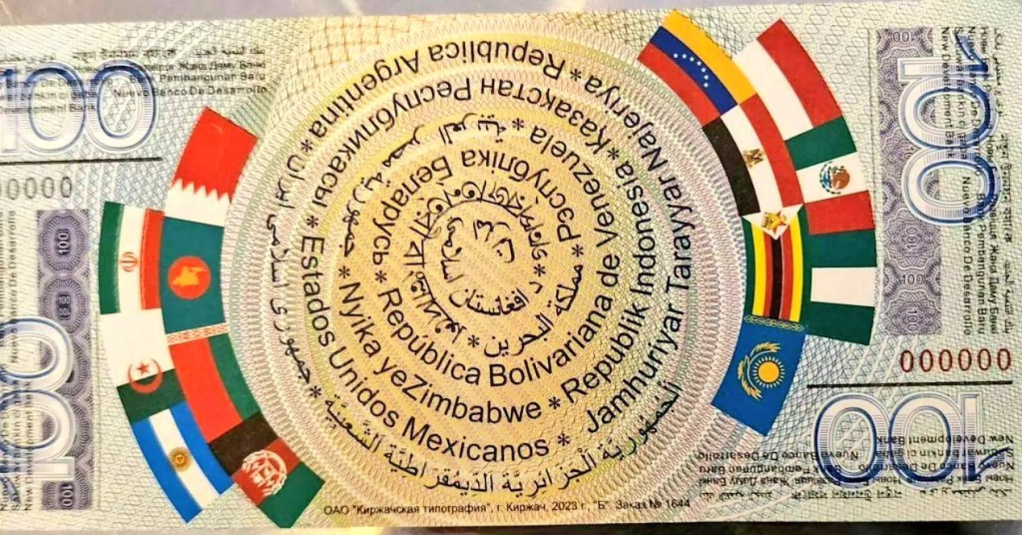
For years rumours have abounded, sometimes even from credible sources, that Mexico was on the brink of joining the BRICS. As readers may recall, Mexico’s flag was even among the 14 featured on the purely symbolic BRICS banknote Vladymir Putin flashed for the cameras at the 16th BRICS summit in Kazan last year (it’s the one in the middle of the far-right column). As we noted at the time, the stunt probably amounted to little more than expert trolling from Putin.

Russian Embassy spokesman Andrei Zemskiy recently acknowledged that the USMCA makes it much more difficult for Mexico to join the BRICS — a goal that Russia is openly pursuing. According to the renowned Mexican-Lebanese geopolitical analyst Alfredo Jalife, Mexico’s membership of the BRICS would be a net-positive for the country, but the US will never let it happen.

North America First (Until Now)

In the lead-up to the 15th meeting of the BRICS summit in Johannesburg in August 2023, South Africa’s Foreign Minister Naledi Pandor claimed that Mexico was among more than a dozen countries that had applied to join the alliance.

But each time the rumours reached fever pitch, the Mexican government batted them down. Here’s what former President Andres Manuel López Obrador (aka AMLO) had to say in response to Pandor’s claims (translation by yours truly):

“Our proposal is to strengthen the treaty with the United States and Canada, consolidate ourselves as a region, strengthen us, help each other, complement each other, share investment, technology, labour forces, the skills of the workers of the three countries, improve wages, and consolidate North America.”

On another occasion, AMLO conceded that Mexico’s geographic reality left it little choice but to pursue further economic integration with the US and Canada:

We cannot shut ourselves off, we cannot break up, we cannot isolate ourselves. It is a fact that we have 3,800 kilometres of border, for reasons of geopolitics (presumably in reference to the US’ invasion, occupation and appropriation of more than half of Mexico’s territory in the mid-19th century). With all due respect, we are not a European country, nor are we Brazil. We have this neighbourhood and, furthermore, if we agree on things, as we have done, we can help each other out… Our economic integration is already well advanced.

It initially seemed that AMLO’s presidential successor, Claudia Sheinbaum, would follow the same course. But since Donald J Trump’s return to the White House, Mexico’s already strained relations with the US have soured to the point of curdling.

How can one possibly talk about consolidating North America as an integrated economic bloc when the US is constantly threatening to impose tariffs on both of its North American trade partners, in direct violation of the USMCA trade agreement, while openly talking about invading Mexico and turning Canada into the 51st state?

Over the past week, Washington has declared Mexico a foreign “adversary” together with the likes of Iran, Russia and China. It has also imposed potentially ruinous sanctions against two Mexican banks and a brokerage house for allegedly laundering money for drug cartels without presenting any clear evidence. As is becoming increasingly clear, the move was essentially a shakedown by the Trump admin aimed at getting greater control over Mexico’s banking system as well as its relationship with China.

Until recently, the accepted wisdom in Mexico was that Mexico’s economy is simply too integrated with the US and Canada’s and too dependent on the US for it to be able to join the BRICS. Economically speaking, it seemed to make little sense: Mexico shares with the US the world’s largest trade partnership as well as a significant trade surplus whereas with China it has a significant — and growing — deficit.

Trump 2.0: The Great Global Unifier

But as we previously noted, if anyone is able to change this dynamic, it is Trump 2.0, the great global unifier:

…either through its constant bullying or its wilful destruction of the USMCA, a trade deal that Trump himself brokered and which Trump himself called the “best trade deal ever” just five years ago. Simply by calling Mexico an adversary and comparing the country with the likes of Russia, China and Iran, Trump’s attorney general has helped further alienate the US’ most important trade partner while further arousing anti-US sentiment among the Mexican public.

Lo and behold, one week later President Sheinbaum just announced that her government will be participating as an observer in the 17th annual meeting of the BRICS summit in Rio de Janeiro on July 6-7. Sheinbaum herself will not be part of the delegation since her government, she says, has enough on its plate at home. Instead, Mexico will be represented by its Foreign Minister Ramon de la Fuente.

It could be argued that this is part of a process that already began with AMLO’s election in 2018. Unlike many of his direct predecessors, AMLO was keen to reengage with Latin America and the Global South as a whole, even going so far as to rejoin the G77+China in 2023.

The BRICS association currently comprises ten countries – Brazil, Russia, India, China, South Africa, Egypt, Ethiopia, Indonesia, Iran and the United Arab Emirates. In October 2024, an additional 13 countries (Algeria, Belarus, Bolivia, Cuba, Indonesia, Kazakhstan, Malaysia, Nigeria, Thailand, Turkey, Uganda, Uzbekistan and Vietnam) were invited to participate as “partner countries”, allowing them to engage with and benefit from BRICS initiatives.

It’s worth stressing that Mexico is going as an observer country, which is the first of many steps towards becoming a member. It is not officially a member of the group and cannot participate in any of the internal decisions taken at the Summit. But it can give its opinion and collaborate in joint projects, especially in areas of economics and development. More importantly, it will be able to put out feelers to see what kinds of models of future collaboration may be on offer.

At the same time, the Sheinbaum government is intensifying efforts to diversify Mexico’s economic and trade relations away from the US. That includes a possible deepening of its trade ties with Brazil. In August, a key meeting is scheduled to take place between the two countries’ secretaries of Commerce and Foreign Affairs to discuss ways of expanding trade. Brazilian companies will also be in attendance and meeting with Mexican businessmen to see how the economies can complement each other.

“We can supply what Brazil doesn’t have and they can supply what Brazil has that we don’t, not only in terms of the trade agreement but also in terms of investments,” Sheinbaum said.

Together, Brazil and Mexico represent 65% of the GDP of Latin America and the Caribbean.  Trade between the two countries has already grown by over a third in the past six years, from $10 billion in 2019, to more than $13.5 billion in 2024, according to Rodrigo Almeida, head of the Commercial Sector of the Brazilian Embassy in Mexico. That is despite the very limited trade agreement currently in place between the two countries.

As the FT points out, $13.5 billion is still a tiny fraction of the $840bn of goods traded between the US and Mexico last year — and the $161.8bn in 2024 exchanged between Brazil and China in 2024. But there is also room for continued growth:

For Mexico, which is gearing up for a tense renegotiation of its USMCA deal with the US and Canada, Brazil could offer investment opportunities in sectors such as aerospace and pharmaceuticals, while helping ease its dependence on the US for imports of grains including yellow corn. Brazilian officials say its industrial and agribusiness sectors are interested in increasing exports to Mexico.

A major milestone came just over a year ago when the Mexican Mexicana de Aviación purchased 20 aircraft from the Brazilian company Embraer.

At the same time, Mexico is also looking to expand its bilateral trade with India, the EU and the United Arab Emirates. In her meeting last week with Indian Prime Minister Narendra Modi on the side lines of the G7, Sheinbaum discussed areas of opportunity, particularly regarding critical materials.

“We are very interested in the link with the pharmaceutical industry in India, but that it is invested in Mexico,” Sheinbaum said. “This year we are going to have a very important meeting about it.”

Even Mexican Businesses Are Looking Elsewhere

It’s not just Mexico’s government that is talking in earnest about diversifying Mexico’s economic and trade relations away from the US; so, too, is its biggest business lobby. The Employers’ Confederation of the Mexican Republic, or Coparmex, warned that the fallout from the US’ dramatic shift towards protectionism leaves Mexico little choice but to shift its trade policy towards closer ties with Asia, Africa and Latin America.

Edmundo Enciso, president of the Nearshoring and Foreign Trade Commission of Coparmex Mexico City, told El Economista that the tariffs imposed by the Trump administration on steel, the automotive sector and agricultural products are already generating devastating effects on value chains throughout North America. This, together with Trump’s crackdown on migration, the mass deportation of Mexican workers and his new tax on remittance payments, is destabilising entire communities in Mexico and destroying local employment.

“Mexico has a historic opportunity to diversify its alliances, and that does not mean breaking with the United States but rather rebalancing our relationship and developing an autonomous foreign policy, which puts Mexico’s interests at the centre,” said Enciso.

The fact that big business lobbies like Coparmex, which represent the interests of arguably the biggest beneficiaries of Mexico’s decades-long trade liberalisation with the US, are now calling for greater trade diversification hint at the scale of the damage Trump 2.0 has already inflicted on US-Mexico relations in its first five months in power…

Continue reading on Naked Capitalism

Is Washington Trying to Provoke a Full-Blown Banking Crisis in Mexico?

This time round, it wouldn’t be just US banks that would be heavily exposed to the resulting fallout; so, too, would European lenders.

Last week was the week that the United States “put Mexico’s banks on the ropes.” So reads a headline from El País a few days ago. The Trump administration had just imposed economic sanctions against two small Mexican banks, Intercam (total assets: $7 billion) and CIBanco (total assets: $4 billion), and a brokerage house called Vector (total assets: $12 billion) for allegedly laundering the proceeds of the cartels’ fentanyl trafficking business.

Four months after officially designating Mexican drug cartels as terrorist organisations, the US has fired its first salvo of economic sanctions against its southern neighbour and largest trade partner. The sanctions are the Treasury Department’s first actions under Biden-era anti-fentanyl legislation that now gives US federal agencies additional powers to combat money laundering associated with this drug and other synthetic opioids.

“Financial facilitators like CIBanco, Intercam and Vector are enabling the poisoning of countless Americans by transferring money on behalf of cartels, making them vital cogs in the fentanyl supply chain,” Treasury Secretary Scott Bessent said in a press release. “Through the first use of this powerful authority, today’s actions affirm the Treasury’s commitment to using all tools at our disposal to counter the threat posed by criminal and terrorist organizations trafficking fentanyl and other narcotics.”

As the former long-time partner of Soros Fund Management, Bessent has had plenty of experience crashing banks and foreign currencies (h/t The Night Wind). Meanwhile, here’s former CIA agent and current US Ambassador to Mexico Ron Johnson “saluting the leadership” of acting US Assistant Treasury Secretary Anna Morris, who is “advancing the commitment of POTUS Donald Trump to dismantle narco-terrorist cartels”.

The Treasury’s Financial Crimes Enforcement Network, or FinCEN, hit CIBanco, Intercam and brokerage Vector Casa de Bolsa SA with orders that essentially prohibit the entities from engaging in certain transfers of funds in the US as of July 15. The fallout, as intended, was rapid and brutal.

Within hours Fitch had downgraded the ratings of all three institutions and HR Ratings had downgraded the ratings of the two lenders. The brokerage house Vector announced the closure of its foreign exchange business. Predictably, institutional clients and investors began scrambling to pull their money out of the institutions, prompting Mexico’s banking regulator, the National Banking and Securities Commission, or CNBV, to temporarily step in to manage the three firms — “to safeguard the interests of customers, savers and investors”.

In pure damage limitation mode, the CNBV said in a statement that it had confidence in “the soundness and resilience of the Mexican financial system and will continue to work in ongoing coordination to foster its stability, integrity, and proper functioning.”

Edgar Amador Zamora, head of Mexico’s Ministry of Finance and Public Credit (SHCP), said that “Mexico’s banking system has not experienced any interruption, is operating normally and remains one of the most solid at the international level with capitalisation and liquidity ratios higher than those required by international standards, which allows the proper functioning of our financial markets.”

Whether this will be enough to calm market jitters and forestall a run on the two lenders, or other lenders in Mexico, time will soon tell. Meanwhile, the situation for the three banks affected continues to deteriorate. On Monday, Visa cancelled international transactions with CIBanco’s cards. Citi Group has taken steps to cut ties with CIBanco and Intercam. One silver lining is that the Mexico peso has not only remained firm against the dollar since the crisis began but has actually continued to strengthen.

As to the question in the title, the answer, I believe, is: not quite.

Washington is clearly trying to provoke a banking crisis in Mexico — indeed, has already achieved that goal — but it will presumably stop short of creating a full-blown one, assuming it can, for the simple reason that the resulting contagion could do serious harm to the US’ economy and financial sector. And if there is one thing Trump has so far proven to be somewhat sensitive to, it is the potential economic fallout of his policies.

“Nobody’s Piñata”

One thing that is clear is that Mexico’s Claudia Sheinbaum government and market participants are livid about the US’ latest intervention in Mexico’s affairs, particularly given the paucity of evidence presented against the three institutions to justify the imposition of sanctions and the way in which those sanctions were imposed.

In her morning press conference, Sheinbaum said her government had received a “confidential report” a few weeks ago from US authorities in relation to suspicions against the three institutions. But she claims that no concrete evidence was presented. 

“We are not going to cover up for anyone. There is no impunity, but it has to be proven that, in fact, there was money laundering taking place. Not with words, but with conclusive evidence,” Sheinbaum demanded in her morning press conference on Friday. “We coordinate, we collaborate, but we do not subordinate ourselves. Mexico is a great country and the relationship with the US is one of equals, not of subordination. We are not anyone’s piñata.”

Sheinbaum was not alone in her opprobrium. Many Mexican economists and analysts have accused the US of breaking its own basic operational rules and standards as well as flagrant hypocrisy. They include Enrique Quintana, the vice-president and general editorial director of Mexico’s most respected financial newspaper, El Financiero, which is affiliated with Bloomberg. In an editorial piece Friday, Quintana lambasted the Trump administration for taking a political action against Mexico’s banks without presenting a shred of evidence:

In the statement from the Financial Crimes Control Network under the Department of the Treasury, it is indicated that Mexican institutions had participated, directly or indirectly, in the processing of operations linked to fentanyl.

However, no forensic evidenceverifiable financial traces, or documentary evidence have been presented to the Mexican authorities to support such allegations.

Moreover, the accused entities were not given prior notification or summoned to any joint review process or bilateral investigation mechanism, as set out in the protocols on financial cooperation and the fight against organised crime.

Instead, the Treasury Department opted for public ridicule without trial or defence, in a tactic that, more than justice, smacks of political pressure.

In other words, the US is once again riding roughshod over the basic rules of engagement. The irony, says Quintana, is that Mexico has actually strengthened its financial supervision mechanisms in recent years:

The National Banking and Securities Commission (CNBV), the Financial Intelligence Unit (UIF) and the Bank of Mexico have tightened controls on unusual movementsstrengthened compliance processes in financial institutions and collaborated with international organizations to prevent operations with resources of illicit origin.

That said, it wouldn’t be hard for Trump’s anti-fentanyl taskforce to find Mexican banks and other financial institutions that are laundering the proceeds of fentanyl trafficking — especially given the preponderance of illicit money flows within Mexico’s economy, estimated to be worth more than 5% of GDP. But it would be just as easy, if not easier, to find US banks doing the same.

Another expert who sees political — or rather, geopolitical — motivations behind Washington’s latest salvo of economic sanctions is Rogelio Madrueño, a researcher at the Centre for Advanced Studies on Security, Strategy and Integration. Madrueño told El País that US actions should be framed as part of a strategic reconfiguration to confront its main global rival: China, and consequently use all the geo-economic instruments of its foreign policy to achieve strategic objectives (machine translated):

“In this context, there were already early warnings of a second wave of pressures in the field of money laundering, clearly aimed at the government of Mexico. In short, there is a real market, and it is potentially true. However, it is not a problem exclusive to Mexico, but regional and, in any case, it is being used as a tool of political pressure.”

The US is now demanding much closer surveillance of the 52 banks that make up Mexico’s banking system. According to El País, more than one bank is already reviewing its own anti-money laundering security protocols. Will that mean having to pay much closer attention to funds moving between Mexico and China and vice versa, which last year reached a record $132 billion?

In recent years, China has consolidated its position as Mexico’s second most important trading partner, accounting for 20% of the North American country’s total imports, up from 15% in 2015. Diplomatic relations between the two countries have also strengthened even as Mexico has bowed to US pressure and imposed some tariffs on Chinese goods. The US is determined to reverse this trend, and one way of doing that is to make it harder for Mexican companies to transact with their Chinese counterparts.

I suspect that one of the main reasons for the attack on Mexico’s banking system is simple power dynamics: put simply, Mexico, unlike Iran, Russia and China, is an easy target for Washington to hit. Whatever Sheinbaum may say, Mexico makes for an excellent piñata for the Trump administration, and arguably always has been for the US. And hitting it from time to time, whether figuratively or literally, may even bring electoral dividends among Trump’s base.

Another possible motive is to undermine political support for Mexico’s government, currently one of the most popular in Latin America, and drive a wedge between Sheinbaum and her presidential predecessor and mentor, Andrés Manuel López Obrador (aka AMLO).

As mentioned last week, the brokerage firm Vector is owned by the well-connected Mexican businessman Alfonso Romo, who served as former President Andrés López Manual Obrador’s point man with national and international business interests during AMLO’s first two years in power. Whether this will prove to be the long-sought smoking gun that ties AMLO to the drug cartels, allowing government agencies in Washington to build a legal case against the former president, remains to be seen.

Flagrant Hypocrisy

One thing that has not gone unnoticed in some quarters of the Mexican press is Washington’s more hands-off approach to US banks’ prolific laundering of drug cartels’ money.

Just five years ago, a wide-ranging investigation by the International Consortium of Investigative Journalists (ICIJ) called the FinCEN files revealed that many of the largest US and European banks, including JP Morgan Chase, HSBC and Deutsche Bank, had for almost two decades “defied money laundering crackdowns by moving staggering sums of illicit cash (over $2 trillion) for shadowy characters and criminal networks that have spread chaos and undermined democracy around the world.”

In 2009, when Wachovia was found to have failed to apply the proper anti-laundering strictures to the transfer of $378.4 billion into dollar accounts from so-called casas de cambio (CDCs) in Mexico in 2009, it paid a paltry $160 million fine.

When HSBC was caught a few years later engaging in similar behaviour, then-Attorney General Eric Holder (in the words of the US House Committee on Financial Services) “overruled an internal recommendation by DOJ’s Asset Forfeiture and Money Laundering Section to prosecute HSBC because of DOJ leadership’s concern that prosecuting the bank would have serious adverse consequences on the financial system,” giving birth to the Too Big to Jail moniker.

Then this happened in 2019:

There are even indications that drug money essentially saved some big banks from ruin during the Global Financial Crisis. In 2010, the head of the UN Office on Drugs and Crime Antonio Maria Costa said he had seen evidence that the  of organised crime were “the only liquid investment capital” available to some banks on the brink of collapse. As Yves noted at the time, what the UN’s drug tzar was essentially saying was that the banks entered into the money-laundering business on a much greater scale than before as a matter of survival.

Indeed, it is in the US where the US Treasury Department has encountered by far the highest number of money laundering alerts linked to fentanyl trafficking, accounting for a staggering 95 out of 100 alerts issued. As the Mexican daily La Jornada reports, around $100 billion of illicit funds is estimated to flow each year from global drug trafficking operations into the US financial system, including from the entire supply chain of fentanyl sold in the country, including the Treasury Department’s own accounts.

Yet to date no US bank has been singled out by FinCEN or has even reported an investigation of the money flowing in and out of the country with the largest population of addicts. Instead, the focus is on two small Mexican lenders and a brokerage house.

A Dangerous Move

The good news for Mexico is that the two banks targeted by the sanctions are too small to pose a systemic risk. CI Banco has 214 branches in Mexico and $7 billion in assets while Intercam has 60 branches and $4 billion in assets. They barely account for 2% of the total assets of the Mexican banking sector between them, according to Forbes.

Nonetheless, their sudden take down has dented confidence in Mexico’s financial system, and confidence is supremely important for any banking sector. Other Mexican lenders — and their clients, investors and lenders — are presumably wondering they will be next.

Let’s be clear about one thing: this was an act of economic warfare…

Read the full article on Naked Capitalism