The company that ” knows everything about you” is going from strength to strength as war rises and and the so-called “liberal” West turns into a dystopian novel.
Amid all the controversy generated by Trump’s $45 million birthday military parade on Sunday, with some claiming it was a giant flop while others insist it was a roaring success despite the low turnout, one thing appears to have been largely overlooked: Silicon Valley’s role in part-bankrolling the event.
As The Verge reports, while taxpayers footed the bill for the soldiers, tanks, and planes at the parade, several major tech firms helped pay for the “festivities” along the parade route. They included Oracle, Amazon, Coinbase, Meta, all with close ties to the Trump administration, and Palantir, Silicon Valley’s darkest unicorn which aspires to one day operate the US government’s common operating system. A number of blue-chip sponsors also pitched in, such as Chrysler, Dodge, Jeep, Ram, Coca-Cola, Walmart, BNY, Goldman Sachs and Exiger.
However, it was Palantir’s logo that was beaming from video boards above President Trump’s head. With soft rock guitar solos playing in the background and tanks rolling past the cheap-looking stage, accompanied by patrols of robot dogs, the scene had all the glamour and style of a low-budget Hollywood sci-fi from the mid-1980s. If Trump was looking to project a message of power to the world, it was a spectacular failure. But there was still plenty of menace on display.
Palantir said in an emailed statement on Sunday that the company “proudly supported yesterday’s celebration of the Army’s” 250th anniversary “alongside some of America’s greatest companies.”
Palantir Joins the Army
Palantir’s star is rising rapidly under Trump 2.0 while its shares hit record highs on an almost daily basis. The firm’s co-founder, Peter Thiel, was one of relatively few Silicon Valley moguls to bankroll Trump’s 2016 presidential campaign, and now he’s cashing in. Thiel is also a former employer-cum-mentor of Vice President JD Vance, whose senate run Thiel almost single handedly funded with a record breaking $15 million donation. This would seem to suggest that Thiel’s influence would be even greater in a Vance administration.
Palantir is involved in a new Pentagon initiative aimed at spurring innovation within the US army, titled Detachment 201. As Defense News reports, Shyam Sankar, Palantir’s chief technology officer, was one of four Silicon Valley tech execs invited to join the US Army Reserve as lieutenant colonel, to help inject their speed and expertise into the army’s military innovation. The other three Army Reserve lieutenant colonels were from Meta, Open AI and Thinking Machines Lab.
Granted, Silicon Valley has always been closely intertwined with the MIC and the CIA, with many big-tech firms receiving seed funding from one or the other, or both. But in the case of Palantir, the connections run deeper. The company essentially began life as an unofficial spin-off from DARPA’s Total Information Awareness (TIA) Program, which was ostensibly shut down in late 2003 when Congress decided that building a comprehensive surveillance program for all US citizens was perhaps a tad excessive, even in the post 9/11 era.
In reality, TIA would serve as the prototype for sweeping surveillance programs later developed by the NSA, and exposed by whistleblower Edward Snowden. Meanwhile, Palantir was created, with CIA seed funding (like so many Silicon Valley firms), to be the privatised version of TIA.
Now, its CTO has just enlisted in a new special corps within the US military. In an op-ed for the Free Press Project, Sankar notes that it would have been unthinkable for so many tech heavyweights to openly align with the US military just a decade ago:
Equally, it would’ve been out of character for the military to enlist the support of the nation’s business elite — much less to create a special corps so that they could deploy their technical talents in service of the government.
But a sea change has taken place in both places because of the urgency and seriousness of the moment.
Wars in Europe and the Middle East and, above all, the threat of a war in the Pacific have focused the national mind and initiated a scramble for mobilization. Exploding pagers and long-distance drone strikes from shipping containers prove that technology has once again changed the battlefield. Our military has to change with it.
As luck would have it, Palantir is a leading expert in exactly these kinds of technology. As leaked Los Angeles Police Department training documents revealed, its Gotham software collects and churns through huge reams of personal data, from gender, race, names, contact details, addresses, prior warrants, mugshots, surveillance photos, personal relationships, past and current employers, tattoos, scars, piercings and other identifying features.
The company says its programs help users to spot hidden relationships and networks, uncover terrorist activity, and even predict attacks. The darker the world grows, the richer the pickings for this increasingly menacing (but still relatively little known) company. It wasn’t as if there weren’t warnings that this day — the day of peak Palantir — would come, even from some mainstream media outlets.
In 2018, during Trump’s first term, Bloomberg published an in-depth piece titled:
Palantir Knows Everything About You
The subheading:
Peter Thiel’s data-mining company is using War on Terror tools to track American citizens. The scary thing? Palantir is desperate for new customers.
A couple of paragraphs:
Founded in 2004 by Peter Thiel and some fellow PayPal alumni, Palantir cut its teeth working for the Pentagon and the CIA in Afghanistan and Iraq. The company’s engineers and products don’t do any spying themselves; they’re more like a spy’s brain, collecting and analyzing information that’s fed in from the hands, eyes, nose, and ears. The software combs through disparate data sources—financial documents, airline reservations, cellphone records, social media postings—and searches for connections that human analysts might miss. It then presents the linkages in colorful, easy-to-interpret graphics that look like spider webs. U.S. spies and special forces loved it immediately; they deployed Palantir to synthesize and sort the blizzard of battlefield intelligence. It helped planners avoid roadside bombs, track insurgents for assassination, even hunt down Osama bin Laden. The military success led to federal contracts on the civilian side. The U.S. Department of Health and Human Services uses Palantir to detect Medicare fraud. The FBI uses it in criminal probes. The Department of Homeland Security deploys it to screen air travelers and keep tabs on immigrants.
Police and sheriff’s departments in New York, New Orleans, Chicago, and Los Angeles have also used it, frequently ensnaring in the digital dragnet people who aren’t suspected of committing any crime. People and objects pop up on the Palantir screen inside boxes connected to other boxes by radiating lines labeled with the relationship: “Colleague of,” “Lives with,” “Operator of [cell number],” “Owner of [vehicle],” “Sibling of,” even “Lover of.” If the authorities have a picture, the rest is easy. Tapping databases of driver’s license and ID photos, law enforcement agencies can now identify more than half the population of U.S. adults.
If Palantir knew everything about us in 2018, it presumably knows even more today, after purportedly participating in Elon Musk’s DOGE “clean-up” of government spending as well as an effort to build a new “mega API” for accessing Internal Revenue Service records.
Palantir has also found new customers along the way, including an array of government departments, from US Immigration and Customs Enforcement (ICE) to NHS England, as well as banks, other tech firms, insurance providers, Wendy’s and a resurgent NATO. A company that aspires to be “in every missile (or drone)” and whose CEO, Alex Karp, openly brags about helping to kill “mainly terrorists”, has found fertile room for growth in both the US’ private healthcare industry and the UK’s publicly owned NHS.
While two-thirds of its sales are still US-based, the company is rapidly expanding its overseas operations, particularly to the UK. As we noted a couple of months ago, the Trump and Starmer governments may differ wildly in terms of style, language and professed ideals, but they have some key things in common:
Both are looking to transform their respective countries into AI powerhouses while also launching similar full-frontal assaults against basic democratic rights and freedoms, including freedom of speech and the right to protest. Both have launched brutal crackdowns on protests against Israel’s genocide of Gaza (and both are now fully behind Netanyahu’s reckless war on Iran).
A Leading Financial Indicator for Dystopia and War
In fact, one would be hard pressed to find a more reliable financial indicator for dystopia and war in the collective West than Palantir Technologies’ company stock. Note how the graph has steepened in recent months.
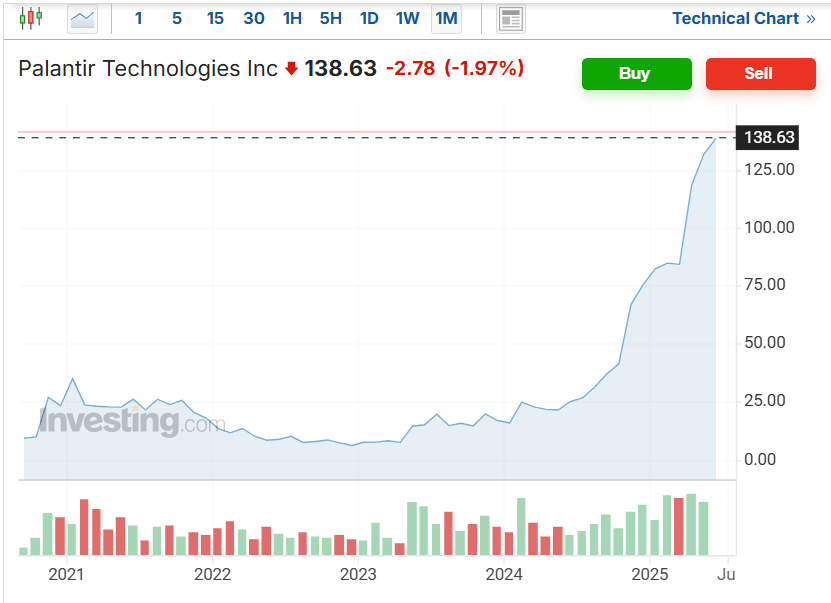
In May, as the wars escalated in the Middle East and Eastern Europe and as ICE intensified its raids against undocumented workers, Palantir was the S&P 500’s top-performing company. Since Trump 2.0 took over in late January, the company’s shares have almost doubled. In the past year alone, they are up 470%. To put that in perspective, the S&P’s Aerospace & Defense Select Industry Index has offered returns of just 40% over the same time period.
Granted, Palantir has one of the highest P/E ratios on the planet, at 617. The P/E ratio compares a company’s share price with its earnings per share, and is often used to determine the relative value of a company’s share in side-by-side comparisons. The fact that investors are willing to invest so much in a company that is still earning so little, relatively speaking, suggests they see a bright future ahead for the AI-empowered surveillance and control technologies that Palantir specialises in.
In other words, they are going long on war overseas and repression at home…
Continue reading on Naked Capitalism
 Nick Corbishley