As Washington Declares Mexico An “Adversary”, Russia Offers to Help Mexico Reduce Its Energy Dependence on US

The Trump administration’s global charm offensive continues apace.

On Wednesday, President Trump posted footage on his Truth Social platform of B2 stealth fighter jets dropping bombs to the soundtrack of “Bomb Iran,” a parody of the Beach Boys’ 1960’s song “Barbara Ann”, just days after imposing a fragile — or in the words of the former British diplomat Craig Murray, “phantom” — ceasefire on Iran and Israel. Trump also threatened to impose tariffs on Spain after the Pedro Sánchez government had the temerity to question the wisdom of tripling Spain’s defence spending over the next ten years before falling into line.

On the same day, Trump’s Attorney General, Pam Bondi, seemed to suggest that the US has updated its list of “foreign adversaries” by throwing Mexico, the US’ largest trade partner, into the mix alongside more established names like Iran, Russia and China. The revelation came during a Senate Expenditures Committee hearing in which Bondi praised to the rafters Trump’s leadership in the face of international crises, such as the conflict in the Middle East, as well as his role in protecting US citizens from external threats, including the drug overdose epidemic.

“We will not be intimidated and we will keep America safe because of President Trump’s leadership. Not only against Iran, but also against Russia, China and Mexico,” Bondi said in response to questions by the chicken-hawk neo-con Senator Lyndsey Graham. “In the face of any foreign adversary, whether it tries to kill us physically or by overdosing our children with drugs, we will do everything in our power, thanks to his leadership, to keep America safe.”

Graham asked whether Mexico was helping the US with its drug problem, to which Bondi responded:

Senator, that conversation might be better to have in a classified setting. 

However, Bondi did say that the “Sinaloa Cartel has wreaked havoc in our country, and continues to wreak havoc. And fentanyl keeps coming in.” What she didn’t mention is that deaths caused by fentanyl have fallen by 26% from a 2023 peak, according to estimates by the CDC.

Graham, meanwhile, was happy to fill in the gaps, alleging that half of Mexico is run by the cartels:

We’re never going to be safe here until we get Mexico to change its strategy… Enough, enough with Mexico. Enough of that crap. We are going to go after them with or without help from Mexico because I do not know what the right response is against a neighbour who allows this type of illegal thing to enter our country and kill more young people than any other.

A Convenient Scapegoat

Lyndsey Graham has been trying to pin all the blame for the US’ opioid crisis on Mexico for some time now while trying to obfuscate the much darker truth: as Peter Isackson pointed out in 2019, “the very real opioid crisis did not originate south of the border, but is a totally domestic problem whose source has now been clearly identified. The culprit: OxyContin, a multibillion dollar opioid manufactured and marketed in the United States by the very American firm, Purdue Pharma, owned by the Sackler family.”

Granted, in recent years the US’s opioid crisis has morphed into a fentanyl crisis, much of which appears to be entering the US via Mexico. However, as Mexico’s President Claudia Sheinbaum has repeatedly noted, the US tends to view its narcotics problem exclusively through a supply-side lens. That way, all of the blame for the US’ opioid crisis can be shifted overseas, diverting attention away from the role played by US pharmaceutical companies such as the Sacklers’ Purdue Pharma in starting and fuelling the opioid epidemic.

Meanwhile, the Trump administration continues to ramp up the pressure on Mexico. A couple of weeks ago, Trump’s Secretary of Homeland Security accused Sheinbaum of encouraging the violent protests against ICE raids in Los Angeles. Donald Trump’s son, Eric, also made incendiary remarks on Fox News while drawing a comparison between Iran’s recent attacks on Israel and a hypothetical attack by Mexico on the US: “if Mexico were to fire rockets into the US, I think they would be decapitated in about four seconds.”

The US is also escalating its financial war against the Mexican cartels, some of which Trump recently designated as terrorist organisations. This week, the Treasury Department accused three Mexican financial institutions of participating in money laundering on behalf of drug cartels involved in fentanyl trafficking between Mexico and the US. They included the brokerage firm Vector Casa de Bolsa, which is owned by the Mexican businessman Alfonso Romo, who served as former President Andrés López Manual Obrador’s interface with national and international business interests during AMLO’s first two years in power.

Whether this will prove to be the long-sought smoking gun that ties AMLO to the drug cartels, allowing government agencies in Washington to build a legal case against the former president, remains to be seen. It is also unclear what punishment the US will end up meting out against these three financial institutions, and what kind of reverberations they could trigger for Mexico’s broader economy.

This is all part of an intensifying war of words — and actions — the US is waging against its southern neighbour and largest ever trade partner, using the excuse of the Global War on Drugs to justify ever increasing encroachments on Mexico’s already limited sovereignty.

Recent months have seen US spy planes increasing their surveillance at the Mexican border, the US’ renaming of the Gulf of Mexico to Gulf of America, the appointment of a former Green Beret and CIA agent as US ambassador to Mexico, the imposition of a tax on all remittance payments issued from the US and now the threat to designate Mexico as a US “adversary.” As far as I’m aware, for Mexico to be officially considered a foreign adversary, an executive order must be issued by the White House.

In one of his first acts as US ambassador to Mexico, Ron Johnson tweeted out the following veiled warning about China’s threat to critical infrastructure and food security:

The Chinese embassy in Mexico responded with the following message:

“Being an enemy of the United States is dangerous, but being a friend is fatal.” A true friend doesn’t forcibly plunder your land, discriminate against migrants, or arbitrarily impose tariffs on you. Equity, respect, cooperation, and shared benefits constitute the proper way for countries to treat each other. Our Mexican friends are fully aware of the “two-faced” tricks of feigning cooperation while stabbing in the back.

Russian Offers of Help

At the same time, Moscow is pushing for closer relations with Mexico. Speaking at the Saint Petersburg International Economic Forum (SPIEF) last weekend, Russia’s Energy Minister Sergei Tsivilev announced that Russia is ready to supply liquefied natural gas (LNG) to Mexico as well as share some of its technologies and know how. The offer of help comes at a time when Mexico is importing a staggering 70% of the natural gas it uses from from the United States, most of which arrives in pipelines and is used for electricity generation and industry.

The risks of such dependence became glaringly evident during the Texas winter storm in 2021, when power outages caused millions in losses in Mexico, as a result of which the Mexican government has sought to expand its strategic gas storage capacity. The New York Times even described Mexico’s outsized — and growing — reliance on US natural gas as its Achille’s heel in its relations with the Trump administration.* Now, it seems that Russia is keen to lend Mexico a helping hand…

Read the full article on Naked Capitalism
Javier Milei’s Controversial “Memorandum of Understanding” With Israel

Milei’s chainsaw austerity will not apply to Israeli residents of Argentina. Meanwhile, Israel’s national water company controls more and more of Argentina’s water supply.   

Just two days day before Israel launched its first series of attacks against Iran on June 13, Argentina’s faux libertarian president Javier Milei was in Jerusalem to receive the Genesis Prize in a special ceremony at the Knesset. The award, often referred to as the “Jewish Nobel”, includes a $1 million cash prize that Milei said he will donate to programs aimed at fostering closer relations between Latin American nations and Israel.

With the world’s sixth-largest Jewish population, Argentina has traditionally been a close ally of Israel. In fact, the southern Argentinian region of Patagonia was on the short-list of candidates for the founding of a Jewish state in the late 19th century.

Relations between the two countries have only got stronger since Milei, an aspiring Jewish convert with close ties to the highly influential Chabad Lubavitch movement, took over as president in December 2023. One of his first acts in government was to cancel Argentina’s entry into the BRICS-plus association before it even happened and align Argentina with the US and Israel. Months later, his government would apply to become a NATO “Global Partner”.

“Freedom, Democracy and Western Values”

When Israel and Iran locked horns in April 2024, Milei called an immediate cabinet meeting in Buenos Aires that he then allowed Israel’s ambassador to Argentina to effectively chair. After that meeting, Milei told a veteran journalist off record that Argentina “cannot be neutral in the Third World War.” When it comes to Israel, Milei has never been neutral, as he was happy to remind the members of the Knesset during his acceptance speech for the Genesis Prize:

Unfortunately, I am not fortunate enough to be here in happy times; with the Hamas attack on October 7, 2023, the Israeli people have been victims of the most aberrant aggression in the last 80 years and the entire free world has witnessed the face of the most abject barbarism…

Argentina is not going to stay on the sidelines. As I announced in my first participation in the UN, Argentina will raise its voice and strengthen in favour of the defence of our fellow human beings. The nations that defend Western culture, our way of life, our political and civil understanding based on the defence of freedom, property and life, have to be together and align ourselves to guard that legacy, establishing new political, commercial, cultural, diplomatic and military ties: an alliance of free nations.

I have said from the beginning of my administration that I consider Israel, together with the United States, our most important strategic partner. Our present agenda is diametrically opposed to that of previous governments, which – disregarding the unbreakable bond between our peoples – decided to make pacts with dictatorships of all kinds. They made common cause with oppression, despotism and intolerance, perhaps because that is where they wanted to direct the destinies of our nation. We choose freedom, democracy and Western values, the same maxims that Israel defends in a region where they are so scarce.  

During his latest stay in Jerusalem, Milei prayed at the Wailing Wall for the second time since taking office. He and his sister met with Prime Minister Benjamin Netanyahu and senior members of his cabinet, though details of the meeting were not released. One of the results, however, was the signing of a “Memorandum in Defence of Freedom and Democracy against Terrorism and Anti-Semitism” that reaffirms the strategic alliance between Argentina and Israel.

The Memorandum sets the stage for unprecedented cooperation against terrorism, cybercrime investigations, establishing fast-track customs lanes, joint satellite launches and water technology centres on the Paraná River, Argentina’s most important trade and transport waterway. As readers may recall, the Milei government has already signed an agreement with Washington allowing for the stationing of members of the US Army Corps of Engineers along the Argentine sections of the river.

A commercial agreement was also signed that establishes direct flights between Buenos Aires and Tel Aviv. According to La Nación, the memorandum have been designed to deepen security ties and innovation cooperation not only between Israel and Argentina but throughout the Southern Cone:

Hence, the Memorandum has also been baptized as the “Isaac Accords”, as if it were something similar to the “Abraham Accords” sealed by Israel and several Arab countries in the Persian Gulf region, but in the far south of the Latin American continent.

On June 12, the Milei government made official a long-standing proposal for a social security agreement with Israel that will enable the payment of welfare benefits to Israeli citizens with residency permits in Argentina. The measure was first drafted in 2017 by the then-Mauricio Macri government and was enacted by the Milei government in May 2024. But it wasn’t included in Argentina’s official gazette, and thereby fully activated, until June 12.

The agreement means that any Israeli citizen with legal residence in Argentina will be able to receive pensions, retirements and social benefits such as maternity, disability and other contributory benefits. In exchange, any Argentine citizens residing in Israel will be able to access the social security system of that country, in a reciprocity scheme.

This kind of reciprocal arrangement is standard practice for countries around the world, and Argentina has already similar deals with many other nations. Generally speaking, they make life easier for individuals who have worked in multiple countries by preventing dual taxation of social security and addressing gaps in benefit coverage. However, this particular agreement between Argentina and Israel is controversial, for at least four reasons:

  1. Israel’s near-pariah status. Israel is committing a genocide in Gaza and its prime minister and former defence minister are currently wanted for the crimes of starvation as a method of warfare and of intentionally directing an attack against the civilian population of Gaza. Seeking closer strategic alignment with a country that is verging on pariah status is not a good look. Even the EU has released a report, far too late in the day, corroborating UN allegations that Israel is guilty of “indiscriminate attacks … starvation … torture … [and] apartheid” against Palestinians;
  2. Timing. The arrangement became official literally the day before Israel attacked Iran in an unprovoked act of aggression — the “ultimate war crime” according to the Nuremberg Tribunal and the US Prosecutor Justice Jackson. Given the escalating wars in their direct neighbourhood and the bombs dropping directly on Tel Aviv and Haifa, many Israelis are presumably looking for a bolthole. With its already large Jewish community, Argentina would fit the bill nicely, especially given its new direct air connection with Tel Aviv and reciprocal social security agreement.
  3. Where’s the money? According to Milei, there is no money left in his government’s coffers, which is why his government has slashed spending on public goods like education, healthcare, transport and infrastructure. As Diario Notes, “it is striking for many Argentines that while benefits are cut to the local citizens themselves, new expenditures are enabled in the name of international reciprocity.”

In February, the government dismantled the palliative care program of the National Cancer Institute. It has ripped funding from hospitals, universities and scientific research centres and slashed public subsidies for public transport and energy, including for low-income households.

As we noted at the time, the economic pain being visited upon millions of Argentinean workers and pensioners is not an unfortunate by-product or unintended consequence; it is the intended goal — to impoverish workers and pensioners to the point where they cannot fill their shopping basket or buy even the most basic of necessities. If you starve the economy of demand, inflation eventually has to go down. Which it has, albeit at the cost of almost killing the host.

Indeed, Milei’s chainsaw austerity has been so brutal that it has even begun to hit the quality of bank credit, as Bloomberg reported a couple of weeks ago:

Banks in recent weeks started recording initial signs of credit deterioration. Overdue credit card balances climbed to 2.8% in March, the highest in three years, while defaults on personal loans jumped to 4.1%, the highest in nine months, according to the country’s central bank. The number of bounced checks is on the rise, too.

Overall, bad debt charges across Argentina’s financial system reached a five-year peak when measured as a share of total assets, the central bank data show.Stress is also building among corporates, with an increase in business defaults pointing to more troubles ahead.

No hay plata” (there’s no money) is one of Milei’s most common slogans. But it depends what for. There’s still money to buy second-hand F-16 fighter jets from the US, via Denmark. There’s also money for the ever-larger riot police operations needed to violently suppress public protests, including the hundreds of elderly retirees who gather outside parliament every Wednesday to demand higher pensions.

And there’s money for Israeli citizens to access state-funded pensions and other social benefits — at a time of rampant austerity for Argentina as a whole. As the Mexican media outlet Milenio notes, this is another gesture from Milei of Argentina’s geopolitical realignment:

We are seeing a huge wave of cuts to social spending for the majority of the Argentine public, hitting medicines, university budgets, basic subsidies, and the Milei government decides to activate a policy that allows these kinds of additional contributions from the Argentine State — all on the basis of a supposed international reciprocity.

But as we have been arguing for the past year and a half, it is far from clear how Argentina — as in the people, not the government — is benefiting from any of these realignment efforts, whether with the US or Israel. With regard to the latter, the risks are clearly rising as the Milei government maintains its full-throated, uncritical support of Israel’s genocidal regime even as it starves Gaza to death and launches an unprovoked attack against Iran, which could ignite a regional, if not world, war…

Continue reading on Naked Capitalism

Christine Lagarde’s Delusions of Grandeur(o)

As the US dollar’s decline deepens, is this the EU’s “global Euro moment”?  

Before we get into the meat of this piece, a brief word of caution from our host on the inherent dangers of discussing de-dollarisation (taken from Yves’ preamble to a 2023 interview with Michael Hudson on the topic):

It seems most commentators are adopting one of two positions, either defending the dollar or eagerly predicting a quick demise.

This is not how this kind of transition happens. As we stressed, it took two world wars and the Great Depression to dethrone sterling. The fact that countries are succeeding in reducing their attack surface to US sanctions by engaging in more bilateral trade does reduce the perception of US power (keep in mind sanctions never worked as well as the PR would have you believe).

The fact is that trade-related foreign exchange flows are a tiny fraction of investment-related foreign exchange trading. The level ebbs and flows, but a Bank of International Settlements study put it at 60x the level of trade flows. I have not seem more current work.

On top of that, the effort to promote more bilateral trade is already exhibiting the sort of issues your humble blogger predicted. Unless the two countries engage in close to balanced trade (not likely) one country will wind up accumulating the currency of anther country. From Outlook India in Russia Has Accumulated Billions Of Rupees In Indian Banks: Russian FM Sergei Lavrov:

Russian Foreign Minister Sergei Lavrov has said that Russia has accumulated billions of rupees in Indian banks which it can’t use.

According to the report in NDTV, Lavrov Foreign pointed to a ballooning trade surplus with India.

“This is a problem,” the report quoted Lavrov as having said in Goa on the sidelines of the Shanghai Cooperation Organization meeting.

Why is winding up with rupees different than winding up with the dollar? The US has the most liquid and deep capital markets, so countries that wind up holding them can park them in financial assets. As the Asian crisis showed, central banks lacking foreign exchange reserves were unable to defend themselves from currency crises, which put them at the mercy of the IMF. After that episode, the Asian Tigers managed their affairs so as to influence currency pricing so that among other things, they’d run trade surpluses and accumulate foreign currencies, mainly the dollar.

By contrast, India does not have a lot in the way of investible assets, so it’s not as if Russia could readily sell much of its holdings to investors. The only other sort of part that would want rupees would be a country that was running a trade deficit with India. But are there remotely enough takers of that sort?

This illustrates a wee problem. Having a more finanicialized economy is an advantage in the “desirable financial asset” category, even though, as we have seen, financialization beyond a certain models level is sub-optimal for growth (this per the IMF).

In recent years there has been a lot of chatter about a BRICS-based currency or basket of currencies emerging to fill the growing gap left over by a declining dollar, but there’s still little to show for it — at least publicly. India has repeatedly declared a lack of interest in the idea, with its foreign minister warning last year that the legal structure would entail a reduction, rather than an enhancement, of sovereignty (BRICS rulings would have to supersede national courts). Brazil has also poured cold water on the idea in recent months.

Which brings us to the point of this post. Given there is presently no other realistic alternative to the dollar, at least in the form of a national currency, perhaps this is “Europe’s global euro moment.” That is the thrust of a recent Financial Times op-ed by European Central Bank President Christine Lagarde.

Bear in mind that Lagarde is not a Brussels-based apparatchik that is prone to making sweeping, ill-considered public statements; she is the Euro Area’s most senior central banker, albeit one with a background in international law and politics rather than finance. And central bankers tend to weigh their words in public a lot more carefully than most politicians, especially regarding something as important as the future of the world’s reserve currency system.

Lagarde has also proven herself to be a faithful servant of the Transatlantic business and financial elite, to the point of being convicted of negligence for her approval of a €404 million award to billionaire businessman Bernard Tapie for the disputed sale of a firm, for which she faced no punishment. She is also hotly tipped to replace Klaus Schwab in the top job at the World Economic Forum in Switzerland.

As such, the fact that Lagarde is talking openly about Europe’s need to seize the opportunity presented by the US’ economic decline, the weakness of the US dollar, down over 10% against the euro, the pound and the Swiss franc since Trump’s inauguration, and rising economic and geopolitical uncertainty, in order to boost the global standing of the euro currency should not be dismissed out of hand, no matter how deluded it may sound (more on that later).

One thing we can rest assured is that she is not just speaking for herself. Here are the first three paragraphs of the op-ed:

We are witnessing a profound shift in the global order: open markets and multilateral rules are fracturing, and even the dominant role of the US dollar, the cornerstone of the system, is no longer certain. Protectionism, zero-sum thinking and bilateral power plays are taking their place. Uncertainty is harming Europe’s economy, which is deeply integrated in the global trading system, with 30mn jobs at stake.

But the shift under way also offers opportunities for Europe to take greater control of its own destiny and for the euro to gain global prominence. At present, the euro is the world’s second most-used currency, accounting for 20 per cent of global foreign exchange reserves, compared with 58 per cent for the US dollar.

Increasing the euro’s global status would bring tangible benefits: lower borrowing costs, reduced exposure to currency fluctuations and insulation from sanctions and coercive measures.

This is not so much a delusion as it is an outright lie. How would increasing the euro’s global status insulate countries from sanctions and coercive measures when the EU itself is one of the world’s biggest users of sanctions and coercive measures globally. The 27-nation bloc just imposed its 17th round of sanctions against Russia. Lagarde herself was just in Ukraine where, according to Ukraine’s finance minister, she discussed “possible steps toward confiscating frozen Russian assets” — something the EU has been talking about doing for a long time:

The EU has also built the world’s largest online censorship regime. It also frequently resorts to coercive measures — or the threat thereof — against its own members. For example, it has threatened Spain with legal action if its government tries to prevent a hostile bank takeover from taking place on its own territory. It also cancelled the first round of elections in Romania last year after a majority of Romanians voted for the wrong sort of candidate.

The Real Beneficiaries

As even Lagarde herself concedes, the EU has not benefitted from the US dollar’s decline, from over 70% of global foreign exchange reserves to under 60%. As Thomas Fazi points out in an article for Unherd, “the euro’s global footprint has barely exceeded the aggregate use of the national currencies it replaced — roughly 20% of global foreign exchange reserves… Instead, currencies including the Swiss franc, British pound, and Japanese yen have picked up the slack. There’s little reason to believe the euro’s status will now improve.”

In fact, global investors, including many central banks, are increasingly turning to gold as a safe haven. In fact, as the European Central Bank itself pointed out in a recent study, gold surpassed the euro last year to become the world’s second-largest reserve asset among global central banks, following a record buying spree.

As the FT reported in its article, “How Gold Became the World’s Refuge from Uncertainty”, Trump’s trade war against the world, “combined with rising geopolitical tensions and questions about the long-term role of the US dollar, have all contributed to a blistering gold rally — one that has taken even gold boosters by surprise.” And it is central banks, including some in Eastern Europe, that are doing much of the buying.

Indeed, one of the central banks that has bought the most gold over recent years is the Narodowy Bank Polski (NBP). In the second and third quarters of last year, Poland’s central bank was the world’s largest buyer of gold. Following its purchases in Q1-2025, NBP now has more gold reserves (509 tonnes) than the European Central Bank itself (507 tonnes), which are worth over $1 trillion at the current gold price.

Other eastern European central banks, including Hungary, Czechia’s and Serbia’s have stepped up their gold purchases in recent years, particularly after the sanctions imposed on Russia following the launch of its Special Military Operation in Ukraine, in February 2022. Arguably the most important driver of exploding demand for gold, which the FT piece studiously ignores, is collapsing trust in the Western financial order as a result of the seizure of Russian assets, including its gold, by the US, EU and UK.

Three Foundational Pillars

According to Lagarde, the Euro Area can still take advantage of the dollar’s decline — by strengthening “three foundational pillars: geopolitical credibility, economic resilience, and legal and institutional integrity”:

First, the euro’s global standing rests on Europe’s role in trade. The EU is the world’s largest trader — it is the number one partner for 72 countries, representing almost 40 per cent of global GDP. This is reflected in the share of the euro as an invoicing currency, which stands at around 40 per cent. The EU must use this position to its advantage by forging new trade agreements.

The first claim is also a flat out lie: it is China that is the world’s largest trader, representing the number one trade partner for around 120 countries, according to the Wilson Center. Also, Lagarde’s insistence on forging more trade agreements, as if that is all the EU needs to do to enhance its “geopolitical credibility”, shows just how wedded Lagarde and her handlers remain to long-discredited neoliberal ideas.

If she had learnt anything from China’s progress in recent decades, she would be talking about seeking win-win deals, engaging with governments in the “Global South” on a more equal basis and abandoning the militarist, interventionist way of thinking. In fact, there is not a single mention of China, the BRICS or the Global South in the article, which perhaps doesn’t come us a surprise. It’s just one more example of Western arrogance, hubris and self-absorption…

Continue reading on Naked Capitalism

Welcome to Peak Palantir

The company that ” knows everything about you” is going from strength to strength as war rises and and the so-called “liberal” West turns into a dystopian novel.

Amid all the controversy generated by Trump’s $45 million birthday military parade on Sunday, with some claiming it was a giant flop while others insist it was a roaring success despite the low turnout, one thing appears to have been largely overlooked: Silicon Valley’s role in part-bankrolling the event.

As The Verge reports, while taxpayers footed the bill for the soldiers, tanks, and planes at the parade, several major tech firms helped pay for the “festivities” along the parade route. They included Oracle, Amazon, Coinbase, Meta, all with close ties to the Trump administration, and Palantir, Silicon Valley’s darkest unicorn which aspires to one day operate the US government’s common operating system. A number of blue-chip sponsors also pitched in, such as Chrysler, Dodge, Jeep, Ram, Coca-Cola, Walmart, BNY, Goldman Sachs and Exiger.

However, it was Palantir’s logo that was beaming from video boards above President Trump’s head. With soft rock guitar solos playing in the background and tanks rolling past the cheap-looking stage, accompanied by patrols of robot dogs, the scene had all the glamour and style of a low-budget Hollywood sci-fi from the mid-1980s. If Trump was looking to project a message of power to the world, it was a spectacular failure. But there was still plenty of menace on display. 

Palantir said in an emailed statement on Sunday that the company “proudly supported yesterday’s celebration of the Army’s” 250th anniversary “alongside some of America’s greatest companies.”

Palantir Joins the Army

Palantir’s star is rising rapidly under Trump 2.0 while its shares hit record highs on an almost daily basis. The firm’s co-founder, Peter Thiel, was one of relatively few Silicon Valley moguls to bankroll Trump’s 2016 presidential campaign, and now he’s cashing in. Thiel is also a former employer-cum-mentor of Vice President JD Vance, whose senate run Thiel almost single handedly funded with a record breaking $15 million donation. This would seem to suggest that Thiel’s influence would be even greater in a Vance administration.

Palantir is involved in a new Pentagon initiative aimed at spurring innovation within the US army, titled Detachment 201. As Defense News reports, Shyam Sankar, Palantir’s chief technology officer, was one of four Silicon Valley tech execs invited to join the US Army Reserve as lieutenant colonel, to help inject their speed and expertise into the army’s military innovation. The other three Army Reserve lieutenant colonels were from Meta, Open AI and Thinking Machines Lab.

Granted, Silicon Valley has always been closely intertwined with the MIC and the CIA, with many big-tech firms receiving seed funding from one or the other, or both. But in the case of Palantir, the connections run deeper. The company essentially began life as an unofficial spin-off from DARPA’s Total Information Awareness (TIA) Program, which was ostensibly shut down in late 2003 when Congress decided that building a comprehensive surveillance program for all US citizens was perhaps a tad excessive, even in the post 9/11 era.

In reality, TIA would serve as the prototype for sweeping surveillance programs later developed by the NSA, and exposed by whistleblower Edward Snowden. Meanwhile, Palantir was created, with CIA seed funding (like so many Silicon Valley firms), to be the privatised version of TIA.

Now, its CTO has just enlisted in a new special corps within the US military. In an op-ed for the Free Press Project, Sankar notes that it would have been unthinkable for so many tech heavyweights to openly align with the US military just a decade ago:

Equally, it would’ve been out of character for the military to enlist the support of the nation’s business elite — much less to create a special corps so that they could deploy their technical talents in service of the government.

But a sea change has taken place in both places because of the urgency and seriousness of the moment.

Wars in Europe and the Middle East and, above all, the threat of a war in the Pacific have focused the national mind and initiated a scramble for mobilization. Exploding pagers and long-distance drone strikes from shipping containers prove that technology has once again changed the battlefield. Our military has to change with it.

As luck would have it, Palantir is a leading expert in exactly these kinds of technology. As leaked Los Angeles Police Department training documents revealed, its Gotham software collects and churns through huge reams of personal data, from gender, race, names, contact details, addresses, prior warrants, mugshots, surveillance photos, personal relationships, past and current employers, tattoos, scars, piercings and other identifying features.

The company says its programs help users to spot hidden relationships and networks, uncover terrorist activity, and even predict attacks. The darker the world grows, the richer the pickings for this increasingly menacing (but still relatively little known) company. It wasn’t as if there weren’t warnings that this day — the day of peak Palantir — would come, even from some mainstream media outlets.

In 2018, during Trump’s first term, Bloomberg published an in-depth piece titled:

The subheading:

Peter Thiel’s data-mining company is using War on Terror tools to track American citizens. The scary thing? Palantir is desperate for new customers.

A couple of paragraphs:

Founded in 2004 by Peter Thiel and some fellow PayPal alumni, Palantir cut its teeth working for the Pentagon and the CIA in Afghanistan and Iraq. The company’s engineers and products don’t do any spying themselves; they’re more like a spy’s brain, collecting and analyzing information that’s fed in from the hands, eyes, nose, and ears. The software combs through disparate data sources—financial documents, airline reservations, cellphone records, social media postings—and searches for connections that human analysts might miss. It then presents the linkages in colorful, easy-to-interpret graphics that look like spider webs. U.S. spies and special forces loved it immediately; they deployed Palantir to synthesize and sort the blizzard of battlefield intelligence. It helped planners avoid roadside bombs, track insurgents for assassination, even hunt down Osama bin Laden. The military success led to federal contracts on the civilian side. The U.S. Department of Health and Human Services uses Palantir to detect Medicare fraud. The FBI uses it in criminal probes. The Department of Homeland Security deploys it to screen air travelers and keep tabs on immigrants.

Police and sheriff’s departments in New York, New Orleans, Chicago, and Los Angeles have also used it, frequently ensnaring in the digital dragnet people who aren’t suspected of committing any crime. People and objects pop up on the Palantir screen inside boxes connected to other boxes by radiating lines labeled with the relationship: “Colleague of,” “Lives with,” “Operator of [cell number],” “Owner of [vehicle],” “Sibling of,” even “Lover of.” If the authorities have a picture, the rest is easy. Tapping databases of driver’s license and ID photos, law enforcement agencies can now identify more than half the population of U.S. adults.

If Palantir knew everything about us in 2018, it presumably knows even more today, after purportedly participating in Elon Musk’s DOGE “clean-up” of government spending as well as an effort to build a new “mega API” for accessing Internal Revenue Service records.

Palantir has also found new customers along the way, including an array of government departments, from US Immigration and Customs Enforcement (ICE) to NHS England, as well as banks, other tech firms, insurance providers, Wendy’s and a resurgent NATO. A company that aspires to be “in every missile (or drone)” and whose CEO, Alex Karp, openly brags about helping to kill “mainly terrorists”, has found fertile room for growth in both the US’ private healthcare industry and the UK’s publicly owned NHS.

While two-thirds of its sales are still US-based, the company is rapidly expanding its overseas operations, particularly to the UK. As we noted a couple of months ago, the Trump and Starmer governments may differ wildly in terms of style, language and professed ideals, but they have some key things in common:

Both are looking to transform their respective countries into AI powerhouses while also launching similar full-frontal assaults against basic democratic rights and freedoms, including freedom of speech and the right to protest. Both have launched brutal crackdowns on protests against Israel’s genocide of Gaza (and both are now fully behind Netanyahu’s reckless war on Iran).

A Leading Financial Indicator for Dystopia and War

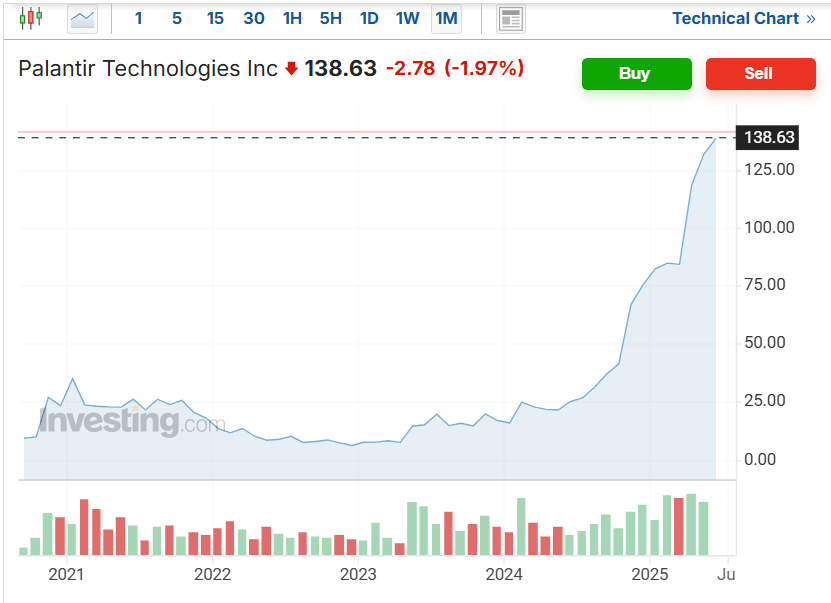
In fact, one would be hard pressed to find a more reliable financial indicator for dystopia and war in the collective West than Palantir Technologies’ company stock. Note how the graph has steepened in recent months.

In May, as the wars escalated in the Middle East and Eastern Europe and as ICE intensified its raids  against undocumented workers, Palantir was the S&P 500’s top-performing company. Since Trump 2.0 took over in late January, the company’s shares have almost doubled. In the past year alone, they are up 470%. To put that in perspective, the S&P’s Aerospace & Defense Select Industry Index has offered returns of just 40% over the same time period.

Granted, Palantir has one of the highest P/E ratios on the planet, at 617.  The P/E ratio compares a company’s share price with its earnings per share, and is often used to determine the relative value of a company’s share in side-by-side comparisons. The fact that investors are willing to invest so much in a company that is still earning so little, relatively speaking, suggests they see a bright future ahead for the AI-empowered surveillance and control technologies that Palantir specialises in.

In other words, they are going long on war overseas and repression at home…

Continue reading on Naked Capitalism

Is A Soft Coup Brewing in Colombia, the US’ Long-Time “Israel of Latin America”?

In the space of just a few days, Colombia has been plunged into a political crisis that could end up toppling its first ever left-wing government.

Given the present situation in Colombia, which, as Lambert was wont to say, is “overly dynamic”, particularly following the attempted assassination last weekend of a sitting senator and aspiring presidential candidate by a 15-year old sicario, this post is unavoidably quite speculative in nature.

First, a little background.

Led by former M-19 guerrilla Gustavo Petro, Colombia’s government is not only seeking to introduce sweeping labour and healthcare reforms that threaten the interests of Colombia’s financial and business elite but is also in the process of realigning Colombia’s foreign and trade policy away from the US and toward the BRICS — in particular, the US’ number-one peer rival, China.

Petro has also denounced the destructive insanity of the US-led global war on drugs, including from the podium of the UN General Assembly in New York. Colombia was also one of the first (and only) countries to fully break off diplomatic ties with Israel in response to the Gaza genocide — a principled and dangerous act given Israel’s strong ties with Colombia’s police, military and paramilitary forces.

All, of these actions, needless to say, are big no-noes for a country whose government and military have been aligned with the US and Israel for over half a century, and whose political institutions and class remain firmly tethered to the US.

In fact, in 2008 Venezuela’s then-President Hugo Chavez famously labelled Colombia the “Israel of Latin America” after the Colombian military made an illegal cross border attack in Ecuador. In 2021, the Spanish left-wing politician Manuel ‘Manu’ Pineda, drew the same comparison, describing Colombia as a “North American military base that serves as both an experiment and a launch pad for destabilising the wider region”:

Colombia is playing a very important role in the destabilisation of Venezuela, for example. A country full of military bases that, with the pretext of combatting drug trafficking, are actually hosting counter-insurgency troops; because as far as drug trafficking is concerned, they seem to be wildly ineffective. Colombia is the largest supplier of cocaine to the United States, by far, according to the DEA’s own reports.

In short, Colombia has played a key role in US counter-insurgency policy in South America, particularly toward Ecuador and Venezuela. As in Afghanistan, the US’ drug control programs in the country appear to have been a lot less successful — as long as one takes the word “control” to mean “reduction”.

The US currently has seven formal military bases in Colombia, according to the Latin American Strategic Center for Geopolitics (also known as CELAG). However, a report (in Spanish) published by School of Americas Watch in April 2021 claims there are also dozens of so-called “quasi-bases” — which differ from formal bases in no other way than that they lack a formal lease agreement for use of facilities — scattered around the country, particularly in areas rich in mineral resources and/or close to Colombia’s border with Venezuela.

Since the year 2000 Colombia has received $13 billion of aid from the US, according to the Washington Office on Latin America, most of which was spent on weapons, soldiers and herbicides. Colombia was the only Latin American country to support the US-led war in Iraq and even contributed soldiers to the occupation of Afghanistan. In 2017, Colombia became one of NATO’s global partners, and the Alliance’s first Latin American partner.

The End of a 200-Year Trend

In short, Colombia was an almost perfect vassal state. But that changed in June 2022, when the former M-19 guerrilla Gustavo Petro made history by becoming Colombia’s first left-wing president since the country won independence in 1819. One of the few people who came close to achieving the feat, Jorge Eliécer Gaitán Ayala, was assassinated during his second presidential campaign, way back in 1948.

It is no exaggeration to describe Colombia as a hostile territory for left-wing politics. In the late ’80s, the then-Colombian President Virgilio Barco hired Rafi Eitan, a former Mossad chief, to help end the guerrilla conflict in the country. Eitan’s involvement in Colombia’s civil war was kept secret for 36 years, for obvious reasons: one of Eitan’s recommendations, which was enthusiastically embraced by Barco, was to exterminate the political leaders of the Patriotic Union (UP), the left-wing party that emerged from a peace agreement with the FARC guerrilla.

What followed was a brutal years-long assassination campaign that took the lives of 3,122 members of UP, including two presidential candidates, five sitting congressmen, 11 deputies, 109 councillors, several former councillors, eight current mayors, eight former mayors and thousands of other activists. According to data presented to the Inter-American Commission on Human Rights, the total number of victims is more than 6,000, including murders, disappearances, torture, forced displacements and other human rights violations.

Three years ago, however, a majority of Colombians voted against the status quo. The problem, as we noted at the time, is that Petro has limited room for manoeuvre, firstly because he only has one four-year term in which to enact his government’s ambitious reform agenda. Also, he does not have a full majority in either of the two legislative chambers. As a result, many of his government’s proposed legislation has been blocked or significantly watered down in Congress, including its labour and healthcare reforms.

To get out of the impasse, Petro has decided to let the people decide. On Wednesday, Petro and his cabinet signed a decree calling for a referendum on August 7 on a raft of proposed labour and healthcare reforms that have been bogged and watered down.

The proposed labour reforms include the strengthening of union guarantees, an increase in the mandatory surcharge for night shifts, the strengthening of controls on temporary work agencies, the extension of paternity leave and the regulation of work on digital platforms. The health reforms, meanwhile, seek to expand the state’s role in financing and providing health services at the expense of private providers.

Like the labour reforms, they have also faced stiff opposition in Congress. Interestingly, the Senate, after a mammoth 12-hour session yesterday, did finally approve 75% of the articles proposed by the government in its labour reforms, which suggests the call for a public consultation is already concentrating minds and lubricating the wheels of government.

Early Stirrings of a Coup?

Now, in his third (and penultimate) year in government, Petro faces what could be the early stirrings of a soft coup against his government, The first major act came on Saturday when 39-year old Miguel Uribe Turbay, an opposition MP and potential presidential contender, was shot in the head by a 15-year old sicario as he was addressing a campaign event in a public park in Bogota.

The handgun used has apparently been traced back to a gun shop in Mesa, Arizona. It appears to be yet another example of how US gun smuggling is fuelling deadly violence throughout Latin America and the Caribbean.

Somehow, Uribe Turbay survived the assassination attempt but is still in critical condition. The grandson of former President Julio Cesar Turbay Ayala, he is a member of Álvaro Uribe Vélez’s Centro Democratico party.

Among right-wing circles, Álvaro Uribe Vélez is widely credited with bringing some semblance of order and stability to Colombia after decades of fratricidal warfare. This he did, however, at great human cost, by mobilising the army and ruthless paramilitary organizations — including one allegedly set up by Uribe himself and his brother — against leftist guerrilla groups.

When they ran out of guerrillas to kill, the military and paramilitaries began killing entire villages of innocent civilians and dressing them up as guerrillas. It was one way of ensuring that the “aid” money kept flowing from the US. In total, 6,402 civilians were murdered by the military between 2002 and 2008 and passed off as rebels in a practice dubbed “false positives.” According to the findings of Colombia’s Truth Commission, the US-supported paramilitary groups killed almost twice as many people as the guerrilla groups.

For the moment, we do not know is behind the assassination attempt on Uribe Turbay. However, comparisons have been drawn with Fernando Villavicencio, the journalist-turned-presidential candidate who was assassinated just weeks before the first round of Ecuador’s elections in 2023.

Villavicencio’s assassination was widely credited with galvanising support for the eventual election winner, Daniel Noboa, the US-born and raised son of the Ecuador’s richest man, a banana magnate. A couple of months ago, Villavicencio’s widow accused Ecuador’s Attorney General, Diana Salazar, of pressuring her into blaming Ecuador’s former left-leaning President Rafael Correa for the murder of her husband.

As happened in Ecuador, the attempted assassination of Uribe Turbay has created an atmosphere of fear and panic in Colombia, a country that has spent much of the past 100 years in a state of civil war. Some opposition figures appear to be more than happy to fan the flames of fear and hatred.

“We must understand that today we took a massive step back towards the Colombia of death,” said Vicky Davila, a former journalist and television presenter who is currently leading the polls among the right wing candidates.

As happened in Ecuador, many opposition figures and media outlets have already pinned the blame on the Petro government — just as Villavicencio’s death was blamed on the Correista Citizen Revolution Movement. In both cases, no solid evidence has been presented.

Again, from Vicky Davila:

“I tell you now, the whole country: the main politician responsible for this is President Gustavo Petro because he has promoted an atmosphere of violence, an atmosphere that has brought us bloodshed and pain.”

It is against this backdrop that Petro announced on Wednesday to a crowd gathered in Cali that a far-right leader of the Andean country, whose identity he did not reveal, has been in contact with US Secretary of State Marco Rubio to organise an alleged coup d’état against him. From Swiss Info:

“I have information and I know that a certain leader of the extreme right in Colombia has been talking to the secretary of state,” Petro said, adding that this person would be “allied with drug trafficking” and looking for sectors of the extreme right in Colombia and the United States to “carry out a coup d’état” in the South American country.

During a speech to a crowd gathered in the centre of Cali, in the southwest of the country, to talk about the popular consultation with which he seeks to approve his labour reforms, Petro assured that there is a recording that supports his accusations and that it has already been heard by Colombia’s Attorney General Luz Adriana Camargo.

Although he did not reveal the identity of the alleged suspect, he clarified that it is not the right-wing former president Álvaro Uribe (2002-2010), founder of the Democratic Center party.

“I want (to ask) the owners of that recording to make it public in the newspapers of the United States, hopefully,” the president said.

Boy Who Cried Wolf?

This is not the first time that Petro has alerted of an approaching coup or lawfare attempt against himself or his government. In fact, it has happened so often that there is almost a “boy who cried ‘Wolf’” quality to his warnings. However, this time it may actually be true, for four main reasons…

Continue reading on Naked Capitalism

A New Gold Rush Is Causing (Potentially) Irreversible Damage to the Amazon Rainforest, Study Warns

As the world is gripped by a new bout of gold fever that shows no sign of abating, the environmental risks for one of the world’s most important ecosystems are rising. 

A few months ago, my wife and I had the fortune to catch the final day of Brazilian photographer Sebastião Salgado’s Amazônia at Barcelona’s Maritime Museum. It was one of  the best photo exhibitions I have ever seen. The exhibition — Salgado’s last before passing away from leukaemia just a few weeks later — impressed upon me more than anything I had read or seen before just how vast, complex and fragile the Amazon ecosystem is.

Amazônia featured more than 200 photographs taken by Salgado from land, water, and air over a seven-year period, portraying the forest and its mountains, rivers, waterfalls and lakes, as well as a handful of the hundreds of tribes living in the Brazilian part of Amazonia. Featuring the sounds of the forest, the thunder of water tumbling from high, and the songs of unknown birds, insects, and other exotic creatures, it was a multisensorial experience. As my wife said, it’s worth seeing just for the cloud-studded skies, or “flying rivers” as Salgado called them.

Sebastião Salgado. Amazônia. Poster 'Parana'. Libros TASCHEN

From an economist-turned-artist whose haunting black-and-white images exhaustively documented decades of conflict in the Global South, poverty and the rapaciousness of late-stage capitalism, the Amazônia exhibition had one main overarching goal: to safeguard the world’s largest rainforest for future generations.

“We have an obligation to maintain some of these great sanctuaries, and the Amazon is one of them, to guarantee in a certain way the survival of our species,” Salgado told a press conference in Mexico City in December.

“We are losing the Amazon. Eighteen percent of the Amazon has gone. (We) have destroyed it and we may never recover it again. These photographs represent 82% of the Amazon. And one also photographs the dead Amazon, the fires in the Amazon (…) Here we present the Amazon that we need to keep together.”

The Amazon is not just a natural wonder, it is a vast socio-cultural artifact. As the exhibition points out, the Brazilian part alone is currently home to more than 300 different tribes, speaking 300 different languages. A third of those groups have had no recorded contact with the outside world. As Salgado said, “It is the prehistory of humanity that lives within this forest. But (it) is losing [its habitat].”

Global Gold Rush

Sadly, the pressures driving deforestation are, if anything, intensifying. They include a global gold rush that is turbocharging the illegal mining of the precious yellow metal under the Amazon’s rich soil.

A new paper in Communications, Earth and Environment, titled “Landscape Controls on Water Availability Limit Revegetation After Artisanal Gold Mining in the Peruvian Amazon” warns that the increasing use of suction mining for gold is not just depleting the world’s largest rainforest but is making it much harder for the ecosystem to regenerate afterwards.

Suction mining is used, often by smaller-scale operations, to blast apart soil with high-pressure water cannons. The loosened sediment is then sent through sluices that sift out gold particles, while the lighter material, including nutrient-rich topsoil, is washed away. What is left standing at the end of this process are stagnant ponds — some as big as football fields — and towering sand piles up to 30 feet (10 metres) high.

Using drones, soil sensors, and underground imaging to understand how suction mining has reshaped lands in two affected areas of Peru’s Madre de Dios region, the research team found that unlike the excavating mining used in other parts of the Amazon, suction mining leaves little behind to support new growth. From the study’s abstract:

Deforestation from artisanal, small-scale gold mining is transforming large regions of the tropics, from lush rainforest to barren collections of tailings and ponds. Natural forest regeneration is slow due to dramatic soil changes, and existing reforestation strategies are failing. Here we combine remote sensing, electrical resistivity imaging, and measurements of soil properties to characterize post-mining areas in the Madre de Dios region, Peru. We find that the post-mining landscape has dramatically changed water infiltration dynamics, driving decreases in subsurface water availability and presenting a major barrier to revegetation…. Our results suggest that access to water should be prioritized when targeting reforestation sites, potentially requiring large-scale geomorphological reconfiguration. As gold mining is expected to expand, responsible practices and remediation strategies must account for the critical yet often overlooked role of water.

According to the study, small-scale gold mining destroyed more than 95,000 hectares — an area more than seven times the size of San Francisco — of rainforest in the Madre de Dios region between 1980 and 2017. Across the Amazon, gold mining now accounts for nearly 10% of deforestation.

This is still dwarfed by the damage caused by livestock farming, which accounts for around 80% of Amazonian deforestation. However, the new paper in Communications, Earth and Environment suggests the damage caused by suction mining will be much more difficult to reverse due to the resulting loss of the most nutrient-rich layers of the soil as well as the suction mining’s intensive use of water.

Using on-site sensers, the researchers found that the sand piles function like sieves, with rainwater draining through them up to 100 times faster than in undisturbed soil. As a result, the areas dry out almost five times faster after rain, leaving little moisture available for new roots. On exposed sand piles, surface temperatures could reach as high as 145 F (60 C).

Peru is a huge player in the illegal gold business, accumulating the largest amount of gold of unknown origin exported to the world market. But Illegal mining for gold is not just a Peruvian problem.

In April, Greenpeace released a report showing that 4,219 hectares of Brazilian rainforest had been destroyed by gold miners in four Indigenous territories — Yanomami, Munduruku and Kayapó and Sararé — in just two years. While the first three territories saw a marked decline in mining activities, this was more than compensated by a 93% increase in activity in Sararé.

Below are some of the photos Salgado captured of Serra Pelada, which in the early ’80s became the world’s largest open-pit mine. At its peak, the mine drew an estimated 80,000 “garimpeiros” (independent mineral prospectors) who migrated from across Brazil to join the gold rush.

The rampant gold mining in the Amazon is also causing widespread mercury poisoning, as Amazon Frontlines reported in January 2024:

Searching for gold in the Amazon is like trying to find a needle in a haystack, blindfolded. Most of this precious metal is finely spread through sediments and soils, like tiny specks that are almost impossible to see. To solve this problem of scarcity and invisibility, miners have found a “magnet for gold” that can be chemically bonded to gold dust, creating an amalgam. This magic lodestone – mercury – is also one of the most toxic substances on Earth, which is why it is strictly controlled by the Minamata convention that was ratified by Ecuador in 2016. Despite this, it is widely used throughout the Amazon. A scientific study in the northern Ecuadorian Amazon found that 90% of artisanal or small-scale miners used mercury.

Once the mercury has been fixed to gold, it burns (as mercury has a lower melting point than gold), releasing large amounts of this toxic substance into the air. Mercury is eventually deposited throughout the jungle, adding to the unknown amounts of mercury that are dumped or dumped directly into ecosystems, making “artisanal” and small-scale mining the largest source of pollution on Earth.

However, as long as there is high demand for gold, people will find ways to get it to market, even in the smallest amounts. A database created by journalists from Peru, Colombia, Venezuela, Ecuador and Brazil, as part of the special investigation “Golden Opacity: Mechanisms Used for Old Trafficking in Latin America’’, led by Convoca.pe, suggests that at least 5,941 tons of gold were exported from those countries between 2013 and 2023. Of this amount, the origin of over 3,000 tons is unknown. Most of it was apparently laundered through Peru.

The recent surge in the price of gold and the promise of lucrative returns has also drawn new entrants into the market, including drug traffickers, according to a Bloomberg report in January:

[In Brazil, w]ildcat miners, known as the garimpeiros, have existed for the better part of a century, deforesting the land and dirtying the waters. But now, a federal crackdown on environmental crimes and a gold rally that’s sent prices to record highs has driven the industry into further darkness.

Visits by Bloomberg News to mining sites, along with dozens of interviews with miners, experts, locals and officials, unveil a world that is becoming increasingly lethal as a decades-old industry comes under the influence of drug gangs.

“The criminal organizations that have been dedicated to drug trafficking for a long time have discovered a new market,” said Andre Luiz Porreca Ferreira Cunha, a federal prosecutor assigned to illegal mining investigations across the Amazon, including the Rodrigues case. “They are creating parallel states in the middle of the Amazon. It’s terrifying.

Across the globe, if you buy gold, there’s a growing chance that you’re bankrolling bad actors.

About 20% of the world’s bullion output comes from informal, small-scale mining. The producers are sometimes called “artisanal miners,” but it’s an industry that’s typically illegal, untaxed and often in violation of environmental and other regulations. In Brazil, the miners are a major factor in the destruction of the Amazon. And globally, the sector is the planet’s single biggest source of global mercury contamination, exceeding even coal-fired power plants, according to a study from the United Nations.

Gold – often dubbed the world’s oldest currency – has for millennia attracted underworld characters. But that has been supercharged by a historic rally, which gives illegal miners greater incentive to dig it up any way they can. Spot prices jumped 27% in 2024. The metal reached an all-time high of $2,790.10 an ounce in late October and has more than doubled since the end of 2018.

A Colossal Loss of Trust 

Since then, gold has continued its surge in price, reaching a fresh all-time high of $3,500.05 per ounce on April 22. The spot price is currently just over $3,300 . There are myriad reasons why the gold price has almost tripled since 2018, most of which have little to do with gold itself. Some were discussed in a 2022 article we cross-posted from The Saker.

One of the most important factors is a generalised breakdown in trust and confidence in the dollar-based financial system. In recent years, the US and the UK, the two main custodians of gold, have engaged in actions that have seriously eroded investors’ trust in their capacity as custodians, not only of gold but also of other key financial assets, including US treasury bills.

In 2019, the British government recognised Juan Guaidó as Venezuelan president, and supported his legal battle to seize roughly $2 billion of Venezuelan gold held in the Bank of England. From that point on, the gold Venezuela holds in the UK has essentially been confiscated.

Although Guaidó was ultimately unable to get his greedy little hands on the gold due to legal appeals launched by Venezuela’s real government in Caracas, the country’s gold still sits frozen in the Bank of England’s vaults — more than a year after Venezuela’s leading opposition parties voted to oust Guaidó as “interim president.” The damage this has done to the City of London’s standing as a global financial centre is no doubt considerable, noted UK Declassified in 2023:

“[W]hatever happens next, this case sets a precedent which could have far-reaching consequences: the UK’s coup weapons now include asset stripping a foreign state, and transferring those assets to political actors engaged in regime change. This will surely serve as a warning to any state which plans to store its gold in the Bank of England.”

Even before the UK decided to confiscate Venezuela’s gold, governments around the world, particularly in Central and Eastern Europe were already getting antsy about entrusting their gold deposits to the Bank of England or US Federal Reserve…

Continue reading on Naked Capitalism

China’s Quiet Rapprochement With Israel

“The war continues, but the war is not the theme of Israel-China bilateral relations.”

Public outrage over Israel’s escalating genocide in Gaza has intensified so much in recent weeks that even Israel’s closest friends in Europe, including the UK, France and Germany, have begun to express reservations.

In the UK, Labour backbenchers have intensified their calls for the Keir Starmer government to impose economic sanctions on Israel while the former Labour Party leader Jeremy Corbyn, now an independent MP, has requested a parliamentary inquiry into the UK’s supporting role in Israel’s near-annihilation of the Gaza Strip.

Legal Ass Covering

Granted, many of these objections, especially those coming from the highest levels of government in countries like the UK, Germany and France, fall into one or more of three categories: “empty rhetoric”, “too little, too late”, and/or “attempted legal ass-covering”. As Norman Finkelstein explains in an interview with India & Global Left, Europe’s senior politicians know exactly what is about to happen, which is why they are trying to cover their ass after spending much of the past 21 months cheering on Israel’s army:

That’s why they start to denounce Israel — because they want to keep their hands clean at the moment when they knew that ‘this is it’, that Israel was going to push [the Gazans] out. So they decide they have to be on record as opposing the second… Nakba. They knew what Israel was doing and they wanted to distance themselves.

So, you remember, the French, Canadians and British denounced what Israel was doing. Then the Germans weighed in. Then the Nazi Princess Ursula Von der Leyen weighed in. Then the EU foreign policy chief Kaja Kallas weighed in. They all needed to have it on record that ‘we opposed’ it. They all knew what Israel was planning.

Also, while some of the language used in official public statements and press releases may have changed in recent weeks, the actions haven’t.

Just days after Germany’s Foreign Minister Johann Wadephul criticised Israel’s actions in the Gaza Strip, he reiterated Germany’s continuing materiel support for those actions. In the UK, Keir Starmer, who allegedly cut his teeth practicing international human rights law, decried the situation in Gaza as “appalling and intolerable.” Hours later, another UK spy plane was doing the rounds over Gaza collecting yet more actionable intel for the IAF’s bombing campaigns.

All that being said, the mere fact that the language is shifting in many Western capitals is nonetheless relevant. It means that even some of Israel’s biggest apologists have finally run out of words to excuse or obfuscate its worst war crimes, now they are reaching their final phases.

Piers Morgan, who is as reliable a barometer of shifting Anglo-American public opinion as one is likely to find, is finally calling Israel’s military campaign against Gaza, now in its 21st month, a genocide. When even the likes of Morgan are no longer willing to defend the indefensible in Gaza, the Netanyahu regime’s PR offensive has finally collapsed. That would be good news, if it wasn’t already too late. With 92% of Gaza’s housing units and 70% of all structures already destroyed or damaged, Gaza is already uninhabitable.

But not all the talk is inconsequential for Israel, claims an op-ed in the FT:

In the past few weeks, EU foreign ministers have triggered a review of Israel’s association agreement with the bloc, Britain has halted trade talks, Norway’s sovereign wealth fund blacklisted an Israeli company for facilitating energy deliveries to West Bank settlements, and the leaders of France, the UK and Canada threatened to put sanctions on the country.

The sanctions the EU imposed on Israeli settlers late last year are already beginning to bite, it seems. Just yesterday, Israel’s Finance Minister Bezalel Smotrich lambasted the country’s banks that have refused to provide services to sanctioned Israeli settlers. Smotrich called on the lenders not to comply with the sanctions, warning that failure to do so could result in them facing steep compensation bills.

“Building Meaningful Partnerships”

However, not everyone is trying — or even pretending — to distance themselves from Tel Aviv right now. The People’s Republic of China, for example, is actually seeking to strengthen its ties with Israel.

After initially siding with Palestine (and Hamas) following October 7, Beijing is now looking to rebuild ties with Israel. Just four days ago, as Israel’s Defence Forces were unleashing coordinated attacks on aid depots, China’s ambassador to Israel Xiao Junzheng discussed “deepening China-Israel economic and trade cooperation” with Israel’s Minister of Economy and Industry, Nir Barkat.

“In a world where economic resilience and innovation matter more than ever,” said Xiao Junzheng, “building meaningful partnerships is key.”

Beijing’s relationship with Israel has always been complex. Israel was the first country in the Middle East to recognise People’s Republic of China, in 1950. However, the People’s Republic of China did not return the favour by recognising and beginning formal relations with Israel until 1992 — 42 years later. Since then, the economic and strategic ties between the two countries have grown and deepened, to the point that China is now Israel’s second largest trade partner.

At the same time, the PRC has strengthened its ties with Israel’s main regional rival, Tehran, and has been providing weaponry not only to Iran, including allegedly material for hundreds of ballistic missiles, but also Iran’s three main proxies in the region, Hamas, Hezbollah and the Houthi militia. Beijing also refused to condemn Hamas’ attack on October 7, and only broke its silence a week later to criticise Israel for its military invasion of Gaza and demand a ceasefire.

In April 2024, Ma Xinmin, a Foreign Ministry legal department official, set out Beijing’s stance at an International Court of Justice hearing in February:

“In pursuit of the right to self-determination, the Palestinian people’s use of force to resist foreign oppression and to complete the establishment of an independent state is an inalienable right well founded in international law.”

A month later, the RAND corporation concluded that Beijing was effectively “burning its bridges with Israel”. A couple of weeks ago, rumours even swirled that Chinese jet fighters had broken Israel’s blockade of Gaza to deliver much-needed supplies to Gaza’s starving people. It was fake news that most supporters of the multipolar world order wanted to believe. In reality, China is cosying up to Israel…

Continue reading on Naked Capitalism

Iron Rivers Everywhere: How US Arms Smuggling Is Fuelling Violence in Mexico, Central America and the Caribbean

Even US-aligned governments in the region are beginning to ask, somewhat naively, which side the US is on in the war on guns, begging the question: which war? 

In the early hours of May 20, Ximena Guzmán, the 42 year-old private secretary of Mexico City Mayor Clara Brugada, parked her car in the usual place on the side of Tlalpan Avenue. She was there to pick up José Muñoz, a 52-year old colleague and advisor to Brugada, as she did every morning. When Muñoz got into the car, a hitman lurking just a few metres away drew a nine millimetre handgun and emptied the 12 bullets in the magazine at the two civil servants. Both died almost instantly.

This all took place in broad daylight and amid rush hour traffic. The hitman fled on a black motorcycle, which he ditched a short distance away. There, with the help of at least three other accomplices, he used a blue car to drive to the Iztacalco borough, where they picked up another vehicle, a grey pickup truck, which they drove into the neighbouring State of Mexico where they disappeared. As El País reported, this team of clearly professional assassins left no trace behind (qualifiers in parenthesis my own):

No fingerprints, no [clear] suspects, no [clear] motive… The weapon they used was clean: analysis of the shell casings found at the scene revealed it hadn’t been used in previous crimes.

The reason I added the two qualifiers is that while there may not be clear suspects or motives behind the crime, there are a number of possible suspects, all with their own possible motives.

The most obvious suspect, according to most domestic and international media, would be one of the large Mexican drug cartels such as Jalisco Next Generation, La Familia Michoacan or the Sinaloa cartel, though the latter has been heavily weakened in recent months. The obvious motive: revenge for the Sheinbaum government’s recent security crackdowns, including the capture and extradition to the US of dozens of cartel capos.

While the cartels are perfectly capable of taking such action, and pulling it off with ease, one can’t help but wonder: why target two mid-to-high ranking Mexico City civil servants with no direct involvement in security matters? To sow panic in government ranks? To send a message that nowhere is safe and that anyone can be targeted in broad daylight regardless of whether they have ties to Mexico’s security forces?

Another possible suspect, highlighted by the journalist Jesús Escobar Tobar, is Mexico City’s real estate mafia, whose illegal manipulation of the property market in Mexico City is coming under sustained pressure from Clara Brugada’s municipal government’s policies. These white-collar criminals, presumably with contacts in the police and security services, probably have the means as well as a clear motive for carrying out this crime.

Another possible suspect is the US government and its three-letter agencies. Despite its dramatic decline across most areas of governance, Washington is still ruthlessly efficient at killing innocent people on each and every continent, especially its own.

It also has motives. For a start, the execution-style killing of these two civil servants further destabilises the Sheinbaum government, reinforcing the impression that it cannot guarantee security in any part of Mexico’s territory, including even the (generally safer) capital. This, in turn, strengthens Washington’s case that Mexico needs US intervention to help steady the ship. In recent weeks, President Trump has repeatedly asked Sheinbaum to allow US troops to enter Mexico to combat the drug cartels.

The timing was also curious. The exact morning that Guzmán and Muñoz were executed, Sheinbaum’s government was scheduled to present the latest security figures for Mexico City, which showed a marked improvement. Also, the US’ new Ambassador to Mexico (and former CIA agent and green beret) Ron Johnson had just taken up residence at the US’ new billion-dollar embassy in the Mexico City borough of Polanco.

All of this, of course, amounts to little more than conjecture for there is no proof pointing to any particular suspect — at least not currently in the public domain.

Now, let’s shift our focus 2,800 kilometres to the east, to Haiti. Roughly a week after the double-assassination in Mexico, the New York Times published a story that at first glance seems entirely unrelated to the events in Mexico. Erik Prince, the former Blackwater founder and CEO, arms trafficker, shadow Trump advisor and wannabe colonialist, had just been awarded a contract by Haiti’s Western-controlled government to conduct “lethal operations” against gangs that are, in the Grey Lady’s words, “terrorizing the nation and threatening to take over its capital.”

Arguably the longest-suffering victim of Western colonialism and neo-colonialism on the American continent, Haiti has suffered so many interventions in recent decades that it is now often referred to as the “Republic of NGOs”, many of them US or UN-led. After a devastating earthquake in 2010 killed an estimated 200,000 people and left many government buildings in rubble, thousands of aid organizations decamped in Haiti and built a powerful parallel state accountable to no one but their boards and donors.

As the Nation magazine noted, “the international relief effort after the 2010 earthquake excluded Haitians from their own recovery.” The latest attempt to bring order to the country was through the deployment of hundreds of Kenyan troops and police officers. But it has clearly failed — hence the need for a private sector-led military intervention (some reports in alternative media claim this is really about quashing popular revolt again as ex-policeman Jimmy Cherizier calls for a revolution to topple embattled government).

From the Times:

With Haiti’s undermanned and underequipped police force struggling to contain the gangs, the government is turning to private military contractors equipped with high-powered weapons, helicopters and sophisticated surveillance and attack drones to take on the well-armed gangs. At least one other American security company is working in Haiti, though details of its role are secret.

Since drone attacks targeting gangs started in March, they have killed more than 200 people, according to Pierre Esperance, who runs a leading human rights organization in Port-au-Prince.

After the U.S. occupations of Afghanistan and Iraq ended, security firms like those owned by Mr. Prince started seeing big streams of revenues dry up. Private military contractors are looking for new opportunities, and they see possibilities in Latin America.

This is the second time in two months that a government on the American continent has hired Prince’s services. In early April, the former Blackwater CEO visited Ecuador to ostensibly help the country’s security services combat “narco-terrorism” — the term du jour in Washington and its vassal state governments in Latin America. That was just after trying (and failing) to crowdfund a mercenary-led coup against Nicolas Maduro’s government in Venezuela while presumably trousering the funds that were donated.

Iron Rivers Everywhere

One thing that Mexico, Ecuador and Haiti have in common, apart from their relative geographic proximity, is that they are all awash in guns. This is despite the fact that the Central America and Caribbean region neither manufactures such weapons nor plays any significant intermediary role in the global trade in guns. Meanwhile, Mexico tightly controls firearm sales, making them practically impossible to obtain legally. In Ecuador, by contrast, the Daniel Noboa government has made it easier to acquire firearms legally over the past year.

Most of the weapons flowing to these countries are coming from the US, of course, and they appear to be coming in ever larger numbers. In a letter sent to US legislators in September last year, New York’s attorney general and 13 other lawmakers across the US called for new measures to stem the outward flow of US-made guns, noting that as many as 90% of weapons used in the Caribbean were bought in the US and smuggled into the region.

In the case of Mexico, the southward flow of weapons, often referred to as the “iron river”, may have increased by as much five fold in volume over the past two decades. According to estimates from the US Bureau of Alcohol, Tobacco, Firearms and Explosives (ATF), 90,000 firearms were smuggled into Mexico in 2004. By 2024, some estimates, including the Mexican government’s, put the figure at around half a million.

While it’s impossible to count precisely how many weapons are successfully smuggled, for obvious reasons, US investigators and federal agencies concede that the number of guns illegally pouring into Mexico and the Caribbean has increased in recent years. So, too, has violent crime — and deaths…

Continue reading on Naked Capitalism