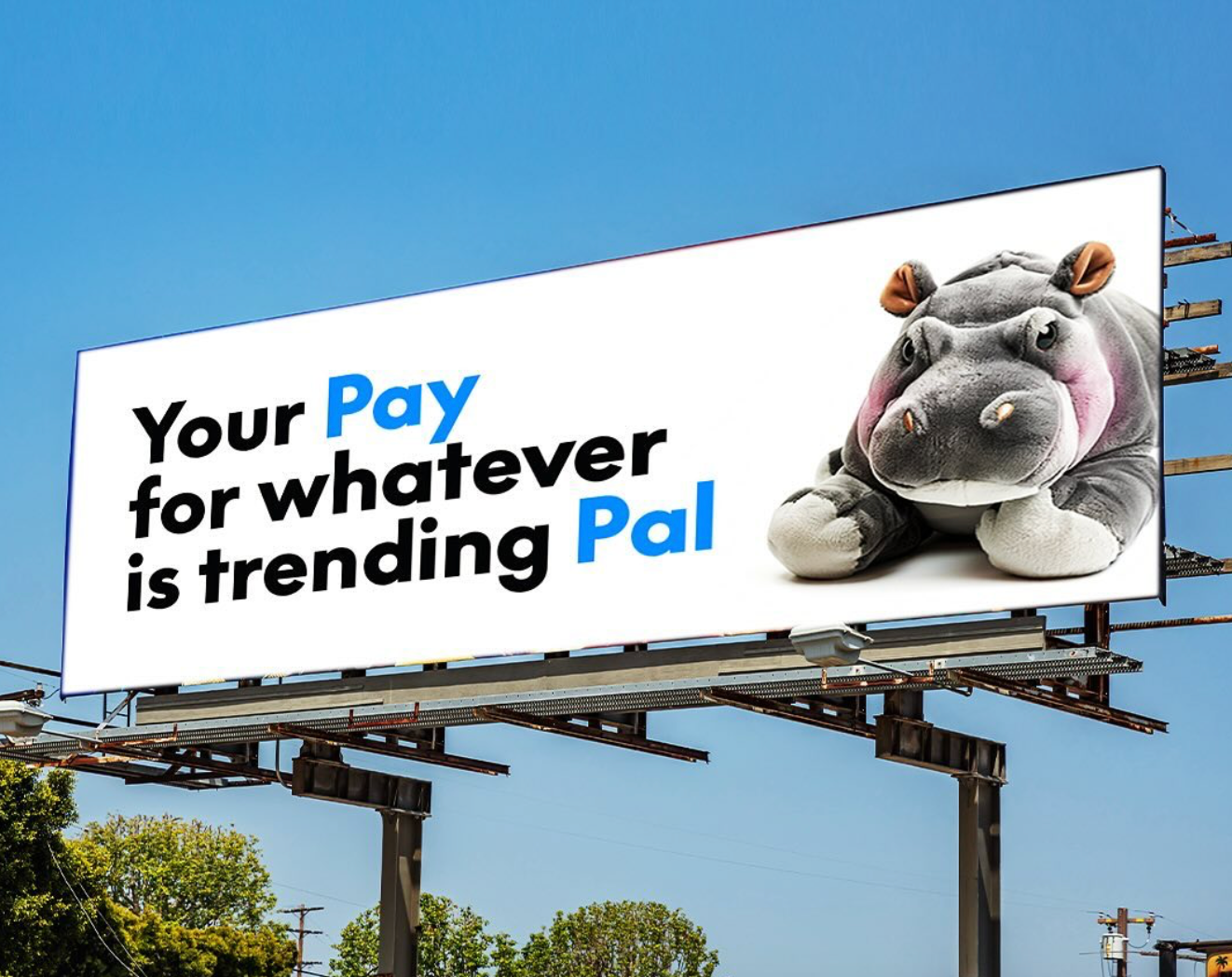
Is PayPal Running a Covert Information Campaign Against Cash in Germany?

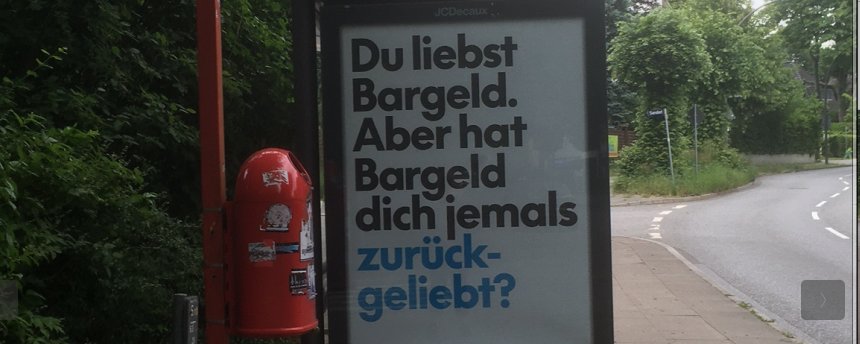
“You love cash. But has cash loved you back?”     

This is the rather peculiar message splashed across a billboard at Duisburg Central Station, in Western Germany. Billboards seen in Frankfurt declare that “Cash is no longer King” — which isn’t (yet) true in Germany — or bear the slogan: “Pay later? Cash can’t do that.” What makes these cryptic anti-cash messages that have been cropping up across German cities and along roadsides in recent days particularly strange is that it is not clear who is behind them. They are bereft of company name or logo.
Imagen

Given as much, there is, by necessity, a speculative edge to this article. There is no way of knowing with total certainty who is paying for this covert information campaign against cash in one of Europe’s most stridently pro-cash countries.

That said, there are clues that point in a particular direction. According to the German financial journalist Norbert Häring, the most likely culprit is the US fintech giant PayPal. The circumstantial evidence is certainly striking. In early May, PayPal published a press release (in German) announcing plans to launch a mobile phone wallet for paying at checkouts in German brick-and-mortar stores (machine translated):

In the coming weeks, PayPal will launch its first contactless mobile wallet – with Germany as its first global market… In the future, consumers will be able to pay securely and conveniently via smartphone, tapping to pay wherever contactless Mastercard payments are accepted. In addition, for the first time they will receive a complete overview of their online and offline purchases on the PayPal app.

Even the style and colour scheme of the font used in the ads roughly match those used in previous PayPal ads:

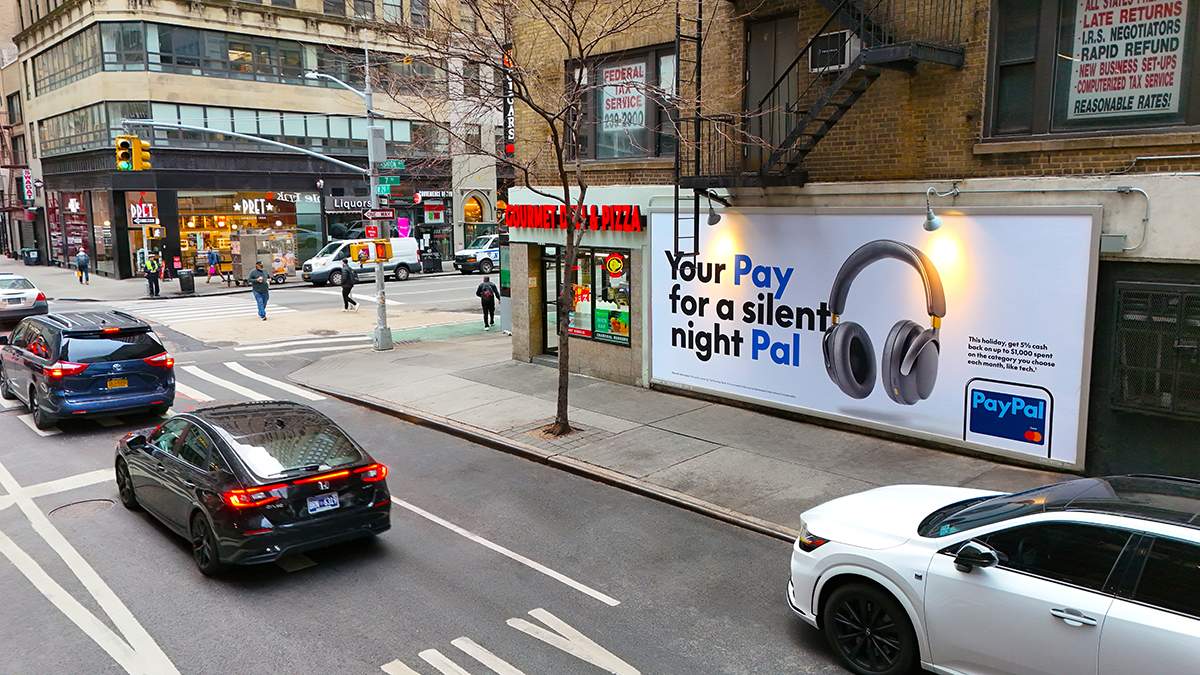
I like the adverts : r/LondonUnderground
Alchemy & PayPal Transform NYC with Bold Wild Posting
How bad art direction broke these PayPal ads | by Holly Pittaway | Medium

Buy Now, Pay Later

Another clue comes from the billboard slogan:

“Pay later? Cash can’t do that.”

Unlike most rival mobile wallets, the PayPal app won’t be limited to instant transactions. Shoppers will have the option to split their payments into 3, 6, 12 or even 24 monthly instalments. As the billboard brags, cash can’t do that!

Another curious coincidence: in its press release, PayPal does not mention even once its two main rivals in the mobile wallet space, Google and Apple Pay. Instead, its pitch is focused almost entirely on the limitations of cash and its declining use in Germany:

“The more the technology develops, the harder it is to ignore the advantages of digital payment,” says Jörg Kablitz, Managing Director, PayPal Germany, Austria and Switzerland. “Cash continues to play a role, but we know that many consumers and businesses are ready for innovative alternatives. We are convinced that PayPal has more to offer than cash. Our app makes paying by smartphone in the store easy and secure. Customers have the flexibility to decide how and when they pay – and can even save money in the process.”

It is not unusual for a fintech firm or payment processing company to aim their sharpest invective at cash, as opposed to their direct corporate rivals. For the US payment duopoly of Mastercard and Visa, which generate fees by facilitating money transfers between bank accounts, cash has long been their main rival. In 2010, the then-CEO of Mastercard (and current president of the World Bank), Ajay Banga, openly declared war on cash:

“In today’s terms, only 3% of retail spend in India or in China are through electronic payments. The rest is cash. I have declared war on cash; I believe MasterCard will grow by growing against cash. If you keep looking at 3%, everybody’s a rival; if you look at the remaining 97%, everyone’s a partner.

Mastercard and Visa have played arguably the biggest role in demonising cash over the years. But it seems that PayPal is joining the bandwagon now that it, too, is offering a digital payments app for physical retail checkouts, putting it in direct competition with physical notes and coins. And it has decided to launch its app in Germany, one of the most important bastions of physical currency in Europe, just as the war on cash there is escalating rapidly.

Cash’s Last Stand?

Though cash use in Germany has declined in recent years, physical notes and coins are still the main payment method, much to the chagrin of the financial and political establishment. After all, Germany is Europe’s biggest economy and together with neighbouring Austria and some countries in Southern Europe, particularly Spain, it is holding back Europe’s transition into a fully digital economy.

In 2023, 51% of all transactions in Germany were still being made with cash, with debit cards in a distant second place at 27%, according to the Deutsche Bundesbank’s annual payments survey. In many advanced economies, including the UK, Australia, Norway, Sweden, Finland and Denmark, around 10-20% of transactions are made with cash. In a survey by the European Central Bank, 69% of Germans said that cash was “important” or “very important” to them.

However, a loose alliance of banks and payment card companies is determined to change this. A few months ago, some of Germany’s biggest banks announced that they were joining forces with large credit card companies in an attempt to force cash out of the market through cartel pricing and unfair competition. From Häring’s article, Banks Form Discount Cartel to Displace Cash – Bundesbank Provides Cover (in German, machine translated):

The new initiative “Germany pays digitally”… is not an “initiative”, but a cartel. It consists of Commerzbank (Commerz Globalpay), Deutsche Bank, Volks- and Raiffeisenbanken (VR Pay), Mastercard, Visa, Flatpay, Unzer and SumUp. Further cartel members are expressly welcome to join. The aim is to displace their main competitor, cash, and the cash service providers through price dumping… cash incurs costs that are often lower for small merchants than the costs of digital payments, but not zero.

Here’s how it will work: the cartel will be offering small merchants and retailers with up to €50,000 in annual turnover free installation of a payment terminal and free use of it for all transactions for up to one year. No fees, no commissions. Those will obviously kick in during the second year. As Häring notes, the cartel members are willing to accept temporary losses in order to incentivise small businesses to accept digital payments instead of cash.

Meanwhile, the availability of cash and the ability to use it to pay for basic services is being squeezed from all sides. Earlier this week, it was announced that bank customers will soon no longer be able to get cash back from Shell petrol stations. According to a report by Frankfurter Rundschau, as of June 30 1,300 Shell petrol stations will no longer provide the cash back service to customers of Deutsche Bank, Postbank, Commerzbank and Hypovereinsbank.

For many people, the cash-back service was a simple, round-the-clock solution at a time of increasingly scarce banking services. Bank customers were able to withdraw up to €1,000 with each purchase. The move is likely to hit rural communities particularly hard since many of them no longer have bank branches or ATMs, in part due to the recent rise in ATM bombings. In the absence of banking services, many of these communities had grown to depend on Shell’s cash back services, notes the Frankfurter Rundschau report:

The vanishing options for withdrawing cash… are becoming a problem, especially in rural areas, due to the lack of bank-Shell cooperation. There, the gas stations were an effective means of withdrawing money.

Banks such as Deutsche Bank and Post Bank say they are offering alternative options in its place. Post Bank, for example, has been offering its customers a “Cash Code”, which is essentially a bar code that allows them to deposit or withdraw cash sums of up to €1,000 at over 12,000 retailers nationwide. But there’s a catch: in order to use the code, you must have a smartphone, an internet connection and the corresponding bank app.

Deutsche Bank is looking to adopt a similar approach in the coming months. As the Frankfurter Rundschau article notes, many older people still do not have a smartphone. Many of those that do will struggle to use the bank app, meaning that accessing cash is becoming more and more difficult for the one key demographic that most uses it.

Yet the same banks that are driving this trend will claim that the public’s gradual shift away from cash is purely the result of technological trends and shifting customer preferences. As the pro-cash activist Brett Scott notes, the financial sector’s escalating assaults on cash have created a feedback loop that constantly reinforces the impression that people are turning their back on cash when, in actual fact, banks are making it harder for them to access it while both bricks-and-mortar businesses and governments are making it harder to use it.

This is all happening as the European Central Bank prepares to launch a “digital euro”, which will be competing directly (and probably unfairly) with cash. As we warned in March, there are myriad reasons why Euro Area citizens should be terrified of the stealthily approaching central bank digital currency, including the threat it will pose to financial privacy and anonymity as well as the programmable features it is likely to offer, which have the potential to revolutionise the very nature of money.

Increasing Competition in Europe’s Digital Payments Market

It is against this backdrop that the online payment giant Paypal has chosen Germany as the first national market to launch its contactless payment app. As Euro Weekly reports, to make this happen, PayPal is introducing its own virtual debit card, fully integrated into the app:

This means users can pay in-store without needing a physical card or even opening a third-party digital wallet. Everything happens within PayPal’s app. It’s clean, simple, and in line with how consumers already use the platform…

What’s more, PayPal is also introducing a cashback system, rewarding users who choose to pay via their smartphones in-store. While full details on rates and conditions are still to come, it’s clear that partner retailers will play a key role, and the incentive may be enough to get users to leave their other digital wallets behind.

This launch also reflects a growing shift in the digital payments landscape, particularly in Europe. Thanks to the Digital Markets Act (DMA), which forces tech giants like Apple to open up their NFC systems to third-party apps, PayPal can now access iPhone hardware that was previously locked to Apple Pay. In short: Apple no longer has exclusive control, and competitors like PayPal are finally able to innovate on equal footing.

While this is a welcome step, it is still telling that in its press release PayPal aims its competitive focus squarely on cash and not on its other rivals in the mobile payments space. Whether PayPal is behind the dissemination of anti-cash ads that have sprouted in recent days, it is impossible to know, for the simple reason that nobody has taken responsibility for those ads. But if it is, it is taking on a form of payment that endured centuries of use and continues to enjoy strong public support in Germany, as well as many other European countries.

If German cash advocates wanted to respond in kind by launching their own counter-information campaign, they would have plenty of material at their disposal (albeit probably a far smaller marketing budget). Here are a few examples…

Continue reading on Naked Capitalism
What Mexico Can Teach Its Northern Neighbour About Combatting Child Obesity, Diabetes and Other Chronic Health Conditions

“The economic burden… of not intervening in the prevention and reduction of childhood overweight and obesity is up to $1.8 trillion in the case of Mexico.” 

The Trump Administration has, to its credit, produced a wide-ranging report on what it sees as the main drivers of disease in American children — something that has been sorely lacking from its predecessors. Those drivers include lifestyle factors, such as widespread addiction to smart phones, tablets and lack of exercise, the increase in routine immunisations given to children, which is debatable, and over-dependence on ultra-processed foods, which now account for almost 70% of the calories consumed by children and adolescents in the US.

There is no debate about that. As the New York Times notes, “these industrially manufactured foods and drinks, like sodas, chicken nuggets, instant soups and packaged snacks, have been linked with a greater risk of obesity, Type 2 diabetes, heart disease and other conditions”.

For the lowdown on ultra-processed foods and the myriad harms they can cause, I turn to one of our two senior resident medical experts, KLG (the other, of course, being IM Doc), and his excellent March 2024 article, Ultra-Processed People in an Ultra-Processed World:

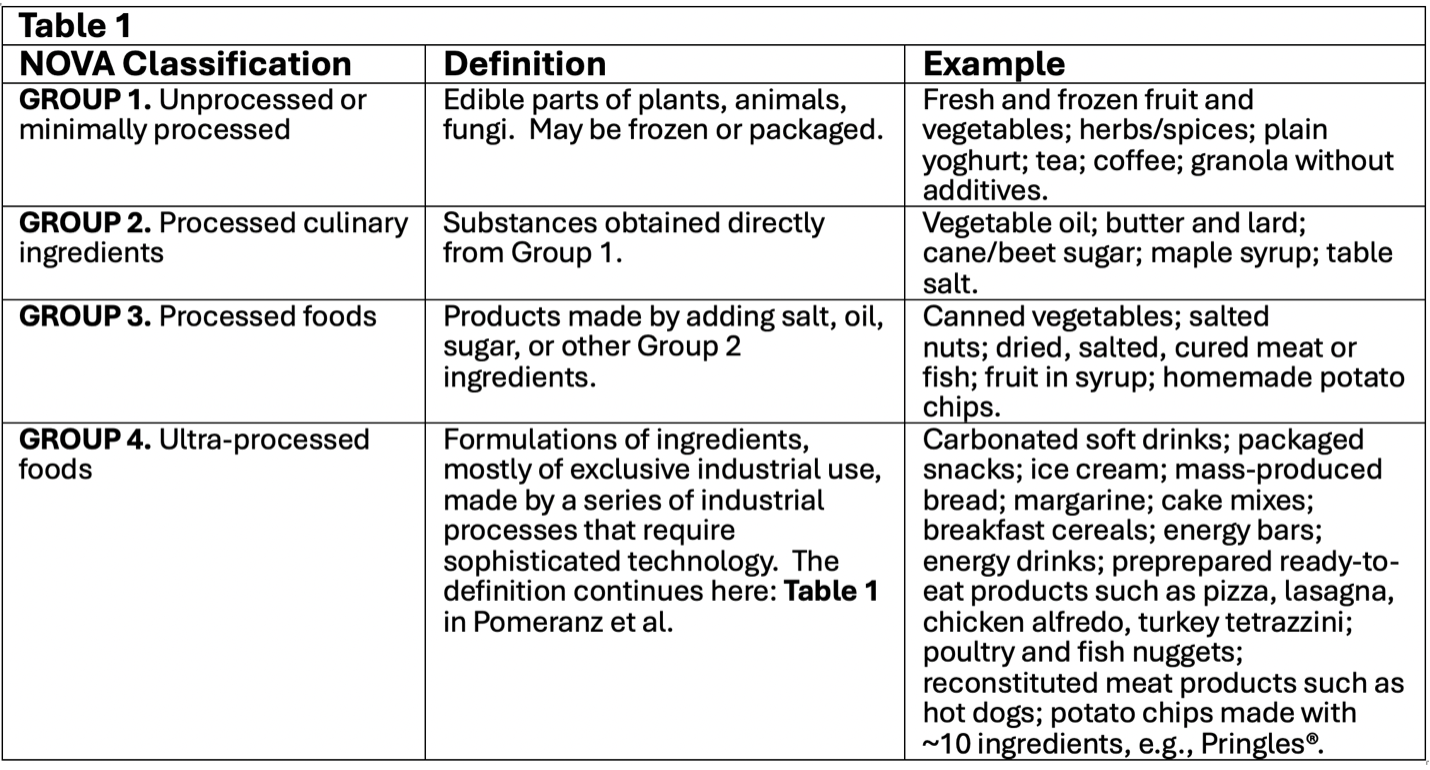
What are ultra-processed foods (UPF) using the NOVA classification system (pdf)?  A simplified Table 1 is derived from Pomeranz et al:

This makes both intuitive and scientific sense.  And it stands to reason after minimal consideration that a diet comprising NOVA Groups 1, 2, and 3… will be a healthy diet.  This case has been made very well in Ultra-Processed People: The Science Behind Food That Isn’t Food (Norton, 2023), which will be our guide. The author Chris van Tulleken has a PhD in Molecular Virology and a medical degree (MBBS: Bachelor of Medicine, Bachelor of Surgery).  He is currently a practicing physician in infectious disease in London and a well-known, award-winning presenter on British television…

UPF is designed to be overconsumed (Chapter 18 of the book “Ultra-Processed People: The Science Behind Food That Isn’t Food”, by Norton).  A summary on the science of UPF and the human body:

  • Destruction of the food matrix by physical, chemical, and thermal processing softens UPF so that they are eaten fast, with the consumption of more calories per minute without feeling satiated.
  • UPF generally have a high calorie density because they are dry, high in fat and sugar, and low in fiber, which means more calories per mouthful.
  • UPF displace diverse whole foods in the diet, especially among low-income groups (UPF is cheap at the cash register but only there) and are often micronutrient-deficient despite the normal load of additives. The proper measures of a diet lie in food, not in the individual chemical compounds and minerals that are essential for life.  These are often not particularly useful in any case.  Fish is good if it is not farmed or loaded with mercury.  Fish oil (omega-3 fatty acids) in capsules from the supplement store, not so much.
  • The mismatch between taste signals and nutrition content of UPF alter metabolism by mechanisms not completely understood, but the obesity epidemic of the past 50 years is clear indication this happens. Artificial sweeteners may have a role in this.
  • UPF are designed essentially to be addictive, so binges are unavoidable. See Sugar Salt Fat. How many of us have consumed, not eaten, an entire bag of potato chips or a tube of Thin Mints at one sitting?
  • The emulsifiers, preservatives, modified starches, and other additives are likely to damage the gut microbiome. The microbiome is relatively new to biomedical science, slowly coming into focus in the past fifteen years, but it clearly has broad effects on human health from the brain to the heart.  The ostensibly harmless additives to UPF are likely to dysregulate the gut microbiome and lead to inflammation.  Chronic inflammation, a concomitant of obesity, is a risk factor for cancer and a host of other diseases.
  • Convenience, price, and marketing of UPF are intentionally designed to prompt us to eat recreationally. Snack, snack, snack.
  • Additives and physical processing required for the palatability of UPF dysregulate our satiety system. Other additives probably affect brain and endocrine function.  Plastics are essential to the marketing of UPF and are another negative externality altogether.
  • The production of UPF requires expensive subsidies (i.e., negative externalities associated with Big Ag production of GMO corn and soybean as commodity crops) that lead to environmental damage caused by industrial agriculture. This includes damage to the human and built environment of rural areas and chemical pollution caused by runoff of pesticides, herbicides, nitrogen, and phosphorous.  The dead zone at the mouth of the Mississippi River is the most glaring example of the latter.

Back on the topic of the Trump report, even the Times mustered praise for its focus on UPF.

Marion Nestle, an emerita professor of nutrition, food studies and public health at New York University with an unfortunate surname, said the report “did a phenomenal job” explaining how ultra-processed foods are harming children’s health. But she questioned the government’s willingness to act on these findings, given that “in order for them to do anything about this, they’re going to have to take on corporate industry,” including Big Ag, Big Food and Big Chem.

It hardly helps matters, notes Dr. Georges Benjamin, executive director of the American Public Health Association, that while the report calls for “gold-standard research,” the Trump administration has drastically cut funding for science while also halting payments to universities like Harvard and Columbia.

“They’re not walking the walk,” Benjamin told the Times. “They’re just talking.”

If the Trump Administration was genuinely serious about tackling child obesity and all its offshoot conditions, taking on Big Food, Big Ag and Big Chem in the process, it already has an example to follow — from its next door neighbour and largest trade partner, Mexico.

Government Strikes Back

Less than two months ago, Mexico’s Claudia Sheinbaum’s implemented a nationwide ban on the sale of unhealthy food in schools. Under the new regulations, titled “Vida Saludable” (Healthy Living), schools at the basic, upper secondary and higher levels have had to phase out the sale in school stores of ultra-processed foods, with high levels of sugar, fats or sodium such as soft drinks, fried foods, sweets or chocolates.

In their place, schools must offer healthy eating options and drinking water for students as well as sports activities. However, the success of “Vida Saludable” will depend largely on the ability of schools to adapt and the willingness of parents to change their own — and by extension, their children’s — eating habits. As Louisa Rogers writes for Mexico News Daily, that will be easier said than done:

A 2016 study, for example, showed that while Mexican mothers correctly perceived their overweight children to be overweight, they weren’t concerned about it because they viewed it as something temporary that the child would outgrow. By and large, this is not true: One study found that 70% of kids who were overweight at age seven remained overweight as adults.

2015 study of 1380 low-income households in Mexico City found that childhood overweight was seen as a normal, even desirable condition: overweight children were seen as “taller, stronger, more of a leader, healthier and smarter than normal and thin children.” The study’s authors noted that mothers and grandmothers tended to define nutrition practices and that grandparents were strongly influenced by memories of a time when overweight children had better chances of surviving malnutrition and disease.

While schools that don’t comply with the new rules can face stiff financial and administrative penalties, the government has repeatedly stated it has no intention of sanctioning parents who put junk food in their children’s lunchboxes. Instead, it will focus on explaining the harmful effects of these foods and the importance of eating a balanced diet. The ban on school sales of UPF is also accompanied by an education campaign that includes proposals for healthy meals.

But the logistical challenges are immense. At most of Mexico’s 255,000 public schools, free drinking water is not available to students. Since 2020, only 4% of them have managed to install drinking fountains.

As Rogers notes, the law prohibiting schools from selling “comida chatarra” (junk food) does not extend to vendors outside the school grounds.  According to a report by the Education Ministry (SEP), 77% of schools had such junk food stands nearby. As we warned in October last year, the government’s ban has already given rise to a lively black market in comida chattara (junk food) as well as armies of mini dealers plying their wares at break time.

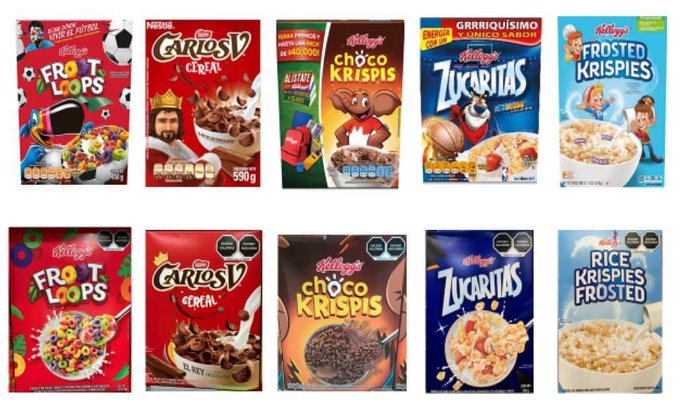
“Vida Saludable” is not the first step Mexico’s government has taken to try to improve Mexicans’ food habits. In October 2020, at the height of the COVID-19 pandemic, the AMLO government passed one of the strictest food labelling laws on the planet. From that date, all soft drinks cans and bottles, bags of chips and other processed food packages must bear black octagonal labels warning of “EXCESS SUGAR”, “EXCESS CALORIES”, “EXCESS SODIUM”  or “EXCESS TRANS FATS” — all in big bold letters that are impossible to miss.

Today, more than half of Mexican food and beverage products have a nutritional warning label — more than any other country in Latin America. The government also banned cartoon food packaging aimed at children. Spot the difference:

Image

Big Food lobbies tried to block both of these measures, of course — just as they tried to block “Vida Saludable”. The Interamerican Association for the Protection of Intellectual Property and the Mexican Association for the Protection of Intellectual Property complained that food labelling was unconstitutional and violated the provisions that Mexico had signed at the international level such as the North American Free Trade Agreement — a tactic that has apparently been used in other jurisdictions where food labelling laws have been passed.

After the food labelling law came into force, several junk food companies filed more than 170 injunctions against the new measure. For almost four years the lawsuits dragged on…

Continue reading on Naked Capitalism
Milei’s Controversial Plan to Turn Argentina into a Money Launderer’s Paradise

“The key is that nobody asks where you got your dollars.”

President Javier Milei is on a mission to transform Argentina into a paradise for money launderers — including, it seems, the creative accountants of drug trafficking organisations. Both he and Economy Minister Luis Caputo have spoken in recent days about “relaxing” (in the FT’s words) Argentina’s curbs on tax evasion and money laundering in a bid to attract billions of dollars of hidden savings back into the formal economy.

The proposal contrasts starkly with the general direction of travel on cash these days, with most governments looking to make it harder to use, deposit and withdraw physical currency. As we reported two weeks ago, Spain’s tax agency has implemented a raft of anti-money laundering measures including one stipulating that anyone planning to withdraw more than $3,000 of their own money from the bank must notify the State in advance, or risk facing punitive fines.

France’s Justice Minister Gerald Darmanin has gone even further, proposing to abolish cash transactions altogether on the grounds that digital payments – including cryptocurrencies – are much easier to trace than physical money and would help authorities combat drug trafficking and other criminal activity.

As such, the Milei government’s proposals should, in principle, represent a welcome step in the opposite direction. However, while the proposals are still somewhat fuzzy on detail, the language used by Milei and Caputo in recent days suggests their intent is not so much to relax tax evasion and money laundering rules as it is to remove them altogether.

This will be a boon not just for criminal organisations but also for inveterate tax evaders who for years, if not decades, have stashed their money in tax havens like Panama and the Cayman Islands, including Caputo himself. The government calls the initiative the “Plan for the Historic Reparations of the Savings of Argentines” and says it will take place in two stages.

“The first involves everything that the national executive branch can do and is within its reach. It will be applied by decree, which the President will sign in the next few hours, and the UIF will adapt its regulations to the new scheme,” said Milei’s spokesperson, Manuel Adorni. One of the decrees signed by Milei stipulates that there will be no fiscal control over cash operations involving sums lower than just under $50,000.

The second stage, said Adorni, “will consist of a bill [sent to Congress] to shield Argentine savers from here to the future, against the next administrations.”

Ask No Questions, Get No Answers

“I do not care in the slightest” how Argentines got their dollars, Milei said during a television interview on Monday, during which he appeared to encourage tax evasion and play down the risk of courting organised crime. From the Buenos Aires Herald:

Asked about dollars stemming from tax evasion, the president said that “taxes are robbery,” later adding: “people who tried to protect themselves from thieving politicians are heroes, not criminals.”

He went on to argue that organized crime such as drug trafficking should be combated by the Security Ministry and the Defence Ministry, without involving the economy. “You do not use the economy to fight crime,” he said.

Even for Milei, who admits to having regular conversations with his dead dog through a medium, this is an absurd thing to say. After all, it is through the economy that criminal organisations are able to transform the proceeds of their activities into untraceable money that can easily be spent, or into assets that can be held or sold.

What the Milei government is essentially proposing to do is, on the one hand, escalate its “all-out war” on the drug trade — which, if we’re being honest, is not very libertarian-minded — while at the same time giving drug traffickers free reign to launder their money into the official economy.

Drug money is a huge source of liquidity for the global banking system — so much so that Antonio Maria Costa, head of the UN Office on Drugs and Crime, claimed that drugs money essentially saved some banks from collapse during the 2008-09 Global Financial Crisis, becoming “the only liquid capital investment available.” The fact that Canadian lender TD Bank was recently fined $3 billion for laundering drug money suggests this trend is alive and well.

And that appears to be what Milei’s new fiscal amnesty is ultimately all about: remonetising Argentina’s financial system (and central bank) using the proceeds of crime and tax evasion, because something tells me it will be mainly criminals, both of the blue- and white-collar variety, (and not everyday Argentines) who will be taking advantage of the new rules. And even some of them may blanch at the idea of putting their money in Argentina’s banking system.

Now, back to the Buenos Aires Herald piece:

For the measure to work, [Milei] said, “the key is that nobody asks where you got your dollars. What’s more, I don’t care where you got your dollars. I don’t care in the slightest. That’s to say, economic issues are fixed in the economy. Issues of other kinds are fixed in the legal and judicial sphere. You have to understand that: they shouldn’t be mixed.”

After the plans were announced, María Eugenia Marano, a lawyer focusing on economic crimes, told the Herald that allowing the population to use dollars with no questions asked facilitated bringing laundered money back into the financial system.

Here’s what Milei has to say about the suckers who have actually been complying with the law and paying their taxes over recent decades:

“Maybe [that person] didn’t have the talent, the guts or whatever it was to get out of the system. If everyone had managed to do the same, perhaps the politicians would have stopped stealing from us.”

All of which is darkly ironic given the Milei government ramped up taxes on just about everyone, particularly the lower middle classes, as part of the economic shock program it began administering in December 2023.

“Liberating Mattress Dollars”

In a speech at the annual conference of one of Argentina’s most powerful business lobbies, AmCham, on Tuesday Caputo spoke of “liberating” the use of “mattress dollars” to promote the “remonetisation” of economic activity. That is something Argentina desperately needs.

Industrial activity in the country plummeted by 4.5% in March, exacerbating an already well-established trend. It was the worst decline since December 2023, when the just-installed Milei government imposed a 118% devaluation. A recent report by the Interdisciplinary Institute of Political Economy (IIEP) of the University of Buenos Aires (UBA) found that exports of the sector plummeted 17% in the past 20 years.

Corporate defaults are also rising, partly due to the government’s recent lifting of currency controls, Bloomberg reports:

Companies took advantage of the currency controls that created a gap in exchange rates by importing goods at the stronger official rate and selling them in pesos linked to a weaker parallel rate. Companies were also able to borrow in the local capital markets, benefiting from investors looking to hedge against currency risks and rushing to buy securities linked to the official exchange rate, such as bonds or commercial paper.

Following those recent overhauls however, companies are beginning to stumble, with two subsidiaries of utility Albanesi SA on Monday unable to pay $19.5 million in interest on a bond that was issued just six months ago. The default adds to a list that’s expected to get longer as Milei pursues his dramatic shift of the Argentine economy.

Agro-industrial companies Grupo Los Grobo LLC, Agrofina and agricultural supplier Red Surcos SA in recent months also failed to meet their debt obligations. Red Surcos, for one, in December defaulted on the payment of two promissory notes. Los Grobo and Agrofina accumulated claims for non-payment of debts of around $300 million, according to local news reports.

So far, the defaults aren’t systemic, nor are they concentrated in a single sector. Still, they’re highlighting the growing pain points for companies in Milei’s Argentina.

Consumption, particularly among lower income groups, is also showing no sign of recovery as annual inflation remains at a still-high 47% while wages in the private sector continue to stagnate. In March consumption levels fell 5.4% year over year. It was the 16th consecutive month of decline. It is against this backdrop that the Milei government is seeking to lure billions of “mattress dollars” back into the official economy.

“It is not money laundering,” Caputo said, “it is the beginning of a new regime”:

“What we’re going to do is much deeper. It is the beginning of a new regime. In Argentina, the level of informality is so high as a result of two reasons: taxes and excessive regulations. Argentina assumes that 99.99% are criminals and this is not the case. We take this to a level of madness that leads people to escape formality.”

The Milei government estimates that Argentines have anywhere between US$200 billion and US$400 billion — the equivalent of between 33% and 66% of the country’s GDP. According to the INDEC statistical bureau, Argentines held US$256 billion in cash and deposits outside the nation’s financial system in the last quarter of 2024. Releasing that money, Milei says, could “drive a sharp acceleration in economic growth.”

Successive Argentine governments, including Milei’s, have launched tax amnesties but with muted impact. Milei has likened his proposed “Plan for the Historic Reparations of the Savings of Argentines” to a tax amnesty — just without the tax part.

You might think that such a move would earn the Milei government a stern rebuke from the US government but so far, crickets. In fact, Abigail Dressel, the chargé d’affaires of the US embassy in Argentina, spoke at the same event as Caputo, and had nothing but effusive words about US-Argentine relations and Argentina’s “radical shift in economic policy” under Milei. Perhaps conversations are taking place in private but in public there’s not been a whimper of protest from the US Treasury or State Department.

Decades of Distrust

One of the main reasons for Argentines’ penchant for holding dollars under the mattress is the chronic weakness of the Argentine peso, notes the FT:

The currency’s value has been decimated by chronic inflation, prompting people to save in dollars. When the government introduced currency controls in 2011, limiting dollar purchases in order to prop up the peso, many Argentines took their earnings outside of the legal system to a vast black market for dollars, known as “the blue”…

Those hidden dollars can be exchanged on the black market for pesos and used to make small purchases, but anything significant is risky.

Retailers must take ID for cash purchases of more than about $180 and report them to tax authorities.

The FT hints at an arguably more important reason: the general public’s distrust of the government and banking system following “several episodes in the 1990s and 2000s where the government abruptly restricted access to savings.”

Those “episodes” include the so-called “Corralito” (corral, animal pen) of December 2001, when the Fernando de la Rua government, facing a gathering bank run, imposed a limit of cash withdrawals of 250 ARS per week. At that time, the ARS was pegged artificially one to one against the dollar.

With the stroke of a pen, $70 billion of personal and business savings were frozen. Within days, de la Rua was forced to flee the Casa Rosada by helicopter following nationwide protests, strikes and looting that had resulted in 30 deaths and 400 injuries. Weeks later, his replacement, Eduardo Duhalde, depreciated the Argentine currency by 400%, leaving millions of Argentines facing ruin.

Well-connected bankers, financiers and politicians were able to pull their money out of the banking system and send it overseas before the Corralito came into effect. Much of it still remains overseas but could soon be coming back thanks to the new rules.

The question is: will Argentines in general be willing to entrust their hard-earned savings with the banks again, especially given the ongoing weakness of the economy?

Continue reading on Naked Capitalism
US Looks to Escalate Its Economic War Against the World By Taxing Remittance Payments

Paradoxically, this is likely to create more, not less, illegal immigration to the US. 

By threatening to tax remittances — money sent from migrant workers in the US to their families back home — the Trump administration is bringing to life one of the worst nightmares of developing and emerging economies worldwide: the end of the long-rising tide of remittance inflows. These inflows have become an essential source of income for families, communities and nations in the so-called “Global South”.

On Wednesday, the Ways and Means Committee of the US House of Representatives approved the chairman Jason Smith’s proposal to impose a 5% excise tax on remittance transfers that would cover more than 40 million people, including green card holders and non-immigrant visa holders, such as people on H-1B, H-2A and H-2B visas. Until now, remittances were not subject to US taxation, making this a stark policy reversal.

The proposal reads as follows:

This provision imposes a five percent excise tax on remittance transfers which will be paid for by the sender with respect to such transfers. The provision requires that the tax be collected by the remittance transfer providers and the remittance transfer providers are responsible for remitting such tax quarterly to the Secretary of the Treasury.

The provision also makes it clear that remittance transfer providers have secondary liability for any tax that is not paid at the time that the transfer is made. The provision also creates an exception for remittance transfers that are sent by verified U.S. citizens or U.S. nationals by way of qualified remittance transfer providers.

With 26 votes in favour and 19 against, the committee approved the legislation proposed by Smith. The Democratic caucus spoke out against the proposal, while Republican legislators showed unanimous support. The proposed tax on remittances forms part of the administration’s Trumpian-titled “One, Big, Beautiful Bill” that is expected to be voted on by the full House of Representatives by May 26 and, if approved, sent to the Senate for discussion.

Trump recently said he is also working on a presidential memorandum to “shut down remittances” sent by people in the US illegally without revealing any specifics, such as how it would work.

Proponents of such measures argue that limiting, prohibiting or taxing remittances would make life more difficult for undocumented immigrants in the US while raising much needed revenue for the US government. However, it also risks exacerbating poverty and economic uncertainty in the US’ own “backyard”, particularly small Central American states for whom remittances have become the major source of national income.

And that, paradoxically, could end up fuelling even more illegal immigration to the US.

More Migration = More Remittances

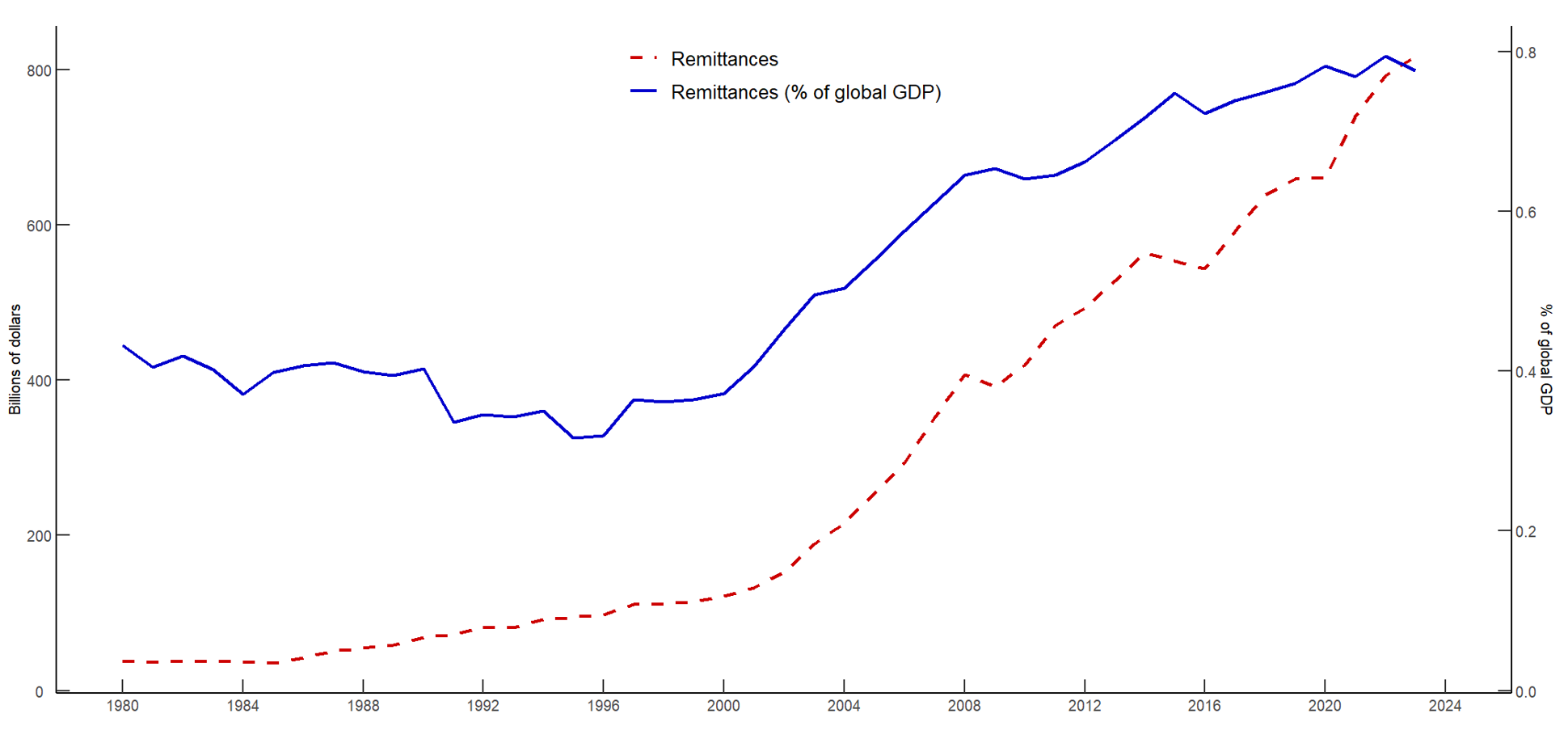
As the graph below (courtesy of the Fed) shows, remittances have grown at breakneck pace, increasing more than five fold since the start of this century to reach almost $800 billion in 2024.

Figure 1. World Remittances. See accessible link for data.

The main reason for this surge is that more people are working overseas than ever before. The total number of migrant workers globally more than tripled between 2010 and 2020, from 53 million to 170 million, according to the International Labor Organisation (ILO). Migrant workers often end up doing jobs that are deemed essential, many of them low paid. Many ended up filling the ranks of the briefly celebrated but quickly forgotten “essential workers” in advanced economies like the US during the COVID-19 pandemic.

And it is the world’s poorest and most vulnerable economies that depend on remittances the most, and are therefore most at risk from the Trump administration’s proposed tax raid. To paraphrase the title of Michael C Klein and Michael Pettis’ 2020 book, trade wars are, ultimately, class wars.

Many of these economies, already pummelled by the double whammy of the COVID-19 pandemic and the surge in global inflation and interest rates that followed, are already teetering on the edge. As Jomo Kwame Sundaram has regularly warned in pieces cross-posted here, recent policies in the Collective West, particularly the US, have been increasing the financial strains in developing economies, with the real danger of setting off cascading crises.

Now they face another double whammy: declining remittance payments in the months to come, assuming the Trump administration continues to escalate its crackdown on migrant workers, together with a 5% tax on the remaining remittances. That tax, if approved by Congress, is likely to ramp up the financial pressure even higher, and essentially constitutes a 5% tax on many of the poorest communities in the poorest nations, including some in the US’ direct neighbourhood.

As the Fed notes, of the estimated $818 billion in remittance flows in 2023, of which an estimated $93 billion came from the US, more than any other country, $656 billion went to low- and middle-income countries (LMICs):

Remittances continue to be a key source of external financing for LMICs, surpassing foreign direct investment (FDI) and official development assistance. Unlike capital flows such as FDI, which are often concentrated in a few large emerging economies, remittances are more evenly distributed across developing nations…

Furthermore, remittances constitute a significantly larger share of GDP in many developing nations, highlighting their critical role in financing the current account and promoting macroeconomic stability. In 2023, remittances accounted for over 20% of GDP in countries like El Salvador, Honduras, Nepal, and Lebanon, compared to FDI which accounted for less than 4% of GDP in these nations.

If the GOP’s proposed tax on remittances, together with Trump’s proposed ban on remittances by illegal immigrants, have their desired effect, these money flows will begin to subside. What’s more, this will be happening precisely at a time when Trump’s tariffs are (in the words of Michael Hudson) threatening to “radically unbalance the balance of payments and exchange rates throughout the world, making a financial rupture inevitable.”

The Most Vulnerable Economies 

One country that is likely to be hit hard is India, the world’s largest recipient of remittance inflows — with a total haul of $83 billion in 2024. As Akshat Shrivastava, founder and CEO of The Wisdom Hatch Fund, warns, US non-resident Indians, or NRIs, account for roughly 28% of all remittances sent to India:

This is close to 32Bn$ (annually). To put this in context, India’s education budget is 15Bn$. If we miss out on such a large volume of money, it will have far-lasting consequences. When an additional layer of tax is put (sic), they are likely to send less money. This impacts our foreign reserves.

NRIs have been helping India massively: it is easy to brush their contributions aside. But, if they have less incentive to invest due to such taxations, the implications will be far lasting.

That said, India gets the lion’s share of its remittances from other regions, including the Middle East and the UK. The same cannot be said of Mexico, the world’s second largest recipient of remittances. Of the $64 billion of remittances it received in 2024, 96.6% came from the US, according to BBVA Research.

Mexican President Claudia Sheinbaum lambasted the proposed tax in a recent morning press conference, calling on Republican lawmakers to reconsider it, warning that it “would damage the economy of both nations and is also contrary to the spirit of economic freedom that the US government claims to defend.”

Sheinbaum also accused the US government of targeting migrant workers with double taxation:

How are they going to tax [remittances] if Mexicans in the US already pay taxes? All Mexicans living in the United States pay taxes, whether they are have documents or not, they all pay taxes. There are even states that already tax remittances.

In other words, they will face triple taxation. Carlos Marentes, executive director of the Border Farm Workers Center in El Paso, agrees, telling the Border Report:

I have seen farm workers send remittances and show their Mexican passport with the H-2 visa. This is money they earned working, that their employer deducted taxes from. In addition, when they send the money home, they pay the (electronic wire) fees.

Those fees are often exorbitant, especially for smaller transfers (typically around $200). The World Bank’s Remittance Prices Worldwide database reveals that the global average cost for sending $200 in the first quarter of 2023 was about $12.50, or 6.25%.

Remittances have become one of Mexico’s mainstays in recent years, particularly in the rural communities hit hardest by the devastating effects of NAFTA on Mexico’s small-scale farmers. In 2024 alone, Mexico received $64.7 billion in remittances. That’s more than any country on the planet bar India, and is the equivalent of 3.4% of GDP. In some Mexican states, such as Puebla, remittances can represent as much as 10% of total revenues.

As we reported last week, the cumulative value of remittance income in the first three months of 2025 was $14.26 billion dollars, which is slightly higher than the $14,083 billion reported last year. This is despite the Trump administration’s crackdown on migrant workers, resulting in US-based Mexican workers losing over 130,000 jobs in the first quarter of 2025,  according to data from the Latin American and Caribbean Remittances Forum.

In other words, this vital lifeline for so many Mexican families has so far weathered Trump’s immigration crackdown surprisingly well — presumably because the migrant workers who have held onto their jobs are sending more money than usual back home. But as we warned in that post, whether this trend continues or begins to reverse depends on the vagaries and whims of the Trump administration…

Continue reading on Naked Capitalism
The Curious Case of the Hostile Takeover Bid by a Bank Facing Criminal Charges

Despite facing prosecution on a number of charges, including widespread corporate espionage, Spain’s BBVA still wants to take over its third biggest rival. The ECB has already given its blessing. 

For the first time ever, Spain’s national government has launched a public consultation on a proposed corporate buyout, sparking accusations from market players of government interference and overreach. The buyout in question is the hostile takeover bid launched last May by BBVA, Spain’s second largest bank by assets, against Banco Sabadell, the smallest of Spain’s big four lenders, which would further consolidate Spain’s banking sector.

Melding the two lenders together would create a bank with more than 1 trillion euros in total assets, which may be enough to propel the newly bloated lender onto the Financial Stability Board’s leader board of Global Systemically Important Banks, or G-SIBs, some time in the near future. In other words, BBVA would become, like its biggest domestic rival, Grupo Santander, officially too big to fail.

However, it would also create a lender that, like Santander, is too big to bail. Needless to say, Spain’s Pedro Sánchez government is strongly opposed to the proposed merger. Economy Minister Carlos Cuerpo says the main goal of the consultation is to gather “useful” information on what the Spanish people think about BBVA’s “hostile” takeover bid before deciding what action to take.

“As in other public consultations regarding our regulatory framework, those citizens, organizations, associations and economic agents who may be affected by the operation can participate,” said Cuerpo.

Once the consultation is complete, at the end of this week, the Ministry of Economy will have a week to analyse the information provided before deciding whether or not to recommend that the Council of Ministers try to block the proposed buyout or impose draconian conditions on Sabadell the deal.

Wiretaps, Blackmail and Shake-Downs

What makes this takeover bid particularly controversial is that both BBVA, as a legal entity, and some of its senior executives, former and current, are facing criminal prosecution over charges of widespread corporate spying and disclosure of rival companies’ secrets. The eight former executives facing charges include BBVA’s long-time president, Francisco González (2000-2018), and its former CEO, Ángel Cano.

For a period of 12 years (2004-16), BBVA hired the services of Grupo Cenyt, a private investigation firm belonging to former police chief Jose Manuel Villarejo, to spy on businessmen, politicians and journalists on behalf of the bank. Villerejo is currently serving a 19-year prison sentence for using Grupo Cenyt to wiretap, blackmail, and threaten people at the request of companies and private individuals, including, it seems, BBVA.

While other Spanish corporations, including Repsol, Iberdrola and CaixaBank, also hired Villarejo’s services, it was BBVA that would go on to become his biggest client, paying more than $10 million in fees and commissions.

In 2004, BBVA hired Cenyt to investigate executives at the construction company Sacyr, which was looking to buy a stake in the bank, as well as government officials in the former administration of Prime Minister José Luis Rodríguez Zapatero. The bank’s then-president, González, allegedly instructed his security chief to hire Villarejo to wiretap the phones of Sacyr’s president, the Spanish prime minister and the head of the administration’s economic office.

In the years that followed, Villajero is alleged to have spied on and, in some cases, bribed, intimidated and/or spread fake news, on a host of prominent figures, including senior executives of some of the bank’s largest rivals and corporate debtors, financial regulators, journalists, government ministers, members of the left-of-centre political party, Podemos, and the then-King of Spain Juan Carlos. In total, Cenyt’s team of private investigators listened to 15,000 phone calls on behalf of the bank.

Villarejo has been in prison since 2017, where he could one day be joined by the current and former BBVA executives accused of hiring his services if they are found guilty of the charges they face — I know, senior bankers don’t go to jail in this post-Lehman world, but one can still dream, can’t one?

As reader vao put it in a comment to a previous post, the reasoning why banks or bankers should be treated as “too big to jail” is that “even if the problems [facing a struggling or bankrupt bank] were caused by illegal shenanigans, members of its management are too influential and bringing them to account would ruin the confidence amongst economic actors.”

For the moment, BBVA’s lawyers are working around the clock to try to stall the trial, particularly as it tries to take over its third largest rival in an operation that nobody but itself and the ECB seems to want. So far, all its trial appeals have been struck down. The bank has also been accused of not cooperating with Spain’s National Court over requests for emails and other documents as well as refusing to share information on the case with its own shareholders — you know, the sort of things that only the biggest banks tend to get away with.

Banco Sabadell’s President, Josep Oliu, has underscored the risks of Sabadell being bought out by a rival bank that is currently in the dock (or at least should be):

The bank is facing criminal prosecution. If the result of these accusations is that it is found  guilty, it could have a major impact on the value of its stock. Sabadell’s shareholders should know this. Transparency is needed.

The Risks of Further Concentration

But BBVA’s legal pickle is seemingly not serious enough to prevent Spain’s main market regulator, the National Commission on Markets and Competition (CNMC), from approving its  proposed hostile takeover bid. However, the regulator did require certain binding commitments from BBVA, such as keeping bank branches open in areas with fewer competitors and maintaining the lending conditions Sabadell has already provided to its SME clients.

The Spanish government insists, however, that there are compelling competition and prudential reasons for blocking the proposed merger. Spain’s banking industry, it says, is already concentrated enough, with the four biggest lenders — Banco Santander, BBVA, CaixaBank, and Sabadell — controlling over 70% of the retail banking space. Before the 2008 financial crisis, the country was home to 45 savings banks and a dozen commercial banks. Now there are barely ten large and mid-size lenders left.

The consultation is not a referendum, and therefore its result is not binding. However, according to sources cited by El Diario, the government is trying to arm itself with as many arguments as possible to hamper BBVA’s hostile takeover bid. As we have previously reported, another merger in Spain would have a clear negative impact on banking competition and stability. However, the European Central Bank does not see this as a problem — in fact, it is going out of its way to encourage greater bank concentration in the Euro Area…

Continue reading on Naked Capitalism
Mexico’s Exports to US Just Surged to a New Record High Despite, or Largely Because of, Trump’s Tariffs

The world’s largest bilateral trade relationship continues to grow, but it’s a trend that is unlikely to last.

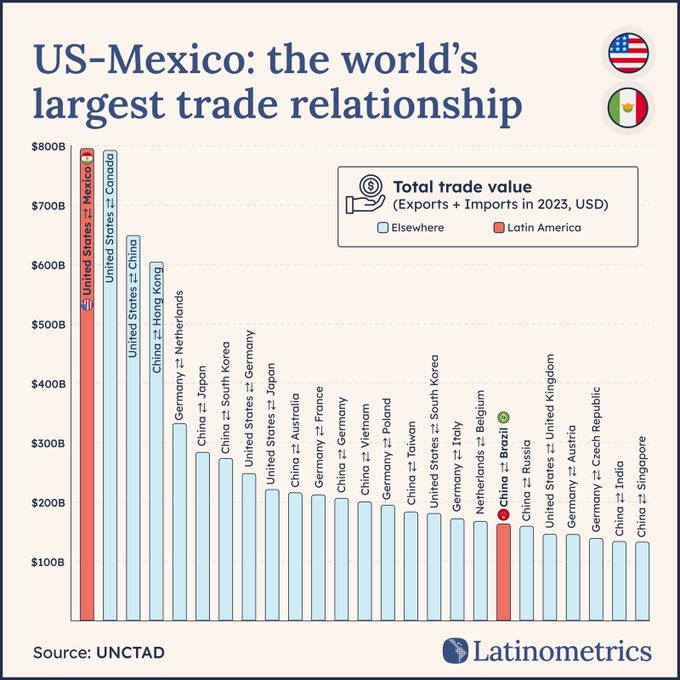
Donald Trump’s tariffs have not slowed down Mexican exports to the United States, as many predicted. On the contrary, in the first quarter of 2025, Mexico sold goods worth $131 billion, an unprecedented figure since records began, according to information from the US Department of Commerce’s Census Bureau. It represents a whopping 9.6% increase on the $119.8 billion reported in the same period of 2024.

It was a similar story for Mexico’s imports from the US, which surged by 4.8% year on year to $84 billion. The result is that total trade between the two countries reached $215 billion in the first quarter, another historic record. After notching up a total value of $840 billion last year, the world’s largest bilateral trade relationship seems, at first blush, to be going from strength to strength.

Imagen

Mexico’s exports to the US surged in the first three months of this year despite the fact that since February 4 the Trump administration has imposed a 25% tariff on all Mexican export goods that are not covered by the USMCA trade deal, which is just over half of the total. Also, since March 12 the Trump administration has imposed a 25% tariff on Mexican exports of steel, aluminium and some derivatives of both metals, including canned beer.

Yet despite Trump’s tariffs, Mexico, like Canada and China, the US’ second and third largest trade partners, increased its earnings from exports sent to the US in the first quarter of 2025. But this is a trend that is unlikely to last, especially if the US enters recession.

In fact, trade between the US and fellow USMCA member Canada already fell sharply in March after the outgoing Trudeau government imposed retaliatory tariffs on the US — something Mexico’s Sheinbaum government has so far ruled out doing — which prompted further retaliatory tariffs from Trump. While Canada’s trade with the US slumped in March, its trade with other countries surged, reports Bloomberg:

The Trump administration’s duties on Canadian steel, aluminum, autos and other products, as well as Canada’s retaliatory levies on a range of American goods, led to a large pullback in activity between Canada and its largest trading partner in March. Exports to the US plunged 6.6%, the biggest drop in nearly five years, while imports fell 2.9%, Statistics Canada data showed Tuesday.

Exports to other countries jumped 24.8%, however, almost entirely offsetting the decline in outbound shipments to the US. Imports from other countries were also up 1%. As a result, Canada’s merchandise trade deficit with the world narrowed to C$506 million, down from C$1.4 billion in February and beating the C$1.6 billion shortfall expected in a Bloomberg survey of economists.

The country’s trade surplus with the US narrowed to C$8.4 billion, from C$10.8 billion in February.

While Canadian companies are looking to expand their domestic market and overseas markets beyond the US, the reality is that Canadian companies that are heavily dependent on the US market will struggle to make up for trade lost with the US elsewhere if Trump continues to hike tariffs on Canadian goods. This is particularly true if the global economy enters a downturn, as is looking increasingly likely. From Reuters:

While some Canadian companies have lost trust, those reliant on the U.S. market cannot entirely replace it, especially smaller firms, companies and industry associations have said.

Canada’s economy is less than a tenth the size of its neighbor and shipping overseas is costly.

Meanwhile, the US’ trade deficit with Mexico continues to grow, reaching $140.5 billion in the first quarter of 2025, according to the Census Bureau. This is all happening not just despite but in large part because of Trump’s tariffs.

Since Trump began tariffing the world, both consumers and businesses have been front-loading imports from countries subject to relatively lower tariffs, including Mexico, out of fear that the tariffs will spike again once Trump’s 90-day pause ends on July 9. Though Trump has implemented various tariffs targeting Mexico as part of his broader trade policy, he excluded the country from his list of nations facing steep “reciprocal tariffs.”

Amid the recent panic buying, US imports jumped 41.3% for the quarter — the largest rise since the third quarter of 2020, when many global economies, including the US, began to emerge from the first lockdowns. This explosion in pre-tariff imports has been identified as one of the main factors behind the US economy’s sharp slowdown in the first quarter.

Unfortunately for Mexico, the relief is likely to be short lived. As US businesses and consumers grapple with rising prices and supply shortages, consumption will inevitably fall.

It has also taken time for Trump’s tariffs to feed through to customers, but that is now beginning to happen. Just this week, Ford announced price rises of up to $2,000 on three models produced in Mexico, the Maverick, Bronco Sport and Mach-E, citing higher US tariffs on imported vehicles as one reason for the adjustment. US retailers expect a drop of 20-30% in imports in the coming months, according to Goldman Sachs analysts.

As Yves warns in her post Complacency, Denialism and the Risk of an Economic Trumpocalypse, given the scale of disruption and dislocations caused thus far, not just by Trump’s tariffs but also DOGE and the immigration crackdown, “it’s hard to have a good picture of where things stand in in the US and where the bottom might be”:

That is not merely the result of information being retrospective in what looks to be a rapidly accelerating downswing, but also small businesses and/or intermediate goods producers taking the biggest hits, and they are generally not well studied.

But based on the tone of the press, discussions with people in the US, and a very recent and short trip to New York City,1 much, and arguably too much, of the US seems to be in summer of 1914 mode: cheerfully living in a sense of normalcy that is about to vanish permanently. To put it another way, if there was a sufficiently widespread appreciation of what was looming over the horizon, May 1 would have seen the launch of open-ended general strikes.

Trump really is well on his way to implementing a reactionary restructuring of the US and international economy. “The end of globalization” is too bloodless a formula to convey the severity of the dislocations that have only started to arrive.

Even in the vanishingly unlikely scenario that Trump were to abandon his tariff policies in the next week, the confusion and interruption of supplies will still have done considerable harm. The longer they remain in place, the more that damage, particularly small business closures and downsizings at small and bigger enterprises, will become permanent.

The High Costs of Dependence

And that is bad news for the US’ largest trade partner, Mexico…

Continue reading on Naked Capitalism

Despite Last Week’s Nationwide Blackout, Spanish Government Takes Criminalisation of Cash to Whole New Level

Taking money out of the bank becomes a Kafkaesque nightmare. Anyone looking to withdraw more than $3,000 of their own money must notify the State in advance as well as explain the reason(s) why, or face fines. 

It was only eight days ago that Spain suffered its biggest blackout in recent history. As we reported on the day, without the widespread culture of cash use in the country the chaos would have been far worse:

Unlike some other parts of Europe, cash is still King in Spain, albeit a slightly diminished one, accounting for 57% of in-store payments, according to the Bank of Spain’s latest annual household survey. As such, most local people were able to make emergency purchases and many customer-facing businesses were able to continue operating. I cannot imagine the sort of chaos that would reign if something similar were to happen in my native United Kingdom, where the overwhelming majority of people do not use cash, or in cashless Sweden, where the amount of cash in circulation is equivalent to around 1% of gross domestic product — compared to 8% in the US and more than 10% in the EU.

It is fear over exactly this kind of eventuality that has prompted governments and central banks in Scandinavia to try to reverse the public’s mass abandonment of cash that they themselves helped set in motion many years ago. As Sweden’s Riksbank warned last year, rapid digitalisation has made payments “more vulnerable to cyber attacks and disruptions to the power grid and data communication”.

Put simply, cash saved the day — a message that has been reported throughout the Spanish media over the past week. Those who didn’t have cash on them or at home suddenly found themselves trapped in an economic limbo, reports the right-leaning La Razón :

This technological “fade to black” has reopened the debate on the need to preserve cash, considered by some to be expendable…

Monday’s blackout highlighted the fragility of a completely digitised system. People trying to pay for a bus ticket, a loaf of bread or a taxi suddenly realised they did not have a single euro in their pockets. The ATM network did not offer a solution either, as it was also paralysed. The image of citizens rummaging for forgotten coins, asking strangers for help or asking for credit [from local businesses] reflects the degree of current technological dependence.

[T]he day after the blackout, long queues of citizens could be seen waiting to withdraw money from ATMs out of fear that the situation experienced hours earlier would be repeated.

Spain’s biggest financial newspaper, Expansiónnotes that “cash, the most common payment method in Spain, has become the plan B option in emergency situations like the blackout”. The left-leaning El Diario highlights one of the main lessons of the blackout: “you have to carry cash with you”.  The blackout “has reopened the debate on the importance of cash, which became the only real way to acquire basic products and services”, writes El Confidencial while El Periodico gave the final verdict: cash is “clearly still necessary in our daily lives”.

However, Spain’s Pedro Sánchez government, which is on a mission to squeeze the life out of cash, appears to have other ideas.

In June 2020, at the height of the COVID-19 lockdown, Moncloa presented a non-legislative proposal advocating for “the gradual elimination of cash payments” as part of plans to increase tax collection and combat the black economy. Since then, it has slashed the national cash payment limit from $2,500 to $1,000, one of the lowest levels in Europe. To its credit, it did respond to nationwide protests in 2022 against bank branch closures and the proliferation of cashless businesses by obligating retail establishment to accept cash payments.

But the long-term goal of the Sánchez government is to take cash down. Just before the blackout, it unveiled plans to take the criminalisation of cash to a whole new level. Spain’s tax agency implemented a raft of anti-money laundering measures including one stipulating that anyone planning to withdraw more than $3,000 of their own money from the bank must notify the State in advance, or risk facing punitive fines. They must also explain to their bank, and by extension the government, the reason(s) for the withdrawal. From El Diario:

A new regulation has already come into force that tightens control over bank withdrawals. The Tax Agency has established that citizens and companies must notify in advance if they plan to withdraw large amounts of cash. If they do not do so, they will face penalties that can reach €150,000, depending on the seriousness of the infraction. This measure is part of the Government’s recently launched plans to combat tax fraud and money laundering.

According to the Treasury, withdrawals that exceed certain thresholds must be communicated through a specific procedure. Financial institutions will also have the obligation to report suspicious transactions.

The obligation to notify the Tax Agency of a cash withdrawal applies when the amount to be withdrawn equals or exceeds €3,000. Notice must be given at least 24 hours before carrying out the operation… For operations exceeding 100,000 euros, notice must be given at least 72 hours in advance.

The regulations establish that the notification must include data such as the amount being withdrawn, the purpose of the withdrawal, the identity of the customer and the final recipient of the money if the two are different. If this obligation is not complied with, it is considered a serious infraction. In the event of a withdrawal being detected without prior notice, a penalty may be imposed that varies between 1% and 10% of the amount withdrawn, with a minimum of 600 euros and a maximum of 150,000 euros.

The notification must be filed through the tax agency’s official website using a digital certificate, Cl@ve PIN, or electronic ID card. If approved, the bank customer will then receive a receipt that must be shown at the bank when withdrawing his or her cash. On Banco Sabadell’s website, customers are advised that if they need to withdraw more than €3,000 at once, the bank will ask for proof of the reason for the withdrawal. This receipt is then sent to the Tax Agency and the Bank of Spain.

Back to the article:

This measure also relies on the active collaboration of banks, which must temporarily block operations if they detect that the requirement of prior notification has not been met. In addition, they must send periodic information to the Treasury on cash movements that exceed the established thresholds. The spotlight is also on repeated operations for lower amounts, such as withdrawals of €800 or 900 €euros, which could raise suspicions if they are not properly supported.

Until now, withdrawn amounts of €3,000 euros or more only had to be reported by the bank in question to the Spanish central bank, which in turn reports them to the tax authority. These reports will presumably continue to take place.

But it’s not just the money coming out of bank accounts that the government wants to know all about; it also wants to know about the money going in to them.

According to El Español, the Spanish Tax Agency will be requesting proof of the provenance of funds if an amount equal to or greater than €3,000 is deposited in a bank. If a bank customer deposits smaller amounts across different days, it will also be considered suspicious. If the provenance of funds cannot be demonstrated in a satisfactory manner, the Tax Agency reserves the right to impose fines of up to 150% of the money deposited, with maximum fines of up to €150,000 in the most serious cases.

The Bank of Spain recommends keeping all the receipts, contracts and any other type of documentation necessary to explain the origin of the money that we deposit in the bank or what we are going to use it for if it is withdrawn.

Interesting Timing

This is all happening as the European Union gears up to launch its central bank digital currency, the digital euro. As we reported in late March, the two main EU authorities driving the rollout of the digital euro, the European Central Bank and the EU Commission, are keen to bring forward the launch, even as most Euro Area citizens surveyed on the matter seem broadly disinterested in their proposed CBDC.

As previously mentioned, it is not easy to sell a project that is broadly seen, even by many politicians and some central bank insiders around the world, not only as a “solution in search of a problem” but one that is fraught with risks. Even the German MEP appointed to lead the European Parliament’s legislative push for a digital euro, the Rapporteur Stefan Berger, became one of its fiercest critics, eventually stepping down from the role.

And there is plenty to criticise about the proposed digital euro, including the threat it would pose to financial privacy, particularly in a world where cash has been totally eliminated, as the Spanish government seek to achieve; the way programmable currencies like the digital euro could be used not only to monitor our spending but also control it; and the fact that the digital euro will almost certainly go hand in hand with the EU’s digital identity wallet, allowing for the creation of an almost perfect digital control grid.

Combining digital currencies with digital IDs while phasing out, or even banning, the use of cash would grant governments and central banks the ability not only to track every purchase we make but also to determine what we can and cannot spend our money on. They could also be used to strongly encourage “desirable” social and political behaviour while penalizing those who do not toe the line.

As the German financial journalist and cash advocate Norbert Häring puts it, the only discernible function of the digital euro is to “help displace cash and bring Europe closer to total digital surveillance.”

Spain has seen a flurry of articles in the mainstream media over the past few days arguing that the proposed digital euro would have fared well during last week’s blackout since it will apparently be able to function both online and offline (while apparently also not needing electricity). The ECB and EU Commission are currently trying to sell the project to the EU citizenry, and their ostensible representatives in Brussels whose support they will need in the European Parliament’s vote on the definitive legal framework for the digital euro in October.

One popular argument in favour of the proposed CBDC currently doing the rounds is that a digital euro would allow Europe to defend itself not only against the stablecoins being let loose by the Trump administration’s hands-off regulatory approach but also the US card duopoly that dominates the global payments landscape, Visa and Mastercard…

Continue reading on Naked Capitalism

Washington Is Once Again Weaponising the IMF to Try to Reclaim Its “Back Yard”

Through its selective lending to struggling economies in Latin America, the IMF is helping Washington, once again, to reassert its strategic influence.

A couple of weeks ago, Argentina’s Milei government signed a $20 billion loan agreement with the IMF to help stall a run on the peso and allow it to keep servicing the $41 billion of debt it already owed the Fund. The deal included an unusually large $12 billion chunk upfront. The Washington-based World Bank and Inter-American Bank threw in additional emergency loans of $12 billion and $10 billion a-piece.

As we reported at the time, the IMF loan was granted despite fierce opposition from senior staff at the Fund. Even before the new loan, Argentina, which represents only 0.6% of global GDP, was already the Fund’s biggest debtor by a country mile — accounting for more than one-third of its entire global lending.

Pressure to Sign on the Dotted Line

Bloomberg has since revealed that half of the IMF’s board of directors was opposed to granting the new loan, presumably out of fear that: a) the loan would be used by the Milei government to fund its electoral campaign in the upcoming mid-term elections, just as the Macri government did in 2018; and b) Argentina would once again fail to meet its debt obligations, leaving the IMF in an even more dangerous place.

However, the board ended up buckling to pressure from the IMF’s President Kristalina Georgieva and the Trump administration, and signed on the dotted line. Days later, Georgieva urged Argentines to “stay the course” in the midterm elections in October, sparking accusations in Argentina of electoral meddling.

Georgieva’s words were also seen as confirmation that the $20 billion loan was indeed intended to help the Milei government reach October with the economy more or less intact, so that it could “stay the course”. Hours later, Georgieva had to qualify her words, insisting that she was not telling Argentines who they should vote for in the elections but rather emphasising the need for a continuation of economic policy.

Hours later, the photo below went viral showing Georgieva wearing a chainsaw brooch, in homage to Milei’s famous campaign prop. The man to her right, who gave her the accessory, is Federico Sturzenegger, Argentina’s minister of deregulation and government transformation. Sturzenegger, a graduate of the WEF’s Young Global Leader program and former central banker, apparently inspired Elon Musk’s Department of Government Efficiency (DOGE) and was recently appointed to the IMF’s Advisory Council on Entrepreneurship and Growth.

A Risky Relationship

However, Washington’s cosying up to Milei’s Argentina is not without its dangers. As the Bloomberg article notes, the more money the Fund throws at the serial defaulter, the more risks it heaps onto its own balance sheet:

There are risks for the lender in handing over so much cash upfront in a program that’s essentially refinancing large existing debts, according to Brad Setser, a former senior official at the US Treasury.

“The Fund would be raising its exposure when the peso is clearly overvalued and the country is repaying bonds,” he said. “It looks like the Fund is positioning itself as, de facto, the junior creditor.”

However, Argentina still has some valuable assets that have no doubt been pledged as collateral. They include vast deposits of both lithium and unconventional oil and gas.

But this is as much about politics and geopolitics as it is about finance and economics. As we reported a couple of weeks ago, the fact that Milei was visited by the US Treasury Secretary Scott Bessent just three days after the IMF deal was signed speaks volumes about Argentina’s importance to the US’ geostrategic ambitions.

On the one hand, it is on the doorstep of the Antarctic, with its vast stores of unexplored and unexploited resources, including the largest freshwater reserve on the planet. It also shares the “Triple Frontier” with Brazil and Paraguay, a key border in South America in terms of population, movement of people and international relations, making it an enticing prospect for a Trump administration looking to reassert US influence throughout the Americas.

The same goes for Argentina’s proximity to the Drake Passage, a wide waterway connecting the Atlantic and Pacific Oceans between Cape Horn (the southernmost point of South America) and the South Shetland Islands off Antarctica. If the US could control both the Drake Passage and the Panama Canal, it would control the two bi-oceanic passages on the American continent.

US Southern Command Pays a Visit

All this considered, it came as little surprise that Argentina was visited on Tuesday by the new chief of US Southern Command, Admiral Alvin Holsey, to discuss issues of “regional security.”

The next day, Holsey and his entourage went to Ushuaia, the capital of Tierra de Fuego, to inspect in situ the joint US-Argentine naval base and logistics hub being developed on the shores of the Beagle Channel, a privileged access route to the South Atlantic.

In April 2024, Milei travelled the 1,860 miles separating Buenos Aires from Ushuaia to meet briefly with the then-US Southern Command Chief, Laura Richardson, to announce the creation of the joint naval base. “This is a major logistics centre that will constitute the closest development port to Antarctica and will make our countries the gateway to the white continent,” Milei said at the time.

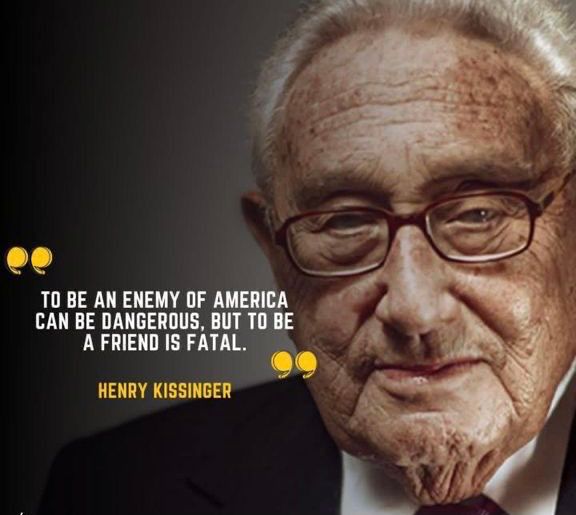
Kissinger once described Latin America as a “dagger pointed at the heart of Antarctica” (nice imagery). He also said this.

Imagen

If Latin America is indeed a dagger, it is growing in value and importance to Washington as the Trump administration seeks to retrench from certain parts of the world back to the American continent as well as assert control over the continent’s two bi-oceanic passages. As El País explains in an article from yesterday, the main goal is to push back against China’s growing presence in Latin America:

Ushuaia is 620 miles from Antarctica. The Chilean base at Punta Arenas is 870 miles away. These are shorter distances than those of other countries in the Southern Hemisphere: South Africa, New Zealand and Australia.

The official purpose of [Admiral Holsey’s] visit was to “supervise firsthand the role of Argentine forces in protecting key maritime routes for global trade,” according to the statement issued by the Southern Command. The Trump administration is also interested in the Ushuaia bi-oceanic passage, in parallel with the pressure it is exerting on Panama to secure control of the Canal. In both cases, Trump’s move seeks to displace Beijing from strategic spaces in Latin America following the Asian power’s advance on the continent in recent years.

Through its lending to struggling economies in Latin America, the IMF is once again helping Washington to reassert its strategic influence in its backyard. It is probably no coincidence that three of the four countries in the region that have outstanding debts with the IMF — Argentina, Ecuador and El Salvador — all have governments that are not only completely aligned with Washington but are also completely on board with Israel’s genocide.

But these countries are currently in a very small minority…

Read the full article on Naked Capitalism