Banks and Payment Card Companies Form a Discount Cartel to Take Down Cash in “Cash-Addicted” Germany

The cash assassins set their sights on Europe’s biggest economy.

If there’s one major European economy that did not get the memo on moving swiftly away from cash to digital payments during the COVID-19 pandemic, it is Germany. Though cash use has declined in recent years, physical notes and coins are still the main payment method. In 2023, 51% of all transactions were still being made with cash, with debit cards in a distant second place at 27%, according to the Deutsche Bundesbank’s annual payments survey. [1]

In the same year, Foreign Policy magazine described Germany as “hopelessly addicted” to cash:

Germany is not the only country standing athwart the global trend toward cashless payments. In Austria, cash is so popular that the Austrian chancellor has claimed it should amount to a constitutional right. Yet in other European countries, such as the United Kingdom, cash will account for just 6 percent within a decade, and in the Netherlands only 11 percent of transactions were made in cash last year. In other bigger economies, the pace of the decline is even faster. While in China 8 percent of point-of-sale (POS) transactions were made in cash, in India, cash use has declined from 91 percent in 2019 to 27 percent in 2022.

But in Germany, an obsession with [NC: as opposed to “concerns about] privacy, mistrust of big-tech and fintech in general [NC: probably warranted], and worries about political and financial crises depleting bank balances overnight—an experience rooted in history as well as a cultural desire for control—all contribute to the country’s love for cash…

On average, Germans carry more than 100 euros in their wallets—much more than their counterparts in many other developed nations. Since the euro was introduced, the Bundesbank has issued more cash than any other member in the 27-nation European Union, and according to the Bundesbank report, even though cash use was down from 74 percent in 2017, as high as 69 percent of respondents expressed their intention to continue to pay in cash.

Even as Germany has suffered wave after wave of ATM bombings, providing banks with a perfect pretext for closing even more branches and ATMs, and local and federal authorities have made it increasingly difficult to pay in cash for basic services such as public transport or registering a driving license, as the German financial journalist and cash advocate Norbert Häring has documented (in German), most Germans have continued to cling to cash.

In a survey conducted by the European Central Bank, 69% of Germans said that cash is either important or very important to them. As Der Spiegel International noted, with a gentle dash of PMC arrogance and derision, in its article last April, “Cash’s Last Stand”, this is particularly true of “older people and people with low incomes and education levels.”

Enter the Cash Assassins

But the country’s financial institutions, together with payment processors, are now taking matters into their own hands. As Häring reports (in German), big banks are joining forces with large credit card companies in an attempt to force cash out of the market through cartel pricing and unfair competition:

The new initiative “Germany pays digitally”… is not an “initiative”, but a cartel. It consists of Commerzbank (Commerz Globalpay), Deutsche Bank, Volks- and Raiffeisenbanken (VR Pay), Mastercard, Visa, Flatpay, Unzer and SumUp. Further cartel members are expressly welcome to join. The aim is to displace their main competitor, cash, and the cash service providers through dumping prices. I can’t judge whether it’s a legal cartel, but it seems legally questionable to me…

This is because cash causes costs that are often lower for small merchants than the costs of digital payments, but not zero.

Here’s how it will work: the cartel will be offering small merchants and retailers with up to €50,000 in annual turnover free installation of a payment terminal and free use of it for all transactions for up to one year. No fees, no commissions. Those will obviously kick in during the second year. As Häring notes, the cartel members are willing to accept temporary losses in order to incentivise small businesses to accept digital payments instead of cash.

The irony is that two of the banks involved in the scheme, Deutsche Bank and Commerzbank, are also directly involved in Deutsche Bundesbank’s recently established National Cash Forum, whose stated mission is “to preserve cash as a cost-effective and widely used means of payment in Germany.”

One would be hard-pushed to find a better example of the fox looking after the chicken coop. As Häring notes, the central bank’s cash forum is clearly a facade intended to give the impression that the central bank and commercial lenders are taking measures to protect cash while doing the exact opposite.

As for Visa and Mastercard, it should hardly come as a surprise that they are involved in this cartel-like attack on cash. Both are members of the Better Than Cash Alliance (BTCA), a coalition of governments, financial firms, IT companies and philanthro-capitalist foundations that have been pushing back against cash use worldwide, primarily in the Global South, for over a decade. The state sponsors of BTCA include Germany’s federal government.

For payment companies like Mastercard and Visa that generate fees from facilitating money transfers between banks accounts, cash is their ultimate rival. In 2010, the then-CEO of Mastercard (and current president of the World Bank), Ajay Banga, openly declared war on cash:

“In today’s terms, only 3% of retail spend in India or in China are through electronic payments. The rest is cash. I have declared war on cash; I believe MasterCard will grow by growing against cash. If you keep looking at 3%, everybody’s a rival; if you look at the remaining 97%, everyone’s a partner.

Both Mastercard and Visa have played arguably the biggest role in demonising cash over the past decade or so. As Brett Scott documents in his book Cloud Money, the payments industry has “consistently cast card payments as being safer, cleaner and higher status than cash, thereby slowly associating the latter with crime, disease and low status.”

The demonisation campaign hit a whole new level when cash became erroneously associated with COVID-19 infections. In early March 2020, a WHO spokesperson said:

“We know that money changes hands frequently and can pick up all sorts of bacteria and viruses … when possible it’s a good idea to use contactless payments.”

The WHO would later walk back its statement, stressing that it was not advising people to abandon the use of cash. But by then media outlets, payment card companies, fintech start-ups and big-box retailers had seized on the original comments and magnified them, sparking fears over the safety of cash. At the same governments and central banks around the world loosened the limits on contactless card payments.

For Mastercard this was nothing new. The company has been stoking the global public’s fear of cash as a vector of bacteria and disease since at least March 2013, when it sponsored an Oxford University “trial” into the germ loads found on the banknotes of a selection of global currencies. Mastercard reserved the exclusive right to present the findings of the trial as well as the results of a highly misleading survey on public perceptions of the health risks of cash, which it did in gaudy glory around the world.

“A Roaring Success”

In most countries in the so-called collective West, the Global War on Cash has been a roaring success. As shown in the map below, by the the second year of the pandemic cash had already been eclipsed in most of the economies of Northern and North-Western Europe. Granted, it was a different story in other parts of the continent, particularly Central and Southern Europe. It is also true that some countries, including the UK, France, and Spain, have seen a moderate recovery in cash use since the lockdowns of 2020-21.

The mass abandonment of cash has been driven by a host of factors such as generational shifts and technological advances, including the rise of e-commerce and seamless contactless payments. Payment card companies, banks and big retailers knew from the get-go that contactless payments would not only offer higher transaction speeds and lower cash handling costs but also encourage compulsive consumption. Now, the payment card companies and banks want to move away from cards to biometric payments.

But the notion that this is all part of an organic bottom-up process is swiftly debunked by this example of cartel-like behaviour from German banks and global payment processors. The War on Cash continues to escalate, particularly in countries countries where cash is still King, albeit a rather diminished one, such as Germany, Spain and Austria.

Unless access to cash and the ability to use it as a means of payment are protected by law, ideally through constitutional amendments, its future is far from guaranteed, especially with the European Central Bank and the European Commission desperate to accelerate the rollout of the Euro Area’s proposed central bank digital currency, the digital euro…

Read the full article on Naked Capitalism
Five Reasons Why Euro Area Citizens Should Be Terrified By the ECB’s (Apparently) Fast Approaching Digital Euro

Imagine a technology that could facilitate an unprecedented expansion of totalitarian power in the hands of the ECB and EU Commission. What could possibly go wrong?

If you are a citizen of one of the Euro Area’s 20 member nations and are wondering why the legacy media is suddenly awash with articles on the European Central Bank’s proposed digital euro after studiously ignoring its development over the past six years, there is a simple reason: the digital euro is closer than ever to becoming a reality — at least according to own architects.

In fact, the two main EU institutions driving its development, the European Central Bank (ECB) and the European Commission, are, if anything, determined to accelerate its roll out. Which kind of makes you wonder: why all the rush?

With the “preparation phase” of the digital euro scheduled to end in October and since the European Central Bank and the European Commission need the European Parliament, the EU’s rubber stamping chamber legislative assembly, to approve the definitive legal framework for the bloc’s proposed central bank digital currency, or CBDC, the time has finally come to sell the project to the people — with the help, of course, of the legacy media and news agencies.

However, it is not easy to sell a project that is broadly seen, even by many politicians and some central bank insiders around the world, not only as a “solution in search of a problem” but one that is fraught with risks. Even the German MEP appointed to lead the European Parliament’s legislative push for a digital euro, the Rapporteur Stefan Berger, become one of its fiercest critics, eventually stepping down from the role.

According to the German financial journalist Norbert Häring, the only identifiable function of the digital euro is to “help displace cash and bring Europe closer to total digital surveillance.” So, how do you sell a project whose advocates (in the words of Federal Reserve Governor Christopher Waller) “often fail to ask a simple question: What problem would a CBDC solve?”

The answer, it seems, at least in the case of the Euro Area, is to generate as much fear as possible about Europe’s dependence on US payments providers at a time when the US is increasingly viewed as hostile to Europe. Lagarde says that the digital euro is necessary in order to preserve Europe’s monetary sovereignty — oh, the irony. Last week, the European Central Bank chief economist Philip Lane warned about the risks of Europe’s outsized dependence on American payment providers leaving it open to future economic coercion. From Reuters:

“Europe’s reliance on foreign payment providers has reached striking levels,” Lane said in a speech in Cork, Ireland. “This dependence exposes Europe to risks of economic pressure and coercion and has implications for our strategic autonomy, limiting our ability to control critical aspects of our financial infrastructure.”

“We are witnessing a global shift towards a more multipolar monetary system, with payments systems and currencies increasingly wielded as instruments of geopolitical influence,” he said.

He warned that national card schemes have been entirely replaced by international alternatives in 13 of the euro zone’s 20 countries, making it imperative that the ECB pushed ahead with issuing a digital currency.

“The digital euro is a promising solution to counter these risks and ensure the euro area retains control over its financial future,” Lane said.[1]

And here comes the first big lie from the Reuters piece:

A digital euro would function much like cash, allowing people to make direct retail payments without relying on a card service provider.

This could not be further from the truth (as we will explain in point #2 below), but it sure sounds reassuring to EU citizens who continue to trust the word of the media on matters of great import. And there are few matters more important than the system of money we live and work under.

As we warned back in 2022, the mass development and rollout of central bank digital currencies would represent (and this, I believe, is not hyperbole) a financial revolution that threatens to radically reconfigure the very nature of money itself. And let’s be clear: this will not be a bottom-up revolution. There are no European citizens marching in the streets calling for a digital euro, for the simple reason that most people already believe they are using a digital euro currency every time they pull out their card or mobile phone.

But there are some key differences between the ECB’s proposed digital euro, and the digital euro currency currently in use. For a start, the former will be money issued by the state, via the central bank (though it will still be commercial banks that manage all the customer-facing activities) and users will be allowed to hold a maximum deposit of 3,000 euros at any one time [2]. The latter, meanwhile, is private money issued and managed by commercial banks.

As the use of cash has declined, in part because of the war waged upon it by the EU Commission and the ECB, the amount of public money in the economy has also declined. Now, the ECB and Commission want to reverse this dynamic by issuing their own CBDC. But this will have potentially far-reaching implications that should give all EU citizens pause. Here are five of the most important reasons why we should be terrified of the fast approaching launch of the ECB’s digital euro:

1. The Digital Euro Could (And Almost Certainly Will) Be Used As a Tool of Financial Surveillance and Control.

A central bank digital currency system will technically no longer require middlemen such as banks or credit card companies. That said, Europe’s largest financial institutions, many of which have been helping to build the architecture for the CBDC system, will find a new role in the new digital reality. This probably explains why the ECB is so keen on further consolidation in Europe’s banking sector: once the digital euro is firmly established, there will be even less need for choice and competition within the banking sector.

As the ECB noted in a press release last December, “Supervised intermediaries, such as banks, would play a key role in distributing the digital euro. They would act as the main point of contact for individuals, merchants and businesses for all digital euro-related issues and would perform all end-user services.”

Meanwhile, the ECB, like all central banks that end up launching a CBDC, will retain oversight and control over the creation, destruction, and movement of money, just as Agustin Carstens, general manager of the Bank of International Settlements, put it at a 2020 summit of the IMF:

“We don’t know who’s using a $100 bill today and we don’t know who’s using a 1,000 peso bill today. The key difference with the CBDC is the central bank will have absolute control [over] the rules and regulations that will determine the use of that expression of central bank liability, and also we will have the technology to enforce that.”

It is not just the prospect of the ECB and the Commission being able to track, trace and monitor all of our financial activity — what we earn, how we spend, what we save — that should terrify us; it is also the prospect of them being able to “program” money so as to achieve certain monetary, fiscal or social policy objectives.

In a fully cashless digital-euro system, the central bank and Commission would have a complete record of every transaction made by everyone, allowing it to essentially eradicate tax evasion. The potential applications go far beyond that, notes NS Lyons, a Washington DC-based consultant and analyst in his 2022 article CBDC Caution: A Central-Bank-Issued Digital Dollar Could Enable a Dark Future:

Fines, such as for speeding or jaywalking, could be levied in real time, if CBDC accounts were connected to a network of “smart city” surveillance. Nor would there be any need to mail out stimulus checks, tax refunds, or other benefits, such as universal basic income payments. Such money could just be deposited directly into accounts. But a CBDC would allow government to operate at much higher resolution than that if it wished. Targeted microfinance grants, added straight to the accounts of those people and businesses considered especially deserving, would be a relatively simple proposition.

Other potential forms of programming applications include setting expiry dates for stimulus funds or welfare payments to encourage users to spend it quickly in order to boost economic activity. It would be a central banker’s wet dream. Programmable money could also be used to encourage the right sorts of consumption and discourage or even prevent the wrong sorts. Taken to the extreme, governments could use CBDCs to exclude the deplorables and undesirables from the economy altogether.

As independent media outlets like this one have shone an ever brighter spotlight on the potential dangers of programmable money, the ECB has shifted its stance, claiming now that it will not use programmable money. But at the same time it has relabelled programmable money as “conditional payments” and appears to have given the job of programming these payments to the payment service providers who will be managing all customer-facing activities.

As Lyons warns, CBDCs, “if not deliberately and carefully constrained in advance by law,… have the potential to become even more than a technocratic central planner’s dream. They could represent the single greatest expansion of totalitarian power in history.” Imagine that power in the hands of the likes of Ursula von der Leyen and Christine Lagarde!

2. It Will Probably Accelerate the Demise of Cash… and By Extension, Financial Privacy.

The ECB, like the EU Commission, insists that a central bank-issued digital euro will co-exist alongside cash for many years, if not decades, to come. As we’ve noted in previous articles, cash, while in gradual decline in the EU, is still widely supported and used in many member states, particularly Germany and Austria. Also, as the near-cashless nirvanas of Scandinavia are discovering, cash offers payment systems greater resilience, particularly in times of war and rising cyber theft.

However, will cash enjoy a level-playing field with a digital euro? It’s unlikely…

Continue reading on Naked Capitalism

Moody’s Heaps Further Pressure on Mexico’s Economy by Changing Outlook of Banking System to Negative

This time, it’s not just Wall Street banks that should be worried about the contagion risks from a full-blown banking crisis in Mexico. So, too, should their European counterparts. 

Moody’s has changed the outlook of the Mexican banking system from positive to negative due to the ongoing tariff tensions with the United States and the country’s economic slowdown. The US ratings agency cited a number of reasons for the change in outlook, including Mexico’s slowing economic growth, driven apparently by reduced public spending and market-unfriendly institutional changes. Trump-induced uncertainties surrounding trade relations with the United States are also contributing to macroeconomic pressures and lower business volumes.

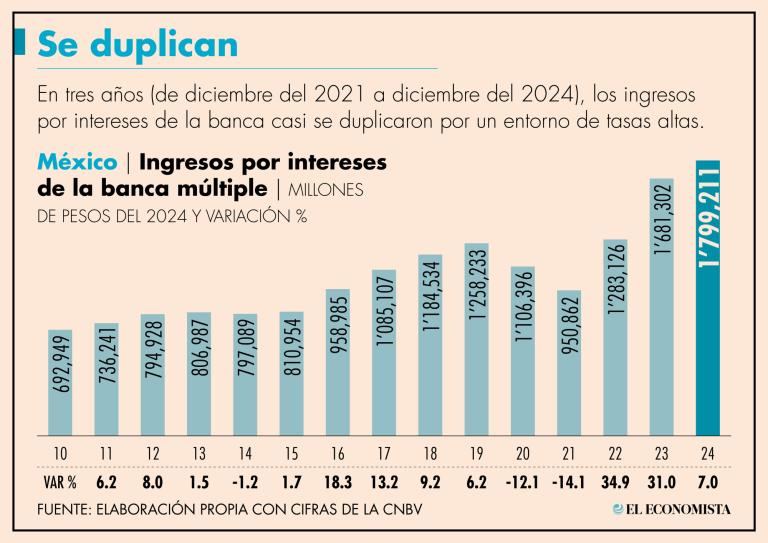
These trends are all likely to heap further pressure on an already slowing banking sector. A three-year surge in banking sector revenues, driven largely by higher benchmark interest rates, already began slowing last year, as the graph below, courtesy of El Economista, shows. Not coincidentally, in March last year the Bank of Mexico began the process of reversing rate rises. A year on, rates are now at 9.5%, 200 basis points below their former 11.5% peak.  

[Translation of accompanying text: in three years (from December 2021 to December 2024), the banks’ net interest income almost doubled due to the higher-rate environment].

The Moody’s report also underscores the Mexican government’s waning capacity to provide economic support due to its weaker fiscal position as well as the potential economic impact of recent reforms to the country’s institutional framework. They include the judicial reforms that passed by a whisker last Autumn, almost sparking a constitutional crisis in the process — a topic we covered in some detail here, here and here.

The judicial reform was the foundation stone of former President Andrés Manuel López Obrador’s reform agenda. It was also a stepping stone, allowing for the reversal of the corporate capture and control of the country’s judiciary. Now, the Sheinbaum government can begin focusing on passing its other proposed reforms in areas such as energy, mining, fracking, GM crops, labour laws, housing, indigenous rights, women’s rights, universal health care and water management.

Suffice to say, many of these reforms are bitterly opposed by the business elite, both foreign and domestic. If fully implemented, they will limit the ability of corporations, particularly in the mining sector, to extract wealth at exorbitant social and environmental cost. For decades corporations have been able to count on the support of a pliant judiciary that has faithfully served and protected the interests of the rich and powerful. That now appears to have changed, but it is already having an impact on how foreign investors and ratings agencies view Mexico.

The Biggest Threat

Moody’s also flagged the rising risk of state oil company Pemex’s contingent liabilities materializing on the government’s balance sheet. Mexico is currently two notches off losing its investment grade rating with Moody’s and S&P and just one away from losing it with Fitch Ratings.

Granted, when it comes to the pronunciations of US credit ratings agencies, a disclaimer is needed. As was shown in the subprime crisis, when rating agencies like Moody’s were giving triple-A ratings to mortgage backed securities that were found later to be nothing but dog **** (to quote from our resident Rev Kev), the sector is riddled with conflicts of interest. It is also hard to shake the feeling that this sort of report is aimed more at putting pressure on Mexico to adopt Wall Street friendly policies than providing a true reflection of Mexico’s economic health.

The irony is that the biggest risk to Mexico’s economic health comes from the Trump Administration’s constant threats of tariffs, mass deportations and military intervention. As Moody’s warns, US tariffs could harm Mexico’s manufacturing, automotive, and technology industries. These disruptions may lead to currency depreciation, increased inflation, and constraints on interest rate cuts, which would in turn dampen loan demand. The resulting volatility in exports, exchange rates, and inflation could also reduce banks’ risk appetite.

Even though most of the tariffs have yet to be implemented for any meaningful length of time, they are already causing acute economic uncertainty between the US and its largest trade partner, Mexico. Last week, Roberto Lyle Fritch, the president of the Business Coordinating Council (CCE), one of Mexico’s largest business lobbies, warned that the persistent threat of tariffs puts manufacturing production in Mexico at risk, potentially leading to massive layoffs, a fall in foreign direct investment (FDI), and stagnating economic growth.

FDI may already be taking a hit. Blue chip Japanese companies have warned more than once that the on-off threats of tariffs is making them think twice about investing any more in Mexico.

The Japan External Trade Organization, or Jetro, a government-related organization that works to promote mutual trade and investment between Japan and the rest of the world, said that four major Japanese investments in Mexico have already been halted due to the reigning uncertainty. Three major Japanese car manufacturers, Nissan, Mazda and Honda, have even threatened to pull out of Mexico altogether.

The Waxing and Waning Whims of Donald J Trump

These cases underscore one of the biggest problems with Trump’s constant use of the threat of tariffs to get what he wants: the prolonged uncertainty it creates. Even if he keeps walking back those threats, Trump is still doing immense, if not fatal, damage to the USMCA trade deal by raising economic uncertainty to levels that many companies simply are not willing to bear. As the WSJ recently noted, Trump’s arbitrary and personalized policymaking is at odds with the predictability that businesses crave.

Trump could tamp down the anxiety by laying out a coherent agenda (as some advisers have attempted) and a process for implementing it, such as asking Congress to write new tariffs into law, as the Constitution stipulates.

But that isn’t his nature. He revels in the power to impose and remove tariffs and other measures without warning, process, checks or balances.

The result has been economic-policy uncertainty at levels seen in past shocks such as the 2001 terrorist attacks, the 2008-09 financial crisis and the onset of the Covid pandemic in 2020. Those were all driven by events beyond U.S. control. This one is man-made, and will wax and wane with that man’s word and actions.

The financial toll from Trump 2.0’s tariffs is already magnitudes higher than the impact from all the tariffs imposed by Trump’s first administration. According to the FT, the first Trump administration imposed levies on imports valued at around $380 billion in 2018 and 2019. The new tariffs already affect $1 trillion worth of imports, estimates the Tax Foundation think-tank, rising to $1.4 trillion assuming exemptions covering some goods from Canada and Mexico expire on April 2, as was initially indicated.

When the reciprocal tariffs kick in on April 2, assuming they actually do, Mexico should, in principle, be less affected than other countries since: a) it has a trade agreement with the US; and b) unlike Canada and the EU, Mexico has opted not to impose retaliatory tariffs on US goods. But Trump’s tariffs are driven not just by economic considerations but also other issues such as the amount of progress Mexico is deemed to be making on containing immigration and executing the US’ whimsical demands vís-a-vís the drug cartels.

Deportation and Remittances

Mexico also faces other risks, including the prospect of the US dumping millions of deported LatAm immigrants at its southern border. If Trump carries through on this threat, it will impose a massive social-welfare overhead on Mexico’s economy. The mass deportation of Mexican immigrants will also deprive Mexican families, and the broader economy, of some of the much-needed money remitted by workers who send what they can afford back to their families. In 2024 alone, Mexico received $64.7 billion in remittances — equivalent to 3.4% of GDP.

In some Latin American and Caribbean countries, remittances represent an even larger lifeline for the economy. They include Nicaragua, where they represent 27.2% of GDP, Honduras (25.2%), El Salvador (23.5%), Guatemala (19.6%), Haiti (18.7%) and Jamaica (17.9%). Deporting immigrants en masse will remove a substantial source of revenue that has been supporting the exchange rates of these countries’ currencies vis-à-vis the dollar.

This, together constant threat of US tariffs is not just causing (potentially irreparable) harm to the USMCA trade deal; it is also, as Michael Hudson warned a few weeks ago, threatening to “radically unbalance the balance of payments and exchange rates throughout the world, making a financial rupture inevitable.”

So far, the Mexican peso has withstood the vagaries of Trump 2.0’s economic policy surprising well, and is actually slightly stronger than it was when Trump returned to the White House on Jan 20. The currency is up 2.4% against the dollar so far this month and 3.4% over the past three months. Analysts at Barclays attribute this, in part, to the cautious, largely non-confrontational approach that Mexican President Claudia Sheinbaum has taken to handling the tariff issue.

There are also other factors that should work in Mexico’s favour. For example, as the Moody’s analysts note, the banking sector retains strong capital reserves and credit loss provisions, which should support its ability to absorb potential losses. That said, bank sector profitability is likely to decline due to rising provisioning needs.

Another potential fillip is the fact that the Bank of Mexico currently holds the highest level of foreign currency reserves on record ($235 billion). This is roughly three times higher than the reserves on hand during the 2008 Global Financial Crisis.

To put that in perspective, Canada, an economy roughly 10-15% larger than Mexico’s, has total reserves of just $121 billion. The UK’s $3.31 trillion economy is backed by even less (just $94 billion of reserves). However, stacked up against similarly sized emerging economies that have also suffered debt crises in recent decades, Mexico’s reserves look somewhat less impressive. Russia, for example, boasts foreign currency reserves of almost $700 billion while South Korea’s central bank has just over $400 billion at its disposal.

Whether Mexico’s reserves are enough to avert a full-fledged debt or banking crisis, we will hopefully never have to find out…

Continue reading the article on Naked Capitalism

Caribbean Countries Blast US Plans to Sanction Cuban Medical Missions Around the World

While Cuba exports doctors to the world, the US exports sanctions.

Perhaps one of the least surprising features of US foreign policy during these first few months of Trump 2.0 is that it includes an intensification of the economic blockade of Cuba, now in its 63rd year. With the State Department under the aegis of a fanatical Cuban-American politician like Marco Rubio who has built his entire career on demonising the Cuban Revolution and trying to economically starve into submission the people of his parents’ homeland, it was odds on that US-Cuban relations would get even worse.

But what was perhaps not quite so clear was the extent to which the US’ new actions against Cuba would further isolate Washington from most of the countries in its own “backyard”, not to mention the world at large. Below is a visual reminder of just how out of step Washington already is on the world stage wrt its ongoing economic embargo on Cuba. This map, courtesy of Ben Norton’s Geopolitical and Economy Report, shows how many countries voted in favour of lifting the blockade in the latest UN resolution, held in October.

Cuba blockade UN vote 2024 map

For years, the rest of the world, including long-standing US vassal states like all EU member states, the UK, Japan, South Korea, Australia and Canada, have demanded an end to the US embargo. Only the US and Israel consistently vote against the resolution. The only US government to break with this trend was the Obama Administration, which abstained in the 2016 vote, notes the Washington Office on Latin America (WOLA):

[It also] lifted restrictions for Cuban-Americans to travel and to send family and donative remittances, reestablished the U.S. Embassy in Havana, removed Cuba from the SSOT list, expanded access to the internet, and licensed a range of trade opportunities for U.S. companies. Beyond these specific policies, this shift in discourse by a U.S. president signaled the biggest change in U.S.-Cuba policy since diplomatic relations were severed in 1961, and ushered in a new era in the relations, leading to 23 bilateral accords on issues of mutual interest. The next two years saw an unprecedented boom in private-sector activities in Cuba, significant openings for civil society discourse, and other reforms by the Cuban government.

In 2017, the Trump administration undid all the progress Obama achieved and more. It swiftly imposed new restrictions prohibiting U.S. companies from doing business with certain Cuban companies managed by the armed forces and prohibited U.S. visitors from staying in hotels operated by those companies. It eliminated people-to-people educational travel, placed strict caps on family remittances, and made it impossible to send remittances by wire service.

A New Low for US Foreign Policy

Now, Trump 2.0 seems to determined to isolate the US even further by trying to prevent some of the world’s poorest countries from availing of the medical assistance provided, often free of charge, by Cuba’s medical missions. It is yet another new low for US foreign policy. As Helen Yaffe writes for Jacobin, while Cuba exports doctors, the US exports sanctions (and, of course, other weapons of war).

On February 25, Rubio’s State Department announced visa restrictions for both government officials in Cuba as well as any other officials in the world who are found to be “complicit” in the island nation’s overseas medical assistance programs. The sanctions would extend to “current and former” officials and the “immediate family of such individuals,” and could also include trade restrictions for the countries involved.

In essence, the US government is accusing Cuba of using forced labour, even likening overseas Cuban medical personnel to slaves. If this latest sanctions gambit is successful, it will have crippling effects on a Cuban economy that has been cut out of the US-dominated financial system for years and is now grappling with nationwide power outages. It will also hurt dozens of the world’s poorest countries that depend upon Cuban medical missions precisely at a time when many of them are facing the prospect of looming debt crises.

The real objective, writes Yaffe, is “to undermine both Cuba’s international prestige and the revenue it receives from exporting medical services”:

[F]or decades tens of thousands of Cuban medical professionals (far more than the World Health Organization’s workforce) were stationed in some sixty countries, mostly to work in underserved… populations in the Global South. By threatening to withhold visas from foreign officials, the U.S. government intends to sabotage these Cuban medical missions abroad. If the measure works, millions of people will suffer…

Since 2004, earnings from exports of Cuban medical and professional services have been the island’s largest source of income. Cuba’s ability to conduct “normal” international trade is currently obstructed by the long US blockade, but the socialist state has succeeded in converting its investments in education and health care into national earnings, while also maintaining free medical assistance to the Global South based on its internationalist principles.

Since launching inaugural missions in Chile and Algeria in the early 1960s, more than 605,000 Cuban medical professionals have been dispatched to an estimated 180 (out of 195) countries, mainly in the Caribbean and Latin America. They have provided essential medical care and support during natural disasters (e.g., Chile’s largest ever earthquake in 1960), wars (e.g., Algeria’s war for independence from France), epidemics (e.g., Cholera in Haiti, Ebola in Africa, to COVID-19 pandemic), nuclear disasters (Chernobyl) and have even helped countries establish their own public health care systems.

The World Health Organization awarded the Henry Reeve brigades, established in 2005, with the prestigious 2017 Dr Lee Jong-wook Memorial Prize for Public Health in 2017, by which time they had helped 3.5 million people in 21 countries. In the COVID-19 pandemic nearly 40 countries across the world received assistance from Cuba’s medical missions, including even wealthy, western nations like Andorra and Italy and South American nations not politically aligned with Cuba, such as Peru.

As NBC reported at the time, the island nation “has once more punched far above its weight in medical diplomacy,” describing the medics’ success as “a setback for the administration of U.S. President Donald Trump”, which had “launched an unprecedented campaign against Cuba’s medical missions in recent years, citing what it calls their exploitative labor conditions.”

A Six-Decade Policy of Forced Hunger

The medical missions are now the largest source of income for the government in Havana, bringing in $6 to $8 billion per year, far more than the proceeds from tourism. Now, the US intends to bring pressure to bear on the dozens of countries that continue to benefit from the Cuban medical missions in an attempt to cut Cuba off from its largest source of external financing.

This is part of an ongoing six-decade policy set out in a 1960 memorandum whose aim is “to weaken the economic life of Cuba . . . [to deny] money and supplies to Cuba, to decrease monetary and real wages, to bring about hunger, desperation and overthrow of government.” The US has long achieved all of those aims apart from the overarching one: the overthrow of the Cuban government.

As already mentioned, this is not the first time the US has targeted Cuba’s medical missions as part of its raft of sanctions against the island. In Trump’s first administration, his then-Secretary of State Mike Pompeo pressured countries on the American continent to expel Cuban medical staff in the midst of the COVID-19 pandemic, calling them victims of forced labour and human trafficking. Washington aligned governments in the region such as Bolsonaro’s Brazil and Guillermo Lasso’s Ecuador acceded, with fatal consequences. From the NYT:

“In their zeal to get rid of the Cuban doctors, the Trump administration has punished every country in the hemisphere, and without question that has meant more Covid cases, and more Covid deaths,” said Mark L. Schneider, a former head of strategic planning for the Pan-American Health Organization who was a State Department official in the Clinton administration. “It is outrageous.”

Smaller, less powerful countries like Ecuador felt the pain. Ecuador acceded to American pressure and sent home nearly 400 Cuban health care workers shortly before the pandemic. Then the country also suffered from the Trump administration’s freeze on funding for the health organization, which hampered its ability to provide emergency supplies and technical support.

Now, Trump 2.0 wants to extend this practice of crushing Cuba’s medical missions to the entire globe. But the idea is already getting pushback in the US’ direct neighbourhood. Last week, several leaders of countries of the Caribbean Community (Caricom) lambasted the restrictions, arguing that Cuba’s medical missions are fundamental for the survival of the region’s health systems. They have also rejected the US allegations that hiring Cuban doctors is labour exploitation.

The Prime Minister of Barbados, Mia Mottley, current president of Caricom, said she is prepared, like other leaders in the region, to forego her US visa if “a sensible agreement” is not reached on this matter, since “principles matter”.

Similar arguments were made by Gaston Browne, Ralph Gonsalves and Keith Rowley, the respective prime ministers of Antigua and Barbuda, Saint Vincent and the Grenadines, and Trinidad and Tobago.

“I just returned from California and, if I never go back there in my life, I will make sure that the sovereignty of Trinidad and Tobago is respected by all,” Rowley said.

All Caricom leaders also agreed that availing of Cuba’s medical missions does not represent a form of human trafficking.

“We pay them the same as the Barbadians,” said Mottley. “We repudiate and reject the idea, spread not only by this U.S. government but by the previous one, that we were involved in human trafficking.”

The US allegations that the Cuban government is engaging in human trafficking do not much bear  scrutiny. In countries below a certain income level, the cost of the medical missions is entirely borne by the Cuban state. In countries like Barbados, the Cuban doctors are paid the same as local medical staff.

Cuba started monetising its medical services primarily out of basic economic necessity. After the collapse of its most important ally and economic partner during the Cold War era, the Soviet Union, in the early 1990s, Cuba began introducing reciprocal agreements to share the financial burden of the medical programs with recipient countries that could afford it. Following the launch of the famous “oil-for-doctors” program with Venezuela in 2004, the export of medical professionals became Cuba’s main source of revenue.

However, as Yaffe points out, “this income is then reinvested into medical provision on the island. However, Cuba continues to provide medical assistance free of charge to countries who need it.”

By contrast, when a comparatively rich nation such as Qatar opts to staff some of its hospitals with Cuban doctors, the doctors can receive as little as 10% of what other foreign medical professionals can make working in government hospitals in Qatar while still earning significantly more than they would in Cuba. The remainder is pocketed by the government in Havana.

This situation is still relatively rare but has become increasingly common as Cuba has leveraged its medical knowhow and resources. Even though doctors volunteer to take part in the missions, US-based critics of the Cuban government claim the programme is exploitative, as The Guardian reported in 2019:

However, others argue the medical missions are highly-coveted opportunities in a country where doctors earn just $40 to $70 a month.

“I don’t believe that they are being exploited,” says John Kirk, professor of Spanish and Latin American studies at Dalhousie University in Canada. “They are earning significantly more than they would earn at home. They have been trained in a socialist system, have paid nothing for their medical training, and understand that the superior amount paid to the Cuban government is used to subsidise the healthcare system back in Cuba.”

The Guardian spoke to several medics at the Cuban hospital and some defended the system.

“I believe we should help everybody,” says one. “Based on that, yes it is fair, because I know that the other amount is used to support our health and education system … but if you think only of yourself, of course it’s not fair.”

In the US’ purely-for-profit healthcare system, by contrast, the managers think only of themselves and their companies’ bottom line — hence why so many people in the US still have no access to basic healthcare while hundreds of thousands of people are plunged into bankruptcy each year by extortionate medical costs.

This is one of the main reasons, together with life-style and dietary trends in the US and the near-total absence of processed food in Cuba, why life expectancy in the US, the world’s richest economy, is now over two years lower than in Cuba, one of the world’s poorest countries whose government nonetheless has poured much of its scarce resources into healthcare provision.

Despite that poverty, Cuba is arguably the world’s most generous provider of overseas aid. As Yaffe documents, “Guatemalan researcher Henry Morales reframed Cuba’s international solidarity as ‘official development assistance’ (ODA), using average international market rates and adopting the methodology of the Organization for Economic Cooperation and Development (OECD), to calculate the magnitude of its contribution to global development and facilitate comparison with other donors”:

According to Morales, the monetary value of Cuba’s professional medical and technical services, ODA, exceeded 71.5 billion dollars between 1999 and 2015 alone, which is equivalent to 4.87 billion dollars per year. This means that Cuba annually devoted 6.6% of its GDP to ODA, the highest proportion in the world. In comparison, the European average was 0.39% of GDP and the United States contributed only 0.17%. Given that the U.S. blockade cost Cuba between $4 billion and $5 billion annually in this period, without this burden the island could have doubled its contribution to ODA.

Waning US Influence 

By targeting sanctions against Cuba’s professional medical and technical services, the Trump Administration’s presumed goal is to isolate Cuba globally as well as tip its embattled government over the edge by depriving it of its main source of income. However, by taking such a drastic step the US risks further ostracising itself from the countries in its own neighbourhood as well as the world at large.

Continue reading on Naked Capitalism

Stablecoins vs CBDC — US and EU Are on Different Paths to the Same Destination: Programmable Money

While the programmability features of CBDCs have generated considerable alarm, it’s a very different story for the stablecoins that the US government seeks to regulate with its “GENIUS” act.

The Guiding and Establishing National Innovation for U.S. Stablecoins act, aka the “GENIUS” Act, introduced by Republican Tennessee Senator Bill Hagerty on February 4, was under debate this week as the Senate Banking Committee prepared to vote on its proposed measures. The bill aims to regulate stablecoins like Tether’s USDT, Paypal and Circle’s USDC, cryptocurrency tokens that are pegged to a fiat currency value (in this case, the dollar), exchange-traded commodities (such as precious metals or industrial metals), or another cryptocurrency.

The Trump Administration sees the regulation and promotion of stablecoins as a roundabout means of maintaining the dollar’s supremacy in global payments. Centralized stablecoin issuers back their digital tokens using US bank deposits and short-term cash instruments like Treasury bills, which helps support the demand for the US dollar and US debt. Stablecoin issuers are today the 18th-largest buyer of US government debt, holding over $120 billion in Treasury bonds. That amount will presumably increase if stablecoins are given full regulatory approval.

Despite its name, concerns have been raised about the GENIUS act’s potential ramifications. During a House Financial Services Committee hearing on Tuesday, Rep. Stephen Lynch (D-MA) spoke about the supposed stability of “stablecoins”, noting that they keep “blowing up” while also being susceptible to extreme concentration. He also asked a banking expert if, given that stablecoins operate a lot like deposits, they might risk breaking down the separation between banking and commerce, to which the expert responded:

Yes, absolutely, that’s also a major risk, if you don’t have the sort of protections that exist in the banking system.

This exchange echoes concerns raised by Adam Levitin, a professor of law at Georgetown University, in an article we cross-posted last week, which I strongly recommend readers who haven’t done so to read in full. Levitin concludes that by creating a regulatory regime for stablecoins, “the federal government will ‘own’ any problem that arises in the market.” In other words, the Trump administration is setting the stage for publicly funded bailouts of stablecoin issuers:

[H]ere’s the pernicious operation of its ineffective insolvency provisions:  they promise to have created safety for stablecoin investors at no cost, but because it cannot deliver on that promise, it sets up a situation where the government has to deliver safety otherwise, on its own dime. In other words, it sets up a bailout. When there is another crypto crash and stablecoin owners realize that they’re going to incur major losses, they will come crying for a bailout, noting how critical stablecoins are for the whole DeFi world and how they thought their investments were safe because of the GENIUS Act.

What do you think will happen then? After Silicon Valley Bank can one really have confidence that they won’t get a bailout? Will banks be allowed to support their insolvent stablecoin issuer subsidiaries? Will the US Strategic Cryptocurrency Reserve (if created) be used to bail them out by buying their stablecoins at 100¢ on the dollar?

The GENIUS Act creates an implicit government guaranty of stablecoins. That means that taxpayers will be implicitly subsidizing the DeFi transactions that rely on stablecoins and that generally sit outside of the reach of anti-money laundering enforcement: taxpayers are going to be implicitly subsidizing money laundering. Is that really a desirable policy outcome? I fear the consequences of the GENIUS Act haven’t been fully thought through.

Giving Impetus to the Digital Euro

On the opposite side of the North Atlantic, the EU, never one to let any kind of crisis or internal or external threat go to waste, is using the US’ GENIUS act as a pretext to accelerate the roll out of its central bank digital currency (CBDC), the digital euro. On Wednesday, EU finance ministers emerged from a meeting of the Eurogroup parroting the idea that the Trump administration’s stablecoin ambitions underscored the urgent need for a digital euro. Otherwise, the EU’s payments system could fall even more heavily under US control.

Paschal Donohoe, the Irish Finance Minister and President of the Eurogroup, warned that crypto-asset markets are “evolving very fast, both politically and technologically” and “can have important consequences for us here in Europe”.

“The digital euro is critical to staying ahead of the curve in this area. A huge amount of technical work has now been done and there is growing appreciation amongst ministers of the importance of this work.”

Pierre Gramegna, managing director of the European Stability Mechanism, raised the prospect of the GENIUS act legislation encouraging Silicon Valley tech giants to launch their own stablecoins, as Meta once threatened to do with its proposed Libra coin (not to be confused with Javier Milei’s recently rug-pulled meme coin, $LIBRA), which was later renamed Diem:

“What is at stake here is also European Sovereignty. The US administration’s stance on this (crypto) compared to the past has changed. And the US administration is favourable towards cryptocurrency and especially dollar denominated stablecoins, which may raise certain concerns in Europe.”

“It could eventually reignite foreign and US tech giants’ plans to launch mass payment solutions based on dollar denominated stablecoins. If this were to be successful, it could affect the Euro area’s monetary sovereignty and financial stability.”

“Therefore, the ESM supports the European Central Bank’s urgency in making the digital euro a reality to safeguard Europe’s strategic autonomy. The digital euro is today more necessary than ever.”

“We also welcome as ESM and support the initiative of the Commission to relook at the Mica directive which could prove key here to counter the effects we discussed.”

The institution responsible for rolling out the digital euro, the European Central Bank, hopes to finish the preparation phase by October this year, meaning the Euro Area’s CBDC could go live any time thereafter. According to a tender document recently revealed by the German financial journalist Norbert Häring, the ECB expects to be able to introduce the digital euro in 2028 and is pushing ahead with its development despite growing internal EU opposition.

The ECB’s President Christine Lagarde was barely able to hide her excitement at the prospect in a recent press conference, arguing that the task ahead consists primarily of getting all the relevant stakeholders on board. Obviously, they do not include the EU’s 450 million citizens who have been kept in the pitch dark about all of these developments:

“Fabio Panetta on the Board and then Piero Cipollone, who has replaced Fabio, have taken the lead together with a very good team, which is focused on accelerating the pace and hopefully campaigning enough with all the stakeholders – meaning the European Parliament, European Council, European Commission – so that we can eventually, not put to bed, but put to reality this digital euro.”

State of Play Elsewhere

By contrast, many other jurisdictions, including five-eye nations like the US, Canada and Australia, appear to be losing interest in CBDCs, in particular retail CBDCs that are meant for use by the general public and businesses of all shapes and sizes, which is precisely what the EU is aiming for with its digital euro. The Reserve Bank of Australia, conversely, is prioritising the development of a wholesale CBDC, which is intended exclusively for large transactions, particularly cross-border ones, between banks and other financial institutions.

Nearly a third of central banks have delayed plans for a CBDC due to regulatory concerns and changing economic conditions, according to a survey of 34 central banks published in February by the Official Monetary and Financial Institutions Forum (OMFIF). Also, the proportion of central banks that claim to be less inclined to issue than last year has risen to 15% from zero in 2022. As the survey notes, the road to CBDC issuance is “far from smooth” — as evidenced by the lacklustre rollout of CBDCs in jurisdictions like Nigeria, Jamaica and the Bahamas.

As we reported back in October, the prospect of the US, current holder of the world’s reserve currency, permanently pulling out of the global race to develop a CBDC is prompting all manner of teeth gnashing in thinktank land. In March, the Brookings Institute warned that while “the US dollar remains king” — for now — “unless US policymakers take decisive steps to adapt to an increasingly digital financial system, the United States risks losing the economic and geopolitical advantages afforded to it by the dollar’s dominance of the global financial system.”

The Atlantic Council put it in even starker terms:

[I]f this bill ever became law, the United States would be the only country in the world to have banned CBDCs. It would be a self-defeating move in the race for the future of money. It would undercut the national security role of the dollar as the decision would only accelerate other countries’ development of alternative payment systems that look to bypass the dollar in cross-border transactions. This would make US sanctions less effective.

Final Destination: Programmable Money 

While the Trump administration has explicitly rejected launching a CBDC, the GENIUS bill could set the US on a roundabout route to more or less the same final destination anyway. And that destination is programmable money.

One of the main differences between the digital money we use today and the digital money envisioned for the near-future by central banks and stablecoin developers is “programmability” — smart contracts that automate and add new features to money. In 2021, a director at the Bank of England said programmable money could bring about “some socially beneficial outcomes,” such as “preventing activity which is seen to be socially harmful in some way.”

For example, governments could directly subtract taxes and fees from any account, in real time, with every transaction or paycheck, if it so wished. As the Washington DC-based blogger and political consultant NS Lyons noted in his 2022 post, Just Say No to CBDC, programmable money could put an end to tax evasion since central banks and governments would have a complete record of every transaction made by everyone:

Money laundering, terrorist financing, any other unapproved transaction would become extremely difficult. Fines, such as for speeding or jaywalking, could be levied in real time, if CBDC accounts were connected to a network of “smart city” surveillance. Nor would there be any need to mail out stimulus checks, tax refunds, or other benefits, such as universal basic income payments. Such money could just be deposited directly into accounts. But a CBDC would allow government to operate at much higher resolution than that if it wished. Targeted microfinance grants, added straight to the accounts of those people and businesses considered especially deserving, would be a relatively simple proposition.

Other potential forms of programming applications include setting expiry dates for stimulus funds or welfare payments to encourage users to spend it quickly. Or blocking payments for certain goods or services deemed undesirable by the government of the day. In the most extreme case, programmable money could be used to strongly encourage “desirable” social and political behaviour while penalizing those who do not toe the line.

As Lyons points out, “The most dangerous individuals or organizations could simply have their digital assets temporarily deleted or their accounts’ ability to transact frozen with the push of a button, locking them out of the commercial system and greatly mitigating the threat they pose. No use of emergency powers or compulsion of intermediary financial institutions would be required: the United States has no constitutional right enshrining the freedom to transact.”

Neither, of course, does the EU, which in its march toward ever greater consolidation and centralisation of power is trampling over many of the basic constitutional freedoms and rights enshrined both in its own constitution as well as those of its constituent member states.

Now, both the Commission and the ECB want to fast track the creation of a digital euro. The ECB claims that the digital euro will not be programmable, but can its word be trusted?

Continue reading on Naked Capitalism

BlackRock’s Takeover of Panama Canal Is First Major Victory for Trump’s “Americas First” Policy

It is also a major victory for Wall Street. But what could it mean for China’s trade relations with Latin America, in particular the US’ largest trade partner Mexico?

Midway through last week, as the economic reverberations from Trump’s latest round of tariffs spread around the world, the Hong Kong-based (and Cayman Islands-registered) conglomerate CK Hutchinson Holdings caught global markets off guard. Seemingly out of the blue, the company announced that it was selling 80% of its subsidiary Hutchinson Port Holdings, including its 90% stake in the Balboa and Cristobal docks at either end of the Panama Canal, to BlackRock, the world’s largest investment manager.

An Associated Press article reported that the sale effectively puts “the ports under American control after President Donald Trump [had] alleged Chinese interference with the operations of the critical shipping lane.” In a speech to the US Congress on March 4, Donald Trump boasted:

To further enhance our national security, my administration will be reclaiming the Panama Canal. And we’ve already started doing it.

Just today, a large American company announced they are buying both ports around the Panama Canal, and lots of other things having to do with the Panama Canal, and a couple of other canals.

CK Hutchison’s decision to sell up its port holdings company in a deal valued at nearly $23 billion, including $5 billion in debt, gives the BlackRock consortium control over 43 ports in 23 countries. They include the Panamanian ports of Balboa and Cristobal, four ports in Mexico (more on that later), 13 in Europe, 12 in the Middle East and Africa, and 11 in East Asia and the Pacific. Unsurprisingly, Hutchison will retain control of its 10 docks in China, including two in Hong Kong.

The move was driven by one main concern, reports the South China Morning Post — geopolitics:

CK Hutchison Holdings’ decision to sell its port operations in the Panama Canal and elsewhere is to mitigate against geopolitical risks even though it framed it as a purely commercial move, analysts and sources said, urging Hong Kong’s other major companies to also prepare for unparalleled global uncertainties.

There can be no denying it: the deal is a major geopolitical victory for the Trump administration as well as a setback for China’s belt-and-road ambitions, with some 6% of global trade passing through the Panama Canal. While this move will not fully eliminate China’s influence in Panama, it does represent a diplomatic recalibration and a shift towards closer alignment with Washington. It is also a major victory for Wall Street, as Benjamin Norton noted in his Geopolitical Economy Report:

BlackRock is the world’s biggest investment company. It managed a record high of $11.6 trillion in assets in the fourth quarter of 2024. (The top 500 investment managers on Earth together held $128 trillion in assets at the end of 2023.)

The Associated Press reported that the BlackRock-led consortium now controls at least 43 ports in 23 countries. The Wall Street giant’s subsidiary Global Infrastructure Partners was central to the US government-sponsored Partnership on Global Infrastructure and Investment (PGI), which was launched by the Joe Biden administration and the G7.

BlackRock’s billionaire CEO Larry Fink was invited to sit with Western heads of state at the G7 summit in Italy in 2024, where he called for “public-private partnerships” to help Wall Street firms buy up global infrastructure, especially in poor, formerly colonized countries.

BlackRock has enjoyed a very close relationship with the US government, under both Democrats and Republicans. Fink said before the US presidential election in November 2024 that it “really doesn’t matter” who wins, because both parties would benefit Wall Street.

Bloomberg reported that Fink personally called Trump and asked him to help BlackRock purchase the Panama Canal ports. The financial media outlet noted that the billionaire CEO bragged of BlackRock’s deep links with governments worldwide, stating, “We are increasingly the first call”.

Trying to Halt a 25-year Trend

As we have documented in numerous posts since 2021, the US’ apex strategic rival, China, has not only gained a foothold in the US’ backyard in the past three decades but has even begun to win the race for economic supremacy in the region. China is already South America’s largest trade partner, and as we saw with the recent opening of the Chinese-funded and controlled mega-port in Chancay, Peru, its Belt and Road Initiative promises to further cement that position.

Besides Hutchinson’s controlling stake of Panama’s two main ports since 2015, the Trump administration’s main bone of contention with Panama was the fact that its government, like most governments in Latin America, had signed the Belt and Road Initiative. In fact, Panama was the first Latin America country to do so, in 2017. Since then, 20 other countries in the region have signed the initiative, including Venezuela, Chile, Uruguay, Ecuador, Bolivia, Costa Rica, Cuba, Perú, Nicaragua and Argentina.

To placate Washington’s demands, the Panamanian President José Raúl Mulino said he would not renew the initiative when it comes up for review, becoming the first country to leave Beijing’s global infrastructure initiative. He also mentioned the possibility of his government reconsidering the concession granted to Hutchison Ports. The move sparked an unusually sharp rebuke from Beijing slamming Washington’s “Cold War mentality” in Latin America.

From Al Jazeera:

A spokesperson for the Ministry of Foreign Affairs of the People’s Republic of China on Friday hit out at the United States for sabotaging the global infrastructure programme.

Beijing “firmly opposes the United States using pressure and coercion to smear and undermine Belt and Road cooperation,” said Lin Jian in a statement. “The US side’s attacks … once again expose its hegemonic nature.”

Referring to a visit this week to the region by Marco Rubio, Lin said the US Secretary of State’s comments “unjustly accuse China, deliberately sow discord between China and relevant Latin American countries, interfere in China’s internal affairs, and undermine China’s legitimate rights and interests”.

A Different Vision of Multipolarity

With Trump back in power, the US may have finally accepted the multipolar reality of today’s world but, as Conor noted in his recent post, The Empire Rebrands: Foreign Policy Under Trump 2.0, the Washington’s vision of multipolarity differs markedly from the one envisioned by China, Russia and other countries in the so-called “Global South”:

As many have pointed out, the US seeks win-lose transactions, and this is nothing new under Trump. As Glenn Diesen states:

In a multipolar world, security is enhanced by reducing the security competition between the great powers, while a mutually beneficial peace can exist under a balance of power and acceptance of the status quo. Even small- and medium-sized states can obtain more political autonomy from the great powers by cooperating with all great powers to diversify their economic connectivity. However, the US appears to be attempting to defeat China as its main rival, and coerce small and medium states into spheres of influence to ensure political and economic obedience.

This is now playing out in Latin America. It is no coincidence that the US’ new Secretary of State Marco Rubio’s first international tour was to the five Central American countries of Panama, El Salvador, Guatemala, the Dominican Republic and Costa Rica. Officially speaking, Rubio was visiting these countries for three main reasons: to stop mass illegal immigration to the US; to fight the “scourge of transnational criminal organizations and drug traffickers”; and “to counter China, and deepen economic partnerships to enhance prosperity in our hemisphere.”

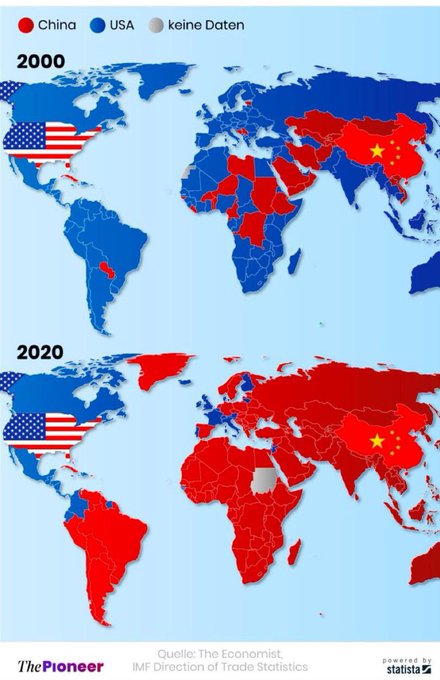
As a trading power, the US continues to holds significant sway over Central America. Pound for pound, it is still Latin America and the Caribbean’s largest trading partner. But that is predominantly due to its huge trade flows with Mexico, which account for a whopping 71% of all US-LatAm trade. As Reuters reported in 2022, if you take Mexico out of the equation, China has already overtaken the US as Latin America’s largest trading partner.

Imagen

Meanwhile, China’s trade with Mexico, as with most parts of Central America, is growing fast, or at least was. And it is this trend that the Trump administration wants to halt, or even reverse. In order to achieve that, Trump 2.0 is, according to the Washington Post, “reviving” the two-centuries old Monroe Doctrine:

Long-attuned to U.S. slights both perceived and real, few [policy makers in the region] missed Trump’s throwaway line during his signing of executive orders just hours after his inauguration. Relations with Latin America “should be great,” he told reporters in the Oval Office. “They need us much more than we need them. We don’t need them.”

“What is the point of saying that?” asked the senior South American official, who spoke on the condition of anonymity to avoid drawing unwanted attention to his country. “It’s destroying trust. … Instead of inviting us to a new vision, he doesn’t invite anybody. There are only threats.”

Of course, the Monroe Doctrine never went away, it has just waxed and waned. During the first two decades of this century, it took a back seat as Washington focused on executing its War on Terror in the Middle East. As it squandered trillions of dollars spreading mayhem and death and breeding a whole new generation of terrorists, China began snapping up Latin American resources, in particular food, petroleum and strategic minerals like lithium.

But even during this time Washington was able to organise a failed coup d’état against Hugo Chavez’s government in Venezuela (2002) and a successful coup against Manuel Zelaya’s government in Honduras (2009). There was another unsuccessful coup against Venezuela’s Chavista government in 2019 as well as a successful one in Bolivia. The partly self-inflicted downfall of Peru’s socialist leader Pedro Castillo in 2022 also got the prior blessing from Washington’s ambassador in Lima and former CIA agent, Lisa Kenna .

By the early 2020s, it was clear that Washington had begun rejigging the Monroe Doctrine, a 202-year old US foreign policy position that opposed European colonialism on the American continent, in order to apply it to its most important strategic rivals of today, including China, Russia, Iran and even Hezbollah. Just this past week, a bipartisan bill titled the “No Hezbollah in Our Hemisphere Act” was introduced to the US Congress seeking to counter the Lebanese terrorist group’s influence in the region.

But it is China’s rapid rise in the US’ own “backyard” that is of greatest concern in Washington. Unlike the US, Beijing offers win-win trade and investment deals to national governments in the region. It also does not tend to meddle in internal politics, or at least hasn’t until now, preferring to let the money do the talking. As the former US Treasury Secretary Laurence Summers once admitted, “When a Latin American head of state asked me for something, I lectured them. While I was preaching, the Chinese were building airports.”

When it comes to international trade, win-win strategies tend to work far better than the zero sum games pursued by Washington. As China’s influence in the region has grown, it is the US military that has done a lot of the talking. In January 2023, General Laura Richardson, the then-Commander of US Southern Command (USSOUTHCOM), reminded the Atlantic Council of just how important Latin America’s resources are as well as the need to “box out” China and Russia from them.

In other words, despite what the Washington Post may claim, the Trump Administration’s attempted shakedown of small and mid-sized Latin American countries does not represent the revival of the Monroe Doctrine. That said, it does represent a significant escalation in that trend, and one that many countries in the region and beyond will be keeping a close eye on — including, of course, China.

This time around, China’s government is taking a much harder line against Trump’s aggressive foreign and trade policy, including on the American continent…

Read the full article on Naked Capitalism

Are the Wheels Finally Beginning to Fall Off the Mileis’ Faux Libertarian Clown Bus?

For readers who may be wondering why the above title features the name “Milei” in plural, there is a simple reason: the Milei clown show is a double act. The Argentine President Javier Milei has a sister, Karina, who, as his former campaign manager and current General Secretary of the Presidency, essentially manages his political agenda and personal expenses. She is, as her brother frequently describes her, “la Jefa” (the boss). And she is now the focus of a criminal investigation for her alleged role in the recent $LIBRA crypto scam.

Largest Ever Crypto Theft

The deputies of an opposition grouping that calls itself the “Civic Coalition” has filed a criminal complaint against Karina, accusing her of the crimes of bribery, influence peddling and violating the Public Ethics Law in relation to the $LIBRA meme coin scam, which Forbes magazine has described as the world’s “largest ever crypto theft”.

The article provides a brief reminder of how it all went down:

On February 14, Milei took to X to promote a little-known token called LIBRA, claiming it would boost Argentina’s economy by funding small businesses. His post linked to a website featuring his signature slogan, “long live freedom,” and assured his 3.8 million followers that “the world wants to invest in Argentina.” Thousands did. LIBRA skyrocketed from near zero to almost $5—before crashing to under $1 within hours.

Milei quickly deleted the post, claiming he was unaware of the project’s details, but the damage was done. Lawyers in Argentina, led by Milei’s political opponent Claudio Lozano, filed more than 100 fraud complaints against the president, and an Argentine judge opened up an investigation…

The numbers paint a brutal picture: 86% of traders who bought into LIBRA lost money, with total losses reaching $251 million, according to blockchain analytics firm Nansen. A lucky few pocketed $180 million.

The focus is now on Milei’s sister, who just a few years ago was scraping a living reading Tarot cards and selling “tortas” (cakes) out of her garage but is now arguably the most powerful woman in Argentina, drawing unflattering comparisons with Kim Yo-jong, the sister of North Korean leader Kim Jong-un.

The deputies behind the lawsuit accuse “la Jefa” of coordinating the President’s meetings with the promoters of $LIBRA. As general secretary of the presidency, Karina decides who gets to see the president and who doesn’t, and according to recent allegations, she has made a tidy little sideline out of it.

A year and a half ago, just before Milei’s election, the prominent Argentine businessman Juan Carlos Pallarols revealed that when he tried to arrange a meeting with Milei, he was told to speak to his sister, Karina, who “managed his agenda”. When he did that, Karina Milei told him that in order to set up a meeting, he would need to pay a “deposit” US$ 2000, for which purposes she provided bank account details.

Karina is also accused of coordinating the President’s meetings with the promoters of $LIBRA. The criminal complaint against her recalls the alleged message sent by Hayden Mark Davis, the creator of the token, in which he apparently said:

“I send money to his sister and he signs everything I say and does what I want.”

Once people like Davis were admitted to Javier Milei’s inner circle, they began making bank. As the New York Times reports, Davis told attendees of a crypto currency conference held in Buenos Aires in October that he had “control” over Mr. Milei and could broker deals:

“Everything from Milei tweeting” to “all the front-facing Milei stuff basically, showing up at things, et cetera — I have control over a lot of those levers,” Mr. Davis said in an audio message to an entrepreneur, obtained by The Times.

“But,” he added, “there’s a cost.” He insinuated that cost could be in the millions of dollars. “I’m not trying to screw anyone over,” he said, using an expletive.

Another entrepreneur said Mr. Davis made an even more brazen offer in writing: He would deliver a meeting with Mr. Milei and a partnership with the Argentine government in exchange for roughly $90 million in cryptocurrencies over 27 months, according to a copy of the proposal viewed by The Times.

There is no evidence that Mr. Milei was aware of the proposals.

Javier Milei already faces one criminal investigation in Argentina as well as another in the US over his decision to promote — or as he puts it “disseminate” — the rug-pulled LIBRA meme coin. Last week, Mauricio Claver-Carone, Donald Trump’s State Department envoy for Latin America, said in a CNN interview with Andrés Oppenheimer that the US justice system will investigate the $LIBRA scandal, in which “defrauded Americans” lost millions of dollars:

“It’s complicated that there were victims, defrauded Americans, hundreds — if not thousands — who have lost millions of dollars [to the $LIBRA cryptocurrency]. And [on top of] some of the president’s [Javier Milei] advisers were Americans… I think there are going to be judicial investigations; it is a complex issue, but a good lesson for President Milei, and for others, in the sense of being better advised, of having a better team and not falling into unnecessary mistakes and self-inflicted coups.”

In recent years Claver Carone has clashed with Milei and senior members of his government, in particular the Economy Minister Luis Caputo, arguing at one point that while “Milei speaks like a true orthodox liberal” at international conferences, “domestically he has a team that is governing like Peronists.”

The U.S. Department of Justice (DOJ) has reportedly already begun investigating President Javier Milei over his promotion of the LIBRA token, along with the alleged involvement of the project’s founders and two Argentine entrepreneurs. According to sources cited by Argentine newspaper La Nación, the DOJ initiated its investigation one week after the collapse of the meme coin. Reports indicate that the probe is still in its early stages, with authorities beginning to gather preliminary information.

Diverting Attention and Tightening Control

As the fallout from the $LIBRA scandal grows, the Milei siblings have done what most cornered politicians that have been caught scamming their own supporters would do: they have tried to divert attention from the meme coin scandal by whipping up a frenzy over other issues while trying to tighten their control over Argentina’s justice system.

To that end, Javier Milei appointed, by presidential decree, two friendly judges to the Supreme Court in an act that the constitutional lawyer Eduardo Barcesat has described as “institutional chaos” and “another step towards authoritarianism”. This is a trend that has intensified since the Libragate scandal.

At the end of Milei’s speech to open parliamentary sessions last week, Milei’s chief advisor, Santiago Caputo, the nephew of Milei’s Economy Minister (and former Wall Street banker) Luis Caputo, physically attacked one of the deputies who had jeered Milei during his speech. Even more disconcerting, this same advisor, who wields significant influence over Argentina’s intelligence agencies, ran a “mega-poll” in January to gauge whether Argentines would accept an authoritarian regime in exchange for greater economic stability.

Milei has also tried to appeal to the “law-and-order” vote by proposing to drop the age of criminal responsibility from 16 to 10 after a seven year-old girl was killed by a car driven by a 14 year-old boy, who cannot be criminally charged, and his 16-year old friend, who committed crimes when he was under 16. According to Milei, if Argentina had had a lower age of criminal responsibility, he would not have been free to steal the car and thereafter run over the seven year-old girl.

In his recent speech at the opening of the parliamentary sessions, Milei called for shaking up “all the penalties” of Argentina’s penal code. He has also tried to take advantage of the tragedy by calling on the Peronist governor of Buenos Aires Province, Martin Kiciloff, to resign and let the federal government intervene in the day-to-day management of the province.

Milei’s government has also landed itself in trouble by trying to rework the language for people with learning disabilities. In January, it published in the official gazette new parameters by which individuals will be evaluated in order to obtain, or continue to receive, a disability allowance. The terminology used included “idiot”, “imbecile”, and “mentally retarded.” The text was copied word for word from a decree signed in 1998 by President Carlos Menem, an ultra-liberal Peronist whom Milei considers Argentina’s best president despite the fact he laid the groundwork for the collapse of Argentina’s economy in 2001.

When the proposed language changes sparked a public backlash, the Milei government quickly backtracked and fired the minister in charge, but the intention was clearly there, and it speaks volumes about how the senior members of the government view the most vulnerable in society.

They include the pensioners who continue to bear the brunt of Milei’s austerity policies and continue to protest on a weekly basis against the pension freezes and cuts to subsidies, including for essential medicines. This is how they’re treated:

Economy About to Take Off, Or Fall Off a Cliff

Right now, the economy appears to be in “slow recovery” mode after just suffering one of its worst years this century. According to a new report by Nielsen IQ, household consumption plummeted by 17% in 2024 due to a severe adjustment in purchasing power. The combination of still painfully high inflation (117% accumulated in 2024) and the withdrawal of government subsidies for most basic services, from energy to transport, has left many households with little choice but to pinch their pennies.

“2024 marked a turning point in mass consumption in Argentina, with a historic drop that impacted all categories and sales channels,” said Javier González, commercial leader of NielsenIQ Argentina. “”By 2025, although a partial recovery is expected, the Argentine consumer will continue to be strategic in their purchasing decisions, prioritizing price and cost-benefit ratio.”

Though household disposable income has begun improving, according to the report it is still 40% below 2017 levels, the year before then-President Mauricio Macri requested an IMF bailout. And the last thing the country’s struggling industrial sector needs to hear: last year, industrial activity slumped by 9.4%, the highest fall since 2002.

How things proceed in the short term will depend largely on how quickly Argentina can sign its next deal with the IMF, which will mean another injection of much-needed dollars. It will also mean many years more of IMF-imposed structural adjustment, which of course Milei will happily apply…

Continue reading on Naked Capitalism

Coca Cola: Made in Mexico, Apparently

As the world’s largest soft drinks manufacturer faces a consumer boycott in its largest global market, Mexico, its marketers just came up with a cunning plan. But will it work?

For a company whose sales depend so heavily on brand perception, Coca Cola has a serious image problem. In the Middle East, for example, its close ties to and support of Israel appear to be putting a drag on sales in many Arab countries. According to Palestinian activists in Gaza and many BDS activists in the wider Arab world and in some European countries as well, Coke is finally becoming one of its priority targets:

“[T]he BDS movement has always considered Coca-Cola boycottable but has not prioritized it as a target based on its careful and strategic target-selection criteria.  This has changed now the local alternatives to Coca-Cola have been gaining market share across the world, including in Palestine, China, Bangladesh, Sweden, Egypt, India, South Africa, Turkey, Lebanon and elsewhere.”

What began as a Palestinian-led boycott movement against companies perceived as supportive of Israel has apparently gained momentum across the region. In the West Bank, the local manufacturers of rival brand of Chat Cola have seen sales soar as shopkeepers “relegate Coke cans to the bottom shelf — or pull them altogether”, reports ABC:

“When people started to boycott, they became aware that Chat existed,” Fahed Arar, general manager of Chat Cola, told The Associated Press from the giant red-painted factory, nestled in the hilly West Bank town of Salfit. “I’m proud to have created a product that matches that of a global company.”

With the “buy local” movement burgeoning during the war, Chat Cola said its sales in the West Bank surged more than 40% last year, compared to 2023.

While the companies said they had no available statistics on their command of the local market due to the difficulties of data collection in wartime, anecdotal evidence suggests Chat Cola is clawing at some of Coca-Cola’s market share.

“Chat used to be a specialty product, but from what we’ve seen, it dominates the market,” said Abdulqader Azeez Hassan, 25, the owner of a supermarket in Salfit that boasts fridges full of the fizzy drinks…

The Coca-Cola Company did not respond to a request for comment.

Whether or not the movement brings lasting consequences, it does reflect an upsurge of political consciousness, said Salah Hussein, head of the Ramallah Chamber of Commerce.

“It’s the first time we’ve ever seen a boycott to this extent,” Hussein said, noting how institutions like the prominent Birzeit University near Ramallah canceled their Coke orders. “After Oct. 7, everything changed. And after Trump, everything will continue to change.”

To meet the rising demand for non-Coke Cola, Chat Cola is looking to expand its operations to other parts of the Middle East, beginning in Jordan. Meanwhile, it was just announced in Scotland that Coca-Cola will no longer be served at the Glasgow Film Theatre after workers at the cinema said they would no longer handle any goods connected to the BDS (Boycott, Divestment and Sanctions) movement, including Coca Cola brands. A statement said:

Following discussions between Unite the Union and the Glasgow Film Theatre, we have come to an agreement to remove Coca-Cola products from the cinema bar, for the duration of the Glasgow Film Festival.

After the festival, the remaining Coca-Cola stock will be used up – as this has already been purchased – before permanently switching to an ethically-sourced alternative. This ensures that no more money will be spent on Coca-Cola.

“Made in Mexico”

The Coca Cola company is also facing a gathering consumer backlash on the other side of the Atlantic, albeit for wildly different reasons, including in one of its most important global markets, Mexico. According to a 2022 study from the University of Yale, Mexico is the leading consumer of soft drinks in the world with an average consumption of 163 litres per person per year — 40% more than the US in second place, with 118 litres. But that market could be at risk.

In early February, rumours began circulating that Coca Cola had fired Latino workers in Texas and reported them to US Immigration and Customs Enforcement (ICE). The allegations, which the company has denied, spread rapidly on TikTok, spawning a movement called the “Latino Freeze” that, among other things, urges consumers to stop purchasing Coca-Cola products and support Latino-owned businesses instead.

The Latin Freeze movement is a US nationwide spending boycott, specifically targeting companies that have rolled back their policies on diversity, equity and inclusion (DEI) as the Trump administration has ramped up its deportations. When Trump began threatening Canada, Mexico and Europe with tariffs on US imports of their products, consumer boycotts of US products began spreading far beyond US borders.

These boycotts are already having a notable effect on some US products. For example, sales of Teslas are down sharply in some European countries including France and Sweden. In a recent poll, 78% of Swedes said they were willing to boycott US products.

In mid-February, as Trump’s threats of 25% tariffs hung over Mexico’s economy like a sword of Damocles, Mexico’s Ministry of Economy decided to relaunch the famous “Made in Mexico” label, with the aim of promoting and giving greater recognition to the products that are made in the country. The “Hecho en México” seal, in addition to shining a light on national manufacturers, seeks to raise public awareness about the importance of strengthening the local value chain and supporting companies that generate jobs and development opportunities in each region.

However, it’s not just local companies that are blazoning the above stamp on their products. So, too, are US multinationals including Coca Cola and Walmart, which is by far the largest retail chain in Mexico after spending decades buying up most of the local competition. The grocery giant was recently fined by Mexico’s competition authorities a risible $4.3 million for alleged anti-competitive practices involving suppliers. The agency that issued the fine, known as the Federal Competition Commission, cited concerns about “a relative monopolistic practice.”

Like Walmart, Coca Cola may not be Mexican by origin but its suite of products that are consumed in Mexico are certainly made there — using, of course, huge volumes of Mexico’s scarce fresh water supplies. Any product that is manufactured or assembled in Mexico, and has quality and excellence standards that enhance the identity and reputation of the origin of its raw materials, can use the “Hecho en México” label.

For the moment, only two Coca Cola brands will carry the label — the original Coca Cola and Coca Cola Sin Azúcar — but the initiative is expected to be extended to other brands in the coming months.

The Mexican Coca-Cola Industry (IMCC), consisting of 11 companies including FEMSA, which operates the largest independent Coca-Cola bottling group in the world and the largest convenience store chain in Mexico, has 73 bottling plants, 350 distribution centres and more than 13,000 delivery routes, with which it serves its millions of highly addicted customers. It directly employs more than 100,000 people and claims to generate more than 1.6 million jobs indirectly. FEMSA alone directly and indirectly employs 300,000 people.

So large is Coca Cola’s economic footprint in Mexico that some legacy media articles have even begun warning about the potential economic blowback of the boycotts. On social media, the company reaffirmed its commitment to the Latino and Mexican community:

  • “Since we were born in Mexico with our first bottling plant in 1926, we have been and are part of every Mexican family.”
  • “Our products are produced locally by local hands and hearts. Buying a Coca-Cola product in Mexico directly supports local economies and jobs.”
  • “We are proud to support hundreds of thousands of Mexicans, shopkeepers, farmers and retailers.”

What Coca Cola doesn’t mention is that its bottling subsidiary FEMSA, like Walmart’s Mexico unit, essentially refused to pay any of the corporate taxes it owed in Mexico for more than 30 years. They were apparently able to get away with this because the governments prior to that of Andrés Manel López Obrador (2018-24) had essentially no desire to collect taxes from certain companies, as Raquel Buenrostro, who headed the SAT tax authority under AMLO, told El País:

“Some businessmen were surprised to be summoned [to the tax office] because they had never had to pay the taxes. They told me that every three years they would simply waive the unpaid taxes.”

That all changed when Buenrostro took over as the head of Mexico’s SAT tax authority in 2019 and began pro-actively pressuring multinational companies to finally settle their tax bill.

“When we spoke to Walmart the first time, they said, ‘look, as we’re nice guys (buena onda) we’re going to give you $30 million,” Buenrostro recently recalled in an interview. “I told them it’s not a question of what you give us, it’s what you owe us. There was a serious battle with Walmart, which at one point said: I prefer to litigate for 30 years than pay taxes.”

It was only when Buenrostro threatened to hold the companies and their executives criminally responsible for their tax avoidance policies that they finally agreed to cough up. Years-long and in some cases decades-long legal claims were resolved in a matter of days. But not everybody was happy with the new set-up. The American Bar Association lambasted the Mexican government for using heavy handed tactics. Four ambassadors, from the US, Canada, Japan and France, paid Buenrostro a visit, all in the hoping of convincing her to back off a little, to no avail.

Now, with its strategy of joining the “made in Mexico” bandwagon, the Mexican Coca-Cola Industry (IMCC) seeks to reinforce the brand’s identity in the country and strengthen the bond with its consumers. However, its success will depend on the public perception of the political and social context facing the Coca-Cola Company globally…

Continue reading on Naked Capitalism