The Zelensky government’s “state in a smartphone” model of digital identity and governance, once a source of pride and inspiration for other countries, has become a source of derision.
Regular NC readers are by now no strangers to Ukraine’s “state-of-the-art” Diia (Ukrainian for “action”) digital governance and identity system. For those who are, a quick recap: In December 2022, we reported that Ukraine’s Volodymyr Zelensky government was trying to digitise just about everything it could, including most government services and bureaucracy, even against a backdrop of war, rolling blackouts and internet outages:
Ukraine may be suffering a rising wave of rolling power blackouts and internet outages as the proxy war between Russia and NATO intensifies, but that doesn’t seem to have crimped the Zelensky government’s ambitions to transform the country into a digital wonderland. In the past week alone, Ukraine’s central bank unveiled plans for a digital E-hryvnia and Kyiv signed a digital trade agreement (yep, they do exist) with the United Kingdom.
USAID Funding
In January 2023, Samantha Power, speaking at Davos, the then administrator of Washington’s soft power arm, USAID, heralded Diia as “a great anti-corruption tool” and unveiled US government plans to replicate the “success” of Ukraine’s e-governance app in other countries around the world — including, presumably, the United States itself. As the promotional video below shows, Diia was developed “with support from USAID”.
Ukraine’s digitisation of government services predated the conflict with Russia, but in the eternal spirit of never letting a good crisis go to waste, it was significantly expanded once the hostilities began.
The purpose of Diia was not just to digitise public services but to automate, outsource and privatise them, as Ukraine’s Minister of Digital Transformation and Deputy Prime Minister Mykhailo Fedorov Fedorov told the WEF’s 2021 class of Young Global Leaders, of which he is a graduate:
The Government needs to become as flexible and mobile as an IT company, to automate all functions and services, significantly change the structure, reduce 60% of officials, introduce large-scale privatisation and outsourcing of government functions. Even in customs. Only such a Government will be able to bring about quick and bold reforms to rebuild the country and ensure rapid development.
Then, in May 2023 we picked apart a shamelessly gushing article by the United Nations Development Programme, another financial backer of Diia, about Ukraine’s accelerating war-time digital transformation:
Despite being plunged into war, Ukraine is forging ahead with a comprehensive re-think of how business is conducted, and how Ukrainian people interact with each other and with their government.
“We are building the most convenient digital state in the world — without corruption, without bureaucracy, absolutely paperless, and open for everyone,” Ms. Ionan [Ukraine’s Deputy Minister of Digital Transformation] says.
The online portal and a mobile application for public services is called Diia, which is Ukrainian for ‘action’.
It aims to move all public services online, cover the entire country with internet access, close the gender and generational gaps in digital literacy, and make Ukraine the most welcoming country in the world for IT companies.
Inconvenient Consequences
That dream has withered already. Ukraine cannot muster much of a welcome for IT companies given that not only is it on the verge of losing its NATO-led proxy war against Russia while also suffering regular nationwide blackouts but large parts of its Diia system are down after being hit by a massive Russian cyber attack in early December. It is as yet unclear how much of the data held on the system has been compromised. But needless to say, the consequences for Ukrainian citizens appears to be anything but convenient, as Kyiv Independent reports:
At the start of December, Ukrainians suddenly found themselves unable to sell cars, file legal claims, or register marriages through the state’s recently digitized government registries.
The Justice Ministry on Dec. 19 formally announced that a Russian hack had taken a laundry list of critical government databases that had been put under the Justice Ministry offline. The databases contain sensitive information from property ownership to biometric data to tax records.
Relevant Ukrainian offices quickly called it an act of war from Russia. “The information space is one of the key directions of the enemy’s attacks,” wrote the State Communications Service, the national cybersecurity agency, in a statement provided to the Kyiv Independent…
XakNet, a hacking group previously tied to Russian intelligence, took credit for the attack, posting on Telegram data they claim to have hacked from the Ukrainian civil registry. The hackers claimed to have deleted at least some of the registry data…
XakNet hackers also claimed to have destroyed backup data in servers in Poland. In its message the hacker group mocks Ukraine’s government, saying: “It’s very telling to store government data on foreign storage — that’s what independence Ukrainian-style looks like, apparently.”
A December 20 article published byy ownership services, vehicle re-registration, “eRestoration,” “eHousing,” and many others.”
Given the Zelensky government’s ambition to do away with all old-f RBC-Ukraine suggests the scale of the fallout is significant: “over 20 services in the Diia app are temporarily unavailable, including worker reservations, business registration, online marriage registrations, propertashioned, paper-based bureaucracy in its mad rush to create the perfect paperless state, it would be interesting to know whether it left in place analogue backups for these bureaucratic processes.
Ukraine’s Justice Ministry recently insisted that all of its state registries were ready to operate but that access to some registers was still limited, as their data still needs to be updated. Access to government services through the Diia app would be available in the near future, it said on Jan. 20 — over six weeks after the initial cyber attack. On January 23, UNN reported that it is now once again possible to obtain a preferential mortgage and change your place of residence online through the Diia app.
“We are working to restore all services in the app and on the portal,” said Fedorov.
Crumbling Public Trust
But the hack is likely to further undermine public trust in the Zelensky government. As even the New York Times reported recently, the high popularity that the Ukrainian president enjoyed in the early days of the Russian invasion, with an approval rating of about 90 percent, has dipped badly in recent months. Of course, given that Zelenksy’s government has cancelled elections for as long as the war goes on, this doesn’t matter much.
But Ukraine’s reputation as a pioneer in digital governance is also under fire. For the first time since the Diia system’s launch in February 2020, media in the country and abroad are beginning to question the wisdom of digitising government services so quickly and then centralising the system and data into a single digital portal under the control of just one government department, the Ministry of Justice. What was once a source of pride for the government is fast becoming a source of derision.
What’s in a simple name change? It seems like potentially quite a lot.
Mexico is one of the countries most exposed to the potential economic and political fallout from Donald J Trump’s second-term as president. Its economy is almost totally dependent on the US, with over 80% of its exports going to its northern neighbour. For over a year threats of punitive tariffs and even unilateral military intervention in Mexico’s drugs wars have poured forth from the mouths not just of Trump and his closest allies, but also senior Republican politicians more broadly.
To what extent this can be put down to bluster and bluff time will soon tell. As Michael Hudson warned a few days ago, if Trump makes good on his trade and immigration threats (which are also economic threats) against Mexico, Mexico could end up suffering a severe economic crisis or even default on its dollar debt.
New Name, Different Reality?
If we cast out minds back, Trump’s first term began in similar fashion, with a barrage of dire threats and warnings, only for Mexico’s economy to emerge as arguably the biggest beneficiary of Trump’s trade war with China. But things could be markedly different this time round. With no hopes of re-election, Trump has a whole lot less to lose. He has also been spared the permanent distraction of a Russiagate scandal and has generally appointed loyal personnel, as opposed to swamp rats like Mike Pompeo and John Bolton, to most of the key positions.
Words have already turned into actions. In his first week back in power, Trump deployed thousands of military personnel after declaring an emergency on the common border; he has designated Mexican drug cartels as terrorist organisations and begun deporting large numbers of migrants to Mexico. To cap things off, on Friday the Trump administration’s Interior Department announced that it had officially changed the name of the Gulf of Mexico to the Gulf of America, as well as the Alaskan peak Denali to Mount McKinley.
A day later, Trump told a crowd during a visit to Las Vegas:
“We’re renaming the Gulf of Mexico into the Gulf of America, and you know what? Mexico was delighted when it heard about it. They said, ‘This is great.’”
That, of course, is Trump’s version of events packaged and doled out to his MAGA fans in Nevada, much as he told MAGA fans back in 2016 and 2017 that Mexico would end up paying for the construction of the border wall. In reality, Mexico’s Sheinbaum government has reacted firmly but calmly to Trump’s moves, emphasising that his proposal to rename the Gulf of Mexico will only apply to the US’ continental shelf.
Trump’s rebranding of the Gulf of Mexico is an “attempt at symbolic and expansionist appropriation linked to strategic and economic interests, particular in relation to certain natural resources,” claims an article in National Autonomous University of Mexico’s global magazine. “The name ‘Gulf of America’ suggests an intention to associate this geographic space directly with the United States, which could modify the international perception of that space.”
The name “Gulf of Mexico” has appeared on European maps since the 16th century, long before the existence of the United States of America. Over the past century, the name has also been institutionalised by international organizations such as the International Geographic Union and the United Nations. As such, it seems unlikely that the term “Gulf of America” will catch on fast, if at all. Even Washington’s Five-Eye partner, the UK, has said it will continue to use the original name, Gulf of Mexico, unless the new name gains widespread use in the English language, according toThe Telegraph.
An Auspicious Omen
In his executive order, Trump asks the Board on Geographic Names “to honor the contributions of visionary and patriotic Americans” and change its policies and procedures to reflect that.
“In accordance with President Donald J. Trump’s recent executive order, the Department of the Interior is proud to announce the implementation of name restorations that honor the legacy of American greatness, with efforts already underway,” the Interior Department said in a statement. “As directed by the President, the Gulf of Mexico will now officially be known as the Gulf of America and North America’s highest peak will once again bear the name Mount McKinley.”
It is an auspicious omen for the US’ nearest neighbours given that President William McKinley (1897-1901) was president during one of the most expansionist periods in US history. Before his assassination in 1901, McKinley had turned the Philippines into a US colony, taken possession of Guam and Puerto Rico, annexed Hawaii, and made Cuba into a protectorate. In the Philippine–American War alone, at least 200,000 local civilians perished, with some estimates reaching as high as one million.
Like his 19th century idol, Trump seems keen to usher in a new era of territorial expansion for the United States, whether through the purchase of Greenland or the retaking of the Panama Canal. In a recent speech, Trump told a rally that the US “may be a substantially enlarged country in the not-too-distant future”:
For years, for decades, we were the same size to the square foot, probably got smaller actually. But we might be an enlarged country pretty soon. And one of the things we’re going to be doing is “drill, baby, drill. Because that’s going to bring everything down.”
By “everything”, I assume Trump was referring to the prices of everything, not literally everything, but who knows? Everybody cheered anyway.
What’s in a Name?
Mexico, of course, has cause for concern. It has already lost more than half of its territory to US conquest. According to the renowned Mexican-Lebanese geopolitical analyst Alfredo Jalife, it has suffered no fewer than 13 separate incursions from its northern neighbour since gaining independence from Spain in 1810. Could it lose even more of its land (or sea)? Will the Trump administration’s rebranding of the Gulf of Mexico have genuine geostrategic implications, or will it, like so many rebranding exercises, be a purely superficial upgrade (or downgrade)?
For the moment, it’s impossible to tell. But Mexico should be on guard. Although it may seem like a symbolic gesture with farcical undertones aimed largely at Trump’s base, the renaming of the Gulf of Mexico to Gulf of America is, as notes a report in the Mexican newspaper El Universal, “fraught with potential political, diplomatic, economic and legal implications that could transform the dynamics of international relations as well as directly impact the countries that share this gigantic maritime area, including its strategic resources.”
Those resources include the gulf’s huge deposits of oil and gas. According to data from the US Energy Information Administration (EIA), the Gulf of Mexico accounts for 14% of total US crude oil production and 5% of total dry natural gas production. These resources are critical to US energy independence. The Gulf of Mexico is also a vital nerve centre for international maritime trade. More than 60% of US grain exports — equivalent to 30 million tons — leave ports located in this region, according to the National Association of Grain Exporters.
At a recent forum, Martha Bárcena Coqui, who was Mexico’s ambassador to the United States between December 2018 and February 2021, suggested the name change could be a first move toward starting to reclaim territory where there is oil.
The Gulf of Mexico has a total area of around 1.6 million square kilometres, of which just over half (829,000 square kilometres) belongs to Mexico. The US owns 662,000 square kilometres. Most of the rest belongs to Cuba. There are also two large areas of overlapping interests that are believed to be rich in oil and gas deposits — the so-called Eastern and Western Gaps of the Gulf of Mexico,” which are commonly known as “Doughnut Holes”.
These delineations are clearly defined and supported by international law. But it as yet unclear just what the Trump administration’s intentions are concerning the Gulf. According to the US historian Douglas Brinkley, “the Gulf of Mexico is the cradle of US economic and military expansion.” Trump’s proposal to change its name, he said, is not only designed to reinforce his vision of America First, but also sends a clear message to the rest of the world about US intentions to reassert its control over strategic areas:
“[T]hese types of symbolic gestures are a form of coercive diplomacy. By renaming the Gulf of Mexico, the United States is redefining its role as a global leader, but it is doing so in a way that upsets its allies and neighbours.”
There are few areas more strategically — and these days, economically — important to Washington than its southern neighbour, Mexico, which is not only the US’ largest trade partner but is pivotal to US plans to “nearshore” its supply chains away from China. But Mexico has something the US government and energy corporations apparently covet: huge deposits of as yet unexploited oil and gas embedded within in its eastern seabed.
“Current technologies allow drilling at depths greater than 10,000 meters, which has increased the interest of powers, such as the United States, in the Gulf’s deep waters, says Héctor Mendoza Vargas, a researcher at the Institute of Geography of the UNAM:
Today, pipelines are manufactured in a single piece, which avoids pressure problems and facilitates the safe extraction of oil. The Gulf of Mexico is not only economically important, but also geopolitically. Its location connects key ports, such as Veracruz, Tampico, New Orleans, and Progreso, making it a strategic node for international trade and communications.
For over a decade Jalife has been warning about the US’ territorial ambitions in the Gulf of Mexico. In 2013, he wrote in La Jornada that “Mexico seems trapped with no way out in the US’ geostrategic ambitions to control the Gulf of Mexico and the Caribbean Sea, as part of its new military/energy and security redesign… amid the advent of the new tripolar world order that it now shares with Russia and China”:
In the crosshairs would be the plethoric hydrocarbon deposits in the Gulf of Mexico, which the US wants to rename the Gulf of the United States, which seems to revive the US/Dutch geo-strategist Nicholas John Spykman’s concept of the “US’ Mediterranean Sea” — a mare nostrum similar to that of the Roman Empire, which comprises the surface of the Gulf of Mexico/Gulf of the United States (1.55 million square kilometres) and the Caribbean Sea (2,754 million square kilometres) that in total yield an area of 4,304 million square kilometres
As we have noted in recent articles, the US is partially retrenching to its main sphere of interest: North and Central America and its environs. According to Jalife, it will be a very serious error on the part of both the Mexican government and political commentators in the country not to take Trump’s renaming of the Gulf of Mexico seriously:
It’s a mistake to personalise this. Behind Trump is the majority of the US Congress, the Senate, the electoral vote, and the Supreme Court… Everything about the Gulf of Mexico reeks of petrol and gas. The US part of the Gulf has been largely exhausted while the Mexican part is more or less untouched.
The main reason for this is that Mexico’s national state-owned oil company Petróleos de Mexico, aka Pemex, doesn’t have the capital, or sometimes expertise, to drill in the Gulf’s deep waters. In 2014, the then-Enrique Peña Nieto’s government opened up the country’s oil sector to international competition, making it possible for foreign oil majors to win tenders and begin drilling in deeper waters, with Pemex as little more than a minor partner in many of the projects. It was meant to be the final straw for the country’s state-owned oil giant.
But when Andrés Manuel Lopéz Obrador came to power in 2018, he placed a moratorium on oil exploration in the gulf and tried to halt or even reverse many of Peña Nieto’s privatisation efforts, with a particular focus on restoring Pemex’s refining capacity, so far with mixed results.
Early indications suggest his successor, Sheinbaum, will continue rolling back Peña Nieto’s market-friendly energy reforms by prioritizing state control of the sector and reducing the role played by private companies. In November, she and her ruling Morena party approved sweeping changes to Mexico’s electricity and hydrocarbons industries by reclassifying state-owned enterprises Pemex and CFE from productive to public companies.
As a result of all this, there is a stark contrast between the scale of drilling activity in each part of the Gulf of Mexico. In the gulf’s US waters, oil companies have been pumping oil for years from deep waters, defined as anything below 500 meters (1,640 feet). The US has over just 20 years left of proven natural gas reserves, according to estimates from the US Energy Information Administration (h/t Stev_Rev).
Meanwhile, Pemex officials estimate that as many as 50 billion barrels of oil may still reside in the depths of Mexico’s side of the gulf, more than all their proven reserves on land and in shallower waters. As for the Cuban part, there has been little drilling at all, partly due to the constraints imposed by the US embargo. The communist country is currently mired in its worst energy crisis in decades, and is receiving emergency supplies of oil and gas from a number of countries including Mexico.
Jalife is one of few observers, Mexican or otherwise, to point out that Trump is not the first contemporary US politician to propose changing the name of the Gulf of Mexico. In 2012, Mississippi State Rep. Steve Holland, a democrat, introduced a bill, known as HB 150, calling for the part of the Gulf of Mexico that is bordered by Mississippi to be renamed the “Gulf of America.” In the end, the proposal was never voted on. After igniting a storm of protest among Hispanic voters, Holland insisted that the bill was meant as a satirical spoof.
Whether true or not, Trump’s version of Holland’s bill is certainly not a spoof. And it could soon be reality. Just today, Google Maps announced that it will soon rename the body of water to “Gulf of America” for users in the United States after it is updated in the US government system in response to Trump’s executive order.
Of course, it’s perfectly possible that Trump’s renaming of the Gulf of Mexico is purely an exercise in political posturing, aimed primarily at his voter base. Also, lest we forget, Mexico and the US have long had different names for the river that forms a natural boundary between the US and Mexico south of El Paso, with the Mexicans calling it Rio Bravo and the USians, Rio Grande.
Octavio Pescador, a UCLA academic and research analyst, told El Universal that “any movement that alters the perception or management of the Gulf of Mexico could have direct consequences on US energy security and global oil prices”:
So, I don’t think anything out of the ordinary will happen because of [Trump’s] change of name of the gulf… Donald Trump, within the United States and in his legislation, is going to call it the Gulf of America because he has that power and he is going to use it — but not because he plans to seize maritime territory, because there are territorial maritime limits and they are very well defined and there is an international maritime law that the US Congress recognizes for any arbitration. I don’t think it will go that way.
Likewise, legal analyst James Kraska believes that “the United States cannot, under any circumstances, claim full jurisdiction over the gulf without facing significant legal resistance from Mexico and other international actors.” This includes the need to negotiate any changes to the Gulf’s international waters in multilateral forums, such as the International Maritime Organization(IMO).
But since when did the US care about international law? Israel, with the direct help and support of the US and the UK, is carrying out a genocide in Gaza while trying to colonise large swathes of the Middle East as part of its plans to establish a “Greater Israel”. Like Netanyahu, Trump appears to be hankering after a similar expansionist project. As Giles Paris writes in an op-ed for Le Monde in English, Trump clearly intends to redraw US borders. Whether that will include not just land but sea, time will soon tell…
“In our countries, no one can walk the streets with a mask on their face,” and “yet we allow people to roam freely on the Internet without linking their profiles to a real identity.”
Spanish Prime Minister Pedro Sánchez was uncharacteristically frank on a range of sensitive issues in his speech this week at the World Economic Forum’s annual meeting. He suggested not only putting an end to online anonymity on social media but also forcing “media platforms to link every user account to a European digital identity wallet.”
In other words, what we’ve been warning about for a few years now — the worldwide emergence of digital identity systems and how they will be used, in the words of a 2018 WEF report, to “open up [or close off]” access to basic online (and offline) services — is now being openly discussed at Davos by a senior European politician. Eight months after the EU launched its digital identity program, the race is on to sell it to the public.
Ripping the Mask Off
Below is the relevant clip of Sánchez’s speech which includes the bizarre words: “in our countries, no one can walk the streets with a mask on their face,” and “yet we allow people to roam freely on the Internet without linking their profiles to a real identity.” Of course, not that long ago, no one could walk the streets of Spain and other European countries without a mask on their face, a fact that Sánchez, who was president of Spain throughout the pandemic, seems to have conveniently forgotten.
At the WEF, Spanish PM Pedro Sanchez calls "TO END ANONYMITY ON SOCIAL MEDIA" and that the EU should "FORCE THESE PLATFORMS TO LINK EVERY USER ACCOUNT TO A EUROPEAN DIGITAL IDENTITY WALLET" #wef25 This is making the rounds on Spanish-speaking media https://t.co/GRWM499OzPpic.twitter.com/NmkD07MPHl
Sánchez’s proposal ostensibly seeks to curb the toxic effects of social media networks on what he calls “European democracy”, which is a bit rich given that the EU has done more than anyone to undermine European democracy. As the great, late British MP Tony Benn once said, “the powers that rule us talk about [democracy]. But they resist it with all the wiles and techniques at their command.”
The EU and national EU governments have been doing this for decades, as NC reader vao pointed out in a recent comments thread:
Case in points: the various referenda that took place in the past.
1) Referendum on the EU Constitution. As soon as that treaty was rejected in the Netherlands and France, the ratification process was interrupted, including in countries where referenda were to be held, and the process re-launched in a form that made sure popular opinion would have no impact on the final decision.
2) Except in Ireland, where a referendum was compulsory. When the Irish answered “incorrectly”, they had to vote again to make sure the new EU organization was accepted. Again, politicians will never take “no” for an answer.
3) A similar procedure was attempted regarding the compensations of losses of British and Dutch banks following the financial melt-down in Iceland. The voters rejected the loan guarantee packages twice. The Dutch and British government then attempted to get their way via judicial means.
4) Netherlands introduced the possibility of a consultative referendum in 2015. In 2016, a referendum was demanded regarding the EU-Ukraine association agreement — which treaty was rejected by 61% of the voters. After a period of dithering, the government decided to ignore the result and ratify the treaty anyway. A second referendum was held regarding a new intelligence and security services act — which law was also rejected. Again, the government passed the law anyway after minimal modifications. This was the second and last referendum to be held; by then, Dutch politicians were enough pissed off by the popular opinion and had already repelled the law instituting the possibility of a referendum.
The EU’s assault on European democracy has become even more brazen of late. In November, it tried to overturn an election in Georgia, which is not even an EU member, to no avail. It then had more success in pressuring Romania’s Constitutional Court to cancel the first round of the country’s election in Romania after a right-ring populist who favoured better ties with Russia won the most votes.
A few days ago, the former Commissioner for the EU’s Internal Market, Thierry Breton, who used to describe himself as the “enforcer” of the EU’s Digital Services Act before stepping down from that role, said the same could happen to Germany if the voters there also make the wrong choice in the upcoming elections.
“We have to prevent outside meddling and make our laws apply,” Breton said, referring to allegations of Russian involvement, based on bogus intel from the state intelligence services, before admitting actual EU interference. “We did it in Romania, and we will obviously have to do it in Germany, if necessary.”
This is the model of European democracy Sánchez wants to protect — one that has zero regard for elections in national member states. Incidentally, Breton joined Bank of America as an advisor just weeks after resigning from the Commission, in direct contravention of the EU’s own rules on lobbying bans for ex-commissioners. According to the Commission’s Code of Conduct, outgoing commissioners must respect a two-year cooling-off period before taking up a new role that involves lobbying or a potential conflict of interest.
Full Weaponisation of the EU’s Digital Services Act
In his speech, Sánchez also called for “the European regulation of Digital Services to be fully applied” as well as sanctions to be imposed on those who do not comply with it. Sánchez accused the owners of the social media platforms of wanting to increase their political power “by undermining our democratic institutions”. Many of those social media owners were not at the Davos this year since it clashed with Donald J Trump’s inauguration, and this time round Trump is their ticket to direct political power ally.
“We must ensure that social media executives are responsible for compliance with the rules on platforms, as is the case in other sectors,” said Sánchez.
Of course, Sánchez has one particular Big Tech owner in mind: Elon Musk, whose X platform, formerly known as Twitter, has been under investigation for over a year under the EU’s Digital Services Act (DSA) over how it tackles the spread of illegal content and information manipulation. The company has been accused of manipulating the platform’s systems to give far-right posts and politicians greater visibility over other political groups. In recent months, Musk has intensified his meddling in countries around Europe, including the UK.
Sánchez also has one particular country in mind when it comes to spreading mis-and dis-information that is supposedly harmful to European democracy. No prizes for guessing which: Russia, he said, is “weakening democratic institutions and forces.”
The German embassy also joined the pile-on, with slapstick consequences.
One of the many rudimentary tasks of embassies and consulates is to promote and support educational exchange programs, scholarships, and academic partnerships with host countries. This is precisely what Russia’s embassy in Mexico has been doing on social media. On January 8, it posted a tweet informing young Mexican students that there was only one week left for them to apply for a scholarship to study at a Russian university during the 2025-26 academic year.
However, within a few days, the US and German embassies in Mexico had hijacked the thread. First, the US embassy posted a tweet on Jan 13 warning about study and work opportunities in Russia, recalling that “a level 4 travel alert for travel to Russia remains in effect” — for USians, of course, not Mexicans:
“We urge all prospective students who are offered study opportunities in Russia to carefully review the details of the scholarship or work-study program for which they have been recruited, in order to ensure that the program is legitimate and that the work or study undertaken matches the advertised information. We remind US citizens that a level 4 travel alert on travel to Russia remains in effect.”
“Students should be aware of the dangers of being forced into alternative activities in Russia’s defence industry upon their arrival. According to media reports, third-country nationals have come to Russia with false promises and have been forced to work in the Russian defence industry and, in some cases, to fight in its war against Ukraine.”
Translation: “LOL, of course I’m going to study in a decadent empire — an empire with an opioid crisis”, to which the US responded (with a smiling emoji):
The United States is a country where criticism is allowed, and that is what allows us to continue improving.
And that was an open invitation for the following tweet (translation: “careful what you say, Daddy”) featuring a photograph of the independent journalist Sam Husseini being forcibly picked up and dragged from a State Department press conference after confronting Secretary of State Anthony Blinken about his support for Israel’s genocidal war in Gaza, which happened just two days after the US embassy’s tweet:
On Jan 14th, Germany’s embassy in Mexico piled on with a tweet of its own, titled:
“Study in Russia? Better choose Germany!”
The tweet suggested that instead of heading to Russia, Mexican students would be better off going to Germany, where “they will find prestigious universities and better quality of life”. The German embassy also dutifully retweeted the message posted by the US embassy.
In a response dripping with sarcasm, the Russian embassy thanked its US counterpart for its interest in Russia’s international scholarship program. It also pointed out that attending a Russian university is a great way to “broaden horizons” in this transitional period to a multipolar world, adding that the program is also open to “our American friends.”
As for the German embassy, if its intention was to hamper Russia’s PR campaign for its study programs, it seems to have backfired completely. For a start, far more young, aspiring Mexicans will have heard about those programs thanks to the US and German embassies’ ham-fisted attempts at online trolling.
Some X users posted videos of German police beating pro-Palestine protesters, others ridiculed the government for its self-inflicted economic crisis and/or its US vassalage. A common target of their disdain was the German Foreign Minister Annalena Baerbock, sometimes shown in photographs alongside Syria’s new “transitional” Prime Minister (and former Al-Qaida kingpin), Mohammed al-Bashir.
For every user that appeared to show a genuine interest in studying in Germany, there were dozens more who scoffed at the idea. One shared the following tweet, suggesting that today’s Germany may not be such a welcoming place for Mexican students:
But the German embassy just kept digging. On Jan 15, the new ambassador, Clemens von Goetze, published an op-ed in El Economista in which he outlined some of the shared challenges facing Germany and Mexico and the need to confront them together. Those challenges apparently include the war in Ukraine, upon which Mexico’s former AMLO and current Sheinbaum governments have maintained a strictly neutral stance, much to Washington and the EU’s chagrin…
The name Loretta Preska may ring a few bells among regular NC readers, having graced these pages on a few occasions. The senior US district judge of the US District Court for the Southern District of New York is probably best known for her decision in 2020 to sentence Steven Donziger, the human rights lawyer who had helped secure a historic $9.5 billion judgment against the company ten years earlier over its pollution of the Amazon rainforest in Ecuador, to six months in prison — after more than two years of house arrest.
The ruling triggered a torrent of opprobrium from around the world. The United Nations Working Group on Arbitrary Detention said it was “appalled” by the U.S. legal system’s treatment of the former environmental lawyer and demanded the US government “remedy the situation of Mr. Steven Donziger without delay and bring it in conformity with the relevant international norms” by immediately releasing him. That didn’t happen.
Rick Claypool, research director for Public Citizen, tweeted at the time of Donziger’s imprisonment that the case “perfectly encapsulates how corporate power has twisted the US justice system to protect corporate interests and punish their enemies” — adding that as Donziger was ordered to prison for six months, members of the Sackler family won immunity from opioid lawsuits targeting their private company, Purdue Pharma.
Preska herself has faced multiple allegations of improper conduct and conflicts of interest, as Jacobinreported in 2021:
Preska’s conduct ha[s] been a focal point of the trial ever since she was, against local rules, handpicked to oversee the case by judge Lewis A. Kaplan, the Chevron-invested former tobacco industry lawyer who had blocked the judgement against the company and launched the contempt case. Preska denied Donziger’s request for a jury trial, barred Zoom access to the trial for the public, and consistently ruled against Donziger’s legal team. She refused to hear from Donziger’s lawyers about why he had drawn the contempt charge by not turning over his laptop and phone — namely, to protect attorney-client privilege — and at one point sat and read newspapers while presiding over the proceedings.
Critics pointed to Preska’s seat on the advisory board of the New York chapter of the Federalist Society, the right-wing judicial lobby of which Chevron is a donor.
“The Harshest Possible Ruling”
Now, Preska is back in the news (albeit mainly in Latin America), and once again for all the wrong reasons. The New York district judge is presiding over a case concerning the Argentine government’s 2012 expropriation of the 51% stake in YPF, Argentina’s national oil and gas company, held by the Spanish oil major Repsol. In September 2023, Preska ruled in favour of the plaintiff, Burford Capital, a Guernsey-based litigation funder/vulture fund representing two minority shareholders of YPF, Petersen Energía and Petersen Inversora, on the grounds that the expropriation violated YPF’s corporate bylaws.
This ruling was hardly a surprise, particularly given Preska’s pro-business reputation. What was a surprise was the size of the pay out: $16.1 billion. According toBloomberg Linea, Burford Capital acquired the rights to the lawsuit in 2015 for $16.6 million from former YPF shareholders and could earn at least $6.2 billion if the full judgment is paid — a whopping 373-fold return!
Sixteen billion dollars is a sizable sum for any country to pay, let alone one that owes the IMF close to $40 billion, is in deep recession and constantly on the verge of default. What’s more, that sum is growing by an additional $1 billion per year due to unpaid interest and legal fees. As one Argentine news site put it, it was the “harshest possible ruling imaginable.” The magistrate also freed YPF from any responsibility, meaning it will be the country, and not the company (which has 49% of the shares in private hands), that will have to settle up.
This is not the first time that a decision in the US District Court for the Southern District of New York has harmed Argentina’s finances. In 2014, another senior judge from the district, Thomas Griesa, ruled that Argentina must pay two investor holdouts from its 2002 debt default– NML Capital and Aurelius Capital Management, both deep-pocketed vulture funds that had bought Argentine bonds at a fraction of their face value — before it could pay the other 93% of its bondholders, who had accepted debt-restructuring haircuts in 2005 and 2010.
The decision was so controversial that even the US Treasury, the French government and the IMF filed amicus brief cases with the Supreme Court, to no avail. As Michael Hudson said at the time in an interview with The Real News Network, the implications of the ruling went far beyond Argentina:
You have a case of the tail wagging the dog. And that’s why everybody from the U.S. government to Europe was insisting that the Supreme Court overruled Judge Griesa’s ruling. And the Supreme Court said, wait a minute, since the ruling is only local New York State bankruptcy contract law, it’s not a national law and a constitutional law, so we don’t have any ground to review it. And the other people said, wait a minute. It may be, of course, that it’s local law, but we’re dealing with an entire country and international relations, and the international relations means that other countries will now shun New York and the dollar market for bonds, and there goes Wall Street.
In the end, Argentina continued to refuse to pay — until the newly elected Macri government agreed in 2016 to settle with Paul Singer’s NML Capital by paying $2.4 billion in damages — a 1,270% return on its initial investment, according to an article in New Yorker.
Where’s the Gold?
For its part, the YPF case is considered one of the most significant disputes in recent history between a sovereign state and international creditors*. This week, Preska ordered the Argentine Republic to disclose the whereabouts of its state-owned assets abroad, including the central bank’s roughly $4.5 billion of gold reserves as well as, allegedly, the nation’s sovereign accounts in the US, including those belonging to diplomats, embassies and consulates, as well as the bank accounts of companies with which it has engaged in commerce.
Judge Preska also said that regardless of whether the gold reserves are in the custody of the Central Bank of the Argentine Republic (BCRA) or in some other jurisdiction, Argentina is obliged to provide documentation showing that these assets are, or are not, in its possession. According to Infobae, one of Latin America’s largest online news portals, this latest injunction underscores the Argentine State’s obligation to comply with the US court’s orders.[2]
“What the judge did was issue an order that obliges Argentina to report where the country’s gold is located and how much came out of the BCRA’s reserves,” Sebastián Marill, CEO of Latam Advisors and an expert in the case, told Ambito. It is estimated that at least 60% of Argentina’s gold reserves were sent to London in recent years. This includes, of course, all the gold bars that the Minister of Economy (and former JP Morgan exec), Luis Caputo, covertly dispatched last year (for further background, click here).
Michael Hudson suggested in response to a previous post that Milei may have sent the gold to the UK precisely so that it could be seized. Given Milei’s near-total devotion to the Anglo sphere, Economy Minister Luis Caputo’s loyalties to Wall Street as well as the UK’s seizure of Venezuela’s gold, this is is a very real possibility…
After two-thirds of Swiss voters rejected the government’s proposed e-ID system in 2021, a slightly revamped “Digital Passport Act (E-ID Act)” is back on the political agenda.
In March 2021, Switzerland was the scene of a rare exercise in popular democracy, and one that is unlikely to be repeated in other “liberal” democracies. A public referendum was held on the government’s plans to roll out a digital identity program, which would have allowed it to control and license an identity data verification system essentially run by private companies.
But in January 2021, Swiss civil society groups lobbied against the proposed law and collected enough signatures to force a referendum. Almost two-thirds (64.4%) of voters rejected the proposed e-ID program, which should have been enough to put paid to the government’s plans. At the time, Swiss Info described the result as a “blow” for the government “amid fears about data protection.” A previous attempt to set up a public-private e-identity solution, known as SuisseID, had failed more than ten years earlier.
But instead of accepting defeat, the Swiss government went back to the drawing board, and got creative. After the vote, Justice Minister Karin Keller-Sutter urged parliament and critics of the e-ID measure to rethink their approach in order to avoid a potential drag on Switzerland’s digitization efforts.
“We have no choice and must work towards a new solution, even if it takes several attempts. It is key for Switzerland to catch up with other countries when it comes to digitalisation.”
There are few better examples of TINA (Margaret Thatcher’s “There is No Alternative”) in operation today than digital identity, and the central bank digital currencies (CBDCs) to which they are inexorably tied. It seems that more or less every country on the planet, from the most advanced economies to the most impoverished, from democracies to theocracies, is either in the process of creating such a system or has already done so, often with the assistance of the World Bank and/or the UN Development Program, and their partner companies and NGOs.
“A Legal Identity for All”
Even if two-thirds of a country’s voters reject it in a referendum, the plan must proceed.
There is an obvious reason for this: one of the UN’s Sustainable Development Goals (SDG #16.9) is to provide “a legal identity for all” by 2030. And that identity will ideally be of a digital nature — not just for the hundreds of millions who currently do not have legal identity, but for everyone on the planet.
The SDGs were adopted by the UN in 2015 as a “universal call to action to end poverty, protect the planet, and ensure that by 2030 all people enjoy peace and prosperity” — all laudable goals that show little sign of materialising in five years’ time. In fact, for the past two years, the Doomsday clock has been set at 90 seconds to midnight, the closest it has ever been to midnight — a reflection of the unprecedented dangers the world faces from nuclear war, environmental disaster and other threats.
One area in which governments have overdelivered in recent years is digital identity.
In 2016, a little-known private-public consortium called ID2020 was established to help promote (emphasis my own) “privacy-protecting approaches to digital identity”, with seed money from Microsoft, Accenture, PricewaterhouseCoopers, the Rockefeller Foundation, Cisco and Gavi, the largely Gates Foundation-funded vaccine alliance. Other participants include Barclays, BlackRock, Bloomberg, BYN Mellon, Deloitte, Ernst & Young, Facebook, Google, IBM, JP Morgan Chase, Mastercard and Infosys, the Indian company that helped design Aadhaar, the world’s largest digital ID system.
At the same time, the World Bank has been driving global efforts to build an inclusive and trusted digital ID framework across the Global South through its Identification for Development (ID4D) initiative, which the NYU School of Law’s Center for Human Rights and Global Justice (CHRGJ) has warned risks “paving a digital road to hell”:
Through the embrace of digital technologies, the World Bank and a broader global network of actors has been promoting a new paradigm for ID systems that prioritizes what we refer to as ‘economic identity.’ These systems focus on fueling digital transactions and transforming individuals into traceable data. They often ignore the ability of identification systems to recognize not only that an individual is unique, but that they have a legal status with associated rights.
One of the main reasons why there is (seemingly) no alternative to digital identity is that there are simply too many powerful interests aligned behind it. It is the keystone of the new panopticon of digital public infrastructure (DPI) being constructed around us.
For governments and national security agencies, the benefits are clear: expanded power and control at a time when economic conditions are about to get significantly worse for the vast majority of the population. For big tech companies, it will mean new opportunities to amass even more data over our lives, which they will then be able to transform into even more revenues and profits. For central banks and the TBTF banks whose interests they predominantly serve, it will mean even more financial power.
A New System “Taking Shape”
In November of 2023, the Swiss government unveiled plans for a new digital ID system. This time it would be the federal government, not private sector partners, who would be responsible for issuing the e-ID and offering the infrastructure necessary for its operation. By September of last year, both of Switzerland’s legislative houses had approved the legal basis for a slightly revamped system. As Netzwochereported in December, the federal government’s latest digital ID scheme “is taking shape”, despite public opposition (machine translated):
On 6 December 2024, the Federal Council adopted the principles for the technical implementation, which is to take place in two phases. The goal is to provide the e-ID by 2026 (NC: coincidentally, the same year that all EU Member States are supposed to provide digital identity platforms to all of their citizens). The e-ID is intended to enable citizens to provide digital proof of identity securely and in compliance with data protection regulations.
At the same time, the federal government’s electronic wallet, in which the e-ID and other digital evidence can be stored, has been given a name: “Swiyu”. The artificial word is made up of the elements “SWI” for Switzerland, “I” for I, identity and innovation, and “YU” for you (you) and unity (unity), according to a statement from the federal government.
This time, the system will be largely state-run. Supporters of the initiative claim the right lessons have been learnt from the 2021 failure. A Swiss government commission has recommended that e-ID data be kept exclusively in a government digital wallet. However, private-sector wallet makers will be able to store and present electronic IDs in the future so long as they comply with council regulations. In other words, private sector participation will still be critical, especially when it comes to building the infrastructure.
It is hoped that these steps will help assuage citizens’ concerns about data security. But not everyone is convinced. Last Thursday, the Mass-Voll group, an organisation that emerged during the protests against the government’s COVID-19 measures, has already begun collecting signatures for a new referendum. The group argues that the Swiss people have already put a stop to this, having already rejected e-ID in 2021 with a 64% no vote.
“In total disregard of the will of the people, Parliament still wants to introduce the e-ID. This is unacceptable,” said Mass-Voll.
The group began gathering signatures last Thursday, and has until April 19 to collect the requisite 50,000 signatures to trigger a nationwide referendum. One of the group’s main arguments against the latest e-ID proposal is the danger it poses to personal data security (machine translated):
The Swiss Digital Passport Act (E-ID Act) promotes the misuse of sensitive personal data: it does not provide sufficient protection against the increasing number of cyberattacks. And it exposes citizens’ data to private companies, which analyse it with the help of AI and make a profit from it. In doing so, the law undermines people’s privacy and endangers their democratic freedoms.
One of the ironies of the Swiss government’s latest attempt to launch a digital ID system is that in its previous attempt it argued that the public sector does not have the necessary technical expertise to launch and maintain a functional, efficient digital ID system, which is why it proposed outsourcing the lion’s share of the project to private-sector players. But this was also one of the reasons why the original project faced so much public opposition — the fear that private corporations cannot be trusted with so much sensitive personal data…
While the old Guaidó lives it up in Florida, at somebody’s apparent expense, the new Guaidó, Edmundo González Urritia, seems determined to spoil Maduro’s party.
The former US-selected interim president of Venezuela Juan Guaidó is currently living in Florida, where he gives occasional classes at the Florida International University’s Adam Smith Center for Economic Freedom while under investigation by the FBI for allegedly fleecing US taxpayers. In recent days, Guaidó, who is also wanted on charges of treason, usurpation of functions and money laundering back in his home country, was caught on a smartphone camera drinking and chatting at one of Florida’s most exclusive tennis clubs.
Guaidó jugando padell en Miami mientras en sus redes pide que en Venezuela haya una guerra civil.
While Guaidó wines and dines with Florida’s well-to-do, many Venezuelans are asking themselves how he is able to fund such a lavish lifestyle. From the Brazilian media outlet Globo Vision (machine translated from Spanish):
Juan Guaidó is once again viral on social media for his pleasures in Miami, United States, after appearing playing paddle tennis with his wealthy friends and squandering the money he stole from the Venezuelan people.
A video shows him very comfortable and happy wearing sportswear at an important paddle tennis club in Miami, this after having asked for sanctions against Venezuela and promoting suffocation of the Venezuelan family.
It should be noted that the former deputy and fugitive from Venezuelan justice has not been able to explain how he covers his luxuries in the North American nation.
In mid-2023, it was impossible for him to explain in an interview how he covers his living expenses, or what he lives on, while he remains in the United States, a country in which he is a refugee.
“I am an engineer. I have two postgraduate degrees,” was the response of the former parliamentarian, who did not offer further details on whether he practices this profession to finance his stay in the North American country. When asked how he supports himself abroad, the journalist said: “I do not believe that you are working as an engineer these days.”
In addition, at the end of 2023, the media reported that the Federal Bureau of Investigation (FBI) of the United States is investigating the destination of millions of dollars that the White House approved for humanitarian aid for the so-called “interim government” headed by Guaidó.
On the relentless social networks, comments against Guaidó are gaining ground. Users talk about the significant transformation since his flight to the United States and wonder about that life in Miami, characterized by luxury and comfort.
The New Guaidó
But where is the new Guaidó?
Edmundo González Urrutia, the 75-year old former diplomat who, according to the opposition’s calculations, won Venezuela’s elections on July 28 by a landslide, only to flee to Spain just over a month later, has spent the past week touring Latin America trying to drum up support for his claim to the presidency. The countries he visited include Argentina, where he was given a hero’s welcome by Argentine President Javier Milei; Uruguay; the United States, where he met with Biden but was unable to secure a meeting with Trump; Panama and the Dominican Republic.
Here is a tweet from the original Juan Guaidó celebrating Guaidó 2.0’s appearance at the Casa Rosada in Argentina alongside Milei. “We will be free,” Guaidó writes, before thanking Milei for “bearing witness to the defence of democracy”:
Here is another video of a very frail-looking González backstage being supported and shepherded by two women, one of whom I believe is his daughter. This is a man who, to all intents and purposes, can barely walk without the help of others, who makes even Biden look fit and strong, yet who is expected (by some) to seize power from Maduro today.
Edmundo González no puede ni caminar solo. Lo tienen que sostener entre dos mujeres. El títere que escogieron para representar los intereses de María Corina (y por tanto de 🇺🇸 + 🇮🇱) está más senil que Biden.pic.twitter.com/jOXluW1W97
Of course, González Urritia is nothing more than a place-holder for Marina Corina Machado, who is the de facto leader of Venezuela’s main opposition coalition, the Democratic Unitary Platform. Machado was barred from standing for election in July due to corruption charges and because, for years, she has toured the world trying to organize a US or Israel-led invasion of Venezuela. Often referred to by her supporters as “Venezuela’s Iron Lady”, she is also the CIA’s lady in Caracas. Unlike González Urritia, she is still in Venezuela, albeit in hiding.
The media’s role in selling the next military misadventure should never be underestimated, even in this media-skeptic age.
Over the past month or so, the New York Times has published no fewer than four articles about the grisly fentanyl trade, three of which focus exclusively on the Mexican side of the business. The scale and timing of the output have prompted accusations in Mexico that the Grey Lady is helping to prepare the ground for the incoming Trump administration’s plans to intervene militarily in Mexico, just as it has helped drum up support for many of the US’ previous military misadventures of recent decades, including, perhaps most famously, the second Gulf War.
The media’s role in selling the next military adventure should never be underestimated, even in this media-skeptic age. In a 2010 article, the late Australian war journalist John Pilger cited a quote from the then-US commander General David Petraeus. Writing in the US army manual on counterinsurgency, Petreaus had described Afghanistan as a “war of perception . . . conducted continuously using the news media”. What really matters, Pilger wrote, is not so much the day-to-day battles against the Taliban as the way the adventure is sold in America where “the media directly influence the attitude of key audiences”.
A few sample headlines:
The New York Times headlines during US military interventions
"How to Strangle Iraq" "Bombing Iraq is not enough" "American bombs make Iraq stronger" "Bomb North Korea Before It's Too Late" "Bomb Syria, even if it's illegal" "To stop Iranian bombs, bomb Iran"
The most recent Times article, published on December 29, has sparked a storm of controversy inside Mexico. Titled “This Is What Makes Us Rich’: Inside a Sinaloa Cartel Fentanyl Lab”, the article recounts how two courageous NYT reporters, including the newspaper’s Mexico City bureau chief, Natalie Kitroeff, and a photographer witnessed the alleged manufacture of fentanyl in a cramped, makeshift kitchen in downtown Culiacán, the capital of Sinaloa state, “on a bustling street full of pedestrians, cars and food stalls.”
As the article’s accompanying photos show, the kitchen is crammed with pans, utensils, a selection of bottled Mexican sauces, what appears to be a jar of mayonnaise as well as a half-finished bottle of Corona beer. The cartel’s cook wears the flimsiest of protective equipment in a poorly-ventilated apartment (Lambert would not be impressed).
‘This Is What Makes Us Rich’: Inside a Sinaloa Cartel #Fentanyl Lab. @nytimes reporters witnessed the dangerous fentanyl production process inside a secret lab in Culiacán run by Mexico’s most powerful criminal syndicate. https://t.co/tSDuSb2Il5 via @nytimes#ToxicDrugCrisis
“We wore gas masks and hazmat suits, but the cook had on only a surgical mask,” the report claims. “He and his partner had rushed here to fulfill an order for 10 kilograms of fentanyl. While one sniff of the toxic chemicals could kill us, they explained, they had built up a tolerance to the lethal drug.”
The idea that Mexico’s fentanyl “cooks” can build up such high levels of tolerance to fentanyl that they no longer need protection from the gases generated by the chemical reactions beyond a pair of rudimentary rubber gloves, a balaclava and a baseball cap in a room with two small ventilation vents seems rather fanciful. As the Mexican journalist Jesús Escobar Tobár notes, it simply “doesn’t pass the smell test” (pun presumably intended).
José Jaime Ruiz writes, acidly, in Milenio, that the big takeaway from the Times‘ latest expose is not that Mexico’s drug cartels are producing fentanyl in primitive kitchens with only the most basic kitchen utensils at their disposal, which according to some experts is possible though highly dangerous; it is that the cooks themselves have developed superhuman resistance to a substance so toxic that it is killing off close to a hundred thousand people in the US each year.
The Mexican government has responded to the report by accusing the NYT reporters of having “over-active imaginations” — inspired, perhaps, by popular TV shows like Narcos and Breaking Bad. President Claudia Sheinbaum herself described the article as “lacking in credibility”. That’s not to say that fentanyl is not being produced in Mexico in large quantities, including in makeshift facilities similar to the one featured in the report, but rather that certain details are clearly being exaggerated.
“Fentanyl is 50 times more potent than morphine, both in toxicity and potency, depending on the dose,” said Dr. Alex Svarch, director of Mexico’s IMSS Bienestar health system at Claudia Sheinbaum’s morning press conference roughly a week ago. “There is no scientific physiological phenomenon known as lethal tolerance to toxicity. This explains why there is inexorably a need for a laboratory where exposure conditions can be controlled, where there is specialized equipment to carry out chemical synthesis and with professional ventilation systems, not a domestic kitchen, as the report shows.”
After analysing the images and videos published by The New York Times, Juana Peñaloza Ibarra, a precursor chemical analyst at Mexico’s Navy Department, concluded that the report does not show a series of chemical precursors necessary for the manufacture of fentanyl, nor the requisite machinery, much less the minimum personal protective equipment, without which it is impossible to avoid intoxication from toxic gases during the manufacturing of the drug.
“Therefore,… there are insufficient elements to demonstrate that the information presented in the article of The New York Times documents a laboratory for the synthesis of fentanyl hydrochloride.”
Some Mexican journalists have suggested that the NYT reporters may have fallen victim to a hoax hatched by one of Sinaloa’s drug gangs. Mike Vigil, a former DEA agent, speculates that they may have paid the cartel members for the scoop, and paid a very high price in the process. One journalist, Claudia Villegas, suggested that now that the world knows just about everything there is to know about Mexico’s side of the drug trade, perhaps it’s time for the NYT to conduct some investigative reporting on how the fentanyl reaches US streets after crossing the border.
So far, the Times has issued two statements backing the reporting “fully”, including, apparently, the heavily disputed claim that people can develop substantial resistance to the drug:
The New York Times responds to criticisms about our reporting on fentanyl production in Mexico: pic.twitter.com/xW7fu0xNMu
The second statement ends with a few words of self-congratulatory smugness:
“The role of independent journalism is to document the world as it is, bringing the truth to light to audiences everywhere”
The Sheinbaum government admits that illicit fentanyl production is a problem in Mexico, but it takes issue with the tabloid way in which the NYT garnishes its reporting. It also asserts that the main driver of the US’ opioid epidemic is demand rather than supply. Although trafficking of the drug in Sinaloa has not ceased, authorities argue that legal reforms and inter-institutional coordination have helped frustrate criminal operations. This has coincided with a commitment by China to rein in the production of critical chemicals for the manufacture of fentanyl as well as a sharp decline in drug overdose fatalities in the US in recent months.
But articles like this New York Times one serve a larger purpose — namely, to further Washington’s geostrategic interests in Mexico as well as helping to shift responsibility for the US’ largely homemade drug problems…
After avoiding the issue for years, the legacy media are now trying to manufacture public complacency and consent for the government’s digital identity — and by extension, CBDC — agenda.
On July 5, the day Keir Starmer became UK prime minister, we wagered that a Starmer government would intensify the push to roll out a digital identity system in the UK — a country that has, until now, resisted all recent attempts to introduce an identity card system, including, most notably, by Starmer’s backroom consultant and mentor, Tony Blair.
Unfortunately, that prediction has proven to be pretty much on the money. Since taking office, the Starmer government has:
Launched the new Office for Digital Identities and Attributes, with the task of overseeing the country’s digital ID market. As of October 28, almost 50 organizations with DIATF-certified services had been added to the office’s register.
Pledged to roll out a digital ID card for army veterans. As in the US, the UK government is also looking to launch a digital driving license by next year.
Announced plans to introduce digital ID legislation for age verification purposes, meaning that young people will soon be able to use digital ID wallets on their phones to prove they are over 18 when visiting pubs, restaurants and shops.
Now, the propaganda is kicking into gear, and the main selling points, as always, are speed and convenience:
In its first commercial, the Department for Science, Innovation and Technology chose a British pub as the venue to showcase the, ahem, benefits of digital identity. In Greece, the government is trying to push the EU’s digital identity wallet on the public by making it obligatory for accessing sports stadiums. In Spain, the government is trying to make it a prerequisite for accessing online porn while Australia has just passed a law making it necessary for all Australians to verify their age (presumably with its fledgling digital ID) to access social media.
As we have noted in previous articles, digital identity programs, and the central bank digital currencies (CBDCs) with which they are inseparably tied, are among the most important questions today’s societies could possibly grapple with since they threaten to transform our societies and lives beyond recognition, granting governments and their corporate partners much more granular control over our lives — precisely at a time when democracy is on the decline across the West, authoritarianism is on the rise and public trust in government is sinking to record lows.
Given what is at stake, digital public infrastructure such as digital IDs and CBDCs should be under discussion in every parliament of every land, and every dinner table in every country in the world. That is finally beginning to happen in the UK, but if early signs are any indication it is likely to be less an open debate than a barrage of propagandistic talking points. In the past three weeks alone, there have been gushing articles, op-eds and editorials on the potential wonders of digital identity in the Daily Mail, the Times of London, the Financial Times and Sky News.
In an op-ed for the Daily Mail, Tony Blair, with characteristic zeal for digital public infrastructure (DPI), touts digital identity as a cure-all for just about everything, from bringing down NHS waiting lists to tracking illegal immigrants, to cutting benefit fraud and resolving the UK government’s fiscal crisis:
Around the world, governments are moving in this direction. Of the 45 governments we work with, I would estimate that three-quarters of them are embracing some form of Digital ID. The President of the World Bank, Ajay Banga, has said it is a top priority for the Bank’s work with leaders. But this is only one part of the immense, seismic change which this technological revolution will bring.
It is transforming drug discovery, with a whole raft of new treatments which will give us the chance to shift our healthcare system radically to prevention of disease rather than cure. If we used the potential of facial recognition, data and DNA, we would cut crime rates by not small but game-changing margins. There are interactive education apps now available which could provide personal tutoring for pupils.
But we need the right digital infrastructure to access all of this. And a Digital ID is an essential part of it.
In its article, “Why Britain Needs a Digital ID System“, published last week, the FT concludes that “if Britain wants a truly modern state”, digital identity is “an idea whose time has come”. The article cites estimates from the Tony Blair Institute for Global Change (who else?) that a digital identity system could boost public finances by about £2bn a year, “mostly by reducing benefits fraud and improving tax collection, on top of broader economic gains”:
It reckons a voluntary system, built in part on the government’s existing — but low-profile — One Login initiative to enable a single sign-in to government services, could be set up within one parliamentary term and 90 per cent of citizens would sign up.
How will they achieve such a large take-up within such a short period, without cover? Yet according to The Times, an overwhelming majority of UK citizens are in favour of digital identity, citing a recent poll for the Times and Justice Commission:
The poll found that more than two thirds of Tory voters backed the introduction of digital ID cards, compared with 12 per cent who opposed it. Sixty per cent of those who voted Labour at the last election were in favour of the policy and 15 per cent were against it. Among Liberal Democrats, 54 per cent supported the idea compared with 16 per cent who did not. For Reform, the split was 59 per cent in favour and 21 per cent opposed.
One should perhaps be wary of reading too much into the results of one poll, especially when said results appear to chime perfectly with the long-term policy goals of the government of the day. Readers may recall that back in 2021, a flurry of polls claimed to show that a majority of Brits support the roll out of digital vaccine certificates, including one by the Serco Institute, an international think tank tied to the Serco Group, a British multinational defence, health, space, justice, migration, customer services, and transport company.
As Blair himself admitted recently, in reality the British public will need “a little coercing persuading” to embrace digital ID. That is presumably where the mainstream media comes in.
What Doesn’t Get Mentioned?
There are so many gaping gaps in the UK media’s no-warts-at-all discussion of digital identity that it’s hard to know where to begin. The FT, to its credit, concedes that “Britain has a dismal record in public sector IT — think of the Post Office Horizon scandal.” What it leaves out is the fact that this disastrous government IT program, which ruined the lives of thousands of Post Office submasters, was the brainchild of Tony Blair, the man whom the media are now treating as an authority on all matters technological.
Nor does the FT article mention that Blair was warned that the Horizon IT system could be flawed before it was rolled out, but chose to proceed nonetheless. When the anticipated problems began surfacing, his government did everything it could to cover them up. Yet somehow Tony Blair and his foundation are still a voice of authority on issues of digital governance.
The Post Office Horizon scandal is just one of a laundry list of IT disasters that successive UK governments have overseen, as our regular UK-based commenter Paul Greenwood recently reminded us:
This is brought to you from the same regime that cannot:
a) get e-Gates at major airports to function, b) has repeatedly postponed eVisas because they cannot get them to work; c) has repeatedly postponed Phytosanitary checks on agricultural imports at borders because ……..cannot get it to work…
(That’s not to mention) the Great NHS Computer Disaster…….the largest IT Project in Europe… [that cost more than £1 billion and never launched].
The NHS computer disaster, now used as a case study for how large government IT projects can go spectacularly wrong, costing billions of dollars in squandered public funds, was also launched by Anthony Charles Linton Blair. It involved the participation of IT consulting giants like Accenture and Fujitsu, which was the lead company behind the Post Office Horizon system and has been selected to lead the digital ID scheme, despite a pledge earlier this year to refrain from participating in UK government procurement.
Of the four articles on digital ID, not a single one has offered more than a token paragraph on the potential risks and downsides of digital identity. As the leading industry publication Biometric Update gleefully reported on December 16, the UK press has been “won over” on digital identity, and is now setting about “explaining why” to the British public.
Other issues that are completely ignored or glossed over include:
Privacy. All four of the articles pay lip service to the threat digital identity poses to privacy. The FT argues that “privacy arguments have less force when most adults happily carry smartphones stuffed with apps that can track everything from how many steps they do to what colour socks they buy.” However, as some FT readers pointed out in the comments thread, those apps can be turned off at any time. And whose to say that everyone’s mobile phone is “stuffed with apps”? Mine, for instance, has just two on it (Spotify and WhatsApp).
One thing a near-mandatory digital identity system will ensure is that we will never be without our trusted mobile phones. This sort of “digital coercion” — a term I learnt from the German financial journalist and digital rights activist, Norbert Häring — is on the rise just about everywhere. As Häring reported in September, this should hardly come as a surprise given that one of the main organisations pushing for the rapid rollout of digital public infrastructure (digital ID, digital health passes, instant payment systems, central bank digital currency…) is the corporate-controlled, WEF-partnered United Nations.
Security. Another major issue with digital ID is security, though it is totally glossed over in the MSM articles. While the FT mentions “dangers with hacking and cyber attacks”, it also claims that digital ID could help to combat “identity fraud.” Yet Norway and Sweden are suffering an epidemic of identity theft and cyber crime despite having rolled out digital ID systems years ago that are now thoroughly integrated into people’s daily lives? In Sweden, many cyber crimes involve BankID, the ubiquitous digital authorization system used by nearly all Swedish adults.
India, which is home to the world’s largest biometric-based digital ID system, Aadhaar, has suffered huge security problems, from identity theft to innumerable data breaches, including two in which the data of roughly a billion people were compromised. Much of it ended up for sale on the net. Said data included each person’s biometric identifiers (i.e. their iris and fingerprint scans). If this data is hacked, there is no way of undoing the damage. You cannot change or cancel your iris or fingerprint like you can change a password or cancel a credit card.
In South East Asia, cyber criminals have been targeting iOS users with malware that purloins face scans from the users of Apple devices to break into and pilfer money from bank accounts – thought to be a world first. Likewise, in India there have been reports of bank accounts being emptied using compromised Aadhaar numbers and biometric identifiers.
As we shift into a world where digital public infrastructure (DPI) increasingly dominate our lives, the security of our data, including our biometric identifiers, seems to be increasingly at risk. Of all the UK articles on digital identity in the UK, not a single one mentions the word “biometric” once, perhaps because that might actually scare off some readers.
Exclusion. While often touted as a tool for social and financial inclusion, the reality is that digital identity systems are inherently exclusionary. As the World Economic Forum admits, while verifiable identities “create new markets and business lines” for companies, especially those in the tech industry that will help to operate the systems while hoovering up all the data, they also (emphasis my own) “open up (or close off) the digital world for individuals.”
It is not just the digital world that could end up being closed off; so, too, could much of the analogue world. As the now-ubiquitous WEF infographic suggests, a full-fledged digital identity system, as currently conceived, could end up touching just about every aspect of our lives, from our health (including the vaccines we are supposed to receive) to our money, to our business activities, our private and public communications, the information we are able to access, our dealings with government, the food we eat and the goods we buy…
Imagine being physically denied access to your office, business, or livelihood. Imagine being refused entry to a grocery store or being told who you can or cannot sit with at a restaurant. Imagine being barred from a hospital room when you or your family member needs critical care.
Unthinkable? Today, these scenarios and worse are happening in “democracies” all over the world, and could be our collective future—orchestrated by AI, Big Tech, and state-sponsored apps—all in the name of “protecting” public health with vaccine passports.
The stakes could not be higher. If you do not have a vaccine passport, you will be prevented from accessing basic services, from earning a living or traveling within your own country. Even if you do have one, you will be exposed to unprecedented levels of government and corporate surveillance, data mining, and behavioral control.
In Scanned, investigative journalist Nick Corbishley examines and exposes the lies and overreach that underpin the wholesale erosion of personal freedoms that is happening at an alarming rate. In clear language supported by rigorous research, Corbishley uncovers how the rollout of vaccine passports not only represents an unprecedented violation of privacy and bodily autonomy, but how it perpetuates the idea that a “small” collective sacrifice will allow us to return to normality.
If things continue on the current path, Corbishley makes clear, getting back to “normal” is never happening. Put simply, instead of a return to normality, we will see the creation of a starkly different form of existence in which most of us will have virtually no agency over our own lives.
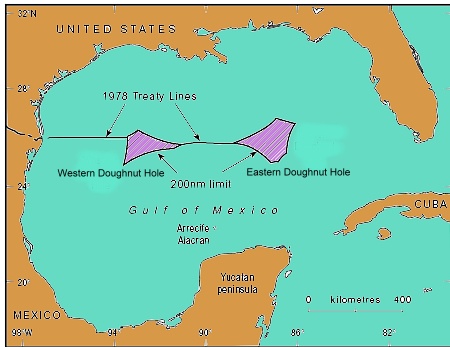
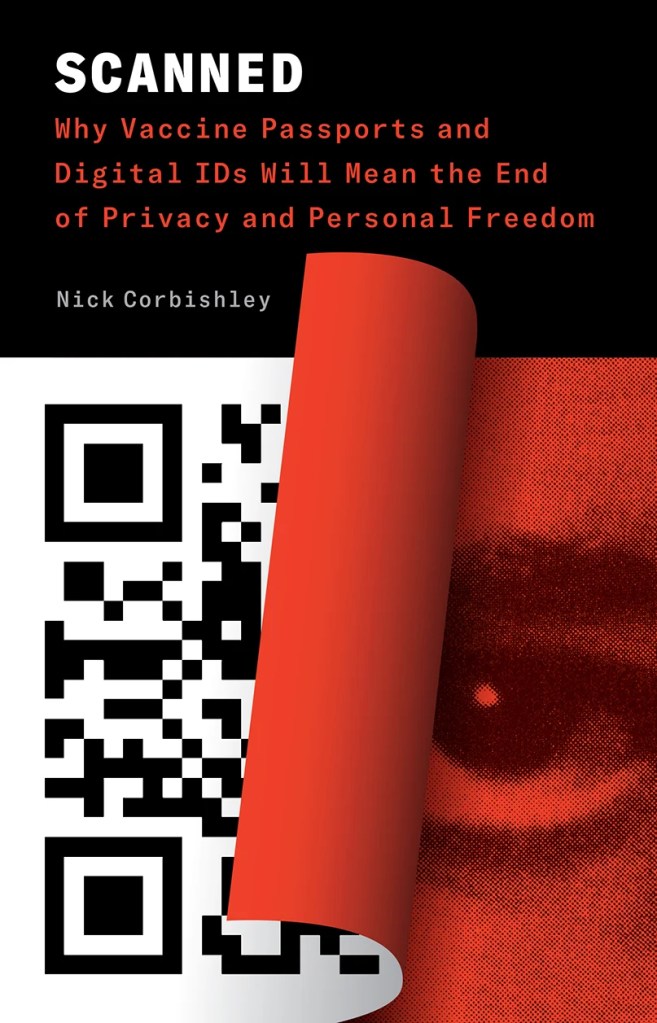
 Nick Corbishley