An Example from Switzerland: Neuchâtel Becomes Second Canton to Enshrine Right to “Offline Life” in Constitution

“It is a question of having access to all the services of the State without having a computer, smartphone or tablet.”

As the world becomes steadily digitised, it is getting harder and harder to do even the simplest of tasks offline, while surveillance, control and censorship of the online world is growing. Access to essential services is increasingly restricted to a specific platform or app that is often linked to Big Tech platforms and services.

At the same time, many of those same apps and tech platforms are undergoing a process of rapid “enshittification” (or as we call it round these parts, crapification) — so much so that Macquarie Dictionary has crowned the Cory Doctorow-coined term as its word of the year. Here’s how the Australian dictionary defines enshittification:

“The gradual deterioration of a service or product brought about by a reduction in the quality of service provided, especially of an online platform, and as a consequence of profit-seeking.”

App-Controlled Lockers and Car Park Meters

Just yesterday, my wife and I tried to rent a luggage locker at a Mexico City bus station for a couple of hours to avoid having to lug our luggage around with us before catching our connecting journey, only to find that doing so required downloading an app and sharing our personal data and bank details with the app company — all to pay one dollar fifty in storage fees. Needless to say, we declined.

In Germany, the logistics giant DHL has introduced new, “lean” parcel lockers where customers can only collect parcels if they use the company’s “Post & DHL App” on their smartphones. As the European Digital Rights network (EDRi) reports, anyone who is unable to receive a parcel at home may be redirected to one of these lockers: “in this case, the only way to receive parcels without the app is to request a second delivery to the original address – an option that is time-limited and well-hidden on DHL’s website.”

Another example I’ve noticed during my recent visits to the UK is parking. For decades motorists using a car park in my home town had fed coins into a meter and got a ticket. Then, about ten years ago, a new meter was introduced offering a card alternative to cash, which seemed like a good idea at the time. Some years later a parking app was included. Yet more choice! Then a new meter was unveiled – payment by card or app only. Within a year, the meter had disappeared altogether. In its place stood a sign instructing customers to pay by app only.

The assumption was clear: every driver wishing to park their car has a smartphone and knows how to download and operate apps, and is quite happy to share their personal data and bank account information with an obscure, probably foreign-based app company.

To cap things off, the mobile coverage was poor and the price of parking had gone up to include an extra fee for the app company. Worse still, in many parts of the UK enterprising fraudsters have begun placing QR code stickers on top of the parking apps’ QR codes, directing unsuspecting carpark users to fake websites designed to extract their bank card or account details. Victims of these scams end up losing far more than the price of a couple of hours’ parking. The ultimate insult: many get fined for not buying a parking ticket.

So, what had begun as a process of broadening customer choice had ended up narrowing it to the point at which the only way for customers to pay for their parking was with a smartphone. And instead of costs going down, they were going up, so that the app company – a new 21st century middleman – could turn a tidy profit. Rather than being quicker and more convenient, this new system is making life more difficult for many customers, and is even making some easy prey for fraudsters. As the Sheffield Star reports, customers are not happy:

Anne Middleton, of High Green, said: “I’m not to keen on that idea actually. I quite like to put my cash in. I’m not good with the apps, I always get it wrong.”

She said she had used apps and had one or two on her phone. But she added: “Generally they go wrong, so we end up not bothering or we find one that takes cash.”

Briony Salter, from Wincobank, agreed parking companies only allowing apps was unacceptable. She said: “I wish they would do parking meters – it’s easier if people have got change.

“Not everyone has a smart phone so I think it’s a very new generation thing. There are a lot of older people who may not be very handy with a phone. Maybe just going back to old payment systems is a lot easier than it is currently.”

Sara and Ian Hobson, from Woodhouse, both felt app-only was unacceptable.

Ian said: “Most people don’t know how to do it with an app. You have to download the app, then you have to pay. It’s easier just to get some coins out and put them in.”

“Digital Coercion” 

Unfortunately, governments, banks and businesses in many countries are doing everything they can to drive out the use of cash for basic services like public transport and parking, and replace them with purely digital payment means. They are also making it increasingly difficult to interact with government and receive state benefits without using smartphone apps. Ukraine’s “Diia” digital ID and governance platform, launched in February 2020, offers a perfect template, according to USAID, the European Union and the United Nations Development Program.

“Digital coercion” — a term I learnt from the German financial journalist and digital rights activist, Norbert Häring — is on the rise just about everywhere. As Häring reported in September, this should hardly come as a surprise given that one of the main organisations pushing for the rapid rollout of digital public infrastructure (digital ID, digital health passes, instant payment systems, central bank digital currency…) is the corporate-controlled, WEF-partnered United Nations…

Continue reading on Naked Capitalism

Is Trump About to Deal a Mortal Blow to NAFTA 2.0?

The USMCA trade agreement, now in its fifth year of existence and up for renegotiation in 2026, is already looking frail.

Yesterday (Nov 25), US President-Elect Donald Trump announced that on his first day back in office he would use executive powers to impose a 25% tariff on all products entering the US from Mexico and Canada, its USMCA partners, as well as an additional 10% tariff on Chinese imports. Those tariffs, he said, will remain in place until the flow of fentanyl and illegal immigrants into the US is halted.

Predictable as this announcement may have been, it still raises lots of (largely unanswerable) questions.

Will the Trump administration apply the tariffs across the board, as Trump’s message strongly suggests, or will it be more judicious in their application? In 2018, the Trump administration prioritised tariffs on intermediate goods to avoid hurting consumers. What will the broader economic effects be this time round? How severe will their impact be on inflation, economic activity and product shortages in the US, given this new round of tariffs will be levied not just on China but also the US’ other two biggest trade partners (Mexico and Canada)?

Is the US even ready or capable of reindustrialising in the targeted sectors? Six years after Trump began his trade war on China, the US may have diversified its imports away from China for low value-added goods (e.g. bedding, mattresses, and furniture), but diversification for higher value-added goods (e.g. smart phones, portable computers, lithium-ion batteries) is proving far harder, data from the Atlantic Council (of all places) suggests.

There are also serious questions about the legality of Trump’s proposed tariffs. Will Canada and Mexico retaliate with their own tit-for-tat tariffs? If so, just how badly could the resulting trade war spiral? Will it push the three countries into recession? How badly will it hit the Mexican peso, which has already faced significant depreciation so far this year? What will the legal consequences be? Lastly, how will the tariffs on Mexican and Canadian goods help the US tackle its opioid and fentanyl epidemic if precious little is done on the demand side of the equation?

“What tariffs should we put on their merchandise until they stop consuming drugs and illegally exporting weapons to our homeland?” asked the president of Mexico’s Senate, Gerardo Fernández Noroña.

One thing that is clear is that trilateral relations between the erstwhile “Three Amigos” of North America are about to become a lot more strained — for a while at least.

That said, the long-term impact may not be as severe as some are fearing. When Trump began his first presidential term, it was generally assumed that it would be disastrous for Mexico’s economy. Yet more or less the opposite occurred: the Trump administration’s trade war on China and resulting nearshoring strategy helped turn Mexico into the US’ largest trade partner.

Also, this is not the first time Trump has threatened to impose tariffs on Mexico. In 2019, he said he would impose a 5% tariff on all goods entering from Mexico unless it stemmed the flow of illegal immigration to the United States. Nine days later, Trump ditched the plan after Republican senators had threatened to try to block the tariffs if he moved ahead with them.

Canada Turns On Mexico

This time round, however, it’s not just Trump that’s talking tough on North American trade. A couple of weeks ago, Doug Ford, the premier of Ontario, Canada’s richest province, called for Mexico’s removal from the USMCA trade agreement due to its growing trade and diplomatic ties with China (a topic we covered just a couple of months ago).

“Since signing on to the United States-Mexico-Canada Agreement, Mexico has allowed itself to become a backdoor for Chinese cars, auto parts and other products into Canadian and American markets, putting Canadian and American workers’ livelihoods at risk while undermining our communities.”

Ford’s position is far from an isolated one. Danielle Smith, the premier of Alberta, Canada’s third richest province, expressed a similar view just days later, noting that “Mexico has taken a different direction” and that Americans and Canadians want to have “a fair trade relationship.” Chrystia Freeland, Deputy Prime Minister of Canada, said she shares the concerns of the United States regarding Mexico’s relationship with China.

The same apparently goes for Canadian Prime Minister Justin Trudeau. Last Thursday, just three days after meeting with Mexican President Claudia Sheinbaum on the side lines of the G20 meeting in Rio, he told a press conference that the USMCA would ideally continue as a trilateral trade deal, but hinted that if Mexico did not tighten its policy against China, other alternatives would have to be sought.

“We have an absolutely exceptional trade agreement at the moment,” Trudeau said.  “We will guarantee Canada’s jobs and growth in the long term. Ideally, we would do it as a united North American market, but, pending the decisions and choices that Mexico has made, we may have to consider other options.”

Politicians in the United States and Canada have expressed growing concerns that under the USMCA, Chinese companies could assemble cars in Mexico and ship them north, which would spare them tariffs. In recent years, China has poured huge sums of money into Mexico to build factories and automotive plants. And trade is booming between the two countries…

Continue reading on Naked Capitalism
FT Confirms What We’ve Been Saying for Three Years: The US Is Losing the “Battle… for Latin America” to China

“Beijing is now the main trading partner for most nations in the region and has the fastest-growing stock of investments.”

On August 17, 2021, we published an article titled “The US Is Losing Power and Influence Even In Its Own Back Yard.” It was the first in a series of articles that have traced how China has gradually surpassed the US as South America’s main trading partner and has even begun chipping away at US economic dominance over parts of Central America, the Caribbean and, more recently, Mexico. From that initial article:

Unlike the US, China generally does not try to dictate how its trading partners should behave and what sorts of rules, norms, principles and ideology they should adhere to. What China does — or at least has by and large done over the past few decades until now — is to trade with and invest in countries that have goods — particularly commodities — it covets…

In Latin America and the Caribbean it has worked a treat. China’s rise in the region coincided almost perfectly with the Global War on Terror. As Washington shifted its attention and resources away from its immediate neighbourhood to the Middle East, where it frittered away trillions of dollars spreading mayhem and death and breeding new terrorists, China began snapping up Latin American resources. Governments across the region, from Brazil to Venezuela, to Ecuador and Argentina, took a leftward turn and began working together across various fora. The commodity supercycle was born.

China’s trade with the region grew 26-fold between 2000 and 2020, from $12 billion to $315 billion, and is expected to more than double by 2035, to more than $700 billion.

[Recent data suggest it is well on track to achieving that. In 2023, the total trade volume between China and Latin America reached a record $480 billion, according to China’s National Customs Administration]

In the last 20 years China has moved from an almost negligible position as a source of imports and destination of exports within the region to become its second trade partner, at the expense not just of the US but also Europe and certain Latin American countries such as Brazil whose share of inter-regional trade has fallen. According to the World Economic Forum, “China will approach—and could even surpass—the US as LAC’s top trading partner. In 2000, Chinese participation accounted for less than 2% of LAC’s total trade. In 2035, it could reach 25%.”

A Thousand-Word Photo?

The potential ramifications of China’s rise to dominance of South America, a region whose fortunes and resources have been largely controlled by Europeans and their North American descendants for the best part of the past 500 years, appear to be finally dawning on the West. The German broadcaster DW reported last week that “Alarm bells are ringing in the United States,” citing an article by Swiss newspaper Neue Zürcher Zeitung:

“As a supplier of raw materials, South America has great economic importance for China’s development. This is where 45 percent of the agricultural products traded on the world market come from. Meat and soybean exports are particularly important for the nutrition of the Chinese population. South America also supplies two fundamental minerals for the energy transition: lithium and copper. Two-thirds of the known lithium reserves and forty percent of the copper reserves are located in the region. Chile and Peru are the two largest copper producers in the world. (…)

Spain’s El País warned that the Asian giant is expanding its political and economic influence in the region, eroding the role of the West and putting Washington and Brussels on alert. The Financial Times appears to have reached the same conclusion. In a “Global Insight” op-ed on Wednesday, the pink paper’s Latin American editor, Michael Stott, averred that Joe Biden has lost to Xi Jinping in the “battle for Latin-America”:

“Beijing is now the main trading partner for most nations in the region and has the fastest-growing stock of investments.”

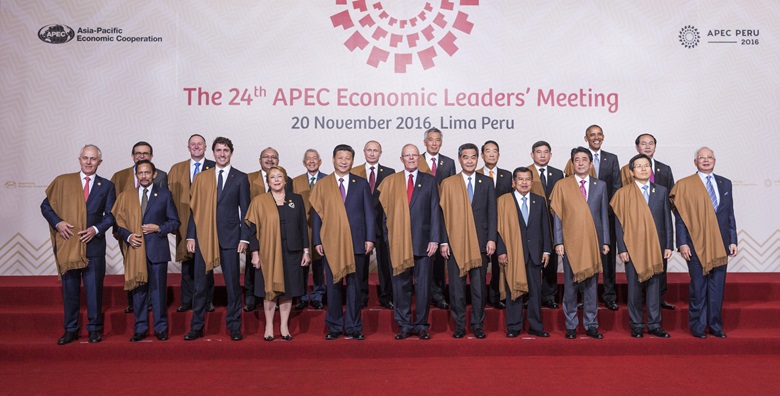
The article notes that Biden’s farewell trip to Brazil and Peru “epitomises Washington’s waning influence” in the region, citing photos from last week’s Apec summit in Peru and this week’s G20 meeting in Brazil as visual proof of that waning influence. In both photos Xi Jinping stands front and centre in the first row while Biden “lingers near the end of the back row in one picture and is absent from the other.” There are, however, official explanations for this that have nothing to do with the US and China’s relative strategic influence:

In the first picture at last week’s Apec summit in Peru, leaders stood in alphabetical order, which favoured China over a rival superpower starting with U. In the second, shot at this week’s G20 meeting in Rio de Janeiro, US diplomats said the group photo was taken early, before Biden had arrived.

As we can see in this photo of the 2016 Apec summit, also in Peru, Obama was also close to the end of the back row.

Nonetheless, as the op-ed notes, “the summit photographs serve as metaphors for the eclipse of the US by China in Latin America, a region that Washington used to call its backyard,” and which Biden has called its “front yard”, as if that were somehow better.

China Making Moves

A better illustration of the two rival superpowers’ sharply contrasting approaches in Latin America was on display last week at the opening of Peru’s Chancay megaport, at which Xi Jinping made a guest appearance. What was China’s paramount leader doing attending the inauguration of a Peruvian port? First, he was already in Peru to attend the Apec Summit; and second, Chancay is as much, if not more, Chinese than it is Peruvian since it is majority financed and owned by Chinese state-owned company Cosco Shipping.

This has raised questions about Peru’s sovereignty. From DW:

In 2021, the national port authority granted Cosco exclusivity to operate Chancay. When this clause was made public, there was a nationwide outcry in Peru.

In March of this year, the government asked the judiciary to annul this provision. (…) But in June, President Dina Boluarte backtracked under pressure from China and abandoned the request to annul the clause. At the same time, the Peruvian Congress adjusted the port law, so that exclusive rights are now allowed for Cosco.

With an estimated total cost of $3.6 billion, the half-finished port in Chancay represents one of the most important infrastructure projects China has spearheaded in the region. The first phase of construction has already cost $1.3 billion and the next five phases will see further investments of another $2.3 billion through 2032.

Chancay is the first port on South America’s Pacific coast that will be able to receive ultra-large vessels – which can transport more than 18,000 containers — and it is hotly tipped to become the main maritime node in Latin America, especially if China’s ambition to forge a new maritime-land corridor between China and Latin America bears fruit.

“China wishes, together with Peru, to use the port of Chancay as a starting point to create a new land and sea corridor between China and Latin America, connecting the Inca Trail with the 21st century Maritime Silk Road, and opening a path to shared prosperity for Peru and for the countries of Latin America and the Caribbean,” Xi said on Thursday during a bilateral meeting with Peruvian President Dina Boluarte, according to Chinese media.

The idea of building a land corridor connecting South America’s Pacific and Atlantic seaboards is hardly a new one. In fact, it has been on the drawing board since the late 19th century. In 2007, the then-heads of state of Brazil, Bolivia and Chile, Lula da Silva, Evo Morales and Michelle Bachelet, agreed to undertake efforts to build a land route connecting the Atlantic port of Santos (Brazil) with the Pacific ports of Arica and Iquique (Chile) or Port of Ilo (Peru) and expedite custom procedures along that route.

But progress has been sporadic…

Continue reading on Naked Capitalism
Will Online Age Verification Be the Trojan Horse for the Mass Rollout of Digital IDs?

Online age verification threatens to trap everyone, not just minors, in its web, as the Australian government recently admitted.

As readers may recall (while perhaps also recoiling), Spain is in the process of developing a licence to w*nk online. In July, the Pedro Sánchez government unveiled plans to launch a digital age verification system to prevent minors from being able to access pornographic websites. The country’s then-Minister of Digital Transformation (an increasingly common government position), José Luis Escrivá, announced that the system would be based on a digital wallet app that is currently in the beta phase of testing.

The app will allow adult porn users to obtain anonymous digital access credentials, which according to the government will soon be necessary to enter digital spaces hosting adult content. The government has even spoken of rationing the amount of online porn adult users can consume. It is also considering making changes to Spain’s General Telecommunications Law that will allow it to ban access to all digital platforms that do not incorporate age verification mechanisms. It is not alone in seeking such powers.

In October, Ireland adopted its Online Safety Code, which mandates that digital services protect people, especially children, from harm online. It calls on video-sharing platforms to, among other things, use age-assurance mechanisms to prevent children from accessing pornography or gratuitous violence.

As is often the case with sweeping Internet regulation, there are at least a few positive features, such as restrictions on corporate advertising that urges children to buy something by exploiting their inexperience or credulity, or to ask their parents to buy something. In the UK, the government is considering supporting a private member’s bill that would raise the age at which social media companies would be allowed to harvest data on children.

Ireland’s age verification rules will apply to all video-sharing platforms that have their EU headquarters in the country including Facebook, YouTube, X, TikTok, LinkedIn, Tumblr, and Instagram. This is an advantage Ireland has over most other EU countries when it comes to implementing online legislation: thanks to its low corporate tax rate, many of the world’s largest tech companies have chosen Dublin as the headquarters for their European operations, granting the Irish government a certain amount of leverage over them.

In Spain, by contrast the proposed digital verification system will only be mandatory for adult content websites hosted in Spain. In other words, once the system is up and running (assuming it ever is), users, regardless of their age, will be able to continue accessing the vast majority of adult content sites on the Internet without any government hindrance. And if someone specifically wants to continue accessing Spanish-hosted porn, they could do so by simply using a VPN.

New Developments on Spain’s “Pajaporte”

Since July, Escrivá has moved on to greener pastures, and is now serving as governor of the Bank of Spain. Last week, his replacement as minister of digital transformation, Óscar López, claimed that the government has already developed the technological apparatus to make the ‘Beta Digital Wallet’ app a practical reality. From La Vanguardia:

During his appearance before the Committee on the Economy, Trade and Digital Transformation, López said that some people have asked the Government to put the initiative on hold until new European regulation on the protection of minors comes into force some time next year. However, he said that “the Government is not going to sit idly by” and will fulfil President Pedro Sánchez’s pledge to approve this tool, without waiting for EU legislation.

The proposed age verification app, which has already been dubbed on social media as “pajaporte” — an amalgam of the Spanish words “paja” (to jerk off or wank) and “pasaporte” — is now being tested by Spain’s National Cryptologic Centre, says López. And its reach is likely to extend far beyond Spanish residents’ porn habits.

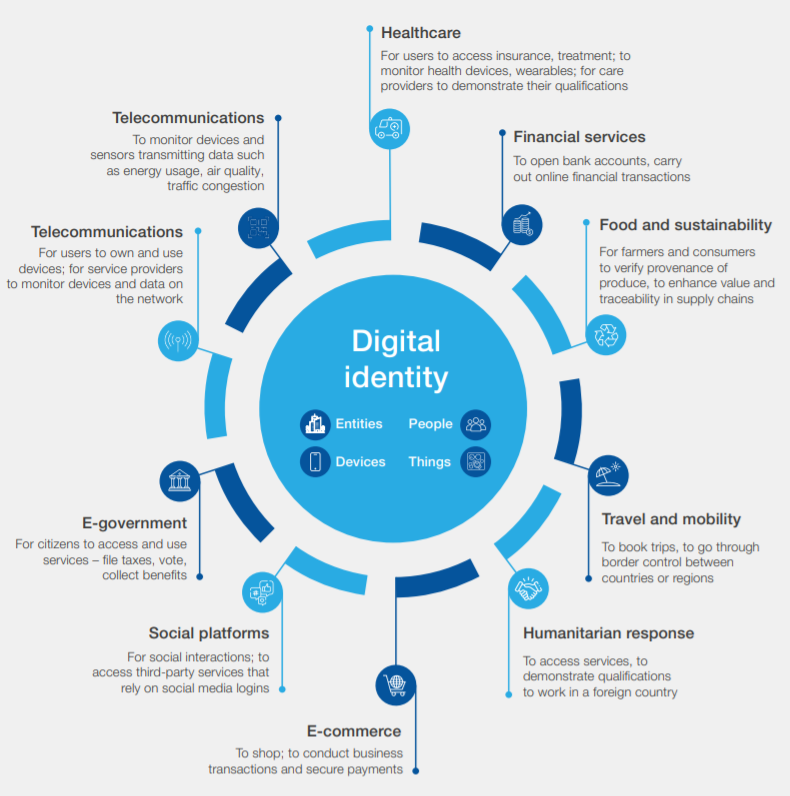
In July, Carmen Cabanillas, director general of governance at the Ministry of Digital Transformation, said the tool could also be required to access messaging apps, social media, video sharing sites and internet browsers, which, as I pointed out in my previous piece, is eerily reminiscent of two of the ten use cases (telecommunications, social platforms) depicted on the World Economic Forum’s now-infamous 2018 infographic on digital identity.

More ominous still, López said that “the Spanish tool is being followed closely in Europe” and that “in a year’s time the whole of Europe will be using it”.

As I posited in my July 12 article, “A License to W*nk: Spain to Launch Digital Identity Wallet to Limit and Ration Access to Internet Porn Sites”, the real motive here is not to protect young children from the insidious effects of online porn, which is almost certainly a laudable goal given the violent nature of porn today and the young age at which many children are being exposed to it; it is to begin the process of launching digital identity wallets for widespread public use:

[Now that digital identity is a legal reality in the EU], what we are likely to see in the months ahead is a sudden explosion of Trojan Horse initiatives aimed at instilling the need for digital identity wallets for a host of common everyday activities or services, whether accessing porn websites or, as in India, receiving State benefits. As with the vaccine certificate, the goal is to achieve as broad an uptake in as short a time as possible.

The government of Greece recently provided a hint of how that might be achieved: by making access to certain public services and spaces — in this case, sports stadiums — contingent on possession of a digital ID wallet…

Of course, [these policies] directly contradict the Commission’s repeated assurances that the digital identity wallet is purely optional and that EU citizens will not face exclusion or discrimination for not using one…

Speaking at an event this week on “Governing in the Age of AI”, organised by his own TBI foundation, Tony Blair, one of the world’s most vocal advocates of digital surveillance and control technologies, described Digital ID as “an essential part of a modern digital infrastructure.” He then added, to peals of laughter from the audience, that “we will have a little work of persuasion to do here.”

Five Eye Nations Also on Board

Perhaps unsurprisingly, the Five Eye nations are also firmly on board with the idea of online age verification. Australia, which launched its own digital identity app, myID, earlier this year, is looking to ban under-16s from social media platforms, and will need an age verification system to enforce that ban. To the end, on May 1 this year the Albanese government announced the launch of an age assurance technology trial to “protect children from harmful online content.”

The proposal enjoys full cross-party support. Here is Peter Dutton, the leader of the main opposition Liberal Party, explaining why these draconian measures are necessary:

The comments below Dutton’s video are eye-opening. Virtually none of them are positive. As of writing, the video has been retweeted 319,000 times and liked just 465 times. Many of the commenters accuse the government and main opposition party of seeking to intrude excessively in the lives of children and their parents. Some point out that online age verification is merely a handy gateway for the introduction of digital identity into our lives…

Continue reading on Naked Capitalism

As Rumours Swirl That Mexico Has Lost USMCA Case on GM Corn Ban, Sheinbaum Pledges to Protect Mexico’s Native Corn

The USMCA trade agreement, now in its fifth year of existence and up for renegotiation next year, is looking increasingly frail.

This is a story we have been tracking fairly closely over the past couple of years, and unfortunately, as things currently stand, it doesn’t look like it’s going to have a happy ending — unless, of course, you’re a Big Ag exec. Mexico has purportedly lost the dispute settlement panel brought by the US and Canada over its ban on imports of genetically modified corn for direct human consumption. That’s according to unnamed sources briefed on the ruling in a preliminary official report that has already been released to interested parties.

Those parties appear to include Mexico’s Economy Minister Marcel Ebrard. Speaking at a conference on the future of North America on Wednesday, Ebrard acknowledged that it could lose the corn dispute against its USMCA partners: “Now they have already given us the preliminary results of the [case], the process is not yet finished,… but maybe they will beat us.”

In other words, not only will the US government have sued Mexico for not buying their high-risk GMO products, citing basic precautionary reasons related to health and the environment, it also appears to have won the case.

Stiff Penalties

After a year of presentations and deliberations, the three arbitrators chosen to oversee the case are expected to issue a ruling by the end of this month. If that ruling goes against Mexico, as the sources cited by publications like El Economista claim, the government will have to reverse its 2023 decree banning GM corn for human consumption — or face stiff penalties, including possibly sanctions.

Mexico’s government may opt for the latter, says Timothy A Wise, author of Eating Tomorrow and senior adviser at the Institute of Agriculture and Trade Policy:

“If Mexico loses, it could accept the penalty but keep the policy. AMLO [President Andrés Manuel López Obrador] has also indicated that he would seek hearings in other international venues. What I think is safe to say is that Mexico has no intention of allowing GM corn into its tortillas.”

Whether that is true or not, time will soon tell. Early indications suggest that AMLO’s presidential successor, Claudia Sheinbaum, is not for budging. Two months before winning the presidential election in June, Sheinbaum signed an accord with Mexico’s peasant organisations to uphold the ban on transgenic maize in food and replace glyphosate with safer alternatives.

On the day of her inauguration, she learnt that US congressmen had just sent a letter to the US Trade Representative exhorting her to pressure Sheinbaum to back down on the GM corn ban. Uncowed, Sheinbaum used her inaugural speech to reiterate Mexico’s rejection of genetically modified corn. Yesterday, as rumours swirled that Mexico had lost the dispute, Sheinbaum announced that her government would in the coming days present a plan to enshrine the protection of the country’s non-genetically modified white corn in the constitution.

We have to differentiate between white corn and yellow corn. Mexico is self-sufficient in white corn and we have an obligation to ensure that the white corn cultivated in Mexico is not genetically-modified. This will be in the constitution as this is the best defence we have for biodiversity as well as for our health.

The potential health risks posed by GM corn — painstakingly documented by the hundreds of peer-reviewed studies cited in Mexico’s defence, including indications of serious kidney and liver ailments in adolescents after even low-level exposures to glyphosate — are magnified in Mexico, where the national diet revolves around minimally processed white corn, in particular tortillas. Cornmeal provides more than 60% of the average Mexican’s daily calories and protein, which is around 10 times the US average, putting Mexicans at 10 times the risk.

“The Emperor Has No Science”

In a recent article for TruthDig, Wise explains why a ruling against Mexico would make very little sense. A brief three-point summary:

  1. Mexico’s restrictions have not reduced U.S. corn exports in any meaningful way. On the contrary, Mexican imports of US corn have actually surged to record levels during the year-and-a-half since the presidential decree, largely as a result of the country’s drought last year. And even as Mexico gradually phases out its consumption of GM corn for other purposes, mainly as animal feed, US farmers will always have the option of producing non-GM white corn and securing their Mexican markets for the long haul.
  2. In its complaint, the US government alleged that Mexico’s approach to biotechnology is not based on science, and challenged the Mexican government to prove otherwise. Which it proceeded to do in emphatic fashion, “providing mountains of evidence from peer-reviewed literature that showed ample cause for concern about the risks of consuming GM corn and the residues of the herbicide glyphosate — most commonly known as Roundup — that often come with it.”
  3. For its part, Mexico has challenged the US to show that its GM corn is safe to eat in the quantities and forms that Mexicans consume it, and has seemingly received no response. “As a Reuters headline put it in March: ‘Mexico waiting on US proof that GM corn is safe for its people.’ No such proof was forthcoming as the U.S. government flailed in its attempts to counter the hundreds of studies Mexico identified that showed risk. A U.S. filing claiming to rebut the evidence did no such thing.”

As Wise puts it, “the emperor has no science.” But that won’t prevent it from prevailing. The practice of science is a pale shadow of what it used to be, as KLG’s excellent essays keep reminding us.

If the Mexican government loses this case and is forced to repeal the 2023 decree banning GMO corn, it will have effectively lost the ability to set its own food policies. As Alexander Zaitchik notes in an excellent backgrounder provided by The Nation, this would represent a brutal loss of national sovereignty and food security that could have reverberations far beyond North America:

Do nations have the right to determine their own food policies? Can they make laws to safeguard domestic agriculture, public health, the environment, and the genetic integrity of the national diet?

If sovereignty means anything, the answer to these questions is yes. Defending food supplies is an ancient cornerstone of the social contract, one enshrined in 21st-century trade pacts, including the US-Mexico-Canada Agreement (USMCA), the successor to NAFTA. In December 2023, Mexican President Andrés Manuel López Obrador invoked this right when he banned genetically modified corn for human consumption and announced a plan to phase out the use of glyphosate, GM corn’s signature herbicide, which the World Health Organization calls “probably carcinogenic to humans.” The measure, said López Obrador, was necessary to guarantee Mexicans’ “rights to health and a healthy environment, native corn, [and] ensure a nutritious, sufficient, and quality diet.”…

[W]hatever [the dispute panel’s] judgement, the US-Mexican dispute has put a needed spotlight on mounting global concern about the consolidation of a global food system dominated by a handful of biotech and chemical firms. Mexico’s challenge has also bolstered its standing as hemispheric leader of an agroecology movement gaining momentum across the global south.

“If the biotech companies defeat maize in its center of origin, it will embolden them to do the same in other centers of origin,” said Tania Monserrat Téllez, an organizer with Sin Maiz, No Hay Pais (Without Corn, There Is No Nation), a coalition of groups in Mexico supporting the ban. “We are challenging an entire model of production that threatens not just Mexico, but the world.”

That model revolves around the mass production of lab-designed GM seeds for crops that will end up laced with toxic herbicides like glyphosate. The accompanying business model involves the ruthless enforcement of rigid intellectual copyright and patent laws. It is a business model that has been vigorously opposed by campesino groups throughout Latin America, which, together with North America, is one of the two most important regions of the world for GM crop cultivation.

In 2013, for example, Colombia’s government passed into law a resolution that sought to force the nation’s farmers to exclusively use certified seeds – patented by the world’s largest agribusiness companies. When Colombian farmers realised that sharing or giving away seeds – a practice that dates back millennia – was now a crime, they mounted a collective resistance struggle that brought large swathes of the country’s rural heartland to a standstill, culminating in direct, bloody clashes with government and paramilitary forces…

Continue reading on Naked Capitalism

Another Central Bank in Europe Warns Citizens to Have Cash “Under the Mattress” Amid Rising Payments System Fragility

“You have to take into account that you may not be able to pay by debit card for a longer period of time,” notes the Dutch National Bank. “Then you have to have cash under the mattress, or be able to pay with QR codes.”

In October, 2022, Päivi Heikkinen, the Head of the Payment Systems Department and Chief Cashier at the Bank of Finland, warned that Finland’s payments system could go down for weeks, and urged households to keep enough cash to last them for up to 72 hours in case of payment system disruptions. The irony, as we pointed out at the time, is that Finland, like its Scandinavian peers, is among the world’s most cashless economies, and its central bank, like its counterparts in Norway and Sweden, played more than a bit-part role in making that possible:

According to the Bank of Finland, [Finland] is on track to become completely cashless by 2030. A survey conducted last year by the central bank found that only 7% of people use cash when making purchases. Ninety percent of the survey’s respondents said they pay for their groceries with a card or mobile payment app.

However, Heikkinen says that now is not a good time to give up cash completely, given the rising risk of attacks against Finnish infrastructure, including its payments system:

“More payment methods bring resilience. If a single payment method sometimes does not work, then we have other payment methods at our disposal. Cash still plays a very important role here.”

It seems that more and more central banks in Europe are rediscovering one of the beauties of cash: its resilience. It won’t fail in a power cut or seize up during a cyber attack (although, of course, ATMs might). As Brett Scott, author of Cloudmoney: Cash, Cards, Crypto and the War for our Wallets, notes , any society that runs purely on digital platforms operated by large financial institutions “is going to have major resiliency problems.” 

Role of Ukraine Conflict

To reinforce Finland’s payments system, the Bank of Finland has recommended that the use of cash payments be guaranteed by law. In March 2022, the bank initiated a proposal for legislation to ensure a minimal level of cash-paid services.

But it’s not only the central bank that appears to be re-evaluating its approach toward cash: so, too, is the general public, with 95% of citizens considering it crucial for cash to continue serving as a valid payment method alongside digital alternatives, according to a 2023 survey by IRO Research for Nosto ATMs. The war in Ukraine and Finland’s recent membership of NATO appear to have played a role in this shift. According to the survey, the conflict in Ukraine and concerns about supply security have affected the attitude of nearly one-third (28%) of Finns towards cash.

“Cash usage, especially in the context of supply security, is fundamentally tied to social responsibility,” said Risto Lepo, Country Manager of Nosto ATMs. “Not every Finn has access to bank cards or digital services. Historically, societal upheavals often lead to an increased reliance on cash. The conflict in Ukraine underscored the importance of supply security, prompting Finns to consider multiple payment methods as a prudent approach.”

A similar phenomenon has occurred in Sweden and Norway. As we reported in mid-October, the government and central bank of Norway, one of Europe’s most cashless economies, are now seeking to slow or even reverse the mass abandonment of cash. Only 3% of Norwegians used cash in their latest purchase in a physical shop, according to a recent central bank survey. In a bid to change that, a new amendment to Norway’s Financial Contracts Act came into force on October 1 that bolsters citizens’ rights to pay with cash in retail settings.

Earlier this year, the world’s oldest bank, Sweden’s Riksbank, cautioned about the unintended consequences of rapidly driving cash out of the economy. In its 2024 payments report, it warned of “serious fraud problems that could undermine trust in the payment system.” Digitalisation, it said, also makes payments “more vulnerable to cyber attacks and disruptions to the power grid and data communication,” adding that these developments suggest “we should concentrate more than before on the challenges of digitalization.”*

Since then, The Daily Telegraph has reported that criminals in Sweden are “having a field day” after the country’s mass abandonment of cash. Around the same time, Fortune magazine ran an article titled “Going Cashless Has Turned Sweden from One of the Safest Countries into a High-Crime Nation.”

The country’s central bank now wants to reverse course, and has called on the government to adopt urgent measures to strengthen cash’s role as a means of payment. Late last year, the central bank echoed a point we have been making for a number of years: “it is not enough to simply take measures to strengthen the availability of cash through withdrawal requirements and new depots, it must also be usable.”

“Cash Under the Mattress”

The latest European central bank to sound the alarm is the Dutch National Bank (DNB), which in late October highlighted the rising threat posed to the financial system by artificial intelligence, surging cybercrime and system outages. Cyberattacks against the financial sector account for roughly one-quarter of all attacks and can, in extreme cases, “make financial services temporarily unavailable” across the country’s entire financial system, the central bank wrote in its financial stability report

In the Netherlands, like everywhere in Europe and most parts of the world, cash use has fallen sharply over the past decade.* Between 2019 and 2022, it was the second country in the Euro Zone where access to cash worsened the most. From Cash Essentials:

Per the European Central Bank’s (ECB) 2022 SPACE study, the Netherlands is the penultimate euro-area country by volume of cash payments after Finland. Cash has the lowest share of person-to-person payments in the euro area. Dutch consumers had the lowest cash holdings, with €46.

Cash services and infrastructure have shrunk, particularly after the three major banks  (ABN AMRO, ING, and Rabobank) merged their ATMs into the Geldmaat joint venture in 2019. ATMs for withdrawing cash declined 29.1%, from 7,226 in 2018 to 5,122 in 2023; recirculating ATMs combining withdrawal and deposit functions shrank 34.2%, from 2,960 in 2018 to 1,948 in 2023 (CPA Memorandum 2024:

While Dutch cash use has declined in the aggregate, 1.3-1.5 million Dutch people depend on cash in their daily transactions, according to a rough 2020 estimate by McKinsey (CPA Policy Compass 2024: 1c). In 2022, 13% of Dutch consumers reported cash was their preferred payment instrument; a plurality (46%) consider having the option to pay with cash very or fairly important.

The Netherlands has already suffered two large payment outages in the past 15 months, not to mention the fallout from the global Crowdstrike meltdown. In August 2023, a nationwide outage made it prevented stores from being able to process many debit card payments. Problems with ATMs were also reported. Then, on May 16 and 18 of this year, another outage struck retail payment systems, with more than a third of PIN-based payments affected. This time, ATMs were unaffected, providing a vital lifeline for citizens and businesses.

However, DNB’s monetary affairs chief Olaf Sleijpen recently told the Dutch financial newspaper Financieele Dagblad that people should not assume that payments system will always work:

This could happen, for example, if the services of a number of large financial institutions were to go down at the same time, if several banks were to suffer financial damage at the same time or if customers were to lose confidence in the sector due to an incident.

A bank’s services can be out of service for a longer period of time and customers need to be prepared for this, says DNB director Olaf Sleijpen. “Large online attacks simply happen more often. Just look at the hack at the National Police (in which contact details of almost all police employees were stolen at the end of September, ed.) You have to take into account that you may not be able to pay by debit card for a longer period of time. Then you have to have cash under the mattress, or be able to pay with QR codes.”…

The biggest danger of bank hacks is that if one bank is hit, consumers lose confidence in the entire system, says Sleijpen. “This could lead to a run, which may lead to DNB having to block financial transactions. Then people can no longer access their money. You don’t want that.”

Third-Party Risks

The report also notes that the financial sector is increasingly vulnerable to incidents affecting third parties, as recently demonstrated by the Cloudstrike outage that caused millions of Microsoft systems around the world to crash, bringing the operating systems of banks, payment card firms, airlines, hospitals, NHS clinics, retailers and hospitality businesses to a standstill. Affected businesses were faced with a stark choice: go cash-only, or close operations until the systems came back online.

The scale of the resulting disruption was so great that it even prompted some of the UK’s largest newspapers, which had heretofore played a key supporting role in the War on Cash, to warn about the inherent fragility risks of a cashless society. In the wake of the outage, New Zealand’s central bank, like an increasing number of central banks in Europe, recommended that citizens have some cash on hand in the case of future incidents.

Continue reading on Naked Capitalism

After Weeks of Political Chaos and Uncertainty, Mexico’s Judicial Coup Fizzles to Nothing

President Claudia Sheinbaum, her governing party, Morena, and arguably Mexico as a whole just dodged a rather large bullet.  

Despite her landslide victory and her party’s super-majority in both legislative houses, allowing for constitutional changes, Mexican President Claudia Sheinbaum’s recent assumption of power has been all but smooth. As we reported just over a month ago, on the third day of her presidency, Mexico’s Supreme Court plunged the country into a constitutional crisis by seeking to derail, or at least delay for as long as possible, the now-former AMLO government’s judicial reform package, which had already passed both houses:

For the first time ever, Mexico’s Supreme Court of Justice of the Nation (SCJN) has decided to submit a constitutional reform for review. The reform in question involves a root-and-branch restructuring of the judicial system* and it has already passed both legislative houses with the necessary two-thirds majorities. It is bitterly opposed by members of Mexico’s opposition parties, the judiciary, big business lobbies, and the US and Canadian governments.

[On October 3] the SCJN admitted an appeal against the government’s judicial reform program by a majority of eight votes to three. With this ruling, the Supreme Court hands over the dispute consideration to one of the judges that voted in favour of the resolution. The court could also issue a stay, essentially suspending the constitutional reform. The Mexican financial daily El Financiero described the ruling as “the last bullet” (interesting choice of words) against the now-former Mexican President Andrés Manuel López Obrador’s  “Plan-C” reforms.

That last bullet has now been spent, and it missed the target narrowly. On Tuesday [Nov 5], the Supreme Court met to rule on whether to strike down key parts of the judicial overhaul, including drastically scaling back the election of judges and magistrates by popular vote, one of the most controversial aspects of the reform.

If the Supreme Court ruled in favour of the resolution and the Sheinbaum government stuck to its guns, it would set up “a direct confrontation between two pillars of government that, legal scholars say, has little to no precedent in recent Mexican history,” wrote the New York Times last week (h/t Robin Kash).

Sheinbaum said she was unwilling to negotiate “what the people have decided and is already part of the Constitution” while the eight judges who had voted to admit the appeal were now expected to vote in favour of it. For the resolution to pass, eight out of eleven votes were needed. A full-blown constitutional crisis seemed inevitable — until one of the eight judges broke ranks and voted against the resolution, arguing that the country’s highest court does not have the power “to say what the Constitution should or should not include.”

“Wow, Wow, Wow!”

Eight versus three suddenly became seven versus four: one vote short. But then the unthinkable happened: the court’s president, Norma Piña, suggested that the minimum number of votes be reduced from eight to six. Even some of Piña’s fellow judges were struck by this desperate attempt by Mexico’s most senior judge to change the rules of the game in the middle of the game. The judge sitting next to Piña, who had voted against the resolution, summed up the moment with three words (in English): “wow, wow, wow!”

“It was blatant confirmation of the court’s political intentions, which went far beyond what you’d expect in a judicial debate,” said the veteran political commentator Denise Maerker. “It disqualified [the whole process]… It was a political ruse that ended up exposing the president of the court and the terrible job she has done presiding over the court.”

Days before the hearing, it was revealed that in December Piña had met up with the leader of the Institutional Revolutionary Party, Alejandro Moreno Cárdenas, at the home of fellow Supreme Court judge Juan Luis González Alcántara Carrancá — and not at the Mexican Institute of Culture, as Piña had claimed. Among the issues discussed was the development of a joint plan between Piña and the main opposition parties to prevent Sheinbaum and Morena from winning the June 2 elections.

The plan clearly didn’t work: Sheinbaum ending up winning the biggest majority in modern Mexican history while Morena secured qualified majorities in both legislative houses, giving them the power to pass sweeping reforms to Mexico’s constitution…

Continue reading on Naked Capitalism

Just How Dystopian Can Starmer’s Britain Become?

While Starmer’s government is trying to expand the powers of the British State, it is using powers it already has — namely anti-terrorism laws — to arrest and intimidate pro-Palestinian journalists, activists and protesters.

After his election victory in July, which by the UK’s first-past-the-post system gave his party a disproportionate majority in parliament (h/t Vesa), Keir Starmer promised that his new Labour government would “tread more lightly” on the lives of voters. It is one of a multitude of pledges Starmer has broken in just his first four months in office, during which time his approval rating has suffered the biggest post-election fall of any British prime minister in the modern era. It’s worth recalling that his government’s massive parliamentary majority represents just about 20 per cent of the eligible electorate.

As the veteran journalist Peter Oborne warned in 2023, “you would be very unwise to believe a word Starmer ever says.”

Just in the last week, he and his Chancellor, Rachel Reeves, broke their pledge not to raise taxes on working people — by raising national insurance contributions for even the lowest-earning workers. The impact will be felt most keenly by small businesses, many of which are already struggling. As Richard Murphy notes on his blog, “Big businesses can afford to pay, but small businesses rarely pay their owners a great deal (contrary to common perceptions), and they will suffer, as will employment prospects for many people who are on lower pay.”

The latest broken promise came yesterday with the announcement of a hike in student tuition fees in England, from £9,250 to £9,535 a year. It is the first hike in seven years, and it comes after a period of persistent high inflation. Starmer had pledged to abolish tuition fees altogether when he ran for the leadership of the Labour Party in 2020, saying the Labour Party “must stand by its commitment to end the national scandal of spiralling student debt and abolish tuition fees.” Once in power, he did the exact opposite.

And there will be no “treading lightly” on voters, either. On the contrary, as Starmer told delegates at the Labour Party conference in September, under his government, the State would take more “control” in people’s lives. None of this should come as a surprise, of course. The Labour leader’s ruthless purge of the left and pro-Palestine voices in his party as well as his role in the British State’s persecution of Julian Assange were all clear warning signs, wrote Oborne and Richard Sanders, two of the journalists behind Al Jazeera‘s “The Labour Files”, in 2023:

In the Labour party, not only is the right in control, it is brutally pummelling the left into the dirt, determined that it will never again wield so much as a shred of meaningful influence within the Labour movement.

At the start of the first programme in The Labour Files, a Merseyside activist, Paul Davies, posed a question:

“If a small group of secretive people manipulate and control one of the two great parties in Great Britain, what will they do when they have control of MI5? When they have control of all the levers of the state? Are they suddenly going to believe in justice and proper investigations and fairness? Or are they going to be the same as they are now? Or even worse?”

A New, Orwellian Government Office

One of the main ways the British State plans to exert greater control over people’s lives is through the rollout of digital surveillance technologies. As we predicted would happen four months ago, the Starmer government is pushing hard to make digital identity a reality. Last week, as the country’s attention was focused on the government’s first budget announcement, Downing Street quietly launched a new government office to oversee the UK’s blossoming “digital identity market”: the so-called “Office for Digital Identities and Attributes”, or ODIA (which, I suppose, could be pronounced, fittingly, as “oh dear”).

First launched in 2022 by the Rishi Sunak government as an interim governing body for digital IDs, ODIA is now officially part of the Department for Science, Innovation and Technology (DSIT). Its responsibilities will include developing and maintaining the UK Digital Identity and Attributes Trust Framework (DIATF), which outlines standards that digital ID providers must follow, maintaining a register of certified organisations, and issuing a trust mark to identify registered services.

As the industry news site Biometric Update reports, another key task for the new government body will be liaising with international partners to promote interoperability of digital ID platforms among jurisdictions: “Industry experts have noted that the UK is behind other nations in digital ID” — including, first and foremost, the EU and Australia.

But both the UK government and its private-sectors partners are determined to catch up, notes the website Think.Digital Partners, an industry association whose “content partners” include seven UK government departments and tech companies like AWS, Microsoft and Solar Winds:

In a panel discussion on the future of digital wallets and identity strategies, industry leaders outlined both the opportunities and challenges facing the UK as it looks to become a global leader in the rapidly evolving space.

They were speaking at the recent Think Digital Identity and Cybersecurity for Government event in London…

“We’re conflating payments with wallets, but what a wallet will be in the future is likely to be much more than just payments,” explained Jim Small, head of identity at Hippo. “It’ll be a secure repository where we can own our own data, our own information, things like verifiable credentials and decentralised identifiers.”

Small pointed to initiatives around the world, from the US tech giants’ digital wallets to the EU’s eIDAS-based ID schemes, as examples of the diverse approaches being taken. However, he emphasised the need for a more centralised, ecosystem-focused framework to drive widespread adoption…

With regulatory clarity, user-centric design, and a focus on high-value use cases, the experts agreed that the UK can emerge as a global leader in digital identity, transforming how citizens interact with both government and businesses.

This would be a dream come true, not only for the tech companies involved but also for Starmer’s mentor, Tony Blair, who has repeatedly called for the development of a digital identity system in the UK, after trying but failing as prime minister to introduce an identity card system in the country. In his speeches, Blair routinely emphasises how a digital identity will be connected to one’s vaccine status.

“More Dangerous Than You Think”

Digital identity systems may help streamline bureaucracy and reduce fraud, but they are also fraught with risks. As Brett Solomon, the then-executive director of Access Now, warned in a 2018 Wired op-ed titled “Digital IDs Are More Dangerous Than You Think”, digital ID, writ large, “poses one of the gravest risks to human rights of any technology that we have encountered.”

Those risks include massive breaches of personal data, including biometric identifiers; hacks and system outages; function creep as more and more basic services require digital identification; unparalleled government and corporate surveillance; the near-total exclusion of people who don’t have access to mobile devices or the internet as well as those who do but choose not to comply with governments’ increasing demands…

Continue reading on Naked Capitalism

Argentine President Javier Milei Fires His Foreign Minister for Voting Against US’ 62-Year Blockade of Cuba

This year, like last year, only two countries voted against lifting the blockade: the US and Israel. But Argentina was meant to stand shoulder-to-shoulder with them. 

Once again, the United Nations General Assembly has overwhelmingly voted to condemn the US’ illegal economic blockade of Cuba, now in its 62nd year. In total, 187 countries voted in favour of lifting the blockage and just two against: the US and Israel. The only country that abstained was Moldova, which has a pro-Western government that is trying to join the EU.

Rest of World vs US + Israel (+ Argentina, kind of)

This map, courtesy of Ben Norton’s Geopolitical and Economy Report, offers an emphatic illustration of just how isolated the US is on this issue. It is, quite simply, the rest of the world, including long-standing US vassal states like the EU, the UK, Japan, South Korea, Australia and Canada, against Washington and Tel Aviv:

Cuba blockade UN vote 2024 map

In a heated exchange with the State Department’s Matt Miller in yesterday’s press conference (see below), AP’s Matt Lee asked, “So at what point… are you guys going to realize that the entire world except you and Israel thinks that the embargo is a really bad idea and should be stopped” — to which Miller responded: “Look, I think we are quite clear on the opinion of other countries around the world. And it’s one with which we disagree…we make our own policy determinations.”

https://x.com/DropSiteNews/status/1843721680532976016

Cuba has presented the non-binding resolution, “Necessity of ending the economic, commercial and financial embargo imposed by the United States of America against Cuba” every year (bar 2020) since 1992 — the year the US extended the blockade to third countries. Each year, the resolution passes almost unanimously. Last year, like this year, the only two countries that voted against were the US and Israel. The only notable difference is that it was Ukraine, not Moldova, that abstained. This year, Ukraine did not even vote.

One of the biggest surprises in this year’s non-binding resolution was the inclusion of Argentina among the 187 countries that voted in favour of lifting the blockade. Argentina’s faux libertarian President, Javier Milei, has done everything he can to align his government’s foreign policy with the US and Israel, even going so far as to apply to join NATO as well as offer to send military equipment to Ukraine and move Argentina’s embassy in Israel to Jerusalem. Indeed, this was the first time since his arrival in office that Argentina has broken with that alignment.

Initially, some of Milei’s fiercest supporters in the media, such as La Derecha Diario, argued that by voting in favour of free trade and against commercial blockades, Milei was staying true to his libertarian principles, which couldn’t have been further from the truth. There is also the fact that Argentina has always voted against the US blockade of Cuba, even during the Mauricio Macri government, so this would have been a mere continuation of more than three decades of bipartisan policy. But that wasn’t true either.

Hours later, it emerged that Argentina’s Foreign Minister Diana Mondino had, intentionally or not, voted the wrong way, for which she was unceremoniously fired. As Ben Norton notes, “the vote was 187 vs 2… Milei wanted it to be 186 vs 3” — thereby rendering Argentina just as globally isolated as the US and Israel. Even the right-wing governments that Milei likes to associate himself with, such as Orban’s Hungary, Meloni’s Italy, Noboa’s Ecuador, and Bukele’s El Salvador, voted in favour of lifting the blockade.

To justify Mondino’s dismissal, President Milei’s office said Argentina was “categorically opposed to the Cuban dictatorship” — just as it was categorically opposed to China’s “murderous” dictatorship… until the government desperately needed Chinese money to keep Argentina’s economy semi-afloat. Now, all of a sudden, Communist China is, in Milei’s own words, “a very interesting trading partner”.

As we noted at the time Milei said that, the fact that even Argentina’s fanatically anti-Communist government is now seeking to forge closer economic ties with Beijing as investments begin to dry up will have no doubt riled a great many people in Washington. Mondino’s support for Cuba’s UNGA resolution will have made matters even worse. For a country that is supposed to be totally servile to Washington, Milei’s Argentina has a funny way of showing it…

Read the full article on Naked Capitalism