Central Bank Digital Currency (CBDC) Projects Are Foundering in Five-Eye Nations. What Gives?

Canada and Australia shelve plans for retail CBDCs while the US could soon become the first country to explicitly ban the central bank from issuing a CBDC.  

As we warned in May 2022, a financial revolution is quietly sweeping the world (or at least trying to) that has the potential to reconfigure the very nature of money, making it programmable, far more surveillable and centrally controlled. To quote Washington DC-based blogger and analyst NS Lyons, “if not deliberately and carefully constrained in advance by law,… CBDCs have the potential to become even more than a technocratic central planner’s dream. They could represent the single greatest expansion of totalitarian power in history.”

At the time of writing that post, around 90 countries and currency unions were in the process of exploring a CBDC, according to the Atlantic Council’s CBDC tracker. Today, just two and a half years later, that number has increased to 134, representing 98% of global GDP. Around 66 of those countries are in the advanced stage of exploration—development, pilot, or launch.

But they do not include the United States. In fact, the US is not just trailing most countries on CBDC development; it could soon become the first country to explicitly ban the central bank from issuing a CBDC, to the undisguised horror of certain think tanks.

“CBDC Anti-Surveillance State Act.”

In May, the US House of Representatives passed HR 5403, also known as the “CBDC Anti-Surveillance State Act.” The bill, first introduced in September 2023 and sponsored by US Senator Ted Cruz, proposes amendments to the Federal Reserve Act to prohibit the US Federal Reserve from issuing CBDCs. It also seeks to protect the right to financial privacy and prevent the U.S. government from “weaponizing their financial system against their own citizens.”

If passed, HR 5403 will prevent the Fed from:

  1. Offering products or services directly to individuals.
  2. Maintaining accounts on behalf of individuals.
  3. Issuing a central bank digital currency or any digital asset that is substantially similar under any other name or label directly to an individual.

To become law, the bill still needs to clear the Senate, which is by not means guaranteed. But it is likely to receive added impetus from a new Trump administration, assuming Trump wins the election and isn’t assassinated before taking office or thwarted by a colour revolution, as Lambert posited yesterday. In January, Trump announced, to thunderous applause at a New Hampshire rally, that as president, he would “never allow the creation of a central bank digital currency.” Such a currency, he said, “would give a federal government, our federal government, absolute control over your money.”

Even a Kamala Harris administration is unlikely to fast-track a digital dollar, with progress set to continue to lag other jurisdictions, according to an article in The Banker. US voters — particularly Republican ones — are increasingly aware — and wary — of the threat posed by CBDCs, as demonstrated by the crowd’s reaction to Trump’s announcement. This, if nothing else, stands as testament to the power of social and independent media, and goes a long way to explaining why governments across the West are trying desperately to muzzle them.

Teeth Gnashing in Think Tankland

The prospect of the US, current holder of the world’s reserve currency, permanently pulling out of the global race to develop a CBDC is prompting all manner of teeth gnashing in think tankland. In March, the Brookings Institute warned that while “the US dollar remains king” — for now — “unless US policymakers take decisive steps to adapt to an increasingly digital financial system, the United States risks losing the economic and geopolitical advantages afforded to it by the dollar’s dominance of the global financial system.”

The Atlantic Council put it in even starker terms. In an article titled, “Don’t Let the US Become the Only Country to Ban CBDCs,” Josh Lipsky, the senior director of the Council’s GeoEconomics Center, and Ananya Kumar, the associate director for digital currencies at the GeoEconomics Center, warn that the passage of HR 5403 could do significant harm to the future of the dollar as well as throttle innovation across both the public and private sector:

The United States trails all of its Group of Seven (G7) peers when it comes to researching and developing a CBDC. Outside the G7, the gap is even wider. Eleven Group of Twenty (G20) countries are in the pilot stage, including Brazil, India, Australia, South Korea, and Turkey. China, too, is on the list and already has 250 million users.

In the absence of US-led models and regulatory roadmaps, there is a growing risk of a fragmented payment system emerging in which different models proliferate and make the international financial architecture more expensive and less efficient. This is the exact opposite of what banks are trying to achieve with these new technologies.

Critics of CBDCs rightly raise concerns about citizens’ privacy. If the Federal Reserve issues a digital form of cash, couldn’t the government then “surveil” the population and see how citizens spend their money? The solution, however, is not to remove the United States from the playing field, which would allow countries such as China, which will not prioritize privacy, to set standards for the rest of the world. Instead, the United States should work with partners and allies to develop digital assets with democratic values—ones that protect privacy, ensure cybersecurity, and foster a healthier global financial system.

In fact, if this bill ever became law, the United States would be the only country in the world to have banned CBDCs. It would be a self-defeating move in the race for the future of money. It would undercut the national security role of the dollar as the decision would only accelerate other countries’ development of alternative payment systems that look to bypass the dollar in cross-border transactions. This would make US sanctions less effective.

It is one thing to decide not to issue a CBDC—and several countries are debating that precise issue right now. But it is an unnecessary and harmful step to preemptively ban the Federal Reserve from even exploring the idea.

Among the countries that have decided, or at least claim to have decided, not to issue a “retail” CBDC — i.e., one meant for use by members of the public — are two fellow five-eye nations: Canada and Australia.

The Bank of Canada was one of the first Western countries to begin exploring the idea of issuing a CBDC, a whole seven years ago. Until recently, it seemed that the central bank was intent on launching a retail CBDC. In the summer, it argued that Canada would need its own digital currency to maintain monetary sovereignty and financial stability, among other reasons, as people continue to use less cash. Then, just a month ago, it quietly reversed policy. As CBC reported, the central bank is now less eager to develop a digital Loonie.

“The Bank has undertaken significant research towards understanding the implications of a retail central bank digital currency, including exploring the implications of a digital dollar on the economy and financial system, and the technological approaches to providing a digital form of public money that is secure and accessible,” the bank said in an email statement.

Instead, the central bank said its focus will be on preparing for the ongoing evolution of payments both in Canada and around the world, through policy research and analysis.

The announcement came almost a year after a public consultation by the central bank revealed widespread public hostility and skepticism toward the proposed launch of a CBDC. Eighty-five percent of respondents said they would not use a digital Loonie in their own lives (unless, of course, forced to) while 92% said there were no circumstances in which they would rather use a digital Canadian dollar over current forms of payment.

The respondents also flagged issues with trust and security with 87% saying they distrusted the ability of the Bank of Canada to create a secure CDBC that is resistant to cyberattacks (87%). Sixty-three percent raised concerns about the security of current forms of digital payment, such as debit and credit cards, money transfers, and digital wallets (63%). Survey respondents also reported concerns about the federal government (86%), tech firms (86%), financial institutions (72%), and the Bank of Canada itself (79%) accessing personal payment data.

In September, the Bank of Canada Governor governor Tiff Macklem said “there is not currently a compelling case to move forward with a CBDC in Canada.” The central bank is not closing the door entirely on the possibility, however, stating that it will “continue to monitor global retail CBDC developments,” and that “the body of knowledge built over recent years will be invaluable if, at some point in the future, Canadians, through their elected representatives, decide they want or need a digital Canadian dollar.”

The chances of that are pretty slim if the public’s response to the consultation is anything to go by. Meanwhile, at the opposite end of the Pacific Ocean the Reserve Bank of Australia has also expressed doubts about developing a retail CBDC, turning its attention instead to a wholesale CBDC.

What is the difference?

A retail CBDC is meant for use by the general public and businesses of all shapes and sizes while a wholesale CBDC is intended for transactions, particularly cross-border ones, between banks and other financial institutions. Speaking at the recent Intersekt Conference in Melbourne, the RBA’s assistant governor Brad Jones said the central bank sees more value in a wholesale digital currency:

“I can confirm that the RBA is making a strategic commitment to prioritise its work agenda on wholesale digital money and infrastructure – including wholesale CBDC – rather than retail CBDC.”  

The RBA believes that a retail CBDC poses more potential “challenges” to the financial system while its impact on the Australian economy is likely to be less “promising”. A wholesale CBDC would be more of an evolution than a revolution, Jones said, making it easier for the commercial banks and payments firms to adapt to the changing reality.

This near-simultaneous shift by Canada and Australia appears to be part of a broader global trend away from retail CBDCs. In recent months, central banks in Switzerland and Taiwan have both expanded wholesale CBDC projects at the expense of retail alternatives. A report by the Bank for International Settlements (BIS) has also confirmed this shift, revealing a sharp rise in wholesale CBDC projects, particularly in advanced economies. The likelihood of issuing a wholesale CBDC within the next six years now surpasses that of issuing a retail CBDC.

That’s not to say that many of the world’s largest economies aren’t aggressively pursuing a retail CBDC, including all five of the BRICS founding nations, Brazil, Russia, India, China and South Africa, as well as the EU, Turkey and Iran, all of which are at the pilot phase…

Read the full article on Naked Capitalism

Are Russian Spy Agencies Trying to Stoke Anti-US Sentiment in Mexico? According to the FBI, They Are

“The time has come to show the United States that it is under threat from a country of 130 million inhabitants that is finally waking up.”

Russia is trying to poison bilateral relations between the Mexico and the US by taking advantage of Mexico’s ruling party Morena’s innate anti-Americanism. That is the conclusion of an article published last week by Washington-based American journalist Dolia Estévez. The apparent basis for this claim is an alleged document published by the “Social Design Agency”, part of a Kremlin-funded global disinformation campaign called Doppelgänger.

That document somehow found its way into the hands of the FBI, and the US Department of Justice declassified it last week. In its decision to reveal elements of the document to Estévez, a reporter with ties to the Woodrow Wilson Centre for International Scholars, a US government think tank, the DOJ sought to “alert public opinion and the Mexican government about Russia’s sinister plans to drag Mexico into a spurious conflict with the United States”.

“Existential Resentment” 

The Russian document advocates intensifying Russian meddling in Mexico by stirring up anti-American sentiment in the country. The authors propose exploiting Mexicans’ “existential resentment” over the loss of over half of their territory to the US in the mid-19th century as well as creating a “perception of threat” on a border overwhelmed by violence and migration — all apparently with one main goal in mind: to help Donald Trump, “our partner”, get back in the White House:

Written in Russian and translated into English, the six-page text.. brings the 1848 war to life with a map depicting California, Nevada, Utah, Arizona, part of Colorado, New Mexico, Oklahoma and Texas as not belonging to either the United States or Mexico. Instead, there is an imaginary gap between the two, with the slogan “Mexico does not forgive” along the dividing line. Although territorial annexation is still present in the collective imagination of some, it is crazy to assume that it will lead to another war with the United States, which the writing evokes with a painting of the Battle of Buena Vista in 1847, which Mexico lost…

From the document’s title, A Mexican Pass for Candidate “A”: A Project for Proxies in the November 2024 Campaign – to the last sentence – “The time has come to show the United States that it is under threat from a country of 130 million inhabitants that is finally waking up” – the project makes [Russia’s] intentions clear: to use Mexico as a tool to erode the credibility of the US electoral system and help Trump win the elections.

“Candidate A (Trump), who was building a border wall, who every day of his presidency talked about the immigration problem coming from the South and to whom the baton must be passed to shift the political narrative [NC: presumably a reference to the war in Ukraine], urgently needs an intensifying confrontation with Mexico.” The success of the U.S. economy, which electorally favours “candidate B” (Democrat), leaves Trump the option of “creating the perception of a threat” from violent cartels and hordes of angry migrants at the border.

Morena, the party of former President Andrés Manuel López Obrador and the current head of state Claudia Sheinbaum, is, in the words of the alleged document cited by Estévez, “an easily manipulated centre-left formation with anti-American tendencies, that is favourable to de-dollarisation and a reorientation of Mexico’s economic priorities.” As for Morena’s electoral base, it consists principally of Mexico’s disadvantaged classes, which largely share this anti-American sentiment — again, according to the document cited by Estévez.

But is the document real? Who knows? It could be. But all we have to go on is the word of the FBI, whose judgment was, to put it mildly, sorely lacking in its “investigation” of Russiagate, as the Durham Report concluded last year:

“[T]he FBI discounted or willfully ignored material information that did not support the narrative of a collusive relationship between Trump and Russia… An objective and honest assessment of these strands of information should have caused the FBI to question not only the predication for Crossfire Hurricane, but also to reflect on whether the FBI was being manipulated for political or other purposes. Unfortunately, it did not.”

Even by the standards of those who brought us Russiagate, this latest story is riddled with holes, not least of which is the alleged document’s use of the word “success” to describe the US economy right now. Then there is the idea that the government of Mexico, whose economy is joined at the hip to the US, is somehow favourable to de-dollarisation. It also seems that Kamala Harris, like Biden before her, is perfectly capable of sabotaging her own presidential campaign without any need of outside help, and one would imagine that Moscow knows this.

Also, both the former Trump and current Biden governments have done a sterling job of stoking anti-US sentiment in Mexico on their own, through a combination of insults (mainly on the part of Trump), lawsuits (mainly Biden) and threats (from both sides but particularly Trump and the Republicans who have been talking about intervening militarily in Mexico to cap the capos for at least five years). And lest we forget, these accusations, whether true or not, are coming from the country that has meddled the most in Mexico for the past 180 years.

That all being said, Russia does have a motive for fanning the flames of anti-US sentiment in Mexico. Exacerbating tensions between the US and its direct southern neighbour and largest trade partner is a good way of keeping the US on its toes in its own neighbourhood, and somewhat distracted from other parts of the world. The same goes for Moscow’s deepening of ties with Cuba, Venezuela and Nicaragua.

But if that is what Moscow is indeed doing, it pales into insignificance with what the US has done over the past 10 years with Russia’s direct neighbour, Ukraine, which includes (but is by no means limited to) orchestrating the Euro Maiden coup, empowering Ukraine’s Azov Nazis and arming Kiev to the teeth so that it could wage war on the Eastern oblasts. When Russia’s invasion of Ukraine finally began, Washington, together with London, did everything they could to wreck any chances of a swift negotiated peace.

Estévez closes her article with this far from convincing exhortation to her readers:

What I relate here should be enough to convince the short-sighted, skeptical or ignorant that Russian interference in Mexico is not an invention of the CIA, nor the product of the “Russophobia” of a handful of journalists on both sides of the Atlantic, but a real and proactive strategy of great importance in which Morena, knowingly or not, is a formidably useful tool.

“Back to the Cold War”

US accusations of Russian meddling in Mexico are likely to continue, if not intensify, in the coming months…

Read the full article on Naked Capitalism
Mexico Escalates Its War on Obesity by Declaring National Ban on Junk Food Sales in Schools

Mexico is the leading consumer of soft drinks in the world with an average consumption of 163 litres per person per year — 40% more than the US in second place. Child and adult obesity are off the charts. 

Yesterday (Oct. 21), while Donald Trump was causing a stir by donning a McDonald’s uniform for the cameras and frying some fries, Mexico’s new Secretary of Public Education, Mario Delgado, announced the launch of a new nationwide program that is unlikely to be replicated north of the border any time soon. The goal of the program, titled “Vida Saludable” (Healthy Life), is to improve the nutrition and overall health of Mexican school children amid an epidemic of child obesity and diabetes.

The program, enacted by the now-former AMLO administration on September 29, has four main pillars: prevent the sale of ultra-processed food and sugary drinks in school settings; promote the consumption of natural drinking water through the provision of water fountains; train educators in healthy nutrition; and promote sports and physical activity. The Claudia Sheinbaum government, still in its maiden month in office, has said it will also train the heads of school cooperatives to sell fruits, vegetables and seasonal foods.

A Six-Month Deadline

“Vida Saludable” will become mandatory for all state schools at all levels of the national education system on March 29. Schools will have just six months to end all sales of foods and drinks that have at least one health warning label from their snack stands, or their administrators could face steep fines.

Of course, many children bring food from home, but the government says it has no intention of sanctioning parents who put junk food in their children’s lunchboxes. Instead, it will focus on explaining the harmful effects of these foods and the importance of eating a balanced diet.

Implementing “Vida Saludable” is likely to be difficult, however. At most of Mexico’s 255,000 public schools, free drinking water is not available to students. Since 2020, only 4% of them have managed to install drinking fountains. There are also doubts about how the government will enforce the ban on the pavements outside schools, where vendors set up stalls of goods to sell to kids at breaktime. This being Mexico, one can expect a lively black market in comida chatarra to spring up in many schools. Enterprising students will no doubt get rich.

Nonetheless, drastic steps are necessary to combat Mexico’s soaring levels of child obesity and diabetes. An estimated 5.7 million Mexican children between the ages of 5 and 11 and 10.4 million adolescents between the ages of 12 and 19 are overweight or obese. In addition, an estimated 7 out of 10 schoolchildren and 5 out of 10 adolescents are physically inactive, which further aggravates the country’s public health crisis.

Mexico’s secretary of education blames these trends on the “high consumption of sugars”, the lack of physical activity and the food policies of previous governments, driven primarily by the profit-maximising needs of the food industry:

“In the neoliberal era they were not concerned about this situation — on the contrary, the sale of these products was promoted and there were even campaigns against hunger promoted by the companies that produce these junk foods. The neoliberal model turned rights such as education, health and food into merchandise.”

The Role of NAFTA

In Mexico, obesity reached epidemic proportions after it joined NAFTA with the United States and Canada in the early 1990s, making processed food more easily available. As the New York Times reported in a 2017 investigation, the commercial opening of North America turbocharged the growth of convenience stores and US-owned fast food restaurants on Mexican soil. In addition, trade liberalisation allowed “cheap corn, meat, high-fructose corn syrup, and processed foods” from the United States to flood into Mexico.

Diets quickly changed as many people, particularly those on lower incomes, replaced largely healthy traditional staples (corn tortilla, frijoles, Jamaica Water…) with highly processed alternatives (hotdogs, nuggets, sodas…). Granted, prior to NAFTA Mexico was already home to a burgeoning junk food industry, but what came after was on a whole different scale.

Mexico is now the leading consumer of soft drinks in the world with an average consumption of 163 litres per person per year — 40% more than the US in second place, with 118 litres, according to a 2022 study from the University of Yale. Incredibly, there is one state in the country that consumes Coca Cola in per-capita volumes five times higher than the national average and 32 times higher than the global average: Chiapas, Mexico’s poorest state.

“It is the epicentre of the epidemic of soft drink consumption,” Dr. Marcos Arana, a researcher at the Salvador Zubirán National Institute of Medical Sciences and Nutrition, told BBC Mundo:

Soft drinks are already an essential part of daily life in this state, especially in the Los Altos region of Chiapas, where the majority of its population is indigenous and rural…

“The availability and advertising of something so cheap is so great and omnipresent in Chiapas in the face of vulnerable populations that they have created an addiction that is seen as a necessity,” Arana says.

“Residents told me that before the road to Tenejapa arrived, there was no diabetes or cardiovascular problems there. That all began when the road arrived in town and the soft drinks, the chips…”, says Jaime Page Pliego, anthropologist and co-author of the study.

Local organizations such as the Centre for Training in Ecology and Health for Peasants (CCESC), which Arana directs, point to the “aggressive” commercial practices of soft drink companies and the easy accessibility of their products in the area as the main drivers of this excessive consumption.

“Coca-Cola is the most available product in Los Altos, you have to walk the farther to buy tortillas or anything else. The number of points of sale is excessive, without any control, and with prices reduced by up to 30%,” says Arana.

As sugar consumption in Mexico has soared, waistlines have exploded. In the past 20 years the number of obese and overweight people has tripled, with a staggering 75% of the population and 35% of the child population now overweight. In addition to obesity, the change in diet has contributed to diabetes becoming the second leading cause of death, after heart disease and ahead of cancer. In 2016, a state of epidemiological emergency was declared in the country due to the high rates of obesity and diabetes.

Food Labelling, Bans on Cartoon Food Packaging…

“Vida Saludable” is not the first step Mexico’s government has taken to try to improve Mexicans’ food habits. In October 2020, at the height of the COVID-19 pandemic, the AMLO government passed one of the strictest food labelling laws on the planet. From that date, all soft drinks cans and bottles, bags of chips and other processed food packages must bear black octagonal labels warning of “EXCESS SUGAR”, “EXCESS CALORIES”, “EXCESS SODIUM” or “EXCESS TRANS FATS” — all in big bold letters that are impossible to miss.

Today, more than half of Mexican food and beverage products have a nutritional warning label — more than any other country in Latin America. The government also banned cartoon food packaging aimed at children.

Big Food lobbies tried to block both of these measures, of course — just as they will no doubt try to block “Vida Saludable”…

Continue reading on Naked Capitalism

As UK’s NHS Drowns in PFI Debt, Private Healthcare Providers Offer to Lend a Helping Hand (sarc)

“The scale of the expansion being considered would surpass moves made by the Blair government, which first introduced use of the private sector by the NHS.”

Chronically under-funded and over-indebted, the UK’s National Health Service (NHS) appears to be coming apart at the seams. While the Keir Starmer government refuses to pour new funds into the declining health service until major “reforms” are enacted– which will primarily involve outsourcing even more of its services to the private sector — the costs to repair many of its crumbling buildings are spiralling. According to an article by Morning Star, the total repairs bill for NHS facilities in England surged to £13.8 billion in 2023, up by a fifth on the previous year:

Costs amounting to £3bn were attributed to “high-risk” repairs, which could cause injury if left unaddressed.

“Vital bits of the NHS are literally falling apart after years of underinvestment nationally,” said NHS Providers deputy chief executive Saffron Cordery. “The safety of patients and staff is at risk.”

The spiralling maintenance backlog outstrips the cost of running the NHS estate itself, which also increased by 11 per cent to £13.6bn…

Last month, a report into the state of the health service by Lord Darzi revealed Britain had spent £37bn less on the NHS between 2010 and 2024 than comparable countries in the Organisation for Economic Co-operation and Development.

To make matters worse, the NHS is now being offered a helping hand from the same private hospitals that want to dismember it. Last week, The Telegraph reported that the government is considering taking up an offer from the private sector that would see cancer checks, surgery and intensive care for NHS patients increasingly taking place in private hospitals. Just as we warned during Starmer’s first week in office, his new Labour government is certain to continue, if not intensify, the piecemeal privatisation of the NHS.

From the Telegraph piece:

The NHS has been pleading for extra funds ahead of the Budget on Oct 30, but in his first speech as Health Secretary, Wes Streeting vowed to end “the begging bowl culture, where the only interaction the Treasury has with the Department of Health is ‘we need more money for X, Y and Z’”.

Under the plans, submitted by private hospitals, the independent sector could treat up to 2.5 million more patients, with some treatment starting in weeks…

The Independent Healthcare Providers Network (IHPN), which represents private hospitals, including groups such as Bupa, Circle Health Group and Care UK, has written to the Chancellor and the Health Secretary saying that more than £1 billion of private sector capacity could be invested into facilities for NHS patients…

The scale of the expansion being considered would surpass moves made by the Blair government, which first introduced use of the private sector by the NHS.

Bought and Paid For

Unmentioned in the article is the that Streeting has received £175,000 from donors linked to private health firms. Collectively, the Labour government’s cabinet ministers have raked in more than £500,000 in donations from firms with links to the sector, including lobbies representing some of the largest private healthcare corporations in the US. This sort of information often gets overlooked in mainstream media articles about the Labour government’s plans for the NHS.

Given who their backers include, it should hardly come as a surprise that Streeting and his cabinet colleagues are reportedly “very interested” in the private sector’s proposals. Streeting has repeatedly pledged to outdo Tony Blair, his mentor and idol, in deploying the private sector in the provision of NHS care. “If you want to understand my appetite for reform, think New Labour on steroids,” he said in a speech in May. And he seems to be keeping to his word.

In his mission to accelerate the privatisation of the NHS, Streeting will be able to count on the experience and expertise of Alan Milburn, who is to be given a lead role in the Health Ministry. During his four-year stint as secretary of state for health (1999-2003) under Blair, Milburn did more than just about anyone to advance the privatisation of the UK’s health system.

The former health secretary, like the current one, is a fervent believer in using private healthcare to tackle the NHS’ ever-growing treatment backlog, and has raked in millions as a consultant to some companies with interests in the sector. As The Guardian puts it, this “could trigger claims that his role at the DHSC puts him at risk of being exposed to conflicts of interest between his public and private sector activities” — as if that isn’t the basic model of governance in the UK today.

Resuscitating PFI

Milburn was also the first health secretary to begin applying the disastrous Private Finance Initiative (PFI) to NHS infrastructure projects. Three decades later, the single biggest financial burden for many NHS trusts is the regular payments they must make for buildings constructed and maintained via PFI. As the FT noted a few days ago, PFI has saddled many local authorities and NHS trusts with “crippling debt repayments.”

Under PFI, instead of borrowing to build, the government began contracting with private sector firms to finance, design, build and maintain public assets, including hospitals, schools, roads, prisons, street lighting and military equipment. The contracts typically run for 25–30 years, and many of them are coming to an end soon…

Continue reading on Naked Capitalism

Nicaragua Severs Ties With Tel Aviv While Germany Creates “Genocide Clause” to Justify Sending More Arms to Israel

The title of this post may, at first sight, seem a little baffling. After all, what does the smallish Central American state of Nicaragua have to do with Europe’s largest economy, Germany, especially with regard to Israel’s war crimes in Gaza? Well, as it turns out, quite a lot.

Nicaragua was the first country to join the case South Africa v. Israel, in January 2024. Three months later, its government, which has long supported the Palestinian cause, filed a suit at the International Court of Justice accusing Germany, Israel’s second largest arms supplier, of complicity in genocide. The Daniel Ortega government argued that by providing military and financial aid to Israel, Germany is facilitating genocide in Gaza and violating the Convention on the Prevention and Punishment of Genocide.

At the same time as Nicaragua took Germany to court for complicity in Israel’s genocide of Gaza, it also filed an emergency application demanding that Germany stop supplying weapons to Israel forthwith. Managua argued that Germany had approved arms deliveries worth €326.5 million to Israel in 2023, ten times more than the previous year. Those deliveries, it said, could help facilitate Israel’s genocidal operations in the Gaza Strip.

In May, the ICJ rejected Nicaragua’s emergency request though it denied Germany’s request to dismiss Nicaragua’s lawsuit entirely. The process, it said, could drag on for years. Which brings us to the present.

On Friday (Oct 11), the Ortega government announced that it will break diplomatic relations with Israel, becoming only the fourth country to do since the Gaza offensive began just over a year ago. On the same day, roughly 9,000 kilometres away, Germany’s Chancellor Olaf Scholz launched a charm offensive in Israel’s direction, insisting that Germany would soon be supplying it with more weapons, after a sharp fall in deliveries this year prompted accusations that Berlin had deliberately delayed the exports.

“We have supplied weapons and … we have made decisions within the government that will ensure further deliveries in the near future,” Scholz said.

Germany’s “Genocide Clause”

An unnamed senior German government told Politico Europe that there was no formal arms embargo in place, blaming the delays instead on “bottlenecks caused by the retooling of the Bundeswehr and the fact that Germany is sending weapons to Ukraine.” This would certainly chime with our reports that Europe is suffering from acute weapons shortages due to the constant drain of resources for project Ukraine and its general lack of operational capability. As one Belgian general put it in February, Europe’s arms production is in “deep shit.”

But according to some observers, cited by DW, the German government have also been “spooked” by the looming threat of legal action — including Nicaragua’s ICJ accusations of complicity in Israel’s genocide of Gaza.

So how did Germany’s coalition government get round this problem? How can it keep furnishing Israel with deadly weapons for its near-constant attacks on civilian targets while putting its mind at ease that it won’t be found guilty of complicity in Israel’s war crimes. According to Germany’s biggest tabloid Bild, the solution, allegedly the brainchild of Vice-Chancellor and Economy Minister Robert Habeck and Foreign Minister Annalena Baerbock, was simple: tell Israel’s government that it would not receive any further weapons unless it provided written guarantees that said weapons would “not be used in acts of genocide.”

And that, apparently, is all that is needed to absolve Germany and its governing class from all responsibility under international law — the assurance of a government that is already guilty of just about every war crime in the book. Lest we forget, Germany has steadfastly denied that Israel has committed any acts of genocide in Gaza. But there appears to be a world of difference between what it says publicly, and what it thinks, or fears, privately.

Israel’s written assurances that it would not use Germany weaponry to commit acts of genocide — which some commentators are now calling Germany’s “genocide clause” — arrived last Thursday, a day before Scholz announced to parliament the re-supplying of arms to Israel.

https://x.com/clashreport/status/1845790121745916124

Unlike Germany, some governments in Europe are scrambling to put as much distance between themselves and Netanyahu’s far-right government as they can. In late May, three Western European countries, Spain, Ireland and Norway, recognised Palestine as a State. Yesterday, Spain’s Prime Minister Pedro Sánchez called for an international arms embargo against Israel, accusing Netanyahu of aiming to impose “a new regional order by force.” He also urged the EU to suspend its association agreement with Israel.

By contrast, Germany continues to stand by Israel as “its reason of state” (in Scholz’s own words). Even after Israel’s recent pager bombings in Lebanon — as clear-cut an example of State terror as you’re likely to ever see — and its attacks these past few days against United Nations Interim Forces stationed in northern Lebanon, which even the EU’s High Representative for Foreign Policy, Josep Borrell, has described as “a serious violation of international law and completely unacceptable,” Berlin stands firmly behind Tel Aviv…

Continue reading on Naked Capitalism

Norway, One of World’s Most Cashless Economies, Just Made It a Lot Easier, Rather Than Harder, to Pay With Cash

Recent trends and developments in Northern Europe suggest the shift away from cash and toward purely digital payment systems may have reached its limits — at least for now.

In a major U-turn in the Global War on Cash, the government and central bank of Norway, one of Europe’s most cashless economies, are seeking to slow or even reverse the mass abandonment of cash. Only 3% of Norwegians used cash in their latest purchase in a physical shop, according to a recent central bank survey.

In a bid to change that, a new amendment to Norway’s Financial Contracts Act came into force on October 1 that bolsters citizens’ rights to pay with cash in retail settings. The new legislation should sound the death knell for all the “we only accept cards” signs plastered on shop windows throughout the country, reports the Norwegian online newspaper Nettavisen.

Norway’s central bank, Norges Bank, explains on its website how the new amendment will “clarify” customers’ right to pay in cash:

Section 3-5 (1) of the Central Bank Act stipulates that banknotes and coins issued by Norges Bank are legal tender. It further states that no one is obliged to accept more than 25 coins of each denomination in one transaction. Beyond this, the Act does not elaborate on what legal tender implies.

In June 2024, the Storting enacted an amendment to Section 2-1, third paragraph of the Financial Contracts Act, clarifying consumers’ right to pay with cash:

“In sales premises where a business regularly sells goods or services to consumers, the consumer shall be offered the option to pay with legal tender if it is possible to pay for the goods or services with other payment solutions in or in immediate connection to the sales premises. If the business has available change, it must also offer to provide change in connection with the payment, unless there is a clear discrepancy between the banknote offered as payment and the amount to be paid. The first and second sentences do not apply to the sale of goods from vending machines, sales in unstaffed premises, and sales in premises to which only a limited group of people have access. The first and second sentences also do not apply when the amount to be paid exceeds 20,000 kroner.”[1]

For anyone wondering, 20,000 kroner is worth close to $2,000. As Norge Bank explains, retail businesses that refuse to abide by this change in the law could face financial penalties:

In connection with this legislative amendment, the Storting also decided to introduce a sanction in the form of an administrative fine, which may be imposed if businesses willfully or negligently violate the rules in Section 2-1, third paragraph.

Motive #1: Genuine Financial Inclusion

One of the main justifications for the legislation is to support the estimated 600,000 people in the country — equivalent to roughly 10% of the population — who struggle to use digital payments, and who have been increasingly excluded from the retail economy. Cashless economics is often touted as a means of encouraging financial inclusion, which generally means extending exploitative and abusive financial services to those previously excluded. However, in reality there is no more inclusive form of payment method than cash.

“In a digital world, it can be easy to forget that there is a large group of people who are not digital,” says Minister of Justice and Public Security Emilie Enger Mehl. “Cash is also an important emergency preparedness for society. I am pleased that the majority in the Storting [Norway’s parliament] so clearly supported our proposal to strengthen the right to pay with cash. The regulations have been too unclear. People should be confident that they will be able to pay when they go to the store, to a restaurant or to the hairdresser.”

Many Norweigan pensioners are “jubilant” about the change in law, reports Nettavisen.

“This is very important for all the elderly who struggle to pay online, remember the code or who struggle to trust bank cards,” says manager Jan Davidsen, manager of the Norwegian Pensioners’ Association. “For many, cash provides security, it is something they have become accustomed to over the course of a long life. This has been a battle for us, so now we are going to celebrate!”

But not everyone is cracking out the champagne.

“I’m not going to change my practices,” Anders Ellburg, general manager of Holmenkollen, an upmarket restaurant in Helsinki, tells Finans Fokus:

“Cash costs me a lot of money to handle. I run a clean business. Only those who run the black market are interested in cash.

Ellburg put his foot down against cash payment as early as 2014. The card advocate from the capital’s fashionable restaurant scene is the only one of the cash-free players we have contacted who wanted to have a chat with Finansfokus. But Ellburg also made it clear that we should rather talk to those who still use cash – and ask why on earth they do it.

“I was the first in Norway to issue a press release stating that I do not accept cash. When older people have come and told me that they have been to the ATM to withdraw money, I have explained that there is no difference between entering the code in the ATM and entering it at a bank terminal in the restaurant,” he says.

Motive #2: Financial Resilience

Besides ensuring that people are not excluded from participating in the economy, the new amendment has another important goal: to provide the economy with greater financial resiliency. In April, a press release from the Ministry of Justice and Public Security highlighted the importance of cash as an “always on” payment option, ensuring Norway’s economy will not be rendered completely inaccessible in the event of “prolonged power outages, system failure or digital attacks against payment systems and banks”.

The Norwegian Directorate for Civil Protection even recommends people to have some amounts of cash at all times in case digital forms of payment stop working — something that appears to be happening with increasing frequency. This echoes a similar message issued a couple of years ago by a Finnish central bank official. In October 2022, Päivi Heikkinen, the Head of the Payment Systems Department and Chief Cashier at the Bank of Finland warned that households in Finland should make sure they have some cash on hand, just in case the country’s payments system goes down.

“More payment methods bring resilience,” said Heikkinen. “If a single payment method sometimes does not work, then we have other payment methods at our disposal. Cash still plays a very important role here.”

A Growing Trend

In another neck of the Scandinavian woods, the world’s oldest central bank, Sweden’s Riksbank, keeps sounding the alarm about the fragility of cashless economies, as we reported in May:

Digitalization… makes payments “more vulnerable to cyber attacks and disruptions to the power grid and data communication,” the bank points out. At the same time, the geopolitical developments of the past few years required “Sweden to have strong civil defense.” The developments suggested “that we should concentrate more than before on the challenges of digitalization.”

Put another way, cash does not crash. It does not fail in a power cut or seize up during a cyber attack (though, of course, ATMs might). By contrast, digital payment systems need a stable and continuous internet connection to process transactions. When these connections fail, the result is often chaos. Digital payment outages have caused significant disruption in a host of countries in recent years, including the USthe UKAustraliaIndonesiaGermanyCanadaSpain and Norway. Generally speaking, the more cashless the country, the greater the disruption.

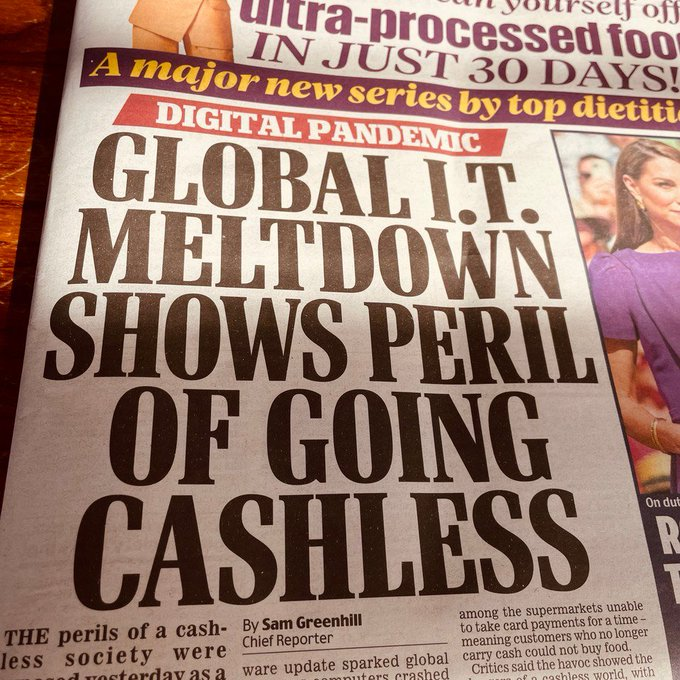
Since that post went up, the world has suffered an even more disruptive payments outage. In July, a content update by the cyber-security firm CrowdStrike caused millions of Microsoft systems around the world to crash, bringing the operating systems of banks, payment card firms, airlines, hospitals, NHS clinics, retailers and hospitality businesses to a standstill. Businesse were faced with a stark choice: go cash-only, or close until the systems came back online.

Such was the scale of the resulting disruption that even stalwart British media outlets like The SunThe TimesThe Guardian and The Mail ran articles on how the global IT outage had underscored the fragility of a cashless society. The Daily Mail plastered the message across its front page:

Imagen

The digital payment outages didn’t stop there; they just keep on coming. On September 12, 250,000 card terminals in Germany — the equivalent of one-in-four of the country’s devices — stopped working, according to FAZ. Once again, the cause of the outage appears to be a software glitch, this time affecting the payment service provider Telecash. On the same day, outages were also reported in the Netherlands.

Protecting the Right to Use Cash: A Growing European Trend

In recent years a growing number of countries in Europe have passed or proposed legislation to protect the right of citizens to use cash as payment. They include Switzerland and Austria, two countries where cash is still very much King, as well as Slovakia, where the Robert Fico government last year passed an amendment to the constitution intended to protect physical payments from a future in which the digital euro becomes mandatory.

Back in Sweden, which is arguably even more cashless than Norway, the Riksbank, like its Norwegian counterpart, has called on the government to adopt urgent measures to strengthen cash’s role as a means of payment. Late last year, the central bank echoed a point we have been making for the past few years: “it is not enough to simply take measures to strengthen the availability of cash through withdrawal requirements and new depots, it must also be usable.”

That means taking a leaf out of neighbouring Norway’s book and adopting legislation that makes it much harder for retail outlets to reject cash payments. In a 14-page response to a parliamentary inquiry on the State’s role in payments, the Riksbank warned that “legislation on cash needs to be tightened up immediately” and “political decisions are needed urgently so that everyone can pay”:

“Cash is essential for digitally and financially excluded consumers. Cash is also the only payment instrument that can be used independently of electricity and telecommunications and is therefore important for Sweden’s emergency preparedness. There is no reason or time to wait for a new review, as the Inquiry infers. There is a considerable risk that cash will be further marginalised and that in the near future it can no longer be used for essential purchases. The Riksbank therefore proposes legislative amendments regarding the possibility of paying cash for essential goods and an obligation for banks to accept cash deposits from consumers”…

The Riksbank does not share the Inquiry’s assessment that, with regard to legal tender, the legislator can wait to introduce even stronger obligations to accept cash until a new review of the status of cash and access to cash has been carried out. In the Riksbank’s opinion, the Inquiry should have submitted legislative proposals that strengthen the position of cash even
more.

The inquiry itself concluded that Sweden’s shift toward a cashless society may have finally reached the outer limits of what is possible — at least for the “foreseeable future.”

Continue reading on Naked Capitalism

Quelle Surprise: Vulture Funds Set Their Sights on the Argentine Gold Milei’s Government Just Shipped to Europe

Europe is hardly the safest place for financial assets these days, as Russia and Venezuela can attest. It may now be Argentina’s turn to have its assets frozen or even stripped.

As readers may recall, a few months ago Argentina’s Milei government began surreptitiously sending shipments of the country’s gold reserves to Europe, where they are purportedly sitting in the vaults of the Bank of England and/or the Basel-based Bank of International Settlements. Of course, Europe is hardly the best destination for financial assets these days, as Russia and Venezuela can attest. As we warned at the time, moving the gold overseas could invite attempts by Argentina’s legions of unpaid creditors to seize the gold as payment or collateral.

That is now beginning to happen.

So far, two hedge funds that have rulings against Argentina over debt in default and/or the 2011 nationalization of the oil company YPF have expressed a keen interest in knowing the whereabouts of Argentina’s gold. Once again, the cases will be heard in New York’s Southern District, where 10 years ago Judge Thomas P Griesa passed an outrageous judgment that, as Michael Hudson said at the time, essentially “prevented not only Argentina but all countries that issue bonds in the New York market from ever writing down or renegotiating the debt.”

Griesa’s ruling was in response to a suit brought by vulture funds to make the Argentinian government pay them 100% of the value of bonds, which they had purchased for a fraction of the face value. This time round, the two plaintiffs involved are asking New York Judge Loretta Preska to compel Argentina to disclose the whereabouts of its gold holdings, so that they can try to take possession of them.*

One of the creditor holdouts demanding discovery of Argentina’s overseas gold holdings is Bahamas-based Bainbridge Fund, which has holdings of Argentine public debt that was defaulted on during the country’s 2001 financial crisis. Bainbridge has refused to participate in any of the debt restructurings proposed by successive Argentine governments since, including the exceedingly generous offer made by the Mauricio Macri administration in 2016.

In 2023, Judge Preska gave Bainbridge the green light to seize Argentine assets worth $95 million plus interest. Now, the fund has launched a discovery process in Preska’s New York Southern District court. In other words, Bainbridge is asking the US court to compel Argentina’s government and central bank to disclose information about their assets and where they are being held, so that it can accelerate the collection of its debts.

“Bainbridge Fund is asking Judge Loretta Preska to order the Argentine Republic to produce information on the destination and use of the gold belonging to the Central Bank currently deposited in Europe,” explained Sebastián Maril, an expert on investor-state arbitration and CEO of Latin Advisor, on X. “Bainbridge is in the midst of asset discovery to collect unpaid damages… and also seeks to take possession of YPF shares in the hands of the State.”

Another fund that is seeking discovery the Burford Capital, a UK-based hedge fund that won a whopping $16.1 billion lawsuit against Argentina in 2023 for the expropriation of energy company YPF. Like Brainbridge, Burford’s funds’ proceedings revolve around the argument that Argentina’s Central Bank is an “alter ego” of the state — a legal term meaning that it does not constitute a separate entity.

Where Is Argentina’s Gold?

None of this should come as a surprise. In fact, it was so predictable that as Michael Hudson suggests in the comments thread below, Milei may have sent the gold to the UK precisely so that it could be seized. Given his near-total devotion to the Anglo sphere, this is is a very real possibility. As we noted in our August 6 post, “What Is the Milei Government Doing With Argentina’s Gold?“, the government’s decision to send multiple shipments of the country’s gold across the Atlantic under the cover of darkness puts it at high risk of seizure by unpaid creditors, of which Argentina has a very large number:

As readers may recall, London — and more broadly, Europe — are hardly the safest places to store gold reserves and other sovereign assets these days. In 2019, the UK government impounded Venezuela’s roughly $2 billion of gold deposits stored at the Bank of England after “derecognising” the Venezuelan President Nicolas Maduro in favour of the US- self-appointed Juan Guaidó. Even after Venezuela’s leading opposition parties voted to oust Guaidó in 2023, the UK continues to hold on to Venezuela’s gold deposits.

With Argentina facing numerous lawsuits over unpaid bills and debts, including one concerning the former Cristina Fernández de Kirchner government’s expropriation of roughly half of national energy company YPF, the risk of part or all of Argentina’s gold being seized is not negligible, as the Secretary General of the Banking Association and deputy, Sergio Palazzo, himself warns:

“The gold in transit may be seized by any judge who eventually orders a seizure for any of the cases Argentina has pending abroad. It’s an unnecessary risk being run, and [the central bank] should clarify to us Argentines the reason for this transaction, whether it is to exchange the gold for foreign currency in another country, or whether it is a credit operation, or whether it is a purchase and repurchase operation with the International Payment Bank.

It is largely thanks to Palazzo’s efforts that the people of Argentina are at least minimally aware that a large chunk of the nation’s gold has been moved across the Atlantic, though the specifics of the transfers remain vague. In mid-July, Palazzo made a FOIA request to the Central Bank of the Republic of Argentina (BCRA) asking the bank to confirm whether “operations to send gold bullion abroad had taken place during the month of June.”

Palazzo also asked the BCRA to provide details of the amounts involved, their ultimate destination, and the officials and administrative procedures behind the operations. The BCRA had 30 days to respond. It still hasn’t said anything. Citing security reasons, the BCRA has refused to say anything about the movements and location of gold in its reserves.

But on July 19, Argentina’s Minister of Economy (and former JP Morgan Chase and Deutsche Bank banker) Luis Caputo confirmed that gold reserves from the Central Bank had been sent abroad. But Caputo did not provide any clarity as to the amount of gold that had left the country or their current whereabouts. He even tried to present the operation as a shrewd financial move, rather than what it really was — the covert pawning of part of the nation’s gold:

“It is a very positive move, because today you have gold in the BCRA that is like a piece of property that cannot be used for anything. If you have it abroad, you can generate returns. It is much better to have it stored outside, where they pay you something for it.”

Caputo did not clarify how much gold had been sent, to which bank, or the kind of operation that was undertaken. As a result, no one knows exactly how much gold has left the BCRA’s vaults or where it is at. According to a recent article in Clarín on Milei’s increasing desperation, isolation and paranoia, $2.3 billion of Argentina’s gold — equivalent to roughly half of the nation’s total gold holdings — is now sitting in a vault in London. And another $700 million’s worth will soon be joining it…

Read the full article on Naked Capitalism

On Third Day of Claudia Sheinbaum’s Presidency, Mexico’s Supreme Court Plunges Country into Constitutional Crisis

Some people, including three of the Supreme Court judges, are calling it an attempted “coup”. Unsurprisingly, Washington’s fingerprints are all over this. 

On Tuesday, Claudia Sheinbaum was sworn in as Mexico’s first ever female president, and she already has her work cut out. Having chosen not to invite Spain’s King Felipe VI to her inauguration over his refusal five years ago to apologise for Spain’s colonial excesses in Mexico, Sheinbaum now has to grapple with a diplomatic crisis with Madrid.

But the biggest problem lies closer to home with a Supreme Court that is determined to derail, or at least delay for as long as possible, the now-former AMLO government’s most important constitutional reform. And in that endeavour it can count on the support of the US government.

For the first time ever, Mexico’s Supreme Court of Justice of the Nation (SCJN) has decided to submit a constitutional reform for review. The reform in question involves a root-and-branch restructuring of the judicial system and it has already passed both legislative houses with the necessary two-thirds majorities. It is bitterly opposed by members of Mexico’s opposition parties, the judiciary, big business lobbies, and the US and Canadian governments.

One “Last Bullet”

Yesterday (Oct. 3), the SCJN admitted an appeal against the government’s judicial reform program by a majority of eight votes to three. With this ruling, the Supreme Court hands over the dispute consideration to one of the judges that voted in favour of the resolution. The court could also issue a stay, essentially suspending the constitutional amendment. The Mexican financial daily El Financiero described the ruling as “the last bullet” (interesting choice of words) against the now former Mexican President Andrés Manuel López Obrador’s  “Plan-C” reforms.

Said reforms seek to radically reconfigure the way Mexico’s justice system works. Most controversially, judges and magistrates at all levels of the system will no longer be appointed but instead be elected by local citizens in elections scheduled to take place in 2025 and 2027. Sitting judges, including Supreme Court judges, will have to win the people’s vote if they want to continue working. New institutions will be created to regulate procedures as well as combat the widespread corruption that has plagued Mexican justice for many decades.

This, insists the AMLO government, is all necessary because two of the main structural causes of corruption, impunity and lack of justice in Mexico are: a) the absence of true judicial independence of the institutions charged with delivering justice; and b) the ever widening gap between Mexican society and the judicial authorities that oversee the legal processes at all levels of the system, from the local and district courts to Mexico’s Supreme Court.

There is some truth to this. And making judges electorally accountable may go some way to remedying these problems, but it also poses a threat to judicial independence and impartiality, of which there is already scant supply. As some critics have argued, with AMLO’s Morena party already dominating both the executive and the legislative, there is a danger that it will end up taking control of all three branches of government — just like the Institutional Revolutionary Party, or PRI, that held uninterrupted power in the country for 71 years (1929-2000).

That said, as I wrote in my previous piece on this issue, the AMLO government has the constitutional right to pursue these reforms, enjoys the support of roughly two-thirds of the Mexican public in doing so, and is following established legal procedures.

A Fierce Clash

Yesterday’s session in the Supreme Court saw an unusually fierce clash of views among the sitting judges. The Supreme Court President Norma Piña claimed that the law is clear that its members can analyse acts that may violate judicial independence. While the majority in favour argued that the Court is not yet making a “substantive” decision on the reform, the three judges that voted against the resolution warned that a “coup” is under way.

Judge Lenia Batres Guadarrama argued that the Court is “arrogating to itself powers it does not have”, such as the power to submit changes to the Constitution approved by the Legislative Branch for review. In doing so, she said, it is violating “the principle of constitutional supremacy, as well as the division of powers and the Constitutional Rule of Law”:

“The SCJN would be carrying out… a real coup d’état by trying to place under constitutional control the work of the reforming power, which has participated in the process of constitutional reform in matters of the Judiciary in strict compliance with the provisions of Article 39 of the Constitution, which establishes that all public power emanates from the people and is instituted for their benefit”.

Another judge, Yasmín Esquivel Mossa, described the court’s proposed resolution as a “precursor to a constitutional coup”:

“The Court wants to ignore the reforming power of the Constitution. It wants to create an unacceptable constitutional crisis, sending the message that this Court can overturn a constitutional reform in an administrative procedure provided for in the organic law of the Judicial Branch of the Federation.”

Senate president Gerardo Fernandez Norona, a member of the governing Morena party, said the Supreme Court “has proven its factional nature, assuming itself as the supreme power, above the legislative power, the executive power and, above all, the sovereign power: the people of Mexico.”

US Fingerprints

After passing both legislative houses in mid-September, the AMLO government’s proposed judicial reform program was supposed to be done and dusted by now. But a powerful minority of stakeholders within the country, including business lobbies, legacy media and opposition parties, are determined to sabotage it, and they have chosen the perfect moment to do so: during the first few days of Sheinbaum’s mandate.

Unsurprisingly, Washington’s fingerprints are all over this. As readers may recall from our previous piece on this Mexican showdown, in late August, the US Ambassador to Mexico, Ken Salazar, sent a very public communique warning that the proposed judicial reforms could have serious consequences for US trade relations with its biggest trade partner.

Days earlier, the Council of Global Enterprises, representing 60 multinational corporations with operations in Mexico, expressed their “grave” concerns about the dampening effect the reforms could have on investment in Mexico. The lobbying group’s members include Walmart, AT&T, Cargill, General Motors, Pepsico, VISA, Exxon Mobil, Bayer and Fedex.

This showdown is not just about electing judges. The judicial reform is one of over a dozen proposed reforms that the government intends to enact in in the areas of energy, mining, fracking, GM foods, labour laws, housing, indigenous rights, women’s rights, universal health care (imagine that, US readers!) and water management. And some of those reforms are likely to affect the ability of corporations, both domestic and foreign, to stuff their pockets…

Continue reading on Naked Capitalism

Washington Enters Panic Mode As Even Javier Milei’s Argentina Seeks Closer Economic Ties With Beijing

China is a very interesting trading partner,” said Javier Milei, who just a year ago described the Chinese government as an “assassin.” They “do not make demands, the only thing they ask is that they not be bothered.”

The US continues to lose economic influence in its own “backyard,” particularly South America, with whom China is already the largest trade partner. Even Javier Milei’s fanatically anti-Communist government in Argentina is now seeking to forge closer economic ties with Beijing as investments begin to dry up. Almost exactly a year after telling Tucker Carlson that he would never trade with China due to its government’s left-wing, authoritarian proclivities, Javier Milei has nothing but fond words for the US’ main strategic rival today.

Alarm bells began flashing in Washington when news emerged that a delegation of senior Argentine ministers, including Karina Milei, the president’s sister who is also general secretary of the presidency, Economy Minister Luis Caputo and Foreign Minister Diana Mondino, had met with China’s Foreign Minister, Wang Yi, on the side lines of the recent UN General Assembly. According to the Argentine media outlet Infobae, the purpose of that meeting was to relaunch the strategic economic agreement between the two countries:

The Biden administration had thought Milei’s government was beyond Xi Jinping’s influence, but all of a sudden the Argentine president is seeking a rapprochement with the communist regime to renew the Chinese swap line that underpins Argentina’s central bank reserves as well as facilitate investments by Chinese companies in lithium and copper, two minerals that Washington considers globally strategic.

“We have to be careful with how we handle this relationship,” U.S. Ambassador to China Nicholas Burns said of diplomatic ties between China and the US. “We’re systemic rivals, and I think we’ll be systemic rivals for the next decade, maybe even beyond.”

And Burns added so that there were no doubts: “China is aiding and abetting the Russian war machine. There is no indication that it will move away from its ‘no limits’ partnership with Russia. The Chinese like to say they are neutral — in the war against Ukraine — but the evidence suggests otherwise. Beijing is sending much-needed components to Russia, on which the Kremlin depends for its ongoing war effort.”

In this context, Milei’s strategy with China to secure the Central Bank’s reserves and obtain investments may trigger a short circuit with the White House. And the eventual short-circuit would continue in the future, regardless of Biden’s successor in the Oval Office: it is a bipartisan position, supported by both Kamala Harris and Donald Trump.

Tellingly, the Argentine government tried to play down the meeting, tagging it on to the end of a Foreign Ministry press release, while China’s Foreign Ministry made quite a big deal out of it, dedicating a whole press release to the matter.

Wang Yi said China has always attached great importance to China-Argentina relations and maintained the stability and continuity of its policy towards Argentina. It is a great pleasure to see that the development of relations with China has become a social consensus in Argentina that transcends political parties…

The economies of China and Argentina are highly complementary, and practical cooperation between the two countries has a solid foundation. China is willing to remain a good friend and partner of Argentina in the development process, expand cooperation in various fields, and share development opportunities. It is incumbent upon both sides to support each other on issues concerning their respective vital interests and far-reaching concerns, and it is hoped that the Argentine side will earnestly abide by its commitments, adhere to the one-China principle and resolutely oppose “Taiwan independence”. China is willing to work with Latin American and Caribbean (LAC) countries, including Argentina, to advance the construction of the China-Community of Latin American and Caribbean States (CELAC) Forum and deepen China-LAC relations.

From Communist “Assassin” to “Very Interesting Trade Partner”

The significance of Milei’s U-turn on China cannot be overstated. His government has aligned Argentina as firmly as possible with the Collective West, even going so far as to apply to become a “global partner” of NATO, months after cancelling Argentina’s membership of the BRICS-plus alliance. It has offered to send weapons to Ukraine while pledging total support for Israel’s genocidal war crimes. In an interview with Bloomberg just over a year ago when still on the campaign trail, Milei referred to the Asian nation as an “assassin”:

“We do not make pacts with communists… I would not promote relations with communists, nor with Cuba, nor with Venezuela, nor with North Korea, nor with Nicaragua, nor with China… People are not free in China, they can’t do what they want and when they do, they get killed. Would you trade with an assassin?

In his chat with Tucker Carlson, Milei said:

Not only am I not going to do business with China, I am not going to do business with any communist… I am a defender of freedom, peace and democracy. The Chinese don’t fit in…

We want to be the moral beacon of the continent, the defenders of freedom, democracy, diversity and peace. We from the State are not going to promote any type of action with communists or socialists.

Granted, all of these statements were made on the campaign train. When Milei the candidate became Milei the president, he quickly softened his position, as he has done with many of his other more radical positions, such as his pledge to shutter Argentina’s central bank and to dollarise Argentina’s economy. In relation to China, Argentina’s second largest trade partner, he quickly clarified that he wouldn’t stand in the way of private business deals between Argentinian and Chinese companies.

“We are liberals,” he said. “And if people want to do business with China, they can.”

But there is a world of difference between Argentine companies doing business with Chinese companies and Argentina’s government pushing for closer economic ties with Beijing. This is precisely what Milei said he would never do.

Softly, Softly

To its credit, the Chinese government remained characteristically tight lipped even as Milei threw insult upon insult in its direction. When Milei won the election, Beijing congratulated him, adding that “China values its relations with Argentina” and is “ready to work with Argentina to continue nurturing our friendship and contribute to each other’s development.” When Milei rejected Xi Jinping’s personal invitation to Argentina to join the BRICS grouping, Beijing said nothing; it just waited.

That softly-softly approach is now paying dividends…

Continue reading on Naked Capitalism