During his first ten months in power, Noboa has done everything he can to place Ecuador even more firmly under Washington’s thumb.
Early into his mandate, Daniel Noboa almost torpedoed Ecuador’s relations with Russia by offering to deliver unused Russian weaponry to the US in exchange for US-made weaponry — in total contravention of the weapons’ export license. The Russian weapons would be sent to Ukraine for its defence, though this was strenuously denied by Noboa, who insisted the weapons were nothing more than worthless scrap. However, when Russia retaliated by threatening to boycott Ecuadorian bananas, the country’s third most important export product and the Noboa family’s main line of business, the Noboa government quickly backtracked.
Born and raised in the US, Noboa is the son of Ecuador’s richest man, Alvaro Uribe. Like his disgraced predecessor, Guillermo Lasso, Noboa Jr. has followed the traditional three-step neoliberal shuffle to a tee: deregulation, liberalisation and privatisation, all in the service of corporations and monopolies — including, of course, Exportadora Bananera Noboa, one of Ecuador’s biggest corporate tax avoiders and evaders. Like Lasso, Noboa is fully on board with the economic program the IMF has prescribed for Ecuador since 2019, with excruciating consequences for most Ecuadorians (more on that letter).
Turning Back the Clock
Now, Noboa is proposing to turn back the clock by amending Ecuador’s constitution to allow the presence of foreign military bases on Ecuadorian soil for the first time in 16 years. His government argues that Ecuador needs foreign military help to combat the transnational crime gangs that are using the country as a major transit route for drugs smuggled from Colombia to Europe and the US. In a video recorded at the former US base in Manta that was uploaded onto X, Noboa said:
“We will present a project of partial reform to the Constitution before the National Assembly that substantially modifies Article 5 of the Constitution that prohibits the establishment of foreign military bases and facilities for military purposes. In a transnational conflict, we need national and international responses. We are lifting the country…which they turned into the cradle of drug trafficking, which they handed out to the mafias with a false notion of sovereignty. Time has shown us that the old decisions only weakened our country.”
If Ecuador’s National Assembly approves the proposed amendment, it would then have to be ratified by the country’s Supreme Court as well as the Ecuadorian people in a referendum.
Noboa declared an “internal war” on the “narco-terrorist” gangs in January, but gang-related violence continues to plague many of the country’s cities, including Manta and Guayaquil. Ecuador currently boasts the highest number of homicides per capita in Latin America, with a rate of 47.2 per 100,000 inhabitants in 2023, eight times higher than it was in 2016.
Noboa’s proposed rewriting of the constitution is controversial given that Ecuador is one of few countries in the world that has successfully closed down US military bases on its soil, forcing all US soldiers to withdraw. As you can see in the map below, of the roughly 800 military bases the US operated around the world in 2020, none were in Ecuador.
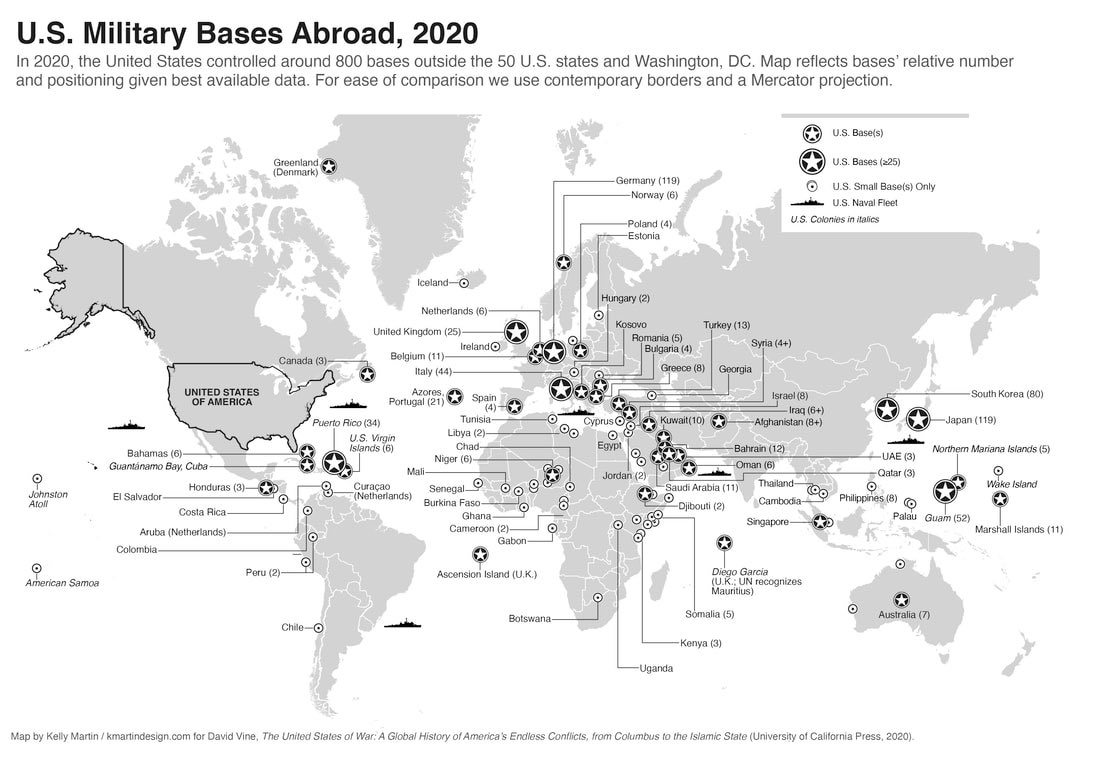
Suffice to say, it is unusual for a country to eject all US bases from its territory, and when it does happen, it is usually the result of violent insurrection from the local populace, as seen recently in Chad and Niger. However, in the case of Ecuador, the removal of US forces was the outcome of a purely democratic process. From our October 6, 2023 post, “First Peru, Now Ecuador: US Southern Command Escalates Its “War on Drugs” in South America“:
In 2009, when the US Air Force’s 10-year lease on the Manta base on Ecuador’s Pacific coast came up for renewal, Rafael Correa’s government held a referendum on the issue. The people overwhelmingly voted for the base to be closed.
According to an article in the Washington Examiner, the US withdrew all of its forces from Ecuador. In reality, they were evicted. From Asia Pacific Journal: Japan Focus:
The last personnel left the base on 18 September, and the facilities used for a decade by the American military were all returned to Ecuador.
At a ceremony marking the American withdrawal, Foreign Minister Fander Falconí made the following strong statement: “The withdrawal of the American military is a victory for sovereignty and peace. Never again foreign bases on Ecuadorian territory, never again a sale of the flag.”
Meanwhile, a relieved Defense Minister Javier Ponce commented: “I am glad that President Correa has fulfilled his election pledge and preserved the constitution.”
On the same day in the capital Quito, the citizens’ group Anti-Bases Coalition Ecuador held a concert of celebration. In exuberant Latin style about 200 people celebrated the American military withdrawal with singing and salsa dancing at an amphitheater. Messages of congratulation were read out from anti-base movements across the globe, starting with Japan, and each was greeted by loud applause.
At the closing ceremony, Martha Youth, a spokeswoman for the US Embassy in Quito, announced that together with other Forward Operating Locations in Central and South America, a total of 700 tons of drugs with a value of 35.1 billion USD had been seized. “We’ve done good work in cooperation with the Ecuadorian authorities”, she said.
However, Pablo Lucio Paredes, head of CONADE (Comisión Nacional de Control Antidopaje del Ecuador) begged to differ.
“Our country has received no benefits from American operations out of the Manta base these ten years. From the outset, the base’s real purpose was linked to the American geopolitical strategy to involve our country in the civil war in neighboring Colombia.”
A Three-Year Process
Now, Ecuador’s eviction of US forces is being undone as part of a gradual, piecemeal process that began five or six years ago. First, the government of Lenin Moreno signed a military cooperation agreement with the United States for more than USD 140 million.
Then, Guillermo Lasso (2021-3) requested US help in creating a “Plan Ecuador” to combat the rising lawlessness in the country. The plan was to be modelled on Plan Colombia, the disastrous drug-eradication program that established at least seven US military bases on Colombian soil, burnt through $15 billion of US “aid” funds, worsened the violence in the country and bathed more than a million hectares of farmland in a rich brew of toxic chemicals, including Monsanto’s glyphosate weed killer — all while overseeing a sharp upsurge in coca production.
In his last days in office, Lasso held a closed-door meeting with senior officials of the US Coast Guard and Department of Defence in Washington. The outcome of that meeting was two status agreements, one that would allow the deployment of US naval forces along Ecuador’s coastline while the other will permit the disembarking of US land forces on Ecuador’ soil, albeit only at the request of Ecuador’s government.
The deal was drawn up and signed as quietly as possible. According to the Washington Examiner, the only legacy media outlet that deigned to cover the story, “the State Department [did not publicize] the agreements in any of the more than 30 press releases issued since Wednesday, [the day the agreements were signed,] but a State spokesperson confirmed… that it had signed status of forces agreements and maritime law enforcement agreements.”
What made these hush-hush agreements particularly egregious is the fact that by the time they were signed, Lasso had virtually no democratic legitimacy left in his home country…
Read the full article on Naked Capitalism
 Nick Corbishley