“People are increasingly looking for ways to digitize everyday items — with one of the top requests being a digital ID.”
Google, owner of the world’s most widely used mobile operating system, web browser and app store, is planning to launch what Reclaim the Net describes as “one of the most controversial technologies in the world”: digital ID. On its developer blog, Jenny Cheng, vice-president and general manager of Google Wallet, unveiled plans for a new type of digital ID based on US passports. Cheng couches the initiative, currently in beta testing, as a response to grassroots demand, rather than Google looking to further expand its outsized footprint in our everyday lives:
People are increasingly looking for ways to digitize everyday items — with one of the top requests being a digital ID. Last year we began rolling out the ability to save select state-issued digital IDs to Wallet. Starting soon, we’ll begin beta testing a new type of digital ID in Google Wallet, giving more people in more places a way to create and store a digital ID, now with a U.S. passport. This new ID pass works at select TSA checkpoints, saving you time and stress at the airport when you’re traveling domestically.
Besides TSA checkpoints, Cheng says Google is working with “partners” to broaden digital IDs’ scope of application to more and more situations, such as car rentals, account recovery, and age and identity verification. The potential online and offline applications are almost endless, as the World Economic Forum’s ubiquitous 2018 infographic shows:
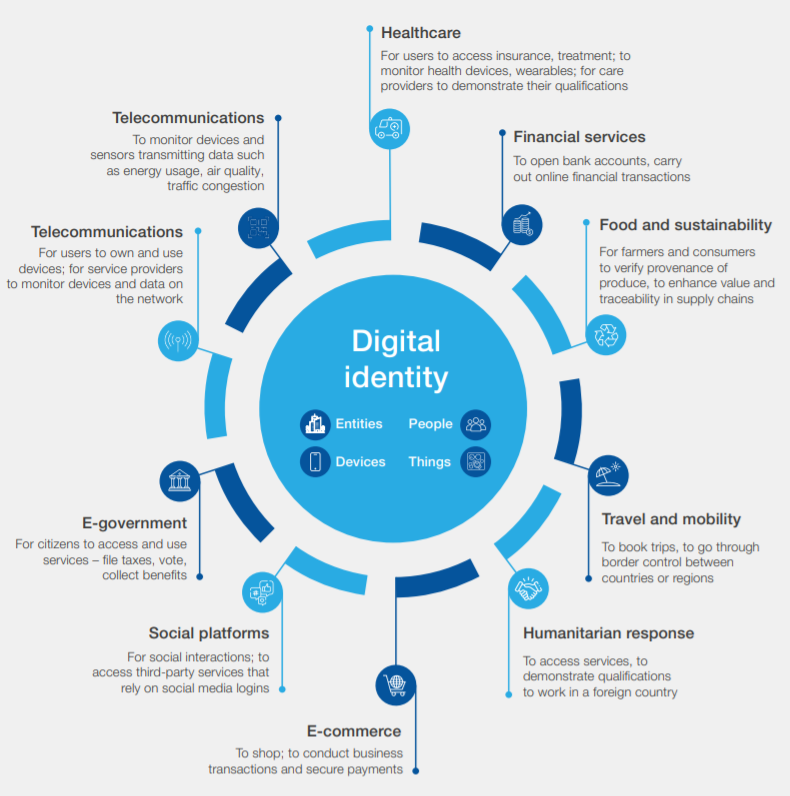
Google’s users will also be able to create an ID pass by selecting the “create an ID pass with your U.S. passport” option in the Google Wallet app. Getting started sounds disarmingly simple: just scan the security chip in the back of your passport, take a selfie video to verify your identity and within minutes your Google ID pass is ready to go.
No More Need for Physical Wallets
The “origin trial” of the new tech involves what its developers say is a new web platform API (“Digital Credentials”) that will allow sites to request verifiable information via digital credentials from a digital wallet (e.g., national ID card or driver’s license). Once the system is fully up and running and the necessary government legislation is in place, the phone will do just about everything, gushes Alan Stapelberg, group product manager at Google Wallet in another blogpost:
Imagine starting a vacation like this: You arrive at the airport and breeze through security by tapping your phone to a reader, scanning your boarding pass and ID. While waiting to board, you grab a drink at an airport bar, tapping your phone to prove your age. When you arrive at your destination, you find your rental car and leave the lot without stopping for an in-person ID check because you already provided the necessary information in the rental car app. You check into your hotel online and your key is issued straight to your digital wallet. You do all of this with your phone — no physical wallet required.
This may feel futuristic, but it could be reality soon. In fact, today people with select U.S. state-issued IDs are able to present their ID in Google Wallet to go through TSA checkpoints in dozens of U.S. airports…
Google is not the only tech corp dreaming of a physical wallet-less world. But what happens if you lose your mobile phone or have it stolen? Or it stops working or runs out of battery? Or a global IT outage occurs like the recent Crowdstrike crash, bringing the digital world to a shuddering, useless halt? Or a natural disaster like the recent typhoon Yagi that ripped through China’s Hainan province, resulting in an hours-long power outage?
Brussels Leading Way
Apps like Google Wallet can already be used for mobile driver’s licenses (mDLs) in a number of US states, including California and Arizona, notes Cheng. She also mentions the EU’s eIDAS 2.0 advancing online verification efforts.
Unbeknown to the vast majority of EU citizens, digital identity has been a legal reality across the 27-nation bloc since March…
Continue reading on Naked Capitalism
 Nick Corbishley