The mainstream media has, until now, played a key role in advancing the Global War on Cash — a war that began with no official declaration but in which propaganda, as with all wars, is a vital weapon.
Last week’s global IT outage appears to have shaken some British media outlets’ confidence in the idea of a fully cashless society. When a content update by the cyber-security giant CrowdStrike caused millions of Microsoft systems around the world to crash on Friday morning, bringing the operating systems of banks, payment card firms, airlines, hospitals, NHS clinics, retailers and hospitality businesses to a standstill, businesses were faced with a stark choice: go cash-only, or close until the systems came back online. From WIRED magazine:
This quickly caused chaos in Australia, whose government has explicitly encouraged businesses to go cashless. Pictures posted on social media showed card-only self-checkout registers at the grocery chain Coles displaying Blue Screens of Death (BSODs). Queues for human-run registers at Australian groceries stretched to the back of the store, according to local media. Some Australian marts simply locked their doors…
Starbucks—whose then-CEO said in 2020 was shifting “toward more cashless experiences”—appeared to have been particularly hard hit. One Kansas-based Starbucks worker posted a TikTok showing that the mobile order system was “completely down.” The machine that the store uses to print labels for cups was also not working. “It just comes out blank every time,” she said, gesturing to the label printer. She tells WIRED that some customers were “upset and very rude” when she tried to explain. A different Starbucks worker said on TikTok that she had to write down every order on sticky notes.
Richard Forno, a cybersecurity lecturer at the University of Maryland, tells WIRED that Friday’s outage demonstrates the vulnerability of our current cloud and internet infrastructure. “Software supply chains have long been a serious cybersecurity concern and potential single point of failure,” Forno says. “Given today’s events, with any luck, perhaps the world may finally realize that our modern information- and often cloud-based society is based on a very fragile foundation that’s not built for security or resiliency.” (A Microsoft spokesperson did not respond directly to this assessment.)
Here on NC, we have periodically discussed (including here, here, here and here) the hyper-fragility of our tightly coupled IT-based societies, particularly on the banking and payments side of things. In March, UK citizens had a foretaste of the inherent fragility of a cashless economy after the payment systems of the country’s two largest supermarket chains, Tesco and Sainsbury’s, went down on the same day. Then, as on Friday, cash provided a vital, albeit imperfect, fall-back mechanism for citizens and businesses.
Cash Does Not Crash
This is one of the most important arguments in favour of cash: the resilience it provides to a country’s overarching payments system. Put another way, cash does not crash. It does not fail in a power cut or seize up during a cyber attack or software outage (though, of course, ATMs might). By contrast, digital payment systems need a stable and continuous internet connection and power supply to process transactions.
This is a lesson central bankers in Sweden, one of the world’s most cashless economies, are apparently relearning. From our recent piece, “The World’s Oldest Central Bank Keeps Sounding Alarm on Fragility of Cashless Economies. Are Other Central Banks Listening?”
After playing a part in the wholesale removal of cash from Sweden’s economy, the Riksbank is now trying to reverse some of the damage it has caused. It is not the only Scandinavian central bank to have flagged up the fragility risks of exclusively digital payment systems. In 2022, the Bank of Finland recommended that the use of cash payments be guaranteed by law. Like all Nordic countries, Finland is a largely cash-free economy. But like Sweden, it has begun to see the risks of going too far, too soon.
It seems that certain legacy media outlets may also finally be learning this lesson. In the UK alone, four of the country’s largest newspapers — The Guardian, The Daily Telegraph, The Times and The Daily Mail — have run articles on how the global IT outage has underscored the fragility of a cashless society. The Daily Mail plastered the message across its front page:
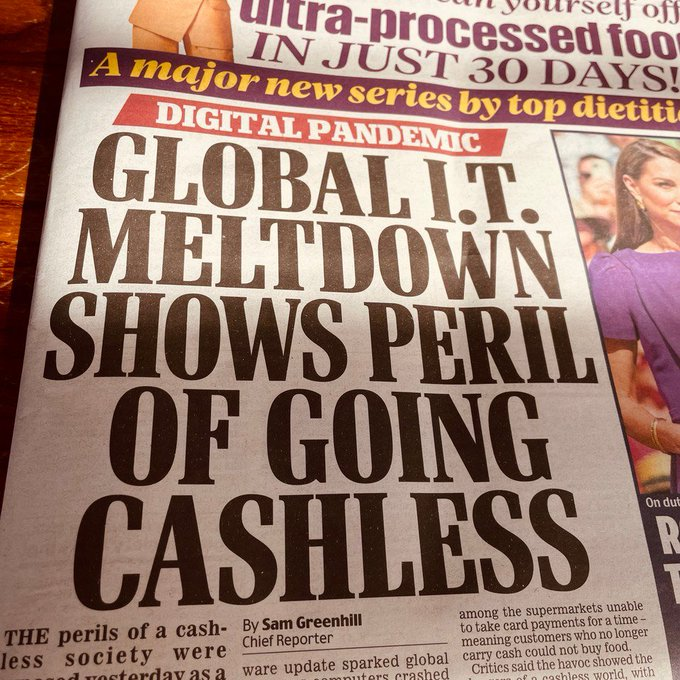
From that article:
Critics said the havoc showed the dangers of a cashless world, with almost half of Britons now leaving the house with only their phones as a means of payment…
Dennis Reed, director of the Silver Voices campaign group which represents older people, said: ‘It’s extremely worrying. This should be a big warning for the Government. Obviously it has affected older people particularly, not just with the cash side of things but GP appointments and everything else.
‘If people can’t pay because they can’t use their phone then when systems go down – and they always will – people won’t be able to access vital services, food, and the essentials of life.
‘With this ever-more digital society, we are reliant on it all working. But we have no control over it. We are putting all our eggs in one basket. The future security of the nation is in danger.’
Martin Quinn, campaign director at the Payment Choice Alliance, told The Daily Telegraph: ‘With IT outages happening now at alarming regularity, businesses should be mindful of only taking card payments.
‘However many supermarkets prefer to have self-service card-only tills, which makes cash users feel like second-class citizens, a concerted effort is needed to return to using and accepting cash, because cash never crashes.’
Media’s Role in Global War on Cash
Over the past couple of decades, the mainstream media has played a crucial role in advancing the Global War on Cash — a war that began with no official declaration but in which propaganda, as with all wars, has been a vital weapon. The mainstream and financial media have provided a perfect platform for that propaganda…
Continue reading on Naked Capitalism
 Nick Corbishley