The proposal comes just months after the European Parliament and the European Council of Ministers unanimously approved the European Commission’s sweeping digital identity regulations.
As readers have presumably guessed, the asterisked word in the title is not “wink”.
Spain’s Pedro Sánchez government recently unveiled plans to push the boundaries of Internet control by launching a digital age verification system to prevent minors from being able to access pornographic websites. A few days ago, the country’s Minister of Digital Transformation (an increasingly common government position), José Luis Escrivá announced that the system will be based on a digital wallet app that is currently in the beta phase of testing. In other words, the app is not quite ready yet but apparently will be by September.
Through said app, adult porn users will be able to obtain anonymous digital access credentials. And those credentials will soon be necessary to enter digital spaces hosting adult content. The whole process will be fairly simple, according to the Spanish newspaper ABC:
The user will only have to register their age through the Digital Wallet by using an official document, such as an electronic ID. They will then be able to generate an anonymous credential that will allow them to enter the porn website. When the Internet user tries to access it, the page in question will be able to check their age through this verification system by reading a QR code. If the user is of legal age and therefore has the access credential, they will be able to consume content; if not, entry will be blocked.
The access credentials will not reveal user data, but will simply confirm whether the user is an adult or a minor. Before imparting that information to any website, the software will verify that the platform in question is a “trusted” entity against a list compiled by the authorities — presumably in the vein of the Trusted News Initiative, but for porn providers.
Rationing Pornography for Adults
The digital wallet will not only close off access to porn websites to minors; it will also ration the number of times adult users can access pornography websites, reports WIRED magazine’s Spanish edition:
The Digital Wallet works as an electronic purse that offers the user a batch of 30 anonymous access credits that are generated within the [mobile] device and are valid for a maximum of 30 days. The system will automatically assign a maximum of three access keys to each pornography platform. “These are used randomly within the same provider a maximum of 10 times and never between several services. When the 30 credits have been used up, 10 for each of the three credentials, another subset of 3 credentials will be selected from the batch of 30,” explains the ministry. A new set of keys will be issued each month.
This is all apparently necessary to prevent government authorities or the companies subcontracted to manage the system from being able to trace users’ browsing habits. But according to remarks made by Escrivá, the 30-day validity period and the number of access keys granted during that time could change if deemed necessary. In other words, the government wants to grant itself the power to determine exactly how much pornography adults can consume on a monthly basis.
The government claims that these intrusive measures are needed in order to prevent minors from accessing sexual material online. It is a powerful pretext (we will discuss the government’s real motive later). Given the ubiquity and nature of online porn these days (yes, I have been a periodic user, though not for a number of years), with much of it violent and/or degrading, there is an argument to be made for restricting accessibility to impressionable minors, especially pre-teens.
“If we don’t all work together, this problem will be impossible to solve,” says Escrivá. During the presentation of the new digital wallet, the minister pointed out that “the vast majority of young people between 18 and 26 years of age see internet porn as a faithful representation of sexual intercourse.” He also stressed that the consumption of this kind of content shapes minors’ perception of sexual relations into adulthood, noting that the number of sexual assaults perpetrated by minors has more than doubled in the past five years.
The proposed digital identity wallet, which has already been dubbed on social media as “pajaporte” — an amalgam of the Spanish words “paja” (to jerk off or wank) and “pasaporte” — has been ridiculed in most quarters, including parts of the mainstream media. A column in El País by Daniel Gascon sarcastically asks: “what is the point of having a welfare state is if it can’t keep track of citizens’ masturbatory habits?” It also notes, again with what seems like a healthy helping of irony, that if there is one thing the proposal is guilty of, it is “a lack of ambition”:
[T]he ideal scenario would be for the Government to authorise the use of any application. This would allow it to better protect citizens, see what they read, what jokes and news they share. It is a matter of public health. But, in the meantime, this is a start.
This article, it seems, was written in jest. But it could be worryingly close to the truth. The Spanish government is already talking of requiring a similar digital identity wallet to access other online platforms. Carmen Cabanillas, director general of Governance at the Ministry of Digital Transformation, said that in the future the tool could be used by messaging applications, social networks or browsers to check the age of users, as well as presumably other things.
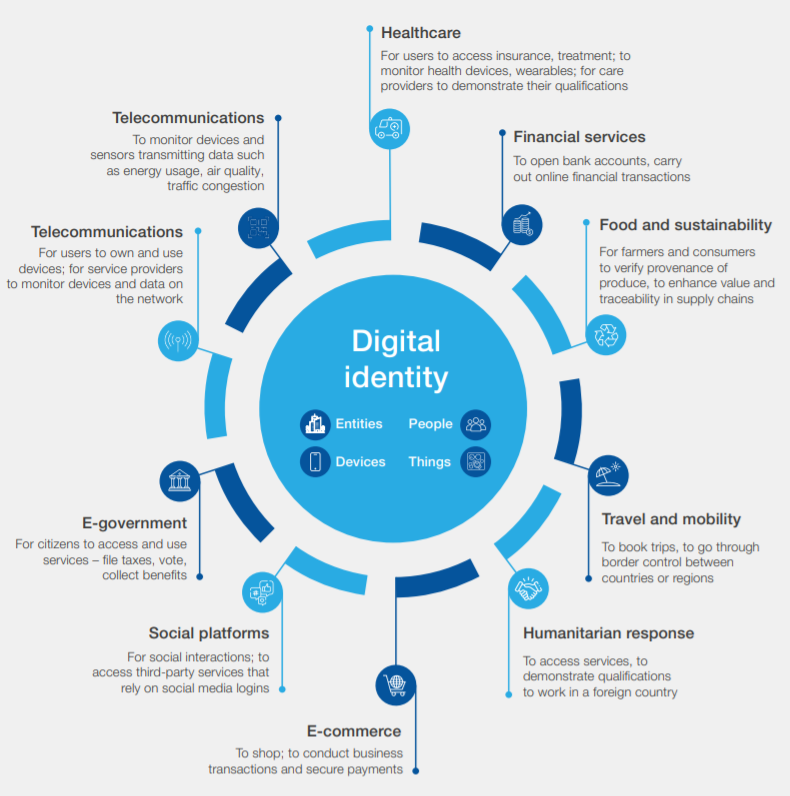
Such proposals are eerily reminiscent of some of the use cases (telecommunications, social platforms) depicted on the World Economic Forum’s now-infamous 2018 infographic on digital identity.
There are, of course, serious flaws in the government’s proposed “pajaporte”. For a start, the digital verification system will only be mandatory for adult content websites hosted in Spain. In other words, once the system is up and running (assuming it ever is), users, regardless of their age, will be able to continue accessing the vast majority of adult content sites on the Internet without any government hindrance. And if someone specifically wants to continue accessing Spanish-hosted porn, they could do so by simply using a VPN.
Presumably, there will be a plethora of other workarounds that (both adult and underage) porn users will be able to use to circumvent the proposed restrictions. As they say here in Spain, “hecha la ley, hecha la trampa,” which essentially means that once a law is approved, someone will find a way of getting around it. And this proposed law has more potential loopholes than a medieval castle. In other words, it is likely to have a limited impact on the amount of Internet porn consumed in Spain, whether by adults or minors.
The Real Motive
That said, the Spanish Government claims that other EU countries are working on similar measures, so that, over time, visiting adult websites without proof of age will become more and more difficult across the EU. The Sánchez government is also apparently considering making changes to Spain’s General Telecommunications Law that will essentially ban access to digital platforms that do not incorporate age verification mechanisms.
The real motive here, I believe, is not to protect children from the insidious effects of online porn; it is to begin the process of launching digital identity wallets for widespread public use…
Continue reading on Naked Capitalism
 Nick Corbishley