Following Sunday’s referendum, Venezuela’s Maduro government de facto “annexes” the oil-rich Essequibo region. Guyana calls for help from friends, including US Southern Command. Military exercises are already under way.
Three and a half weeks ago, we warned that the next major geopolitical flash point in this year of living dangerously could be in Washington’s “backyard” (or as the Biden Administration likes to call it, front yard). Sad to say, it looks like we were right. Like most geopolitical flash points, the region affected, Essequibo (or Guayana Esequiba), boasts a wealth of energy and mineral resources. In 2015, a consortium of energy firms led by Exxon Mobil discovered huge deposits of oil in the region’s disputed waters — and what’s more of the sweet crude variety that is easiest to refine, commanding the highest price on the global market.
In doing so, they reignited a diplomatic conflict that has been blowing hot and cold for the best part of the last two centuries.
Essequibo has been administered by the former British colony of Guyana, of which it constitutes more than two-thirds of its territory and hosts 125,000 of Guyana’s 800,000 citizens, since 1899, when its frontiers were defined by an arbitration panel in Paris. Venezuela eventually accepted the ruling, albeit grudgingly, until 1949, when one of the US lawyers who had defended its case had a memorandum published posthumously that strongly suggested that the ruling had been rigged in Britain’s favour.
Redrawing the Map
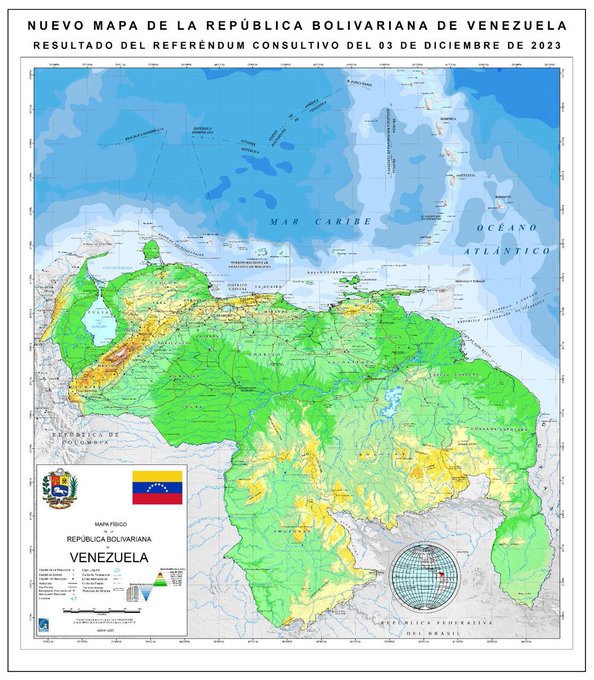
Following Sunday’s referendum, Venezuela’s government has de facto annexed the 159,000 square kilometre territory, as well as its oil-rich waters. While it has not sent troops to the region, it is moving fast to make this new change a reality. On Wednesday, President Nicolás Maduro ordered the immediate publication of new maps of Venezuela showing Essequibo as part of its territory (rather than as a disputed territory). The maps will then be distributed to schools community councils, public establishments, universities and all homes.
This is what the new map looks like (as NC reader Joe Well pointed out in the comments thread to a recent post, there is a common saying in Venezuela that the country is shaped like an elephant, with Essequibo forming the hind and back leg):
Al Jazeera helpfully explains why the Essequibo region is so important, from a geographic, environmental and economical standpoint:
The area is located in the heart of the Guiana Shield, a geographical region in the northeast of South America and one of the four last pristine tropical forests in the world mined with natural and mineral resources, including large reserves of gold, copper, diamond, iron and aluminium among others.
The region also has the world’s biggest reserves of crude oil per capita. Just last month, Guyana announced a “significant” new oil discovery, adding to estimated reserves of at least 10 billion barrels – more than Kuwait or the United Arab Emirates.
With these resources, the country is set to surpass the oil production of Venezuela, and by 2025, according to projections, the country is on track to become the world’s largest per-capita crude producer.
The Venezuelan government’s “annexation” of Essequibo followed a consultative referendum held late Sunday on the fate of the oil-rich region, which Venezuela has claimed as its own since winning full independence from Spain in 1823, (for more historical background to this long-simmering dispute, read my previous post, The Drums of War Are Growing Louder in South America). In the referendum, more than 10.5 million Venezuelan voters, just over 50% of the eligible total, participated, with around 95% casting ballots in favour of annexing the region, according to country’s electoral authorities.
The voters also overwhelmingly voted to reject the conditions “fraudulently imposed” by the British Empire in the Paris Arbitration Award of 1899; to “support the 1966 Geneva Agreement as the only valid legal instrument to reach a practical and satisfactory solution to the territorial dispute; to not recognise the jurisdiction of the International Court of Justice in resolving the dispute; and to oppose, by all legal means, Guyana’s claim to unilaterally dispose of a disputed maritime area, illegally and in violation of international law.
From “Non-Binding” to “Binding”
Before the referendum, the Maduro government insisted that the vote was purely consultative and non-binding; now that it has secured the result it was seeking, it is claiming the opposite.
“The word of the People is popular command,” tweeted Maduro on Wednesday. “We will enforce the decision the Venezuelans made in the consultative referendum to guarantee the development and well-being of our Guayana Esequiba. Venezuela has raised its voice!”
Also on Wednesday, Maduro presented the National Assembly with a draft law for recognising Guayana Esequiba as a province of Venezuela. As provisional authority of the new territory he appointed a deputy from the ruling party, Major General Alexis Rodríguez Cabello, and authorised the creation of subsidiaries for the region of the Venezuelan state-owned oil company Petroleos de Venezuela and the state-owned Venezuelan Corporation of Guayana Essequibo, which will be granted licenses for the exploration and exploitation of oil, gas and mineral deposits.
What motives does Maduro have for doing all of this? It depends, of course, who you ask.
In most Western media, the stock response is that the move on Essequibo is a desperate attempt to shore up political support at home as the country faces the prospect of new elections next year amid a slightly improving albeit still hyper-inflationary economy. The Essequibo claim is one of the few issues on which almost all Venezuelans, including many members of the political opposition, can unite around. It has also been argued that the Maduro government is desperate to get its hands on Essequibo’s sweet crude oil — hence the speed with which it is granting exploration and exploitation licences for the region.
While there may be a kernel of truth in both of these explanations, they completely ignore the spark that set off this latest escalation: Exxon Mobil’s discovery of oil in Essequibo’s disputed waters in 2015. As I documented in my last piece, Exxon Mobil has had a strained relationship with Venezuela’s government since 2007, when Chavez nationalised ExxonMobil’s considerable assets in the country, and the company’s discovery and subsequent exploitation of oil in Essequibo was an extremely provocative step. In a 2017 article, the Washington Post described it as “revenge” for Exxon’s then-CEO Rex Tillersen.
For Exxon Mobil, Guyana is a key cog in its plans for the future. Last year alone, the oil major and its two partners, Hess Corporation and China’s CNOOC Petroleum, earned nearly $6 billion in Guyana. That is expected to grow significantly in the years to come…
Continue reading on Naked Capitalism
 Nick Corbishley