2022: The Year That Many Brits Learnt to Love Cash Again

Small slivers of hope in the Global War on Cash.

However it may seem, the title of this article does not include a typo. It mentions the year 2022, not 2023, for the simple reason that the publication of data on payment habits in the UK has roughly a one-year lag. As such, it wasn’t until late 2023 that it became apparent that the use of cash had rebounded in 2022, for the first time in ten years.

This is potentially an important trend reversal. Until recently it seemed that the British public, with a little helpful nudging from the government, high street banks and retailers, payment card companies, fintech firms and tech giants, was intent on abandoning cash as quickly as possible. A decade ago, around 60% of payments in the UK were made using cash; by 2021, with the COVID-19 pandemic raging, e-commerce booming and the contactless revolution in full swing, that figure had slumped to 15%. As in many other countries, the amount of cash in circulation did increase during this time, but this was a sign of hoarding, not of increased payments.

At the beginning of this year, Mastercard, a company that has singled out cash as its number one enemy and whose former CEO (and now World Bank Managing Director) Ajay Banga described physical money as “public enemy number one”, unveiled the findings of a survey it had commissioned into payment trends in the UK. Those findings, the company said, pointed to a further decrease in cash usage in the UK, which aligned perfectly with the company’s broader goals, exemplified by its current slogan: “World Beyond Cash”.

But then something rather unexpected happened (though we did kind of call it in August 2022): cash began staging a come back. In September this year, a report on payment trends by UK Finance, the country’s largest bank lobbying group, included a striking finding: cash payments had risen in 2022, for the first time in a decade. The number of cash payments had risen by 7%, the report noted, adding that surging inflation had prompted many people to turn back to cash or use it more often than before to help them manage their budgets.

This trend was further confirmed earlier this month (December 2023), when the British Retail Consortium (BRC) released the findings of its annual payments survey, which covers 2022. Like UK Finance, the BRC survey found that cash use had increased. From the Daily Telegraph:

Coins and banknotes accounted for nearly a fifth of transactions in 2022, according to the British Retail Consortium (BRC)’s annual Payments Survey.

Its report said: “This year’s Payments Survey shows an increase in cash usage for the first time in a decade, up from 15pc (in 2021) to just under 19pc of transactions (in 2022).

“Faced with rising living costs, cash was a useful tool for some people to manage their finances and track their day-to-day spending.”

The increase also reflects a natural return to cash following the move to contactless during the pandemic, the report said.

It is the first time since the BRC’s reports started in 2013 that cash usage has increased year-on-year.

Th BRC report tries to make light of this trend reversal, describing the use of cash in shops as still “fairly minimal,” adding that it reflects a “natural return” to cash following the huge shift toward contactless during the pandemic. There may well be some truth to this and one should be wary of reading too much into this potentially short-lived trend reversal. Card payments are still the number payment choice for UK citizens and it is quite possible that this rebound in cash use is merely a dead cat bounce (apologies to cat lovers).

But it is also worth bearing in mind that this is the UK’s largest retail lobbying group doing the talking here. The companies it represents, including large retailers, big banks, tech firms and payment companies like Visa and Mastercard, have a clear bias toward non-cash payments. For example, retailers and banks prefer people to use contactless payments as much as possible because: a) they are quicker to process, which means more sales per hour and more fees for the banks; and b) people tend to spend their money in a more carefree manner, which also means more sales for the retailers and more commissions and fees for the banks.

This was already known when contactless cards began making their appearance almost two decades ago, as a 2006 Financial Times article makes clear:

Mr Williams, [controller at The Bailey Co, parent company of Arby’s, a fast food restaurant chain based in the US], has found that customers spend about 50 per cent more when they use a contactless card than when they pay for their food with cash: “I think it is psychological: because customers are not pulling cash out of their wallet, they spend more.” Arby’s has also made productivity gains with less time being spent on counting money and taking it to the bank, Mr Williams says.

Another benefit to retailers is that cards allow them to capture data about their customers from small transactions.

“If contactless cards offer merchants better information on their customers, that could prove to be valuable,” says Mr Uzureau.

These are all major perks for retail businesses, banks and payment processing companies like Visa and Mastercard, but can be major shortcomings for individual consumers, particularly in times of hardship such as now.  As inflation has surged in the UK, more and more people have struggled to make ends meet, and many are turning to cash for relief. It is an example of how one broadly negative trend — the gradual pauperisation of large swathes of the population through austerity and inflation — can give rise to a broadly positive trend: the rediscovery of the benefits of cash…

Continue reading on Naked Capitalism
Definition of Madness: Peru and Ecuador Ask Washington to Come Up With a “Plan Colombia” 2.0 to Combat Drug Cartels

Even the US House of Representatives Foreign Affairs Committee has admitted that Plan Colombia was a resounding failure from a counter-narcotics perspective (albeit not from a “counter-insurgency” one).

This is a development we have been tracking since June 2022, when the then-President of Ecuador Guillermo Lasso spoke of the possibility of entering into a “Plan Colombia”-style initiative with the US, with the ostensible aim of combating the country’s increasingly powerful drug cartels. Since then, Lasso has departed the scene, brought down by a string of scandals, including, ironically, one revolving around his and his brother-in-law’s alleged ties to an Albanian drug cartel. But his successor, Daniel Noboa, is keen to follow through with the plan Lasso set in motion.

What’s more, Ecuador’s government is not alone in seeking to set up such an arrangement with Washington. The foreign minister of neighbouring Peru, Javier González-Olaechea, announced on Sunday (Dec 10) that he has asked the US Secretary of State Anthony Blinken to help draw up a “Plan Peru” to help combat drug trafficking in the country.

“We are concerned about the production and exportation of cocaine and its derivatives, which is why I raised (with Blinken) the possibility of having a Plan Colombia tailored to our national reality,” the chancellor said in an interview with the Peruvian newspaper Comercio.

Asked whether Plan Peru would include the entry of US troops onto Peruvian soil, González-Olaechea said the issue had not yet been discussed, which is hard to believe. As we reported a few months ago, one of Lasso’s last acts in office was to sign an agreement with the US allowing for the deployment of US naval forces along Ecuador’s coastline and, if requested, the disembarking of US land forces on Ecuador’ soil.

Peru’s Dina Boluarte government and Congress already allowed the temporary entry of over a thousand US troops in the summer. This was just months after the government had unleashed a brutal crackdown on anti-government protests leading to the deaths of an estimated 62 demonstrators and 1,200 injuries. Boluarte herself has been accused, among other things, of “crimes against international law” by Amnesty International and homicide by Peru’s Attorney General Patricia Benavides. Now the government she heads wants to further strengthen its military and security ties with the US.

A History of Failure

The dictum that “Insanity is doing the same thing over and over again and expecting different results” may be falsely attributed to Albert Einstein, but it’s still a good dictum. And there are few better examples of it in operation than this.

The Peruvian government’s “Plan Peru,” said González-Olaechea, would be closely modelled on Plan Colombia, the disastrous US-designed and -delivered drug-eradication program, signed in 1998, that burnt through $10 billion of US and other overseas funds during more than two decades, worsened the violence in Colombia, bathed more than a million hectares of farmland in a rich brew of toxic chemicals, including Monsanto’s “probably” carcinogenic weedkiller glyphosate, exacerbated illegal mining and organised crime while overseeing a significant upsurge in coca production.

Of course, eradicating Colombian cocaine and combating Colombian drug-trafficking cartels were not the only, or even primary, motives behind Plan Colombia or the broader US war on drugs. The primary goal was — and still is — to achieve or preserve geo-strategic dominance in key, normally resource-rich regions of Latin America, as the Colombian journalist Eduardo Giordano noted in a 2020 article.

In Plan Colombia, this took the form of a concerted security campaign to wipe out the guerrilla forces and extinguish their social base among the peasantry, says Giordano. At the beginning of this century, the “war against drug trafficking” came to replace the outdated ideology of the “cold war” in Latin America. Yet Plan Colombia also strengthened the presence of drug trafficking mafias linked to paramilitary groups, which would ultimately cause more deaths than the actual guerrillas, according to Colombia’s Truth Commission.

This is not to say that drug trafficking and other forms of organised crime are not a major problem in Ecuador and Peru. The homicide rate in Ecuador, traditionally one of the safest countries in South America, has soared by almost 500% since 2016, to an estimated 22 murders per 100,000 people in 2022, according to global risk intelligence company Verisk Maplecroft — largely due to an explosion in drug trafficking and organised crime. In August, four Colombian hit men assassinated presidential candidate Fernando Villavicencio in broad daylight. For its part, Peru is the world’s second largest exporter of cocaine and its derivatives.

Yet dusting off a plan that has already proven to be both a resounding and hugely costly failure is unlikely to be the solution to any of these problems. Yet that is precisely what both governments are proposing…

Continue reading on Naked Capitalism

Australia’s Central Bank Governor Discusses Possibility of Retailers Charging People for Paying in Cash

“The challenge with cash is that it really does have a big community public service sort of aura attached to it.”

The Reserve Bank of Australia’s new governor, Michele Bullock, just said the quiet part out loud in the rapidly intensifying war against cash. Speaking at the Australian Payments Network Summit last Tuesday (Dec 12), she was asked whether it’s perhaps time for retailers to stop offering cash as a fee-free payment option to consumers. Bullock responded by pointing out that as the share of consumer payments made using cash has declined, the running costs of processing cash for banks and businesses are mounting. As such, she said, it may be necessary some day to begin charging people for using cash in retail settings:

The issue with cash has always been that businesses don’t really understand the costs of cash in their business. They are at the moment, I think, understanding it a bit more, but in the past they haven’t really. They call “shrinkage” their main cost, which is basically theft, but really they haven’t internalised the cost of processing cash.

The challenge with cash is that it really does have a big community public service sort of aura attached to it. If you try to charge people to use cash, they’re prepared to pay to get it out of an ATM but if businesses started charging people to use cash, I suspect there’d be a very big backlash. Having said that, it’s also true that as economists we want people to face the prices of using particular services that reflect the cost of those services.

So, at the moment I think we are probably in a position where it’s very difficult to actually enforce payment for cash but it’s going to end up… with the costs being embedded in the cost of the financial institutions that are providing these services and people don’t face them. I think it will be a very big challenge.

This sentence bears repeating:

“The challenge with cash is that it really does have a big community public service sort of aura attached to it.”

“Aura” is a curious choice of words to describe people’s continued attachment to cash, as if there were something almost mystical or magical about it. Another interesting word she uses is “challenge,” which in this context I take to mean “problem.” In other words (and this is merely my reading of what she said), the apparent problem with cash is that it is widely perceived to serve the community and the public at large. Yet those are the exact same interests the governor of Australia’s central bank is supposed to be serving, says LNP Senator Gerard Rennick, a former banker who initiated and sits on a Senate committee conducting an inquiry into bank closures:

It’s legal tender and that’s just absurd to say you should pay fees… She should be representing the interests of the Australian people. This is the problem of having a so-called independent reserve bank, that over the years it has shifted its focus from protecting the people to protecting the banks. The RBA is technically saying the banks don’t have a social licence whatsoever and that’s not on.

Judging by the backlash her comments have already triggered, including on social media and even in parts of the mainstream media, Bullock is clearly right about one thing: an important part of the Australian public is still emotionally and financially attached to cash, even though they may not be using it as much as before, and the mere idea of paying extra fees to use a form of money that has existed for millennia would be anathema to them. The national broadcaster ABC posted a number of readers’ comments on its website, including the following three:

Business owner here, instead of a cash surcharge, we need a government option for card transactions, to keep those lower. Operators like Square and Stripe are getting away with charging 2.75% and traditional banks are racing to increase their fees to catch up (we have gone from 0.9% to 1.19% which doesn’t sound large until you remember that it is a 20% increase!). If cash is erased from the arena, you can bet the card transactions will keep getting more and more expensive when the cost associated decreases.* Government needs to step in before the price gorging gets out of hand.

– Rob

We taught our children from a very young age the value of money by paying them in cash for chores, good grades, etc. They would then go and deposit that money at a bank branch and have watched their savings grow. They certainly have a greater appreciation of money and how to manage it via the cash in hand approach, rather than paying them via a banking app. Forms of cash have been around for 5000 years and society shouldn’t be paying a premium to use a physical currency.

– Mark

One reason cash transactions have dropped is that there are fewer opportunities to pull cash out of your account and supermarkets, big box stores and other locations have shifting towards card only payment options.

– Alex

This is a key point. As the financial analyst, author and pro-cash activist Brett Scott noted in a 2018 article for The Guardian, when the big banks announce branch closures and shut ATMs, they create a feedback loop that constantly reinforces the impression that people are turning their back on cash when, in actual fact, banks are making it harder and harder for them to access it:

In closing down their branches, or withdrawing their cash machines, they make it harder for me to use those services. I am much more likely to “choose” a digital option if the banks deliberately make it harder for me to choose a non-digital option.

In behavioural economics this is referred to as “nudging”. If a powerful institution wants to make people choose a certain thing, the best strategy is to make it difficult to choose the alternative.

Financial institutions… are trying to nudge us towards a cashless society and digital banking. The true motive is corporate profit. Payments companies such as Visa and Mastercard want to increase the volume of digital payments services they sell, while banks want to cut costs. The nudge requires two parts. First, they must increase the inconvenience of cash, ATMs and branches. Second, they must vigorously promote the alternative. They seek to make people “learn” that they want digital, and then “choose” it.

Australia’s “Big Four” banks — Commonwealth Bank of Australia, Westpac Banking Corporation, ANZ Group Holdings Ltd, and National Australia Bank Ltd — were recently able to claim yet another major victory in their war of attrition against physical money. More than a billion dollars worth of physical cash disappeared from circulation in the last financial year, marking the first time the number of notes in circulation officially declined since dollars and cents were introduced in 1966. According to Channel Nine News, this is the “strongest sign yet” that Australia is truly on its way to becoming a cashless society.

The pandemic has, of course, intensified this trend. While changing demographics and consumer behaviour have also played a key role, so too has the increased difficulty of accessing and using cash…

Continue reading on Naked Capitalism

Who Is Luis Caputo, Argentina’s New Economy Minister (Who Is Already Making the Economy Scream)?

Meet the new boss, same as the old.

In Spanish, as in English, the word “kaput,” taken from the German “kaputt”, means done for, knackered, wiped out. The surname of Argentina’s new Economy Minister, Luis “Toto” Caputo, is similar, just with a “c” instead of a “k” and ending in “o”, which is probably fitting given that his first dose of economic shock therapy — including a 54% devaluation of the Argentine peso, to bring the official exchange rate closer to the informal “blue” one; a halt on all public works; the freezing of public sector salaries; a sharp rise in taxes, and the elimination of many public subsidies — could wipe out what remains of Argentina’s fragile economy.

Predictably, the package of measures places the lion’s share of the burden on the already buckling shoulders of Argentina’s middle and working classes while the so-called political and economic caste — whom Milei vowed to eliminate during his election campaign — will emerge either largely unscathed or even wealthier. In fact, as I will explain later, Argentina’s central bank, also under new (and old) management, has prepared what many are calling a generous bailout of some of the country’s largest importing companies.

But before that, who is Luis “Toto” Caputo, and why does his name sound so familiar? After all, one of the key pledges Argentina’s Milei made during the election campaign, besides slashing taxes, getting rid of the central bank and dollarising the economy, all of which have been quickly forgotten or reversed, was to do away with the political caste that has dominated Argentine politics for decades. Yet few epitomise that “caste” better than Caputo.

Who is Caputo?

Caputo is a life-long friend of former President Mauricio Macri, whose government (2015-19), with Caputo’s help, did more harm to Argentina’s economy than any other since Carlos Menem’s disastrous ten-year tenure in the 1990’s.

Caputo began his career as an investment banker, first as chief of trading for Latin America at JP Morgan Chase (1994-8) before slotting into a similar role at Deutsche Bank (1998-2003). He was later appointed chairman of Deutsche Bank’s Argentine subsidiary. In more recent years, he has managed his own investment fund and sat on the board of an Argentine energy company.

But what interests us most in this instance is Caputo’s brief period in the public sector, which began in 2015. First, Macri appointed his old school chum as secretary of finance, only to bump him up to finance minister and eventually central bank governor, all in the space of just three years. During that time, Caputo held more sway over Argentina’s economy than just about anybody else in a government position. And it was during that time that the seeds of Argentina’s current crisis, including its out-of-control inflation, were sown.

First, the government offered to pay off the vulture funds that had bought, for cents on the US dollar, the bonds of the investment funds that had refused to accept previous write-downs of Argentina’s debt, in 2005 and 2010. They included US billionaire Paul Singer’s Elliot Management. The government’s goal was to return to international debt markets so as to access cheaper (foreign-denominated) debt, which it then gorged on with reckless abandon.

Between 2016 and 2018 Argentina’s foreign debt mushroomed from 17.7% of GDP to 41.8% and gross debt in foreign currency almost doubled, from 36.3% of GDP to 65.8%. Inflation also surged, from around 15% in late 2015 to over 50% by the end of Macri’s term. Even the Spanish-language Wikipedia page for Caputo includes a section documenting the myriad irregularities and potential fraud involved in the settlement reached with the holdouts (translation my own).

In 2016, the prosecutor Federico Delgado called for an investigation of the State’s payment to the holdouts, through a document in which he demonstrated possible legal and procedural irregularities in the indebtedness and payment, and declared that the $16.5 billion debt the administration took on to write off the $12.5 billion “owed” to the bondholders was “the finishing touch to a gigantic scam against the national State.”

A year later, the American journalist Greg Palast gave an interview in which he stated that Paul Singer financed Mauricio Macri’s presidential campaign with $2.5 million, thus ensuring an exponential profit on his lawsuit against Argentina. In this manoeuvre and in the deal the Macri government would reach with the fund, Singer obtained profits of 10,000%. Asked about his relationship with Paul Singer, Macri declared that he did not know him and that he was not aware that he had made a contribution to his campaign.

But it is what happened next, when Caputo was central bank governor, that set the stage for Argentina’s current woes…

Continue reading on Naked Capitalism

Amid Mushrooming Wars and Other Global Crises, the WEF’s Corporate Takeover of the UN Continues Apace

The multistakeholder model being embraced by the UN gives corporations even more power over society, the economy and the environment, at the expense of national democratic institutions.

At last week’s COP 28 Summit, held in Dubai, which as Yves pointed out is one of the most air conditioned cities on the planet, indigenous groups kicked up a storm about the unprecedented number of fossil fuel lobbyists attending the UN talks. At least 2,456 fossil fuel lobbyists had been granted access to the negotiations, according to an analysis cited by the Guardian. That’s four times the number registered for COP27 in Sharm el-Sheikh, itself a record year, and seven times the number of official indigenous delegates.

Also heavily represented at the negotiations were Big Ag corporations — hardly surprising given that one of the main talking points at this year’s event was tackling emissions from the food sector. From De Smog:

Attendees are present from some of the world’s largest agribusiness firms – such as meatpacker JBS, fertiliser giant Nutrien, food giant Nestlé and pesticide firm Bayer – and powerful industry trade groups.

Meat and dairy interests are especially well represented with 120 delegates in Dubai, triple the number that attended COP27 in Sharm El-Sheikh, Egypt.

Overall the analysis of the delegates list by DeSmog shows that the total number of people representing the interests of agribusiness has more than doubled since 2022 to reach 340.

In addition, the analysis reveals that over 100 delegates have travelled to Dubai as part of country delegations, which grants privileged access to diplomatic negotiations. This number is up from just 10 in 2022…

“With greater scrutiny over emissions from meat and dairy companies, it is not surprising they are stepping up their game to head off any COP outcome that might hinder their operations,” Ben Lilliston, from the Institute for Agriculture and Trade Policy told DeSmog.

“Even so, a tripling of delegates is alarming – it drives home the urgent need for reforms that limit corporate influence at UN climate meetings.”

A Shift in Global Governance

If anything, the opposite is happening. The rapid rise in both the number and, presumably, influence of corporate lobbyists at the UN climate summit is part of a rarely discussed but hugely significant shift in global governance that has been under way for decades but is dangerously close to completion: the corporate takeover of the United Nations. The process is poised to accelerate further at next year’s UN Future Summit, as the renowned German financial journalist Norbert Häring recently warned on his blog:

The complete subjugation of the UN to corporate interests, which the World Economic Forum outlined with its Global Redesign Initiative in 2010 and has successfully pursued since then, is to be enshrined in the rules and regulations of the world organisation at the UN Future Summit in 2024. This is important not least because of the planned pandemic agreement, which is to give WHO excessive powers.

In his 2021 report “Our Common Agenda”, UN Secretary-General António Guterres outlined his ideas for reforming the way international organisations work (global governance) and set up a High-Level Advisory Board on Effective Multilateralism to draw up reform proposals. These were then supposed to be discussed at the UN General Assembly in September 2023 and translated into concrete resolutions.

However, there was resistance from the G77 group, which represents countries of the Global South. The discussion of the High-Level Advisory Board’s proposals was therefore postponed until next year. This “multi-stakeholder future summit” is now to take place in September 2024 and decide on the main features of the UN reform.

The High-Level Advisory Board has already published an 83-page report outlining the steps needed to modernise the world’s foremost multilateral institution. It includes the following paragraph (on page 18):

Our global governance system has a glaring hole: the private sector. Companies of all sizes drive advancements in new technologies; energy, industrial, and agricultural companies are responsible for a huge portion of our global carbon emissions and pollution; banks and finance companies handle our global financial flows; and private companies deliver most of our goods. But our multilateral treaties largely ignore these actors, wrongly assuming that
State action is sufficient to regulate this global network of private actors.

This paragraph could have been lifted straight out of the World Economic Forum’s Global Redesign Initiative (2010),

, which was led by the WEF’s three most senior executives – Klaus Schwab, its Executive Chairman; Mark Malloch-Brown, then its Vice-Chairman; and Richard Samans, its Managing Director. In its final report, titled “Everybody’s Business: Strengthening International Cooperation in a More Interdependent World,” the GRI proposed the creation of a system of multi-stakeholder governance as a partial replacement for intergovernmental decision-making.

That is essentially what the High-Level Advisory Board is also calling for: the replacement of multilateralism — the process of organising relations between the governments of multiple countries, ideally governed democratically, that has been the model of global governance for the past century — with the World Economic Forum’s model of “multi-stakeholder partnerships,” which would bring together the private sector, governments and civil society groups across all areas of global governance. As mentioned, this process has been in the works for decades, as the GRI project directors explained almost 15 years ago:

“While experimentation with individual public—private and multistakeholder partnerships has flourished over the past decade, including in many international organisations, they continue to play an incremental, even experimental, role in the international system rather than a systematic one. For this to change, policy-making processes and institutional structures themselves will need to be adapted and perhaps even fundamentally repositioned with this in mind.”

The WEF’s Main Stakeholder: Transnational Corporations

If enshrined in the UN’s rules and regulations at the UN Future Summit, the WEF’s multi-stakeholder model will grant corporations, many of them partly or even largely to blame for the major crises the world faces, even more power and influence over society, the economy and the environment, at the expense of national democratic institutions. It will mean even less democratic representation and accountability in the decisions taken by UN institutions. In the WEF’s vision — laid out in the GRI’s final report — the government voice “would be one among many without always being the final arbiter.”

It’s not hard to guess who that role will generally fall to. After all, the WEF represents some of the world’s wealthiest and most influential people and corporations. On its website, it has kindly laid out, in alphabetical order, all of its partners, strategic partners and associate partners. It reads like a Who’s Who of many of the world’s largest corporations and philanthro-capitalists, primarily (but not exclusively) from the US and Europe. A is for Apple, B is for Blackrock (or Blackstone Group), C for Citi, D for Deutsche Bank, E for Exxon Mobil, F for Foxconn, G for Glencore, etc.

In a 2016 article for the Transnational Institute, Harris Gleckman, a senior fellow at the Center for Governance and Sustainability and former chief of the NY Office of UNCTAD, distilled the three core elements of the WEF’s multi-stakeholder model of governance:

First, that multi-stakeholder structures do not mean equal roles for all stakeholders; second, that the corporation is at the centre of the process; and third, that the list of WEF’s multi-stakeholders is principally those with commercial ties to the company: customers, creditors, suppliers, collaborators, owners, and national economies. All the other potential stakeholders are grouped together as “government and society”. Note that [Klaus] Schwab says nothing about democracy in this approach to multi-stakeholder activities.

The WEF already plays a significant role in shaping global policy, in part through its Young Global Leaders Forum (2005-today) and its predecessor, the Global Leaders for Tomorrow program (1993-2003). These two programs have helped to create a transnational clique of would-be elitists, some of whom have gone on to fill very important roles in both the public and private spheres. It is almost the epitome of George Carlin’s “Big Club” that you and I ain’t in…

Continue reading on Naked Capitalism

Venezuela Takes a Step Closer to War With US

Following Sunday’s referendum, Venezuela’s Maduro government de facto “annexes” the oil-rich Essequibo region. Guyana calls for help from friends, including US Southern Command. Military exercises are already under way.

Three and a half weeks ago, we warned that the next major geopolitical flash point in this year of living dangerously could be in Washington’s “backyard” (or as the Biden Administration likes to call it, front yard). Sad to say, it looks like we were right. Like most geopolitical flash points, the region affected, Essequibo (or Guayana Esequiba), boasts a wealth of energy and mineral resources. In 2015, a consortium of energy firms led by Exxon Mobil discovered huge deposits of oil in the region’s disputed waters — and what’s more of the sweet crude variety that is easiest to refine, commanding the highest price on the global market.

In doing so, they reignited a diplomatic conflict that has been blowing hot and cold for the best part of the last two centuries.

Essequibo has been administered by the former British colony of Guyana, of which it constitutes more than two-thirds of its territory and hosts 125,000 of Guyana’s 800,000 citizens, since 1899, when its frontiers were defined by an arbitration panel in Paris. Venezuela eventually accepted the ruling, albeit grudgingly, until 1949, when one of the US lawyers who had defended its case had a memorandum published posthumously that strongly suggested that the ruling had been rigged in Britain’s favour.

Redrawing the Map

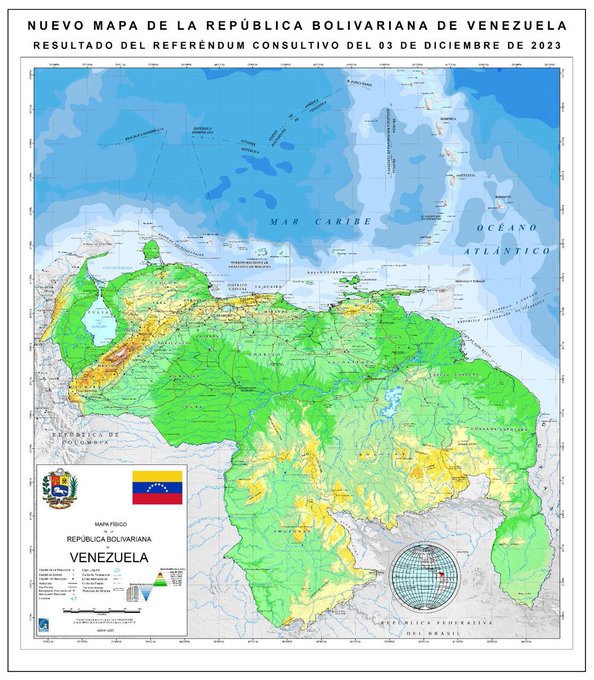
Following Sunday’s referendum, Venezuela’s government has de facto annexed the 159,000 square kilometre territory, as well as its oil-rich waters. While it has not sent troops to the region, it is moving fast to make this new change a reality. On Wednesday, President Nicolás Maduro ordered the immediate publication of new maps of Venezuela showing Essequibo as part of its territory (rather than as a disputed territory). The maps will then be distributed to schools community councils, public establishments, universities and all homes.

This is what the new map looks like (as NC reader Joe Well pointed out in the comments thread to a recent post, there is a common saying in Venezuela that the country is shaped like an elephant, with Essequibo forming the hind and back leg):

Imagen

Al Jazeera helpfully explains why the Essequibo region is so important, from a geographic, environmental and economical standpoint:

The area is located in the heart of the Guiana Shield, a geographical region in the northeast of South America and one of the four last pristine tropical forests in the world mined with natural and mineral resources, including large reserves of gold, copper, diamond, iron and aluminium among others.

The region also has the world’s biggest reserves of crude oil per capita. Just last month, Guyana announced a “significant” new oil discovery, adding to estimated reserves of at least 10 billion barrels – more than Kuwait or the United Arab Emirates.

With these resources, the country is set to surpass the oil production of Venezuela, and by 2025, according to projections, the country is on track to become the world’s largest per-capita crude producer.

The Venezuelan government’s “annexation” of Essequibo followed a consultative referendum held late Sunday on the fate of the oil-rich region, which Venezuela has claimed as its own since winning full independence from Spain in 1823, (for more historical background to this long-simmering dispute, read my previous post, The Drums of War Are Growing Louder in South America). In the referendum, more than 10.5 million Venezuelan voters, just over 50% of the eligible total, participated, with around 95% casting ballots in favour of annexing the region, according to country’s electoral authorities.

The voters also overwhelmingly voted to reject the conditions “fraudulently imposed” by the British Empire in the Paris Arbitration Award of 1899; to “support the 1966 Geneva Agreement as the only valid legal instrument to reach a practical and satisfactory solution to the territorial dispute; to not recognise the jurisdiction of the International Court of Justice in resolving the dispute; and to oppose, by all legal means, Guyana’s claim to unilaterally dispose of a disputed maritime area, illegally and in violation of international law.

From “Non-Binding” to “Binding”

Before the referendum, the Maduro government insisted that the vote was purely consultative and non-binding; now that it has secured the result it was seeking, it is claiming the opposite.

“The word of the People is popular command,” tweeted Maduro on Wednesday. “We will enforce the decision the Venezuelans made in the consultative referendum to guarantee the development and well-being of our Guayana Esequiba. Venezuela has raised its voice!”

Also on Wednesday, Maduro presented the National Assembly with a draft law for recognising Guayana Esequiba as a province of Venezuela. As provisional authority of the new territory he appointed a deputy from the ruling party, Major General Alexis Rodríguez Cabello, and authorised the creation of subsidiaries for the region of the Venezuelan state-owned oil company Petroleos de Venezuela and the state-owned Venezuelan Corporation of Guayana Essequibo, which will be granted licenses for the exploration and exploitation of oil, gas and mineral deposits.

What motives does Maduro have for doing all of this? It depends, of course, who you ask.

In most Western media, the stock response is that the move on Essequibo is a desperate attempt to shore up political support at home as the country faces the prospect of new elections next year amid a slightly improving albeit still hyper-inflationary economy. The Essequibo claim is one of the few issues on which almost all Venezuelans, including many members of the political opposition, can unite around. It has also been argued that the Maduro government is desperate to get its hands on Essequibo’s sweet crude oil — hence the speed with which it is granting exploration and exploitation licences for the region.

While there may be a kernel of truth in both of these explanations, they completely ignore the spark that set off this latest escalation: Exxon Mobil’s discovery of oil in Essequibo’s disputed waters in 2015. As I documented in my last piece, Exxon Mobil has had a strained relationship with Venezuela’s government since 2007, when Chavez nationalised ExxonMobil’s considerable assets in the country, and the company’s discovery and subsequent exploitation of oil in Essequibo was an extremely provocative step. In a 2017 article, the Washington Post described it as “revenge” for Exxon’s then-CEO Rex Tillersen.

For Exxon Mobil, Guyana is a key cog in its plans for the future. Last year alone, the oil major and its two partners, Hess Corporation and China’s CNOOC Petroleum, earned nearly $6 billion in Guyana. That is expected to grow significantly in the years to come…

Continue reading on Naked Capitalism

Pfizer and BioNTech Are Suing Poland Over Its Refusal to Pay for More COVID-19 Vaccines. Are They Also Suing Hungary?

Even by the normal standards of investor-state dispute settlements (ISDS), Pfizer and BioNtech’s lawsuit against the government of Poland for refusing to take delivery of more unwanted vaccines is especially egregious.

Investor State Dispute Settlements, commonly abbreviated to ISDS, rightly have a bad rep, especially among the world’s poorer countries. ISDS clauses in bilateral or collective investment trade agreements effectively allow privately owned overseas corporations to sue entire nations if they feel that a law has lost them, or in some cases could lose them, money on their investment. It is what gives today’s predominantly corporate-friendly trade treaties their claws and their teeth.

This is a topic we have covered both widely and in depth over the past decade. One of my own bailiwicks, Latin America, continues to top the investment arbitration caseload at the International Centre for Settlement of Investment Disputes (ICSID), accounting for 28% of the total of registered cases by June 2022. Even the world’s richest countries are beginning to fret about ISDS clauses, as Jomo Kwame Sundaram, a former UN Assistant Secretary General for Economic Development, documented in an article we cross-posted last month.

But even by the normal standards of investor-state dispute settlements (ISDS), Pfizer and BioNtech’s lawsuit against the government of Poland over its refusal to continue paying for their COVID-19 mRNA vaccine is especially egregious, for reasons I will explain a little later. Starting this Wednesday, the suit will be heard in Belgium, the country where the EU Commission signed its notorious vaccine deal with Pfizer-BioNTech, worth up to $36 billion.

The suit will take place as both companies report falling revenues and sliding profits. Public demand for their biggest selling product, the mRNA COVID-19 vaccines they co-developed, is a shadow of its former self, for obvious reasons. This has been reflected in their market performance: since their August 2021 peak, BioNtech’s shares are down almost 75% from their  peak while Pfizer’s have fallen by half.

Force Majeure: Ukraine War

The two companies are suing the Polish government for combined damages of 6 billion Polish zloty (€1.4 billion). In a statement to the British Medical Journal, Pfizer said the “formal proceedings follow a prolonged contractual breach, and lengthy discussions”:

“Poland placed a binding order and purchased all the doses that are in dispute and agreed to a specific delivery schedule in respect of those doses. Poland has, however, refused to take delivery of those doses. Pfizer and BioNTech believe it is important that all parties respect their contractual obligations under the agreement that has facilitated and underpinned the successful European pandemic response.”

Now, according to Dziennek Gazeta Prawna, the Polish financial newspaper that first broke the story about Pfizer and BioNTech’s lawsuit against Poland, Hungary has also stopped taking delivery of its Pfizer BioNtech vaccines and is also facing legal action. An article published in the newspaper on Monday claims that both Visegrad countries cited a force majeure clause in their vaccine contract. The war in Ukraine, they said, had led to millions of Ukrainian refugees flowing across their borders and into their towns and cities, draining their public coffers of much-needed funds (machine translated):

The Hungarian government refused to accept further deliveries of vaccines, citing, like Poland, the need to accept refugees from Ukraine and the related expenses, as well as problems with storing the preparation and the lack of demand for further vaccinations.

This is an unprecedented case, mainly due to the unique nature of the agreements that Pfizer has concluded with Poland, Hungary and the rest of the EU “25”. This will be the first such trial, a person from Brussels familiar with the matter tells us. Due to its sensitivity — the proceedings are just beginning — he (or she) wishes to remain anonymous. As he (or she) explains, Pfizer’s contracts with Poland, Hungary and other EU member states are not standard contracts, so there are no precedents for this situation. The total value of the agreement negotiated by the European Commission is approximately EUR 34 billion.

The lawsuit, or possibly lawsuits, are especially egregious for three main reasons.

Reason #1: An Unsafe and Ineffective Product

Pfizer-BioNTech’s COVID-19 vaccines are in much lower demand in Europe, as just about everywhere else, for a good reason: they have proven to be not nearly as safe nor as effective as their manufacturers had originally claimed. In fact, the contract the EU Commission originally signed with Pfizer-BioNtech — which was published, in full unredacted form, by Italian broadcaster RAI in April 2021 — includes the following provision (at the bottom of page 48):

The Participating Member State further acknowledges that the long-term effects and efficacy of the vaccine are not currently known and there may be adverse effects of the Vaccine that are not currently known.

In other words, both the European Commission and the governments of European member states knew perfectly well that there was no way of knowing whether the vaccines were either safe or effective, yet they told a very different story to the European public. Lest we forget, the Commission’s “Green Pass” vaccine passport system — which the World Health Organisation has announced it planss to use as a template for a global digital health certificate — helped to ensure there was healthy demand for the vaccines, at least in the first year of their roll out.

Now that most people have cottoned on to the mRNA vaccines’ abject lack of efficacy and safety and are no longer willing to roll up their sleeves for more booster shots, EU governments are sitting on vast stockpiles of unwanted vials. This is particularly true of many countries in Central and Eastern Europe where vaccine uptake was already low to begin with.

By the summer off 2022 a coalition of 10 nations was asking for the deal to be renegotiated. Poland was joined by Bulgaria, Croatia, Estonia, Hungary, Latvia, Lithuania, Romania, Slovakia, and Slovenia. As I reported in January, Germany’s government had accumulated more than 150 million unused vials in its central warehouse and was even talking of cancelling or reducing the additional orders it had made.

That was enough to get the European Commission, kicking and screaming, back to the negotiating table. But the result of that renegotiation was a deal that was still far more favourable to Pfizer than it was to European taxpayers. According to Martin Sonneborn, a German MEP and former editor-in-chief of the German Satirical magazine Titanic, the result of the deal was to “replace Pfizer’s existing €10 BILLION payment obligation with a €10 BILLION payment obligation to Pfizer,” albeit spread out over a longer period of time.

Reason #2: Pfizergate

The second reason why the lawsuit is especially egregious, even by usual ISDS standards, is that the EU’s purchases of Pfizer-BioNTech vaccines are themselves the subject of a criminal investigation. That’s right: Pfizer and BioNTech are trying to force payment through the Belgian court system of a contract that is being investigated by the Luxembourg-based European Public Prosecutor’s Office (EPPO) for criminal malpractice. Meanwhile, BioNtech is facing a rash of lawsuits in its native Germany for suspected injuries and adverse events caused by its COVID-19 vaccine while Pfizer is facing a trial in Texas for misrepresenting the efficacy of its vaccine.

The EU’s vaccine procurement scandal began in earnest in April 2021 when European Commission President Ursula Von der Leyen (whom I shall refer to from now on as VdL) bragged in an interview with the New York Times that she had personally helped secure a massive vaccine deal with Pfizer BioNtech through direct phone conversations and text messages with Pfizer CEO Albert Bourla. Weeks later, the Commission closed the world’s largest ever pharmaceutical deal, worth apparently €35 billion.

Shortly afterwards, the European Commission refused to accede to a Belgian journalist’s freedom of information (FOI) request for Commission President Ursula von der Leyen’s text messages with Pfizer CEO Albert Bourla — the same messages she had boasted about to the New York Times. The Commission’s initial response was to stonewall the journalist, arguing that its “record-keeping policy would in principle exclude instant messaging.”

In response, EU Ombudsman Emily O’Reilly launched an inquiry that concluded that the Commission’s refusal to cooperate constituted “maladministration.” A report by the EU’s Court of Auditors found that VdL’s participation in preliminary negotiations for the vaccine contract represented a complete departure from the EU’s standard negotiating procedures. The Commission refused to provide the auditors with records of the discussions with Pfizer, either in the form of minutes, names of experts consulted, agreed terms, or other evidence.

This was enough to trigger a formal investigation into the Commission’s acquisition of COVID-19 vaccines by the European Public Prosecutor’s Office. A Belgian citizen has also denounced the Commission for alleged corruption and destruction of documents.

VdL has also faced accusations of conflicts of interest over her husband’s role as scientific director at US biotech company Orgenesis, which received around €320 million in subsidies from the Italian government. After Orgenesis received the money, which was backed by EU funds, Heiko von der Leyen was elected to sit on the supervisory board of the project. He would later step down from the board after EU lawmakers and Italian media had drawn attention to his role.

While senior EU lawmakers, with help from most European media outlets, are doing everything they can to bury the Pfizergate story, others are refusing to let it go…

Continue reading on Naked Capitalism

The Drums of War Are Growing Louder in South America

As tensions rise in the Essequibo territorial dispute, Brazil sends reinforcements to its northern border, Venezuela holds a referendum on whether to annex the region and Guyana mulls hosting US military bases.

Just over two weeks ago, I posted a piece flagging the possibility that the next geopolitical flash point in this year of living dangerously could be a centuries-old border dispute in an oil-rich corner of South America. That oil-rich corner is Essequibo, a sparsely populated 160,000 square-kilometre chunk of disputed land, comprising mainly rain forest, that makes up roughly two-thirds of Guyana, a former British colony. But the land has also been claimed by Venezuela since it won its independence from Spain just over 200 years ago. With a little encouragement from the US, the dispute now threatens to escalate into a full-blown war.

A map of the region:

Guyana: “Essequibo Is We Own” | Three Worlds One Vision

Troop Movements

On Wednesday (Nov 29), the Ministry of Defence of neighbouring Brazil announced it was sending military reinforcements to its northern border as a precautionary measure. The northern Brazilian state of Roraima, in the middle of the Amazon jungle, shares a border with both Venezuela and Essequibo and Brasilia is concerned that the ratcheting tensions between its two neighbours could descend into violence.

Last week, Brazil’s President Luiz Inácio Lula da Silva (aka Lula) sent his senior adviser, Celso Amorim, a former minister of defence and foreign secretary, to Caracas to meet with the President of Venezuela, Nicolás Maduro, to express the Brazilian government’s concerns about the risk of war breaking out between the two countries. That meeting does not appear to have had the desired effect. On Wednesday, Lula posted a message on X reminding that (machine translated):

When a country decides to go to war, it is declaring the bankruptcy of dialogue. And I came into politics through dialogue, and I believe that it is much more sensible and effective to waste a few hours at negotiating tables than to go around shooting at random, killing innocent women, children and men.

The Brazilian government is particularly concerned about the possible fallout from a popular consultative referendum the Maduro government is holding this Sunday on the country’s territorial claims over Essequibo. The referendum includes five questions, the fifth of which is whether citizens agree that incorporating Essequibo as part of Venezuela’s own territory and granting its “current and future population” Venezuelan citizenship is a good idea.

The move is largely seen by Maduro’s critics as an attempt to shore up domestic support at home and is also a response to Guyana’s increasingly close military ties with the US. Caracas insists that the referendum is purely consultative and non-binding, and that it has no intention of annexing the territory. But at the same time it is increasing its military activity close to the border with Essequibo, ostensibly to combat illegal mining activities.

Ominously, Venezuela’s Minister of Defence Vladimir Padrino López recently said the dispute with Guyana “is not an armed war, for now.”

“Go out and vote (in the referendum). This is not an armed war, for now, it is not an armed war,” he said, adding that the members of the Bolivarian National Armed Forces (FANB) will be “permanently on guard” for “any action that threatens” the country’s “territorial integrity.”

The government of Guyana is also raising the stakes. Up until last week it had repeatedly denied allegations from Caracas that it was planning to invite US Southern Command to set up a forward operating base in Essequibo. But then last Friday the country’s Vice President Bharrat Jagdeo said in a press conference:

“We have never been interested in military bases, but we have to protect our national interest… We’re going to be working with a number of countries on greater defence cooperation. We will have from the US Department of Defence next week two visits to Guyana, by two teams. And then several other visits in the month of December and then high level representation from the Department of Defence here.”

In other words, it appears that US Southern Command is about to set up a new forward operating base, or bases, in a territory that is still very much in dispute…

Continue reading on Naked Capitalism