Ecuador was already in a major crisis; now it is in an even bigger one.
In what appears to have been a highly professional hit job, Fernando Villavicencio, one of the eight candidates in Ecuador’s upcoming presidential election, on August 20, was assassinated on Wednesday (Aug 9). The candidate was shot three times in the head by sicarios while boarding his campaign vehicle after a political rally in Quito. Nine people were wounded in the shooting. The police arrested six people in relation to the assassination, one of whom died in police custody after reportedly sustaining a bullet wound during the hit.
Villavicencio’s death was confirmed by Ecuador’s outgoing President Guillermo Lasso, who posted the following message on his Twitter (X) account:
“My solidarity and condolences to his wife and daughters. Because of their memory and their struggle, I assure you that this crime will not go unpunished.”
The Ecuadorean police say the six suspects arrested in connection with the assassination are Colombian, which prompts the question: are they ex-military? This may explain their ability to pull off three head shots from a distance in the middle of a crowd. It’s also worth recalling that Colombian mercenaries were also behind the assassination of Haitian President Jovenel Moïse in 2021.
“Time for the Brave”
Before his assassination, 59-year old Villavicencio was placing fourth or fifth in most polls. He took a particularly hard line on the drug cartels that have made life insufferable for everyday Ecuadorians over the last two years. “Being silent and hiding in moments that criminals kill citizens and officials is an act of cowardice and complicity,” he said. “I double down on my decision to go on fighting daily to defeat the mafias.”
Before entering politics, he was a muckraking journalist who made a name for himself exposing the corruption of the government of former leftist President Rafael Correa, currently in exile in Belgium. On the campaign trail Villavicencio portrayed himself as an anti-corruption crusader and campaigned under the slogan, “It’s time for the brave.”
But as notes former British diplomat Craig Murray on his blog, Villavicencio’s anti-corruption campaigning was “selective and aimed only at making accusations against left wing figures.” By contrast, he bitterly opposed the judicial process against President Lasso on corruption charges, calling it “a legal atrocity” that leaves the constitution “in rags”.
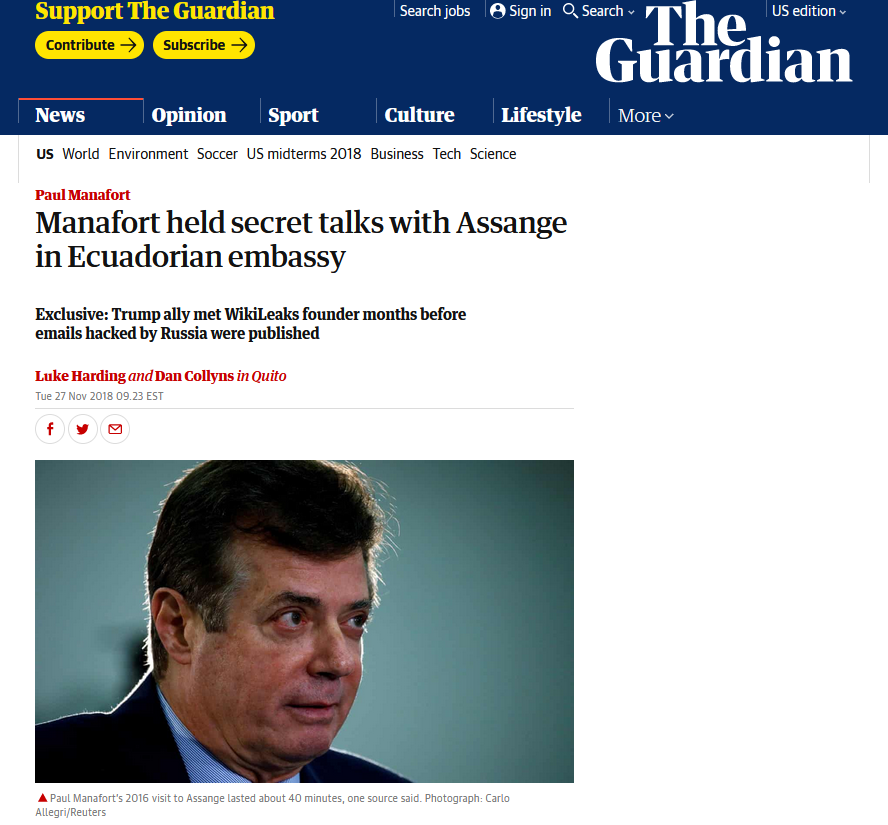
He also helped Luke Harding and Dan Collins fabricate the Guardian’s infamous front page story that Paul Manafort and Julian Assange had held pro-Trump meetings in the Ecuadorean Embassy, which was never corroborated by any other newspaper. As Murray points out, the story was fabricated in order to breathe new life into Clinton’s flagging “Russiagate” invention.
Wikileaks has described Villavicencio as a “serial fabricator” of news stories. He has also made enemies along the way, including, it seems, some of Ecuador’s biggest drug cartels. In the clip below, Villavicencio told the crowd that he “has no fear”, calling his “brave” voters his “bulletproof vest” and declaring that the time for threats is over. “The drug lords,” he said, “can come. Bring them on. The sicarios can come…They can bend me. They can never break me.”
For the moment, it is not clear who is responsible for Villavicencio’s death, and like many other political assassinations in Latin American it may never be. Murray speculates that Villavicencio may have paid the ultimate price for coming out of the shadows and seeking the political limelight after spending years helping the CIA forge documents, distribute them and spread corruption allegations against left-wing figures. It’s an interesting theory, backed up by decades of CIA-backed coups and political assassinations in the region, but for the moment that is all it is…
Read the full article on Naked Capitalism
 Nick Corbishley