Spain’s general elections this Sunday (July 22) could be a milestone event — of the bad rather than good kind.
If the latest polls are right — and, of course, they may not be — the until recently reasonably fringe party VOX could be about to become the first far-right party to enter national government since the dying days of Francisco Franco, in 1975. This it will do by becoming the junior partner in a coalition government with the conservative People’s Party (PP), as has already occurred in numerous towns, cities and regions across Spain in the wake of local and regional elections in May.
In such an outcome, Spain’s new prime minister will be Alberto Núñez Feijóo, the former president of Galicia’s regional government and current leader of the People’s Party. And he has a dark, shady past that he is trying his damnedest to downplay.
A Smuggler’s Paradise
That past was brought into sharp relief by El Pais’ publication, in 2013, of a series of leaked photos from 1995 showing Feijóo, then deputy health secretary of the region, enjoying both a luxury yacht cruise and a mountain road trip with Marcial Dorado, a known smuggler and then-suspected (and later convicted) capo of theGalician drug-smuggling mafia.
Dorado is on the left, Feijóo on the right:
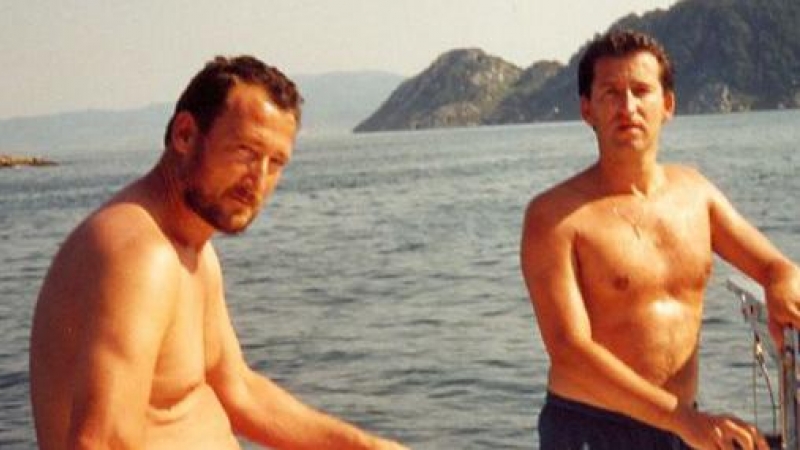
As I reported for WOLF STREET at the time, Galicia has long been a smuggler’s paradise:
Perched on Spain’s rugged North-Western coast and boasting a wealth of hidden bays and isolated beaches, Galicia has long been one of Europe’s most important entry points for contraband merchandise.
“It’s a historic tradition here that really took off in the late 1960s, early 1970s, with American tobacco,” Susana Luana, a journalist for the regional daily Voice of Galicia, told the BBC. “A number of local fishermen used their fishing infrastructure, including boats, to transport the goods and used their knowledge of the thousands of tiny coves and beaches here to bring them safely ashore.
“Later they increased their earnings considerably by smuggling drugs instead of tobacco. These former fishermen established a name for themselves as professional smugglers and so were able to make lucrative deals with the Colombian cocaine mafia.”
Much like Mexico, Galicia has become an indispensable link in the 21st century narco-traffickers’ distribution chain. And like their Mexican counterparts, Galician drug smugglers seem to have furnished cosy ties with key figures in the local and regional government.
Not that the revelation of said relations seems to faze Nuñez Feijóo, who in a recent press conference resorted to the Partido Popular’s now-standard defence against corruption charges: namely, to play dumb and deny all possible wrong doing, even as evidence mounts to the contrary.
“The photos are what they are: photos. There is nothing behind them,” said Feijóo. “No connection whatsoever to contracts with the Xunta [Galicia’s regional government] or the health department, or party funding.”
A Flimsy Defence
That last statement is an interesting one given that Galicia’s health department, of which Feijóo was then deputy secretary, was already doing business with Dorado. The department had signed a contract to purchase diesel and gasoline for the region’s hospitals and ambulances from companies belonging to Dorado. At that time, Dorado owned several gas station companies whose diesel and gasoline he used to power the fishing boats, gliders and trucks that transported his merchandise (which he still insists to this day was only contraband tobacco). He also used the companies to launder the proceeds from his smuggling/trafficking operations.
Feijóos’ defence rests on the three-pronged premise that he had no idea whatsoever of his host’s criminal past or his current line of work. And anyway, they barely knew each other — a claim that Dorado has consistently denied. As defences go, it is pretty flimsy, as I concluded in my WS article:
Even in these times of political decadence, debauchery and ineptitude in Spain, Feijóo’s assertion that he was completely in the dark about Dorado’s line of business beggars belief. After all, when most normal people meet a new acquaintance, the conversation inevitably turns to the matter of one’s vocational calling. “How do you do?” quickly morphs into “What do you do?”
Such basic formalities should hold even greater weight for a junior government minister whose actions are, or are at least supposed to be, subject to official codes of conduct and public scrutiny. As such, Feijóo is guilty, at best, of woeful political judgement and incompetence and, at worst, of knowingly consorting with criminal elements. Either way, in any self-respecting democracy – which obviously excludes present-day Spain – Feijóo would have walked, or been pushed, as soon as the allegations were made public.
That didn’t happen. Instead, Feijóo stayed in his job, went on to become leader of the PP and is now on the verge of becoming prime minister of Spain…
Read the full article on Naked Capitalism
 Nick Corbishley